

|
시장보고서
상품코드
2123315
통합형 워크플레이스 관리 시스템(IWMS) 시장 : 점유율 분석, 업계 동향과 통계, 성장 예측(2026-2031년)Integrated Workplace Management System (IWMS) - Market Share Analysis, Industry Trends & Statistics, Growth Forecasts (2026 - 2031) |
||||||
 Mordor Intelligence
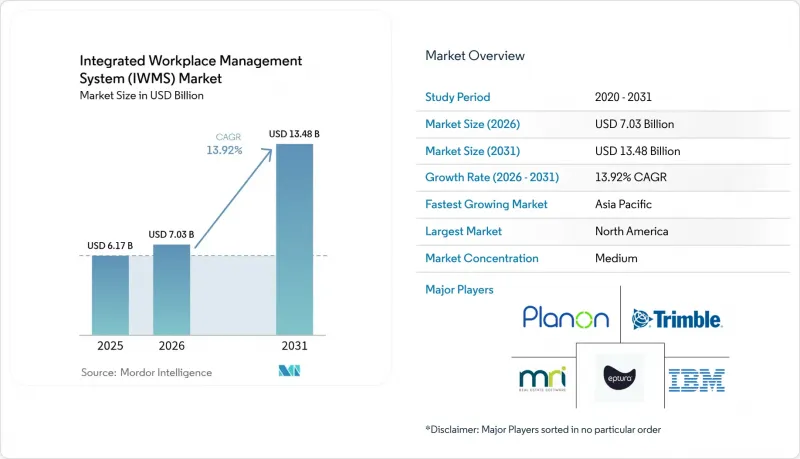
Mordor Intelligence에 의하면, 통합형 워크플레이스 관리 시스템(IWMS) 시장 규모는 2026년에 70억 3,000만 달러에 이를 것으로 추정되고 있어 2025년 61억 7,000만 달러에서 성장하여 2031년에는 134억 8,000만 달러에 이를 것으로 예측됩니다.
2026년부터 2031년까지의 연평균 성장률(CAGR)은 13.92%를 나타낼 전망입니다.
본 보고서에서는 시장을 제공 방식(솔루션, 서비스), 도입 형태(클라우드, On-Premise, 하이브리드), 조직 규모(대기업, 중소기업), 최종 이용 산업(IT 및 통신, 은행 및 금융 서비스·보험, 헬스케어 및 생명과학, 제조, 소매 및 전자상거래 등) 및 지역별로 분류하고 있습니다.
세계 통합 워크플레이스 관리 시스템(IWMS) 시장 동향 및 인사이트
클라우드 우선 IWMS 도입
현재 기업들은 인프라 비용을 절감하고, 몇 달이 아닌 몇 주 만에 도입을 완료하기 위해 클라우드 네이티브 플랫폼을 필수로 여기고 있습니다. SAP는 2025년 1분기에 49억 9,300만 유로의 클라우드 매출을 기록했으며, 클라우드 ERP는 전년 동기 대비 34% 증가하여 구독형 제공 모델에 대한 구매자의 신뢰도가 높음을 알 수 있습니다. 기존 인사 및 재무 시스템과의 통합을 통해 데이터 품질이 향상되고 의사 결정이 신속해집니다. 사용량에 따른 과금 체계 덕분에, 과거에는 종합적인 솔루션을 도입할 여력이 없었던 중견 기업들도 더 폭넓게 이용할 수 있게 되었습니다. 또한, 각 벤더사는 고객의 시스템 중단을 초래하지 않으면서 새로운 분석 기능을 제공하는 지속적인 업데이트 기능을 통합하고 있습니다.
공간 최적화를 통한 비용 절감
상업용 부동산의 경비는 운영 비용의 20%를 초과하기도 하기 때문에 미사용 바닥 면적을 줄이는 점유율 분석 도구의 도입이 급속히 확산되고 있습니다. 시스코는 센서를 활용한 레이아웃 재설계를 통해 PENN1 시설의 바닥 면적을 25% 줄이는 동시에 에너지 효율을 36% 향상시켰습니다. IWMS(시설 관리 시스템) 대시보드에서는 실시간 이용 현황이 시각화되므로, 적절한 시기에 공간 통합이나 재임대 여부를 결정할 수 있습니다. 하이브리드 환경에서는 고정된 책상 배치 비율 대신 동적인 좌석 배정이 채택되어, 출근 상황이 변동하더라도 공석률을 낮게 유지할 수 있습니다.
IWMS 분야의 전문 지식 부족
시설의 워크플로우와 기업 소프트웨어 통합을 모두 이해하는 전문가가 팀에 없다면 프로젝트는 정체될 수밖에 없습니다. 중소기업용 ERP 도입에 관한 동료 심사 연구에서는 숙련된 인력이 성공의 중요한 요인으로 꼽히고 있는데, 이는 IWMS가 직면한 과제와도 일치합니다. 이러한 인력 부족은 컨설팅 비용을 상승시키고 도입 기간을 장기화시킵니다. 특히 시설 관리가 여전히 수작업에 의존하고 있는 신흥국에서는 이러한 경향이 두드러집니다. 또한 규제상의 이유나 언어 장벽으로 인해 현장 지원이 필요한 구매자에게는 현지 지원 체계가 미흡한 점도 장벽이 되고 있습니다.
부문 분석
2025년, 시설 및 공간 관리 시장은 16억 7,000만 달러 시장 규모를 기록하며 통합형 워크플레이스 관리 시스템 시장 전체의 27.05%를 차지했습니다. 기업들은 공실률 감소와 에너지 낭비 절감을 통해 가시적인 비용 절감 효과를 얻을 수 있기 때문에 우선 이러한 모듈을 도입하고 있습니다. IFRS 16 준수 기한이 다가옴에 따라, 부동산 및 리스 관리가 그 뒤를 잇고 있습니다. 환경 지속가능성 관리는 규모는 작지만, 2031년까지 연평균 성장률(CAGR) 15.62%로 성장을 주도하고 있습니다. 이러한 추세는 탄소 회계가 현재 재무 회계와 마찬가지로 경영진의 의사 결정에 영향을 미치고 있음을 여실히 보여줍니다.
2025년에는 전문 서비스 매출이 14억 1,000만 달러를 돌파했습니다. 이는 사내에 전문 지식을 갖춘 인력이 부족함을 반영합니다. 공급업체는 설정, 데이터 마이그레이션 및 교육을 제공하여 고객이 의도한 투자 수익률(ROI)을 확실히 달성할 수 있도록 지원하고 있습니다. 매니지드 서비스는 업무를 완전히 외부에 위탁하기를 선호하는 중견 기업을 유치하고 있으며, 인건비 및 인재 이직 위험을 줄이고 있습니다. Brightly Origin 도입을 통해 시설 자금 조달액을 25% 증가시킨 McLaren Health Care와 같은 사례는 전문 지식을 갖춘 파트너가 플랫폼을 운영함으로써 얻을 수 있는 이점을 여실히 보여줍니다.
2025년, On-Premise형 도입은 통합형 워크플레이스 관리 시스템 시장 점유율의 50.70%를 차지했습니다. 규제가 엄격한 업계에서는 기밀 데이터를 방화벽 내에 보관하면서 그 위에 클라우드 분석 기능을 통합함으로써, 정보 유출 위험을 최소화하는 다층적 아키텍처를 구축하고 있습니다. 또한 대기업은 기존 투자를 조기에 폐기하지 않고, 기존 서버 용량을 활용하고 있습니다.
한편, 클라우드 구독은 연평균 성장률(CAGR) 17.11%를 기록하며 가장 빠른 성장세를 보이고 있습니다. 싱가포르의 ‘Productivity Solutions’와 같은 정부 보조금은 하드웨어에 대한 초기 투자가 필요 없는 클라우드 모델로 중소기업이 전환하도록 장려하고 있습니다. 벤더는 매월 기능 업데이트를 제공하며, 고객은 별도의 업그레이드 프로젝트를 수행하지 않고도 최신 혁신 기술을 활용할 수 있습니다. 하이브리드 배포 환경에서는 클라우드 포털과 On-Premise 데이터 레이크를 통합함으로써, 조직은 세밀한 제어력을 유지하면서 AI 워크로드를 위한 탄력적인 처리 용량의 이점을 누릴 수 있습니다.
지역별 분석
북미에서는 2025년에 20억 5,000만 달러의 매출을 기록했으며, 이는 전 세계 매출의 33.20%를 차지했습니다. 선점자 우위, SEC(미국 증권거래위원회)의 엄격한 공시 규정, 그리고 성숙한 벤더 생태계가 지출을 뒷받침하고 있습니다. 이 지역의 기업들은 과거 건물 정보에 AI를 결합하여 입주율을 예측하거나 설비 고장을 사전에 방지함으로써 운영 지표를 높은 수준으로 유지하려는 움직임이 점점 더 확산되고 있습니다.
유럽에서는 18억 3,000만 달러의 매출을 기록했으며, 이러한 성장은 기업 지속가능성 보고 지침(CSRD) 등 기후 변화 규제의 확대와 밀접한 관련이 있습니다. 시설 관리 팀은 에너지 계량기 및 탄소 배출 대시보드를 IWMS에 통합하여 당국 및 투자자를 대상으로 감사에 대응할 수 있는 보고서를 작성하고 있습니다. 독일, 네덜란드, 북유럽 국가에서는 탄소 중립을 향한 로드맵이 개보수 공사를 가속화하면서 도입이 현저히 진전되고 있습니다.
아시아태평양 시장 규모는 15억 6,000만 달러였으나, 연평균 성장률(CAGR)은 15.44%로 가장 높은 성장세를 보일 것으로 전망됩니다. 급속한 도시화에 따라 효율적인 공간 활용이 요구되는 한편, 건설 업계의 인력 부족이 자동화를 촉진하고 있습니다. 일본의 개발사들은 보유 부동산 전체에 LPWA 센서 네트워크를 도입하고 있으며, 싱가포르에서는 기술 격차를 해소하기 위해 스마트 시설 관련 교육 커리큘럼을 지원하고 있습니다. 인도와 인도네시아에서는 레거시 시스템을 완전히 배제하기 위해 클라우드 제품군을 도입하고 있으며, 중동의 프로젝트에서는 혹독한 기후에 대응하기 위해 IWMS를 지역 냉방 시스템 및 태양광 발전 자산과 연동하고 있습니다.
기타 혜택:
- 엑셀 형식 시장 예측(ME) 시트
- 3개월간의 애널리스트 지원
자주 묻는 질문
목차
제1장 서론
제2장 조사 방법
제3장 주요 요약
제4장 시장 구도
제5장 시장 세분화
제6장 경쟁 구도
제7장 시장 기회와 향후 전망
JHS 26.09.09According to Mordor Intelligence, integrated workplace management system market size in 2026 is estimated at USD 7.03 billion, growing from 2025 value of USD 6.17 billion with 2031 projections showing USD 13.48 billion, growing at 13.92% CAGR over 2026-2031.
This report Segments the Industry Into by Offering (Solutions, and Services), Deployment (Cloud, On-Premise, and Hybrid), Organization Size (Large Enterprise, and Small and Medium Enterprises), End-Use Industry (Information Technology and Telecommunications, Banking, Financial Services and Insurance, Healthcare and Life Sciences, Manufacturing, Retail and E-Commerce, and More), and Geography.
Global Integrated Workplace Management System (IWMS) Market Trends and Insights
Cloud-First IWMS Adoption
Enterprises now mandate cloud-native platforms to cut infrastructure spending and deploy in weeks rather than months. SAP recorded EUR 4.993 billion cloud revenue in Q1 2025, with cloud ERP rising 34% year over year, underscoring buyer confidence in subscription delivery models. Integration with existing HR and finance systems improves data quality and speeds decision-making. Usage-based pricing broadens access for mid-sized firms that once found comprehensive suits unaffordable. Vendors also embed continuous updates that deliver new analytics features without customer downtime.
Cost-Out Through Space Optimization
Commercial property expenses can exceed 20% of operating costs, so occupancy analytics tools that reduce unused floorspace gain rapid traction. Cisco cut floor area by 25% at its PENN1 facility while improving energy efficiency by 36% through sensor-driven layout redesign. IWMS dashboards visualize real-time utilization, allowing timely consolidation or subletting decisions. In hybrid settings, dynamic seating assignments replace static desk ratios, keeping vacancies low even with variable attendance.
Shortage of IWMS Domain Expertise
Projects stall when teams lack professionals who understand both facility workflows and enterprise software integration. A peer-reviewed study on SME ERP rollouts cites skilled manpower as a critical success factor, mirroring IWMS challenges. Scarcity inflates consulting fees and elongates deployments, particularly in emerging economies where facility management remains manual. Limited local support also deters buyers that require on-site assistance for regulatory or language reasons.
Other drivers and restraints analyzed in the detailed report include:
- Compliance With IFRS 16 and ESG Mandates
- Post-Pandemic Hybrid Work Programs
- High Transformational Switching Costs
For complete list of drivers and restraints, kindly check the Table Of Contents.
Segment Analysis
Facilities and Space Management contributed USD 1.67 billion in 2025, equal to 27.05% of the integrated workplace management system market size. Firms adopt these modules first because they deliver visible savings by reducing vacancy and trimming energy waste. Real-estate and lease management follows closely as IFRS 16 compliance deadlines tighten. Environmental sustainability management, although smaller, leads growth at 15.62% CAGR to 2031. Its momentum underscores how carbon accounting now influences boardroom decisions as much as financial accounting.
Professional services revenue surpassed USD 1.41 billion in 2025, reflecting the scarcity of in-house expertise. Vendors provide configuration, data migration, and training, ensuring customers achieve intended return on investment. Managed services attract mid-market firms that prefer to outsource operations entirely, lowering payroll and retention risks. Case studies such as McLaren Health Care, which raised facilities funding by 25% after adopting Brightly Origin, illustrate the gains realized when expert partners run the platform.
On-premise installations commanded 50.70% of the integrated workplace management system market share in 2025. Highly regulated industries keep sensitive data within their firewalls and integrate cloud analytics on top, creating layered architectures that minimize breach exposure. Large enterprises also leverage existing server capacity instead of retiring sunk investments early.
Cloud subscriptions, however, register the quickest climb at 17.11% CAGR. Government grants such as Singapore's Productivity Solutions push SMEs toward cloud models that need no hardware outlay. Vendors issue feature updates monthly, letting clients consume innovations without upgrade projects. Hybrid deployment blends cloud portals with on-premise data lakes, giving organizations granular control while benefiting from elastic processing for AI workloads.
Complete Report Scope:
- By Offering
- Solutions
- Real Estate and Lease Management
- Facilities and Space Management
- Asset and Maintenance Management
- Project Management
- Environmental Sustainability Management
- Integrated Workplace Analytics
- Other Solutions
- Services
- Professional Services
- Managed Services
- Solutions
- By Deployment Mode
- Cloud
- On-premise
- Hybrid
- By Organization Size
- Large Enterprises
- Small and Medium Enterprises
- By End-use Industry
- Information Technology and Telecommunications
- Banking, Financial Services and Insurance
- Healthcare and Life Sciences
- Manufacturing
- Retail and E-commerce
- Government and Public Sector
- Education
- Other Industries
- By Geography
- North America
- United States
- Canada
- Mexico
- South America
- Brazil
- Argentina
- Rest of South America
- Europe
- United Kingdom
- Germany
- France
- Italy
- Spain
- Nordics
- Rest of Europe
- Middle East and Africa
- Middle East
- Saudi Arabia
- United Arab Emirates
- Turkey
- Rest of Middle East
- Africa
- South Africa
- Egypt
- Nigeria
- Rest of Africa
- Middle East
- Asia-Pacific
- China
- India
- Japan
- South Korea
- ASEAN
- Australia
- New Zealand
- Rest of Asia-Pacific
- North America
Geography Analysis
North America generated USD 2.05 billion in 2025, or 33.20% of global revenue. Early mover advantage, stringent SEC disclosure rules, and mature vendor ecosystems sustain spending. Enterprises there increasingly layer AI over historical building information to predict occupancy and pre-empt equipment failures, keeping operational metrics high.
Europe recorded USD 1.83 billion, with growth tied to expanded climate regulations such as the Corporate Sustainability Reporting Directive. Facilities teams integrate energy meters and carbon dashboards into IWMS to produce audit-ready reports for authorities and investors. Uptake is notable in Germany, the Netherlands, and the Nordics, where net-zero roadmaps accelerate retrofits.
Asia-Pacific contributed USD 1.56 billion yet will post the fastest 15.44% CAGR. Rapid urbanisation necessitates efficient space use, while talent shortages in building trades push automation. Japanese developers deploy LPWA sensor networks across portfolios, and Singapore sponsors smart facilities curricula to close skill gaps. India and Indonesia adopt cloud suites to bypass legacy systems altogether, and Middle East projects link IWMS with district cooling and photovoltaic assets to manage extreme climates.
- International Business Machines Corporation
- Planon Group B.V.
- MRI Software LLC
- Trimble Inc.
- Eptura Inc.
- Accruent LLC
- FM:Systems (Johnson Controls International plc)
- SAP SE
- Oracle Corporation
- ServiceNow, Inc.
- Nuvolo, Inc.
- Spacewell International NV
- Tango Analytics LLC
- iOFFICE, LP
- SpaceIQ, Inc.
- Archibus, Inc.
- Schneider Electric SE
- Causeway Technologies Limited
- AssetWorks, LLC
- OfficeSpace Software, Inc.
- Flairsoft Ltd.
Additional Benefits:
- The market estimate (ME) sheet in Excel format
- 3 months of analyst support
TABLE OF CONTENTS
1 INTRODUCTION
- 1.1 Study Assumptions and Market Definition
- 1.2 Scope of the Study
2 RESEARCH METHODOLOGY
3 EXECUTIVE SUMMARY
4 MARKET LANDSCAPE
- 4.1 Market Overview
- 4.2 Market Drivers
- 4.2.1 Cloud-first IWMS adoption
- 4.2.2 Cost-out through space optimization
- 4.2.3 Compliance with IFRS 16 and ESG mandates
- 4.2.4 Post-pandemic hybrid-work programs
- 4.2.5 CPIP shift to unify OT-IT-IoT data
- 4.2.6 Workplace carbon-credit trading readiness
- 4.3 Market Restraints
- 4.3.1 Shortage of IWMS domain expertise
- 4.3.2 High transformational switching costs
- 4.3.3 Data-sovereignty limits for IoT telemetry
- 4.3.4 "Shadow-IT" data-quality inconsistencies
- 4.4 Evaluation of Critical Regulatory Framework
- 4.5 Value Chain Analysis
- 4.6 Technological Outlook
- 4.7 Porter's Five Forces
- 4.7.1 Bargaining Power of Suppliers
- 4.7.2 Bargaining Power of Buyers
- 4.7.3 Threat of New Entrants
- 4.7.4 Threat of Substitutes
- 4.7.5 Competitive Rivalry
- 4.8 Impact Assessment of Key Stakeholders
- 4.9 Key Use Cases and Case Studies
- 4.10 Impact on Macroeconomic Factors of the Market
- 4.11 Investment Analysis
5 MARKET SEGMENTATION
- 5.1 By Offering
- 5.1.1 Solutions
- 5.1.1.1 Real Estate and Lease Management
- 5.1.1.2 Facilities and Space Management
- 5.1.1.3 Asset and Maintenance Management
- 5.1.1.4 Project Management
- 5.1.1.5 Environmental Sustainability Management
- 5.1.1.6 Integrated Workplace Analytics
- 5.1.1.7 Other Solutions
- 5.1.2 Services
- 5.1.2.1 Professional Services
- 5.1.2.2 Managed Services
- 5.1.1 Solutions
- 5.2 By Deployment Mode
- 5.2.1 Cloud
- 5.2.2 On-premise
- 5.2.3 Hybrid
- 5.3 By Organization Size
- 5.3.1 Large Enterprises
- 5.3.2 Small and Medium Enterprises
- 5.4 By End-use Industry
- 5.4.1 Information Technology and Telecommunications
- 5.4.2 Banking, Financial Services and Insurance
- 5.4.3 Healthcare and Life Sciences
- 5.4.4 Manufacturing
- 5.4.5 Retail and E-commerce
- 5.4.6 Government and Public Sector
- 5.4.7 Education
- 5.4.8 Other Industries
- 5.5 By Geography
- 5.5.1 North America
- 5.5.1.1 United States
- 5.5.1.2 Canada
- 5.5.1.3 Mexico
- 5.5.2 South America
- 5.5.2.1 Brazil
- 5.5.2.2 Argentina
- 5.5.2.3 Rest of South America
- 5.5.3 Europe
- 5.5.3.1 United Kingdom
- 5.5.3.2 Germany
- 5.5.3.3 France
- 5.5.3.4 Italy
- 5.5.3.5 Spain
- 5.5.3.6 Nordics
- 5.5.3.7 Rest of Europe
- 5.5.4 Middle East and Africa
- 5.5.4.1 Middle East
- 5.5.4.1.1 Saudi Arabia
- 5.5.4.1.2 United Arab Emirates
- 5.5.4.1.3 Turkey
- 5.5.4.1.4 Rest of Middle East
- 5.5.4.2 Africa
- 5.5.4.2.1 South Africa
- 5.5.4.2.2 Egypt
- 5.5.4.2.3 Nigeria
- 5.5.4.2.4 Rest of Africa
- 5.5.4.1 Middle East
- 5.5.5 Asia-Pacific
- 5.5.5.1 China
- 5.5.5.2 India
- 5.5.5.3 Japan
- 5.5.5.4 South Korea
- 5.5.5.5 ASEAN
- 5.5.5.6 Australia
- 5.5.5.7 New Zealand
- 5.5.5.8 Rest of Asia-Pacific
- 5.5.1 North America
6 COMPETITIVE LANDSCAPE
- 6.1 Market Concentration
- 6.2 Strategic Moves
- 6.3 Market Share Analysis
- 6.4 Company Profiles (includes Global level Overview, Market level overview, Core Segments, Financials as available, Strategic Information, Market Rank/Share for key companies, Products and Services, and Recent Developments)
- 6.4.1 International Business Machines Corporation
- 6.4.2 Planon Group B.V.
- 6.4.3 MRI Software LLC
- 6.4.4 Trimble Inc.
- 6.4.5 Eptura Inc.
- 6.4.6 Accruent LLC
- 6.4.7 FM:Systems (Johnson Controls International plc)
- 6.4.8 SAP SE
- 6.4.9 Oracle Corporation
- 6.4.10 ServiceNow, Inc.
- 6.4.11 Nuvolo, Inc.
- 6.4.12 Spacewell International NV
- 6.4.13 Tango Analytics LLC
- 6.4.14 iOFFICE, LP
- 6.4.15 SpaceIQ, Inc.
- 6.4.16 Archibus, Inc.
- 6.4.17 Schneider Electric SE
- 6.4.18 Causeway Technologies Limited
- 6.4.19 AssetWorks, LLC
- 6.4.20 OfficeSpace Software, Inc.
- 6.4.21 Flairsoft Ltd.
7 MARKET OPPORTUNITIES AND FUTURE OUTLOOK
- 7.1 White-space and Unmet-need Assessment


