

|
시장보고서
상품코드
2123419
괴사조직 제거 시장 : 점유율 분석, 업계 동향과 통계, 성장 예측(2026-2031년)Wound Debridement - Market Share Analysis, Industry Trends & Statistics, Growth Forecasts (2026 - 2031) |
||||||
 Mordor Intelligence
Mordor Intelligence에 의하면, 2026년 괴사조직 제거 시장 규모는 55억 4,000만 달러로 추정되며, 2025년 52억 5,000만 달러에서 확대되어, 2031년에는 72억 9,000만 달러에 이를 것으로 예측됩니다.
2026년부터 2031년까지 연평균 성장률(CAGR) 5.62%로 성장할 것으로 전망됩니다.
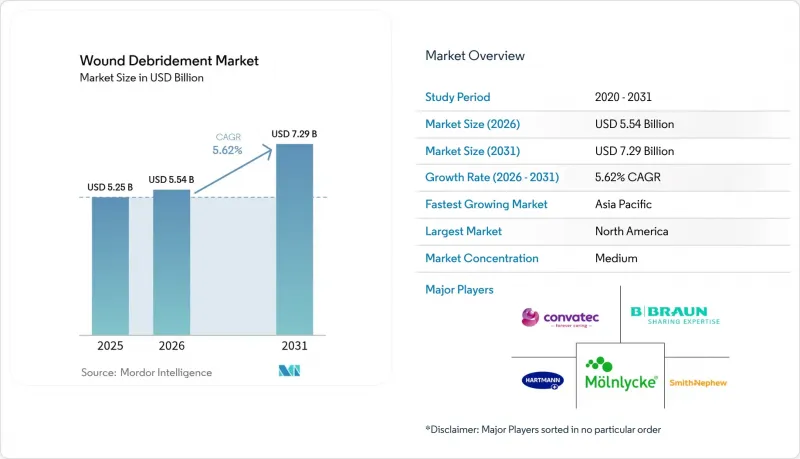
본 보고서는 제품별(젤, 연고·크림, 외과적 데브리드먼트 기기 등), 방법별(외과적, 효소적 등), 상처 유형별(만성 궤양(당뇨병성 족부 궤양 등), 외과적·외상성 상처, 화상), 최종 사용자(병원, 외래수술센터(ASC) 등), 지역(북미, 유럽 등)별로 분류되어 있으며, 시장 예측은 금액(달러) 기준으로 제시되어 있습니다.
전 세계 괴사조직 제거 시장 동향 및 인사이트
당뇨병성 족부 궤양 및 정맥성 하퇴 궤양 발생률 증가
당뇨병성 족부 궤양은 당뇨병 환자의 15-25%에 영향을 미치며, 당뇨병 관련 절단 사례의 85%는 이러한 궤양을 전조로 발생합니다. 현재, 상처 가장자리를 넘어 조기에 적극적으로 데브리드먼트를 실시함으로써 생물막과 과다 증식 조직이 제거되어 절단 위험이 현저히 감소한다는 것이 입증되었습니다. 이러한 임상적 변화에 따라, 조직을 선택적으로 제거하면서 부수적인 손상을 주지 않는 효소 및 초음파 기반 플랫폼에 대한 수요가 증가하고 있습니다. 한편, 압력을 조절하는 깔창과 같은 예방 도구는 초기 단계에서의 중재 필요성을 더욱 높이고 있습니다.
첨단 하이드로서저리 및 초음파 시스템의 급속한 보급
VERSAJET 플랫폼으로 대표되는 생리식염수 제트식 하이드로서저리는 시술을 효율화하고 건강한 조직을 보존합니다. SonicOne과 같은 초음파 장치는 저주파 진동을 통해 괴사 조직을 제거하며, 통증이 없고 육아 조직 형성을 촉진합니다. 연구를 통해 상처 봉합률 향상 및 입원 기간 단축이 보고됨에 따라, 병원 및 외래 진료 센터에서는 이러한 치료법이 빠르게 도입되고 있으며, 괴사조직 제거 시장은 비접촉식이며 정밀하게 제어되는 치료 방식으로의 전환을 가속화하고 있습니다.
치료비 및 기기 비용의 총액이 고액
당뇨병성 족부 궤양의 1건당 평균 비용은 환자 1명당 4,888유로이며, 그 지출의 대부분은 의료기기가 아닌 장기 입원에 기인합니다. 따라서 보험사는 고가의 플랫폼이 상처 치유 기간을 단축하거나 합병증을 경감시킨다는 확실한 증거를 제시할 것을 요구하며, 이를 충족한 경우에만 고액의 비용을 보상하고 있습니다. 이에 대응하여 의료 제공업체들은 초기 기기 비용이 아닌 총 치료비 분석에 중점을 두며 대처하고 있습니다.
부문 분석
하이드로서지컬 시스템은 부수적인 외상을 최소화하면서 괴사 조직을 절제할 수 있는 능력 덕분에 2025년에 괴사조직 제거 시장에서 28.21%의 점유율을 차지했습니다. 수술실에서 인기가 높은 이유는 신속한 설치, 우수한 가시성, 그리고 낮은 감염 위험에 있습니다. 이러한 선두에도 불구하고, 초음파 장치는 환자의 불편함을 완화하고 교차 오염을 줄여주는 비접촉식 조작의 이점에 힘입어 연평균 성장률(CAGR) 9.28%로 시장을 확대되고 있습니다. 효소 겔은 만성 궤양 치료에서 여전히 일정한 입지를 유지하고 있는 반면, 기계식 패드는 표층의 괴사 조직만을 제거해야 하는 경우에 한해 제한적으로 사용되고 있습니다.
초음파 기술이 탄력을 받고 있는 이유는 진폭을 조절하여 임상의가 작용 깊이를 미세하게 조정할 수 있기 때문이며, 이는 불규칙한 형태의 화상 상처나 취약한 당뇨병성 궤양에 매우 유용합니다. 이러한 이점 외에도 초기 투자 비용의 감소가 더해져, 초음파 기술을 이용한 괴사조직 제거 시장의 변혁이 가속화되고 있습니다. 대조적으로, 구더기 요법과 같은 생물학적 요법은 임상적으로 효과적이지만 문화적 저항에 직면해 있습니다. 또한, 항균 드레싱에 대한 규제 당국의 엄격한 감시도 내성 문제의 우려를 피할 수 있는 기계적 대안으로 혁신가들을 몰아넣고 있습니다.
외과적 데브리드먼트는 응급실 및 외상 수술실에서의 역할 덕분에 2025년 괴사조직 제거 시장 규모의 39.05%를 차지했습니다. 단 한 번의 시술로 괴사 조직과 생물막을 제거할 수 있는 이 능력은 혈관외과 및 정형외과 의사들 사이에서 확고한 입지를 다지고 있습니다. 그 다음으로는 효소 데브리드먼트가 꼽히며, 수술을 견딜 수 없는 환자에게 화학적 접근법을 제공합니다.
연간 8.44%의 성장률을 보이는 초음파 기반 접근법은 정확성과 환자의 편안함을 동시에 보장하며, 외래 진료에서도 반복적으로 시행할 수 있어 병상 점유율 감소로 이어집니다. 기계적 및 자가 용해적 기법은 허약한 환자에 대한 치료 수단으로 계속해서 활용되고 있지만, 생물학적 전략의 경우 2024년 후반 FDA가 의료용 구더기에 대한 감독 권한을 CBER로 이관함에 따라, 보다 명확한 규제 방향이 기대되고 있습니다.
지역별 분석
북미는 당뇨병 유병률이 높고, 보험 급여가 충실하며, AI를 활용한 평가 소프트웨어의 조기 도입에 힘입어 2025년 매출의 37.02%를 차지했습니다. 스미스 앤 네퓨(Smith & Nephew)는 2025년 1분기 ‘Advanced Wound Management’ 사업 부문에서 3.8%의 기초 성장률을 보고하며, 이 지역의 지속적인 수요를 뒷받침하고 있습니다. 규제 환경은 여전히 우호적이지만, 최근 FDA의 경고 서한에서는 제조 품질이 강조되고 있어 자금력이 풍부한 기업이 유리한 입장에 있습니다.
유럽은 여전히 혁신의 중심지로서, 스타트업 기업들이 효소 요법 및 광선 요법 기기 개발을 추진하는 한편, 규제 당국은 항균제에 대한 증거 요건을 강화하고 있습니다. 일회용 플라스틱 캐니스터 사용을 제한하는 환경 규제로 인해 공급업체들은 음압상처치료용 소모품의 재설계를 강요받고 있습니다.
아시아태평양은 성장의 원동력이며, 2031년까지의 연평균 성장률(CAGR)은 6.86%를 나타낼 것으로 예측됩니다. 고령화, 수술 건수 증가, 그리고 3차 병원에 대한 정부 투자가 이 지역의 확장을 뒷받침하고 있습니다. 콤바텍(Combatec)은 중국의 규제 지연을 지적하고 있지만, 생분해성 임시 매트릭스를 사용한 현지 임상시험에서 94.6%의 치유율을 기록한 것은 첨단 치료법에 대한 국내 수요가 높음을 여실히 보여주고 있습니다. 동남아시아 및 남아시아 국가에서는 전문의 수가 제한적인 점을 보완하기 위해 원격 지도 네트워크에 대한 투자가 진행되고 있으며, 이러한 움직임이 AI 기반 도구에 대한 수요를 자극하고 있습니다.
라틴아메리카 및 중동 및 아프리카에서는 예산 제약과 인력 부족으로 인해 도입 속도가 완만하지만, 만성 상처 발생률은 증가하고 있습니다. 당뇨병성 족부 병변 클리닉을 지원하는 다자간 원조 프로그램을 통해 2027년 이후 새로운 수요원이 개척될 것으로 예측됩니다.
기타 혜택:
- 엑셀 형식 시장 예측(ME) 시트
- 3개월간의 애널리스트 지원
자주 묻는 질문
목차
제1장 서론
제2장 조사 방법
제3장 주요 요약
제4장 시장 구도
제5장 시장 규모와 성장 예측
제6장 경쟁 구도
제7장 시장 기회와 향후 전망
JHS 26.09.07According to Mordor Intelligence, wound debridement market size in 2026 is estimated at USD 5.54 billion, growing from 2025 value of USD 5.25 billion with 2031 projections showing USD 7.29 billion, growing at 5.62% CAGR over 2026-2031.
This report is Segmented by Product (Gels, Ointments & Creams, Surgical Debridement Devices, and More), Method (Surgical, Enzymatic, and More), Wound Type (Chronic Ulcers [Diabetic Foot Ulcer and More], Surgical & Traumatic Wounds and Burns), End User (Hospitals, Ambulatory Surgical Centers and More) and Geography (North America, Europe, and More. ) the Market Forecasts are Provided in Terms of Value (USD).
Global Wound Debridement Market Trends and Insights
Rising incidence of diabetic foot and venous leg ulcers
Diabetic foot ulcers affect 15-25% of people living with diabetes, and 85% of diabetes-related amputations are preceded by such ulcers. Evidence now shows that early, aggressive debridement reaching beyond wound edges removes biofilm and hyperproliferative tissue and markedly lowers amputation risk. This clinical shift increases demand for enzymatic and ultrasonic platforms that deliver tissue-selective removal without collateral damage, while preventive tools such as pressure-altering insoles further elevate upstream intervention needs.
Rapid adoption of advanced hydrosurgical and ultrasonic systems
Saline-jet hydrosurgery, exemplified by the VERSAJET platform, streamlines procedures and preserves healthy tissue. Ultrasonic devices such as SonicOne remove devitalized tissue through low-frequency vibration, are painless, and foster granulation. Hospitals and outpatient centres quickly adopt these modalities as studies report faster closure rates and shorter admissions, accelerating the wound debridement market transition toward non-contact, precision-guided care.
High overall treatment and device costs
Average diabetic foot ulcer episodes cost EUR 4,888 per patient, with most spending tied to lengthier inpatient stays rather than devices. Payers therefore insist on robust evidence showing that premium platforms shorten time to closure or reduce complications before reimbursing higher prices. Providers respond by focusing on total cost-of-care analyses instead of front-end device costs.
Other drivers and restraints analyzed in the detailed report include:
- Growing volume of complex surgical procedures
- Ageing population with impaired wound healing
- Shortage of certified wound-care specialists
For complete list of drivers and restraints, kindly check the Table Of Contents.
Segment Analysis
Hydrosurgical systems secured 28.21% of wound debridement market share in 2025 through their ability to excise devitalised tissue with minimal collateral trauma. Their popularity in operating rooms stems from faster set-up, better visibility, and lower infection risk. Despite this lead, ultrasonic devices are expanding at a 9.28% CAGR, aided by non-contact operation that eases patient discomfort and lowers cross-contamination. Enzymatic gels retain a place in chronic ulcer care, whereas mechanical pads find limited use when only superficial slough must be removed.
Ultrasonic technology builds momentum because adjustable amplitude lets clinicians fine-tune depth of action, which is invaluable for irregular burn beds and fragile diabetic ulcers. These advantages, together with shrinking capital costs, underpin ultrasonic disruption of the wound debridement market. By contrast, biologic methods such as maggot therapy, though clinically effective, confront cultural resistance. Regulatory scrutiny of antimicrobial dressings also pushes innovators toward mechanical options that sidestep resistance issues.
Surgical debridement represented 39.05% of the wound debridement market size in 2025 on account of its role in emergency departments and trauma theatres. Its capacity to remove necrosis and biofilm in one session cements its status among vascular and orthopaedic surgeons. Enzymatic debridement follows, offering a chemical route for patients who cannot tolerate surgery.
Ultrasonic approaches, growing 8.44% yearly, combine precision with patient comfort and can be repeated in outpatient clinics, therefore lowering bed occupancy. Mechanical and autolytic routes continue to serve frail patients, while biologic strategies await clearer regulatory pathways after the FDA transferred oversight of medicinal maggots to CBER in late 2024.
Complete Report Scope:
- By Product
- Gels
- Ointments & Creams
- Surgical Debridement Devices
- Hydrosurgical Devices
- Ultrasound-Assisted Debridement Devices
- Mechanical Debridement Pads
- Biologic Debridement (Maggot Therapy)
- Other Products
- By Method
- Surgical
- Enzymatic
- Mechanical
- Autolytic
- Biologic
- Ultrasonic
- By Wound Type
- Chronic Ulcers
- Diabetic Foot Ulcers
- Pressure Ulcers
- Venous Leg Ulcers
- Surgical & Traumatic Wounds
- Burns
- Chronic Ulcers
- By End User
- Hospitals
- Ambulatory Surgical Centers
- Home-Care Settings
- By Geography
- North America
- United States
- Canada
- Mexico
- Europe
- Germany
- United Kingdom
- France
- Italy
- Spain
- Rest of Europe
- Asia-Pacific
- China
- Japan
- India
- Australia
- South Korea
- Rest of Asia-Pacific
- Middle East and Africa
- GCC
- South Africa
- Rest of Middle East and Africa
- South America
- Brazil
- Argentina
- Rest of South America
- North America
Geography Analysis
North America generated 37.02% of 2025 sales, anchored by high diabetes prevalence, generous reimbursement, and early uptake of AI-enabled assessment software. Smith+Nephew reported 3.8% underlying growth in its Advanced Wound Management franchise for Q1 2025, underscoring sustained regional demand. Regulations remain supportive, yet recent FDA warning letters emphasise manufacturing quality and favour well-capitalised firms.
Europe remains an innovation hub, with start-ups progressing enzymatic and photonic devices and regulators tightening evidence requirements for antimicrobial agents. Environmental legislation that discourages single-use plastic canisters prompts suppliers to redesign negative-pressure wound therapy consumables.
Asia-Pacific is the growth engine, forecast to deliver a 6.86% CAGR through 2031. Ageing populations, rising surgical volumes, and government investment in tertiary hospitals underpin expansion. ConvaTec has noted regulatory delays in China, yet local trials of biodegradable temporising matrices yielding 94.6% healing rates spotlight domestic appetite for advanced therapy. South-East Asian and South Asian nations invest in tele-mentoring networks to compensate for limited specialist density, a move that stimulates demand for AI-guided tools.
Latin America and the Middle East & Africa show slower uptake because of budget limits and workforce shortages, though incidence of chronic wounds is climbing. Multilateral aid programmes that sponsor diabetic foot clinics are expected to open new pockets of demand beyond 2027.
- Smiths Group
- Convatec
- Molnlycke Health Care
- B. Braun
- Hartmann Group
- Bioventus (Misonix)
- Lohmann & Rauscher
- Solventum
- Coloplast
- DeRoyal Industries
- Arobella Medical
- Histologics LLC
- Medaxis AG
- Soring GmbH
- Zimmer Biomet (Pulsavac)
- RLS Global AB
- PulseCare Medical
- Integra LifeSciences
- Medtronic
- Stryker
Additional Benefits:
- The market estimate (ME) sheet in Excel format
- 3 months of analyst support
TABLE OF CONTENTS
1 Introduction
- 1.1 Study Assumptions and Market Definition
- 1.2 Scope of the Study
2 Research Methodology
3 Executive Summary
4 Market Landscape
- 4.1 Market Overview
- 4.2 Market Drivers
- 4.2.1 Rising Incidence Of Diabetic Foot & Venous Leg Ulcers
- 4.2.2 Growing Volume Of Complex Surgical Procedures
- 4.2.3 Rapid Adoption Of Advanced Hydrosurgical & Ultrasonic Systems
- 4.2.4 Ageing Population With Impaired Wound Healing
- 4.2.5 AI-Enabled Wound-Assessment Platforms Accelerating Debridement Decisions
- 4.2.6 Biofilm-Targeting Topical Enzymes Improving Debridement Efficiency
- 4.3 Market Restraints
- 4.3.1 High Overall Treatment & Device Costs
- 4.3.2 Shortage Of Certified Wound-Care Specialists In Emerging Economies
- 4.3.3 Tightening FDA/EMA Scrutiny On Collagenase & Enzymatic Agents
- 4.3.4 Sustainability Push Against Single-Use NPWT Canisters & Disposables
- 4.4 Value / Supply-Chain Analysis
- 4.5 Regulatory Landscape
- 4.6 Technology Outlook
- 4.7 Porter's Five Forces Analysis
- 4.7.1 Bargaining Power of Suppliers
- 4.7.2 Bargaining Power of Buyers
- 4.7.3 Threat of New Entrants
- 4.7.4 Threat of Substitutes
- 4.7.5 Intensity of Competitive Rivalry
5 Market Size and Growth Forecasts (Value-USD)
- 5.1 By Product
- 5.1.1 Gels
- 5.1.2 Ointments & Creams
- 5.1.3 Surgical Debridement Devices
- 5.1.4 Hydrosurgical Devices
- 5.1.5 Ultrasound-Assisted Debridement Devices
- 5.1.6 Mechanical Debridement Pads
- 5.1.7 Biologic Debridement (Maggot Therapy)
- 5.1.8 Other Products
- 5.2 By Method
- 5.2.1 Surgical
- 5.2.2 Enzymatic
- 5.2.3 Mechanical
- 5.2.4 Autolytic
- 5.2.5 Biologic
- 5.2.6 Ultrasonic
- 5.3 By Wound Type
- 5.3.1 Chronic Ulcers
- 5.3.1.1 Diabetic Foot Ulcers
- 5.3.1.2 Pressure Ulcers
- 5.3.1.3 Venous Leg Ulcers
- 5.3.2 Surgical & Traumatic Wounds
- 5.3.3 Burns
- 5.3.1 Chronic Ulcers
- 5.4 By End User
- 5.4.1 Hospitals
- 5.4.2 Ambulatory Surgical Centers
- 5.4.3 Home-Care Settings
- 5.5 By Geography
- 5.5.1 North America
- 5.5.1.1 United States
- 5.5.1.2 Canada
- 5.5.1.3 Mexico
- 5.5.2 Europe
- 5.5.2.1 Germany
- 5.5.2.2 United Kingdom
- 5.5.2.3 France
- 5.5.2.4 Italy
- 5.5.2.5 Spain
- 5.5.2.6 Rest of Europe
- 5.5.3 Asia-Pacific
- 5.5.3.1 China
- 5.5.3.2 Japan
- 5.5.3.3 India
- 5.5.3.4 Australia
- 5.5.3.5 South Korea
- 5.5.3.6 Rest of Asia-Pacific
- 5.5.4 Middle East and Africa
- 5.5.4.1 GCC
- 5.5.4.2 South Africa
- 5.5.4.3 Rest of Middle East and Africa
- 5.5.5 South America
- 5.5.5.1 Brazil
- 5.5.5.2 Argentina
- 5.5.5.3 Rest of South America
- 5.5.1 North America
6 Competitive Landscape
- 6.1 Market Concentration
- 6.2 Market Share Analysis
- 6.3 Company profiles (includes Global level Overview, Market level overview, Core Segments, Financials as available, Strategic Information, Market Rank/Share for key companies, Products and Services, and Recent Developments)
- 6.3.1 Smith+Nephew
- 6.3.2 ConvaTec Group PLC
- 6.3.3 Molnlycke Health Care AB
- 6.3.4 B. Braun SE
- 6.3.5 PAUL HARTMANN AG
- 6.3.6 Bioventus (Misonix)
- 6.3.7 Lohmann & Rauscher
- 6.3.8 Solventum
- 6.3.9 Coloplast A/S
- 6.3.10 DeRoyal Industries Inc.
- 6.3.11 Arobella Medical
- 6.3.12 Histologics LLC
- 6.3.13 Medaxis AG
- 6.3.14 Soring GmbH
- 6.3.15 Zimmer Biomet (Pulsavac)
- 6.3.16 RLS Global AB
- 6.3.17 PulseCare Medical
- 6.3.18 Integra LifeSciences
- 6.3.19 Medtronic plc
- 6.3.20 Stryker Corporation
7 Market Opportunities & Future Outlook
- 7.1 White-space & unmet-need assessment


