

|
시장보고서
상품코드
2123501
사료용 목초 시장 : 점유율 분석, 업계 동향·통계, 성장 예측(2026-2031년)Forage Feed - Market Share Analysis, Industry Trends & Statistics, Growth Forecasts (2026 - 2031) |
||||||
 Mordor Intelligence
Mordor Intelligence에 의하면, 사료용 목초 시장 규모는 2025년에 932억 달러로 평가되었고 2026년 978억 달러에서 2031년까지 1,283억 달러에 이를 것으로 예측되며, 예측 기간(2026-2031년) CAGR은 5.60%를 나타낼 전망입니다.
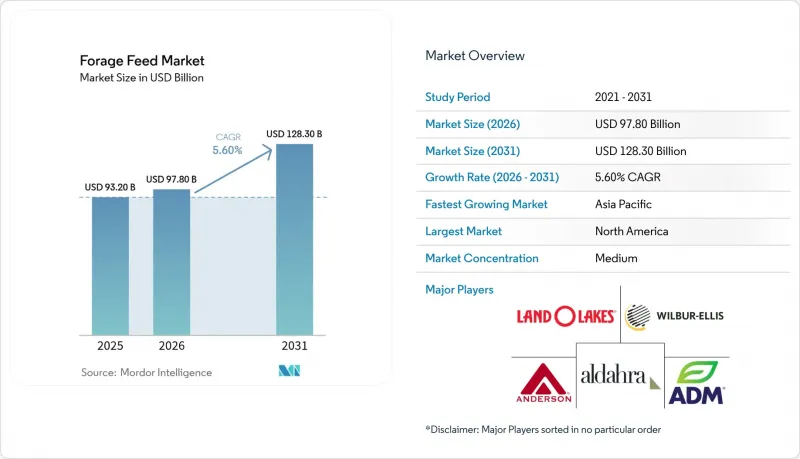
본 보고서는 제품 유형(알팔파 건초, 티모시 건초 등), 가축 유형(젖소, 육우 등), 형태(베일, 펠릿 등), 유통 채널(사료 공장, 농장 직접 공급 등), 지역(북미, 남미, 유럽,아시아태평양 등)별로 분류되어 있습니다. 시장 예측은 금액(달러) 및 수량(메트릭 톤)으로 제시되어 있습니다.
전 세계 사료용 목초 시장 동향 및 인사이트
대규모 젖소 및 육우 사육 농장의 확대
대규모 젖소 농장 및 육우 비육장에서의 수직 통합이 조달 관행을 변화시키고 있습니다. 5,000두 이상의 규모를 가진 농장에서는 수년에 걸친 사료용 목초 계약을 체결하는 사례가 증가하고 있습니다. 이러한 계약을 통해 고정 가격을 대가로 안정적인 공급량과 단백질 함량이 보장되어, 현물 시장의 가격 변동으로 인한 위험을 완화하고 있습니다. 이 접근 방식을 통해 영양사는 건물 함량이 일정한 사료 배합을 수립할 수 있게 되었으며, 집약적인 젖소 사육 시스템에서 사료 전환율을 8%에서 12%까지 개선하고 있습니다. 이러한 지역에서는 계절적 가격 변동을 완화하기 위해 주 정부가 지원하는 협동조합이 최대 5만 미터톤의 수용 능력을 갖춘 중앙 집중형 건초 저장 시설을 건설하고 있습니다. 이는 북미산 사료용 작물이 프리미엄급 투입 자재이며, 1미터톤당 150달러를 초과하는 컨테이너 운임도 정당화될 수 있다는 아시아 유제품 가공업체들의 인식을 반영한 것입니다.
고섬유 사료를 권장하는 메탄 배출 감축 정책
캐나다, 유럽연합(EU), 뉴질랜드 정부는 젖소 및 육우 생산자들이 가축 사료에 소화 가능한 섬유질을 더 높은 비율로 포함하도록 장려하는 장내 메탄 감축 목표를 시행하고 있습니다. 이러한 전환으로 인해 곡물 중심의 농축 사료보다 콩과 식물 유래 사료의 사용이 촉진되고 있습니다. 이 이니셔티브는 기준선 및 대책 시행 후의 배출량을 기록한 사업체에 대해 총 사료 비용의 최대 8%를 상쇄할 수 있는 수익원을 제공합니다. 이 정책은 장내 발효를 줄이고, 각국의 배출권 거래 제도에 따라 환급 대상이 되는 고섬유질 사료 혼합물의 도입을 장려하기 위한 것입니다. 또한, 3-니트로옥시프로판올(3-NOP) 및 바이오숯과 같은 사료 첨가제를 콩과 작물의 건초와 조합하여 시험이 진행되고 있으며, 메탄 배출량을 20% 이상 감축하는 것을 목표로 하고 있습니다.
기후 변동과 가뭄 위험
미국 그레이트 플레인스, 호주, 아르헨티나에서 수년 연속 가뭄이 발생한 결과, 2024년 및 2025년에는 알팔파와 목초의 수확량이 10%에서 15% 감소했습니다. 이로 인해 일본, 한국, 아랍에미리트의 수입업체들은 조달 전략을 다각화할 수밖에 없게 되었으며, 더 높은 입고 비용을 감수해야 했습니다. 2025년 중반, 미국 가뭄 모니터링(United States Drought Monitor)은 캘리포니아주, 네바다주, 아이다호주의 알팔파 생산 카운티 중 42%를 ‘심각’에서 ‘극히 심각’한 가뭄 상태로 분류했습니다. 그 결과, 1차 수확량은 평균 18% 감소했으며, 고품질 알팔파의 현물 시장 가격은 톤당 320달러를 넘어 2024년 수준보다 25% 상승했습니다. 기후 모델에 따르면, 2030년까지 주요 사료 생산 지역 전체에서 섭씨 35도를 넘는 폭염 일수가 20%에서 30% 증가할 것으로 예측됩니다.
부문 분석
알팔파 건초는 가장 큰 부문으로, 2025년에는 사료용 목초 시장 점유율의 37.4%를 차지하며 고생산성 젖소에게 선호되는 사료로서의 입지를 공고히 했습니다. 이러한 선호도는 조단백질 함량이 18%를 초과하고 상대 사료 가치가 150 이상인 데 기인합니다. 자발적인 탄소 크레딧 제도나 규제에 따른 배출량 상한선 등 시장 인센티브로 인해, 집약적 축산 농가들은 루멘 기능을 향상시키는 고섬유질·저단백질 혼합 사료에 더 많은 예산을 할당하도록 유도되고 있습니다. 각 공급업체들은 현재 프로바이오틱스가 함유된 접종제와 보존 기간을 최대 8개월까지 연장할 수 있는 습도 관리 포장을 제공합니다.
클로버 및 기타 콩과 식물의 건초는 가장 빠르게 성장하는 부문이 되어 2031년까지 연평균 성장률(CAGR) 7.8%로 확대될 것으로 예상되며, 모든 제품 유형 중 가장 높은 성장률을 보일 것으로 전망됩니다. 이러한 성장은 클로버의 질소 고정 특성에 기인하며, 이를 통해 생산자는 1에이커당 연간 80-120달러의 합성 비료 비용을 절감할 수 있습니다. 또한, 클로버는 토양의 탄소 고정을 촉진하므로, 생산자는 VERRA 및 Climate Action Reserve가 관리하는 프로토콜에 따라 탄소 상쇄 지급 대상이 됩니다. 클로버의 공생 뿌리혹은 대기 중의 질소를 고정하여 합성 비료에 대한 의존도를 낮추는 동시에, 검증된 탄소 상쇄에 기여하고 있습니다.
젖소는 가장 큰 부문으로, 2025년에는 사료용 목초 시장의 42.6%를 차지했습니다. 이는 북미, 유럽 및 아시아태평양의 집약적 경영이 원동력이 되고 있습니다. 이러한 경영에서는 반추위 건강을 지원하고 유지방 함량을 3.8% 이상으로 유지하기 위해 사료에 40%에서 55%의 목초를 함유한 토탈 믹스 레이션(TMR)이 배합되었습니다. 2025년, 일본과 한국은 합계 45만 미터톤의 티모시와 알팔파 건초를 수입했습니다. 일본의 낙농협동조합은 홀스타인 젖소군의 유지방 수율(1산기당 평균 10,000Kg)을 최적화하기 위해 단백질 함량 18% 이상, 수분 함량 12% 이하를 지정했습니다. 유럽연합(EU)의 ‘농장에서 식탁까지(Farm to Fork)’ 전략은 2030년까지 농업에서 발생하는 온실가스 배출량을 30% 감축하는 것을 목표로 하고 있었습니다.
가금류 부문은 가장 빠르게 성장하는 부문이 될 것이며, 2031년까지 연평균 성장률(CAGR) 6.9%로 성장할 전망입니다. 미국, 유럽, 동남아시아의 통합형 양계 기업들은 케이지 프리 달걀 기준(중량 대비 5%-7% 이상의 섬유질 섭취 필수)을 충족하기 위해 산란계 사료에 잘게 썬 알팔파를 혼합하고 있습니다. 아시아와 아프리카의 인구 증가와 1인당 소득 증가는 동물성 단백질 소비 확대를 뒷받침하고 있습니다. 인도, 인도네시아, 나이지리아 등의 국가에서 중산층 가구는 식물 중심의 식생활에서 가금육을 섭취하는 식생활로 전환하고 있으며, 그 속도는 국내 사료 생산 능력을 웃돌고 있습니다. 잘게 썬 사료나 분쇄된 사료는 산란계의 배합 사료에 알팔파를 혼합하는 가금 통합 사업자에게 특히 매력적입니다. 또한, 낙농 사업에서는 장기 저장 기간 동안에도 총 소화 가능 영양소(TDN)의 영양 밀도를 65% 이상 유지하기 위해 발효 건초 사일리지나 사일리지 첨가제가 사용되고 있습니다.
지역별 분석
북미는 2025년에도 사료용 목초 시장 점유율의 33.7%를 차지하며 지역별 최대 위치를 유지했습니다. 이러한 성장은 산업 규모의 낙농 복합 시설, 선진적인 정밀 농업 인프라, 그리고 견고한 수출 경로에 의해 뒷받침되고 있습니다. 이 지역은 소 사육 규모의 확대가 정체되고 있는 점과 토지 이용을 둘러싼 경쟁 심화 등의 과제에 직면해 있습니다. 생산량 면에서는 미국이 선두를 차지하고 있으며, 캘리포니아주와 애리조나주에서는 비용 효율적인 물류 경로를 통해 건조 알팔파를 아시아 시장으로 수출하고 있습니다. 캐나다는 서늘한 기후에서 재배되는 작물의 이점을 활용하고 있지만, 높은 운송비로 인해 이익률 압박에 직면해 있습니다. 멕시코에서는 통합형 쇠고기 가공업체들이 사료 공급 프로토콜을 강화함에 따라 사료용 목초 시장이 점차 확대되고 있습니다.
아시아태평양은 가장 빠르게 성장할 것으로 예측되며, 2031년까지 연평균 성장률(CAGR) 6.3%를 기록할 전망입니다. 이러한 성장은 인구 증가, 서유럽식 식습관으로의 전환, 그리고 가축 생산의 수직 통합이 급속히 확산됨에 따라 주도되고 있습니다. 중국에서는 내몽골의 집약적 낙농 경영을 배경으로, 2024년부터 2025년까지 고품질 압축 알팔파 베일의 수입이 크게 증가했습니다. 인도에서는 콜드체인 인프라에 대한 투자를 바탕으로 한 협동조합 주도의 낙농 네트워크 확장이 발효 건초 사료 및 단백질 강화 펠릿 수요를 견인하고 있습니다. 주요 수출국인 호주는 반복되는 가뭄과 물 배분 정책 변경과 같은 과제에 직면해 있어, 이러한 요인들이 생산 증가를 제한할 가능성은 있지만, 한편으로는 물 이용 효율이 높은 콩과 작물을 사료용 목초 시장에서의 전략적 작물로 자리매김하는 계기가 되고 있습니다.
유럽에서는 질소 고정성 콩과 작물의 촉진과 탄소 크레딧 이니셔티브를 뒷받침하는 지속가능성 관련 규제 및 공동농업정책(CAP)에 기반한 개혁을 원동력으로 삼아 성장 가능성이 전망되고 있습니다. 독일, 프랑스, 네덜란드는 여전히 강력한 낙농 산업을 유지하고 있지만, 미국산 건초 수입에 대한 식물 검역 규제로 인해 현지 조달이 진행되고 있습니다. 동유럽에서는 헝가리 등 시장이 자급자족 목표를 지원하는 ADM사의 ‘Vitafort’ 합작 사업 등 새로운 가공 분야에 대한 투자의 혜택을 받고 있습니다.
기타 혜택:
- 엑셀 형식 시장 예측(ME) 시트
- 3개월간의 애널리스트 지원
자주 묻는 질문
목차
제1장 서론
제2장 조사 방법
제3장 주요 요약
제4장 시장 구도
제5장 시장 규모와 성장 예측(수량 및 금액)
제6장 경쟁 구도
제7장 시장 기회와 향후 전망
JHS 26.09.09According to Mordor Intelligence, the forage feed market size was valued at USD 93.20 billion in 2025 and estimated to grow from USD 97.80 billion in 2026 to reach USD 128.30 billion by 2031, at a CAGR of 5.60% during the forecast period (2026-2031).
This report is Segmented by Product Type (Alfalfa Hay, Timothy Hay, and More), by Livestock Type (Dairy Cattle, Beef Cattle, and More), by Form (Bales, Pellets, and More), by Distribution Channel (Feed Mills, Direct Farm Supply, and More), and by Geography (North America, South America, Europe, Asia-Pacific, and More). The Market Forecasts are Provided in Terms of Value (USD) and Volume (Metric Tons).
Global Forage Feed Market Trends and Insights
Expanding Large-Scale Dairy and Beef Operations
Vertical integration among large-scale dairies and beef feedlots is transforming procurement practices. Operations with more than 5,000 head are increasingly entering into multi-year forage contracts. These agreements ensure consistent volume and protein specifications in exchange for fixed pricing, reducing exposure to spot-market fluctuations. This approach enables nutritionists to formulate rations with consistent dry matter content, improving feed conversion ratios by 8% to 12% in intensive dairy systems . In these regions, state-backed cooperatives are constructing centralized hay-storage facilities with capacities of up to 50,000 metric tons to mitigate seasonal price volatility. This reflects the perception among Asian dairy processors that North American forage is a premium input, justifying container freight rates exceeding USD 150 per metric tons.
Methane-Mitigation Policies Favoring High-Fiber Forage
Governments in Canada, the European Union, and New Zealand are implementing enteric methane reduction targets that encourage dairy and beef producers to incorporate higher proportions of digestible fiber into livestock rations. This shift promotes the use of legume-based forages over grain-heavy concentrates. This initiative provides a revenue stream that can offset up to 8% of total feed costs for operations that document baseline and post-intervention emissions. Policy incentivizes the adoption of high-fiber forage blends that reduce enteric fermentation and qualify for rebates under the country's Emissions Trading Scheme. Additionally, feed-grade additives such as 3-nitrooxypropanol (3-NOP) and biochar are being tested in combination with legume hay to achieve methane reductions exceeding 20%.
Weather Volatility and Drought Risk
Consecutive drought years in the United States Great Plains, Australia, and Argentina reduced alfalfa and grass-hay yields by 10% to 15% in 2024 and 2025. This compelled importers in Japan, South Korea, and the United Arab Emirates to diversify their sourcing strategies and accept higher landed costs. In mid-2025, the United States Drought Monitor classified 42% of the alfalfa-producing counties in California, Nevada, and Idaho as experiencing severe to exceptional drought conditions. This resulted in an average 18% reduction in first-cutting yields and drove spot-market prices for premium alfalfa above USD 320 per metric ton, representing a 25% increase from 2024 levels . Climate models predict that by 2030, extreme-heat days exceeding 35 degrees Celsius will increase by 20% to 30% across major forage-producing regions.
Other drivers and restraints analyzed in the detailed report include:
- Carbon-Credit Upside from Nitrogen-Fixing Forage Legumes
- Rising Demand for High-Protein Meat and Dairy
- Stricter Phytosanitary Barriers on Cross-Border Hay Trade
For complete list of drivers and restraints, kindly check the Table Of Contents.
Segment Analysis
Alfalfa hay was the largest segment, led with 37.4% of the forage feed market share in 2025, underscoring its position as a preferred forage for high-producing dairy cattle. This preference is attributed to its crude protein content exceeding 18% and a relative feed value above 150. Market incentives, including voluntary carbon credit schemes and regulatory emission caps, are encouraging intensive cattle farms to allocate larger budgets to high-fiber, low-protein blends that enhance rumen function. Suppliers are now offering probiotic-infused inoculants and moisture-controlled wrapping, which can extend shelf life by up to eight months.
Clover and other legume hay will be the fastest-growing segment and are projected to expand at a 7.8% CAGR through 2031, marking the fastest growth among all product types. This growth is driven by clover's nitrogen-fixing properties, which enable growers to eliminate the annual synthetic fertilizer costs of USD 80-120 per acre. Additionally, clover supports soil carbon sequestration, qualifying growers for carbon offset payments under protocols administered by Verra and the Climate Action Reserve. The symbiotic root nodules of clover fix atmospheric nitrogen, reducing reliance on synthetic fertilizers and contributing to verified carbon offsets.
Dairy cattle were the largest segment, accounting for 42.6% of the forage feed market share in 2025, driven by intensive operations in North America, Europe, and the Asia-Pacific. These operations formulated total mixed rations with 40% to 55% forage inclusion to support rumen health and maintain milk-fat content above 3.8%. Japan and South Korea collectively imported 450,000 metric tons of timothy and alfalfa hay in 2025. Japanese dairy cooperatives specified protein content above 18% and moisture levels below 12% to optimize milk-fat yields in Holstein herds, which averaged 10,000 kilograms per lactation. The European Union's Farm to Fork strategy aimed to reduce agricultural greenhouse gas emissions by 30% by 2030.
Poultry will be the fastest-growing segment, advancing at a 6.9% CAGR through 2031. Integrators in the United States, Europe, and Southeast Asia are incorporating chopped alfalfa into layer rations to meet cage-free egg standards, which require a minimum fiber intake of 5% to 7% by weight . Population growth and rising per capita incomes in Asia and Africa are driving increased animal protein consumption. Middle-income households in countries such as India, Indonesia, and Nigeria are transitioning from plant-based diets to include poultry at rates that exceed domestic forage production capacity. Chopped and chaffed forage is particularly appealing to poultry integrators blending alfalfa into layer rations. Additionally, dairy operations use fermented haylage and silage additives to maintain nutrient density above 65% total digestible nutrients during extended storage periods.
Complete Report Scope:
- By Product Type
- Alfalfa Hay
- Timothy Hay
- Clover & Other Legume Hay
- Silage
- Haylage
- Other Forage (grass mix, crop residues)
- By Livestock Type
- Dairy Cattle
- Beef Cattle
- Poultry
- Equine
- Swine
- Other Livestock (sheep, goats, camelids)
- By Form
- Bales
- Pellets and Cubes
- Chopped/Chaffed Forage
- Fermented Haylage and Silage Additives
- By Distribution Channel
- Feed Mills
- Direct Farm Supply
- Online Platforms
- By Geography
- North America
- United States
- Canada
- Rest of North America
- South America
- Brazil
- Argentina
- Rest of South America
- Europe
- Germany
- France
- United Kingdom
- Italy
- Spain
- Russia
- Rest of Europe
- Asia-Pacific
- China
- India
- Japan
- Australia
- South Korea
- Rest of Asia-Pacific
- Middle East
- Saudi Arabia
- United Arab Emirates
- Rest of Middle East
- Africa
- South Africa
- Egypt
- Rest of Africa
- North America
Geography Analysis
North America retained the largest regional position 33.7% of of the forage feed market share in 2025. This growth is supported by industrial-scale dairy complexes, advanced precision agriculture infrastructure, and strong export pipelines. The region faces challenges such as plateauing herd expansions and increased land-use competition. The United States leads production, with California and Arizona exporting dehydrated alfalfa to Asian markets through cost-efficient logistics corridors. Canada benefits from cool-season crop advantages but faces margin pressures due to high freight rates. In Mexico, the forage feed market is gradually expanding as integrated beef processors enhance feeding protocols.
Asia-Pacific will be the fastest-growing forecast to post the quickest 6.3% CAGR through 2031. This growth is driven by population increases, dietary shifts toward Western preferences, and the rapid adoption of vertical livestock integration. China experienced a significant rise in premium compressed alfalfa bale imports during 2024-2025, fueled by intensive dairy operations in Inner Mongolia. In India, the expanding cooperative dairy network, supported by investments in cold-chain infrastructure, is driving demand for fermented haylage and protein-enriched pellets. Australia, a key exporter, faces challenges from recurring droughts and evolving water-allocation policies, which may limit production growth but position water-efficient legumes as strategic crops in the forage feed market.
Europe shows growth potential, driven by sustainability mandates and reforms under the Common Agricultural Policy, which promote nitrogen-fixing legumes and carbon credit initiatives. Germany, France, and the Netherlands maintain strong dairy industries, but phytosanitary restrictions on United States hay imports are encouraging localized sourcing. In Eastern Europe, markets like Hungary are benefiting from new processing investments, such as ADM's Vitafort joint venture, which supports self-sufficiency goals.
- ADM
- Wilbur-Ellis Company LLC
- Triple Crown Nutrition
- Land O'Lakes, Inc.
- Anderson Hay
- Al Dahra ACX, Inc.
- Gruppo Carli
- Border Valley Trading
- Standlee Premium Products, LLC
- Lucerne Farms
- Mitsubishi Corporation (Riverina)
- Baileys Horse Feeds
Additional Benefits:
- The market estimate (ME) sheet in Excel format
- 3 months of analyst support
TABLE OF CONTENTS
1 Introduction
- 1.1 Study Assumptions and Market Definition
- 1.2 Scope of the Study
2 Research Methodology
3 Executive Summary
4 Market Landscape
- 4.1 Market Overview
- 4.2 Market Drivers
- 4.2.1 Expanding large-scale dairy and beef operations
- 4.2.2 Rising demand for high-protein meat and dairy
- 4.2.3 Methane mitigation policies favoring high-fiber forage
- 4.2.4 Carbon-credit upside from nitrogen-fixing forage legumes
- 4.2.5 In-field mobile baler-wrapper robots boosting harvest quality
- 4.2.6 Feed-grade biochar blends improving forage digestibility
- 4.3 Market Restraints
- 4.3.1 Weather volatility and drought risk
- 4.3.2 Competition for arable land with cash crops
- 4.3.3 Stricter phytosanitary barriers on cross-border hay trade
- 4.3.4 Shift toward fermented concentrates over loose forage
- 4.4 Regulatory Landscape
- 4.5 Technological Outlook
- 4.6 Porter's Five Forces Analysis
- 4.6.1 Threat of New Entrants
- 4.6.2 Bargaining Power of Suppliers
- 4.6.3 Bargaining Power of Buyers
- 4.6.4 Threat of Substitutes
- 4.6.5 Intensity of Competitive Rivalry
5 Market Size and Growth Forecasts (Volume and Value)
- 5.1 By Product Type
- 5.1.1 Alfalfa Hay
- 5.1.2 Timothy Hay
- 5.1.3 Clover & Other Legume Hay
- 5.1.4 Silage
- 5.1.5 Haylage
- 5.1.6 Other Forage (grass mix, crop residues)
- 5.2 By Livestock Type
- 5.2.1 Dairy Cattle
- 5.2.2 Beef Cattle
- 5.2.3 Poultry
- 5.2.4 Equine
- 5.2.5 Swine
- 5.2.6 Other Livestock (sheep, goats, camelids)
- 5.3 By Form
- 5.3.1 Bales
- 5.3.2 Pellets and Cubes
- 5.3.3 Chopped/Chaffed Forage
- 5.3.4 Fermented Haylage and Silage Additives
- 5.4 By Distribution Channel
- 5.4.1 Feed Mills
- 5.4.2 Direct Farm Supply
- 5.4.3 Online Platforms
- 5.5 By Geography
- 5.5.1 North America
- 5.5.1.1 United States
- 5.5.1.2 Canada
- 5.5.1.3 Rest of North America
- 5.5.2 South America
- 5.5.2.1 Brazil
- 5.5.2.2 Argentina
- 5.5.2.3 Rest of South America
- 5.5.3 Europe
- 5.5.3.1 Germany
- 5.5.3.2 France
- 5.5.3.3 United Kingdom
- 5.5.3.4 Italy
- 5.5.3.5 Spain
- 5.5.3.6 Russia
- 5.5.3.7 Rest of Europe
- 5.5.4 Asia-Pacific
- 5.5.4.1 China
- 5.5.4.2 India
- 5.5.4.3 Japan
- 5.5.4.4 Australia
- 5.5.4.5 South Korea
- 5.5.4.6 Rest of Asia-Pacific
- 5.5.5 Middle East
- 5.5.5.1 Saudi Arabia
- 5.5.5.2 United Arab Emirates
- 5.5.5.3 Rest of Middle East
- 5.5.6 Africa
- 5.5.6.1 South Africa
- 5.5.6.2 Egypt
- 5.5.6.3 Rest of Africa
- 5.5.1 North America
6 Competitive Landscape
- 6.1 Market Concentration
- 6.2 Strategic Moves
- 6.3 Market Share Analysis
- 6.4 Company Profiles (Includes Global-level Overview, Market-level Overview, Core Segments, Financials, Strategic Information, Market Rank/Share, Products and Services, and Recent Developments)
- 6.4.1 ADM
- 6.4.2 Wilbur-Ellis Company LLC
- 6.4.3 Triple Crown Nutrition
- 6.4.4 Land O'Lakes, Inc.
- 6.4.5 Anderson Hay
- 6.4.6 Al Dahra ACX, Inc.
- 6.4.7 Gruppo Carli
- 6.4.8 Border Valley Trading
- 6.4.9 Standlee Premium Products, LLC
- 6.4.10 Lucerne Farms
- 6.4.11 Mitsubishi Corporation (Riverina)
- 6.4.12 Baileys Horse Feeds


