

|
시장보고서
상품코드
2123507
두개 임플란트 시장 : 점유율 분석, 업계 동향과 통계, 성장 예측(2026-2031년)Global Cranial Implants - Market Share Analysis, Industry Trends & Statistics, Growth Forecasts (2026 - 2031) |
||||||
 Mordor Intelligence
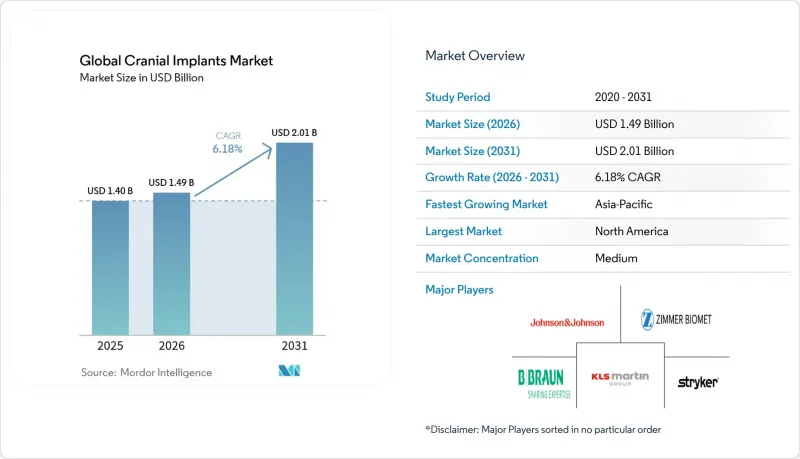
Mordor Intelligence에 의하면, 두개 임플란트 시장 규모는 2025년 14억 달러에서 2026년에는 14억 9,000만 달러로 확대되어 2026년부터 2031년까지 CAGR 6.18%로 성장을 지속하여, 2031년까지 20억 1,000만 달러에 이를 것으로 예측됩니다.
본 보고서는 소재별(티타늄, 폴리에테르에테르케톤(PEEK) 등), 기술별(3D 프린팅 임플란트, CAD/CAM 절삭 임플란트 등), 최종 사용자별(병원, 전문 신경외과 센터 등) 및 지역별(북미, 유럽, 아시아태평양, 중동 및 아프리카, 남미)로 분류되어 있습니다. 본 보고서에서는 상기 각 부문 시장 규모(달러)를 제시하고 있습니다.
전 세계 두개 임플란트 시장 동향 및 인사이트
두부 외상 및 뇌신경외과 수술 발생률 증가
세계적으로 매년 약 6,900만 건의 외상성 뇌손상이 발생하고 있으며, 중증 사례의 경우 종종 두개골 성형술을 통한 재건이 필요합니다. 고령화, 자동차 보유 대수 증가, 조직적인 스포츠 활동의 확대가 임상적 부담을 가중시키고 있습니다. 신경 보호에 관한 국방 연구도 수요를 더욱 확대시키고 있으며, 군의관들은 전장에서의 부상에 대해 신뢰성이 높은 합성 플레이트를 요구하고 있습니다. 병원 차원에서는 전문 신경 외상 센터가 복잡한 사례를 일원적으로 수용함으로써 대량 공급업체에게 예측 가능한 조달 주기가 형성되고 있습니다. 외상 발생률은 경기 순환과의 상관관계가 약하기 때문에 두개 임플란트 시장은 ‘디펜시브 헬스케어’의 지위를 누리고 있으며, 이는 제조업체와 의료 시스템 양측 모두의 장기적인 계획을 뒷받침하고 있습니다.
환자 맞춤형 임플란트를 위한 3D 프린팅의 발전
적층 가공 기술을 통해 획일적인 치료에서 환자 개개인에 맞춘 재건술로 변혁이 진행되고 있습니다. 2024년 3D Systems사의 PEEK 재질 두개골 플레이트가 FDA 승인을 획득한 것은 고분자계 적층 가공 임플란트의 규제상 실현 가능성을 입증한 것이었습니다. 현재 외과의사는 클라우드 기반 설계 도구를 활용해 CT 데이터를 몇 분 만에 인쇄 가능한 파일로 변환할 수 있게 되었으며, 이는 수술 시간과 마취 시간 단축으로 이어지고 있습니다. 병원 측은 입원 일수 단축과 환자 만족도 지수 향상을 근거로 보험사와의 협상에서 우위를 점할 수 있게 되었습니다. 한편, 절삭 가공으로는 실현할 수 없었던 격자형 충진 구조나 두께가 가변적인 벽이 일상화되면서, 무게 경감과 생체역학적 응력 경로의 최적화가 진행되고 있습니다. 인공지능과 자사 소유의 프린터를 결합한 공급업체는 경쟁 우위를 더욱 공고히 하고 있는 반면, 기존의 기계 가공 공장은 상품화(commoditization)의 위험에 직면해 있습니다.
신흥국에서의 뇌신경외과 인프라 확대
중국의 의료 개혁에서는 2030년까지 1조 4,000억 달러를 2급 도시의 외상 치료 거점을 포함한 신규 시설 건설에 투입할 방침을 밝혔습니다(중국 국가위생건강위원회). 인도의 ‘국가 의료기기 정책’은 연평균 15% 성장을 목표로 하며, 현지 임플란트 생산을 위한 합작 투자를 장려하고 있습니다(인도 정부). 수술 중 영상 진단이 지역 병원에도 보급됨에 따라, 외과의사들은 경력 초기 단계부터 고도의 두개골 성형술 기술을 도입하고 있습니다. 동남아시아에서 민간 건강보험이 점진적으로 확대됨에 따라 비용 측면의 장벽이 더욱 완화되어, 두개 임플란트 시장은 주요 대도시권을 넘어 확장되고 있습니다.
부문 분석
2025년, 티타늄 제품은 두개 임플란트 시장 점유율의 52.14%를 차지하며, 임상 현장에서 확고한 수용을 받고 있음을 입증하고 있습니다. 이 부문은 외과의사의 풍부한 사용 경험과 뛰어난 기계적 강도 대 중량비라는 장점에 힘입고 있습니다. 한편, PEEK는 가장 빠르게 성장하고 있는 소재로, 방사선과 의사들이 그 선명한 영상 품질을 높이 평가함에 따라 연평균 성장률(CAGR) 7.02%를 기록하며 성장하고 있습니다. 매출 측면에서 볼 때, FDA 승인을 받은 환자별 솔루션에 힘입어 2031년까지 두개 임플란트 시장에서 PEEK의 점유율은 꾸준히 확대될 것으로 전망됩니다.
PEEK 쉘 내에 티타늄 메쉬를 삽입한 하이브리드 구조체는 방사선 투과성을 유지하면서 스트레스 실드를 경감하기 때문에 완전한 폴리머 임플란트에 신중한 외과의사들에게 타협점으로서의 선택지를 제공합니다. PMMA는 단가가 저렴하여 자원이 부족한 환경에서 틈새 시장을 유지하고 있는 반면, 흡수성 폴리머는 임플란트 수술 후에도 두개골 성장이 지속되는 소아 사례에서 주목받고 있습니다. 첨단 표면 텍스처링 기술과 플라즈마 코팅 기술을 통해 모든 소재에서 골 유착이 촉진되고 있으며, 이로 인해 성능 격차가 줄어들고 두개 임플란트 시장 내 경쟁이 격화될 가능성이 있습니다.
지역별 분석
북미는 메디케어의 적용 범위와 하이엔드 영상 진단 시스템의 도입 실적을 바탕으로 2025년 매출의 40.78%를 차지했습니다. 메이요 클리닉(Mayo Clinic)이나 존스 홉킨스 대학(Johns Hopkins University)과 같은 학술 거점은 혁신의 인큐베이터 역할도 수행하며, 두개골 성형술에 증강현실(AR) 내비게이션의 조기 도입을 가속화하고 있습니다. 그러나 지불 기관의 압력이 높아짐에 따라 정가 인상은 억제되고 있으며, 공급업체들은 재수술률을 입증할 수 있는 수준으로 낮춤으로써 높은 가격 책정의 정당성을 입증해야만 하는 상황에 처해 있습니다.
아시아태평양은 중국과 인도에서 수십억 달러 규모의 공립 병원 건설에 힘입어 연평균 성장률(CAGR) 8.31%로 가장 빠르게 성장하고 있는 지역입니다. 의료기기 승인 절차의 효율화와 현지 생산에 대한 우대 조치로 인해 다국적 기업과 국내 진출기업 모두 시장에서 출시까지 걸리는 기간이 단축되고 있습니다. 일본과 한국은 수술용 로봇 보급률에서 선두를 달리고 있으며, 임플란트의 정밀한 적합성과 합병증 발생률 감소라는 선순환을 만들어내고 있습니다. 가구 소득 증가와 민간 보험의 보급으로 인해 선택적 두개골 성형술을 더 쉽게 받을 수 있게 되어, 두개 임플란트 시장의 성장세가 유지되고 있습니다.
유럽에서는 의료기기 규정(MDR)으로 인해 규정 준수 비용이 증가함에 따라, 꾸준하기는 하지만 성장 속도가 둔화되고 있습니다. 독일과 프랑스는 근거 기반 조달을 주도하고 있으며, 판매업체에 대해 종단적 치료 성과 데이터 제출을 의무화하고 있습니다. 의료 기록의 디지털화가 널리 진행되고 있는 북유럽 국가들에서는 단일 지불자 제도를 통해 국가 차원에서 실제 임상적 가치를 평가할 수 있기 때문에 환자 맞춤형 임플란트가 급속히 보급되고 있습니다. 중동 및 걸프 국가에서는 의료 관광 프로그램이 프리미엄 임플란트 수요를 뒷받침하고 있는 반면, 아프리카 시장은 여전히 발전 단계에 있지만 국제적인 외상 치료 이니셔티브의 혜택을 받고 있습니다. 종합적으로 볼 때, 이러한 지역별 미묘한 차이로 인해 두개 임플란트 시장에서 사업을 전개하는 기업들은 각 지역에 맞춘 시장 진출 전략을 수립해야 합니다.
기타 혜택:
- 엑셀 형식 시장 예측(ME) 시트
- 3개월간의 애널리스트 지원
자주 묻는 질문
목차
제1장 서론
제2장 조사 방법
제3장 주요 요약
제4장 시장 구도
제5장 시장 규모와 성장 예측
제6장 경쟁 구도
제7장 시장 기회와 향후 전망
JHS 26.09.07According to Mordor Intelligence, the cranial implants market size is expected to grow from USD 1.40 billion in 2025 to USD 1.49 billion in 2026 and is forecast to reach USD 2.01 billion by 2031 at 6.18% CAGR over 2026-2031.
This report is Segmented by Material (Titanium, Polyether-Ether-Ketone (PEEK) and More), by Technology (3-D Printed Implants, CAD/CAM-Milled Implants and More), by End-User (Hospitals, Specialty Neurosurgery Centers and More), and Geography (North America, Europe, Asia-Pacific, Middle East and Africa, and South America). The Report Offers the Value (in USD) for the Above Segments.
Global Cranial Implants Market Trends and Insights
Rising Incidence of Cranial Trauma & Neurosurgical Procedures
Worldwide, roughly 69 million traumatic brain injuries occur each year, and severe cases often necessitate cranioplasty reconstruction. Aging populations, higher motor-vehicle density, and organized sports elevate the clinical burden. Defense research into neuro-protection further amplifies demand as military surgeons require dependable synthetic plates for battlefield injuries. At the hospital level, dedicated neuro-trauma centers consolidate complex cases, creating predictable procurement cycles for high-volume suppliers. Because trauma incidence is weakly correlated with economic cycles, the cranial implants market enjoys defensive-healthcare status that supports long-term planning by manufacturers and health systems alike.
Advancements in 3-D Printing for Patient-Specific Implants
Additive manufacturing transforms a one-size-fits-all procedure into tailored reconstruction. The 2024 FDA clearance of 3D Systems' PEEK cranial plate proved the regulatory viability of polymeric additive implants. Surgeons now access cloud-based design tools that convert CT data into a ready-to-print file in minutes, trimming operating time and anesthesia exposure. Hospitals gain negotiating leverage with insurers by citing shorter length of stay and higher patient-satisfaction indices. Meanwhile, lattice infills and variable-thickness walls impossible in milling become routine, lowering weight and optimizing biomechanical stress paths. Suppliers that combine artificial intelligence with in-house printers are building widening competitive moats while legacy machine shops face commoditization risk.
Expanding Neurosurgical Infrastructure in Emerging Economies
China's healthcare reform earmarks USD 1.4 trillion through 2030 for new facilities, including trauma hubs in tier-2 cities National Health Commission of China. India's National Medical Devices Policy targets 15% annual growth and encourages joint ventures for localized implant production Government of India. As intraoperative imaging reaches community hospitals, surgeons adopt advanced cranioplasty techniques earlier in their careers. Gradual expansion of private health insurance in Southeast Asia further softens cost barriers, broadening the cranial implants market beyond major metropolitan centers.
Other drivers and restraints analyzed in the detailed report include:
- Superior Clinical Outcomes of Titanium & PEEK Implants
- High Cost & Limited Reimbursement for Customized Implants
- Post-Operative Infection Leading to Implant Removal
For complete list of drivers and restraints, kindly check the Table Of Contents.
Segment Analysis
Titanium held 52.14% of cranial implants market share in 2025, underscoring its entrenched clinical acceptance. The segment benefits from abundant surgeon familiarity and favorable mechanical strength-to-weight ratios. PEEK, however, is the fastest-expanding material, advancing at a 7.02% CAGR as radiologists favor its imaging clarity. In revenue terms, PEEK's portion of the cranial implants market size is forecast to widen steadily through 2031, propelled by FDA-cleared patient-specific solutions.
Hybrid constructs that embed titanium meshes inside PEEK shells mitigate stress shielding while preserving radiolucency, offering a middle path for surgeons wary of fully polymer implants. PMMA retains a niche in low-resource settings because of low unit cost, while resorbable polymers gather interest for pediatric cases where skull growth continues post-implantation. Advanced surface texturing and plasma coating technologies are improving bone ingrowth across all materials, potentially blurring performance gaps and intensifying competition within the cranial implants market.
Complete Report Scope:
- By Material (Value, USD Million)
- Titanium
- Polyether-ether-ketone (PEEK)
- Polymethyl-methacrylate (PMMA)
- Hydroxy-apatite
- Other Materials
- By Technology (Value, USD Million)
- 3-D Printed Implants
- CAD/CAM-Milled Implants
- Conventional Machined Implants
- By End User (Value, USD Million)
- Hospitals
- Specialty Neurosurgery Centers
- Ambulatory Surgical Centers
- By Geography (Value, USD Million)
- North America
- United States
- Canada
- Mexico
- Europe
- Germany
- United Kingdom
- France
- Italy
- Spain
- Rest of Europe
- Asia-Pacific
- China
- India
- Japan
- South Korea
- Australia
- Rest of Asia-Pacific
- South America
- Brazil
- Argentina
- Rest of South America
- Middle East and Africa
- GCC
- South Africa
- Rest of Middle East and Africa
- North America
Geography Analysis
North America generated 40.78% of 2025 revenue, anchored by Medicare coverage and an installed base of high-end imaging systems. Academic hubs such as Mayo Clinic and Johns Hopkins also function as innovation incubators, accelerating early adoption of augmented-reality navigation during cranioplasty procedures. Nevertheless, mounting payer pressure keeps list-price inflation in check, compelling suppliers to justify premium tariffs with demonstrable reductions in revision rates.
Asia-Pacific is the fastest-growing region at an 8.31% CAGR, propelled by multibillion-dollar public-hospital buildouts in China and India. Streamlined device-approval pathways and incentives for local production shorten time to market for both multinationals and domestic entrants. Japan and South Korea lead surgical robotics penetration, fostering a virtuous cycle of precise implant fit and lower complication rates. Rising household incomes and broader private-insurance availability make elective cranioplasty more accessible, sustaining momentum in the cranial implants market.
Europe exhibits steady but slower growth as the Medical Device Regulation raises compliance costs. Germany and France spearhead evidence-based procurement, obliging sellers to produce longitudinal outcome data. Nordic countries, which have digitized health records extensively, adopt patient-specific implants quickly because their single-payer systems can evaluate real-world value at national scale. In the Middle East and Gulf states, medical-tourism programs underpin premium implant demand, while African markets remain nascent but benefit from international trauma-care initiatives. Collectively, these regional nuances demand tailored go-to-market strategies from companies active in the cranial implants market.
- Stryker
- Zimmer Biomet
- Johnson & Johnson
- Integra LifeSciences Holdings
- Medtronic
- KLS Martin Group
- Xilloc Medical B.V.
- OssDsign AB
- Renishaw plc
- B. Braun (Aesculap)
- Anatomics
- Tecomet Inc.
- Synimed
- OsteoMed (An Acumed Company)
- Evonik Industries
- CranioTech Inc.
- ADEOR medical AG
Additional Benefits:
- The market estimate (ME) sheet in Excel format
- 3 months of analyst support
TABLE OF CONTENTS
1 Introduction
- 1.1 Study Assumptions & Market Definition
- 1.2 Scope of the Study
2 Research Methodology
3 Executive Summary
4 Market Landscape
- 4.1 Market Overview
- 4.2 Market Drivers
- 4.2.1 Rising incidence of cranial trauma & neurosurgical procedures
- 4.2.2 Advancements in 3-D printing for patient-specific implants
- 4.2.3 Superior clinical outcomes of titanium & PEEK implants
- 4.2.4 Expanding neurosurgical infrastructure in emerging economies
- 4.2.5 Augmented-reality assisted implant positioning (under-reported)
- 4.2.6 Military neuro-protection R&D boosting bioceramic adoption (under-reported)
- 4.3 Market Restraints
- 4.3.1 High cost & limited reimbursement for customized implants
- 4.3.2 Post-operative infection leading to implant removal
- 4.3.3 Regulatory ambiguity for bio-resorbable scaffold materials (under-reported)
- 4.3.4 Supply-chain risk for medical-grade PEEK resin (under-reported)
- 4.4 Value / Supply-Chain Analysis
- 4.5 Regulatory Landscape
- 4.6 Technological Outlook
- 4.7 Porter's Five Forces
- 4.7.1 Threat of New Entrants
- 4.7.2 Bargaining Power of Suppliers
- 4.7.3 Bargaining Power of Buyers
- 4.7.4 Threat of Substitutes
- 4.7.5 Competitive Rivalry
5 Market Size & Growth Forecasts
- 5.1 By Material (Value, USD Million)
- 5.1.1 Titanium
- 5.1.2 Polyether-ether-ketone (PEEK)
- 5.1.3 Polymethyl-methacrylate (PMMA)
- 5.1.4 Hydroxy-apatite
- 5.1.5 Other Materials
- 5.2 By Technology (Value, USD Million)
- 5.2.1 3-D Printed Implants
- 5.2.2 CAD/CAM-Milled Implants
- 5.2.3 Conventional Machined Implants
- 5.3 By End User (Value, USD Million)
- 5.3.1 Hospitals
- 5.3.2 Specialty Neurosurgery Centers
- 5.3.3 Ambulatory Surgical Centers
- 5.4 By Geography (Value, USD Million)
- 5.4.1 North America
- 5.4.1.1 United States
- 5.4.1.2 Canada
- 5.4.1.3 Mexico
- 5.4.2 Europe
- 5.4.2.1 Germany
- 5.4.2.2 United Kingdom
- 5.4.2.3 France
- 5.4.2.4 Italy
- 5.4.2.5 Spain
- 5.4.2.6 Rest of Europe
- 5.4.3 Asia-Pacific
- 5.4.3.1 China
- 5.4.3.2 India
- 5.4.3.3 Japan
- 5.4.3.4 South Korea
- 5.4.3.5 Australia
- 5.4.3.6 Rest of Asia-Pacific
- 5.4.4 South America
- 5.4.4.1 Brazil
- 5.4.4.2 Argentina
- 5.4.4.3 Rest of South America
- 5.4.5 Middle East and Africa
- 5.4.5.1 GCC
- 5.4.5.2 South Africa
- 5.4.5.3 Rest of Middle East and Africa
- 5.4.1 North America
6 Competitive Landscape
- 6.1 Market Concentration
- 6.2 Market Share Analysis
- 6.3 Company Profiles (includes Global level Overview, Market level overview, Core Segments, Financials as available, Strategic Information, Market Rank/Share for key companies, Products & Services, and Recent Developments)
- 6.3.1 Stryker Corporation
- 6.3.2 Zimmer Biomet Holdings Inc.
- 6.3.3 DePuy Synthes (Johnson & Johnson)
- 6.3.4 Integra LifeSciences Holdings
- 6.3.5 Medtronic plc
- 6.3.6 KLS Martin Group
- 6.3.7 Xilloc Medical B.V.
- 6.3.8 OssDsign AB
- 6.3.9 Renishaw plc
- 6.3.10 B. Braun (Aesculap)
- 6.3.11 Anatomics Pty Ltd
- 6.3.12 Tecomet Inc.
- 6.3.13 Synimed
- 6.3.14 OsteoMed (An Acumed Company)
- 6.3.15 Evonik Industries AG
- 6.3.16 CranioTech Inc.
- 6.3.17 ADEOR medical AG
7 Market Opportunities & Future Outlook
- 7.1 White-space & Unmet-Need Assessment


