

|
시장보고서
상품코드
2123521
생세포 캡슐화 시장 : 점유율 분석, 업계 동향과 통계, 성장 예측(2026-2031년)Live Cell Encapsulation - Market Share Analysis, Industry Trends & Statistics, Growth Forecasts (2026 - 2031) |
||||||
 Mordor Intelligence
Mordor Intelligence에 의하면, 생세포 캡슐화 시장 규모는 2025년 2억 3,605만 달러에서 2026년에는 2억 4,464만 달러로 확대되어 2026년부터 2031년까지 CAGR 3.64%로 성장을 지속하여, 2031년에는 2억 9,248만 달러에 이를 것으로 예측됩니다.
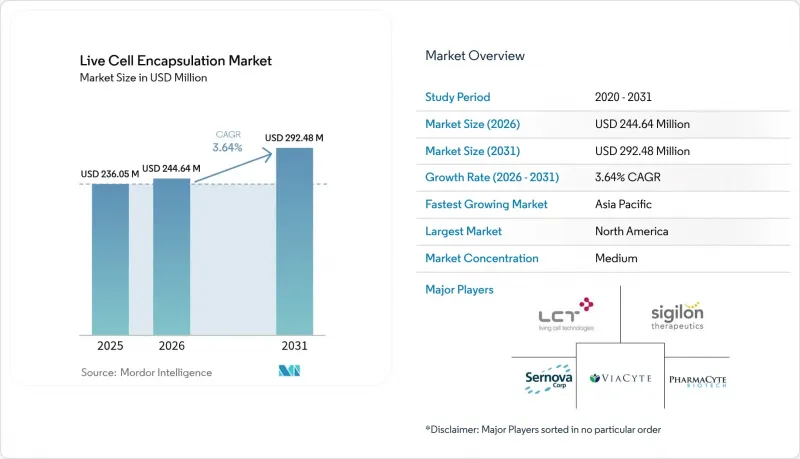
본 보고서는 제조 기술(간이 적하법 등), 폴리머 유형(알긴산염 등), 용도(약물 전달 등), 세포 출처(자가 유래 등), 캡슐화 규모(마이크로캡슐화 등), 최종 사용자(바이오의약품·바이오기술 기업 등), 지역(북미 등)별로 분류되어 있습니다. 시장 예측은 금액(달러) 기준으로 제시되어 있습니다.
전 세계 생세포 캡슐화 시장 동향 및 인사이트
바이오기술 연구에 대한 민관 투자 확대
벤처 캐피털과 전략적 자본이 세포 기반 플랫폼에 지속적으로 유입되고 있습니다. Formation Bio는 2024년 시리즈 D 라운드에서 3억 7,200만 달러를 조달했으며, Vertex는 TreeFrog Therapeutics와 잠재적 마일스톤 보상을 포함해 2억 1,500만 달러 규모의 라이선스 계약을 체결했습니다. 이러한 자금 유입으로 기업들은 개념 증명(PoC) 단계에서 임상시험 단계로 전환할 수 있게 되었으며, 그 예로 2024년에 1상 임상시험에 진입한 15건의 신규 캡슐화 세포 치료 프로그램이 있습니다. FDA의 신속 심사 지정으로 개발 주기가 8-10년에서 약 5-7년으로 단축되어 위험이 감소하는 동시에 더 많은 자본이 유입되고 있습니다. 유럽의 ‘호라이즌 유럽’ 보조금은 민간 자금을 보완하는 한편, 아시아태평양 국가들은 세금 환급 및 실험실 공간 지원을 통해 추가적인 인센티브를 제공합니다. 이러한 노력들이 결합되어 연구 개발 파이프라인을 활성화하고, 여러 대륙에 걸쳐 제조 거점을 확대함으로써 생세포 캡슐화 시장을 성장시키고 있습니다.
만성 질환 및 퇴행성 질환의 부담 증가
110만 명 이상의 미국인이 1형 당뇨병을 앓고 있으며, 이는 면역 보호 캡슐을 활용한 β세포 대체 요법에 대한 강력한 근거가 되고 있습니다. 노화성 황반변성은 이미 전 세계 1억 9,600만 명에게 영향을 미치고 있어, NT-501이 현재 해결하고자 하는 미충족 의료 수요를 여실히 드러내고 있습니다. 고소득 국가에서 만성 질환의 치료비는 연간 3조 8,000억 달러를 초과하고 있어, 의료 제도에서는 평생에 걸친 치료를 대체할 수 있는 일회성 투여나 투여 빈도가 적은 세포 치료법에 대한 평가가 점점 더 활발히 진행되고 있습니다. 인구 고령화와 생활 방식의 변화가 이러한 압박을 더욱 가중시키고 있어, 내분비계, 안과, 신경퇴행성 질환을 적응증으로 하는 캡슐화 세포 제품의 목표 고객층이 확대되고 있습니다. 질환 유병률이 높아짐에 따라 지속적인 효과나 치유를 약속하는 치료법에 대한 보험사의 보상 의지도 높아지고 있으며, 이에 따라 생세포 캡슐화 시장의 수익 전망도 확대되고 있습니다.
의약품 등급 생체 재료의 입수 어려움
캡슐화용 알긴산염 또는 키토산의 FDA·EMA 기준을 충족하는 공급업체는 전 세계적으로 불과 십여 개사에 불과하며, 그 결과 리드 타임이 6-8주로 길어지고 가격이 15-20% 비싸지고 있습니다. 원자재가 완제품 비용의 25-30%를 차지하기 때문에 공급 차질은 생세포 캡슐화 시장 전체로 파급될 가능성이 있습니다. 아시아태평양에 지리적으로 집중되어 있어 운송비와 환율 위험이 발생합니다. 위험을 완화하기 위해 많은 개발 기업이 이중 공급원 전략을 채택하거나 사내 정제 라인에 투자하고 있지만, 새로운 생산 능력이 즉시 가동되는 것은 아닙니다. 그때까지는 원자재 부족이 당분간 시장 확대의 걸림돌로 남아 있을 것입니다.
부문 분석
생세포 캡슐화 시장은 여전히 정전기적 분사법에 의존하고 있으며, 이 기술은 정밀한 액적 형성 및 오랜 기간 규제 당국으로부터 인정받아 온 점 덕분에 2025년 매출의 38.12%를 차지했습니다. GMP 준수 제조 공정에서는 안과용 및 내분비계 임플란트의 투여량 균일성 사양을 충족하는 좁은 캡슐 직경 범위가 입증되었습니다. 그러나 노즐 1개당 처리 능력은 여전히 중간 수준에 머물러 있어, 제조업체들은 생산량을 늘리기 위해 멀티 노즐 어레이를 도입하거나 회전 디스크 피더와 결합할 수밖에 없습니다. GMP 등급의 정전식 장비 1대당 설비 투자액은 50만 달러를 초과하며, 무균 상태를 유지하기 위해서는 각 장비에 HEPA 필터가 장착된 아이솔레이터와 자동 배지 교환 장치가 여전히 필요합니다.
CAGR 5.12%로 발전하고 있는 회전 디스크식 분무화는 3-5배 높은 처리량을 실현하고 있어, 대량 생산되는 프로바이오틱스 및 기능성 식품 라인에 큰 이점이 됩니다. 균일한 원심력을 통해 200µm 미만의 캡슐 직경을 실현하면서도 90% 이상의 생존율을 유지합니다. 각 제조업체는 인라인 이미징을 통합하여 액적 크기를 실시간으로 검증하고 있으며, 이를 통해 신속한 시정 조치가 가능해져 불량률 감소로 이어지고 있습니다. 단순한 적하법은 설비 비용이 저렴하여 학술 분야에서는 여전히 널리 사용되고 있지만, 임상 제조에의 채택은 제한적입니다. 한편, 동축 기류법이나 초음파법은 특히 음료 용도에서 섬세한 균주에 초저 전단력이 필요한 상황에서 주목을 받고 있습니다. 마이크로플루이딕스 기술은 현재 틈새 분야이지만, 유닛당 경제성이 향상된다면 환자 맞춤형 치료에 획기적인 정밀도를 가져다줄 것으로 기대됩니다.
알긴산염은 수십 년에 걸친 임상 데이터와 예측 가능한 겔화 동역학에 힘입어 2025년에는 42.05%의 시장 점유율을 차지했습니다. 칼슘에 의한 가교 형성으로 공정 검증이 용이하며, GMP 준수 정제 공정이 문서화되어 있다면 규제 당국도 불순물 프로파일에 대해 문제 삼지 않습니다. 그러나 알긴산염 배치는 해조류 수확 상황에 따라 편차가 있어 점도 변동이 발생하므로 공정 제어가 복잡해지고 있습니다. 현재 각 제조업체는 로트 간 편차를 줄이고 치료 효과의 일관성을 확보하기 위해 인라인 레오미터를 도입하고 기계적 안정제를 첨가하고 있습니다.
황산 셀룰로오스는 뛰어난 인장 강도와 약물의 방출 기간을 수 주에서 수 개월까지 연장할 수 있는 제어 가능한 다공성을 갖추고 있어, 연평균 성장률(CAGR) 6.39%를 기록하며 가장 빠르게 성장하는 폴리머입니다. 식물 유래이기 때문에 재생 가능한 조달이 가능하며, 주요 제약 기업들이 연례 보고서에서 공표하는 ESG 목표와도 부합합니다. 하이브리드 매트릭스는 알긴산과 나노셀룰로오스 또는 키토산을 결합하여 췌장이나 망막 이식에 적합한 확산 속도를 조절하는 것입니다. 실리카 기반 제제는 시장 점유율이 그리 크지는 않지만, 고온 분무 건조와 같은 가혹한 가공 환경에 대응하는 것을 목적으로 합니다. 또한, 합성 생분해성 폴리머 역시 시간 제어된 분해가 치료상의 종결점과 일치하는 특수한 틈새 시장을 차지하고 있습니다. 따라서 폴리머 선정은 원자재 비용보다 적응증별 요구 사항에 따라 좌우되기 때문에 생세포 캡슐화 시장 내에서는 다양한 상황이 발생하고 있습니다.
지역별 분석
2025년, 북미는 매출 점유율 43.12%를 유지했습니다. 이 지역의 견고한 벤처 생태계 덕분에 자본은 보스턴의 켄들 스퀘어, 샌프란시스코 베이 지역, 노스캐롤라이나주의 리서치 트라이앵글에 집중되고 있습니다. FDA의 ‘브레이크스루(Breakthrough)’ 및 ‘RMAT’ 절차는 임상 현장에서의 조기 도입을 촉진하고 있으며, NT-501의 환급 마일스톤은 임상 결과가 평가 지표를 충족할 경우, 지불 주체가 봉입 세포 치료 비용을 부담할 의사가 있음을 뒷받침하고 있습니다. 주(州)를 넘나드는 협력을 통해 물류, 디지털 배치 기록, 실시간 출하 전 검사가 효율화되었으며, 이 모든 요소가 어우러져 국내 시장 진출 리드타임을 단축하고 있습니다.
아시아태평양은 가장 빠르게 성장하는 시장으로, 2031년까지 연평균 성장률(CAGR)이 4.55%를 나타낼 것으로 예측됩니다. 중국에서는 임상 비용을 보전해 주는 정책적 우대 조치와 지방 자치단체의 보조금 덕분에 전 세계 세포 및 유전자 치료 임상시험의 37%가 수행되고 있습니다. 지방 자치단체가 인프라 구축에 자금을 지원하는 한편, 쑤저우와 상하이의 수탁 제조업체(CMO)는 인건비를 낮게 유지하면서도 ISO·cGMP 인증을 유지하고 있습니다. 일본의 ‘기능성 식품’ 제도는 프로바이오틱스 수요를 뒷받침하고 있으며, 한국은 폐쇄형 바이오프로세스에 보조금을 투입하고 있습니다. 인도의 제약 생태계는 공급량을 확대하여 배지 성분과 일회용 어셈블리를 경쟁력 있는 가격으로 공급하고 있습니다. 비용 측면의 우위와 만성 질환 유병률의 상승이 맞물려, 아시아태평양 전체에서 생세포 캡슐화 시장 규모가 확대되고 있습니다.
유럽은 성숙하면서도 혁신 주도형 환경을 보이고 있습니다. EMA(유럽의약품청)의 집중 심사는 27개 회원국을 포괄하지만, 브렉시트 이후 제도 차이로 인해 영국에 대한 신청은 중복하여 진행해야 하므로 행정적 부담이 발생하고 있습니다. 독일, 프랑스, 북유럽 국가들은 셀룰로오스 기반 캡슐화 소재 개발을 촉진하는 지속가능성 이니셔티브를 지원하고 있으며, 산업 정책을 ESG 촉진요인과 연계하고 있습니다. 산학 컨소시엄은 ‘호라이즌 유럽’ 자금을 활용하여 저탄소 제조 워크플로우를 개발하고 있으며, 이는 그린 바이오프로세싱에 대한 지역의 중점을 반영하고 있습니다. 성장 속도는 아시아태평양만큼 빠르지는 않지만, 유럽의 엄격한 품질 기준과 강력한 구매력 덕분에 생세포 캡슐화 시장은 계속해서 수익성이 높은 시장으로 남아 있습니다.
다른 지역에서는 남미, 중동 및 아프리카가 여전히 시장이 형성되는 단계이지만, 두 자릿수 성장 가능성을 보이고 있습니다. 브라질 ANVISA의 첨단 의료에 관한 지침, 사우디아라비아의 ‘비전 2030’에 따른 의료 분야 투자, 그리고 남아프리카공화국이 바이오 제조 허브가 되려는 목표 등은 모두 미래 수요를 시사합니다. 그러나 콜드체인 인프라의 부족과 보험 환급의 불확실성으로 인해, 현 시점에서는 시장 규모 확대가 제약받고 있습니다. 중기적으로는 기술 이전 협정 및 다자간 금융을 통해 해당 지역에서의 추가적인 보급이 촉진되어, 전 세계 생세포 캡슐화 시장에 추가적인 수익을 가져다줄 가능성이 있습니다.
기타 혜택:
- 엑셀 형식 시장 예측(ME) 시트
- 3개월간의 애널리스트 지원
자주 묻는 질문
목차
제1장 서론
제2장 조사 방법
제3장 주요 요약
제4장 시장 구도
제5장 시장 규모와 성장 예측
제6장 경쟁 구도
제7장 시장 기회와 향후 전망
JHS 26.09.09According to Mordor Intelligence, the live cell encapsulation market size is expected to grow from USD 236.05 million in 2025 to USD 244.64 million in 2026 and is forecast to reach USD 292.48 million by 2031 at 3.64% CAGR over 2026-2031.
This report is Segmented by Manufacturing Technique (Simple Dripping, and More), Polymer Type (Alginate, and More), Application (Drug Delivery, and More), Cell Source (Autologous, and More), Encapsulation Scale (Micro-Encapsulation, and More), End User (Biopharma & Biotech Firms, and More), Geography (North America, and More). The Market Forecasts are Provided in Terms of Value (USD).
Global Live Cell Encapsulation Market Trends and Insights
Growing Public-Private Investments in Biotechnology Research
Venture and strategic capital continue to pour into cell-based platforms. Formation Bio raised USD 372 million in a 2024 Series D round, and Vertex inked a license with TreeFrog Therapeutics featuring USD 215 million in potential milestones. This influx of funds helps companies shift from proof-of-concept to clinical execution, exemplified by 15 new encapsulated-cell therapy programs that entered Phase I in 2024. The FDA's expedited designations cut development cycles from 8-10 years to roughly 5-7 years, reducing risk and drawing more capital. Europe's Horizon Europe grants complement private money, while Asia-Pacific countries sweeten the pot with tax rebates and subsidized lab space. Taken together, these initiatives enlarge the live cell encapsulation market by fueling R&D pipelines and expanding manufacturing footprints in multiple continents.
Rising Burden of Chronic and Degenerative Diseases
More than 1.1 million Americans live with Type 1 diabetes, creating a strong rationale for beta-cell replacement solutions that leverage immune-protected capsules. Age-related macular degeneration already affects 196 million people worldwide, underscoring the unmet need that NT-501 now addresses. Chronic-care expenditures exceed USD 3.8 trillion annually in high-income nations, so health systems increasingly evaluate cell therapies that might offer one-time or infrequent dosing in lieu of lifelong regimens. Demographic aging and lifestyle shifts amplify these pressures, expanding target populations for encapsulated-cell products aimed at endocrine, ophthalmic and neurodegenerative indications. As disease prevalence rises, so does payer willingness to reimburse therapies that promise durable or curative outcomes, thereby increasing the revenue horizon for the live cell encapsulation market.
Limited Availability of Pharmaceutical-Grade Biomaterials
Only about a dozen suppliers worldwide meet FDA and EMA standards for encapsulation-grade alginate or chitosan, leading to 6-8 week lead times and price premiums of 15-20%. Supply disruptions can ripple across the live cell encapsulation market because raw materials account for 25-30% of finished-goods cost. Geographic concentration in Asia-Pacific adds freight and currency exposure. To mitigate risk, many developers are adopting dual-source strategies or investing in in-house purification lines, but new capacity won't come online quickly. Until then, raw-material scarcity remains a near-term drag on expansion.
Other drivers and restraints analyzed in the detailed report include:
- Advancements in Biomaterials and Encapsulation Technologies
- Supportive Regulatory Pathways for Advanced Cell-Based Therapies
- High Development and Manufacturing Costs
For complete list of drivers and restraints, kindly check the Table Of Contents.
Segment Analysis
The live cell encapsulation market continues to rely on electrostatic dripping, which captured 38.12% revenue in 2025 thanks to precision droplet formation and long-standing regulatory familiarity. GMP runs demonstrate narrow capsule-diameter ranges that satisfy dose-uniformity specifications for ocular and endocrine implants. However, throughput per nozzle remains moderate, compelling manufacturers to deploy multi-nozzle arrays or hybridize with rotating disk feeders to raise volume. Capital outlays per GMP-grade electrostatic unit top USD 500,000, and each unit still needs HEPA-filtered isolators and automated media exchanges to maintain sterility.
Rotating disk atomization, advancing at a 5.12% CAGR, offers three- to five-fold higher throughput, an advantage for high-volume probiotics and functional-food lines. Uniform centrifugal forces yield capsule diameters under 200 µm while maintaining >= 90% viability. Producers integrate inline imaging to verify droplet size in real time, allowing rapid corrective actions and lower scrap rates. Simple dripping persists in academic settings because equipment costs are low, though its adoption in clinical manufacturing remains limited. Meanwhile, coaxial airflow and ultrasonic methods find traction where delicate strains require ultra-low shear, especially in beverage applications. Microfluidics, while currently a niche, promises disruptive precision for patient-specific therapies once unit economics improve.
Alginate held 42.05% market share in 2025, bolstered by decades of clinical data and predictable gelation kinetics. Calcium-crosslinking makes process validation straightforward, and regulators are comfortable with impurity profiles when GMP purification is documented. Nonetheless, alginate batches vary by seaweed harvest, leading to viscosity shifts that complicate process control. Producers now employ inline rheometers and add mechanical stabilizers to reduce lot-to-lot variability, thereby safeguarding therapeutic consistency.
Cellulose sulfate is the fastest-growing polymer, with a 6.39% CAGR, due to superior tensile strength and controllable porosity that extends drug release from weeks to months. Its plant origin enables renewable sourcing, aligning with ESG targets that major pharmas publicize in annual reports. Hybrid matrices combine alginate with nanocellulose or chitosan to tailor diffusion rates for pancreatic or retinal implants. Silica-based formulations-accounting for a modest share-target harsh-processing environments such as high-temperature spray drying. Synthetic biodegradable polymers also occupy specialized niches where time-controlled degradation matches therapeutic endpoints. Polymer selection is thus governed more by indication-specific needs than raw-material cost, fostering a diverse landscape within the live cell encapsulation market.
Complete Report Scope:
- By Manufacturing Technique
- Simple Dripping
- Electrostatic Dripping
- Coaxial Airflow
- Rotating Disk Atomisation
- Other Manufacturing Techniques
- By Polymer Type
- Alginate
- Chitosan
- Silica
- Cellulose Sulfate
- Other Polymer Types
- By Application
- Drug Delivery
- Regenerative Medicine
- Cell Transplantation
- Probiotics & Functional Foods
- Other Applications
- By Cell Source
- Autologous
- Allogeneic
- Xenogeneic
- Genetically-Engineered
- By Encapsulation Scale
- Micro-Encapsulation
- Macro-Encapsulation
- By End User
- Biopharma & Biotech Firms
- Academic & Research Institutes
- CROs & CMOs
- Other End Users
- Geography
- North America
- United States
- Canada
- Mexico
- Europe
- Germany
- United Kingdom
- France
- Italy
- Spain
- Rest of Europe
- Asia-Pacific
- China
- Japan
- India
- Australia
- South Korea
- Rest of Asia-Pacific
- Middle East & Africa
- GCC
- South Africa
- Rest of Middle East & Africa
- South America
- Brazil
- Argentina
- Rest of South America
- North America
Geography Analysis
North America retained 43.12% revenue share in 2025. The region's robust venture ecosystem funnels capital into Boston's Kendall Square, the San Francisco Bay Area and North Carolina's Research Triangle. The FDA's Breakthrough and RMAT pathways encourage early clinical adoption, while reimbursement milestones for NT-501 validate payers' willingness to cover encapsulated-cell therapies when clinical outcomes meet endpoints. Interstate collaborations streamline logistics, digital batch records and real-time release testing, collectively shortening lead times for domestic deployments.
Asia-Pacific is the fastest-growing territory, projected at a 4.55% CAGR to 2031. China hosts 37% of global cell- and-gene therapy trials thanks to policy incentives and provincial grants that offset clinical expenses. Local governments fund infrastructure, while contract manufacturers in Suzhou and Shanghai offer lower labor costs yet maintain ISO and cGMP certification. Japan's Foods with Function Claims regime boosts probiotic demand, and South Korea channels subsidies into closed-system bioprocessing. India's pharmaceutical ecosystem adds volume, supplying media components and single-use assemblies at competitive pricing. Cost advantages and rising chronic-disease prevalence collectively expand the live cell encapsulation market footprint across Asia-Pacific.
Europe presents a mature but innovation-driven environment. EMA's centralized review covers 27 member states, though post-Brexit divergence requires duplicated filings for the United Kingdom, introducing administrative overhead. Germany, France and the Nordic countries back sustainability initiatives that spur cellulose-based encapsulation materials, aligning industrial policies with ESG drivers. Academic-industry consortia tap Horizon Europe funding to develop low-carbon manufacturing workflows, reflecting regional emphasis on green bioprocessing. Though growth is slower than in Asia-Pacific, Europe's stringent quality standards and strong purchasing power keep the live cell encapsulation market lucrative.
Elsewhere, South America, the Middle East and Africa remain nascent but show double-digit growth potential. Brazil's ANVISA guidance on advanced therapies, Saudi Arabia's Vision 2030 healthcare investment and South Africa's aspiration to become a biomanufacturing hub all hint at future demand. However, limited cold-chain infrastructure and reimbursement uncertainty currently constrain volume. Over the medium term, technology-transfer agreements and multilateral financing could unlock further regional uptake, contributing incremental revenue to the global live cell encapsulation market.
- ViaCyte Inc.
- Living Cell Technologies Ltd.
- Sigilon Therapeutics Inc.
- Sernova Corp.
- PharmaCyte Biotech
- Neurotech Pharmaceuticals Inc.
- Blacktrace Holdings
- Buchi Labortechnik AG
- Atelerix
- Kadimastem Ltd.
- Austrianova Pte Ltd.
- Stem Cell Therapies Australia Pty
- Microfluidic ChipShop GmbH
- Sphere Fluidics Ltd.
- Merck
- 3P Innovation Ltd.
- BICO Group AB
- Corning
- Lonza Group
- Charles River
Additional Benefits:
- The market estimate (ME) sheet in Excel format
- 3 months of analyst support
TABLE OF CONTENTS
1 Introduction
- 1.1 Study Assumptions & Market Definition
- 1.2 Scope Of The Study
2 Research Methodology
3 Executive Summary
4 Market Landscape
- 4.1 Market Overview
- 4.2 Market Drivers
- 4.2.1 Growing Public-Private Investments in Biotechnology Research
- 4.2.2 Rising Burden of Chronic and Degenerative Diseases
- 4.2.3 Advancements in Biomaterials and Encapsulation Technologies
- 4.2.4 Supportive Regulatory Pathways for Advanced Cell-Based Therapies
- 4.2.5 Incorporation of Encapsulated Probiotics into Functional Foods and Beverages
- 4.2.6 Integration of Encapsulated Cells with Implantable or Wearable Delivery Devices
- 4.3 Market Restraints
- 4.3.1 Limited Availability of Pharmaceutical-Grade Biomaterials
- 4.3.2 High Development and Manufacturing Costs
- 4.3.3 Stringent Regulatory and Quality Compliance Requirements
- 4.3.4 Competition from Gene-Edited And Allogeneic Cell Therapy Alternatives
- 4.4 Regulatory Landscape
- 4.5 Porter's Five Forces Analysis
- 4.5.1 Threat Of New Entrants
- 4.5.2 Bargaining Power Of Buyers
- 4.5.3 Bargaining Power Of Suppliers
- 4.5.4 Threat Of Substitutes
- 4.5.5 Intensity Of Competitive Rivalry
5 Market Size & Growth Forecasts (Value, USD)
- 5.1 By Manufacturing Technique
- 5.1.1 Simple Dripping
- 5.1.2 Electrostatic Dripping
- 5.1.3 Coaxial Airflow
- 5.1.4 Rotating Disk Atomisation
- 5.1.5 Other Manufacturing Techniques
- 5.2 By Polymer Type
- 5.2.1 Alginate
- 5.2.2 Chitosan
- 5.2.3 Silica
- 5.2.4 Cellulose Sulfate
- 5.2.5 Other Polymer Types
- 5.3 By Application
- 5.3.1 Drug Delivery
- 5.3.2 Regenerative Medicine
- 5.3.3 Cell Transplantation
- 5.3.4 Probiotics & Functional Foods
- 5.3.5 Other Applications
- 5.4 By Cell Source
- 5.4.1 Autologous
- 5.4.2 Allogeneic
- 5.4.3 Xenogeneic
- 5.4.4 Genetically-Engineered
- 5.5 By Encapsulation Scale
- 5.5.1 Micro-Encapsulation
- 5.5.2 Macro-Encapsulation
- 5.6 By End User
- 5.6.1 Biopharma & Biotech Firms
- 5.6.2 Academic & Research Institutes
- 5.6.3 CROs & CMOs
- 5.6.4 Other End Users
- 5.7 Geography
- 5.7.1 North America
- 5.7.1.1 United States
- 5.7.1.2 Canada
- 5.7.1.3 Mexico
- 5.7.2 Europe
- 5.7.2.1 Germany
- 5.7.2.2 United Kingdom
- 5.7.2.3 France
- 5.7.2.4 Italy
- 5.7.2.5 Spain
- 5.7.2.6 Rest of Europe
- 5.7.3 Asia-Pacific
- 5.7.3.1 China
- 5.7.3.2 Japan
- 5.7.3.3 India
- 5.7.3.4 Australia
- 5.7.3.5 South Korea
- 5.7.3.6 Rest of Asia-Pacific
- 5.7.4 Middle East & Africa
- 5.7.4.1 GCC
- 5.7.4.2 South Africa
- 5.7.4.3 Rest of Middle East & Africa
- 5.7.5 South America
- 5.7.5.1 Brazil
- 5.7.5.2 Argentina
- 5.7.5.3 Rest of South America
- 5.7.1 North America
6 Competitive Landscape
- 6.1 Market Concentration
- 6.2 Market Share Analysis
- 6.3 Company Profiles (includes Global level Overview, Market level overview, Core Business Segments, Financials, Headcount, Key Information, Market Rank, Market Share, Products and Services, and analysis of Recent Developments)
- 6.3.1 ViaCyte Inc.
- 6.3.2 Living Cell Technologies Ltd.
- 6.3.3 Sigilon Therapeutics Inc.
- 6.3.4 Sernova Corp.
- 6.3.5 PharmaCyte Biotech Inc.
- 6.3.6 Neurotech Pharmaceuticals Inc.
- 6.3.7 Blacktrace Holdings Ltd.
- 6.3.8 Buchi Labortechnik AG
- 6.3.9 Atelerix Ltd.
- 6.3.10 Kadimastem Ltd.
- 6.3.11 Austrianova Pte Ltd.
- 6.3.12 Stem Cell Therapies Australia Pty
- 6.3.13 Microfluidic ChipShop GmbH
- 6.3.14 Sphere Fluidics Ltd.
- 6.3.15 Merck KGaA
- 6.3.16 3P Innovation Ltd.
- 6.3.17 BICO Group AB
- 6.3.18 Corning Incorporated
- 6.3.19 Lonza Group AG
- 6.3.20 Charles River Laboratories Inc.
7 Market Opportunities & Future Outlook
- 7.1 White-Space & Unmet-Need Assessment


