

|
시장보고서
상품코드
2123549
위장관 출혈 치료 시장 : 점유율 분석, 업계 동향과 통계, 성장 예측(2026-2031년)Gastrointestinal Bleeding Treatment - Market Share Analysis, Industry Trends & Statistics, Growth Forecasts (2026 - 2031) |
||||||
 Mordor Intelligence
Mordor Intelligence에 의하면, 2026년 위장관 출혈 치료 시장 규모는 9억 3,459만 달러로 추정되고 있어 2025년 8억 9,000만 달러에서 확대되어, 2031년에는 11억 9,000만 달러에 이를 것으로 예측됩니다.
2026년부터 2031년까지의 연평균 성장률(CAGR)은 5.01%가 될 것으로 전망됩니다.
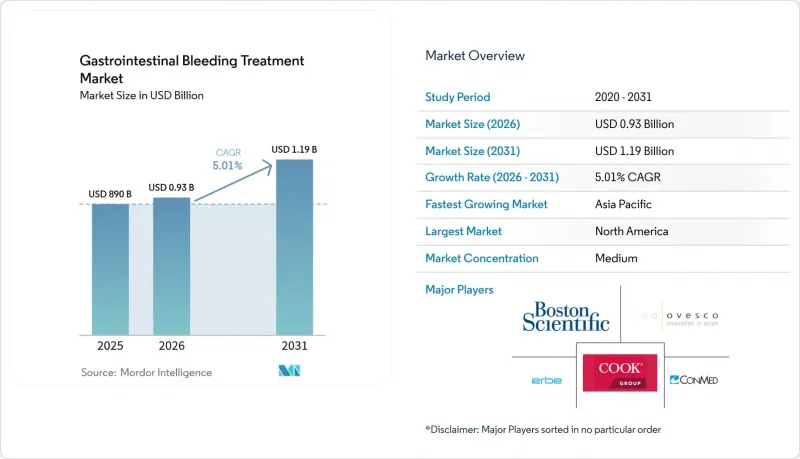
본 보고서는 제품별(내시경용 기계식 기기, 내시경용 열치료 기기, 내시경용 주입 기기 등), 소화관 부위별(상부 소화관, 소장, 하부 소화관), 최종 사용자별(병원, 외래수술센터(ASC) 등), 지역별(북미, 유럽,아시아태평양 등)으로 세분화되어 있습니다. 시장 전망은 금액(달러) 기준으로 제시되어 있습니다.
전 세계 위장관 출혈 치료 시장 동향 및 인사이트
상부 위장관 출혈 사례 발생률 증가
상부 위장관 출혈의 발생률은 성인 10만 명당 84-160건으로 유지되고 있으며, 새로운 치료법이 등장하고 있음에도 불구하고 사망률은 여전히 10%에 육박하고 있습니다. 고령층에서 항응고제 사용은 위험을 증가시키며, 임상의들은 고비용이 드는 재출혈을 방지하기 위해 첫 내시경 검사 시 병용 지혈 키트를 사용할 수밖에 없습니다. 병원에서는 신속한 지혈을 통해 외과 수술로 넘어가는 것을 피할 수 있을 때의 비용 절감 효과를 정량적으로 평가하고 있으며, 이에 따라 시술 시간을 단축하고 클립의 고정력을 높이는 기기에 대한 수요가 증가하고 있습니다. 따라서 각 제조업체는 모든 출혈 병태에 대응할 수 있도록 클립,스프레이, 주입 카테터를 모듈식 키트로 묶어 즉시 사용할 수 있는 체계를 갖추고 있습니다. 정액제 모델을 채택하는 의료기관에서는 편차를 줄이고 치료 성과 보고를 개선하기 위해, 시설 간에 이러한 키트를 표준화하는 움직임이 점점 더 확산되고 있습니다.
저침습 내시경 지혈로의 전환
현재는 내시경을 통한 클립이나 단일 채널 봉합 시스템을 통해, 과거에는 개복 수술로 넘어가야 했던 전층성 벽 결손도 봉합할 수 있게 되어, 입원 일수와 아편계 진통제 사용량이 줄어들고 있습니다. 보스턴 사이언티피크(Boston Scientific)사의 ‘OverStitch NXT’는 표준 위내시경에 연결하여 더 적은 패스 수로 봉합 패턴을 완성하므로, 바쁜 내시경실에서 환자 회전율을 높입니다. 초기 데이터에 따르면, 특히 섬유화 궤양의 경우 열응고법에 비해 30일간의 재출혈률이 낮은 것으로 나타났습니다. 그러나 기술력 격차를 해소하기 위해서는 시뮬레이션을 활용한 기술 향상이 필수적이며, 이로 인해 VR 지원 훈련 모듈이라는 병행 시장이 생겨나고 있습니다. 첨단 장비와 엄격한 자격 인증을 결합한 병원에서는 응급 이송이 감소할 뿐만 아니라, 성과 연동형 보상 계약에서의 품질 점수도 향상되고 있습니다.
신흥 시장의 숙련된 내시경 전문의 부족
아시아태평양에서는 매년 수천 개의 내시경실이 증설되고 있지만, 첨단 폐쇄 기기에 대한 훈련을 받은 인증된 인력이 부족하여 프리미엄 솔루션 도입이 지연되고 있습니다. ESGE는 연수 기간을 연장하는 객관적인 역량 평가 지표를 권장하고 있으나, 이로 인해 국가 예산에 부담이 가중되고 도시와 농촌 간의 격차가 확대되고 있습니다. 벤더 측은 간소화된 클립 적용기나 원격 지도 플랫폼으로 대응하고 있지만, 자격 인증 지연 문제는 여전히 해결되지 않고 있습니다. 그 결과, 조달 위원회는 기술자 양성 체계가 갖춰질 때까지 하이엔드 키트 구매를 미루고 있어, 저소득 국가에서의 위장관 출혈 치료 시장 성장이 둔화되고 있습니다.
부문 분석
기계식 클립은 수십 년에 걸친 임상의들의 익숙함과 여러 병변에 대응할 수 있는 범용성 덕분에 2025년 위장관 출혈 치료 시장에서 44.74%의 점유율을 차지했습니다. 이 부문은 지속적인 소형화와 고정력 강화로 인해 1건당 클립 사용 수를 줄일 수 있다는 장점이 있습니다. 국소 스프레이를 이용한 위장관 출혈 치료 시장 규모는 작지만, 분말 제제가 확산성 출혈에 대응하고 응고 상태와 관계없이 기능하기 때문에 연평균 성장률(CAGR) 11.9%로 확대되고 있습니다. 열 프로브 및 주입 카테터는 정맥류 관리에서 틈새 역할을 유지하고 있으며, 첫 번째 시술에서 지혈을 확실하게 하기 위해 조합 키트에 자주 포함되어 있습니다.
현재, 성능 지표는 삽입 속도에 초점이 맞추어져 있습니다. 보스턴 사이언티피크(Boston Scientific)사의 ‘MANTIS 클립’은 기존 제품에 비해 클립 사용량을 4개 줄이고 소요 시간을 5분 가까이 단축할 수 있어, 수술실의 여유를 확보하고 더 많은 사례를 처리할 수 있게 해줍니다. 조류 유래 생체적합성 지혈제는 면역원성을 저감시켜, 면역억제 상태의 환자군에게도 사용할 수 있게 해줍니다. 각 제조업체는 클립이 미리 장전된 회전 제어식 핸들 설계나, 하이브리드 수술 중 투시 확인을 지원하는 조영 마커 등을 통해 제품 차별화를 꾀하고 있습니다.
지역별 분석
2025년, 북미는 전 세계 매출의 40.25%를 차지했습니다. 이는 메디케어가 입원 환자 및 외래수술센터(ASC)에서의 지혈 처치를 모두 보상하고 있어 의료 제공업체의 현금 흐름이 안정적이기 때문입니다. 또한, 미국의 의료 시스템에서는 AI를 활용한 트라이아지 시범 운영이 진행되고 있으며, 이를 통해 응급 내시경 검사 대기 시간이 단축되고 조기 개입이 촉진되고 있습니다. 캐나다의 단일 지불자 제도에서는 지혈 파우더의 전국 일괄 구매에 자금이 할당되어, 균등한 접근성을 확보함과 동시에 예측 가능한 조달 주기를 실현하고 있습니다. 멕시코는 내시경 치료를 목적으로 한 국경을 넘는 의료 관광의 혜택을 받고 있으며, 특히 더 저렴한 수술을 원하는 무보험 미국인 환자들 사이에서 수요가 증가하고 있습니다.
아시아태평양은 연평균 성장률(CAGR) 8.49%로 가장 빠르게 성장하고 있으며, 이는 소화기암의 급증과 항응고제 처방 증가를 반영합니다. 중국에서는 국가 의료 개혁의 일환으로 군(郡) 수준의 병원에 투시 장치와 캡슐 내시경 판독 장비를 도입하여 설비를 확충하고 있는 반면, 일본에서는 초고령화 사회에 대응한 로봇 보조 봉합 플랫폼이 상용화되고 있습니다. 인도의 민간 병원은 보험에 가입한 중산층을 대상으로 고도의 소화기 의료 서비스를 확충하는 동시에, 걸프 지역 국가들로부터 의료 관광객을 유치하기 위해 재출혈 방지 지표에 주력하고 있습니다.
유럽에서는 연수의 표준화와 병원 컨소시엄 전체 차원의 의료기기 공동 구매를 촉진하는 ESGE 가이드라인에 힘입어 안정적인 성장이 나타나고 있습니다. 독일에서는 내시경용 클립의 외래 진료에 대한 보험 적용을 선도적으로 도입하고 있는 반면, 영국에서는 국민보건서비스(NHS)가 내세운 ‘4시간 이내 응급 대응’이라는 목표를 달성하기 위해 위장관 출혈 신속 대응 유닛의 확충이 진행되고 있습니다. 새로운 EU 의료기기 규정에 따라 승인까지의 기간은 길어졌지만, 일반 시민의 신뢰는 높아졌으며, 병원들이 CE 마크를 획득한 혁신적인 의료기기에 대한 투자를 촉진하고 있습니다.
중동 및 아프리카 및 남미 시장 점유율은 작지만, 3차 의료기관이 내시경 전용 유닛을 개설함에 따라 수량 기준으로 두 자릿수 성장을 기록하고 있습니다. 높은 수입 관세가 여전히 장벽으로 작용하고 있어, 의료기관들은 출혈 치료와 용종 절제 두 가지 이용 사례를 모두 아우르는 다목적 의료기기의 도입을 추진하고 있습니다.
기타 혜택:
- 엑셀 형식 시장 예측(ME) 시트
- 3개월간의 애널리스트 지원
자주 묻는 질문
목차
제1장 서론
제2장 조사 방법
제3장 주요 요약
제4장 시장 구도
제5장 시장 규모와 성장 예측
제6장 경쟁 구도
제7장 시장 기회와 향후 전망
JHS 26.09.07According to Mordor Intelligence, the gastrointestinal bleeding treatment market size in 2026 is estimated at USD 934.59 million, growing from 2025 value of USD 890 million with 2031 projections showing USD 1.19 billion, growing at 5.01% CAGR over 2026-2031.
This report is Segmented by Product (Endoscopic Mechanical Devices, Endoscopic Thermal Devices, Endoscopic Injection Devices, and More), GI Tract Division (Upper GI Tract, Small Bowel, and Lower GI Tract), End User (Hospitals, Ambulatory Surgical Centers, and More), and Geography (North America, Europe, Asia-Pacific, and More). The Market Forecasts are Provided in Terms of Value (USD).
Global Gastrointestinal Bleeding Treatment Market Trends and Insights
Rising Incidence Of Upper GI Bleeding Cases
Upper-GI bleeding rates remain 84-160 per 100,000 adults, with mortality still near 10% despite newer therapies. Anticoagulant uptake in aging cohorts magnifies risk and pushes clinicians to deploy combination hemostasis kits during the index endoscopy to curb costly rebleeds. Hospitals quantify savings when rapid hemostasis avoids surgical conversion, strengthening demand for devices that shorten procedure time and enhance clip retention. Manufacturers therefore package clips, sprays, and injection catheters in modular kits to ensure readiness for any bleeding phenotype. Health systems with capitated payment models increasingly standardize these kits across sites to cut variation and improve outcomes reporting.
Shift Toward Minimally-Invasive Endoscopic Hemostasis
Over-the-scope clips and single-channel suturing systems now seal full-thickness wall defects once referred for open surgery, reducing hospital days and narcotic use. Boston Scientific's OverStitch NXT connects to a standard gastroscope and completes suture patterns in fewer passes, allowing faster turnover in busy labs. Early data show lower 30-day rebleed rates relative to thermal coagulation, especially for fibrotic ulcers. The skill gap, however, necessitates simulation-based upskilling and has opened a parallel market for VR-enabled training modules. Hospitals that couple advanced tools with rigorous credentialing enjoy fewer emergency transfers and better quality scores under pay-for-performance contracts.
Shortage Of Skilled Endoscopists In Emerging Markets
Asia-Pacific adds thousands of endoscopy rooms annually, yet lacks certified staff trained in advanced closure devices, delaying uptake of premium solutions. ESGE recommends objective competence metrics that extend training cycles, placing strain on national budgets and widening urban-rural gaps. Vendors respond with simplified clip applicators and tele-mentoring platforms, but credentialing backlogs persist. Consequently, procurement committees defer purchase of high-end kits until skill pipelines mature, tempering the gastrointestinal bleeding treatment market in lower-income countries.
Other drivers and restraints analyzed in the detailed report include:
- Availability Of Next-Generation Hemostatic Clips & Sprays
- Expanding Elderly Population Using Anticoagulants
- High Cost Of Advanced Endoscopic Devices
For complete list of drivers and restraints, kindly check the Table Of Contents.
Segment Analysis
Mechanical clips held 44.74% of the gastrointestinal bleeding treatment market in 2025 thanks to decades-long clinician familiarity and multi-lesion versatility. The segment benefits from continuous miniaturization and stronger grasp forces that cut clip counts per case. The gastrointestinal bleeding treatment market size for topical sprays, though smaller, expands at a 11.9% CAGR because powders address diffuse bleeding and function regardless of coagulation status. Thermal probes and injection catheters maintain niche roles for variceal management and are frequently bundled in combination kits to guarantee first-pass hemostasis.
Performance metrics now focus on deployment speed; Boston Scientific's MANTIS clip requires 4 fewer clips and nearly 5 fewer minutes than predecessors, freeing lab capacity for additional cases. Biocompatible hemostatic agents sourced from algae reduce immunogenicity, opening use in immunosuppressed cohorts. Manufacturers differentiate via pre-loaded, rotation-controlled handle designs and radiopaque markers that aid fluoroscopic confirmation during hybrid procedures.
Complete Report Scope:
- By Product
- Endoscopic Mechanical Devices
- Endoscopic Thermal Devices
- Endoscopic Injection Devices
- Topical Hemostatic Sprays
- Combination Therapy Kits
- Other Products
- By GI Tract Division
- Upper GI Tract
- Small Bowel / Mid GI Tract
- Lower GI Tract
- By End User
- Hospitals / Clinics
- Ambulatory Surgical Centers
- Specialized GI Centers
- Diagnostic Laboratories
- Other End Users
- Geography
- North America
- United States
- Canada
- Mexico
- Europe
- Germany
- United Kingdom
- France
- Italy
- Spain
- Rest of Europe
- Asia-Pacific
- China
- Japan
- India
- South Korea
- Australia
- Rest of Asia-Pacific
- Middle East and Africa
- GCC
- South Africa
- Rest of Middle East and Africa
- South America
- Brazil
- Argentina
- Rest of South America
- North America
Geography Analysis
North America generated 40.25% of global revenue in 2025 because Medicare reimburses both inpatient and ASC-based hemostasis, stabilizing cash-flows for providers. U.S. health systems also pilot AI-guided triage that decreases emergency endoscopy wait times and promotes early intervention. Canada's single-payer framework funds national bulk buys of hemostatic powders, ensuring uniform access and driving predictable procurement cycles. Mexico benefits from cross-border medical tourism for endoscopic treatment, particularly among uninsured U.S. patients seeking lower procedure costs.
Asia-Pacific is the fastest-growing region at 8.49% CAGR, reflecting a sharp rise in gastrointestinal cancers and anticoagulant prescriptions. China upgrades county-level hospitals with fluoroscopy suites and capsule endoscopy readers under national health reforms, whereas Japan commercializes robot-assisted suturing platforms that cater to a super-aged population. India's private hospitals expand advanced GI services for an insured middle class and focus on rebleed-avoidance metrics to compete for medical tourists from the Gulf.
Europe posts stable growth, aided by ESGE guidelines that harmonize training and drive collective device purchasing across hospital consortia. Germany pioneers outpatient reimbursement for over-the-scope clips, while the United Kingdom expands rapid-access GI bleed units to meet the National Health Service's 4-hour emergency target. The new EU Medical Device Regulation lengthens approval timelines but lifts public confidence, encouraging hospitals to invest in CE-marked innovations.
The Middle East and Africa plus South America occupy smaller shares yet report double-digit volume growth as tertiary centers open dedicated endoscopy units. High import tariffs remain a hurdle, steering facilities toward multipurpose devices that cover both bleeding and polypectomy use-cases.
- Boston Scientific
- Olympus
- Medtronic
- Cook Group
- Conmed
- Erbe Elektromedizin
- Ovesco Endoscopy
- STERIS
- Pfizer
- U.S. Medical Innovations
- Fujifilm Holdings Corp.
- HOYA Corp. (Pentax Medical)
- Johnson & Johnson
- Baxter
- Teleflex
- B. Braun
- Takeda Pharmaceutical Co.
- Novo Nordisk
- Smiths Group
- Ferring Pharmaceuticals
Additional Benefits:
- The market estimate (ME) sheet in Excel format
- 3 months of analyst support
TABLE OF CONTENTS
1 Introduction
- 1.1 Study Assumptions & Market Definition
- 1.2 Scope of the Study
2 Research Methodology
3 Executive Summary
4 Market Landscape
- 4.1 Market Overview
- 4.2 Market Drivers
- 4.2.1 Rising Incidence Of Upper GI Bleeding Cases
- 4.2.2 Shift Toward Minimally-Invasive Endoscopic Hemostasis
- 4.2.3 Availability Of Next-Generation Hemostatic Clips & Sprays
- 4.2.4 Expanding Elderly Population Using Anticoagulants
- 4.2.5 AI-Driven Bleeding-Risk Prediction Algorithms
- 4.2.6 Hospital Incentives For 24/7 GI-Bleed Response Teams
- 4.3 Market Restraints
- 4.3.1 Shortage Of Skilled Endoscopists In Emerging Markets
- 4.3.2 High Cost Of Advanced Endoscopic Devices
- 4.3.3 Supply-Chain Bottlenecks In Specialty Metals & Powders
- 4.3.4 Antimicrobial-Stewardship Limits On Prophylactic PPIs
- 4.4 Porter's Five Forces Analysis
- 4.4.1 Threat of New Entrants
- 4.4.2 Bargaining Power of Buyers
- 4.4.3 Bargaining Power of Suppliers
- 4.4.4 Threat of Substitute Products
- 4.4.5 Intensity of Competitive Rivalry
5 Market Size & Growth Forecasts (Value, USD)
- 5.1 By Product
- 5.1.1 Endoscopic Mechanical Devices
- 5.1.2 Endoscopic Thermal Devices
- 5.1.3 Endoscopic Injection Devices
- 5.1.4 Topical Hemostatic Sprays
- 5.1.5 Combination Therapy Kits
- 5.1.6 Other Products
- 5.2 By GI Tract Division
- 5.2.1 Upper GI Tract
- 5.2.2 Small Bowel / Mid GI Tract
- 5.2.3 Lower GI Tract
- 5.3 By End User
- 5.3.1 Hospitals / Clinics
- 5.3.2 Ambulatory Surgical Centers
- 5.3.3 Specialized GI Centers
- 5.3.4 Diagnostic Laboratories
- 5.3.5 Other End Users
- 5.4 Geography
- 5.4.1 North America
- 5.4.1.1 United States
- 5.4.1.2 Canada
- 5.4.1.3 Mexico
- 5.4.2 Europe
- 5.4.2.1 Germany
- 5.4.2.2 United Kingdom
- 5.4.2.3 France
- 5.4.2.4 Italy
- 5.4.2.5 Spain
- 5.4.2.6 Rest of Europe
- 5.4.3 Asia-Pacific
- 5.4.3.1 China
- 5.4.3.2 Japan
- 5.4.3.3 India
- 5.4.3.4 South Korea
- 5.4.3.5 Australia
- 5.4.3.6 Rest of Asia-Pacific
- 5.4.4 Middle East and Africa
- 5.4.4.1 GCC
- 5.4.4.2 South Africa
- 5.4.4.3 Rest of Middle East and Africa
- 5.4.5 South America
- 5.4.5.1 Brazil
- 5.4.5.2 Argentina
- 5.4.5.3 Rest of South America
- 5.4.1 North America
6 Competitive Landscape
- 6.1 Market Concentration
- 6.2 Market Share Analysis
- 6.3 Company Profiles (includes Global level Overview, Market level overview, Core Segments, Financials as available, Strategic Information, Market Rank/Share for key companies, Products & Services, and Recent Developments)
- 6.3.1 Boston Scientific Corporation
- 6.3.2 Olympus Corporation
- 6.3.3 Medtronic PLC
- 6.3.4 Cook Group (Cook Medical)
- 6.3.5 CONMED Corporation
- 6.3.6 ERBE Elektromedizin GmbH
- 6.3.7 Ovesco Endoscopy AG
- 6.3.8 STERIS PLC
- 6.3.9 Pfizer Inc.
- 6.3.10 US Medical Innovations
- 6.3.11 Fujifilm Holdings Corp.
- 6.3.12 HOYA Corp. (Pentax Medical)
- 6.3.13 Johnson & Johnson (Ethicon)
- 6.3.14 Baxter International Inc.
- 6.3.15 Teleflex Incorporated
- 6.3.16 B. Braun Melsungen AG
- 6.3.17 Takeda Pharmaceutical Co.
- 6.3.18 Novo Nordisk A/S
- 6.3.19 Smith & Nephew plc
- 6.3.20 Ferring Pharmaceuticals
7 Market Opportunities & Future Outlook
- 7.1 White-space & Unmet-Need Assessment


