

|
시장보고서
상품코드
2123566
동물 사료용 미량 미네랄 시장 : 시장 점유율 분석, 업계 동향 및 통계, 성장 예측(2026-2031년)Animal Feed Trace Minerals - Market Share Analysis, Industry Trends & Statistics, Growth Forecasts (2026 - 2031) |
||||||
 Mordor Intelligence
Mordor Intelligence에 의하면, 동물 사료용 미량 미네랄 시장 규모는 2026년에 53억 3,000만 달러로 추정되고, 2031년까지 약 73억 달러에 이를 것으로 예측되며, 예측 기간 중 CAGR 6.5%로 성장할 전망입니다.
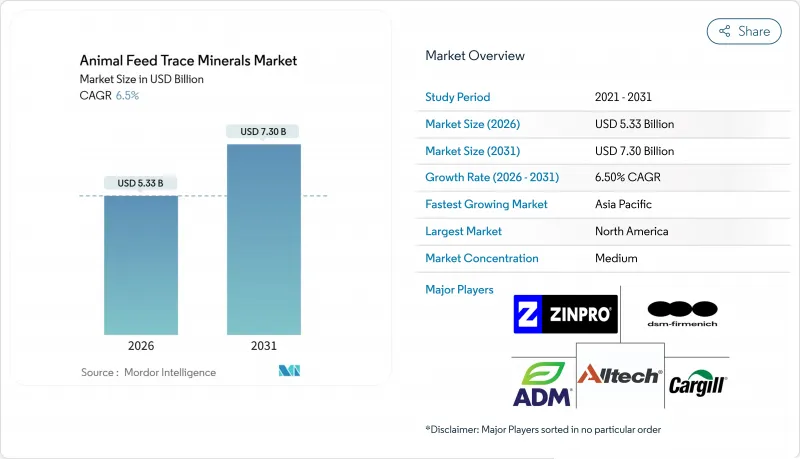
본 보고서는 미네랄 유형별(아연, 구리, 철, 기타), 가축별(가금류, 반추동물, 기타), 원료 유형별(무기, 유기, 기타), 형태별(건조, 액체), 지역별(북미, 유럽, 아시아태평양, 기타)로 분류되어 있습니다. 시장 예측은 금액(달러) 기준으로 제시되어 있습니다.
세계의 동물 사료용 미량 미네랄 시장 동향 및 인사이트
세계 동물성 단백질 수요 증가
2024년, 전 세계 육류 생산량은 1.3% 증가하여 3억 6,500만 톤에 달한 것으로 평가되었습니다. 이러한 성장은 주로 가금류 육류에 기인한 것이며, 쇠고기 생산량 증가도 기여했으나, 돼지고기와 양고기 생산량은 보합세를 보였습니다. 호주, 브라질, 유럽연합(EU),미국에서는 육류 생산이 현저히 증가했습니다. 또한, OECD와 FAO의 전망에 따르면 2031년까지 소비량은 4,790만 톤에 달할 것으로 예상되며, 농지 확대 없이 생산량을 유지하기 위해 영양 밀도가 높고 미네랄이 강화된 사료의 필요성이 강조되고 있습니다. 중국 농업농촌에 따르면, 2025년 중국의 돼지 사육 두수는 3,900만 마리로 회복되었으며, 이에 따라 혼합 사료 생산량이 22% 급증했습니다. 이 혼합 사료에는 80-120ppm의 첨가율로 아연, 구리, 망간이 포함되어 있습니다. 인도의 양계 산업에서는 같은 해, 바이오시큐리티 대책이 마련된 사육 시설과 이에 맞춘 미네랄 공급에 대한 정부의 지원에 힘입어 육계 도입 마릿수가 8% 증가했습니다. 사우디아라비아와 아랍에미리트(UAE) 양국에서는 양계 기업들의 대규모 투자가 이루어지고 있으며, 수출용 사료에 사용되는 킬레이트화 셀레늄과 아연에 대한 수요가 가속화되고 있습니다. 사하라 이남 아프리카에서는 여전히 세계보건기구(WHO)가 정한 단백질 기준치보다 1인당 하루 약 15그램이 부족한 상태이며, 이에 따라 미네랄 강화가 필요한 기부금으로 지원되는 스타터 사료 프로그램이 추진되고 있습니다. 이 지역 전체에서 육류 소비량이 1Kg 증가할 때마다 약 14그램의 미량 미네랄이 보충되며, 이러한 비율은 장기적인 소비량 증가를 뒷받침합니다. 도시 지역의 소득 증가, 식습관의 변화, 슈퍼마켓의 확대 또한 더 높은 품질의 동물성 단백질 구매를 촉진하고 있으며, 이는 미네랄이 풍부한 사료에 대한 수요를 뒷받침하고 있습니다. 세계 식량 안보에 대한 노력 또한 각국 정부의 사료 원료에 대한 보조금 지급을 더욱 촉진하여, 간접적으로 미네랄의 이용률을 높이고 있습니다. 이러한 요인들이 복합적으로 작용하여, 동물 사료용 미량 미네랄 시장은 예측 기간 동안 지속될 수량 주도형의 견실한 성장을 보이고 있습니다.
유기 미네랄의 뛰어난 생체 이용률
아미노산 킬레이트와 단백산염은 무기 황산염이나 산화물에 비해 20-40% 높은 흡수 효율을 보여주고 있으며, 이를 통해 영양사는 최적의 조직 농도를 유지하면서 배합 비율을 낮출 수 있고, 대규모 사업에서는 사료 비용을 1톤당 0.50-1.20달러 절감할 수 있습니다. 브라질에서는 2025년에 120만 마리의 육계를 대상으로 한 Zinpro의 ‘Availa’ 프로그램을 통해 사료 전환율이 12% 개선되어, 생산자는 목표 체중에 3.5일 더 빨리 도달할 수 있게 되었습니다. 유럽식품안전청(EFSA)은 2024년에 생체이용률 계수의 개정을 채택하여, 이를 통해 최대 허용치 산정 시 유기 미네랄이 효과적으로 고려되게 되었기 때문에 배합 재검토가 촉진되고 있습니다. 동남아시아에서는 하이브리드 전략이 점차 확산되고 있으며, 통합형 생산자들은 유기 킬레이트 30%와 무기염 70%를 배합하여 2027년까지 유기 미네랄 사용 비율을 25%까지 높일 계획입니다. 킬레이트를 급여받은 닭 무리에서 관찰된 면역력 향상과 산화 스트레스 감소로 인해 질병으로 인한 비용이 절감되어, 가격 차이를 정당화할 근거가 더욱 강화되고 있습니다. 정밀 사료 급여 도구를 통해 성능이 실시간으로 정량화됨에 따라 유기 미네랄의 경제적 이점을 입증하기가 쉬워져 도입이 가속화되고 있습니다. 또한, 미네랄 배설량 감소에 대해 인센티브를 제공하는 지속가능성 연계형 금융 지원도 구매자들을 킬레이트제로 이끌고 있습니다. 이러한 일련의 동향을 종합해 볼 때, 동물 사료용 미량 미네랄 시장에서 유기 미네랄이 무기염의 우위를 꾸준히 잠식해 나갈 것으로 확실시됩니다.
유기 미량 미네랄의 높은 비용 프리미엄
킬레이트화된 아연과 구리는 황산염 계열에 비해 30-50%의 프리미엄 가격이 책정되어 있으며, 평균 순이익이 톤당 15-25달러인 일반 가금류 및 돼지 사육 시스템에서 완제품 사료 비용을 톤당 2.50-4.00달러 끌어올리고 있습니다. 인도에서는 사료 공장의 70%가 자금 사정이 어려운 소규모 농업 종사자들을 대상으로 공급하고 있기 때문에 2025년 시점에서 유기 미량 미네랄 시장 침투율은 12%에 그친 것으로 평가되었습니다. 사하라 이남 아프리카에서는 15-25%의 수입 관세와 8-12%의 물류 마진으로 인해 생산자의 80%에게 킬레이트제는 감당하기 어려운 수준입니다. 브라질에서는 2025년에 레알이 달러 대비 12% 하락하여 킬레이트제 비용이 상승함에 따라, BRF S.A. 및 JBS S.A.와 같은 통합 기업들은 유기 미네랄의 배합 비율을 20%로 제한하게 되었습니다. 무기염 60%와 킬레이트제 40%를 배합한 하이브리드 혼합물은 생체 이용률의 이점 약 66.67%를 확보하면서도 프리미엄 가격을 절반으로 낮췄으며, 가격 급등으로 인한 충격 속에서도 유기 부문의 연간 성장률 6%를 유지하고 있습니다. 사료 첨가제 제조업체들은 운송 비용을 절감하기 위해 현지에서 킬레이트제 생산에 투자하고 있지만, 생산 규모를 확대하기 위해서는 여전히 막대한 자본이 필요합니다. 규모의 경제가 실현되거나 원료 가격이 정상화될 때까지는 비용이라는 장벽이 도입을 방해하고, 시장 성장을 계속해서 둔화시킬 것으로 보입니다.
부문별 분석
2025년, 아연은 동물 사료용 미량 미네랄 시장 매출의 43%를 차지했습니다. 면역 조절 및 골격 성장에 중요한 역할을 하기 때문에 가금류, 돼지, 반추동물용 사료에서 필수적인 성분이 되고 있습니다. 그 다음으로 구리가 뒤를 이었는데, 이는 주로 자돈용 사료에서의 사용에 기인합니다. 이 경우, 약리학적 용량이 이유기 스트레스 상황에서 장내 환경 안정화에 기여하고 있습니다. 망간의 사용은 산란 회전율이 높은 군에서 달걀 껍질의 강도를 유지하기 위해 종계 및 산란계용 배합 사료에 혼합되고 있다는 점이 주된 원인입니다. 철분의 사용 증가는 자돈의 빈혈을 예방하기 위한 크립 사료 보충제에 사용됨으로써 뒷받침되고 있습니다. 셀레늄은 열대 지역 축산 경영에서 열 스트레스의 완화가 점점 더 중요해짐에 따라 급속한 성장을 보이고 있습니다.
셀레늄의 경우, 유기 효모나 셀레늄 메티오닌과 같은 형태가 대사율이 높은 가축에서 높은 조직 보유율과 항산화 능력을 발휘하기 때문에 2031년까지 연평균 성장률(CAGR) 9.5%를 나타낼 것으로 예측됩니다. 유기 아연과 장내 흡수율을 최대 90%까지 높이는 나노캡슐화 제품 덕분에 배합 비율이 낮아지고 있으며, 그 결과 분변 내 배출량이 감소하여 유럽의 새로운 토양 부하 규제 준수가 용이해지고 있습니다. 구리 수요는 엄격한 환경 규제가 없는 지역에서는 견조한 추세를 보이고 있지만, 유럽연합(EU)에서는 킬레이트화 형태를 통해 성장을 유지하면서 첨가량을 30% 절감할 수 있기 때문에 사료 내 평균 함유량은 감소 추세를 보이고 있습니다. 아미노산 킬레이트화 및 나노 전달 기술에 대한 연구 개발이 활발해지고 있으며, 효율이 더욱 향상될 것으로 기대됨에 따라 동물 사료용 미량 미네랄 시장은 기술 주도형 성장 궤도를 유지할 것으로 전망됩니다.
2025년에는 가금류가 43%를 차지했으며, 동물 사료용 미량 미네랄 시장에서 가장 큰 단독 점유율을 기록했습니다. 이는 해당 부문의 전 세계 사육 마릿수가 1,300억 마리에 달한다는 점과, 균일한 도체 수율을 얻기 위해 안정적인 미네랄 섭취가 필요한 신속한 생산 주기를 반영한 것입니다. 반추동물의 점유율도 확대되고 있으며, 고생산성 젖소와 비육우는 발굽의 강도와 번식 효율을 유지하기 위해 아연과 망간이 필요합니다. 돼지 부문도 큰 기여를 하고 있으며, 규제 압력이 높아지고 있음에도 불구하고 아시아와 남미의 많은 자돈 사육 시설에서는 구리와 아연이 여전히 성장 촉진제 역할을 하고 있습니다. 수산물 양식 부문은 재순환 시스템에서 산화 스트레스를 완화하기 위해 고농도의 셀레늄과 아연이 필요한 새우, 틸라피아, 연어 양식장이 주도하며 연평균 성장률(CAGR) 10.2%라는 가장 빠른 성장 궤도를 그리고 있습니다.
수산물 양식의 급속한 부상은 2025년에 8,800만 톤에 달한 양식 어류 생산량에 힘입은 것입니다. 이는 사상 처음으로 자연 어획량을 넘어섰으며, 종마다 다른 삼투압 조절 요구에 맞춘 특수 미량 미네랄 배합제 개발을 촉진하고 있습니다. 가금류 통합 생산 업체들은 미세 캡슐화된 아연으로의 전환을 추진하고 있습니다. 이를 통해 분진으로 인한 손실이 감소하고, 고속 가동되는 사료 공장에서의 혼합 균일성이 향상되며, 중량 편차에 대해 벌금이 부과되는 가공업체와의 성과 계약 이행을 지원합니다. 중국과 베트남의 양돈업자들은 이유 후 설사를 억제하기 위해 계속해서 150-250ppm의 구리를 투여하고 있습니다. 그러나 토양 오염 규제가 강화됨에 따라 향후 몇 년 동안 생체 이용률이 높은 킬레이트 화합물의 사용이 촉진될 전망입니다. 또한, 고급 반려동물사료 브랜드들도 노령 반려동물의 관절 건강과 면역 기능을 지원하기 위해 킬레이트화된 미네랄의 함량을 늘리고 있으며, 이는 동물 사료용 미량 미네랄 시장에 있어 규모는 작지만 수익성이 높은 수입원이 되고 있습니다.
지역별 분석
2025년, 북미는 전 세계 매출의 35%를 차지했으며, 그 주된 요인은 120만 톤의 미네랄 첨가물을 소비한 미국의 육계 및 소 사육 두수였습니다. 이 지역은 2031년까지 안정적인 성장률을 보이며 확대될 것으로 예측됩니다. 캐나다에서는 정밀 사료를 공급하는 낙농장에서 액상 킬레이트제의 채택률이 사육 두수의 42%에 달한 반면, 멕시코에서는 열 스트레스 문제를 해결하기 위해 할리스코주와 베라크루스주의 가금류 사육군에서 유기 셀레늄의 첨가량이 증가했습니다. 센서 분석의 보급률은 상업 농장의 18%에 달하며, 옥수수나 대두의 가격 변동 속에서도 이익률을 유지하기 위해 데이터에 기반한 미네랄 조정을 뒷받침하고 있습니다.
아시아태평양은 2031년까지 연평균 성장률(CAGR) 8.2%로 확대될 전망이며, 이는 지역별로는 가장 빠른 속도입니다. 이는 중국의 돼지 사육두수 회복과 인도의 가금류 산업 확장에 힘입은 것으로, 이로 인해 해당 지역의 동물 사료용 미량 미네랄 시장 규모가 매년 확대되고 있습니다. 중국에서 현대화된 사료 공장을 대상으로 한 150억 위안(21억 달러) 상당의 보조금으로 인해 킬레이트 미네랄이 우대받고 있으며, 유기 미네랄의 보급률은 2023년 14%에서 2025년에는 22%로 상승할 전망입니다. 인도의 ‘국가 가축 미션’은 소규모 낙농 종사자들에게 미네랄 배합 사료 사용을 의무화하고 있어, 이로 인해 비용 효율이 높은 무기염에 대한 안정적인 수요 기반이 형성되는 한편, 조직형 낙농장에서는 프리미엄 킬레이트제에 대한 수요 여지가 남아 있습니다. 동남아시아의 수산 양식 붐으로 인해 셀레늄과 아연의 배합 비율은 육상 가축보다 20-30% 높아, 베트남과 인도네시아에서 두 자릿수 성장을 이끄는 기반이 되고 있습니다.
유럽에서는 가축 사육 두수의 정체 추세가 배설량 감소를 요구하는 지속가능성 관련 규제에 의해 상쇄되기 때문에 높은 연평균 성장률(CAGR)로 시장이 확대될 것으로 추정됩니다. 규정 2023/915에 따라 사료 제조업체는 킬레이트화된 아연과 구리를 채택하거나, 톤당 30-50유로(32-53달러)의 분뇨 처리 비용을 부담할 수밖에 없게 되었으며, 그 결과 수요는 더 고가의 유기적 솔루션으로 이동하고 있습니다. 영국에서는 브렉시트 이후 첨가제 승인 절차가 가속화되어, 발켐(Valchem)사의 킬레이트화 망간 시장 진입 기간이 14개월 단축되었습니다. 이는 혁신적인 기업들에게 규제 환경의 변화를 보여주는 사례입니다.
기타 혜택
- 엑셀 형식 시장 예측(ME) 시트
- 3개월간의 애널리스트 지원
자주 묻는 질문
목차
제1장 서론
제2장 조사 방법
제3장 주요 요약
제4장 시장 구도
제5장 시장 규모 및 성장 예측
제6장 경쟁 구도
제7장 시장 기회 및 향후 전망
AJY 26.09.11According to Mordor Intelligence, the animal feed trace minerals market size is USD 5.33 billion in 2026 and is projected to reach approximately USD 7.3 billion by 2031, growing at a 6.5% CAGR over the forecast period.
This report is Segmented by Mineral Type (Zinc, Copper, Iron, and More), by Livestock (Poultry, Ruminants, and More), by Source Type (Inorganic, Organic, and More), by Form (Dry and Liquid), and by Geography (North America, Europe, Asia-Pacific, and More). The Market Forecasts are Provided in Terms of Value (USD).
Global Animal Feed Trace Minerals Market Trends and Insights
Rising Global Demand for Animal Protein
In 2024, global meat production is estimated to have risen by 1.3%, reaching 365 million metric tons. This growth was largely driven by poultry meat, with increases in beef output also contributing, while pig and sheep meat production remained stable. Significant growth in meat production occurred in Australia, Brazil, the European Union, and the United States. Moreover, the OECD and FAO outlook pegs consumption to reach 47.9 million metric tons by 2031, emphasizing the need for denser, mineral-fortified rations that sustain output without expanding farmland. According to the Ministry of Agriculture and Rural Affairs of China, China's hog inventory rebounded to 39 million heads in 2025, driving a 22% jump in compound-feed production that pulls zinc, copper, and manganese at inclusion rates of 80-120 parts per million. India's poultry industry increased broiler placements by 8% in the same year, aided by government support for biosecure housing and aligned mineral supplementation. Both Saudi Arabia and the United Arab Emirates are witnessing significant investments by poultry companies, which is accelerating the demand for chelated selenium and zinc in export-quality feed. Sub-Saharan Africa still lags behind the World Health Organization's protein benchmark by approximately 15 grams per person per day, prompting donor-funded starter-feed programs that require mineral fortification. Across these regions, each additional kilogram of meat consumed translates into roughly 14 grams of supplemental trace minerals, a ratio that supports long-term volume growth. Rising urban incomes, changing dietary preferences, and supermarket expansion also stimulate the purchase of higher-quality animal protein, which favors mineral-dense feed. The global push for food security further encourages governments to subsidize feed inputs, indirectly lifting mineral utilization. Combined, these factors provide the animal feed trace minerals market with a durable, volume-driven growth that remains intact throughout the forecast horizon.
Superior Bioavailability of Organic Minerals
Amino-acid chelates and proteinates demonstrate 20-40% higher absorption efficiency than inorganic sulfates or oxides, allowing nutritionists to reduce inclusion rates while maintaining optimal tissue concentrations and trimming feed costs by USD 0.50-1.20 per metric ton in large operations. In Brazil, Zinpro's Availa program, which involved 1.2 million broilers in 2025, improved feed conversion ratios by 12%, enabling producers to reach target weights 3.5 days sooner. The European Food Safety Authority adopted updated bioavailability coefficients in 2024, which effectively account for organic minerals in maximum-limit calculations, encouraging reformulation. Hybrid strategies are gaining ground in Southeast Asia, where integrators blend 30% organic chelates with 70% inorganics and increase organic penetration to 25% by 2027. Improved immune competence and lower oxidative stress observed in chelate-fed flocks reduce morbidity costs, further justifying the premium. As precision-feeding tools quantify performance in real-time, the economic benefits of organic minerals become easier to prove, driving faster adoption. Sustainability-linked loans that reward lower mineral excretion also steer buyers toward chelates. Taken together, these dynamics ensure organic minerals will keep chipping away at the dominance of inorganic salts inside the animal feed trace minerals market.
High Cost Premium of Organic Trace Minerals
Chelated zinc and copper command a 30-50% premium over sulfate forms, increasing finished-feed costs by USD 2.50-4.00 per metric ton in commodity poultry and swine systems, where net margins average USD 15-25 per metric ton. In India, 70% of mills serve smallholders with tight cash flow, limiting organic-mineral penetration to 12% by 2025. Sub-Saharan African import tariffs of 15-25% and logistics markups of 8-12% keep chelates out of reach for 80% of producers. Brazil's real depreciated 12% against the dollar in 2025, inflating chelate costs and prompting integrators such as BRF S.A. and JBS S.A. to cap organic inclusion at 20%. Hybrid blends, which utilize 60% inorganic salts and 40% chelates, capture approximately 66.67% of the bioavailability benefit while halving the premium, sustaining 6% annual organic segment growth even amid sticker shock. Feed additive makers are investing in local chelate production to reduce freight costs, but scaling remains a capital-intensive process. Until economies of scale emerge or ingredient prices normalize, the cost hurdle will continue to dampen adoption and slow the market's growth.
Other drivers and restraints analyzed in the detailed report include:
- Regulatory Curbs on Antibiotic Growth Promoters
- Environmental Benefits of Reduced Mineral Excretion
- Stringent Multi-Region Registration Processes
For complete list of drivers and restraints, kindly check the Table Of Contents.
Segment Analysis
In 2025, Zinc accounted for 43% of the animal feed trace minerals market revenue. Its critical role in immune modulation and skeletal growth made it essential in diets for poultry, swine, and ruminants. Copper followed, primarily due to its use in nursery swine rations, where pharmacological dosing helps stabilize gut health during weaning stress. Manganese usage is driven by its inclusion in breeder and layer formulations to maintain eggshell integrity in high-turnover flocks. Iron's growth is supported by its use in creep-feed supplements to prevent anemia in piglets. Selenium is experiencing rapid growth as heat-stress mitigation becomes increasingly important in tropical livestock operations.
Selenium is projected to post a 9.5% CAGR through 2031 as organic yeast and selenomethionine forms deliver higher tissue retention and antioxidant capacity in high-metabolic livestock. Organic zinc and nano-encapsulated variants that achieve up to 90% intestinal absorption are reducing inclusion rates, thereby lowering fecal output and facilitating compliance with new soil-load rules in Europe. Copper demand remains steady in regions without stringent environmental regulations, but average dietary levels are declining in the European Union as chelated forms enable a 30% reduction while sustaining growth. Intensifying R&D in amino-acid chelation and nano-delivery promises further efficiency gains that will keep the animal feed trace minerals market on a technology-driven upgrade path.
Poultry commanded 43% in 2025 and represented the largest single share of the animal feed trace minerals market share, reflecting the sector's 130 billion-bird global population and fast production cycles that demand consistent mineral intake for uniform carcass yields. Ruminants are growing as high-producing dairy cows and feedlot cattle rely on zinc and manganese for hoof strength and reproductive efficiency. Swine contributes significantly, as copper and zinc still function as growth promoters in many Asian and South American nurseries, despite mounting regulatory pressure. Aquaculture is experiencing the fastest growth trajectory, with a 10.2% CAGR, driven by shrimp, tilapia, and salmon farms that require elevated levels of selenium and zinc to mitigate oxidative stress in recirculating systems.
Aquaculture's rapid ascent is underpinned by farmed-fish output that hit 88 million metric tons in 2025, surpassing wild catch for the first time and triggering specialized trace-mineral formulations matched to species-specific osmoregulatory needs. Poultry integrators are shifting toward micro-encapsulated zinc, which reduces dust loss and improves mixing uniformity in high-speed mills, thereby supporting performance contracts with processors that penalize weight variance. Swine producers in China and Vietnam continue to dose copper at 150-250 parts per million to offset post-weaning diarrhea. However, rising soil-load caps will likely push them toward more bioavailable chelates over the outlook period. Premium pet food brands are also lifting chelated mineral levels to support joint health and immune function in aging companion animals, adding a small but profitable revenue stream for the animal feed trace minerals market.
Complete Report Scope:
- By Mineral Type
- Zinc
- Copper
- Manganese
- Iron
- Selenium
- Others
- By Livestock
- Poultry
- Ruminant
- Swine
- Aquaculture
- Pets and Other
- By Source Type
- Inorganic Salts
- Organic/Chelated
- Nano/Encapsulated
- By Form
- Dry
- Liquid
- By Geography
- North America
- United States
- Canada
- Mexico
- Rest of North America
- South America
- Brazil
- Argentina
- Rest of South America
- Europe
- Germany
- United Kingdom
- France
- Italy
- Spain
- Russia
- Rest of Europe
- Asia-Pacific
- China
- India
- Japan
- South Korea
- Australia
- Rest of Asia-Pacific
- Middle East
- Saudi Arabia
- United Arab Emirates
- Rest of Middle East
- Africa
- South Africa
- Egypt
- Rest of Africa
- North America
Geography Analysis
North America generated 35% of global revenue in 2025, primarily driven by the United States' broiler and cattle herds, which consumed 1.2 million metric tons of mineral additives. The region is projected to expand at a steady growth rate through 2031. Adoption of liquid chelates in precision-fed dairies rose to 42% of herds in Canada, while Mexico's heat-stress challenges lifted organic selenium inclusion across Jalisco and Veracruz flocks. Sensor analytics penetration reached 18% of commercial operations, supporting data-driven mineral adjustments that protect margins as corn and soybean prices fluctuate.
The Asia Pacific is advancing at an 8.2% CAGR through 2031, the fastest regional pace, driven by China's recovery of its hog herd and India's poultry expansion, which together increase the region's animal feed trace minerals market size each year. Subsidies worth CNY 15 billion (USD 2.1 billion) for modernized feed mills in China favor chelated minerals, raising organic penetration from 14% in 2023 to 22% in 2025. India's National Livestock Mission mandates mineralized rations for smallholder dairies, creating a captive base for cost-effective inorganic salts while leaving headroom for premium chelates in organized dairies. Southeast Asia's aquaculture boom absorbs selenium and zinc at inclusion rates 20-30% higher than those of terrestrial livestock, underpinning double-digit growth in Vietnam and Indonesia.
Europe is estimated to grow at a high CAGR, as static animal numbers are offset by sustainability mandates that require lower excretion profiles. Regulation 2023/915 prompted feed mills to adopt chelated zinc and copper or incur manure export costs of EUR 30-50 (USD 32-53) per metric ton, thereby steering demand toward higher-priced organic solutions. The United Kingdom accelerated additive approvals post-Brexit, shortening market entry for Balchem's chelated manganese by fourteen months and signaling a regulatory change for innovators.
- Cargill Incorporated
- Archer Daniels Midland Company
- DSM-Firmenich AG
- Zinpro Corporation
- Alltech, Inc
- BASF SE
- Nutreco N.V. (SHV Holdings)
- Kemin Industries, Inc.
- Phibro Animal Health Corporation
- Adisseo (China National Bluestar (Group) Co., Ltd.)
- Novus International, Inc.
- Balchem Corp.
- Biochem Zusatzstoffe Handels- und Produktionsgesellschaft mbH
- Orffa (Marubeni Corporation)
- Animine
Additional Benefits:
- The market estimate (ME) sheet in Excel format
- 3 months of analyst support
TABLE OF CONTENTS
1 Introduction
- 1.1 Study Assumptions and Market Definition
- 1.2 Scope of the Study
2 Research Methodology
3 Executive Summary
4 Market Landscape
- 4.1 Market Overview
- 4.2 Market Drivers
- 4.2.1 Rising global demand for animal protein
- 4.2.2 Superior bioavailability of organic minerals
- 4.2.3 Regulatory curbs on antibiotic growth promoters
- 4.2.4 Environmental benefits of reduced mineral excretion
- 4.2.5 Precision feeding and sensor analytics adoption
- 4.2.6 Circular-economy sourcing of trace minerals
- 4.3 Market Restraints
- 4.3.1 High cost premium of organic minerals
- 4.3.2 Stringent multi-region registration processes
- 4.3.3 Emerging soil-load caps on heavy metals
- 4.3.4 Specialty-chelate supply-chain fragility
- 4.4 Regulatory Landscape
- 4.5 Technological Outlook
- 4.6 Porter's Five Forces Analysis
- 4.6.1 Threat of New Entrants
- 4.6.2 Bargaining Power of Buyers
- 4.6.3 Bargaining Power of Suppliers
- 4.6.4 Threat of Substitutes
- 4.6.5 Intensity of Competitive Rivalry
5 Market Size and Growth Forecasts (Value)
- 5.1 By Mineral Type
- 5.1.1 Zinc
- 5.1.2 Copper
- 5.1.3 Manganese
- 5.1.4 Iron
- 5.1.5 Selenium
- 5.1.6 Others
- 5.2 By Livestock
- 5.2.1 Poultry
- 5.2.2 Ruminant
- 5.2.3 Swine
- 5.2.4 Aquaculture
- 5.2.5 Pets and Other
- 5.3 By Source Type
- 5.3.1 Inorganic Salts
- 5.3.2 Organic/Chelated
- 5.3.3 Nano/Encapsulated
- 5.4 By Form
- 5.4.1 Dry
- 5.4.2 Liquid
- 5.5 By Geography
- 5.5.1 North America
- 5.5.1.1 United States
- 5.5.1.2 Canada
- 5.5.1.3 Mexico
- 5.5.1.4 Rest of North America
- 5.5.2 South America
- 5.5.2.1 Brazil
- 5.5.2.2 Argentina
- 5.5.2.3 Rest of South America
- 5.5.3 Europe
- 5.5.3.1 Germany
- 5.5.3.2 United Kingdom
- 5.5.3.3 France
- 5.5.3.4 Italy
- 5.5.3.5 Spain
- 5.5.3.6 Russia
- 5.5.3.7 Rest of Europe
- 5.5.4 Asia-Pacific
- 5.5.4.1 China
- 5.5.4.2 India
- 5.5.4.3 Japan
- 5.5.4.4 South Korea
- 5.5.4.5 Australia
- 5.5.4.6 Rest of Asia-Pacific
- 5.5.5 Middle East
- 5.5.5.1 Saudi Arabia
- 5.5.5.2 United Arab Emirates
- 5.5.5.3 Rest of Middle East
- 5.5.6 Africa
- 5.5.6.1 South Africa
- 5.5.6.2 Egypt
- 5.5.6.3 Rest of Africa
- 5.5.1 North America
6 Competitive Landscape
- 6.1 Market Concentration
- 6.2 Strategic Moves
- 6.3 Market Share Analysis
- 6.4 Company Profiles (includes Global Level Overview, Market Level Overview, Core Segments, Financials as Available, Strategic Information, Market Rank/Share for Key Companies, Products and Services, and Recent Developments)
- 6.4.1 Cargill Incorporated
- 6.4.2 Archer Daniels Midland Company
- 6.4.3 DSM-Firmenich AG
- 6.4.4 Zinpro Corporation
- 6.4.5 Alltech, Inc
- 6.4.6 BASF SE
- 6.4.7 Nutreco N.V. (SHV Holdings)
- 6.4.8 Kemin Industries, Inc.
- 6.4.9 Phibro Animal Health Corporation
- 6.4.10 Adisseo (China National Bluestar (Group) Co., Ltd.)
- 6.4.11 Novus International, Inc.
- 6.4.12 Balchem Corp.
- 6.4.13 Biochem Zusatzstoffe Handels- und Produktionsgesellschaft mbH
- 6.4.14 Orffa (Marubeni Corporation)
- 6.4.15 Animine


