

|
시장보고서
상품코드
2123642
장기 이식용 면역억제제 시장 : 시장 점유율 분석, 업계 동향 및 통계, 성장 예측(2026-2031년)Organ Transplant Immunosuppressant Drugs - Market Share Analysis, Industry Trends & Statistics, Growth Forecasts (2026 - 2031) |
||||||
 Mordor Intelligence
Mordor Intelligence에 의하면, 2026년 장기 이식용 면역억제제 시장 규모는 60억 3,000만 달러로 추정되고, 2025년 57억 7,000만 달러에서 확대해, 2031년에는 75억 1,000만 달러에 이를 것으로 예측됩니다.
2026-2031년 연평균 성장률(CAGR) 4.48%로 성장할 것으로 전망됩니다.
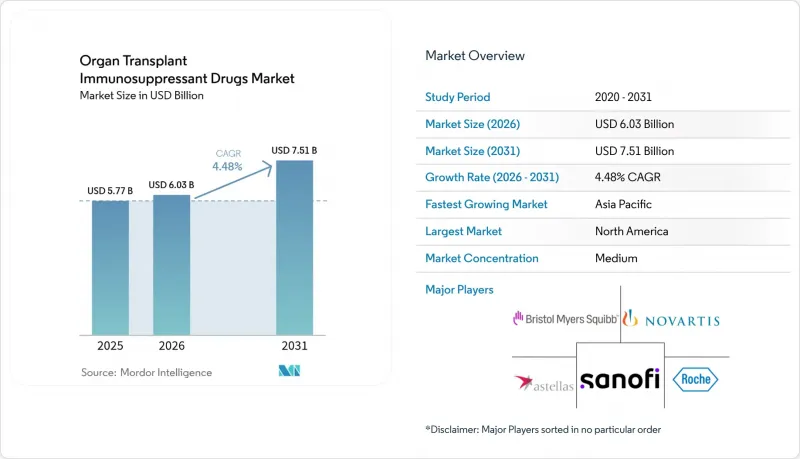
본 보고서는 약물 분류별(칼시뉴린 억제제, 항증식제, mTOR 억제제, 기타), 이식 유형별(심장, 신장, 간, 폐, 기타), 투여 경로별(경구, 정맥 내 투여, 기타), 유통 채널별(병원 약국, 기타), 지역별(북미, 유럽, 기타)로 분류되어 있습니다. 시장 예측은 금액(달러) 기준으로 제시되어 있습니다.
세계의 장기 이식용 면역억제제 시장 동향 및 인사이트
장기 부전 부담 증가가 이식 건수를 끌어올리고 있습니다.
말기 신장 질환, 간 질환, 심장 질환, 폐 질환의 발생률이 급증하면서 수술 건수가 늘어나고, 결과적으로 면역억제제 수요를 촉진하고 있습니다. 3,700만 명 이상의 미국인이 만성 신장 질환을 앓고 있는 반면, 코로나19는 간 질환의 유병률을 악화시켰습니다. 고령화가 진행됨에 따라 이식 후보자 수가 증가하고 있으며, 고령 환자는 면역 저항력이 저하되어 있어 보다 집중적인 치료 요법이 필요해지고 있습니다. 조기 진단을 통해 장기 부전이 더 빨리 발견됨에 따라, 과거에는 실현 불가능하다고 여겨졌던 이식 파이프라인이 확대되고 있습니다. 인공지능(AI)을 활용한 적합성 판정 시스템은 현재 98%의 정확도로 적합성을 예측하고 있으며, 거부 반응 발생을 줄이고 투여 프로토콜을 최적화함으로써 수요를 더욱 촉진하는 선순환을 만들어내고 있습니다.
타크롤리무스와 MMF 제네릭 의약품의 신속 승인
여러 타크롤리무스와 미코페놀산 모페틸(MMF) 제네릭 의약품의 보급으로 치료 비용이 대폭 절감되어, 자금 지원 기관은 제한된 예산 내에서 더 많은 이식 환자를 치료할 수 있게 되었습니다. 주요 의약품에 대한 메디케어 파트 D 지출은 잇달아 출시된 제네릭 의약품 이후 48-67% 감소했습니다. 또한, 즉시 사용 가능한 경구 현탁액의 등장으로 소아 환자에 대한 접근성도 확대되었습니다. 최근 FDA가 아코드(Accord)사의 타크롤리무스 로트에 대해 ‘BX’ 등급을 부여한 것은 생물학적 동등성에 대한 경계가 높아지고 있음을 보여줍니다. 가격 인하는 특히 신흥국에서 매우 중요합니다. 이들 국가에서는 약값이 여전히 수술 후 약물 복용 순응도의 가장 큰 장벽으로 작용하고 있습니다.
다약제 병용 요법의 높은 평생 치료비
미국에서 간 이식 환자 1인당 연간 치료비가 3만 달러를 초과하는 것은 지불자와 환자 모두에게 부담을 주고 있습니다. 메디케어 혜택은 수술 후 3년 만에 종료되기 때문에 중년 이식 환자의 32%가 충분한 의약품 보험에 가입할 수 없게 되었습니다. 합병증으로 인한 입원은 의료 시스템 비용을 더욱 끌어올리고 있으며, 공적 혜택 연장을 요구하는 목소리가 높아지고 있습니다. 경제 모델에 따르면, 이를 통해 비용 절감과 삶의 질 향상이라는 두 가지 목표를 모두 달성할 수 있는 것으로 나타났습니다. 저·중소득 국가에서는 본인 부담금이 무거워 투여량을 줄일 수밖에 없는 경우가 많아, 치료 성과를 저해할 뿐만 아니라 장기 이식용 면역억제제 시장의 확대를 저해하고 있습니다.
부문 분석
2025년, 칼시뉴린 억제제는 매출의 34.15%를 차지했으며, 장기 이식용 면역억제제 시장의 기반을 유지했습니다. 타크로리무스 등 실적이 입증된 약제는 대부분의 이식 장기에서 여전히 1차 선택 약물로 사용되고 있습니다. 그러나 mTOR 억제제는 네프론 보존 효과와 심혈관·대사 측면의 이점으로 인해 연평균 성장률(CAGR) 9.72%의 성장 궤도에 올라 있습니다. 간 이식 후 12개월 이내에 에베로리무스로 조기에 전환한 결과, 환자의 55%에서 신장 기능이 개선되었습니다. 라파마이신을 기반으로 한 4제 병용 요법에서는 20년 이식편 생존율이 20.9%를 달성하여 타크롤리무스의 기준치를 상회했습니다. 베라타셉트와 같은 공동자극 억제제나 미코페놀산 등의 항증식제가 치료의 기반을 보완하고 있으며, 한편 항체 유도 요법은 고위험 수혜자에 대해 상황에 따라 시행되고 있습니다.
새로운 약물 전달 시스템이 시장 성장을 가속하고 있습니다. 자기 조직화 라파마이신 나노입자는 전신 독성을 줄이면서 혈장 내 농도를 유지하며, PEG화된 CD28 표적 단편(VEL-101)은 2상 임상시험 단계로 진입했습니다. 제네릭 의약품의 보급이 확대되고 특허가 만료됨에 따라 가격 경쟁은 격화되겠지만, 표적형 또는 국소 투여 제제 분야의 혁신이 이익률에 가해지는 압박을 상쇄하여 장기 이식용 면역억제제 시장의 중기적 성장 전망을 뒷받침할 것으로 예측됩니다.
2025년에도 신장 이식은 확립된 프로토콜과 높은 유병률에 힘입어 장기 이식용 면역억제제 시장 규모의 61.05%를 계속 차지했습니다. 한편, 폐 이식은 9.68%라는 가장 높은 연평균 성장률(CAGR)을 기록했습니다. 상온 체외 관류법을 통해 이식 적격 기준을 충족하지 못하는 폐를 이식 가능한 상태로 개선함으로써, 순환 정지 후 장기 기증(DCD) 코호트에서 발생하는 1차 이식편 기능 부전을 해소하고 있습니다. 심장 이식 프로그램에서는 급성 기능 부전 시 정맥-동맥 ECMO를 통한 백업 기능을 활용함으로써 1년 생존율을 향상시키고 있습니다. 간과 췌장 이식 건수는 꾸준히 증가하고 있으나, 진화하는 비수술적 질환 관리 옵션과의 경쟁에 직면해 있습니다. 줄기세포 이식 및 혈관화 복합 동종 이식에서는 개인 맞춤형 면역 조절이 채택되고 있으며, 이는 광범위한 장기 이식용 면역억제제 시장에서 향후 틈새 수요 부문이 생겨날 것임을 시사합니다.
폐 이식과 새롭게 등장하는 복합 이식 수술 증가로 인해, 이종 이식 실험이 진행되고 있음에도 불구하고 치료 건수는 전반적으로 계속 증가할 것으로 예측됩니다. 이종 이식이 성공할 경우 유지 요법용 약물 수요가 억제될 가능성도 있지만, 인간 이식편의 한계가 해소되지 않을 경우 새로운 도입 요법을 위한 틈새 시장이 형성될 가능성이 있습니다.
지역별 분석
북미는 4만 6,000건의 이식 실적과 종합적인 보험 적용을 바탕으로 2025년 매출의 42.30%를 차지했습니다. 미국에서는 제네릭 의약품으로의 전환이 진행되고 있음에도 불구하고 타크로리무스의 사용률이 높으며, 캐나다에서는 기계적 관류법의 조기 도입으로 시술 건수가 더욱 증가하고 있습니다. 유럽은 균형 잡힌 성장을 유지하고 있지만, 환급 제도 개혁 및 국경 간 조화에 관한 논의가 소규모 회원국의 접근성에 영향을 미치고 있습니다.
아시아태평양은 연평균 성장률(CAGR) 8.84%로 가장 빠르게 성장하고 있는 지역입니다. 중국의 국가 지원 이식 네트워크, 2023년 인도에서 시행된 1만 3,426건의 신장 이식 수술, 일본에서 이식 후 CMV 치료제로 ‘LIVTENCITY’가 승인된 사례는 모두 이 지역의 성장 모멘텀을 보여줍니다. 규제 명확화, 기증자 등록의 디지털화, 보험 적용 범위 확대와 같은 진전은 2031년까지 이 지역의 장기 이식용 면역억제제 시장 점유율을 끌어올릴 구조적 변화를 뒷받침하고 있습니다.
남미와 중동 및 아프리카는 아직 발전 단계에 있지만 전략적으로 중요한 지역입니다. 브라질의 확립된 간·신장 이식 센터가 남미의 발전을 뒷받침하고 있는 반면, 사우디아라비아와 남아프리카공화국은 해당 지역의 관류 시스템 도입을 주도하고 있습니다. 기증자 수 부족과 자금 면의 제약이 보급을 저해하고 있지만, 목표가 명확한 민관 파트너십을 통해 예측 기간 후반에 장기 이식용 면역억제제 시장에 더 많은 기회가 창출될 가능성이 있습니다.
기타 혜택
- 엑셀 형식 시장 예측(ME) 시트
- 3개월간의 애널리스트 지원
자주 묻는 질문
목차
제1장 서론
제2장 조사 방법
제3장 주요 요약
제4장 시장 구도
제5장 시장 규모 및 성장 예측
제6장 경쟁 구도
제7장 시장 기회 및 향후 전망
AJY 26.09.11According to Mordor Intelligence, organ transplant immunosuppressant drugs market size in 2026 is estimated at USD 6.03 billion, growing from 2025 value of USD 5.77 billion with 2031 projections showing USD 7.51 billion, growing at 4.48% CAGR over 2026-2031.
This report is Segmented by Drug Class (Calcineurin Inhibitors, Antiproliferative Agents, MTOR Inhibitor, and More), Transplant Type (Heart, Kidney, Liver, Lung, and More), Route of Administration (Oral, Intravenous, and More), Distribution Channel (Hospital Pharmacies, and More), and Geography (North America, Europe and More). The Market Forecasts are Provided in Terms of Value (USD).
Global Organ Transplant Immunosuppressant Drugs Market Trends and Insights
Growing Organ-Failure Burden Boosts Transplants
Escalating incidences of end-stage kidney, liver, heart, and lung diseases fuel surgery volumes and, by extension, immunosuppressant uptake. More than 37 million Americans live with chronic kidney disease, while COVID-19 exacerbated liver morbidity. Aging demographics deepen the candidate pool and require more intensive regimens because older patients possess diminished immune resilience. Early diagnostics flag organ failure sooner and feed transplant pipelines once deemed unreachable. Artificial-intelligence matching systems now predict compatibility with 98% accuracy, lowering rejection events and optimizing dosing protocols, thereby creating reinforcing demand cycles.
Rapid Approvals of Generic Tacrolimus & MMF
Uptake of multiple tacrolimus and mycophenolate mofetil generics slashes regimen costs, allowing funding bodies to treat more recipients within fixed budgets. Medicare Part D outlays for key drugs fell 48-67% after successive generic launches, and ready-to-use oral suspensions widened pediatric access. Nonetheless, the FDA's recent BX rating on an Accord tacrolimus lot highlights vigilance over bioequivalence. Price relief is especially pivotal in emerging economies, where drug expenditure remains the primary bottleneck to post-surgery adherence.
High Lifetime Cost of Multi-Drug Regimens
Annual therapy expenses exceeding USD 30,000 per U.S. liver recipient strain payers and patients alike. Medicare coverage lapses three years post-surgery, leaving 32% of middle-aged recipients without adequate drug insurance. Complication-driven hospitalizations further inflate health-system costs, prompting calls to extend public reimbursement, which economic models show would yield both savings and quality-of-life gains. In low- and middle-income countries, out-of-pocket exposure often forces dose skimping, undermining outcomes and constraining organ transplant immunosuppressant drugs market expansion.
Other drivers and restraints analyzed in the detailed report include:
- Improved HLA-Typing & Transplant Diagnostics
- Adoption of Organ Ex-Vivo Perfusion Systems
- Chronic Donor-Organ Shortage
For complete list of drivers and restraints, kindly check the Table Of Contents.
Segment Analysis
Calcineurin inhibitors retained 34.15% revenue in 2025, anchoring the organ transplant immunosuppressant drugs market. Proven agents such as tacrolimus remain first-line for most graft types. Yet mTOR inhibitors are on a 9.72% CAGR trajectory due to nephron-sparing and cardiometabolic benefits. Early conversion to everolimus within 12 months post-liver transplant improved renal function in 55% of patients. Rapamycin-based quadruple therapy delivered 20-year graft survival of 20.9%, eclipsing tacrolimus benchmarks. Co-stimulation blockers like belatacept and antiproliferatives such as mycophenolic acids round out therapeutic backbones, while antibody induction remains situational for high-risk recipients.
Novel delivery systems catalyze growth. Self-assembled rapamycin nanoparticles sustain plasma concentrations with lower systemic toxicity, and pegylated CD28-targeting fragments (VEL-101) progress through Phase 2. As generic penetration rises and patents sunset, price competition will intensify, but innovation in targeted or localized formulations should offset margin pressures, reinforcing the organ transplant immunosuppressant drugs market's mid-term growth outlook.
Kidney grafts continued to dominate 61.05% of the organ transplant immunosuppressant drugs market size in 2025, supported by mature protocols and high disease prevalence. Lung transplants, however, register the briskest 9.68% CAGR. Normothermic ex vivo perfusion elevates marginal lungs to transplantable status, eliminating primary graft dysfunction in donation-after-circulatory-death cohorts. Heart graft programs leverage veno-arterial ECMO back-up during acute dysfunction, boosting one-year survival. Liver and pancreas volumes expand steadily but face competition from evolving non-surgical disease-management options. Stem-cell transplants and vascularized composite allografts adopt tailored immunomodulation, indicating future niche demand pockets within the broader organ transplant immunosuppressant drugs market.
Growth in lung and emerging composite procedures will keep overall therapy volumes rising despite xenotransplantation experiments, whose success could either dampen maintenance-drug need or create new induction niches if human graft limitations persist.
Complete Report Scope:
- By Drug Class
- Calcineurin Inhibitors
- Antiproliferative Agents (IMPDH inhibitors)
- mTOR Inhibitors
- Steroids
- Co-stimulation Blockers (Belatacept)
- Polyclonal/Monoclonal Antibodies
- Other Classes
- By Transplant Type
- Kidney
- Liver
- Heart
- Lung
- Pancreas
- Bone-Marrow / HSCT
- Other Types
- By Route of Administration
- Oral
- Intravenous
- Topical / Implantable
- By Distribution Channel
- Hospital Pharmacies
- Retail Pharmacies
- Online Pharmacies
- Geography
- North America
- United States
- Canada
- Mexico
- Europe
- Germany
- United Kingdom
- France
- Italy
- Spain
- Rest of Europe
- Asia-Pacific
- China
- Japan
- India
- South Korea
- Australia
- Rest of Asia-Pacific
- Middle East and Africa
- GCC
- South Africa
- Rest of Middle East and Africa
- South America
- Brazil
- Argentina
- Rest of South America
- North America
Geography Analysis
North America commanded 42.30% of 2025 sales on the back of 46,000 transplants and comprehensive payer coverage. The United States posts high tacrolimus utilization despite rising generic substitution, and Canada's early adoption of machine perfusion further amps volumes. Europe maintains balanced growth, though reimbursement reforms and cross-border harmonization debates shape access in smaller member states.
Asia-Pacific is the fastest-growing contributor at 8.84% CAGR. China's state-sponsored transplant network, India's 13,426 kidney operations in 2023, and Japan's approval of LIVTENCITY for post-transplant CMV all illustrate momentum. Improvements in regulatory clarity, donor-registry digitization, and insurance expansion underline a structural shift that will raise the region's share of the organ transplant immunosuppressant drugs market through 2031.
South America and the Middle East & Africa remain nascent yet strategic. Brazil's established liver and kidney centers anchor South American progress, while Saudi Arabia and South Africa spearhead regional adoption of perfusion systems. Limited donor pools and funding constraints temper uptake, but targeted public-private partnerships could unlock incremental opportunity for the organ transplant immunosuppressant drugs market in the later forecast window.
- Astellas Pharma
- Roche
- Novartis
- Bristol-Myers Squibb
- Sanofi
- Viatris
- GlaxoSmithKline
- Dr. Reddy's Laboratories
- Veloxis Pharmaceuticals
- Pfizer
- Abbott Laboratories
- CSL Behring
- Lupin
- Sun Pharmaceuticals Industries
- Cipla
- Hikma Pharmaceuticals
- Intas Pharma
- Chiesi Farmaceutici
- Sandoz Group
- Albireo Pharma
- Takeda Pharmaceuticals
Additional Benefits:
- The market estimate (ME) sheet in Excel format
- 3 months of analyst support
TABLE OF CONTENTS
1 Introduction
- 1.1 Study Assumptions & Market Definition
- 1.2 Scope of the Study
2 Research Methodology
3 Executive Summary
4 Market Landscape
- 4.1 Market Overview
- 4.2 Market Drivers
- 4.2.1 Growing Organ-Failure Burden Boosts Transplants
- 4.2.2 Rapid Approvals of Generic Tacrolimus & MMF
- 4.2.3 Improved HLA-Typing & Transplant Diagnostics
- 4.2.4 Adoption of Organ Ex-Vivo Perfusion Systems
- 4.2.5 Implantable Local-Delivery Systems Cut Toxicity
- 4.3 Market Restraints
- 4.3.1 High Lifetime Cost of Multi-Drug Regimens
- 4.3.2 Chronic Donor-Organ Shortage
- 4.3.3 Shift To CNI-Sparing Protocols Lowers Volumes
- 4.3.4 Emerging Xenotransplantation Could Disrupt Demand
- 4.4 Porter's Five Forces
- 4.4.1 Threat of New Entrants
- 4.4.2 Bargaining Power of Buyers
- 4.4.3 Bargaining Power of Suppliers
- 4.4.4 Threat of Substitutes
- 4.4.5 Competitive Rivalry
5 Market Size & Growth Forecasts (value, USD)
- 5.1 By Drug Class
- 5.1.1 Calcineurin Inhibitors
- 5.1.2 Antiproliferative Agents (IMPDH inhibitors)
- 5.1.3 mTOR Inhibitors
- 5.1.4 Steroids
- 5.1.5 Co-stimulation Blockers (Belatacept)
- 5.1.6 Polyclonal/Monoclonal Antibodies
- 5.1.7 Other Classes
- 5.2 By Transplant Type
- 5.2.1 Kidney
- 5.2.2 Liver
- 5.2.3 Heart
- 5.2.4 Lung
- 5.2.5 Pancreas
- 5.2.6 Bone-Marrow / HSCT
- 5.2.7 Other Types
- 5.3 By Route of Administration
- 5.3.1 Oral
- 5.3.2 Intravenous
- 5.3.3 Topical / Implantable
- 5.4 By Distribution Channel
- 5.4.1 Hospital Pharmacies
- 5.4.2 Retail Pharmacies
- 5.4.3 Online Pharmacies
- 5.5 Geography
- 5.5.1 North America
- 5.5.1.1 United States
- 5.5.1.2 Canada
- 5.5.1.3 Mexico
- 5.5.2 Europe
- 5.5.2.1 Germany
- 5.5.2.2 United Kingdom
- 5.5.2.3 France
- 5.5.2.4 Italy
- 5.5.2.5 Spain
- 5.5.2.6 Rest of Europe
- 5.5.3 Asia-Pacific
- 5.5.3.1 China
- 5.5.3.2 Japan
- 5.5.3.3 India
- 5.5.3.4 South Korea
- 5.5.3.5 Australia
- 5.5.3.6 Rest of Asia-Pacific
- 5.5.4 Middle East and Africa
- 5.5.4.1 GCC
- 5.5.4.2 South Africa
- 5.5.4.3 Rest of Middle East and Africa
- 5.5.5 South America
- 5.5.5.1 Brazil
- 5.5.5.2 Argentina
- 5.5.5.3 Rest of South America
- 5.5.1 North America
6 Competitive Landscape
- 6.1 Market Concentration
- 6.2 Market Share Analysis
- 6.3 Company Profiles (includes Global level Overview, Market level overview, Core Segments, Financials as available, Strategic Information, Market Rank/Share for key companies, Products & Services, and Recent Developments)
- 6.3.1 Astellas Pharma Inc.
- 6.3.2 F. Hoffmann-La Roche Ltd
- 6.3.3 Novartis AG
- 6.3.4 Bristol Myers Squibb Co.
- 6.3.5 Sanofi SA
- 6.3.6 Viatris Inc
- 6.3.7 GSK plc
- 6.3.8 Dr. Reddy's Laboratories
- 6.3.9 Veloxis Pharmaceuticals
- 6.3.10 Pfizer Inc.
- 6.3.11 Abbott Laboratories
- 6.3.12 CSL Behring
- 6.3.13 Lupin Ltd
- 6.3.14 Sun Pharma
- 6.3.15 Cipla Ltd
- 6.3.16 Hikma Pharmaceuticals
- 6.3.17 Intas Pharma
- 6.3.18 Chiesi Farmaceutici
- 6.3.19 Sandoz AG
- 6.3.20 Albireo Pharma
- 6.3.21 Takeda Pharmaceutical
7 Market Opportunities & Future Outlook
- 7.1 White-space & Unmet-Need Assessment


