

|
시장보고서
상품코드
2123735
각막 토포그래퍼 시장 : 점유율 분석, 업계 동향과 통계, 성장 예측(2026-2031년)Corneal Topographers - Market Share Analysis, Industry Trends & Statistics, Growth Forecasts (2026 - 2031) |
||||||
 Mordor Intelligence
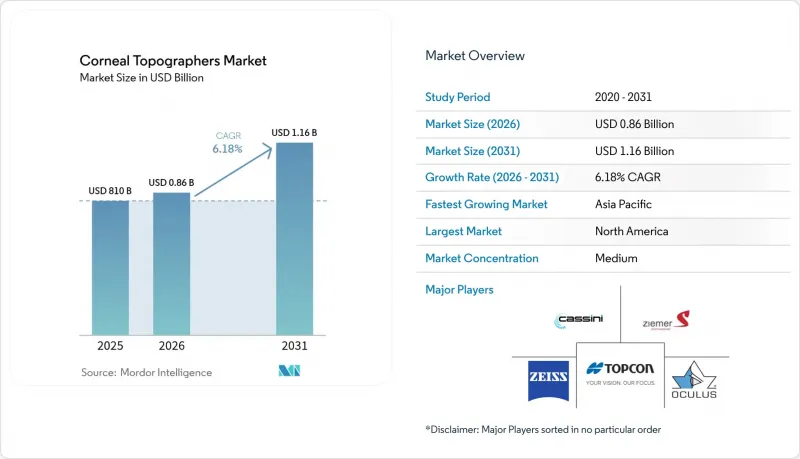
Mordor Intelligence에 의하면, 2026년 각막 토포그래퍼 시장 규모는 8억 6,090만 달러로 추정되고 있어 2025년 8억 1,000만 달러에서 성장하여 2031년 예측은 11억 6,000만 달러가 되어, 2026년부터 2031년까지 CAGR 6.18%로 성장할 전망입니다.
본 보고서는 기술별(플라시드 반사 시스템, 스캐닝 슬릿 시스템 등),용도별(굴절 교정 수술 계획, 콘택트렌즈 피팅(소프트 렌즈 및 RGP 렌즈 피팅, 오르토케라토로지 렌즈 피팅)), 최종 사용자별(병원, 외래수술센터(ASC) 등), 지역별(북미, 유럽, 아시아태평양 등)로 세분화되어 있습니다. 시장 전망은 금액(달러) 기준으로 제시되어 있습니다.
전 세계 각막 토포그래퍼 시장 동향 및 인사이트
소아 및 청년층의 근시 및 원추각막 부담 증가
2050년까지 전 세계 인구의 절반이 근시가 될 것으로 예측되고 있으며, 최근 중국의 횡단면 조사에 따르면 학령기 아동의 유병률이 이미 50.93%에 달하고, 도시 지역에서는 더 높은 수치가 보고되고 있습니다. 소아의 발병 상황을 통해 각막 원추증이 진단되지 않은 채 방치되고 있는 실태가 드러나면서 조기 발견의 중요성이 더욱 커지고 있으며, 임상의들은 선별 검사 프로토콜을 확대되고 있습니다. 각막 토포그래퍼 시장은 오소케라톨로지 피팅 시 근시 억제 효과를 검증하기 위해 정밀한 각막 표면 형상 지도와 축거리 측정이 필요하기 때문에 그 혜택을 보고 있습니다. OCULUS사는 2025년에 ‘Pentacam AXL Wave’ 소프트웨어를 도입하여 단층 촬영과 축장 측정을 통합함으로써 종합적인 근시 관리를 실현했습니다. 젊은 층의 평생 모니터링에 대한 필요성은 반복적인 영상 진단 수요를 창출하여, 1차 진료부터 전문 클리닉에 이르기까지 장비 사용을 촉진하고 있습니다.
고령화가 진행되면서 백내장 및 굴절 교정 수술이 확대되고 있습니다.
미국의 65세 이상 인구는 2020년 5,610만 명에서 2030년까지 7,310만 명으로 증가할 것으로 예측되며, 이에 따라 수술 건수도 증가할 전망입니다. 전 세계 백내장 수술 건수는 2024년 3,100만 건에서 2029년에는 3,700만 건으로 증가할 것으로 예상되며, 각 사례에서 토릭 렌즈나 다초점 렌즈의 선택을 최적화하기 위해서는 각막 매핑이 필수적입니다. Pentacam AXL이 대표적으로 보여주듯이, 각막 단층 촬영과 광학 생체 측정을 통합함으로써 진료 시간을 단축하고 굴절 결과의 예측 정확도를 높일 수 있습니다. 본인 부담금이 높은 프리미엄 IOL의 채택이 확대됨에 따라, 환자들은 오류 없는 결과를 기대하게 되어 고해상도 토포그래피에 대한 수요가 지속될 것입니다. 그 결과, 각막 토포그래피 장비 시장은 고령화가 진행 중인 선진국에서 안정적인 수익 기반을 확보하고 있습니다.
고급 시스템 도입 및 유지 비용의 높음
주력 제품인 하이브리드 플랫폼의 가격은 8만-15만 달러이지만, 가격에 민감한 시장에서는 수입 관세가 가산되면 이 금액이 25-40% 상승할 가능성이 있습니다. 반도체 부족으로 인해 일부 제조업체의 2024년 매출이 3-5% 감소함에 따라 부품 비용은 여전히 높은 수준을 유지하고 있으며, 또한 첨단 광학 시스템에는 정기적인 교정 및 전용 소프트웨어 구독이 필요합니다. 총 소유 비용이 높기 때문에 소규모 의료 기관은 시스템 업그레이드를 주저하며, 구매를 미루거나 더 낮은 사양의 대체품을 선택할 수밖에 없는 상황에 처해 있습니다. 리스나 사용량에 따른 요금 모델은 초기 비용 부담을 줄여주지만, 지속적인 이용료가 운영 예산을 압박하고 있습니다. 각막 토포그래퍼 시장이 클라우드 기반 분석 서비스로 전환됨에 따라, 운영 비용이 설비 투자 절감분을 상쇄할 위험이 있어 가격이 장기적인 억제요인으로 남아 있을 전망입니다.
부문 분석
플라시드 반사 시스템은 합리적인 가격과 확립된 임상 워크플로우의 이점을 바탕으로 2025년에는 35.10%라는 압도적인 점유율을 차지했습니다. 그러나 곡선 기반 알고리즘은 각막 후면의 불규칙성을 처리하기 어렵기 때문에 안과 의사들은 고도 기반 이미징으로 전환하고 있습니다. 플라시드와 샤인프루그, 또는 OCT를 융합한 하이브리드형 다중 모드 플랫폼은 8.47%의 연평균 성장률(CAGR)을 기록하고 있으며, 이는 각막 토포그래퍼 시장 내에서 가장 빠른 성장 속도입니다. 이러한 워크스테이션은 한 번의 촬영으로 각막 두께 측정, 후면 곡률 측정 및 전안부 단층 촬영을 실현하여 수술 전 평가 시간을 몇 분 이내로 단축합니다. 쉔프루그 전용 시스템은 프리미엄 인공수정체 계획에서 여전히 중요성을 유지하고 있지만, 각 벤더들은 경쟁력을 유지하기 위해 AI 모듈을 추가하고 있습니다. 카시니(Cassini)와 같은 LED 컬러 반사 솔루션은 눈물막으로 인한 아티팩트를 보정하여 수술 후 또는 흉터가 생긴 각막의 측정 정확도를 향상시킵니다. 스마트폰용 어태치먼트와 소형 슬릿 스캔 장치는 1차 진료 및 이동 진료를 대상으로 하는 틈새 시장을 차지하고 있습니다. 새로운 분석 기능을 가능하게 하는 지속적인 펌웨어 업그레이드를 통해 하드웨어의 노후화를 지연시키고, 사용자를 브랜드 생태계에 묶어두며, 각막 토포그래퍼 업계 전반의 고객 유지율을 높이고 있습니다.
벤더 동향은 단일 기기보다는 통합형 이미징 제품군을 중심으로 정리되고 있습니다. 칼 자이스 메디텍의 ‘Cirrus’ 플랫폼은 토포그래피와 OCT를 결합하고 있으며, 토프콘은 각막 곡률계와 슬릿 램프 카메라를 번들로 제공합니다. 경쟁의 핵심은 광학 하드웨어뿐만 아니라 알고리즘의 정확성에도 있기 때문에 각사는 딥러닝용 데이터셋에 막대한 투자를 하고 있습니다. 2024년공급 부족을 계기로, 공급망의 회복력, 특히 고품질 이미지 센서에 대한 접근성이 차별화 요인으로 대두되고 있습니다. 클라우드 연결이 보편화됨에 따라, 광학적 정확도 외에도 안전한 데이터 파이프라인과 HIPAA 준수 스토리지가 구매 기준으로 부상하고 있습니다. 전반적으로, 각막 토포그래퍼 시장의 기술 다양화는 시설 예산에 맞춘 단계적 가격 책정을 촉진하는 동시에, 올인원 수술 계획 스테이션을 위한 프리미엄 틈새 시장을 유지하고 있습니다.
지역별 분석
2025년 북미의 38.40% 점유율은 해당 지역의 성숙한 보험 환경, 탄탄한 연구 개발(R&D) 생태계, 그리고 AI 기기의 조기 도입을 뒷받침하고 있습니다. 원추각막이나 복잡한 인공수정체(IOL) 계획에 토포그래피가 사용되는 경우, 메디케어의 보험 적용으로 본인 부담금이 경감되는 한편, 민간 보험사들도 적응증을 점차 확대되고 있습니다. 알콘(Alcon)은 2023년에 8억 2,800만 달러를 연구 개발(R&D)에 투자하며, 지속적인 혁신을 위한 업계의 노력을 보여주고 있습니다. 규제 당국의 심사는 엄격하지만, FDA가 2025년에 발표한 AI 지침을 통해 투명성이 확보되면서 제조업체들의 알고리즘 승인 신청이 가속화되고 있습니다. 시장 포화로 인해 성장은 둔화되고 있으나, 10년 전에 도입된 시스템의 교체 주기가 안정적인 수요를 뒷받침하고 있습니다. 의료 기관들은 사이버 보안을 최우선으로 여기며, 공급업체들에게 구매 전에 데이터 보호 프로토콜 인증을 취득할 것을 요구하고 있습니다. 병원의 예산 압박은 여전히 지속되고 있지만, 보상 제도의 일관성 덕분에 북미 각막 지형도 분석기 시장의 수익 기반은 유지되고 있습니다.
아시아태평양은 2026년부터 2031년까지 8.86%라는 가장 높은 연평균 성장률(CAGR)을 기록하고 있습니다. 도시 지역 어린이들의 근시 유병률이 급증하고 있으며, 동아시아 일부 도시에서는 80%를 초과함에 따라, 부모들은 오르토케라토지 평가 및 조기 선별 검사에 비용을 지불할 의향이 높아지고 있습니다. 중국의 의료기기 승인 기관은 2025년 2월 Zeiss Visumax 800의 SMILE 수술 사용을 승인하며, 첨단 굴절 교정 기술에 대한 규제 당국의 개방적인 태도를 보여주었습니다. 인도에서는 가처분 소득 증가에 따라 중산층이 예방적 안과 의료에 더 많은 비용을 지출하고 있습니다. 한편, 아시아개발은행(ADB)이 제공하는 7,500만 달러 규모의 헬스케어 기술 투자 기금은 공립 병원의 자금 조달을 용이하게 하고 있습니다. 선전과 푸네에 위치한 현지 제조 클러스터는 리드 타임을 단축하고 수입 관세를 낮춤으로써 가격 경쟁력을 높이고 있습니다. 그러나 의료 인력 부족과 보험 환급의 불균형으로 인해 지방 성에서의 도입이 지연되고 있으며, 이동식 검진 유닛과 원격 안과 진료 허브가 필요해지고 있어, 이러한 요인들이 각막 토포그래퍼 시장의 추가적인 다각화를 촉진하고 있습니다.
유럽에서는 예방 의료와 고령화를 배경으로 완만한 확대가 계속되고 있습니다. 조화로운 MDR 규제로 인해 적합성 평가가 합리화되고 있지만, 브렉시트로 인해 영국 시장 진출은 복잡해지고 있습니다. 공공 의료 제도는 백내장 및 원추각막 진단을 위한 각막 영상 진단에 자금을 지원하고 있지만, 재정 긴축으로 인해 남유럽 국가에서는 고가 기기의 보급이 제한되고 있습니다. 중동 및 아프리카은 여전히 발전 단계에 있지만, 산유국들이 의료 지출의 다각화를 추진하고 연수 프로그램이 확대됨에 따라 성장세를 보이고 있습니다. 남미에서는 최근 경기 침체에서 회복되면서 브라질과 아르헨티나에서 안과 기기 입찰이 활성화되고 있습니다. 각 지역에서 조기 개입과 디지털 헬스를 중시하는 정책 지침이 각막 토포그래퍼 시장의 꾸준한 성장을 뒷받침하고 있습니다.
기타 혜택:
- 엑셀 형식 시장 예측(ME) 시트
- 3개월간의 애널리스트 지원
자주 묻는 질문
목차
제1장 서론
제2장 조사 방법
제3장 주요 요약
제4장 시장 구도
제5장 시장 규모와 성장 예측
제6장 경쟁 구도
제7장 시장 기회와 향후 전망
JHS 26.09.07According to Mordor Intelligence, the corneal topographers market size in 2026 is estimated at USD 860.9 million, growing from 2025 value of USD 810 million with 2031 projections showing USD 1.16 billion, growing at 6.18% CAGR over 2026-2031.
This report is Segmented by Technology (Placido Reflection Systems, Scanning Slit Systems, and More), Application (Refractive Surgery Planning, Contact Lens Fitting [Soft & RGP Lens Fitting, Orthokeratology Lens Fitting]), End User (Hospitals, Ambulatory Surgical Centers, and More), and Geography (North America, Europe, Asia-Pacific, and More). The Market Forecasts are Provided in Terms of Value (USD).
Global Corneal Topographers Market Trends and Insights
Rising burden of myopia and keratoconus in paediatric and young-adult cohorts
Half the global population is projected to be myopic by 2050, and recent Chinese cross-sectional surveys already report 50.93% prevalence among schoolchildren, with urban rates even higher. Early-stage keratoconus detection is gaining urgency as paediatric incidence reveals under-diagnosed disease, prompting clinicians to widen screening protocols. The corneal topographers market benefits because orthokeratology fitting requires precise elevation maps and axial length measurement to validate myopia-control efficacy. OCULUS introduced Pentacam AXL Wave software in 2025, merging tomography with axial length for integrated myopia management. Lifelong monitoring needs in younger cohorts yield recurrent imaging demand, bolstering device utilization across primary care and specialty clinics.
Aging demographic fuelling cataract and refractive surgeries
The United States 65-plus population is forecast to climb from 56.1 million in 2020 to 73.1 million by 2030, pushing surgical volumes upward. Global cataract procedures are set to rise from 31 million in 2024 to 37 million in 2029, each case mandating corneal mapping to optimise toric and multifocal lens selection. Integration of corneal tomography with optical biometry, exemplified by Pentacam AXL, cuts chair time and heightens refractive predictability. Premium IOL adoption, which commands higher out-of-pocket spending, raises patient expectations for error-free outcomes, preserving demand for high-resolution topography. Consequently, the corneal topographers market secures a stable revenue base in advanced economies with aging demographics.
High acquisition and maintenance cost of advanced systems
Flagship hybrid platforms list between USD 80,000 and USD 150,000, a figure that can climb 25-40% after import duties in price-sensitive markets. Semiconductor shortages, which shaved 3-5% off some manufacturers' 2024 revenue, keep component costs elevated, while sophisticated optics demand periodic calibration and proprietary software subscriptions. Total cost of ownership discourages smaller practices from system upgrades, nudging them to defer purchases or select lower-spec alternatives. Leasing and usage-based models relieve upfront expenditure, yet recurring fees stretch operating budgets. As the corneal topographers market tilts toward cloud-delivered analytics, operating costs risk offsetting capex savings, sustaining price as a long-run restraint.
Other drivers and restraints analyzed in the detailed report include:
- Government-funded vision screening and tele-ophthalmology roll-outs
- AI-enhanced corneal tomography for early ectasia detection
- Shortage of skilled ophthalmologists and optometrists in emerging markets
For complete list of drivers and restraints, kindly check the Table Of Contents.
Segment Analysis
Placido reflection systems held a commanding 35.10% share in 2025, benefiting from affordability and entrenched clinical workflows. However, their curve-based algorithms struggle with posterior corneal irregularities, nudging ophthalmologists toward elevation-based imaging. Hybrid multi-modal platforms that meld Placido with Scheimpflug or OCT record an 8.47% CAGR, the fastest pace within the corneal topographers market. These workstations deliver pachymetry, posterior curvature, and anterior-segment tomography in a single capture, condensing pre-surgical evaluation into minutes. Scheimpflug-only systems retain relevance for premium intraocular lens planning, yet vendors augment them with AI modules to maintain competitiveness. LED color reflection solutions such as Cassini improve accuracy for post-surgical or scarred corneas by compensating for tear-film artefacts. Smartphone attachments and compact slit-scanning units occupy niche positions targeting primary care and mobile outreach. Continuous firmware upgrades that unlock new analytics postpone hardware obsolescence, binding users to brand ecosystems and reinforcing stickiness across the corneal topographers industry.
The vendor landscape coalesces around integrated imaging suites rather than stand-alone devices. Carl Zeiss Meditec's Cirrus platform combines topography with OCT; Topcon bundles keratometers with slit-lamp cameras. Competitive stakes lie in algorithmic precision as much as optical hardware, prompting players to invest heavily in deep-learning datasets. Supply chain resilience, particularly access to high-grade image sensors, has become a differentiator after 2024 shortages. As cloud connectivity spreads, secure data pipelines and HIPAA-compliant storage emerge as purchase criteria alongside optical fidelity. Overall, technology diversification within the corneal topographers market fosters tiered pricing that aligns with facility budgets while preserving a premium niche for all-in-one surgical planning stations.
Complete Report Scope:
- By Technology
- Placido Reflection Systems
- Scanning Slit Systems
- Scheimpflug Imaging Systems
- Hybrid Multi-modal Systems
- Other Technologies
- By Application
- Refractive Surgery Planning
- Cataract Surgery IOL Selection
- Keratoconus & Ectasia Diagnosis
- Corneal Edema & Dystrophy Assessment
- Contact Lens Fitting
- Soft & RGP Lens Fitting
- Orthokeratology Lens Fitting
- Dry Eye & Ocular Surface Evaluation
- Research & Academic Use
- By End User
- Hospitals
- Ambulatory Surgical Centers
- Ophthalmology Clinics
- Optometry & Vision-care Centers
- Academic & Research Institutes
- By Geography
- North America
- United States
- Canada
- Mexico
- Europe
- Germany
- United Kingdom
- France
- Italy
- Spain
- Rest of Europe
- Asia-Pacific
- China
- Japan
- India
- Australia
- South Korea
- Rest of Asia-Pacific
- Middle East and Africa
- GCC
- South Africa
- Rest of Middle East and Africa
- South America
- Brazil
- Argentina
- Rest of South America
- North America
Geography Analysis
North America's 38.40% share in 2025 underscores its mature payer environment, rich R&D ecosystem, and early AI device adoption. Medicare coverage for topography when used for keratoconus or complex IOL planning softens out-of-pocket impact, while private insurers gradually expand indications. Alcon devoted USD 828 million to R&D in 2023, demonstrating industry commitment to continuous innovation. Regulatory scrutiny is rigorous, yet the FDA's 2025 AI guidance lends transparency, encouraging manufacturers to accelerate algorithm submissions. Market saturation tempers growth, but replacement cycles for systems installed a decade earlier sustain steady demand. Institutions prioritise cybersecurity, pushing vendors to certify data-protection protocols before purchase. Although hospital budget pressure persists, reimbursement alignment preserves the corneal topographers market's North American revenue base.
Asia-Pacific records the fastest 8.86% CAGR between 2026 and 2031. Skyrocketing myopia prevalence in urban children, exceeding 80% in some East Asian cities, drives parental willingness to pay for ortho-K assessments and early screening. China's device-approval agency cleared Zeiss Visumax 800 for SMILE pro in February 2025, signalling regulatory openness to advanced refractive technology. India's middle class spends more on preventive eye care as disposable income rises, while the Asian Development Bank's USD 75 million health-tech investment facility eases financing for public hospitals. Local manufacturing clusters in Shenzhen and Pune shorten lead times and cut import tariffs, enhancing price competitiveness. However, clinician shortages and uneven reimbursement slow adoption in rural provinces, necessitating mobile screening units and tele-ophthalmology hubs that further diversify the corneal topographers market.
Europe maintains moderate expansion anchored in preventive medicine and ageing demographics. Harmonised MDR regulations streamline conformity assessment, yet Brexit adds complexity for UK market entry. Public health systems fund corneal imaging for cataract and keratoconus indications, though austerity budgets cap premium device penetration in Southern Europe. Middle East and Africa remain nascent but show momentum as oil-exporting nations diversify health spending and training programs expand. South America's rebound from recent economic soft patches supports ophthalmology equipment tenders in Brazil and Argentina. Across regions, policy directives that valorise early intervention and digital health bolster a consistent upswing in the corneal topographers market.
- Topcon
- Carl Zeiss
- Nidek
- Oculus Optikgerate GmbH
- Haag-Streit AG
- Cassini Technologies B.V.
- Ziemer Group
- Luneau Technology Group (Visionix)
- Medmont International
- Tomey
- Optos
- Alcon Inc (WaveLight)
- Canon
- Bausch Health
- Essilor Instruments
- Tracey Technologies Corp.
- Eyenuk
Additional Benefits:
- The market estimate (ME) sheet in Excel format
- 3 months of analyst support
TABLE OF CONTENTS
1 Introduction
- 1.1 Study Assumptions & Market Definition
- 1.2 Scope of the Study
2 Research Methodology
3 Executive Summary
4 Market Landscape
- 4.1 Market Overview
- 4.2 Market Drivers
- 4.2.1 Rising burden of myopia & keratoconus in paediatric & young-adult cohorts
- 4.2.2 Aging demographic fuelling cataract & refractive surgeries
- 4.2.3 Government-funded vision-screening & tele-ophthalmology roll-outs
- 4.2.4 AI-enhanced corneal tomography for early ectasia detection
- 4.2.5 Cloud-connected smartphone topographers opening primary-care channel
- 4.2.6 Contact-lens industry demand for ortho-K fitting data integration
- 4.3 Market Restraints
- 4.3.1 High acquisition & maintenance cost of advanced systems
- 4.3.2 Shortage of skilled ophthalmologists & optometrists in EMs
- 4.3.3 Limited reimbursement for standalone corneal imaging
- 4.3.4 Substitution threat from multi-modal anterior-segment OCT devices
- 4.4 Value / Supply-Chain Analysis
- 4.5 Regulatory Landscape
- 4.6 Technological Outlook
- 4.7 Porter's Five Forces Analysis
- 4.7.1 Threat of New Entrants
- 4.7.2 Bargaining Power of Buyers
- 4.7.3 Bargaining Power of Suppliers
- 4.7.4 Threat of Substitute Products
- 4.7.5 Intensity of Competitive Rivalry
5 Market Size & Growth Forecasts (Value)
- 5.1 By Technology
- 5.1.1 Placido Reflection Systems
- 5.1.2 Scanning Slit Systems
- 5.1.3 Scheimpflug Imaging Systems
- 5.1.4 Hybrid Multi-modal Systems
- 5.1.5 Other Technologies
- 5.2 By Application
- 5.2.1 Refractive Surgery Planning
- 5.2.2 Cataract Surgery IOL Selection
- 5.2.3 Keratoconus & Ectasia Diagnosis
- 5.2.4 Corneal Edema & Dystrophy Assessment
- 5.2.5 Contact Lens Fitting
- 5.2.5.1 Soft & RGP Lens Fitting
- 5.2.5.2 Orthokeratology Lens Fitting
- 5.2.6 Dry Eye & Ocular Surface Evaluation
- 5.2.7 Research & Academic Use
- 5.3 By End User
- 5.3.1 Hospitals
- 5.3.2 Ambulatory Surgical Centers
- 5.3.3 Ophthalmology Clinics
- 5.3.4 Optometry & Vision-care Centers
- 5.3.5 Academic & Research Institutes
- 5.4 By Geography
- 5.4.1 North America
- 5.4.1.1 United States
- 5.4.1.2 Canada
- 5.4.1.3 Mexico
- 5.4.2 Europe
- 5.4.2.1 Germany
- 5.4.2.2 United Kingdom
- 5.4.2.3 France
- 5.4.2.4 Italy
- 5.4.2.5 Spain
- 5.4.2.6 Rest of Europe
- 5.4.3 Asia-Pacific
- 5.4.3.1 China
- 5.4.3.2 Japan
- 5.4.3.3 India
- 5.4.3.4 Australia
- 5.4.3.5 South Korea
- 5.4.3.6 Rest of Asia-Pacific
- 5.4.4 Middle East and Africa
- 5.4.4.1 GCC
- 5.4.4.2 South Africa
- 5.4.4.3 Rest of Middle East and Africa
- 5.4.5 South America
- 5.4.5.1 Brazil
- 5.4.5.2 Argentina
- 5.4.5.3 Rest of South America
- 5.4.1 North America
6 Competitive Landscape
- 6.1 Market Concentration
- 6.2 Market Share Analysis
- 6.3 Company Profiles (includes Global level Overview, Market level overview, Core Segments, Financials as available, Strategic Information, Market Rank/Share for key companies, Products & Services, and Recent Developments)
- 6.3.1 Topcon Medical Systems Inc
- 6.3.2 Carl Zeiss Meditec AG
- 6.3.3 NIDEK Co., Ltd.
- 6.3.4 Oculus Optikgerate GmbH
- 6.3.5 Haag-Streit AG
- 6.3.6 Cassini Technologies B.V.
- 6.3.7 Ziemer Ophthalmic Systems AG
- 6.3.8 Luneau Technology Group (Visionix)
- 6.3.9 Medmont International Pty Ltd
- 6.3.10 Tomey Corporation
- 6.3.11 Optos plc
- 6.3.12 Alcon Inc (WaveLight)
- 6.3.13 Canon Inc
- 6.3.14 Bausch & Lomb Incorporated
- 6.3.15 Essilor Instruments
- 6.3.16 Tracey Technologies Corp.
- 6.3.17 Eyenuk Inc
7 Market Opportunities & Future Outlook
- 7.1 White-space & Unmet-need Assessment


