

|
시장보고서
상품코드
2123790
수의학 시장 : 점유율 분석, 업계 동향과 통계, 성장 예측(2026-2031년)Veterinary Medicine - Market Share Analysis, Industry Trends & Statistics, Growth Forecasts (2026 - 2031) |
||||||
 Mordor Intelligence
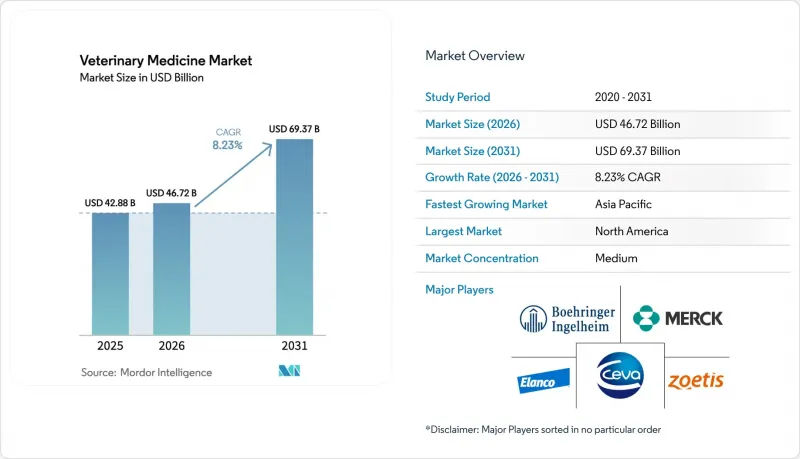
수의학 시장 규모는 2025년 428억 8,000만 달러에서 2026년에는 467억 2,000만 달러로 확대되어 2026년부터 2031년까지 CAGR 8.23%로 성장을 지속하여, 2031년에는 693억 7,000만 달러에 이를 것으로 예측됩니다.
본 보고서는 제품 유형(의약품, 백신, 약용 사료 첨가제), 동물 종(반려동물, 가축),투여 경로(비경구, 경구, 기타), 최종 사용자(동물병원, 동물진료소, 기타) 및 지역(북미, 유럽, 아시아태평양, 중동 및 아프리카, 남미)별로 분류되어 있습니다. 시장 전망은 금액(달러) 기준으로 제시되어 있습니다.
세계 수의학 시장 동향 및 인사이트
증가하는 동물의 만성 질환 및 반려동물 보유율
2024년 미국의 반려동물 사육률은 67%에 달했으며, 현재도 계속 상승하고 있습니다. 한편, 7세 이상의 개 중 약 40%가 만성 질환을 앓고 있습니다. 반려인이 안락사 대신 장기적인 질환 관리를 선택하는 경향이 강해짐에 따라, 2025년 반려동물 1마리당 연간 지출액은 1,620달러에 달하여 전년 대비 12% 증가했습니다. 2025년 말 기준으로 북미에서는 440만 마리의 반려동물이 보험에 가입되어 있으며, 이로 인해 본인 부담 위험의 상당 부분이 보험사로 이전되면서 고가의 바이오 의약품 보급이 촉진되고 있습니다. 2025년에 반려동물 총 수가 2억 마리를 넘어선 중국에서도 유사한 경향이 나타나고 있으며, 도시 지역의 밀레니얼 세대는 가처분 소득의 15%를 반려동물 돌봄에 지출하고 있습니다. 이러한 수요 증가는 성숙한 경제권과 신흥 경제권 모두에서 수의학 시장을 지탱하는 지속적인 성장 요인임을 여실히 보여주고 있습니다.
산업화된 가축 생산의 확대
중국은 3가 백신 접종을 의무화하는 생물안전 규정 하에 2025년 중반까지 돼지 사육 두수를 4억 5,000만 마리로 회복시켰으며, 이로 인해 돼지용 생물제제에 대한 지속적인 수요가 발생했습니다. 인도의 산란계 생산 능력은 2024년부터 2025년까지 8% 증가하여 520억 개의 달걀이 생산된 결과, 호흡기 계통 백신 수요가 높아졌습니다. 브라질의 2억 3,400만 마리 규모의 소 산업에서는 메탄 배출을 줄이면서 동시에 체중 증가도 촉진하는 사료 첨가제의 시범 도입이 진행되고 있으며, 이로 인해 치료용 의약품의 판매량이 증가하고 있습니다. 베트남의 양식업자들은 자체 제조 백신을 도입함으로써 2025년에 항생제 사용량을 22% 줄였습니다. 생산자들이 성장 촉진용 항생제에서 예방 플랫폼으로 전환하는 가운데, 이러한 동향은 전반적으로 수의학 시장의 장기적인 성장 동력이 되고 있습니다.
고도의 수의학 치료 및 진단에 드는 높은 비용
2025년 미국의 MRI 검사 비용은 2,500-3,500달러이며, 보험에 가입하지 않은 반려인 중 40%는 첨단 영상 진단을 받는 것을 주저하고 있습니다. 체중 30kg인 개에 대한 사이트포인트 요법의 연간 비용은 1,080-1,440달러인 반면, 제네릭 스테로이드 약물의 총 비용은 180달러에 불과하여 치료의 지속성에 격차가 발생하고 있습니다. 남미의 축산 농가에서는 1두당 이익이 50달러 미만에 그치고 있어, 사망 위험이 극히 높지 않은 한 2달러짜리 백신은 수익성이 없습니다. 인도의 소규모 낙농가들은 1두당 연간 12미 달러 미만을 지출할 수 있을 뿐이며, 보조금을 통한 예방접종 캠페인에 의존하고 있습니다. 따라서 높은 가격대는 프리미엄 제품의 보급을 방해하고, 수의학 시장의 확장을 억제하고 있습니다.
부문 분석
2025년에는 의약품이 57.11%의 점유율을 차지했으나, 백신은 연평균 성장률(CAGR) 10.62%로 성장을 지속하고, 있으며, 이러한 변화는 항생제의 적정 사용에 관한 규제를 반영한 것입니다. ‘NexGard’나 ‘Credelio’와 같은 구충제는 기후 온난화로 인해 벼룩과 진드기의 발생 시즌이 장기화된 것을 호재로 삼아, 2025년에는 총 10억 달러 이상의 매출을 창출했습니다. 유럽에서는 플루오로퀴놀론계 및 세팔로스포린계 항균제의 사용이 감소함에 따라, 항감염제 매출액은 전년 대비 18% 감소했습니다. 재조합 백신은 DIVA(질병 면역 유도) 효과를 제공하며, 조에티스(Zoetis)사의 ‘포스텔라 골드 PCV MH’는 2유형의 돼지 병원체에 대한 예방 효과를 결합함으로써 2025년에 1억 8,000만 달러의 매출을 기록했습니다. 생산자들이 항생제를 사용하지 않고 성장을 가속하게 되면서, 아미노산계 사료 첨가제 시장은 9% 확대되었습니다.
2025년 매출액 중 반려동물이 55.93%를 차지했으나, 가축용 치료제는 연평균 성장률(CAGR) 12.26%를 나타낼 것으로 예측되어, 이러한 추세에 따라 양자 간의 격차는 점차 좁혀질 전망입니다. 반려동물 분야 매출액 중 개가 62%를 차지하고 있는데, 이는 투여량 증가와 정형외과 수술 건수 증가에 기인합니다. 고양이는 32%로 그 뒤를 이었으며, 솔렌시아(Solensia)와 같은 고양이 전용 바이오의약품에 힘입어 수요가 증가했습니다. 절대액 기준으로는 소가 여전히 가축 분야에서 가장 큰 지출 비중을 차지하고 있습니다. 그러나 중국, 인도, 미국이 1회당 비용을 최소화하면서 수십억 마리의 가금류에 백신 접종을 실시하고 있어, 가금류 분야가 가장 빠르게 성장할 것으로 예측됩니다. 아프리카 돼지열병으로부터의 회복에 따라 양돈 업계의 백신 접종률이 높아져, 2025년까지 상업 농장의 78%를 나타낼 것으로 전망됩니다.
지역별 분석
북미는 2025년 매출의 41.46%를 차지했습니다. 이는 미국의 8,500만 가구가 반려동물을 키우고 있으며, 반려동물 1마리당 연간 지출이 1,500달러를 초과하는 것이 원동력이 되고 있습니다. 이 지역에서는 항생제 적정 사용에 관한 규제가 백신 도입을 뒷받침하는 한편, 온라인 약국의 주도하에 접근성이 확대되고 있습니다. 유럽은 영국과 스웨덴에서 반려동물 보험 가입률이 25%를 초과하고 본인 부담금이 안정화됨에 따라 2025년 매출의 28%를 차지했습니다. 규정(EU) 2019/6에 따라 예방용 생물학적 제제의 사용이 강화되었으며, 통증 관리에 관한 규제로 인해 가축용 진통제의 도입이 진행되고 있습니다.
아시아태평양은 연평균 성장률(CAGR) 11.86%가 예상되며, 중국이 돼지 사육 두수를 회복하고 인도가 가금류 생산 능력을 확대함에 따라 북미의 우위가 점차 도전받고 있습니다. 도시 지역의 가처분 소득 증가가 반려동물 수요를 끌어올리고 있으며, 2025년에는 중국의 주요 도시에서만 1억 2,100만 마리의 반려동물이 사육되고 있었습니다. 콜드체인 부족은 여전히 과제로 남아 있지만, 국내 생물학적 제제 제조에 대한 투자가 확대되고 있어, 이는 수의학 시장에 장기적인 성장의 조짐을 보여주고 있습니다.
남미는 2025년 매출의 9%를 차지하며, 그 주된 요인은 브라질의 2억 3,400만 마리에 달하는 소 사육 두수에 있습니다. 그러나 생산자들이 제네릭 의약품을 선호하기 때문에 1마리당 지출액은 세계 평균보다 낮습니다. 중동 및 아프리카는 6%를 차지하며, GCC 국가들의 말용 치료제와 남아프리카공화국의 구제역 백신이 수요의 주축을 이루고 있습니다. 이 지역의 성장 전망은 콜드체인 인프라 개선과 구매력 향상에 달려 있습니다.
기타 혜택:
- 엑셀 형식 시장 예측(ME) 시트
- 3개월간의 애널리스트 지원
자주 묻는 질문
목차
제1장 서론
제2장 조사 방법
제3장 주요 요약
제4장 시장 구도
제5장 시장 규모와 성장 예측
제6장 경쟁 구도
제7장 시장 기회와 향후 전망
JHS 26.09.11According to Mordor Intelligence, the veterinary medicine market size is expected to grow from USD 42.88 billion in 2025 to USD 46.72 billion in 2026 and is forecast to reach USD 69.37 billion by 2031 at 8.23% CAGR over 2026-2031.
This report is Segmented by Product Type (Drugs, Vaccines, Medicated Feed Additives), Animal Type (Companion Animals, Livestock Animals), Mode of Delivery (Parenteral, Oral, and More), End User (Veterinary Hospitals, Veterinary Clinics, and More), and Geography (North America, Europe, Asia-Pacific, Middle East & Africa, South America). The Market Forecasts are Provided in Terms of Value (USD).
Global Veterinary Medicine Market Trends and Insights
Rising Chronic Animal Diseases & Pet Ownership
Pet-ownership levels climbed to 67% of U.S. households in 2024 and continue to rise, while chronic conditions now affect approximately 40% of dogs older than seven years. The annual spend per companion animal reached USD 1,620 in 2025, a 12% year-over-year increase, as owners opt for long-term disease management over euthanasia. Four-point-four million pets carried insurance in North America by the end of 2025, shifting more out-of-pocket risk to insurers and enabling the uptake of premium biologics. China, with a population of over 200 million pets in 2025, mirrors these patterns as urban millennials allocate 15% of their disposable income to pet care. The resulting demand underscores a durable driver for the veterinary medicine market across both mature and emerging economies.
Industrialised Livestock Expansion
China rebuilt its swine herd to 450 million head by mid-2025 under biosecurity rules that require trivalent vaccines, triggering sustained demand for porcine biologics. India's layer-hen capacity increased by 8% between 2024 and 2025, resulting in the production of 52 billion eggs, which subsequently raised demand for respiratory vaccines. Brazil's 234 million-head cattle sector is trialing methane-reducing feed additives that also improve weight gain, thereby boosting therapeutic volumes. Vietnam's aquaculture producers lowered antibiotic use by 22% in 2025 by adopting autogenous vaccines. Together, these developments serve as a long-term catalyst for the veterinary medicine market, as producers shift from growth-promoting antibiotics to preventive platforms.
High Cost of Advanced Veterinary Care & Diagnostics
MRI scans cost USD 2,500-3,500 in the United States in 2025, discouraging 40% of uninsured owners from pursuing advanced imaging. Cytopoint therapy for a 30-kg dog costs USD 1,080-1,440 per year, while generic steroids total USD 180, creating adherence gaps. South American cattle operations earn margins below USD 50 per head, making USD 2 vaccines unviable unless mortality risk is severe. Small Indian dairy farmers spend under USD 12 annually per cow, relying on subsidized campaigns. High price points, therefore, constrain premium uptake, tempering expansion of the veterinary medicine market.
Other drivers and restraints analyzed in the detailed report include:
- Regulatory Antibiotic-Stewardship Push for Vaccines/Biologics
- Break-Through MAbs & Gene-Based Therapies Approvals
- Stringent Multi-Region Regulatory Pathways
For complete list of drivers and restraints, kindly check the Table Of Contents.
Segment Analysis
Drugs controlled a 57.11% share in 2025, but vaccines are on track for a 10.62% CAGR, a pivot that mirrors antibiotic-stewardship mandates. Parasiticides, such as NexGard and Credelio, generated more than USD 1 billion combined in 2025, buoyed by warming climates that extend flea and tick seasons. Anti-infective sales declined 18% year-over-year in Europe, as the use of fluoroquinolones and cephalosporins decreased. Recombinant vaccines offer DIVA capability, and Zoetis's Fostera Gold PCV MH earned USD 180 million in 2025 by bundling protection against two porcine pathogens. Amino-acid feed additives expanded by 9% as producers sought growth promotion without antibiotics.
Companion animals accounted for 55.93% of 2025 revenue; however, livestock treatments are projected to have a 12.26% CAGR, a rate that will progressively narrow the gap. Dogs represented 62% of companion-animal turnover thanks to higher dosing volumes and a greater orthopedic surgery burden. Cats followed at 32%, boosted by feline-specific biologics such as Solensia. Cattle remain the largest livestock spenders by absolute value. Yet, poultry is expected to grow fastest as China, India, and the United States vaccinate billions of birds at a minimal per-dose cost. The swine sector's recovery from African swine fever has led to high vaccine uptake, reaching 78% of commercial farms by 2025.
Complete Report Scope:
- By Product Type
- Drugs
- Anti-infectives
- Anti-inflammatory
- Parasiticides
- Biologics / Vaccines
- Other Drugs
- Vaccines
- Inactive Vaccines
- Attenuated Vaccines
- Recombinant Vaccines
- Other Vaccines
- Medicated Feed Additives
- Aminoacids
- Antibiotics
- Other Medicated Feed Additives
- Drugs
- By Animal Type
- Companion Animals
- Dogs
- Cats
- Other Companion Animals
- Livestock Animals
- Cattle
- Poultry
- Swine
- Sheep & Goats
- Other Livestock
- Companion Animals
- By Mode of Delivery
- Parenteral
- Oral
- Topical
- Other Mode of Delivery
- By End User
- Veterinary Hospitals
- Veterinary Clinics
- Home-care Settings
- Research & Academic Institutes
- By Geography
- North America
- United States
- Canada
- Mexico
- Europe
- Germany
- United Kingdom
- France
- Italy
- Spain
- Rest of Europe
- Asia-Pacific
- China
- Japan
- India
- Australia
- South Korea
- Rest of Asia-Pacific
- Middle East & Africa
- GCC
- South Africa
- Rest of Middle East & Africa
- South America
- Brazil
- Argentina
- Rest of South America
- North America
Geography Analysis
North America generated 41.46% of the 2025 revenue, driven by 85 million U.S. pet households and an annual per-pet spend exceeding USD 1,500. The region's regulatory emphasis on antimicrobial stewardship pushes vaccine adoption, while e-pharmacy leadership expands access. Europe captured 28% of 2025 sales as pet insurance coverage exceeded 25% in the United Kingdom and Sweden, stabilizing out-of-pocket expenses. Regulation (EU) 2019/6 reinforces the use of preventive biologics, and pain-management rules increase analgesic uptake in livestock.
The Asia-Pacific region is poised for an 11.86% CAGR and is gradually challenging North American dominance as China rebuilds its hog herd and India scales up poultry capacity. Rising urban disposable incomes lift companion-animal demand; tier-1 Chinese cities alone counted 121 million pets in 2025. Cold-chain gaps remain a constraint; however, domestic biologics manufacturing investments are ramping up, signaling a long-term upside for the veterinary medicine market.
South America contributed 9% of 2025 turnover, chiefly from Brazil's 234 million-head cattle herd; however, per-animal spend lags global averages because producers favor generics. Middle East & Africa held 6%, with equine therapeutics in GCC countries and South African vaccines against foot-and-mouth disease anchoring demand. Regional growth prospects depend on improving cold-chain infrastructure and gains in purchasing power.
- Biogenesis Bago
- Bimeda
- Boehringer Ingelheim
- Ceva Sante Animale
- China Animal Husbandry Co.
- Dechra Pharmaceuticals
- Elanco
- Hester Biosciences
- Hipra
- Huvepharma
- IDEXX
- Kyoritsu Seiyaku
- Merck
- Neogen
- Norbrook
- Phibro Animal Health
- Vetoquinol
- Virbac
- Zoetis
Additional Benefits:
- The market estimate (ME) sheet in Excel format
- 3 months of analyst support
TABLE OF CONTENTS
1 Introduction
- 1.1 Study Assumptions & Market Definition
- 1.2 Scope of the Study
2 Research Methodology
3 Executive Summary
4 Market Landscape
- 4.1 Market Overview
- 4.2 Market Drivers
- 4.2.1 Rising Chronic Animal Diseases & Pet Ownership
- 4.2.2 Industrialised Livestock Expansion
- 4.2.3 Regulatory Antibiotic-Stewardship Push for Vaccines/Biologics
- 4.2.4 Break-Through Mabs & Gene-Based Therapies Approvals
- 4.2.5 Digital / E-Pharmacy Acceleration
- 4.2.6 Specialty Therapeutics for Ageing Pets
- 4.3 Market Restraints
- 4.3.1 High Cost of Advanced Veterinary Care & Diagnostics
- 4.3.2 Stringent Multi-Region Regulatory Pathways
- 4.3.3 Consumer Backlash on Antibiotic Use in Food Animals
- 4.3.4 Fragile API & Biologics Cold-Chain Supply
- 4.4 Value / Supply-Chain Analysis
- 4.5 Regulatory Landscape
- 4.6 Technological Outlook
- 4.7 Porter's Five Forces Analysis
- 4.7.1 Threat of New Entrants
- 4.7.2 Bargaining Power of Buyers
- 4.7.3 Bargaining Power of Suppliers
- 4.7.4 Threat of Substitutes
- 4.7.5 Competitive Rivalry
5 Market Size & Growth Forecasts
- 5.1 By Product Type
- 5.1.1 Drugs
- 5.1.1.1 Anti-infectives
- 5.1.1.2 Anti-inflammatory
- 5.1.1.3 Parasiticides
- 5.1.1.4 Biologics / Vaccines
- 5.1.1.5 Other Drugs
- 5.1.2 Vaccines
- 5.1.2.1 Inactive Vaccines
- 5.1.2.2 Attenuated Vaccines
- 5.1.2.3 Recombinant Vaccines
- 5.1.2.4 Other Vaccines
- 5.1.3 Medicated Feed Additives
- 5.1.3.1 Aminoacids
- 5.1.3.2 Antibiotics
- 5.1.3.3 Other Medicated Feed Additives
- 5.1.1 Drugs
- 5.2 By Animal Type
- 5.2.1 Companion Animals
- 5.2.1.1 Dogs
- 5.2.1.2 Cats
- 5.2.1.3 Other Companion Animals
- 5.2.2 Livestock Animals
- 5.2.2.1 Cattle
- 5.2.2.2 Poultry
- 5.2.2.3 Swine
- 5.2.2.4 Sheep & Goats
- 5.2.2.5 Other Livestock
- 5.2.1 Companion Animals
- 5.3 By Mode of Delivery
- 5.3.1 Parenteral
- 5.3.2 Oral
- 5.3.3 Topical
- 5.3.4 Other Mode of Delivery
- 5.4 By End User
- 5.4.1 Veterinary Hospitals
- 5.4.2 Veterinary Clinics
- 5.4.3 Home-care Settings
- 5.4.4 Research & Academic Institutes
- 5.5 By Geography
- 5.5.1 North America
- 5.5.1.1 United States
- 5.5.1.2 Canada
- 5.5.1.3 Mexico
- 5.5.2 Europe
- 5.5.2.1 Germany
- 5.5.2.2 United Kingdom
- 5.5.2.3 France
- 5.5.2.4 Italy
- 5.5.2.5 Spain
- 5.5.2.6 Rest of Europe
- 5.5.3 Asia-Pacific
- 5.5.3.1 China
- 5.5.3.2 Japan
- 5.5.3.3 India
- 5.5.3.4 Australia
- 5.5.3.5 South Korea
- 5.5.3.6 Rest of Asia-Pacific
- 5.5.4 Middle East & Africa
- 5.5.4.1 GCC
- 5.5.4.2 South Africa
- 5.5.4.3 Rest of Middle East & Africa
- 5.5.5 South America
- 5.5.5.1 Brazil
- 5.5.5.2 Argentina
- 5.5.5.3 Rest of South America
- 5.5.1 North America
6 Competitive Landscape
- 6.1 Market Concentration
- 6.2 Market Share Analysis
- 6.3 Company Profiles (includes Global level Overview, Market-level Overview, Core Segments, Financials, Strategic Information, Market Rank/Share, Products & Services, Recent Developments)
- 6.3.1 Biogenesis Bago
- 6.3.2 Bimeda
- 6.3.3 Boehringer Ingelheim Animal Health
- 6.3.4 Ceva Sante Animale
- 6.3.5 China Animal Husbandry Co.
- 6.3.6 Dechra Pharmaceuticals
- 6.3.7 Elanco Animal Health
- 6.3.8 Hester Biosciences
- 6.3.9 HIPRA
- 6.3.10 Huvepharma
- 6.3.11 IDEXX Laboratories
- 6.3.12 Kyoritsu Seiyaku
- 6.3.13 Merck Animal Health
- 6.3.14 Neogen Corporation
- 6.3.15 Norbrook
- 6.3.16 Phibro Animal Health
- 6.3.17 Vetoquinol
- 6.3.18 Virbac
- 6.3.19 Zoetis Inc.
7 Market Opportunities & Future Outlook
- 7.1 White-space & Unmet-need Assessment


