

|
시장보고서
상품코드
2123796
초박형 유리 시장 : 시장 점유율 분석, 업계 동향 및 통계, 성장 예측(2026-2031년)Ultra-Thin Glass - Market Share Analysis, Industry Trends & Statistics, Growth Forecasts (2026 - 2031) |
||||||
 Mordor Intelligence
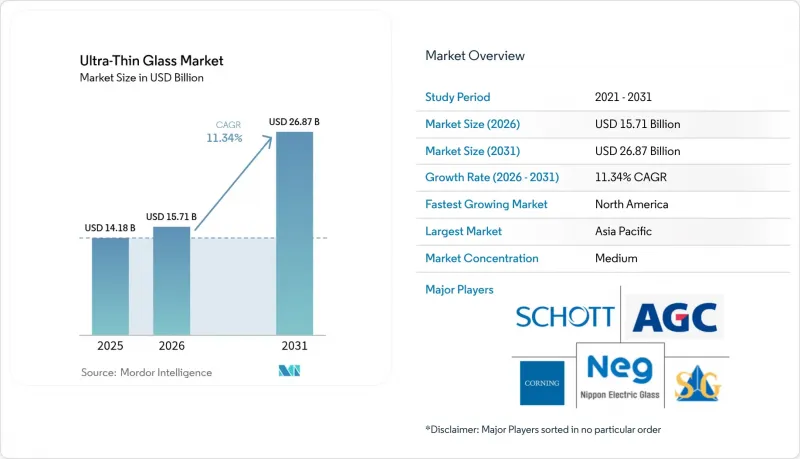
Mordor Intelligence에 의하면, 초박형 유리 시장 규모는 2025년에 141억 8,000만 달러로 평가되었고, 2026년에 157억 1,000만 달러로 추정되고, 2031년까지 268억 7,000만 달러에 이를 것으로 예측되며, 2026-2031년 CAGR 11.34%로 성장할 전망입니다.
본 보고서는 유리 유형별(알루미노규산염, 붕규산염, 소다석회, 기타), 제조 공정별(퓨전 드로우, 다운 드로우, 플로트, 롤 투 롤), 용도별(반도체 기판, 터치 패널, 센서, 자동차, 기타), 최종 사용자별(가전제품, 자동차, 기타), 지역별(아시아태평양, 기타)로 분류되어 있습니다. 시장 전망은 금액(달러) 기준으로 제시되어 있습니다.
세계의 초박형 유리 시장 동향 및 인사이트
소비자 가전 분야 수요 증가
2025년에는 디스플레이 하단 센서 및 엣지 투 엣지 터치 모듈로의 견고한 업그레이드 주기에 힘입어, 소비자 가전 기기가 시장 규모의 대부분을 차지하며 두 자릿수 성장을 견인했습니다. 새로운 ‘코닝 고릴라 아머 2(Corning Gorilla Armor 2)’를 탑재한 삼성의 ‘갤럭시 S25 울트라’는 표면 반사율을 현저히 낮췄습니다. 이러한 혁신으로 인해 경쟁 OEM 업체들도 마찬가지로 0.4mm 두께의 기판을 채택하기 시작했습니다. 이에 이어 노트북 제조업체들도 현재 초박형 유리 패널을 채택하며, 기존에 사용되던 황변이 쉬운 폴리이미드 필름에서 점차 전환하고 있습니다. 그러나 이 부문의 동향은 변화하고 있으며, AI 가속기용 반도체 기판이 시장 점유율을 확대하기 시작했습니다. 이러한 첨단 패키징 용도는 평균 판매 가격이 높을 뿐만 아니라, 알칼리 프리 화학 조성을 채택하고 있습니다. 이를 통해 112 Gbps SerDes 레인의 보호가 보장되며, 수익의 중점이 이러한 성능이 극히 중요한 등급으로 미묘하게 이동하고 있습니다.
폴더블 스마트폰 및 노트북의 급속한 보급
접이식 폼 팩터의 등장으로 초박형 유리의 경제성은 혁명적인 변화를 겪었습니다. 삼성디스플레이는 8.6세대 OLED 생산 라인을 가동 중이며, 2026년 출시가 예상되는 애플의 접이식 아이폰을 위해 주름이 생기지 않는 패널을 공급할 예정입니다. 위험을 줄이기 위해 중국의 각 패널 제조업체들은 마이크로플로트 방식의 소다석회 유리 커버 개발에 협력하고 있습니다. 이러한 혁신적인 커버는 뛰어난 내구성을 자랑하며, 비용 면에서도 큰 우위를 점하고 있습니다. 한편, 코닝(Corning)은 180도 열리는 노트북의 힌지용으로 특별히 설계된 ‘윌로우(Willow)’ 롤-투-롤 호우케이사유리 라이선스 계약을 체결했습니다. 그 결과, 업계의 관심은 단순히 힌지의 내구성을 확보하는 것에서 수율 관리 최적화로 옮겨가고 있습니다. 특히 주목할 점은 플로트 및 마이크로 플로트 생산 라인 모두 대중 시장을 겨냥한 접이식 기기 분야에서 가격과 신뢰성의 균형이 잡힌 ‘최적의 수준’에 가까워지고 있다는 것입니다.
고순도 원자재와 정밀 가공으로 인한 비용 상승
철분 함량이 50ppm 미만인 전자 등급 실리카, 고순도 알루미나 분말, 그리고 백금·로듐 제로 가격의 급등으로 인해 비용이 상승하고 있습니다. 2025년에는 실리카의 현물 가격이 급등하여, 특히 헤지 계약을 체결하지 않은 플로트 라인의 이익률에 영향을 미쳤습니다. 고온에서 가동되는 퓨전 드로우 용광로에서는 정기적으로 도가니를 교체해야 합니다. 또한, 이온 교환법이나 레이저 패터닝 기술에서는 소다석회 유리에 비해 알루미노규산염 커버에 상당한 할증 가격이 요구됩니다. 유럽의 제조업체들은 천연가스 요금 급등으로 인한 압박이 커지는 데 어려움을 겪고 있습니다. SCHOTT사가 마인츠에서 실시한 전기용해 설비 개보수는 어느 정도 완화를 가져왔지만, 에너지 가격 변동을 완전히 막을 수는 없습니다.
부문별 분석
소다-석회계 초박형 제품은 2025년 매출의 46.09%를 차지했으며, 높은 수율로 두께 100μm 미만을 실현하는 마이크로 플로트 생산 라인에 힘입어 연평균 성장률(CAGR) 12.10%를 나타낼 것으로 예측됩니다. 알루미노규산염 유리는 접이식 기기의 커버 소재로 주류를 차지하고 있으며, 800 MPa를 초과하는 표면 압축 강도로 균열 없이 20만 번의 접기를 견딜 수 있음이 보장됩니다. 붕규산 유리 및 알칼리 프리 유리는 반도체 기판을 지탱하는 기반이 되며, 3.5 ppm/°C 미만의 낮은 팽창률로 고속 상호 연결을 보호합니다. 리튬 알루미노실리케이트 유리는 팽창률이 거의 제로에 가까워 HUD(헤드업 디스플레이)용 광학 소자 분야에서는 여전히 틈새 시장으로 남아 있습니다. ISO 12543-4 내구성 시험에서 자동차용 적층판에 있어 붕규산 유리가 우수한 성능을 보이지만, 비용이 높음에도 불구하고 프리미엄 OEM 각사는 고급 모델에 이를 채택하고 있습니다. 따라서 중국의 플로트 유리 제조업체들은 중급 전자기기용으로 소다-석회 유리의 생산 규모를 대폭 확대하고 있는 반면, 다수의 특허를 보유한 기존 기업들은 높은 이익률을 보이는 알루미노실리케이트 유리 및 붕규산 유리 분야를 유지하고 있습니다.
플로트법 및 마이크로 플로트법에 의한 생산량은 2025년 총 생산량의 50.68%를 차지했으며, 생산 능력 확대로 인해 2031년까지 연평균 성장률(CAGR)은 12.89%를 나타낼 것으로 전망됩니다. 마이크로 플로트 라인의 비용은 퓨전 드로우 공법에 비해 대폭 낮기 때문에 최적의 가동률을 전제로 할 경우 투자 회수 기간을 단축할 수 있습니다. 그러나 유리 인터포저나 접이식 커버 등 결함이 허용되지 않는 특정 용도에서는 여전히 퓨전 공법이나 다운드로우 공법에 의존하고 있습니다. 이러한 경향은 이러한 방법에서는 용융 유리가 내화물 표면과 접촉하지 않는다는 사실에서 기인합니다. 예를 들어, SCHOTT사의 다운드로 공법을 이용한 붕규산 유리는 두께 20μm, 표면 거칠기 0.5 nm 미만을 실현하고 있습니다. 주석욕 플로트법에서는 용융 유리가 표면에 접촉함으로써 약 2 nm의 요철이 발생하기 때문에 이러한 성능을 달성할 수 없습니다. 한편, 슬릿 드로우법이나 롤-투-롤법은 급성장하는 플렉서블 전자기기 시장에 대응하고 있습니다. 특히 코닝 윌로우(Corning Willow)사는 곡면 OLED 조명의 선구자이며, 프라운호퍼 연구소는 태양광 발전 모듈용 릴에 코팅을 실시했습니다. 그 결과, 공정 선택은 허용 가능한 불순물 농도와 설비 투자 간의 균형을 맞추는 작업으로 진화하고 있으며, 공급망의 세분화가 진행되고 있습니다.
지역별 분석
아시아태평양은 한국의 OLED 투자와 규모의 경제를 강화하는 중국의 플로트 공정 설비 개조에 힘입어 2025년 매출의 49.59%를 차지했습니다. 북미는 CHIPS법에 따른 팹 건설과 자동차 경량화 의무화에 힘입어 2031년까지 연평균 성장률(CAGR)이 11.91%에 달할 전망입니다. 주요 기업들이 첨단 패키징 수요를 주도하는 한편, AGC의 멕시코 트라스칼라 공장은 미국 OEM 제조업체에 제품을 공급하고 있습니다. 상당한 시장 점유율을 차지하는 유럽은 자동차용 유리 수요와 엄격한 친환경 설계 규제의 영향을 받고 있습니다. SCHOTT의 전기 용해 설비 개조는 에너지 가격 변동 위험을 완화할 뿐만 아니라 CO2 배출량 감축에도 기여하고 있습니다. 한편, BMW 등 각 OEM 업체들은 2027년까지 설정된 차량군 목표를 달성하기 위해 초박형 루프를 채택하고 있습니다. 남미 및 중동 및 아프리카(MEA) 지역은 여전히 발전 단계에 있지만, 태양광 발전 사업, 특히 2028년 이후 주목받을 100μm 붕규산 유리 커버 수요로부터 혜택을 볼 전망입니다.
기타 혜택 :
- 엑셀 형식 시장 예측(ME) 시트
- 3개월간의 애널리스트 지원
자주 묻는 질문
목차
제1장 서론
제2장 조사 방법
제3장 주요 요약
제4장 시장 구도
제5장 시장 규모 및 성장 예측
제6장 경쟁 구도
제7장 시장 기회 및 향후 전망
AJY 26.09.11According to Mordor Intelligence, the ultra-Thin glass market size is projected to be USD 14.18 billion in 2025, USD 15.71 billion in 2026, and reach USD 26.87 billion by 2031, growing at a CAGR of 11.34% from 2026 to 2031.
This report is Segmented by Glass Type (Aluminosilicate, Borosilicate, Soda-Lime, and Others), Manufacturing Process (Fusion Draw, Down-Draw, Float, and Roll-To-Roll), Application (Semiconductor Substrate, Touch Panels, Sensors, Automotive, and Others), End-User (Consumer Electronics, Automotive, and More), and Geography (Asia-Pacific, and More). The Market Forecasts are Provided in Terms of Value (USD).
Global Ultra-Thin Glass Market Trends and Insights
Growing Demand from Consumer Electronics
In 2025, consumer electronics accounted for a significant portion of the market volume, driven by a robust upgrade cycle towards under-display sensors and edge-to-edge touch modules, fueling double-digit growth. Samsung's Galaxy S25 Ultra, featuring the new Corning Gorilla Armor 2, achieved a notable reduction in surface reflectance. This innovation has led rival OEMs to pursue similar 0.4-millimeter substrates. Following suit, notebook vendors are now adopting ultra-thin glass panels, moving away from the previously used yellow-prone polyimide films. However, the segment's dynamics are evolving, with semiconductor substrates for AI accelerators beginning to capture a larger market share. These advanced packaging applications not only command higher average selling prices but also utilize alkali-free chemistries. This ensures the protection of 112 Gbps SerDes lanes, subtly shifting the revenue focus towards these performance-critical grades.
Rapid Adoption in Foldable Smartphones and Notebooks
Ultra-thin glass economics have been revolutionized by the advent of foldable form factors. Samsung Display is rolling out its 8.6-generation OLED line, set to deliver crease-free panels tailored for Apple's anticipated foldable iPhone debuting in 2026. In a bid to mitigate risks, Chinese panel manufacturers are collaborating on microfloat soda-lime covers. These innovative covers boast impressive endurance and come at a significant cost advantage. Meanwhile, Corning has struck a deal, licensing its Willow roll-to-roll borosilicate, specifically designed for 180-degree notebook hinges. As a result, the industry's spotlight has shifted from merely ensuring hinge durability to mastering yield management. Notably, both float and microfloat lines are nearing the pivotal threshold, a sweet spot that harmonizes price and reliability for the mass-market foldable segment.
High Cost of High-Purity Raw Materials and Precision Processing
Costs rise as electronic-grade silica, with iron content less than 50 ppm, high-purity alumina powder, and platinum-rhodium furnace hardware see price hikes. In 2025, spot silica prices surged, impacting float-line margins, especially for those without hedged contracts. Fusion-draw furnaces, operating at high temperatures, necessitate crucible replacements periodically. Additionally, ion-exchange and laser patterning techniques command a significant premium for aluminosilicate covers compared to soda-lime. European manufacturers grapple with heightened pressures from soaring natural-gas tariffs. While SCHOTT's electric-melting retrofit in Mainz offers some relief, it doesn't fully shield against energy price fluctuations.
Other drivers and restraints analyzed in the detailed report include:
- Advancements in Flexible OLED and Micro-LED Display Lines
- Weight-Reduction Needs in Automotive Glazing and HUDs
- Brittleness and Yield Loss During Large-Area Handling
For complete list of drivers and restraints, kindly check the Table Of Contents.
Segment Analysis
Soda-lime ultra-thin products captured 46.09% of 2025 revenue and are forecast to grow at a 12.10% CAGR, underpinned by microfloat lines that hit sub-100 μm thickness at high yield. Aluminosilicate commands foldable-device covers where surface compression above 800 MPa secures 200,000 folds without cracks. Borosilicate and alkali-free glass underpin semiconductor substrates; their sub-3.5 ppm/°C expansion protects high-speed interconnects. Lithium-aluminosilicate remains a niche in HUD optics for its near-zero expansion. ISO 12543-4 durability tests favor borosilicate in automotive laminates, nudging premium OEMs upscale despite higher costs. Chinese float operators are therefore scaling soda-lime to significant production levels for mid-tier electronics, while patent-rich incumbents retain high-margin aluminosilicate and borosilicate tiers.
Float and microfloat technologies delivered 50.68% of 2025 production, and capacity expansions point to a 12.89% CAGR through 2031. The cost of a microfloat line is significantly lower than that of a fusion draw, allowing for a shorter payback period, assuming an optimal utilization rate. However, certain zero-defect applications, such as glass interposers and foldable covers, remain reliant on fusion and down-draw methods. This preference is due to the fact that in these methods, the melt never comes into contact with refractory surfaces. For instance, SCHOTT's down-draw borosilicate achieves a thickness of 20 μm with a roughness of less than 0.5 nm. These metrics are beyond reach in the tin-bath float method, where contact results in asperities of approximately 2 nm. Meanwhile, slit-draw and roll-to-roll processes are catering to the burgeoning flexible electronics market. Notably, Corning Willow is pioneering curved OLED lighting, and Fraunhofer is coating reels for photovoltaic modules. Consequently, the choice of process has evolved into a balancing act between acceptable inclusion density and capital expenditure, leading to a segmentation in the supply base.
Complete Report Scope:
- By Glass Type
- Aluminosilicate (e.g., Gorilla, Dragontrail)
- Borosilicate/Alkali-Free
- Soda-Lime Ultra-Thin
- Others (Lithium-Aluminosilicate, etc.)
- By Manufacturing Process
- Fusion Draw
- Down-Draw/Overflow
- Float and Microfloat
- Slit Draw/Roll-to-Roll
- By Application
- Semiconductor Substrate
- Touch Panel Displays
- Fingerprint Sensors
- Automotive Glazing
- Other Applications (Automotive Displays and Glazing, etc.)
- By End-User Industry
- Consumer Electronics
- Automotive
- Biotechnology
- Other End-User Industries (Energy and Power, etc.)
- By Geography
- Asia-Pacific
- China
- India
- Japan
- South Korea
- Rest of Asia-Pacific
- North America
- United States
- Canada
- Mexico
- Europe
- Germany
- United Kingdom
- France
- Italy
- Rest of Europe
- South America
- Brazil
- Argentina
- Rest of South America
- Middle-East and Africa
- Saudi Arabia
- South Africa
- Rest of Middle-East and Africa
- Asia-Pacific
Geography Analysis
Asia-Pacific delivered 49.59% of 2025 revenue, buoyed by Korean OLED investments and Chinese float retrofits that bolster economies of scale. North America's 11.91% CAGR through 2031, fueled by the CHIPS Act's fabs and mandates for vehicle lightweighting. Major players are driving the demand for advanced packaging, while AGC's Tlaxcala plant in Mexico supplies U.S. OEMs. Europe, holding a notable market share, is influenced by automotive glazing needs and stringent ecodesign regulations. SCHOTT's retrofit of electric melting not only mitigates energy volatility but also reduces CO2 emissions. Meanwhile, OEMs like BMW are adopting ultra-thin roofs to achieve a fleet target by 2027. Although South America and the MEA regions are still emerging, they stand to benefit from solar-energy initiatives, especially with a focus on 100 μm borosilicate covers post-2028.
- AGC Inc.
- Central Glass Co., Ltd.
- Changzhou Almaden Co., Ltd.
- Corning Incorporated
- CSG Holding Co., Ltd.
- Emerge Glass
- Fraunhofer
- Irico Group New Energy Company Limited
- Nippon Electric Glass Co., Ltd.
- Nippon Sheet Glass Co., Ltd.
- Nitto Denko Corporation.
- OFILM
- Samsung
- SCHOTT AG
- Taiwan Glass Ind. Corp.
- Tunghsu Optoelectronic Technology
- Xinyi Glass Holdings Limited.
Additional Benefits:
- The market estimate (ME) sheet in Excel format
- 3 months of analyst support
TABLE OF CONTENTS
1 Introduction
- 1.1 Study Assumptions and Market Definition
- 1.2 Scope of the Study
2 Research Methodology
3 Executive Summary
4 Market Landscape
- 4.1 Market Overview
- 4.2 Market Drivers
- 4.2.1 Growing demand from consumer electronics
- 4.2.2 Rapid adoption in foldable smartphones and notebooks
- 4.2.3 Advancements in flexible OLED and micro-LED display lines
- 4.2.4 Weight-reduction needs in automotive glazing and HUDs
- 4.2.5 Glass interposers for chiplet packaging
- 4.3 Market Restraints
- 4.3.1 High cost of high-purity raw materials and precision processing
- 4.3.2 Brittleness and yield loss during large-area handling
- 4.3.3 Limited recycling streams for greater than 0.3 mm glass waste
- 4.4 Value Chain Analysis
- 4.5 Porter's Five Forces
- 4.5.1 Threat of New Entrants
- 4.5.2 Bargaining Power of Buyers
- 4.5.3 Bargaining Power of Suppliers
- 4.5.4 Threat of Substitute Products
- 4.5.5 Degree of Competition
5 Market Size and Growth Forecasts (Value)
- 5.1 By Glass Type
- 5.1.1 Aluminosilicate (e.g., Gorilla, Dragontrail)
- 5.1.2 Borosilicate/Alkali-Free
- 5.1.3 Soda-Lime Ultra-Thin
- 5.1.4 Others (Lithium-Aluminosilicate, etc.)
- 5.2 By Manufacturing Process
- 5.2.1 Fusion Draw
- 5.2.2 Down-Draw/Overflow
- 5.2.3 Float and Microfloat
- 5.2.4 Slit Draw/Roll-to-Roll
- 5.3 By Application
- 5.3.1 Semiconductor Substrate
- 5.3.2 Touch Panel Displays
- 5.3.3 Fingerprint Sensors
- 5.3.4 Automotive Glazing
- 5.3.5 Other Applications (Automotive Displays and Glazing, etc.)
- 5.4 By End-User Industry
- 5.4.1 Consumer Electronics
- 5.4.2 Automotive
- 5.4.3 Biotechnology
- 5.4.4 Other End-User Industries (Energy and Power, etc.)
- 5.5 By Geography
- 5.5.1 Asia-Pacific
- 5.5.1.1 China
- 5.5.1.2 India
- 5.5.1.3 Japan
- 5.5.1.4 South Korea
- 5.5.1.5 Rest of Asia-Pacific
- 5.5.2 North America
- 5.5.2.1 United States
- 5.5.2.2 Canada
- 5.5.2.3 Mexico
- 5.5.3 Europe
- 5.5.3.1 Germany
- 5.5.3.2 United Kingdom
- 5.5.3.3 France
- 5.5.3.4 Italy
- 5.5.3.5 Rest of Europe
- 5.5.4 South America
- 5.5.4.1 Brazil
- 5.5.4.2 Argentina
- 5.5.4.3 Rest of South America
- 5.5.5 Middle-East and Africa
- 5.5.5.1 Saudi Arabia
- 5.5.5.2 South Africa
- 5.5.5.3 Rest of Middle-East and Africa
- 5.5.1 Asia-Pacific
6 Competitive Landscape
- 6.1 Market Concentration
- 6.2 Strategic Moves
- 6.3 Market Share(%)/Ranking Analysis
- 6.4 Company Profiles (includes Global level Overview, Market level overview, Core Segments, Financials, Strategic Info, Products and Services, Recent Developments)
- 6.4.1 AGC Inc.
- 6.4.2 Central Glass Co., Ltd.
- 6.4.3 Changzhou Almaden Co., Ltd.
- 6.4.4 Corning Incorporated
- 6.4.5 CSG Holding Co., Ltd.
- 6.4.6 Emerge Glass
- 6.4.7 Fraunhofer
- 6.4.8 Irico Group New Energy Company Limited
- 6.4.9 Nippon Electric Glass Co., Ltd.
- 6.4.10 Nippon Sheet Glass Co., Ltd.
- 6.4.11 Nitto Denko Corporation.
- 6.4.12 OFILM
- 6.4.13 Samsung
- 6.4.14 SCHOTT AG
- 6.4.15 Taiwan Glass Ind. Corp.
- 6.4.16 Tunghsu Optoelectronic Technology
- 6.4.17 Xinyi Glass Holdings Limited.
7 Market Opportunities and Future Outlook
- 7.1 White-space and Unmet-need Assessment
- 7.2 Development of Advanced Glass for Solar Energy Projects


