

|
시장보고서
상품코드
2124223
전자 시뮬레이션 소프트웨어 시장 : 시장 점유율 분석, 업계 동향 및 통계, 성장 예측(2026-2031년)Electromagnetic Simulation Software - Market Share Analysis, Industry Trends & Statistics, Growth Forecasts (2026 - 2031) |
||||||
 Mordor Intelligence
Mordor Intelligence에 의하면, 전자 시뮬레이션 소프트웨어 시장 규모는 2026년에 16억 6,000만 달러로 추정되고, 2031년까지 27억 달러에 이를 것으로 예측되며, 2026-2031년 CAGR 10.22%라고 하는 견고한 성장을 나타내고 있습니다.
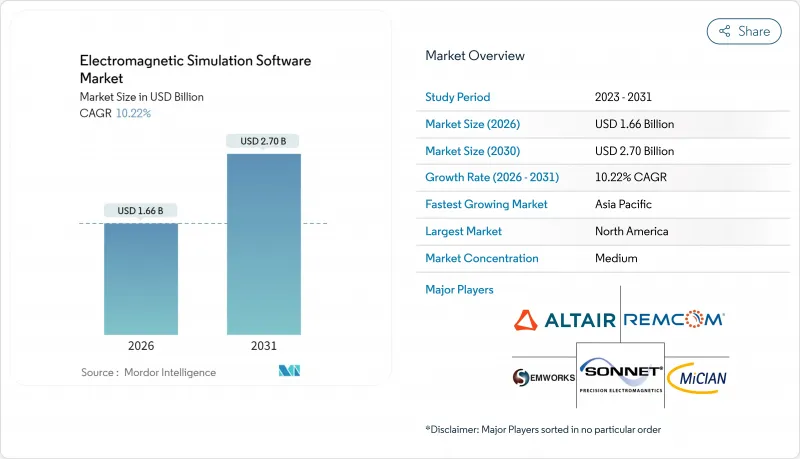
본 보고서는 솔버 유형별(적분 방정식 및 미분 방정식 솔버, 점근적 기법, 기타), 배포 모델별(온프레미스, 클라우드 기반, 기타), 용도별(안테나 설계 및 분석, 기타), 최종 이용 산업별(통신, 항공우주 및 방위, 기타), 주파수 대역별(정적/DC, 무선 주파수, 마이크로파, 기타), 지역별로 분류되어 있습니다. 시장 예측은 금액(달러) 기준으로 제시되어 있습니다.
세계의 전자 시뮬레이션 소프트웨어 시장 동향 및 인사이트
5G/6G 인프라 확장에 따른 첨단 안테나·RF 설계 툴에 대한 수요 증가
2025년, 통신 사업자들은 150만 기 이상의 5G 기지국을 가동했습니다. 또한, 서브 6GHz 대역의 매크로셀에서 mm파 스몰셀로의 전환에 따라, 기존 레이 트레이싱 소프트웨어로는 요구되는 정밀도로 처리할 수 없는 전자기 현상이 두드러지고 있습니다. 전파 솔버는 대규모 페이즈 어레이 전체에 걸친 상호 결합, 스캔 임피던스 드리프트, 그레이팅 로브 억제를 모델링하기 위해, 통신 장비 벤더들은 유한 요소법과 적분 방정식법을 결합한 하이브리드 기법에 대한 투자를 확대되고 있습니다. 일본의 ‘Beyond 5G 추진 컨소시엄’은 2024년에 테라헤르츠 대역 트랜시버 조사에 500억 엔(3억 4,000만 달러)의 예산을 편성했습니다. 이에 따라 시뮬레이션 업체들은 솔버의 주파수 범위를 300GHz 이상으로 확대하고, 그래핀 기반 메타표면을 위해 양자 보정된 재료 모델을 통합해야 할 필요가 생겼습니다. 키사이트의 ‘PathWave Design 2025’는 머신러닝을 활용한 안테나 합성을 통해 설계 반복 횟수를 40% 줄여, 납기 기한이 촉박한 기지국 프로젝트에서 경쟁력을 높이고 있습니다. 향후 제정될 ITU의 IMT-2030 가이드라인 준수에 따라 각 벤더사는 재구성 가능한 지능형 표면 및 홀로그래픽 빔 포밍 시뮬레이션을 수행해야할 것, 이러한 이용 사례에서는 기존 점근적 기법으로는 재현할 수 없는 정밀도가 요구됩니다.
공동 엔지니어링 워크플로우를 위한 클라우드 기반 시뮬레이션 플랫폼으로의 전환
엔지니어링 팀이 고성능 클러스터에 대한 설비 투자를 ‘코어 시간 단위’ 과금 모델로 전환함에 따라, 2025년에는 신규 전자기장 시뮬레이션 라이선스의 42%가 클라우드 배포로 이루어져 2023년의 28%에서 증가했습니다. Cadence OnCloud는 Amazon Web Services 및 Microsoft Azure에서 Clarity 3D Solver 인스턴스를 제공하여, 버스트성 워크로드의 총 소유 비용을 약 30% 절감합니다. Ansys Cloud Direct는 Electronics Desktop 인터페이스 내에 탄력적인 확장 기능을 통합하여, 엔지니어가 배치 스크립트를 작성하지 않고도 유한차분 시간영역법(FDT)을 이용한 스윕 처리를 오프로드할 수 있게 합니다. 클라우드 네이티브 플랫폼인 OnScale은 2025년 상반기에 전자기장 시뮬레이션 작업이 전년 동기 대비 150% 증가했습니다. 이는 의료기기 제조업체들이 IEC 62209를 준수하는 무선 임플란트의 특정 흡수율(SAR) 검사를 가속화했기 때문입니다. 보안 요구 사항으로 인해 국방 및 반도체 부문의 사용자는 온프레미스 환경을 유지하고 있지만, 기밀성이 높은 지오메트리를 로컬 저장소에 보관하면서 필드 솔브를 프라이빗 클라우드에서 실행하는 하이브리드 아키텍처가 탄력을 받고 있습니다.
HPC 라이선싱 및 하드웨어 요구 사항에 따른 높은 총 소유 비용(TCO)
Tier 1 전자기장 솔버의 정가는 라이선스당 5만-15만 달러이며, 연간 유지보수 비용은 초기 비용의 최대 22%에 달할 전망입니다. 프로덕션 환경의 워크로드에서는 128-512개의 CPU 코어, 유한차분 시간영역법(FDTD) 가속용 그래픽 처리 장치(GPU), 저지연 상호 연결을 갖춘 클러스터가 필요한 경우가 많아, 이로 인해 하드웨어 예산이 50만 달러를 초과하기도 합니다. 남미, 중동 및 아프리카의 중소기업에서는 벤더를 통한 자금 조달이나 지역별 클라우드 센터가 부족하기 때문에 성능이 부족한 워크스테이션에서 솔버 실행 시간이 길어지는 결과를 낳고 있습니다. Altair의 토큰 기반 HyperWorks 라이선스는 유연성을 높여주지만, 그 도입은 여전히 엔터프라이즈 계약이 주류를 이루는 북미와 유럽에 집중되어 있습니다. 생성형 AI 훈련에 따른 수요로 인해 2025년 초까지 발생한 GPU 공급 부족으로 인해 워크스테이션의 납기일이 최대 6개월까지 지연되어 설계 일정에 차질이 발생했습니다.
부문 분석
솔버 유형별 전자 시뮬레이션 소프트웨어 시장 규모를 살펴보면, 2025년에는 유한 요소법 솔루션이 매출의 28%를 차지한 것으로 평가되었으며, 이는 전기 모터, 변압기, MRI 코일의 설계 수요에 힘입은 것입니다. 반도체 팹이 3nm 이하 노드에서 온칩 안테나의 공동 시뮬레이션에 유한 차분 시간 영역법을 채택함에 따라, 이 기법은 연평균 성장률(CAGR) 13.5%를 나타낼 것으로 예측됩니다. 이 기법에서는 전자기 결합이 단일 시간 진전 루프 내에서 트랜지스터 모델과 상호 작용하여 전자 시뮬레이션 소프트웨어 시장 전체의 수익 증가를 견인하고 있습니다. 모멘트법은 전기적으로 큰 레이더 단면적의 문제에서 여전히 주류를 이루고 있지만, 10파장을 초과하는 규모를 처리하기 위해서는 다계층 고속 다극법을 통한 고속화가 필요합니다. Altair의 Feko 2024.1은 그래픽 처리 장치(GPU)를 활용하여 NVIDIA A100 클러스터에서 6배의 속도 향상을 실현하고 있어, 위상 배열 개발자들 사이에서 그 매력이 높아지고 있습니다.
유한 요소법과 적분 방정식법을 결합한 하이브리드 솔버는 재료의 범용성과 개방 경계의 효율성을 모두 갖추고 있어, 이는 전자 시뮬레이션 소프트웨어 시장에서 점유율을 확대하는 요인이 되고 있습니다. 다쏘시스템의 3DEXPERIENCE 플랫폼에 통합된 CST Studio Suite는 5G 매시브 MIMO 설계자들이 안테나 어레이를 유한 요소 영역과 자유 공간 경계로 분할함에 따라, 2025년에는 하이브리드 솔버 라이선스 수가 25% 증가할 것이라고 보고하고 있습니다. 점근법, 물리광학, 기하광학, 균일 회절 이론은 파장이 플랫폼의 치수보다 훨씬 작은 경우의 레이더 시그니처 예측에 여전히 유용하지만, 정확도에 대한 요구가 높아짐에 따라 이러한 기법에 의한 수익은 12%에 그치고 있습니다. 유한 적분 기법과 전송선로 행렬 솔버는 구조화된 격자를 통해 곡면에 의한 제약을 보완하는 틈새 시장인 과도 현상(낙뢰) 및 전자기 호환성(EMC) 연구에 활용되고 있습니다.
방위, 자동차, 반도체 부문의 사용자들이 독자적인 형상 데이터를 공용 네트워크로부터 보호하고 있기 때문에 2025년 매출의 58%는 온프레미스 도입이 차지했습니다. 이러한 기반이 있음에도 불구하고, 클라우드 매출은 연평균 성장률(CAGR) 16.5%로 증가하고 있어 전자 시뮬레이션 소프트웨어 시장에서 온프레미스의 우위를 서서히 잠식할 것으로 전망됩니다. 2025년에는 각 벤더사가 로컬 노드와 클라우드 노드를 가로질러 이용 현황을 추적하는 연합 토큰 라이선싱(Federated Token Licensing)을 도입하여 예산 예측을 원활하게 한 결과, 하이브리드 클라우드의 전자 시뮬레이션 소프트웨어 시장 점유율은 18%에 달했습니다.
과거에는 지연 시간에 대한 우려가 대화형 워크플로우의 걸림돌이 되었으나, 현재는 설계 사무소에 인접한 엣지 컴퓨팅 구역을 통해 왕복 50밀리초 이하의 처리 시간이 실현되고 있습니다. Siemens의 ‘Simcenter Cloud HPC’는 서비스 수준 계약(SLA)으로 뒷받침되는 유럽 및 북미 데이터센터 내에 전용 인스턴스를 제공하며, Tier 1 자동차 부품 공급업체들 사이에서 빠르게 채택되고 있습니다. 이를 통해 지적 재산 관리와 컴퓨팅 탄력성 간의 균형이 잘 잡혀 있습니다. OnScale의 서버리스 아키텍처는 로컬 설치가 필요 없고 도입 준비 시간을 몇 분으로 단축해 주기 때문에 하드웨어 클러스터에 대한 투자가 어려운 의료기기 분야의 스타트업 기업들에게 매력적입니다.
지역별 분석
2025년 매출의 36%를 북미가 차지했습니다. 이는 레이더 시그니처 모델링을 수행하는 주요 방위 산업체, 수냉식 랙에 대한 전자기 호환성(EMC) 조사를 실시하는 하이퍼스케일러, 전기차용 레이더 모듈 검증을 수행하는 자동차 Tier 1 공급업체에 기인한 것입니다. 미국 국방부는 2025 회계연도에 전자전 시스템을 위해 12억 달러의 예산을 편성했으며, 그 일부가 전자 시뮬레이션 소프트웨어 라이선스 비용으로 충당되고 있습니다. 캐나다는 2024년 중반에 3.8GHz 대역의 주파수 대역을 경매에 부쳐 안테나 어레이의 연구 개발 투자를 촉진했습니다. 멕시코에서는 2024년에 350만 대 이상의 자동차가 생산됨에 따라, 각 OEM 업체들은 미국-멕시코-캐나다 협정(USMCA) 규정에 따라 수출 전에 국내에서 전자기 호환성(EMC) 시뮬레이션을 실시할 수밖에 없게 되었습니다.
아시아태평양은 2026-2031년 연평균 성장률(CAGR) 12.8%를 나타낼 것으로 예측됩니다. 차이나모바일(China Mobile)은 2025년에 70만 기 이상의 5G 기지국을 구축하여 대규모 MIMO 어레이 시뮬레이션 수요를 촉진했습니다. 일본의 ‘Beyond 5G 추진 컨소시엄’은 테라헤르츠파 연구에 자금을 지원하고 있는 반면, 한국은 2028년에 6G 현장 시험을 실시할 예정입니다. 인도의 Reliance Jio는 2025년 1월 국산 통신 장비 개발을 위해 5억 달러를 배정하여, 국내 전자기장 시뮬레이션 관련 지출을 뒷받침했습니다. 일본에서는 2025년에 신차의 30%에 4D 레이더가 탑재되어 CISPR 25를 준수하는 솔버에 대한 라이선스 수요가 확대되었습니다.
유럽은 2025년 매출의 22%를 차지했으며, 에어버스와 탈레스가 DO-160 및 STANAG 4370 규격에 따른 항공 전자 기기의 전자기 호환성(EMC) 평가용 솔버를 구매한 것이 주요 견인 요인이 되었습니다. 2024년 독일에서 410만 대의 자동차가 생산됨에 따라, 전자 제어 장치(ECU) 인증에 필요한 솔버의 처리 능력이 요구되었습니다. 또한, 영국의 2억 5,000만 파운드(3억 1,500만 달러) 규모의 5G 다각화 기금은 첨단 안테나 설계가 필요한 오픈 라디오 액세스 네트워크(ORA) 공급업체를 지원했습니다. 남미, 중동 및 아프리카 3개 지역의 2025년 매출은 전체의 6%를 차지했으나, 높은 총 소유 비용과 컴퓨팅 인프라의 제한으로 인해 제약을 받고 있었습니다. 그러나 상파울루, 두바이, 요하네스버그에 설치된 지역 데이터센터 덕분에 클라우드 접근성이 확대되고 있습니다.
기타 혜택
- 엑셀 형식 시장 예측(ME) 시트
- 3개월간의 애널리스트 지원
자주 묻는 질문
목차
제1장 서론
제2장 조사 방법
제3장 주요 요약
제4장 시장 구도
제5장 시장 규모 및 성장 예측
제6장 경쟁 구도
제7장 시장 기회 및 향후 전망
AJY 26.09.11According to Mordor Intelligence, the electromagnetic simulation software market size reached USD 1.66 billion in 2026 and is projected to advance to USD 2.70 billion by 2031, reflecting a robust 10.22% CAGR during 2026-2031.
This report is Segmented by Solver Type (Integral and Differential Equation Solvers, Asymptotic, and More), Deployment (On-Premise, Cloud, and More), Application (Antenna Design and Analysis, and More), End-Use (Telecommunications, Aerospace and Defense, and More), Frequency (Static/DC, Radio Frequency, Microwave, and More), and Geography. The Market Forecasts are in Terms of Value (USD).
Global Electromagnetic Simulation Software Market Trends and Insights
Expansion of 5G/6G Infrastructure Demanding Advanced Antenna and RF Design Tools
Operators activated more than 1.5 million 5G base stations during 2025, and the migration from sub-6 GHz macro cells to millimeter-wave small cells exposes electromagnetic phenomena that older ray-tracing software cannot handle at the required accuracy. Full-wave solvers model mutual coupling, scan impedance drift, and grating-lobe suppression across large phased arrays, prompting telecom equipment vendors to invest in hybrid finite element-integral equation methods. Japan's Beyond 5G Promotion Consortium budgeted JPY 50 billion (USD 340 million) in 2024 for terahertz transceiver research, which obliges simulation vendors to extend solver ranges beyond 300 GHz and to incorporate quantum-corrected material models for graphene-based metasurfaces. Keysight's PathWave Design 2025 uses machine-learning-assisted antenna synthesis to cut design iterations by 40%, enhancing competitiveness in time-sensitive base-station programs. Compliance with forthcoming ITU IMT-2030 guidelines will push vendors to simulate reconfigurable intelligent surfaces and holographic beamforming, use-cases that exceed the fidelity of classical asymptotic techniques.
Shift Toward Cloud-Based Simulation Platforms for Collaborative Engineering Workflows
Cloud deployments represented 42% of new electromagnetic simulation licenses in 2025, rising from 28% in 2023, as engineering teams replace capital expenditure on high-performance clusters with per-core-hour billing. Cadence OnCloud provisions Clarity 3D Solver instances on Amazon Web Services and Microsoft Azure, paring total ownership cost by roughly 30% for bursty workloads. Ansys Cloud Direct embeds elastic scaling inside the Electronics Desktop interface, allowing engineers to offload finite difference time domain sweeps without writing batch scripts. OnScale, a cloud-native platform, logged a 150% year-on-year rise in electromagnetic jobs during H1 2025 as medical-device makers accelerated specific absorption rate studies for wireless implants under IEC 62209. Security mandates keep defense and semiconductor users on-premise, but hybrid architectures that keep sensitive geometry in local vaults while executing field solves in private clouds are gaining momentum.
High Total Cost of Ownership for HPC Licenses and Hardware Requirements
Tier-1 electromagnetic solvers carry list prices between USD 50,000 and USD 150,000 per seat, with annual maintenance adding up to 22% of the initial fee. Production workloads often demand clusters with 128-512 CPU cores, graphics processing units for finite difference time domain acceleration, and low-latency interconnects that can lift hardware budgets beyond USD 500,000. Small and medium enterprises in South America, Middle East and Africa lack vendor financing and regional cloud centers, resulting in extended solver runtimes on underpowered workstations. Altair's token-based HyperWorks license improves flexibility, yet uptake remains concentrated in North America and Europe where enterprise agreements dominate. GPU shortages through early 2025, caused by demand from generative-AI training, stretched workstation delivery times by up to six months, squeezing design schedules.
Other drivers and restraints analyzed in the detailed report include:
- Increasing Use of AI-Powered Surrogate Models to Accelerate Design Cycles
- Growing Adoption of Automotive Radar and ADAS Sensors in Electric and Autonomous Vehicles
- Shortage of Skilled Computational Electromagnetics Engineers
For complete list of drivers and restraints, kindly check the Table Of Contents.
Segment Analysis
The electromagnetic simulation software market size for solver type shows finite element method solutions holding 28% revenue in 2025, anchored by electric-motor, transformer, and MRI-coil design needs. Finite difference time domain is forecast to grow at a 13.5% CAGR as semiconductor fabs adopt it for on-chip antenna co-simulation at sub-3-nm nodes, where electromagnetic coupling interacts with transistor models in a single time-marching loop, driving incremental revenue across the electromagnetic simulation software market. Method of moments remains a staple for electrically large radar cross-section problems but requires multilevel fast multipole method acceleration to scale beyond 10 wavelengths. Altair's Feko 2024.1 leverages graphics processing units to deliver a six-fold speed-up on NVIDIA A100 clusters, widening its appeal among phased-array developers.
Hybrid finite element-integral equation solvers bridge material versatility with open-boundary efficiency, explaining their growing share of the electromagnetic simulation software market. CST Studio Suite, now integrated within Dassault Systemes' 3DEXPERIENCE platform, reported a 25% uplift in hybrid-solver licenses in 2025 as 5G massive MIMO designers partition antenna arrays into finite element regions and free-space boundaries. Asymptotic techniques physical optics, geometric optics, and uniform theory of diffraction retain utility for radar signature prediction where the wavelength is much smaller than platform dimensions; however, they represent only 12% revenue as accuracy demands climb. Finite integration technique and transmission-line matrix solvers serve niche transient lightning-strike and electromagnetic compatibility studies where structured grids offset curved-surface limitations.
On-premise deployments captured 58% of 2025 revenue as defense, automotive, and semiconductor users shield proprietary geometry from public networks. Despite this base, cloud revenue is rising at a 16.5% CAGR and is poised to erode on-premise dominance in the electromagnetic simulation software market. The electromagnetic simulation software market share of hybrid cloud reached 18% in 2025 as vendors rolled out federated token licensing that tracks consumption across local and cloud nodes, smoothing budget forecasting.
Latency concerns once hindered interactive workflows, yet edge-compute zones adjacent to design offices now offer sub-50 ms round-trip times. Siemens' Simcenter Cloud HPC delivers dedicated instances in European and North American data centers backed by service-level agreements, and uptake has been brisk among tier-1 automotive suppliers, balancing intellectual property control with compute elasticity. OnScale's serverless architecture eliminates local installation and reduces ramp-up time to minutes, appealing to start-ups in medical devices that cannot fund hardware clusters.
Complete Report Scope:
- By Solver Type
- Integral and Differential Equation Solvers
- Finite Element Method (FEM)
- Finite Difference Time Domain (FDTD)
- Method of Moments (MoM)
- Multilevel Fast Multipole Method (MLFMM)
- Finite Integration Technique (FIT)
- Transmission Line Matrix (TLM)
- Asymptotic Techniques
- Physical Optics (PO)
- Geometric Optics (GO)
- Uniform Theory of Diffraction (UTD)
- Hybrid and Other Numerical Methods
- Hybrid FEM-IE Solvers
- Finite Integral Method (FIM)
- Integral and Differential Equation Solvers
- By Deployment Model
- On-Premise
- Cloud-Based
- Hybrid
- By Application
- Antenna Design and Analysis
- Mobile Device Electromagnetics
- Automotive Radar and ADAS Sensors
- Electromagnetic Compatibility (EMC/EMI)
- Wireless Propagation and Channel Modelling
- Other Applications (Biomedical and Healthcare Circuit Co-Simulation and Signal Integrity, Metamaterials and Photonics, and others)
- By End-Use Industry
- Telecommunications
- Automotive and Transportation
- Aerospace and Defense
- Consumer Electronics
- Healthcare and Medical Devices
- Industrial Automation and IoT
- Other End-Use Industries
- By Frequency Range
- Static / DC
- Low Frequency (< 30 MHz)
- Radio Frequency (30 MHz - 3 GHz)
- Microwave (3 - 30 GHz)
- Millimeter Wave (30 - 300 GHz)
- Terahertz (> 300 GHz)
- By Geography
- North America
- United States
- Canada
- Mexico
- South America
- Brazil
- Argentina
- Rest of South America
- Europe
- Germany
- France
- United Kingdom
- Rest of Europe
- Asia-Pacific
- China
- Japan
- India
- South Korea
- Rest of Asia-Pacific
- Middle East
- Turkey
- Saudi Arabia
- United Arab Emirates
- Rest of Middle East
- Africa
- South Africa
- Rest of Africa
- North America
Geography Analysis
North America accounted for 36% of 2025 revenue thanks to defense primes modeling radar signatures, hyperscalers performing electromagnetic compatibility studies on liquid-cooled racks, and automotive tier-1s validating radar modules for electric vehicles. The United States Department of Defense budgeted USD 1.2 billion in FY 2025 for electronic-warfare systems, a portion allocated to electromagnetic simulation software licenses. Canada auctioned 3.8 GHz spectrum in mid-2024, spurring antenna-array R&D investments. Mexico's production of more than 3.5 million vehicles in 2024 pressed OEMs to perform in-country electromagnetic compatibility simulations before export under the United States-Mexico-Canada Agreement rules.
Asia-Pacific is projected to grow at a 12.8% CAGR from 2026-2031. China Mobile rolled out over 700,000 5G base stations in 2025, catalyzing demand for massive-MIMO array simulation. Japan's Beyond 5G Promotion Consortium funds terahertz research, while South Korea schedules 6G field trials for 2028. India's Reliance Jio earmarked USD 500 million in January 2025 for indigenous telecom equipment, underpinning domestic electromagnetic simulation spending. Japan integrated 4D radar into 30% of new vehicles during 2025, boosting CISPR 25-driven solver licenses.
Europe generated 22% of 2025 revenue, led by Airbus and Thales purchasing solvers for avionics electromagnetic compatibility under DO-160 and STANAG 4370 standards. Germany's production of 4.1 million vehicles in 2024 necessitated solver capacity to certify electronic control units, and the United Kingdom's GBP 250 million (USD 315 million) 5G diversification fund backed open-radio-access-network vendors requiring advanced antenna design. South America and Middle East and Africa together formed 6% of 2025 revenue, constrained by high total cost of ownership and limited compute infrastructure, but regional data centers in Sao Paulo, Dubai, and Johannesburg are widening cloud accessibility.
- ANSYS Inc.
- Dassault Systemes SE
- Keysight Technologies Inc.
- Cadence Design Systems Inc.
- Altair Engineering Inc.
- COMSOL AB
- Siemens Digital Industries Software
- Hexagon AB (MSC Software)
- Synopsys Inc.
- National Instruments Corporation
- ESI Group SA
- Remcom Inc.
- EMPIRE (IMST GmbH)
- WIPL-D d.o.o.
- Mician GmbH
- Sonnet Software Inc.
- ElectroMagneticWorks Inc.
- EMWorks Inc.
- ZMT Zurich MedTech AG (Sim4Life)
- EMCoS Ltd.
Additional Benefits:
- The market estimate (ME) sheet in Excel format
- 3 months of analyst support
TABLE OF CONTENTS
1 INTRODUCTION
- 1.1 Study Assumptions and Market Definition
- 1.2 Scope of the Study
2 RESEARCH METHODOLOGY
3 EXECUTIVE SUMMARY
4 MARKET LANDSCAPE
- 4.1 Market Overview
- 4.2 Market Drivers
- 4.2.1 Expansion of 5G/6G Infrastructure Demanding Advanced Antenna and RF Design Tools
- 4.2.2 Shift Toward Cloud-Based Simulation Platforms for Collaborative Engineering Workflows
- 4.2.3 Increasing Use of AI-Powered Surrogate Models to Accelerate Design Cycles
- 4.2.4 Growing Adoption of Automotive Radar and ADAS Sensors in Electric and Autonomous Vehicles
- 4.2.5 Rising Stringency of Global EMI/EMC Regulations Across Industries
- 4.2.6 Deployment of Digital Twins for Real-Time System Health and Predictive Maintenance
- 4.3 Market Restraints
- 4.3.1 High Total Cost of Ownership for HPC Licenses and Hardware Requirements
- 4.3.2 Shortage of Skilled Computational Electromagnetics Engineers
- 4.3.3 Integration Complexity with Legacy CAD and EDA Workflows
- 4.3.4 Accuracy Limitations at Terahertz Frequencies for Large-Scale Models
- 4.4 Industry Value Chain Analysis
- 4.5 Impact of Macroeconomic Factors on the Market
- 4.6 Regulatory Landscape
- 4.7 Technological Outlook
- 4.8 Porter's Five Forces Analysis
- 4.8.1 Bargaining Power of Suppliers
- 4.8.1.1 Bargaining Power of Buyers
- 4.8.1.2 Threat of New Entrants
- 4.8.1.3 Threat of Substitute Products
- 4.8.1.4 Intensity of Competitive Rivalry
- 4.8.1 Bargaining Power of Suppliers
5 MARKET SIZE AND GROWTH FORECASTS (VALUE)
- 5.1 By Solver Type
- 5.1.1 Integral and Differential Equation Solvers
- 5.1.1.1 Finite Element Method (FEM)
- 5.1.1.2 Finite Difference Time Domain (FDTD)
- 5.1.1.3 Method of Moments (MoM)
- 5.1.1.4 Multilevel Fast Multipole Method (MLFMM)
- 5.1.1.5 Finite Integration Technique (FIT)
- 5.1.1.6 Transmission Line Matrix (TLM)
- 5.1.2 Asymptotic Techniques
- 5.1.2.1 Physical Optics (PO)
- 5.1.2.2 Geometric Optics (GO)
- 5.1.2.3 Uniform Theory of Diffraction (UTD)
- 5.1.3 Hybrid and Other Numerical Methods
- 5.1.3.1 Hybrid FEM-IE Solvers
- 5.1.3.2 Finite Integral Method (FIM)
- 5.1.1 Integral and Differential Equation Solvers
- 5.2 By Deployment Model
- 5.2.1 On-Premise
- 5.2.2 Cloud-Based
- 5.2.3 Hybrid
- 5.3 By Application
- 5.3.1 Antenna Design and Analysis
- 5.3.2 Mobile Device Electromagnetics
- 5.3.3 Automotive Radar and ADAS Sensors
- 5.3.4 Electromagnetic Compatibility (EMC/EMI)
- 5.3.5 Wireless Propagation and Channel Modelling
- 5.3.6 Other Applications (Biomedical and Healthcare Circuit Co-Simulation and Signal Integrity, Metamaterials and Photonics, and others)
- 5.4 By End-Use Industry
- 5.4.1 Telecommunications
- 5.4.2 Automotive and Transportation
- 5.4.3 Aerospace and Defense
- 5.4.4 Consumer Electronics
- 5.4.5 Healthcare and Medical Devices
- 5.4.6 Industrial Automation and IoT
- 5.4.7 Other End-Use Industries
- 5.5 By Frequency Range
- 5.5.1 Static / DC
- 5.5.2 Low Frequency (< 30 MHz)
- 5.5.3 Radio Frequency (30 MHz - 3 GHz)
- 5.5.4 Microwave (3 - 30 GHz)
- 5.5.5 Millimeter Wave (30 - 300 GHz)
- 5.5.6 Terahertz (> 300 GHz)
- 5.6 By Geography
- 5.6.1 North America
- 5.6.1.1 United States
- 5.6.1.2 Canada
- 5.6.1.3 Mexico
- 5.6.2 South America
- 5.6.2.1 Brazil
- 5.6.2.2 Argentina
- 5.6.2.3 Rest of South America
- 5.6.3 Europe
- 5.6.3.1 Germany
- 5.6.3.2 France
- 5.6.3.3 United Kingdom
- 5.6.3.4 Rest of Europe
- 5.6.4 Asia-Pacific
- 5.6.4.1 China
- 5.6.4.2 Japan
- 5.6.4.3 India
- 5.6.4.4 South Korea
- 5.6.4.5 Rest of Asia-Pacific
- 5.6.5 Middle East
- 5.6.5.1 Turkey
- 5.6.5.2 Saudi Arabia
- 5.6.5.3 United Arab Emirates
- 5.6.5.4 Rest of Middle East
- 5.6.6 Africa
- 5.6.6.1 South Africa
- 5.6.6.2 Rest of Africa
- 5.6.1 North America
6 COMPETITIVE LANDSCAPE
- 6.1 Market Concentration
- 6.2 Strategic Moves
- 6.3 Market Share Analysis
- 6.4 Company Profiles (includes Global Level Overview, Market Level Overview, Core Segments, Financials as available, Strategic Information, Market Rank/Share for Key Companies, Products and Services, and Recent Developments)
- 6.4.1 ANSYS Inc.
- 6.4.2 Dassault Systemes SE
- 6.4.3 Keysight Technologies Inc.
- 6.4.4 Cadence Design Systems Inc.
- 6.4.5 Altair Engineering Inc.
- 6.4.6 COMSOL AB
- 6.4.7 Siemens Digital Industries Software
- 6.4.8 Hexagon AB (MSC Software)
- 6.4.9 Synopsys Inc.
- 6.4.10 National Instruments Corporation
- 6.4.11 ESI Group SA
- 6.4.12 Remcom Inc.
- 6.4.13 EMPIRE (IMST GmbH)
- 6.4.14 WIPL-D d.o.o.
- 6.4.15 Mician GmbH
- 6.4.16 Sonnet Software Inc.
- 6.4.17 ElectroMagneticWorks Inc.
- 6.4.18 EMWorks Inc.
- 6.4.19 ZMT Zurich MedTech AG (Sim4Life)
- 6.4.20 EMCoS Ltd.
7 MARKET OPPORTUNITIES AND FUTURE OUTLOOK
- 7.1 White-Space and Unmet-Need Assessment


