

|
시장보고서
상품코드
2124367
데이터 디스커버리 시장 : 시장 점유율 분석, 업계 동향 및 통계, 성장 예측(2026-2031년)Data Discovery - Market Share Analysis, Industry Trends & Statistics, Growth Forecasts (2026 - 2031) |
||||||
 Mordor Intelligence
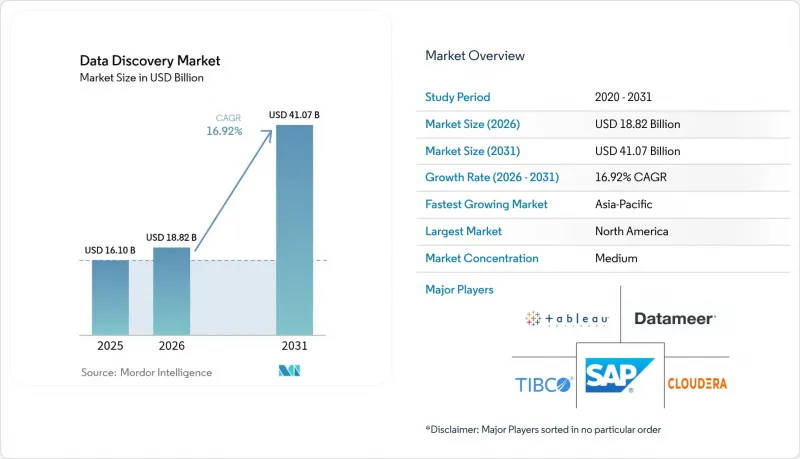
에 의하면, 데이터 디스커버리 시장 규모는 2025년 161억 달러로 평가되었고, 2026년에는 188억 2,000만 달러로 추정되고, 2026-2031년 CAGR 16.92%로 성장을 지속할 전망이며, 2031년에는 410억 7,000만 달러에 달할 것으로 예측됩니다.
본 보고서에서는 업계를 구성 요소별(소프트웨어, 서비스), 기업 규모별(중소기업, 대기업), 구축 형태별(온프레미스, 클라우드, 하이브리드), 용도별(리스크 및 규정 준수 관리, 영업·마케팅 최적화 등), 업종별(은행 및 금융 서비스·보험(BFSI), IT 및 통신 등), 그리고 지역별로 분류하고 있습니다.
세계의 데이터 디스커버리 시장 동향 및 인사이트
다구조화 데이터 소스의 급증
기업들은 현재 IoT 센서, 소셜 피드, 문서, 엣지 디바이스에서 발생하는 데이터 스트림을 수집하고 있으며, 플랫폼은 사전 처리 없이 다양한 형식을 통합할 수 있어야 합니다. 벤더들은 자연어 처리 기능을 통합하고 자산을 자동으로 카탈로그화함으로써, 분석가가 데이터 정리에 소요하는 시간을 단축하고 있습니다. 엣지 배포의 확대에 따라 이러한 요구는 더욱 커지고 있으며, 반도체 공급 부족으로 인해 디스커버리 워크로드 확장에 있어 클라우드의 탄력성이 더욱 매력적으로 대두되고 있습니다. 조직들은 기존의 데이터 웨어하우스만으로는 오늘날 데이터의 처리 속도를 따라잡을 수 없습니다는 결론에 도달했으며, 그 결과 클라우드 네이티브 디스커버리 솔루션으로의 전환이 가속화되고 있습니다.
데이터 기반 의사결정을 위한 기업의 노력
경영진의 지시에 따라 디스커버리 플랫폼은 전략적 자산으로 재정의되었습니다. HP가 Databricks에 도입한 대화형 BI 레이어를 통해 공급망 담당 팀은 막대한 엔지니어링 작업 없이도 간단한 쿼리를 통해 이상 징후를 감지할 수 있게 되었습니다. 또한, 투명성이 높은 데이터 계보 기능은 특히 금융 서비스 업계에서 감사 담당자의 요구 사항도 충족시키고 있으며, 도입에 성공한 사례에서는 기술 도입과 일상적인 의사 결정의 중심에 데이터 인사이트를 두는 문화적 변화가 결합되어 있습니다.
데이터 보안 및 개인정보 보호에 대한 우려
2024년에 발생한 전 세계 사이버 공격의 거의 절반은 데이터나 인증 정보 도난을 수반했으며, 그중 3분의 1이 아시아태평양(APAC)에서 발생했습니다. 제조업은 랜섬웨어의 주요 표적이 되고 있으며, 데이터 접근 범위가 확대됨에 따라 규제 당국의 감시도 더욱 엄격해지고 있습니다. 개인정보 보호 기술은 존재하지만, 성능상의 절충점과 비용이 도입을 가로막고 있습니다. 기업들은 현재 세밀한 접근 제어와 변조 불가능한 감사 로그를 요구하고 있으며, 이로 인해 도입 주기가 길어지고 예산도 증가하고 있습니다.
부문 분석
2025년에도 소프트웨어는 데이터 디스커버리 시장 규모에서 여전히 지배적인 위치를 차지했으며, 매출 점유율은 64.72%였습니다. 그러나 기업들이 성공적인 도입을 위해서는 통합, 거버넌스 및 변경 관리에 대한 전문 지식이 필요하다는 점을 인식함에 따라, 서비스 부문은 연평균 성장률(CAGR) 23.12%라는 가장 빠른 속도로 성장하고 있습니다. 컨설팅 계약은 아키텍처 현대화에 중점을 두는 반면, 매니지드 서비스는 사내 자원이 부족한 중소기업들로부터 지지를 받고 있습니다. 예측 기간 동안 플랫폼의 복잡성이 증가하고 인력 부족이 지속됨에 따라, 서비스 부문이 증가하는 지출에서 더 큰 비중을 차지할 것으로 예측됩니다. 이러한 변화는 도구 중심의 구매에서 측정 가능한 비즈니스 효과를 동반하는 소프트웨어가 패키지화된 성과 지향적 계약으로의 전환을 부각시키고 있습니다.
소프트웨어 벤더들은 과도한 맞춤화를 억제하기 위해 구독 모델을 개선하고 로우코드 기반의 설정 기능을 지속적으로 통합하고 있습니다. 그러나 기업 고객은 데이터 수집, 분류 체계 설계, 계보 검증을 위해 전문 파트너를 통해 라이선스를 보완하는 경우가 빈번합니다. 이러한 하이브리드 구매 행태는 가치가 기능 목록이 아닌 의사결정 속도의 향상으로 측정된다는 시장 전반의 성숙화 추세와 일치합니다.
2025년, 온프레미스 도입은 데이터 디스커버리 시장 점유율의 54.30%를 유지했습니다. 이는 주로 은행 업계 및 공공 부문에서 데이터 현지화가 의무화된 데 기인합니다. 반면, 비용 최적화된 데이터 웨어하우스 및 소버린 클라우드 프레임워크가 위험에 대한 우려를 완화함에 따라, 클라우드 도입은 연평균 성장률(CAGR) 24.62%로 확대될 것으로 예측됩니다. 기업들은 현재 기밀성이 높은 기록의 로컬 저장과 분석 부하의 급증에 대응하기 위해 클라우드 컴퓨팅을 병행하고 있으며, 이로 인해 기반 인프라의 복잡성을 숨겨주는 통합 제어 플레인에 대한 수요가 발생하고 있습니다.
Oracle Alloy를 기반으로 한 후지쯔의 소버린 클라우드 출시는 현지화 규제에 대한 지역적 대응을 보여주면서도 탄력적인 클라우드 확장성을 제공하는 대표적인 사례입니다. 규제 당국의 클라우드 보안 벤치마크 발표가 늘어남에 따라 업계 전반에 걸친 신뢰가 높아지고 있으며, 기업들은 자본 지출(Capex)을 업그레이드 주기를 단축하는 운영 비용(OpEx) 기반의 소비 모델로 전환하고 있습니다.
지역별 분석
북미는 성숙한 거버넌스 프레임워크, 높은 클라우드 보급률, 그리고 견고한 파트너 생태계에 힘입어 2025년 매출의 39.60%를 차지했습니다. 금융 서비스 규제는 계속해서 디스커버리 플랫폼의 업데이트를 촉진하고 있으며, 미국 정보 기관의 2023-2025년 데이터 전략은 상호 운용 가능한 아키텍처에 대한 연방 정부의 이니셔티브을 강조하고 있습니다. 기술 부문의 연구개발(R&D) 연구소는 AI 제품 개발을 추진하기 위해 플랫폼의 적용 범위를 더욱 확대되고 있습니다.
아시아태평양(APAC) 지역은 연평균 성장률(CAGR) 18.27%를 기록하며 가장 빠르게 성장하는 지역이 될 것으로 예측됩니다. 각국의 디지털 정부 프로그램과 국가 AI 로드맵에 따라, 지역에 최적화되면서도 확장성이 뛰어난 디스커버리 환경에 대한 수요가 가속화되고 있습니다. 일본에서는 공공 부문의 Oracle Cloud Infrastructure로의 전환이 이러한 추세를 여실히 보여주고 있으며, 한편 동남아시아 전역에서 데이터센터용량에 대한 투자가 증가하고 있어 보다 광범위한 도입을 위한 물리적 기반을 마련하고 있습니다.
유럽에서는 GDPR(EU 개인정보보호규정) 및 데이터법(Data Act)에 따른 엄격한 데이터 공유 및 데이터 계보 의무화를 배경으로 꾸준한 성장이 예상됩니다. 은행들은 유럽중앙은행(ECB)의 리스크 데이터 관련 지침을 준수해야 하며, 이는 새로운 플랫폼 업그레이드를 촉진하고 있습니다. 반면, 남미와 중동 및 아프리카에서는 시범 단계에서 전사적 도입으로 전환되고 있지만, 인프라 격차와 인력 부족이 단기적인 확장을 저해하고 있습니다.
기타 혜택 :
- 엑셀 형식 시장 예측(ME) 시트
- 3개월간의 애널리스트 지원
자주 묻는 질문
목차
제1장 서론
제2장 조사 방법
제3장 주요 요약
제4장 시장 구도
제5장 시장 규모 및 성장 예측
제6장 경쟁 구도
제7장 시장 기회 및 향후 전망
AJY 26.09.09According to Mordor Intelligence, the data discovery market size is expected to grow from USD 16.1 billion in 2025 to USD 18.82 billion in 2026 and is forecast to reach USD 41.07 billion by 2031 at 16.92% CAGR over 2026-2031.
This report Segments the Industry Into by Component (Software, Services), Enterprise Size (Small- and Mid-Sized Enterprises, Large Enterprises), Deployment Mode (On-Premise, Cloud, Hybrid), Application (Risk and Compliance Management, Sales and Marketing Optimization and More), Industry Vertical (Banking, Financial Services, and Insurance (BFSI), Telecommunications and IT and More), and Geography.
Global Data Discovery Market Trends and Insights
Proliferation of Multi-Structured Data Sources
Enterprises now ingest streams from IoT sensors, social feeds, documents, and edge devices, forcing platforms to unify diverse formats without preprocessing. Vendors embed natural-language processing to auto-catalog assets, reducing the time analysts spend curating data. Edge rollouts amplify this need, and shortages in semiconductors have made cloud elasticity more attractive for scaling discovery workloads. Organizations are concluding that legacy warehouses alone cannot accommodate today's data velocity, thereby accelerating migrations to cloud-native discovery solutions.
Enterprise Push for Data-Driven Decision-Making
Executive mandates have reframed discovery platforms as strategic assets. HP's rollout of a conversational BI layer on Databricks enables supply-chain teams to surface anomalies through simple queries instead of heavy engineering efforts. Transparent lineage functions also satisfy auditors, especially in financial services, and successful deployments pair technology rollouts with cultural shifts that place data insights at the heart of day-to-day decisions.
Data Security and Privacy Concerns
Nearly half of global cyberattacks in 2024 involved data or credential theft, with APAC bearing one-third of incidents. Manufacturers are prime ransomware targets, and broader data access raises regulator scrutiny. Privacy-enhancing technologies exist, yet adoption is hampered by performance trade-offs and cost. Enterprises now demand granular access controls and immutable audit logs that lengthen implementation cycles and inflate budgets.
Other drivers and restraints analyzed in the detailed report include:
- Rapid Uptake of Self-Service Analytics Platforms
- Governance and Compliance Mandates
- Shortage of Data-Engineering and Stewardship Talent
For complete list of drivers and restraints, kindly check the Table Of Contents.
Segment Analysis
Software still dominated the data discovery market size with a 64.72% revenue share in 2025. However, services are growing fastest at a 23.12% CAGR as businesses realise successful rollouts require integration, governance, and change-management expertise. Consulting engagements tackle architecture modernisation, while managed services appeal to SMEs lacking internal resources. Over the forecast horizon, services are expected to capture a larger slice of incremental spending as platform complexity rises and talent bottlenecks persist. The shift underscores the transition from tool-centric purchases to outcome-oriented contracts that bundle software with measurable business impact.
Software vendors continue to refine subscription models and embed low-code configuration to curb heavy customisation. Yet enterprise clients frequently augment licences with specialised partners for data onboarding, taxonomy design, and lineage validation. This hybrid buying behaviour aligns with broader market maturation trends in which value is measured by decision-speed improvements rather than feature lists.
On-premise installations retained 54.30% of the data discovery market share in 2025, owing chiefly to banking and public-sector data-localisation mandates. Cloud deployments, however, are projected to climb at a 24.62% CAGR as cost-optimised warehouses and sovereign-cloud frameworks alleviate risk perceptions. Firms now mix local storage for sensitive records with cloud compute for analytical bursts, creating demand for unified control planes that mask underlying complexity.
Fujitsu's sovereign-cloud launch powered by Oracle Alloy typifies regional responses to localisation rules while still delivering elastic cloud scale. As more regulators publish cloud-security benchmarks, cross-industry confidence grows, and enterprises shift capex toward opex-based consumption models that reduce upgrade cycles.
Complete Report Scope:
- By Component
- Software
- Services
- By Deployment Mode
- On-Premise
- Cloud
- Hybrid
- By Enterprise Size
- Small and Mid-Sized Enterprises
- Large Enterprises
- By Industry Vertical
- Banking, Financial Services and Insurance (BFSI)
- Telecommunications and IT
- Retail and E-Commerce
- Manufacturing
- Energy and Utilities
- Healthcare and Life Sciences
- Government and Public Sector
- Other Verticals
- By Application
- Risk and Compliance Management
- Sales and Marketing Optimization
- Customer Experience and Personalization
- Operations and Supply-Chain Analytics
- Asset and Performance Management
- Other Applications
- By Geography
- North America
- United States
- Canada
- Mexico
- South America
- Brazil
- Argentina
- Rest of South America
- Europe
- United Kingdom
- Germany
- France
- Spain
- Italy
- Rest of Europe
- Asia-Pacific
- China
- Japan
- India
- South Korea
- Australia and New Zealand
- Rest of Asia-Pacific
- Middle East
- Israel
- Saudi Arabia
- United Arab Emirates
- Turkey
- Rest of Middle East
- Africa
- South Africa
- Egypt
- Nigeria
- Rest of Africa
- North America
Geography Analysis
North America retained 39.60% of 2025 revenue, supported by mature governance frameworks, deep cloud penetration, and robust partner ecosystems. Financial-services regulations continue to drive discovery platform renewals, and the U.S. intelligence community's 2023-2025 data strategy underlines federal commitment to interoperable architectures. Technology-sector RandD labs further expand platform footprints to power AI product development.
APAC is forecast to be the fastest-growing region with an 18.27% CAGR. National digital-government programs and sovereign-AI roadmaps accelerate demand for localised yet scalable discovery environments. Japan exemplifies this trajectory through public-sector shifts to Oracle Cloud Infrastructure, while rising data-centre capacity investments across Southeast Asia lay physical foundations for broader adoption.
Europe posts steady gains, underpinned by GDPR and the Data Act's stringent data-sharing and lineage obligations. Banks must align with the European Central Bank's risk-data guidance, stimulating fresh platform upgrades. Elsewhere, South America and the Middle East and Africa are moving from pilot phases toward enterprise-wide deployments, though infrastructure gaps and talent shortages temper near-term expansion.
- Microsoft Corp.
- Tableau Software LLC (Salesforce)
- SAP SE
- QlikTech International AB
- IBM Corp.
- Oracle Corp.
- Amazon Web Services Inc.
- Google LLC (Looker)
- Altair Engineering Inc.
- SAS Institute Inc.
- MicroStrategy Inc.
- Alteryx Inc.
- Datameer Inc.
- Cloudera Inc.
- Talend SA
- Informatica Inc.
- Collibra NV
- Alation Inc.
- Snowflake Inc.
- Tibco Software Inc.
Additional Benefits:
- The market estimate (ME) sheet in Excel format
- 3 months of analyst support
TABLE OF CONTENTS
1 INTRODUCTION
- 1.1 Study Assumptions and Market Definition
- 1.2 Scope of the Study
2 RESEARCH METHODOLOGY
3 EXECUTIVE SUMMARY
4 MARKET LANDSCAPE
- 4.1 Market Overview
- 4.2 Market Drivers
- 4.2.1 Proliferation of multi-structured data sources
- 4.2.2 Enterprise push for data-driven decision-making
- 4.2.3 Rapid uptake of self-service analytics platforms
- 4.2.4 Regulatory mandates for data governance and compliance
- 4.2.5 Generative-AI copilots embedded in discovery workflows
- 4.2.6 Falling cost of columnar cloud data warehouses
- 4.3 Market Restraints
- 4.3.1 Data security and privacy concerns
- 4.3.2 Shortage of data-engineering and stewardship talent
- 4.3.3 Legacy-system integration complexity
- 4.3.4 Sovereign-cloud data-localization rules
- 4.4 Regulatory Landscape
- 4.5 Technological Outlook
- 4.6 Porter's Five Forces Analysis
- 4.6.1 Bargaining Power of Suppliers
- 4.6.2 Bargaining Power of Buyers
- 4.6.3 Threat of New Entrants
- 4.6.4 Threat of Substitutes
- 4.6.5 Intensity of Competitive Rivalry
5 MARKET SIZE AND GROWTH FORECASTS (VALUE)
- 5.1 By Component
- 5.1.1 Software
- 5.1.2 Services
- 5.2 By Deployment Mode
- 5.2.1 On-Premise
- 5.2.2 Cloud
- 5.2.3 Hybrid
- 5.3 By Enterprise Size
- 5.3.1 Small and Mid-Sized Enterprises
- 5.3.2 Large Enterprises
- 5.4 By Industry Vertical
- 5.4.1 Banking, Financial Services and Insurance (BFSI)
- 5.4.2 Telecommunications and IT
- 5.4.3 Retail and E-Commerce
- 5.4.4 Manufacturing
- 5.4.5 Energy and Utilities
- 5.4.6 Healthcare and Life Sciences
- 5.4.7 Government and Public Sector
- 5.4.8 Other Verticals
- 5.5 By Application
- 5.5.1 Risk and Compliance Management
- 5.5.2 Sales and Marketing Optimization
- 5.5.3 Customer Experience and Personalization
- 5.5.4 Operations and Supply-Chain Analytics
- 5.5.5 Asset and Performance Management
- 5.5.6 Other Applications
- 5.6 By Geography
- 5.6.1 North America
- 5.6.1.1 United States
- 5.6.1.2 Canada
- 5.6.1.3 Mexico
- 5.6.2 South America
- 5.6.2.1 Brazil
- 5.6.2.2 Argentina
- 5.6.2.3 Rest of South America
- 5.6.3 Europe
- 5.6.3.1 United Kingdom
- 5.6.3.2 Germany
- 5.6.3.3 France
- 5.6.3.4 Spain
- 5.6.3.5 Italy
- 5.6.3.6 Rest of Europe
- 5.6.4 Asia-Pacific
- 5.6.4.1 China
- 5.6.4.2 Japan
- 5.6.4.3 India
- 5.6.4.4 South Korea
- 5.6.4.5 Australia and New Zealand
- 5.6.4.6 Rest of Asia-Pacific
- 5.6.5 Middle East
- 5.6.5.1 Israel
- 5.6.5.2 Saudi Arabia
- 5.6.5.3 United Arab Emirates
- 5.6.5.4 Turkey
- 5.6.5.5 Rest of Middle East
- 5.6.6 Africa
- 5.6.6.1 South Africa
- 5.6.6.2 Egypt
- 5.6.6.3 Nigeria
- 5.6.6.4 Rest of Africa
- 5.6.1 North America
6 COMPETITIVE LANDSCAPE
- 6.1 Market Concentration
- 6.2 Strategic Moves
- 6.3 Market Share Analysis
- 6.4 Company Profiles (includes Global level Overview, Market level overview, Core Segments, Financials as available, Strategic Information, Market Rank/Share, Products and Services, Recent Developments)
- 6.4.1 Microsoft Corp.
- 6.4.2 Tableau Software LLC (Salesforce)
- 6.4.3 SAP SE
- 6.4.4 QlikTech International AB
- 6.4.5 IBM Corp.
- 6.4.6 Oracle Corp.
- 6.4.7 Amazon Web Services Inc.
- 6.4.8 Google LLC (Looker)
- 6.4.9 Altair Engineering Inc.
- 6.4.10 SAS Institute Inc.
- 6.4.11 MicroStrategy Inc.
- 6.4.12 Alteryx Inc.
- 6.4.13 Datameer Inc.
- 6.4.14 Cloudera Inc.
- 6.4.15 Talend SA
- 6.4.16 Informatica Inc.
- 6.4.17 Collibra NV
- 6.4.18 Alation Inc.
- 6.4.19 Snowflake Inc.
- 6.4.20 Tibco Software Inc.
7 MARKET OPPORTUNITIES AND FUTURE OUTLOOK
- 7.1 White-Space and Unmet-Need Assessment


