

|
시장보고서
상품코드
2124392
엔지니어드 우드 시장 : 점유율 분석, 업계 동향과 통계, 성장 예측(2026-2031년)Engineered Wood - Market Share Analysis, Industry Trends & Statistics, Growth Forecasts (2026 - 2031) |
||||||
 Mordor Intelligence
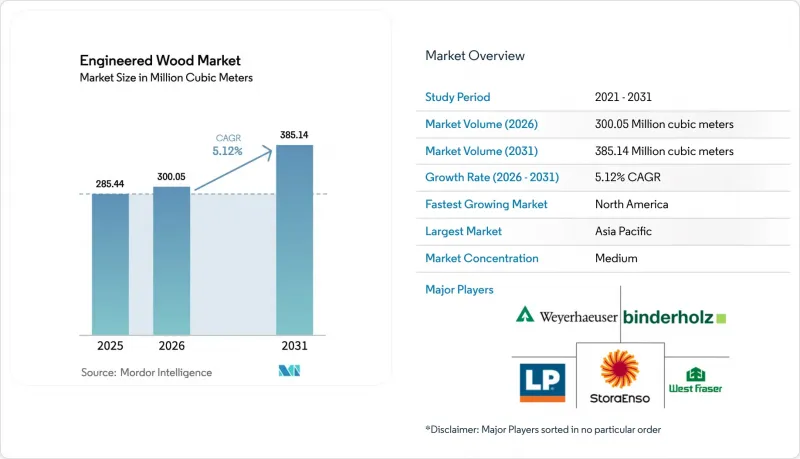
Mordor Intelligence에 의하면, 엔지니어드 우드 시장 규모는 2025년에 2억 8,544만 입방미터로 평가되어 2026년 3억 5만 입방미터에서 2031년까지 3억 8,514만 입방미터에 이를 것으로 예측되며, 예측 기간(2026-2031년) CAGR은 5.12%를 나타낼 전망입니다.
본 보고서는 제품 유형별(합판, OSB, 적층재, CLT, LVL, 파티클보드, 기타),목재 유형별(침엽수와 활엽수), 용도별(주거용과 비주거용), 최종 사용자 산업별(건축 및 건설, 가구 제조, 기타), 지역별(아시아태평양, 북미, 유럽, 기타)로 분류되어 있습니다. 시장 예측은 수량(입방미터) 단위로 제시되어 있습니다.
세계 엔지니어드 우드 시장 동향 및 인사이트
중층 건축물에서 CLT 및 매스 팀버의 채택 급증
2025년, 2021년판 ‘국제 건축 기준(IBC)’ 유형 IV 규정을 채택한 도시 관할 구역에서는 최대 18층 규모의 프로젝트가 일반적인 부채 및 주식 기반 자금 조달을 이용할 수 있게 되었습니다. 비용 모델에 따르면, 특히 공사 기간 단축 및 기초 경량화를 고려할 경우, 포스트텐션 콘크리트에 비해 비용 절감이 예상됩니다. 2025년 말까지 독일의 ‘목재 건축 촉진 정책(Timber Construction Offensive)’을 통해 공립 학교와 병원에 자금이 지원되었으며, 콘크리트에 비해 건설 기간이 단축된다는 사실이 입증되었습니다. 캐나다의 ‘2025년 국가 건축 기준법’에서는 대규모 목조 주택 건축물의 높이 제한이 12층까지 상향 조정되어, 밴쿠버와 토론토에서 프로젝트가 활발해졌습니다. 개발업자들은 고층 목조 건축의 경제적 이점을 점점 더 인식하고 있으며, 유지 관리비 절감과 기존 용도지역 제한 내에서 추가 임대 가능 연면적을 확보할 수 있는 가능성에 주목하고 있습니다.
아시아에서 조립식 저가 주택의 추진이 LVL 및 집성재 수요를 견인
2025년까지 중국의 ‘제14차 5개년 계획’에 따라 도시 지역의 신규 개발에서 조립식 건축이 상당한 비중을 차지하도록 의무화되었으며, 이에 따라 LVL 조이스트와 집성재 빔이 공장에서 조립된 모듈에 채택될 것입니다. 인도의 ‘프라단 만트리 아와스 요자나(Pradhan Mantri Awas Yojana)’는 2025년에 합판 및 파티클보드 수요를 끌어올리고, 기존 벽돌 쌓기 공법에 비해 현장 인력을 줄이는 것을 목표로 하고 있습니다. 2025년, 베트남은 사회주택 건설 계약을 체결하고 비용 상한선을 준수하기 위해 말레이시아산 고무나무 LVL의 사용을 의무화했습니다. 패널 생산을 통합한 모듈 제조업체들은 현재 합판과 LVL의 지역 수요 일부를 확보하고 있으며, 이를 통해 원자재 가격 변동으로부터 공급망을 보호하는 동시에 추가적인 이익을 얻고 있습니다.
포름알데히드/VOC 배출 규제 강화
캘리포니아주의 CARB 2단계 및 미국 TSCA 제6편에서는 합판의 포름알데히드 방출 상한선을 0.09ppm으로 규정하고 있습니다. 이 규제로 인해 제조업체들은 페놀·포름알데히드 수지나 바이오 수지로의 전환을 강요받고 있으며, 이로 인해 원자재 비용이 증가하고 있습니다. EU의 ‘지속가능성을 위한 화학물질 전략’은 2027년까지 포름알데히드를 1B등급 발암물질로 재분류하는 것을 목표로 하고 있습니다. 이러한 움직임으로 인해 EU 전역의 패널 산업에서 설비 갱신 비용을 지출해야 할 가능성이 있습니다. 2025년 4월, 일본은 실내 포름알데히드 기준치를 0.08ppm으로 낮췄습니다. 이로 인해 제조업체가 포름알데히드 무첨가 결합제로 전환하지 않는 한, 기존 MDF는 사실상 시장에서 퇴출될 것입니다. 한편, 수지 업그레이드에 투자할 수 없는 중소 제재소들은 이익률 하락과 통합 압력 증가로 어려움을 겪고 있습니다.
부문 분석
2025년, 합판은 엔지니어드 우드 시장 점유율의 42.23%를 차지하며, 비용을 중시하는 지역의 주택 기초 자재 및 거푸집 시장을 석권했습니다. CLT는 북미와 유럽의 중층 주택 및 공공시설에서 수요를 배경으로 연평균 성장률(CAGR) 12.45%로 확대되고 있으며, 이는 ‘인플레이션 억제법’에 따른 내장 탄소 크레딧에 의해 뒷받침되고 있습니다. 2025년, 미국 남부와 캐나다 프레리 지역의 건설업자들은 지붕 및 벽의 하부 자재로 OSB(방향성 스트랜드 보드)를 채택하여 설비 가동률을 높였습니다. 한편, 캐나다의 경기장에서는 대스팬 용도로 선호되는 글루램(Glulam) 보가 철골 트러스에 비해 내재된 탄소량이 적다는 것이 입증되었습니다.
엔지니어드 우드 시장에서는 양극화가 진행되고 있습니다. CLT나 LVL과 같은 고급 제품은 시공 속도와 ESG 지표가 높이 평가되어, 고가로 거래가 가능한 도시 지역의 재개발 프로젝트에 주력하고 있습니다. 대조적으로, 범용 합판과 OSB는 신흥국의 주택 시장에서 비용 경쟁력을 무기로 시장을 다투고 있습니다. 가구 부문에서는 파티클보드와 MDF가 여전히 주류를 차지하고 있으며, 유럽 제조업체들은 2027년 규제를 염두에 두고 선제적으로 무첨가 포름알데히드계 결합제로의 전환을 추진하고 있습니다. I-조이스트와 구조용 복합재는 조립식 지붕·바닥 카세트에서 보급이 확대되고 있어 현장 노동력을 절감하고 있습니다. 이러한 동향은 높은 수익률을 자랑하는 엔지니어드 우드 솔루션과 대량 생산형 패널이라는 엔지니어드 우드 시장의 양극화를 여실히 드러내고 있습니다.
2025년 생산량의 71.56%를 침엽수 원료가 차지하고 있으며, 그 공급원은 주로 OSB, CLT, 적층재 생산 라인에 공급되는 북미산 스프루스·파인 소나무와 북유럽산 스프루스공급 경로입니다. 활엽수 패널은 2031년까지 연평균 성장률(CAGR) 9.66%로 성장하고 있습니다. 이는 인도네시아와 말레이시아의 제재소가 중동의 인프라 프로젝트를 위해 열대 합판을 수출하고 있으며, 유럽의 구매자들이 자작나무 캐비닛 기판에 프리미엄 가격을 지불하고 있기 때문입니다. 2025년, 중국은 열대 활엽수 원목 수입을 확대하여 전년 대비 증가세를 보였습니다. 이는 주로 해안 지역의 합판 공장에 공급하기 위한 목적입니다. FSC 및 PEFC 인증은 현재 가격 프리미엄을 가져다주고 있으며, 추적성은 공공 조달에서 매우 중요한 경쟁 우위가 되고 있습니다.
동남아시아에서는 열대 활엽수 LVL, 특히 러버우드가 북미 및 유럽용 가구 수출 시장에서 원목 티크의 입지를 위협하기 시작하고 있습니다. 한편, 디자이너용 캐비닛 시장에서는 자작나무 표면 합판에 프리미엄 가격이 형성되어, 범용 침엽수 패널과 수익성이 높은 활엽수 제품 간의 균형이 이루어지고 있습니다. 환경에 대한 모니터링이 강화되는 가운데, 합법성을 검증하고 제3자 인증을 획득하는 능력은 수익성이 높은 유럽 및 북미 시장에 진출하기 위해 필수적인 요소가 되고 있습니다.
지역별 분석
2025년, 아시아태평양은 중국의 조립식 건축 촉진 정책과 인도의 저소득층 주택 사업을 견인력으로 삼아 엔지니어드 우드 시장 규모의 48.26%를 차지했습니다. 2025년, 동남아시아의 수출업체들은 주로 중동과 북미로 합판과 고무재 패널을 수출했습니다. 일본에서는 실내 공기질 기준이 엄격해짐에 따라 국내 제재소들이 신속히 ‘무첨가 포름알데히드’ 기술을 채택하면서 패널 가격이 급등했습니다. 한편, 한국은 공공 건축물의 저탄소 자재 개보수에 자금을 배정하고, 학교 개보수 공사를 위해 CLT 발주를 촉진했습니다.
북미는 2031년 연평균 성장률(CAGR)이 6.26%로, 엔지니어드 우드 시장 중 가장 빠르게 성장하고 있는 지역입니다. 2025년 중반까지 미국의 많은 도시가 유형 IV 대형 목재에 관한 규정을 채택함에 따라, CLT 및 접합재에 대한 견실한 수요 파이프라인이 형성되었습니다. 캐나다에서는 건축 기준 개정을 통해 고층 건축이 허용되게 되었습니다. 또한 멕시코에서는 2025년에 INFONAVIT가 목재 패널 주택을 지원하여 각 세대가 합리적인 가격으로 제공되었습니다.
유럽 내 목재 복합재 분야의 리더십은 북유럽공급망에 확고히 뿌리를 두고 있습니다. 독일에서는 CLT를 활용한 공공 프로젝트에서 건설 속도 향상이 보고되고 있으며, EU의 ‘2025년 건설 제품 규정’에서는 구조용 목재에 대한 환경 제품 선언이 의무화되어 있습니다. 2026년에 시행될 예정인 영국의 ‘퓨처 홈즈 스탠다드’에서는 저탄소 주택이 의무화되어 목조 골조 공법에 유리하게 작용할 것입니다. 남미에서는 2025년에 브라질의 합판 및 OSB 소비량이 현저히 증가할 전망이며, 사우디아라비아에서는 NEOM 프로젝트가 ‘비전 2030’ 이니셔티브의 일환으로 건축자재에 목재 사용을 지정했습니다.
기타 혜택
- 엑셀 형식 시장 예측(ME) 시트
- 3개월간의 애널리스트 지원
자주 묻는 질문
목차
제1장 서론
제2장 조사 방법
제3장 주요 요약
제4장 시장 구도
제5장 시장 규모와 성장 예측
제6장 경쟁 구도
제7장 시장 기회와 향후 전망
JHS 26.09.11According to Mordor Intelligence, the engineered wood market size was valued at 285.44 Million cubic meters in 2025 and is estimated to grow from 300.05 Million cubic meters in 2026 to reach 385.14 Million cubic meters by 2031, at a CAGR of 5.12% during the forecast period (2026-2031).
This report is Segmented by Product Type (Plywood, OSB, Glulam, CLT, LVL, Particleboard, and Other Products), Wood Source (Softwood and Hardwood), Application (Residential and Non-Residential), End-User Industry (Building and Construction, Furniture Manufacturing, and Others), and Geography (Asia-Pacific, North America, Europe, and More). Market Forecasts are Provided in Terms of Volume (Cubic Meters).
Global Engineered Wood Market Trends and Insights
Surging Adoption of CLT and Mass-Timber in Mid-Rise Buildings
In 2025, urban jurisdictions adopting the 2021 International Building Code's Type IV provisions enabled projects of up to 18 stories to access mainstream debt and equity financing. Cost models indicate savings compared to post-tensioned concrete, especially when factoring in shorter schedules and lighter foundations. By late 2025, Germany's Timber Construction Offensive had financed public schools and hospitals, demonstrating faster erection time compared to concrete. Canada's 2025 National Building Code increased the residential mass timber height limit to 12 stories, spurring projects in Vancouver and Toronto. Developers are increasingly recognizing the financial advantages of tall wood, noting its potential to reduce carrying costs and create additional leasable floors within existing zoning limits.
Prefab Affordable-Housing Push in Asia Boosting LVL and Glulam
By 2025, China's 14th Five-Year Plan mandates that prefabricated buildings constitute a significant portion of new urban developments, directing LVL joists and glulam beams into factory-assembled modules. India's Pradhan Mantri Awas Yojana is set to bolster plywood and particleboard demand in 2025, achieving a reduction in on-site labor compared to traditional brick masonry. In 2025, Vietnam awarded contracts for social housing units, stipulating the use of Malaysian rubberwood LVL to adhere to a cost ceiling. Module manufacturers that have integrated panel production are now securing a portion of the regional volume for plywood and LVL, shielding their supply chains from raw material fluctuations and reaping additional margins.
Tightening Formaldehyde/VOC Emission Regulations
California's CARB Phase 2 and the U.S. TSCA Title VI have set a formaldehyde cap at 0.09 ppm for plywood. This regulation is pushing manufacturers towards phenol-formaldehyde or bio-based resins, which increase raw material costs. The EU's Chemical Strategy for Sustainability aims to reclassify formaldehyde as a Category 1B carcinogen by 2027. This move could necessitate retrofit expenditures across the EU's panel sector. In April 2025, Japan tightened indoor formaldehyde limits to 0.08 ppm. This effectively sidelines conventional MDF unless manufacturers pivot to no-added-formaldehyde binders. Meanwhile, smaller mills, unable to invest in resin upgrades, are grappling with shrinking margins and mounting consolidation pressures.
Other drivers and restraints analyzed in the detailed report include:
- Green-Building Codes and Carbon-Credit Incentives
- Cost Efficiencies Versus Solid Wood and Steel
- Timber-Price and Logistics Volatility
For complete list of drivers and restraints, kindly check the Table Of Contents.
Segment Analysis
Plywood accounted for 42.23% of the engineered wood market share in 2025, dominating residential sheathing and formwork in cost-sensitive regions. CLT is scaling at a 12.45% CAGR on the back of mid-rise residential and institutional demand in North America and Europe, supported by embodied-carbon credits under the Inflation Reduction Act. In 2025, builders in the U.S. South and Canadian Prairies turned to oriented strand board (OSB) for roof and wall substrates, increasing its capacity utilization. Meanwhile, in Canadian arenas, glulam beams, favored for long-span applications, demonstrated lower embodied carbon compared to steel trusses.
The engineered wood market is witnessing a split: premium offerings like CLT and LVL are focusing on urban infill projects, where speed and ESG metrics fetch higher prices. In contrast, commodity plywood and OSB are competing on cost in housing markets of emerging economies. Particleboard and MDF continue to dominate the furniture sector, with European manufacturers preemptively shifting to no-added-formaldehyde binders in light of 2027 regulations. I-joists and structural composite lumber are making headway in prefab roof and floor cassettes, reducing on-site labor. This trend highlights the engineered wood market's divide: high-margin engineered solutions versus volume-driven panels.
Softwood inputs represented 71.56% of 2025 volume, supplied chiefly by North American spruce-pine-fir and Nordic spruce streams that feed OSB, CLT, and glulam lines. Hardwood panels are growing at a 9.66% CAGR through 2031 as Indonesian and Malaysian mills export tropical plywood to Middle Eastern infrastructure projects, and European buyers pay premiums for birch cabinetry substrates. In 2025, China ramped up its imports of tropical hardwood logs, marking an increase from the previous year, primarily to supply its coastal plywood mills. Certifications from FSC and PEFC now command a price premium, positioning traceability as a pivotal advantage in public procurement.
In Southeast Asia, tropical hardwood LVL, especially rubberwood, is beginning to overshadow solid teak in furniture exports targeting North America and Europe. Meanwhile, birch-faced plywood is enjoying a premium in the designer cabinetry market, creating a balance between the commodity softwood panels and the more lucrative hardwood products. With growing environmental scrutiny, the ability to verify legality and secure third-party certification is becoming crucial for accessing the lucrative European and North American markets.
Complete Report Scope:
- By Product Type
- Plywood
- Oriented Strand Board (OSB)
- Glulam
- Cross-Laminated Timber (CLT)
- Laminated Veneer Lumber (LVL)
- Particleboard
- Other Engineered Products
- By Wood Source
- Softwood
- Hardwood
- By Application
- Residential
- Non-Residential
- By End-User Industry
- Building and Construction
- Furniture Manufacturing
- Others
- By Geography
- Asia-Pacific
- China
- India
- Japan
- South Korea
- Malaysia
- Thailand
- Indonesia
- Vietnam
- Rest of Asia-Pacific
- North America
- United States
- Canada
- Mexico
- Europe
- Germany
- United Kingdom
- France
- Italy
- Spain
- Turkey
- Russia
- NORDIC Countries
- Rest of Europe
- South America
- Brazil
- Argentina
- Colombia
- Rest of South America
- Middle-East and Africa
- Saudi Arabia
- United Arab Emirates
- Qatar
- Egypt
- Nigeria
- South Africa
- Rest of Middle-East and Africa
- Asia-Pacific
Geography Analysis
Asia-Pacific held 48.26% of the engineered wood market size in 2025, anchored by China's prefabrication mandate and India's affordable-housing rollout. Southeast Asian exporters sent plywood and rubberwood panels in 2025, primarily to the Middle East and North America. Stricter indoor-air standards in Japan led to a surge in panel prices as domestic mills swiftly adopted no-added-formaldehyde technology. Meanwhile, South Korea allocated funds to retrofit public buildings with low-carbon materials, directing orders towards CLT for school renovations.
North America is the fastest-growing engineered wood market at 6.26% CAGR through 2031. By mid-2025, many cities across the U.S. had embraced Type IV mass-timber provisions, creating a robust demand pipeline for CLT and glulam. In Canada, updated codes now permit taller buildings, and in Mexico, INFONAVIT backed wood-panel units in 2025, each priced affordably.
Europe's engineered wood leadership is firmly rooted in Nordic supply chains. Germany reported faster construction in public projects utilizing CLT, and the EU's 2025 Construction Products Regulation mandates environmental product declarations for structural timber. The UK's Future Homes Standard, set to be enforced in 2026, will mandate low-carbon housing, giving an edge to timber-frame systems. In South America, Brazil's consumption of plywood and OSB was significant in 2025, and in Saudi Arabia, the NEOM project earmarked wood for buildings as part of its Vision 2030 initiative.
- Binderholz GmbH
- Boise Cascade
- EGGER
- Georgia-Pacific Gypsum LLC and Georgia-Pacific Wood Products LLC
- HASSLACHER Holding GmbH
- Huber Engineered Woods LLC
- KLH Massivholz GmbH
- Kronoplus Limited
- Louisiana-Pacific Corporation
- Mayr-Melnhof Holz Holding AG
- Nordic Structures
- Pfleiderer
- PWT
- Resolute Forest Products Inc.
- Roseburg Forest Products
- Stora Enso
- SWISS KRONO Group
- West Fraser Timber Co.
- Weyerhaeuser Company
Additional Benefits:
- The market estimate (ME) sheet in Excel format
- 3 months of analyst support
TABLE OF CONTENTS
1 Introduction
- 1.1 Study Assumptions and Market Definition
- 1.2 Scope of the Study
2 Research Methodology
3 Executive Summary
4 Market Landscape
- 4.1 Market Overview
- 4.2 Market Drivers
- 4.2.1 Surging adoption of CLT and mass-timber in mid-rise buildings
- 4.2.2 Prefab affordable-housing push in Asia boosting LVL and glulam
- 4.2.3 Green-building codes and carbon-credit incentives
- 4.2.4 Cost efficiencies versus solid wood and steel
- 4.2.5 Up-cycling forestry residues and waste-wood into value-added panels (under-reported)
- 4.3 Market Restraints
- 4.3.1 Tightening formaldehyde/VOC emission regulations
- 4.3.2 Timber-price and logistics volatility
- 4.3.3 High insurance premiums and fire-code ambiguities for tall mass-timber (under-reported)
- 4.4 Value Chain Analysis
- 4.5 Porter's Five Forces
- 4.5.1 Bargaining Power of Suppliers
- 4.5.2 Bargaining Power of Buyers
- 4.5.3 Threat of New Entrants
- 4.5.4 Threat of Substitutes
- 4.5.5 Competitive Rivalry
5 Market Size and Growth Forecasts (Volume)
- 5.1 By Product Type
- 5.1.1 Plywood
- 5.1.2 Oriented Strand Board (OSB)
- 5.1.3 Glulam
- 5.1.4 Cross-Laminated Timber (CLT)
- 5.1.5 Laminated Veneer Lumber (LVL)
- 5.1.6 Particleboard
- 5.1.7 Other Engineered Products
- 5.2 By Wood Source
- 5.2.1 Softwood
- 5.2.2 Hardwood
- 5.3 By Application
- 5.3.1 Residential
- 5.3.2 Non-Residential
- 5.4 By End-User Industry
- 5.4.1 Building and Construction
- 5.4.2 Furniture Manufacturing
- 5.4.3 Others
- 5.5 By Geography
- 5.5.1 Asia-Pacific
- 5.5.1.1 China
- 5.5.1.2 India
- 5.5.1.3 Japan
- 5.5.1.4 South Korea
- 5.5.1.5 Malaysia
- 5.5.1.6 Thailand
- 5.5.1.7 Indonesia
- 5.5.1.8 Vietnam
- 5.5.1.9 Rest of Asia-Pacific
- 5.5.2 North America
- 5.5.2.1 United States
- 5.5.2.2 Canada
- 5.5.2.3 Mexico
- 5.5.3 Europe
- 5.5.3.1 Germany
- 5.5.3.2 United Kingdom
- 5.5.3.3 France
- 5.5.3.4 Italy
- 5.5.3.5 Spain
- 5.5.3.6 Turkey
- 5.5.3.7 Russia
- 5.5.3.8 NORDIC Countries
- 5.5.3.9 Rest of Europe
- 5.5.4 South America
- 5.5.4.1 Brazil
- 5.5.4.2 Argentina
- 5.5.4.3 Colombia
- 5.5.4.4 Rest of South America
- 5.5.5 Middle-East and Africa
- 5.5.5.1 Saudi Arabia
- 5.5.5.2 United Arab Emirates
- 5.5.5.3 Qatar
- 5.5.5.4 Egypt
- 5.5.5.5 Nigeria
- 5.5.5.6 South Africa
- 5.5.5.7 Rest of Middle-East and Africa
- 5.5.1 Asia-Pacific
6 Competitive Landscape
- 6.1 Market Concentration
- 6.2 Strategic Moves
- 6.3 Market Share/Ranking Analysis
- 6.4 Company Profiles (includes Global overview, Market overview, Core Segments, Financials, Strategic Information, Market Rank/Share, Products and Services, Recent Developments)
- 6.4.1 Binderholz GmbH
- 6.4.2 Boise Cascade
- 6.4.3 EGGER
- 6.4.4 Georgia-Pacific Gypsum LLC and Georgia-Pacific Wood Products LLC
- 6.4.5 HASSLACHER Holding GmbH
- 6.4.6 Huber Engineered Woods LLC
- 6.4.7 KLH Massivholz GmbH
- 6.4.8 Kronoplus Limited
- 6.4.9 Louisiana-Pacific Corporation
- 6.4.10 Mayr-Melnhof Holz Holding AG
- 6.4.11 Nordic Structures
- 6.4.12 Pfleiderer
- 6.4.13 PWT
- 6.4.14 Resolute Forest Products Inc.
- 6.4.15 Roseburg Forest Products
- 6.4.16 Stora Enso
- 6.4.17 SWISS KRONO Group
- 6.4.18 West Fraser Timber Co.
- 6.4.19 Weyerhaeuser Company
7 Market Opportunities and Future Outlook
- 7.1 White-Space and Unmet-Need Assessment


