

|
시장보고서
상품코드
2124476
설탕 포장 : 시장 점유율 분석, 업계 동향과 통계, 성장 예측(2026-2031년)Sugar Packaging - Market Share Analysis, Industry Trends & Statistics, Growth Forecasts (2026 - 2031) |
||||||
 Mordor Intelligence
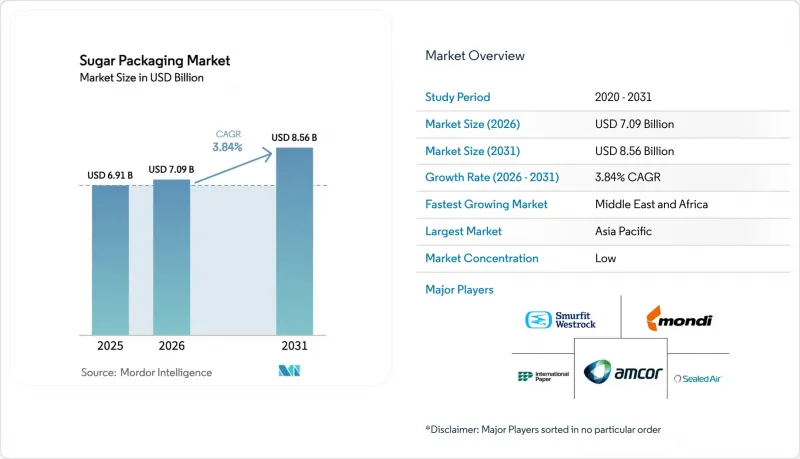
Mordor Intelligence에 의하면, 설탕 포장 시장 규모는 2025년에 69억 1,000만 달러로 평가되었고, 2026년 70억 9,000만 달러에서 2031년까지 85억 6,000만 달러에 이를 것으로 추정되고 있어 예측 기간(2026-2031년) CAGR은 3.84%를 기록할 전망입니다.
본 보고서는 포장 유형(연포장 및 경질 포장), 소재 유형(플라스틱, 종이, 바이오 및 퇴비화 가능한 소재), 포장 크기(1kg 이하, 2-5kg, 5kg 이상), 최종 사용자(대규모, 중규모, 소규모 제조업체), 지역(북미, 남미, 유럽, 아시아태평양, 기타)별로 분류되어 있습니다. 시장 예측은 금액(달러) 기준으로 제시되어 있습니다.
세계 설탕 포장 시장 동향 및 인사이트
신흥 경제국에서의 설탕 소비량 꾸준한 증가
인도의 1인당 소비량은 2025년에 20.1kg에 달할 것으로 예상되며, 인도네시아와 베트남에서도 유사한 증가세가 나타나 벌크용 봉지와 소매용 파우치 모두에 대한 기초 수요를 끌어올렸습니다. 이러한 시장에서는 가정용 쇼핑 시 가격 민감도와 보관 공간 제약이 균형을 이루고 있어, 2-5Kg 크기 대가 가장 큰 수혜를 보고 있습니다. 중국에서는 2025년에 유기농 설탕 및 특수 설탕이 소비량의 8%를 차지할 것으로 예상되며, 가격 프리미엄을 정당화할 수 있는 위변조 방지 기능이 있는 재밀봉 가능한 포장에 대한 수요가 증가하고 있습니다. 동남아시아의 순수입량은 전년 대비 4.2% 증가했으며, 열대 지역의 습기를 견딜 수 있는 연포장 형태를 통해 판매량이 더욱 확대되었습니다. 전반적으로, 이 지역의 소비 증가는 설탕 포장 시장의 직접적인 성장 동력이 되고 있습니다.
맞춤형 지속 가능한 포장 형태에 대한 수요 증가
2025년에 전면 시행될 유럽연합(EU)의 ‘포장 및 포장 폐기물 규정’은 2030년까지 65%의 재활용 가능성 또는 퇴비화 가능성을 의무화하고 있으며, 이에 따라 가공업체들은 단일 소재인 폴리에틸렌이나 폴리젖산(PLA) 기재로 전환하고 있습니다. 몬디(Mondi)에 따르면, 2025년 식품용 연포장재의 혼합 비율에서 바이오 유래 수지가 42%에 달하고,, 2년 전의 28%에서 크게 증가했습니다. 또한 각 브랜드는 1회용 소포장에 절단용 노치, 재밀봉 가능한 지퍼, 분량 조절을 위한 레이저 스코어링 등을 도입하고 있으며, 이 모든 요소가 매장 내 판매 매력을 높이고 있습니다. 2025년 중반에 도입된 암콜(Amcor)의 ‘AmLite’ 시리즈는 나노클레이 코팅을 통해 필름 두께를 15% 줄이면서도 배리어 성능을 유지하고, 탄소 강도와 운송 중량을 감소시켰습니다. 이러한 설계상의 변화로 인해 원자재 가격이 변동하는 상황에서도 설탕 포장 시장은 프리미엄화의 길을 계속 걷고 있습니다.
컨버터의 운영 및 규제 준수 비용
2025년, 프랑스, 독일, 네덜란드의 플라스틱 포장에 대한 확대 생산자 책임(EPR) 수수료는 1kg당 평균 0.12유로(0.13달러)로, 컨버터의 이익률을 압박하는 동시에 매장 가격을 3-5% 끌어올렸습니다. 이러한 비용을 감당할 수 없는 소규모 변환업체들은 상품 계약에서 철수하여 공급망의 일부 통합을 촉진했습니다. 새로운 재활용 가능성 시험 규정에 따라 SKU당 8,000-15,000유로(8,500-16,000달러)의 추가 비용이 발생하고 있으며, 이러한 초기 부담으로 인해 새로운 필름 구조에 대한 투자 회수 기간이 길어지고 있습니다. 캐나다와 아시아 시장의 기준 차이는 재고 관리를 복잡하게 만들고, 시험의 중복을 초래하고 있습니다. 그 결과, 특히 중견 기업을 중심으로 설탕 포장 시장에서의 사업 확장 계획에 제동이 걸리고 있습니다.
부문 분석
2025년 현재, 설탕 포장 시장의 88.32%를 유연한 솔루션이 차지하고 있으며, 2031년까지 연평균 성장률(CAGR) 4.62%로 확대되고 있습니다. 봉지와 파우치가 판매량을 주도하고 있지만, 패스트푸드점 및 호스피탈리티 채널에서는 소포장의 점유율이 꾸준히 증가하고 있습니다. 경질 용기는 여전히 틈새 시장으로 남아 있으며, 투명성과 재사용성이 높은 운송 비용을 상쇄해 주는 프리미엄 유기농 설탕이나 푸드서비스용 디스펜서에 사용되고 있습니다. 쉴드 에어(Shield Air)사의 탈기 밸브가 내장된 재활용 가능한 폴리에틸렌 파우치는 습도가 높은 기후에서 팽창을 방지하고 소매업체의 반품을 줄임으로써 이 형태의 프리미엄 위치를 뒷받침하고 있습니다. 대조적으로, 봉지는 중간 대용량 컨테이너에 시장 점유율을 내주고 있습니다. 자동화된 취급 과정에서는 경질 형태가 선호되기 때문에 자재 운반 분야의 혁신이 설탕 포장 시장 동향에 어떤 영향을 미치고 있는지가 여실히 드러나고 있습니다.
경질 포장의 연평균 성장률(CAGR)이 3.1%로 낮은 것은 성숙한 시장에 집중되어 있고 소비자의 가격 민감도가 높기 때문이지만, 투명성을 순도와 연결 짓는 유럽의 유기농 유통 채널에서는 유리병이 제한적인 부활을 이루고 있습니다. 그러나 경량화, 재밀봉 기능, 옴니채널에서의 내구성이 소매업체와 소비자 모두로부터 여전히 높은 평가를 받고 있기 때문에 연포장이 주도적인 위치를 유지할 가능성이 높다고 볼 수 있습니다. 그 결과, 설탕 포장 시장에서는 필름 과학 및 캡 혁신에 대한 투자가 계속될 것으로 예측됩니다.
2025년, 플라스틱은 설탕 포장 시장에서 68.97%의 점유율을 유지할 것이며, 그 내역은 벌크용으로는 직조 폴리프로필렌, 소매용으로는 다층 라미네이트로 나뉩니다. 그러나 소매업체의 평가 기준과 소비자의 지속가능성에 대한 지향에 힘입어, 바이오 및 퇴비화 가능한 기재가 연평균 성장률(CAGR) 5.22%로 가장 빠르게 성장하고 있습니다. 종이 포장도 점차 점유율을 확대하고 있으며, 특히 유럽의 고급 부문에서 생분해성 라이너가 적용된 크라프트 파우치가 시각적 및 환경적 기대를 모두 충족시키고 있습니다. 비렐루드(Birelud)사의 내유성 라미네이트는 EU 규정 10/2011을 준수하며, 플라스틱을 사용하지 않고도 종이로 안전 기준을 충족할 수 있음을 입증하고 있지만, 가격 프리미엄으로 인해 채택은 여전히 제한적인 상황입니다.
스마핏 웨스트록(Smarmfit-Westlock)과 그란바이오(GranBio)의 합작 사업은 사탕수수 찌꺼기에서 추출한 폴리에틸렌을 대규모로 상용화하는 것을 목표로 하고 있으며, 2029년까지 화석 유래 수지와 비용 경쟁력을 맞추는 것을 목표로 하고 있습니다. 그때까지는 폴리에틸렌 및 폴리프로필렌 필름이 주류를 이어갈 것입니다. 이는 가볍으면서도 검증된 방습성을 발휘해 물류 비용을 최소화할 수 있기 때문입니다. 다만 소매업체의 요구 사항을 고려할 때, 바이오 필름은 점유율을 점차 확대하며 설탕 포장 업계의 혁신에 대한 수요를 지속시킬 것으로 예측됩니다.
지역별 분석
아시아태평양은 2025년에 시장 점유율의 40.21%를 차지하고 있으며, 2031년까지 연평균 성장률(CAGR) 4.1%를 나타낼 것으로 예측됩니다. 인도의 철분 강화 설탕 의무화 프로그램은 고차단 필름 수요를 견인하고 있는 반면, 중국에서는 고급 부문에서의 블록체인 도입으로 안전성 측면에서 제품 차별화가 진행되고 있습니다. 동남아시아에서는 도시화가 가속화됨에 따라 낱개 판매에서 소매용 포장으로의 전환이 급속히 진행되고 있습니다. 일본의 인구 고령화로 인해 각 브랜드는 개봉하기 쉬운 밀봉 방식과 소형 패키지의 개발을 요구받고 있으며, 설탕 포장 시장을 확대하고 있는 지역별 다양한 요구 사항이 부각되고 있습니다.
중동 및 아프리카은 연평균 성장률(CAGR) 5.32%로 가장 높은 성장률을 보일 것으로 전망됩니다. 사우디아라비아에서는 수입품에 대해 위조 방지 포장이 의무화되어 홀로그램 라벨이나 파단식 씰에 대한 수요가 증가하고 있지만, 현지 가공업체가 이를 공급하지 못하는 경우가 많아 유럽 및 아시아 공급업체에게 수출 기회가 생기고 있습니다. 나이지리아의 설탕 소비량은 2025년에 180만 메트ルトン에 달했으나, 국내 포장 생산 능력이 수요를 따라가지 못해 해외 투자가 촉진되고 있습니다. 이집트에서 2025년에 발생한 통화 평가절하와 같은 환율 변동은 원자재 선택에 영향을 미쳐, 산업용 채널에서는 저비용 종이 봉투가 선호되게 되었으며, 이는 지역 전체의 설탕 포장 시장을 재편하고 있습니다.
유럽에서는 설탕 소비량 감소로 인해 성장이 둔화되고 있지만, 지속가능성에 관한 규제에 힘입어 성장세를 유지하고 있습니다. 독일은 재활용이 불가능한 포장재에 대한 EPR(생산자 책임 제도) 요금을 인상하여 단일 소재인 폴리에틸렌으로의 전환을 가속화했습니다. 프랑스의 일회용 플라스틱 소포장 봉지 사용 금지는 불확실성을 초래하고 있으며, 각 브랜드는 종이 대체품을 채택함으로써 위험을 회피하려 하고 있습니다. 스페인과 이탈리아에서 진행 중인 폐쇄형 재활용 시범 사업은 순환 경제의 가능성을 보여주고 있지만, 이해관계자간의 협력에 의존하고 있습니다. 따라서 규제의 복잡성이 유럽 설탕 포장 산업의 전망을 특징짓고 있습니다.
북미에서는 미국이 전자상거래에 의존해 소분 포장 수요를 촉진하고 있는 반면, 캐나다의 EPR(확대 생산자 책임) 초안은 미국의 규정과 달라 국경을 넘는 규정 준수를 복잡하게 만들고 있습니다. 멕시코의 수출업체들은 미국 소매업체들이 요구하는 유통 기한 요건을 충족하기 위해 차단성이 높은 라미네이트 재료를 사용하고 있습니다. 전반적으로 재밀봉 기능과 그래픽 디자인에 중점을 둔 혁신이 설탕 포장 시장의 이 성숙한 분야에서 부가가치를 창출하고 있습니다.
남미는 브라질의 사탕수수 유래 폴리에틸렌 공급과 아르헨티나의 투입 비용 안정화에 힘입어 성장 지역 중 하나가 될 것으로 예측됩니다. 메르코수르(Mercosur)의 포장 자재 관세 인하는 생산 비용을 절감하고 국경을 초월한 통합을 촉진하고 있습니다. 상파울루와 부에노스아이레스의 도시 지역 소비자들은 재밀봉 가능한 파우치를 점점 더 선호하는 반면, 지방 소매업에서는 여전히 저가형 봉지가 주류를 이루고 있습니다. 바이오폴리머 생산 능력이 확대됨에 따라, 남미는 전 세계 설탕 포장 시장에서 사용되는 지속 가능한 원자재의 수출 거점이 될 가능성이 있습니다.
기타 혜택:
- 엑셀 형식 시장 예측(ME) 시트
- 3개월간의 애널리스트 지원
자주 묻는 질문
목차
제1장 서론
제2장 조사 방법
제3장 주요 요약
제4장 시장 구도
제5장 시장 규모와 성장 예측
제6장 경쟁 구도
제7장 시장 기회와 향후 전망
LSH 26.09.14According to Mordor Intelligence, the sugar packaging market size was valued at USD 6.91 billion in 2025 and is estimated to grow from USD 7.09 billion in 2026 to reach USD 8.56 billion by 2031, at a CAGR of 3.84% during the forecast period (2026-2031).
This report is Segmented by Packaging Type (Flexible Packaging, and Rigid Packaging), Material Type (Plastic, Paper, and Bio-Based and Compostable Materials), Packaging Size (<=1 Kg, 2-5 Kg, and More), End User (Large Scale, Medium Scale, and Small Scale Manufacturers), and Geography (North America, South America, Europe, Asia-Pacific, and More). The Market Forecasts are Provided in Terms of Value (USD).
Global Sugar Packaging Market Trends and Insights
Steady Increase in Sugar Consumption in Emerging Economies
Per-capita intake in India climbed to 20.1 kilograms in 2025, and similar gains appeared in Indonesia and Vietnam, lifting baseline demand for both bulk sacks and retail pouches. The 2-5 kilogram bracket benefits most because household shopping trips in these markets balance price sensitivity with storage constraints. In China, organic and specialty sugars represented 8% of consumption in 2025, requiring tamper-evident, resealable packs that justify price premiums. Southeast Asia's net imports rose 4.2% year-on-year, further expanding volumes through flexible formats that withstand tropical humidity. Altogether, heightened regional consumption is a direct growth engine for the sugar packaging market.
Rising Demand for Customized and Sustainable Packaging Formats
The European Union's Packaging and Packaging Waste Regulation, fully enforced in 2025, compels 65% recyclability or compostability by 2030, steering converters toward mono-material polyethylene and polylactic acid substrates. Mondi reported that bio-attributed resins reached 42% of its food-flexible mix in 2025, up sharply from 28% two years earlier. Brands are also embracing single-serve sachets with tear notches, resealable zippers, and laser scoring for portion control, all of which heighten shelf appeal. Amcor's AmLite family, introduced mid-2025, cut film gauge by 15% yet preserved barrier performance via nano-clay coatings, lowering carbon intensity and shipping weight. These design shifts keep the sugar packaging market on a path of premiumization, even as raw material prices fluctuate.
Operational and Regulatory Compliance Costs for Converters
Extended Producer Responsibility fees averaged EUR 0.12 per kilogram (USD 0.13) of plastic packaging in France, Germany, and the Netherlands during 2025, squeezing converter margins and raising shelf prices by 3-5%. Smaller converters unable to absorb these charges exited commodity contracts, prompting some supply chain consolidation. New recyclability testing rules add EUR 8,000-EUR 15,000 (USD 8,500-USD 16,000) per SKU, an upfront burden that lengthens payback periods for new film constructions. Varying standards in Canada and Asian markets complicate inventory management and duplicate testing. The result is a drag on expansion plans, especially for mid-size firms, within the sugar packaging market.
Other drivers and restraints analyzed in the detailed report include:
- Growth of E-commerce Fueling Unit-Sized Sugar Packs
- Blockchain-Enabled Supply Chain Traceability for Premium Sugars
- Shift Toward Alternative Sweeteners Reducing Per-Capita Sugar Use
For complete list of drivers and restraints, kindly check the Table Of Contents.
Segment Analysis
Flexible solutions accounted for 88.32% of the sugar packaging market in 2025 and are expanding at a 4.62% CAGR through 2031. Bags and pouches drive volume, yet sachets are steadily gaining share in quick-service restaurants and hospitality channels. Rigid containers remain niche, catering to premium organic sugars and foodservice dispensers where clarity and reuse offset higher shipment costs. Sealed Air's recyclable polyethylene pouch with an integrated degassing valve prevents ballooning in humid climates, reducing retailer returns and validating the format's premium positioning. In contrast, sacks are ceding space to intermediate bulk containers where automated handling favors rigid formats, underscoring how material handling innovation influences the trajectory of the sugar packaging market.
Rigid packaging's lower 3.1% CAGR stems from concentration in mature markets and consumer price sensitivity, yet glass jars are enjoying a limited revival in European organic channels associating transparency with purity. Flexible formats, however, are likely to retain leadership because lightweighting, resealable features, and omnichannel durability remain highly valued by retailers and consumers alike. Consequently, the sugar packaging market is expected to see continued investment in film science and closure innovation.
Plastic retained 68.97% sugar packaging market share in 2025, split between woven polypropylene for bulk and multilayer laminates for retail. Yet bio-based and compostable substrates are growing fastest at 5.22% CAGR, driven by retailer scorecards and consumer sustainability preferences. Paper packaging also edges higher as kraft pouches with biodegradable liners satisfy both visual and environmental expectations, especially in European premium segments. Billerud's grease-resistant laminate passed EU Regulation 10/2011, demonstrating that paper can meet safety standards without plastics, though price premiums keep adoption selective.
Smurfit WestRock's joint venture with GranBio aims to commercialize bagasse-derived polyethylene at scale, targeting cost parity with fossil-based resin by 2029. Until then, polyethylene and polypropylene films will dominate because they deliver proven moisture barriers at lower weights, minimizing logistics costs. Nonetheless, retailer mandates suggest that bio-based films will capture incremental share, sustaining innovation demand within the sugar packaging industry.
Complete Report Scope:
- By Packaging Type
- Flexible Packaging
- Bags and Pouches
- Sachets
- Sacks
- Rigid Packaging
- Jars and Containers
- Flexible Packaging
- By Material Type
- Plastic
- Woven Polypropylene
- Plastic Films
- Paper
- Bio-based and Compostable Materials
- Plastic
- By Packaging Size
- Less than equal to 1 kg
- 2 - 5 kg
- 5 - 25 kg
- More than 25 kg
- By End User
- Large Scale Manufacturers
- Medium Scale Manufacturers
- Small Scale Manufacturers
- By Geography
- North America
- United States
- Canada
- Mexico
- South America
- Brazil
- Argentina
- Rest of South America
- Europe
- Germany
- United Kingdom
- France
- Italy
- Spain
- Rest of Europe
- Asia -Pacific
- China
- India
- Japan
- South Korea
- Australia
- Rest of Asia-Pacific
- Middle East and Africa
- Middle East
- Saudi Arabia
- United Arab Emirates
- Turkey
- Rest of Middle East
- Africa
- South Africa
- Egypt
- Nigeria
- Rest of Africa
- Middle East
- North America
Geography Analysis
Asia-Pacific held 40.21% of the market share in 2025 and is expected to grow at an estimated 4.1% CAGR through 2031. India's mandated iron-fortified sugar program drives demand for high-barrier films, while China's blockchain adoption in premium segments differentiates products on safety credentials. Southeast Asia is transitioning rapidly from loose bulk to retail packs as urbanization accelerates. Japan's aging demographics are pushing brands to engineer easy-open closures and smaller formats, underscoring diverse regional needs that are expanding the sugar packaging market.
The Middle East and Africa region posts the highest forecast at 5.32% CAGR. Saudi Arabia enforces tamper-evident packaging on imports, spurring holographic labels and breakable seals that local converters often cannot supply, thereby opening export opportunities for European and Asian suppliers. Nigeria's sugar consumption reached 1.8 million metric tons in 2025, but domestic packaging capacity trails demand, promoting foreign investment. Currency volatility, such as Egypt's 2025 devaluation, alters substrate choices, favoring lower-cost paper sacks in industrial channels and reshaping the sugar packaging market across the region.
In Europe, growth is muted by declining sugar use but buoyed by sustainability mandates. Germany raised EPR fees on non-recyclable packs, accelerating the switch to mono-material polyethylene. France's ban on single-use plastic sachets creates uncertainty, prompting brands to hedge with paper alternatives. Closed-loop recycling pilots in Spain and Italy demonstrate the potential of the circular economy but depend on multi-stakeholder coordination. Regulatory complexity, therefore, defines the European outlook for the sugar packaging industry.
In North America, the United States relies on e-commerce to stimulate unit-pack demand, whereas Canada's draft EPR proposal diverges from U.S. rules, complicating cross-border compliance. Mexico's exporters use higher-barrier laminates to meet U.S. retailer shelf-life requirements. Overall, innovation skewed to resealability and graphics delivers incremental value in this mature part of the sugar packaging market.
South America is expected to be one of the growing regions, powered by Brazil's sugarcane-derived polyethylene supply and Argentina's stabilization of input costs. Mercosur tariff cuts on packaging materials cut production costs and encourage cross-border integration. Urban consumers in Sao Paulo and Buenos Aires increasingly prefer resealable pouches, while rural retail still leans on low-cost sacks. As bio-polymer capacity climbs, South America could become an exporting hub for sustainable inputs used worldwide in the sugar packaging market.
- Mondi plc
- Klabin S.A.
- Coveris Holdings S.A.
- United Bags Inc.
- Smurfit WestRock
- Amcor plc
- Sealed Air Corporation
- International Paper Company
- TedPack Company Limited
- Packman Industries
- Swiss Pack Private Limited
- Grupo Bio Pappel S.A.B. de C.V.
- Stora Enso Oyj
- Crown Holdings Inc.
- Huhtamaki Oyj
- Billerud AB
- Glenroy Inc.
Additional Benefits:
- The market estimate (ME) sheet in Excel format
- 3 months of analyst support
TABLE OF CONTENTS
1 INTRODUCTION
- 1.1 Study Assumptions and Market Definition
- 1.2 Scope of the Study
2 RESEARCH METHODOLOGY
3 EXECUTIVE SUMMARY
4 MARKET LANDSCAPE
- 4.1 Market Overview
- 4.2 Market Drivers
- 4.2.1 Steady Increase in Sugar Consumption in Emerging Economies
- 4.2.2 Rising Demand for Customized and Sustainable Packaging Formats
- 4.2.3 Growth of E-commerce Fueling Unit-Sized Sugar Packs
- 4.2.4 Blockchain-Enabled Supply Chain Traceability for Premium Sugars
- 4.2.5 Mandatory Sugar-Fortification Programs Requiring Specialized Packs
- 4.2.6 Adoption of Biodegradable High-Barrier Films in Humid Regions
- 4.3 Market Restraints
- 4.3.1 Operational and Regulatory Compliance Costs for Converters
- 4.3.2 Volatility in Global Sugar Prices Impacting Packaging Demand
- 4.3.3 Shift Toward Alternative Sweeteners Reducing Per-Capita Sugar Use
- 4.3.4 Extended Producer Responsibility (EPR) Increasing Packaging Costs
- 4.4 Industry Value Chain Analysis
- 4.5 Regulatory Landscape
- 4.6 Technological Outlook
- 4.7 Porter's Five Forces Analysis
- 4.7.1 Bargaining Power of Suppliers
- 4.7.2 Bargaining Power of Buyers
- 4.7.3 Threat of New Entrants
- 4.7.4 Threat of Substitute Products
- 4.7.5 Intensity of Competitive Rivalry
- 4.8 Impact of Macroeconomic Factors on the Market
- 4.9 Investment Analysis
5 MARKET SIZE AND GROWTH FORECASTS (VALUE)
- 5.1 By Packaging Type
- 5.1.1 Flexible Packaging
- 5.1.1.1 Bags and Pouches
- 5.1.1.2 Sachets
- 5.1.1.3 Sacks
- 5.1.2 Rigid Packaging
- 5.1.2.1 Jars and Containers
- 5.1.1 Flexible Packaging
- 5.2 By Material Type
- 5.2.1 Plastic
- 5.2.1.1 Woven Polypropylene
- 5.2.1.2 Plastic Films
- 5.2.2 Paper
- 5.2.3 Bio-based and Compostable Materials
- 5.2.1 Plastic
- 5.3 By Packaging Size
- 5.3.1 Less than equal to 1 kg
- 5.3.2 2 - 5 kg
- 5.3.3 5 - 25 kg
- 5.3.4 More than 25 kg
- 5.4 By End User
- 5.4.1 Large Scale Manufacturers
- 5.4.2 Medium Scale Manufacturers
- 5.4.3 Small Scale Manufacturers
- 5.5 By Geography
- 5.5.1 North America
- 5.5.1.1 United States
- 5.5.1.2 Canada
- 5.5.1.3 Mexico
- 5.5.2 South America
- 5.5.2.1 Brazil
- 5.5.2.2 Argentina
- 5.5.2.3 Rest of South America
- 5.5.3 Europe
- 5.5.3.1 Germany
- 5.5.3.2 United Kingdom
- 5.5.3.3 France
- 5.5.3.4 Italy
- 5.5.3.5 Spain
- 5.5.3.6 Rest of Europe
- 5.5.4 Asia -Pacific
- 5.5.4.1 China
- 5.5.4.2 India
- 5.5.4.3 Japan
- 5.5.4.4 South Korea
- 5.5.4.5 Australia
- 5.5.4.6 Rest of Asia-Pacific
- 5.5.5 Middle East and Africa
- 5.5.5.1 Middle East
- 5.5.5.1.1 Saudi Arabia
- 5.5.5.1.2 United Arab Emirates
- 5.5.5.1.3 Turkey
- 5.5.5.1.4 Rest of Middle East
- 5.5.5.2 Africa
- 5.5.5.2.1 South Africa
- 5.5.5.2.2 Egypt
- 5.5.5.2.3 Nigeria
- 5.5.5.2.4 Rest of Africa
- 5.5.5.1 Middle East
- 5.5.1 North America
6 COMPETITIVE LANDSCAPE
- 6.1 Market Concentration
- 6.2 Strategic Moves
- 6.3 Market Share Analysis
- 6.4 Company Profiles (Includes Global Level Overview, Market Level Overview, Core Segments, Financials as Available, Strategic Information, Market Rank/Share, Products and Services, and Recent Developments)
- 6.4.1 Mondi plc
- 6.4.2 Klabin S.A.
- 6.4.3 Coveris Holdings S.A.
- 6.4.4 United Bags Inc.
- 6.4.5 Smurfit WestRock
- 6.4.6 Amcor plc
- 6.4.7 Sealed Air Corporation
- 6.4.8 International Paper Company
- 6.4.9 TedPack Company Limited
- 6.4.10 Packman Industries
- 6.4.11 Swiss Pack Private Limited
- 6.4.12 Grupo Bio Pappel S.A.B. de C.V.
- 6.4.13 Stora Enso Oyj
- 6.4.14 Crown Holdings Inc.
- 6.4.15 Huhtamaki Oyj
- 6.4.16 Billerud AB
- 6.4.17 Glenroy Inc.
7 MARKET OPPORTUNITIES AND FUTURE OUTLOOK
- 7.1 White-Space and Unmet-Need Assessment


