

|
시장보고서
상품코드
2124488
IT 아웃소싱(ITO) : 시장 점유율 분석, 업계 동향과 통계, 성장 예측(2026-2031년)IT Outsourcing (ITO) - Market Share Analysis, Industry Trends & Statistics, Growth Forecasts (2026 - 2031) |
||||||
 Mordor Intelligence
Mordor Intelligence에 의하면, IT 아웃소싱 시장 규모는 2025년에 6,181억 3,000만 달러로 평가되었고, 2026년 6,386억 5,000만 달러에서 성장하여 2031년까지 7,520억 8,000만 달러에 이를 것으로 추정되고 있습니다.
예측 기간(2026-2031년) 동안 연평균 성장률(CAGR)은 3.32%를 기록할 것으로 전망됩니다.
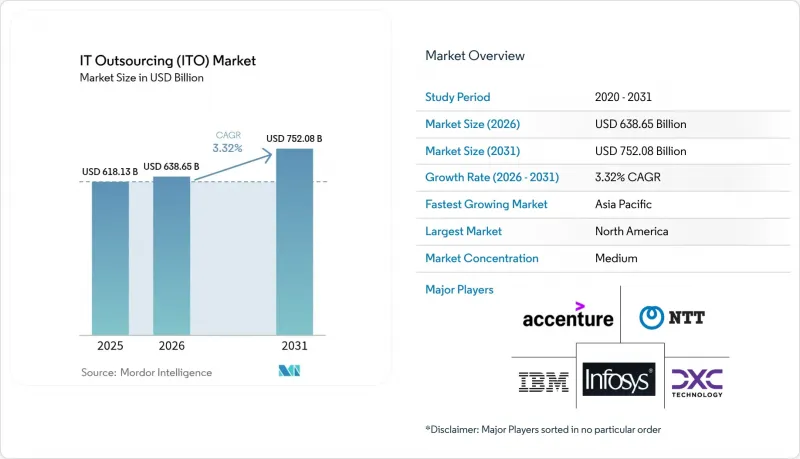
본 보고서는 서비스 유형(인프라 아웃소싱, 애플리케이션 개발·유지보수, 기타), 조직 규모(중소기업 및 대기업), 소싱 거점(온쇼어, 니어쇼어, 기타), 최종 사용자 산업(은행, 금융서비스 및 보험(BFSI), 헬스케어 및 생명과학, 기타), 지역별로 분류되어 있습니다. 시장 예측은 금액(달러) 기준으로 제시되어 있습니다.
세계 IT 아웃소싱(ITO) 시장 동향 및 인사이트
클라우드 네이티브 애플리케이션 현대화에 대한 수요
기업들은 모놀리식 시스템을 마이크로서비스, 컨테이너, 서버리스 함수로 재구축하고 있으며, 이로 인해 플랫폼 엔지니어링, 쿠버네티스 오케스트레이션, 이벤트 주도형 설계 분야에서 대규모 프로젝트가 발생하고 있습니다. 서비스 제공업체들은 특히 규정 준수가 점점 더 복잡해지고 있는 금융 서비스 및 헬스케어와 같은 규제가 엄격한 산업 분야에서 작업 시간에 기반한 청구 대신 성능, 비용 목표, 확장성을 보장하는 성과 기반 계약을 점점 더 많이 제공합니다. 기술적 변혁을 보완하는 것이 문화적 변혁 관리이며, 사내 팀만으로는 쉽게 정착시키기 어려운 애자일 프로세스를 외부 파트너가 지도하는 사례가 빈번히 관찰됩니다.
GenAI를 활용한 서비스 데스크 자동화
생성형 AI는 지능형 라우팅 및 자가 복구 스크립트를 통해 레벨 1 티켓 건수를 최대 40% 줄이고, 평균 해결 시간(MTTR)을 25% 단축하고 있습니다. 가상 비서는 현재 여러 시스템에 걸친 맥락을 파악하고, 개인화된 대응을 제공하며, 사용자가 장애를 인지하기 전에 인시던트를 예측할 수 있게 되었습니다. 다만, 맥락에 따른 판단이 요구되는 복잡한 보안 문제의 경우, 제공업체는 자동화와 인간의 감독을 결합해야 합니다.
심화되는 지적 재산(IP) 도난과 랜섬웨어로 인한 보험 비용 증가
사이버 사고 증가에 따라 보험료가 상승하고 보상 범위가 좁아지면서, 기업들은 암호화, 접근 모니터링 및 개발 구역 분리를 도입할 수밖에 없게 되었고, 그 결과 프로젝트 비용이 증가하고 있습니다(EY). 현재 구매자들은 공급자에게 더 높은 보험 한도 확보와 정기적인 침투 테스트 실시를 요구하고 있으며, 이러한 장벽은 소규모 벤더에게 불리하게 작용하여 업계 재편을 가속화하고 있습니다.
부문 분석
2025년, IT 아웃소싱 시장에서 인프라 아웃소싱이 45.05%를 차지했습니다. 이는 지속적인 모니터링과 규제 준수가 필요한, 장애 허용성이 높은 데이터센터 운영에 대한 기업의 의존도 때문입니다. 그러나 조직이 AWS, Azure, Google Cloud 및 사설 환경을 아우르는 하이브리드 환경의 복잡성에 직면함에 따라, 클라우드 관리 서비스는 연평균 성장률(CAGR) 3.44%로 시장을 주도하고 있습니다. 현재 공급업체들은 비용, 지연 시간, 규정 준수 우선 순위에 따라 워크로드를 순서화하는 통합 관리 플랫폼을 묶어 제공하고 있으며, 이는 기존 인프라 관리와 새롭게 부상하는 멀티 클라우드 오케스트레이션 사이의 경계에 새로운 과제를 제기하고 있습니다.
애플리케이션 개발 및 유지보수에 대한 수요는 로우코드 및 AI 지원형 개발을 통해 재편되고 있으며, 벤더들은 도메인 지식과 통합 전문성을 통해 차별화를 꾀할 수밖에 없게 되었습니다. 엣지 컴퓨팅 및 AI 모델 라이프사이클 서비스는 ‘기타’ 범주로 분류되며, 아직 발전 단계에 있지만 높은 수익을 기대할 수 있는 기회로 부상하고 있습니다. 클라우드 도입이 진행됨에 따라 기존 기업들은 AI를 활용한 자가 복구 기능을 통해 서비스 수준 목표(SLO)를 보장하는 자동화된 사이트 신뢰성 엔지니어링(SRE) 서비스로 사업을 전환하고 있으며, 이를 통해 가격 압박으로부터 인프라 수익원을 보호하고 있습니다.
2025년에는 복잡한 레거시 환경에 대한 심도 있는 아키텍처 노하우가 요구됨에 따라 대기업이 지출의 67.25%를 차지했으나, 중소기업(SME)은 연평균 성장률(CAGR) 3.96%라는 빠른 속도로 확대되고 있습니다. 성과 기반 계약은 IT 지출을 인력 수 대신 구체적인 비즈니스 성과에 연동시키기 때문에 중소기업에서 선호되고 있습니다. 클라우드 네이티브 벤더는 셀프 서비스 포털과 자동 프로비저닝을 통해 진입 장벽을 낮추고, 과거에는 포춘 500대 기업의 예산으로만 이용할 수 있었던 AI, 분석, 사이버 보안 기능을 중소기업이 온디맨드로 이용할 수 있도록 하고 있습니다. 이러한 기술의 민주화로 인해 IT 아웃소싱 시장의 총 잠재 규모가 확대됨에 따라, 기존 공급업체들은 이익률을 훼손하지 않으면서도 경제적으로 규모를 축소할 수 있는 모듈화되고 표준화된 서비스 제공을 요구받고 있습니다.
지역별 분석
북미가 24.12%의 점유율을 차지하고 있다는 사실은 경험이 풍부한 공급업체가 필요한 AI 및 클라우드 현대화 이니셔티브의 주요 도입 지역으로서의 위상을 뒷받침합니다. 미국 기업들은 거래당 비용 및 수익 향상 지표를 규정한 성과 기반 조건으로 기존 계약을 재협상하고 있으며, 이를 통해 인력 차익 거래의 위험을 줄이고 있습니다. 캐나다 기업들은 엄격한 개인정보 보호법을 준수하기 위해 제로 트러스트 보안 프레임워크와 주권 클라우드 인스턴스를 우선시하고 있습니다. 멕시코의 니어쇼어 센터는 애자일 포드와 DevOps 기능을 확충하여 프로젝트 지연을 줄이는 동시에 미국 고객과의 문화적 적합성을 높이고 있습니다.
아시아태평양의 연평균 성장률(CAGR) 3.66%는 인도의 지속적인 우위와 아세안(ASEAN) 국가들의 기여도 증가에 기인합니다. 베트남, 인도네시아, 말레이시아는 정부의 인센티브와 학술 기관과의 제휴를 통해 엔지니어 인재 공급원을 육성하고 있으며, 애플리케이션 개발 및 테스트의 2차 거점으로서의 입지를 확립해 가고 있습니다. 일본과 한국은 국내 인력 부족을 보완하기 위해 차세대 네트워크 운영 및 엣지 클라우드 오케스트레이션을 아웃소싱하고 있으며, 호주에서는 관리형 사이버 보안 및 클라우드 FinOps 서비스에 대한 수요가 증가하고 있습니다.
유럽에서는 엄격한 데이터 보호 규제와 디지털 주권에 대한 지향이 맞물려, 현지 제공업체들은 하이퍼스케일러와 제휴하여 지역에 특화된 주권 클라우드 존을 구축하고 있습니다. 독일, 프랑스, 네덜란드는 국내 데이터 처리를 고수하면서도 산업별 클라우드 전환을 추진하고 있습니다. 영국은 브렉시트에도 불구하고 금융 서비스 아웃소싱 거점으로서의 지위를 유지하고 있으며, 복원력 테스트와 운영 리스크 관리를 중시하고 있습니다. 동유럽의 소프트웨어 엔지니어링 클러스터는 고부가가치 연구개발(R&D) 아웃소싱을 제공하고 있으며, 서유럽 고객과의 다각화 협정을 통해 지정학적 불확실성에 대처하고 있습니다.
기타 혜택:
- 엑셀 형식 시장 예측(ME) 시트
- 3개월간의 애널리스트 지원
자주 묻는 질문
목차
제1장 서론
제2장 조사 방법
제3장 주요 요약
제4장 시장 구도
제5장 시장 규모와 성장 예측
제6장 경쟁 구도
제7장 시장 기회와 향후 전망
LSH 26.09.14According to Mordor Intelligence, the IT outsourcing market size was valued at USD 618.13 billion in 2025 and estimated to grow from USD 638.65 billion in 2026 to reach USD 752.08 billion by 2031, at a CAGR of 3.32% during the forecast period (2026-2031).
This report is Segmented by Service Type (Infrastructure Outsourcing, Application Development and Maintenance, and More), Organization Size (SMEs and Large Enterprises), Sourcing Location (On-Shore, Near-Shore, and More), End-User Industry (BFSI, Healthcare and Life-Sciences, and More), and by Geography. The Market Forecasts are Provided in Terms of Value (USD).
Global IT Outsourcing (ITO) Market Trends and Insights
Cloud-native Application Modernization Demand
Enterprises are re-architecting monolithic systems into microservices, containers, and serverless functions, which opens sizable engagements for platform engineering, Kubernetes orchestration, and event-driven design. Providers increasingly deliver outcome-based contracts that guarantee performance, cost targets, and scalability rather than billing for effort, particularly in highly regulated verticals such as financial services and healthcare where compliance adds complexity. Cultural change management complements the technical shift, and external partners frequently guide agile processes that internal teams cannot easily instill.
GenAI-enabled Service-desk Automation
Generative AI is cutting Level 1 ticket volumes by up to 40% and trimming mean-time-to-resolution by 25% through intelligent routing and self-healing scripts. Virtual assistants now grasp context across multiple systems, drive personalized responses, and predict incidents before users notice disruption. Providers must, however, pair automation with human oversight for complex security issues that demand contextual judgment.
Escalating IP-theft and Ransomware Insurance Costs
Increasing cyber incidents raise premiums and narrow coverage, forcing enterprises to add encryption, access monitoring, and segregated development zones that inflate project costs EY. Buyers now demand providers carry higher insurance limits and submit to regular penetration tests, a hurdle that disadvantages smaller vendors and fuels consolidation.
Other drivers and restraints analyzed in the detailed report include:
- Integration of AI and Automation in DevOps Outsourcing
- Talent-scarcity in Cybersecurity and Observability
- Rising Geopolitical Tensions Disrupting Offshore Delivery Centers
For complete list of drivers and restraints, kindly check the Table Of Contents.
Segment Analysis
Infrastructure outsourcing commanded 45.05% of the IT outsourcing market in 2025 due to enterprises' reliance on resilient data center operations that need continuous monitoring and regulatory compliance. Cloud-managed services, however, are pacing the field with a 3.44% CAGR as organizations confront the complexity of hybrid estates spanning AWS, Azure, Google Cloud, and private environments. Providers now bundle unified management platforms that sequence workloads by cost, latency, and compliance preferences, challenging the boundaries between traditional infrastructure management and emerging multicloud orchestration.
Demand for application development and maintenance is being reshaped by low-code and AI-assisted development, pushing vendors to differentiate through domain knowledge and integration expertise. Edge computing and AI model lifecycle services sit in the "Others" bucket and represent nascent yet high-margin opportunities. As cloud adoption rises, incumbents pivot to automated site-reliability-engineering services that deliver guaranteed service-level objectives using AI-driven self-healing, thereby protecting infrastructure revenue streams against price compression.
Large enterprises retained 67.25% of spending in 2025 as their complex legacy estates require deep architectural know-how, yet SMEs are expanding faster at a 3.96% CAGR. Outcome-based contracts resonate with smaller firms because they align IT spending to tangible business outcomes instead of headcount. Cloud-native vendors lower entry barriers with self-service portals and automated provisioning, giving SMEs on-demand access to AI, analytics, and cybersecurity capabilities once exclusive to Fortune 500 budgets. This democratization of technology widens the total addressable IT outsourcing market and pressures established providers to create modular, standardized offerings that scale down economically without compromising margin.
Complete Report Scope:
- By Service Type
- Infrastructure Outsourcing
- Application Development and Maintenance
- Cloud-Managed Services
- Others
- By Organization Size
- Small and Medium Enterprises
- Large Enterprises
- By Sourcing Location
- On-shore
- Near-shore
- Off-shore
- By End-user Industry
- BFSI
- Healthcare and Life-Sciences
- Media and Telecommunications
- Retail and E-commerce
- Manufacturing
- Others
- By Geography
- North America
- United States
- Canada
- Mexico
- South America
- Brazil
- Argentina
- Rest of South America
- Europe
- United Kingdom
- Germany
- France
- Italy
- Spain
- Rest of Europe
- Asia-Pacific
- China
- Japan
- South Korea
- India
- Australia
- Rest of Asia-Pacific
- Middle East and Africa
- Middle East
- Saudi Arabia
- United Arab Emirates
- Turkey
- Rest of Middle East
- Africa
- South Africa
- Nigeria
- Egypt
- Rest of Africa
- Middle East
- North America
Geography Analysis
North America's 24.12% share confirms its status as the prime adopter of AI and cloud modernization initiatives that demand seasoned providers. United States enterprises are renegotiating legacy contracts toward outcome-based terms that stipulate cost-per-transaction or revenue uplift metrics, reducing labor-arbitrage exposure. Canadian firms prioritize zero-trust security frameworks and sovereign cloud instances to comply with stringent privacy acts. Mexican nearshore centers expand agile pods and DevOps capabilities, reducing project latency and enhancing cultural alignment for US clients.
Asia-Pacific's 3.66% CAGR stems from India's continued dominance and rising contributions from ASEAN economies. Vietnam, Indonesia, and Malaysia are nurturing engineering talent pipelines through government incentives and academic partnerships, positioning themselves as secondary hubs for application development and testing. Japan and South Korea outsource next-generation network operations and edge-cloud orchestration to compensate for local workforce gaps, and Australia increases demand for managed cybersecurity and cloud FinOps services.
Europe combines stringent data-protection mandates with an appetite for digital sovereignty. Local providers form alliances with hyperscalers to launch region-specific sovereign cloud zones. Germany, France, and the Netherlands drive sectoral cloud migration while insisting on in-country data processing. The United Kingdom, despite Brexit, remains a hub for financial-services outsourcing, emphasizing resilience testing and operational-risk controls. Eastern Europe's software-engineering clusters offer high-end R&D outsourcing but navigate geopolitical uncertainty through diversification agreements with Western European clients.
- IBM Corporation
- Tata Consultancy Services
- Infosys Ltd
- Cognizant Technology Solutions
- Wipro Ltd
- HCLTech
- Capgemini SE
- DXC Technology
- NTT Data Corporation
- Atos SE
- CGI Inc.
- Tech Mahindra
- EPAM Systems
- LTI Mindtree
- Globant
- Endava plc
- Softtek
- Andela Inc.
- Persistent Systems
- Accenture plc
Additional Benefits:
- The market estimate (ME) sheet in Excel format
- 3 months of analyst support
TABLE OF CONTENTS
1 INTRODUCTION
- 1.1 Study Assumptions and Market Definition
- 1.2 Scope of the Study
2 RESEARCH METHODOLOGY
3 EXECUTIVE SUMMARY
4 MARKET LANDSCAPE
- 4.1 Market Overview
- 4.2 Market Drivers
- 4.2.1 Cloud-native application modernisation demand
- 4.2.2 GenAI-enabled service-desk automation
- 4.2.3 Integration of AI and automation in DevOps outsourcing
- 4.2.4 Talent-scarcity in cybersecurity and observability
- 4.2.5 Rise of sovereign-cloud and data-residency mandates
- 4.2.6 Vendor shift to outcome-based pricing models
- 4.3 Market Restraints
- 4.3.1 Escalating IP-theft and ransomware insurance costs
- 4.3.2 Rising geopolitical tensions disrupting offshore delivery centers
- 4.3.3 Volatility in hyperscaler egress pricing
- 4.3.4 AI-enabled code-generation reducing outsourcing scope
- 4.4 Supply-Chain Analysis
- 4.5 Regulatory Landscape
- 4.6 Technological Outlook
- 4.7 Porter's Five Forces
- 4.7.1 Threat of New Entrants
- 4.7.2 Bargaining Power of Buyers
- 4.7.3 Bargaining Power of Suppliers
- 4.7.4 Threat of Substitutes
- 4.7.5 Intensity of Rivalry
- 4.8 Assesment of Macroeconomic Factors on the market
5 MARKET SIZE AND GROWTH FORECASTS (VALUE)
- 5.1 By Service Type
- 5.1.1 Infrastructure Outsourcing
- 5.1.2 Application Development and Maintenance
- 5.1.3 Cloud-Managed Services
- 5.1.4 Others
- 5.2 By Organization Size
- 5.2.1 Small and Medium Enterprises
- 5.2.2 Large Enterprises
- 5.3 By Sourcing Location
- 5.3.1 On-shore
- 5.3.2 Near-shore
- 5.3.3 Off-shore
- 5.4 By End-user Industry
- 5.4.1 BFSI
- 5.4.2 Healthcare and Life-Sciences
- 5.4.3 Media and Telecommunications
- 5.4.4 Retail and E-commerce
- 5.4.5 Manufacturing
- 5.4.6 Others
- 5.5 By Geography
- 5.5.1 North America
- 5.5.1.1 United States
- 5.5.1.2 Canada
- 5.5.1.3 Mexico
- 5.5.2 South America
- 5.5.2.1 Brazil
- 5.5.2.2 Argentina
- 5.5.2.3 Rest of South America
- 5.5.3 Europe
- 5.5.3.1 United Kingdom
- 5.5.3.2 Germany
- 5.5.3.3 France
- 5.5.3.4 Italy
- 5.5.3.5 Spain
- 5.5.3.6 Rest of Europe
- 5.5.4 Asia-Pacific
- 5.5.4.1 China
- 5.5.4.2 Japan
- 5.5.4.3 South Korea
- 5.5.4.4 India
- 5.5.4.5 Australia
- 5.5.4.6 Rest of Asia-Pacific
- 5.5.5 Middle East and Africa
- 5.5.5.1 Middle East
- 5.5.5.1.1 Saudi Arabia
- 5.5.5.1.2 United Arab Emirates
- 5.5.5.1.3 Turkey
- 5.5.5.1.4 Rest of Middle East
- 5.5.5.2 Africa
- 5.5.5.2.1 South Africa
- 5.5.5.2.2 Nigeria
- 5.5.5.2.3 Egypt
- 5.5.5.2.4 Rest of Africa
- 5.5.5.1 Middle East
- 5.5.1 North America
6 COMPETITIVE LANDSCAPE
- 6.1 Market Concentration
- 6.2 Strategic Moves
- 6.3 Market Share Analysis
- 6.4 Company Profiles (includes Global level Overview, Market level overview, Core Segments, Financials as available, Strategic Information, Market Rank/Share for key companies, Products and Services, and Recent Developments)
- 6.4.1 IBM Corporation
- 6.4.2 Tata Consultancy Services
- 6.4.3 Infosys Ltd
- 6.4.4 Cognizant Technology Solutions
- 6.4.5 Wipro Ltd
- 6.4.6 HCLTech
- 6.4.7 Capgemini SE
- 6.4.8 DXC Technology
- 6.4.9 NTT Data Corporation
- 6.4.10 Atos SE
- 6.4.11 CGI Inc.
- 6.4.12 Tech Mahindra
- 6.4.13 EPAM Systems
- 6.4.14 LTI Mindtree
- 6.4.15 Globant
- 6.4.16 Endava plc
- 6.4.17 Softtek
- 6.4.18 Andela Inc.
- 6.4.19 Persistent Systems
- 6.4.20 Accenture plc
7 MARKET OPPORTUNITIES AND FUTURE OUTLOOK
- 7.1 White-space and Unmet-need Assessment


