

|
시장보고서
상품코드
2124493
농업용 포장 : 시장 점유율 분석, 업계 동향 및 통계, 성장 예측(2026-2031년)Agricultural Packaging - Market Share Analysis, Industry Trends & Statistics, Growth Forecasts (2026 - 2031) |
||||||
 Mordor Intelligence
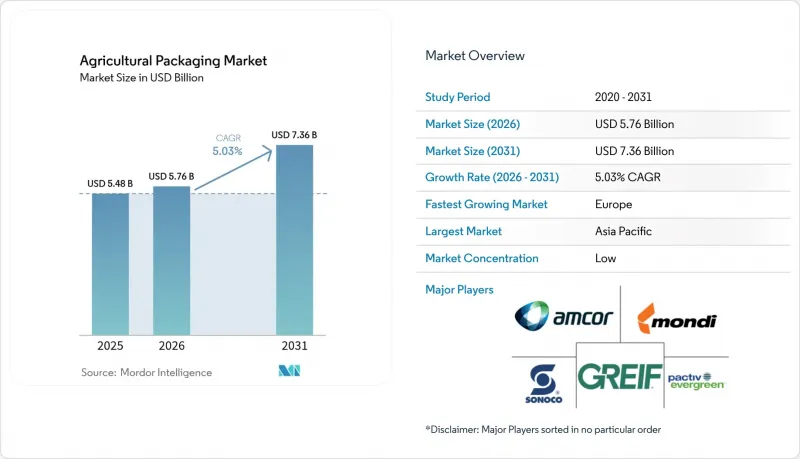
농업용 포장 시장 규모는 2026년에 57억 6,000만 달러로 추정되고 2025년 54억 8,000만 달러에서 확대해, 2031년에는 73억 6,000만 달러에 이를 것으로 예측됩니다.
2026년부터 2031년까지 연평균 성장률(CAGR) 5.03%로 성장할 것으로 전망됩니다.
본 보고서는 소재 유형(플라스틱, 종이 및 판지, 금속, 복합재, 생분해성 필름), 용도(농약, 비료, 종자·형질, 작물 보호용 생물제제), 제품 형태(봉지·자루, 벌크 컨테이너 등), 용량 범위(25kg 이하/20L 이하, 26-100kg/21-200L, 기타) 및 지역별로 분류되어 있습니다. 시장 전망은 금액(달러) 기준으로 제시되어 있습니다.
세계의 농업용 포장 시장 동향 및 인사이트
농약·비료에 대한 수요 증가
각국이 수확량 증대를 목표로 하는 가운데, 전 세계 농약 및 비료 소비량은 지속적으로 증가하고 있습니다. 인도 규제 당국은 2024년 상반기에 기존 살충제부터 신규 유효 성분에 이르기까지 416종의 새로운 작물 보호 제품을 승인했으며, 이에 따라 포장량이 증가했습니다. 중국이 40년에 걸친 전환 과정을 거쳐 세계 최대의 농약 수출국이 됨에 따라, 여러 수출 대상 시장의 규제를 준수하는 표준화된 포장 형식이 요구되고 있습니다. 미국에서는 아시아산 2,4-D 수입에 대한 반덤핑 조사로 인해 국내 충전 계획이 재검토되고 있습니다. 한편, 필리핀 당국의 위조 화학물질 압수 사례는 브랜드 보호에 있어 변조 방지 포장의 중요성을 부각시키고 있습니다(pna.gov.ph). 식량 안보 프로그램과 정밀 살포 장비의 보급을 배경으로, 농업용 포장 시장에서는 누출을 방지하고 작업자의 노출을 줄여주는 고차단성 라미네이트 소재와 소량씩 사용할 수 있는 전용 파우치 수요가 증가하고 있습니다.
지속가능성을 원동력으로 하는 소재 혁신
EU의 PPWR(포장 및 포장재 지침)은 2030년까지 모든 포장재를 재활용 가능하도록 의무화하고, 같은 해까지 PET 재활용 함유율을 30%로, 2040년까지 50%로 높일 것을 규정하고 있습니다. 몬디(Mondi)사의 종이 제품인 ‘어드밴티지 크래프트 멀치(Advantage Craft Mulch)’는 검은색 PE 멀치 필름을 대체하며, 농경지 용도에서 소재 대체의 기세를 보이고 있습니다. 헴프 하드(대마 줄기) 성형 섬유 및 리그닌계 나노 복합재에 관한 학술 연구에 따르면, 바이오 유래 기판은 석유 유래 필름에 필적하는 내습성 및 자외선 차단 성능을 발휘할 수 있는 것으로 나타났습니다. 그라이프(Glyph)사의 ‘EnviroRAP’ 판지 및 락티프스(Lactips)사의 식용 필름에 관한 특허는 지속 가능한 소재가 시범 단계에서 상업적 규모로 전환되고 있음을 뒷받침하는 또 하나의 증거입니다. EPR(확대 생산자 책임) 수수료로 인해 재활용이 불가능한 형태가 불이익을 받는 가운데, 가공업체들은 바이오 수지, 단일 소재 라미네이트, 수성 배리어 소재에 대한 연구 개발 투자를 가속화하고 있습니다.
플라스틱 및 VOC에 대한 규제 압력
PPWR 법은 식품 접촉용 포장재에서 허용 기준을 초과하는 퍼플루오로알킬 물질 및 폴리플루오로알킬 물질의 사용을 금지하고 있으며, 이로 인해 비료 봉지에 사용되던 수많은 불소 수지 코팅이 배제됩니다. 캘리포니아주의 SB 343법은 2026년 10월 이후 재활용 가능성 시험을 통과하지 못한 포장에 ‘체이싱 애로우(Chasing Arrows)’ 마크 표시를 금지하는 한편, SB 54법은 2032년까지 플라스틱 사용량을 25% 감축할 것을 의무화하고 있습니다. 오리건주의 EPR 법에 따르면 2025년 4월부터 포장 중량에 대한 상세한 보고가 의무화되어, 소규모 가공업체의 관리 부담이 증가하고 있습니다. 조사에 따르면, 현재의 퇴비화 시설에서는 바이오백과 기존 플라스틱을 효과적으로 분리할 수 없는 것으로 밝혀져, ‘상업용 퇴비화 가능’이라는 주장을 복잡하게 만들고 있습니다. 이러한 법규들은 종합적으로 설계 변경을 불가피하게 만들며, 그 결과 비용 상승과 농업용 포장 시장에서의 소재 전환 지연을 초래할 가능성이 있습니다.
부문별 분석
2025년, 농업용 포장 시장에서 플라스틱의 점유율은 46.05%를 차지했습니다. 이는 내구성, 경량성, 그리고 확립된 공급망 덕분입니다. 고밀도 폴리에틸렌(HDPE) 드럼통과 폴리프로필렌(PP) 직물 봉지는 내천자성 및 내화학성이 뛰어나 비료 및 농약 용도로 주류를 이루고 있습니다. 그러나 농업용 포장 시장에서는 생분해성 필름으로의 급속한 전환이 진행되고 있으며, 이는 2031년까지 연평균 성장률(CAGR)이 8.01%에 달하는 가장 빠르게 성장하는 하위 부문입니다. 2030년까지 PET에 30%의 재활용 소재 함유를 의무화하는 유럽의 규제로 인해, 가공업체들은 사용 후 수지를 혼합하거나 소재를 완전히 전환해야 하는 상황에 직면해 있습니다. 몬디(Mondi)와 그레이프(Graef)와 같은 제조업체들은 각각 종이 기반 멀치와 100% 재생지 보드 라이너를 상품화하여, 동등한 성능을 제공하면서 동시에 확대 생산자 책임(EPR)의 부담을 경감하고 있습니다.
대마 섬유 성형 기판 및 리그닌·바이오 나노 복합재에 관한 학술적 돌파구로 인해, 기존에는 폴리머 라미네이트에서만 볼 수 있었던 수분, 산소, 자외선에 대한 성능이 기대되면서 경쟁이 격화되고 있습니다. 복합 다층 소재는 고부가가치의 종자나 미량 영양소가 담긴 소형 봉지에서 틈새 시장 지위를 유지하고 있지만, 재활용성에 대한 우려와 층 분리에 드는 비용으로 인해 그 성장은 완만한 수준에 그치고 있습니다. 금속 양동이는 휘발성이 매우 높은 제초제 용기로 사용되고 있지만, 그 판매량은 확대라기보다는 안정세를 보이고 있습니다. 전반적으로, 지속가능성에 대한 요구가 농업용 포장 시장 전체에서 원자재 조달, 금형 투자, 그리고 브랜드 소유자의 메시지 전달 방식을 재정의하고 있습니다.
비료는 2025년 매출의 38.02%를 차지하며, 수확량 극대화에 있어 필수적인 역할을 통해 농업용 포장 시장 규모에서 가장 큰 점유율을 확보했습니다. 과립형 영양소에는 내마모성이 뛰어난 구조가 요구되므로, 봉지, FIBC, 라미네이트 봉지가 주류를 이루고 있습니다. 한편, 작물 보호용 바이오 제품은 시장 규모는 작지만, 잔류 기준 규제를 준수하기 위해 생산자들이 미생물 접종제나 생물촉진제를 채택함에 따라 7.45%라는 가장 높은 연평균 성장률(CAGR)을 보이고 있습니다. 이러한 살아있는 미생물은 생존력을 유지하기 위해 냉장 및 산소 차단 기능이 있는 파우치나 경질 병이 필요하기 때문에 콜드체인에 대응하는 포장 형태의 혁신을 촉진하고 있습니다.
기존의 합성 농약은 여전히 큰 취급량을 차지하고 있지만, 독성에 관한 규제가 엄격해짐에 따라 그 성장세는 둔화되고 있습니다. 종자 형질용 포장재에는 유전적 성능을 보호하기 위해 분진 비산 방지 성능의 향상과 정확한 배출구가 요구되고 있습니다. 각국 정부는 포장 연구 개발에 직접 투자하고 있으며, 미국 농무부(USDA)는 농산물 수출업체에 초점을 맞춘 ‘지속 가능한 포장 혁신 연구소(Sustainable Packaging Innovation Lab)’에 1,000만 달러를 배정했습니다. 이는 포장이 무역을 촉진하는 요소로 점점 더 인식되고 있음을 반영합니다. 개발도상국 시장에서 농업 자재 위조품 대책으로, 컬러 시프트 잉크나 변조 방지 링 등의 진위성 확보 방안이 보급되고 있습니다.
지역별 분석
2025년, 아시아태평양은 농업용 포장 시장 점유율의 39.85%를 차지했습니다. 이는 중국이 세계 최대의 농약 수출국으로 변모한 것과 인도의 비료 집약화 추진에 힘입은 결과입니다. 급속한 기계화, 종자 및 원예 제품을 위한 전자상거래 채널의 확대, 그리고 정부의 식량 안보에 대한 우선적인 노력으로 인해 이 지역의 전망은 견조한 추세를 보이고 있습니다. 베트남의 종이 포장 매출은 이러한 파급 효과를 여실히 보여주며, 연평균 9.73%의 성장률을 기록해 2026년까지 35억 달러에 달할 것으로 예측됩니다. 아시아가 세계 농약 시장에서 차지하는 점유율이 급격히 확대되는 가운데, 가공업체들은 하류 브랜드의 요구 사항을 충족하기 위해 현지에서 수지 재활용을 확대하고 무용제 라미네이션 라인에 대한 투자를 진행하고 있습니다.
유럽은 엄격한 순환 경제 관련 법규와 인증된 지속 가능한 농산물에 기꺼이 비용을 지불하는 부유층 소비자들의 지지에 힘입어, 2031년까지 연평균 성장률(CAGR) 7.86%라는 가장 높은 성장률을 기록할 전망입니다. PPWR(플라스틱 포장 폐기물 규제)만 보더라도 포장 구조의 체계적인 재설계가 요구되고 있어, 성형 섬유 트레이, 단일 소재 필름, 원산지 데이터를 기록하는 스마트 라벨의 도입 여지가 생기고 있습니다. 또한, EU 그린딜의 보조금을 통해 농장의 바이오매스를 포장용 원료로 전환하는 것이 촉진되어 공급망 단축으로 이어지고 있습니다.
북미에서는 수출 지향적인 곡물 및 원예 분야를 배경으로 견조한 수요가 유지되고 있습니다. 미국 농무부(USDA)의 예측에 따르면, ISPM-15 목재 재료 처리 및 추적성 규정을 준수하기 위해 방습 라이너와 QR 코드가 부착된 팔레트 태그에 의존하는 사상 최대의 수출량이 예상됩니다. 중동 및 아프리카은 현재 규모는 작지만, 수입 대체 프로그램의 가속화와 양식업의 확대가 나타나고 있어 건조한 기후에 적합한 연포장 및 경질 포장이 모두 필요할 것으로 보입니다. 라틴아메리카에서는 브라질의 기계화 및 바이오 비료 도입이 호재로 작용하여, 고차단성 다층 봉지를 전문으로 하는 제조업체에게 새로운 기회가 창출되고 있습니다.
기타 혜택 :
- 엑셀 형식 시장 예측(ME) 시트
- 3개월간의 애널리스트 지원
자주 묻는 질문
목차
제1장 서론
제2장 조사 방법
제3장 주요 요약
제4장 시장 구도
제5장 시장 규모 및 성장 예측
제6장 경쟁 구도
제7장 시장 기회 및 향후 전망
KTH 26.09.16According to Mordor Intelligence, the agricultural packaging market size in 2026 is estimated at USD 5.76 billion, growing from 2025 value of USD 5.48 billion with 2031 projections showing USD 7.36 billion, growing at 5.03% CAGR over 2026-2031.
This report is Segmented by Material Type (Plastic, Paper and Paperboard, Metal, Composite, Biodegradable Films), Application (Pesticides, Fertilizers, Seeds and Traits, Crop Protection Biologics), Product Form (Bags and Sacks, Bulk Containers, and More), Capacity Range (<=25 Kg/<=20 L, 26-100 Kg/21-200 L, and More), and Geography. The Market Forecasts are Provided in Terms of Value (USD).
Global Agricultural Packaging Market Trends and Insights
Growing Demand for Agro-Chemicals
Global pesticide and fertilizer consumption keeps rising as nations pursue higher yields. India's regulators cleared 416 new crop-protection products in H1 2024, spanning legacy insecticides and novel actives, thereby boosting packaging volumes. China's four-decade transition into the world's largest pesticide exporter demands standardized pack formats that comply with multiple destination-market rules. In the United States, anti-dumping probes on 2,4-D imports from Asia reshape domestic filling plans, while Philippine authorities' seizure of counterfeit chemicals underscores the role of tamper-evident packaging in brand protection pna.gov.ph. Driven by food-security programs and precision-application equipment, the agricultural packaging market welcomes higher-barrier laminates and smaller dose-specific pouches that reduce spillage and worker exposure.
Sustainability-Driven Material Innovations
The EU's PPWR obliges all packs to be recyclable by 2030 and fixes recycled-content quotas of 30% for PET by that date, rising to 50% by 2040. Mondi's paper-based Advantage Kraft Mulch replaces black PE mulch film, signalling material substitution momentum in field applications. Academic work on hemp-hurd molded fiber and lignin-based nanocomposites shows that bio-derived substrates can deliver moisture resistance and UV shielding comparable to petroleum-based films. Greif's EnviroRAP paperboard and Lactips' edible-film patents add further evidence that sustainable materials are moving from pilot to commercial scale. As EPR fees penalise unrecyclable formats, converters accelerate R&D spend on bio-resins, mono-material laminates, and water-based barriers.
Regulatory Pressure on Plastics and VOCs
The PPWR bans per- and polyfluoroalkyl substances above threshold limits in food-contact packs, eliminating numerous fluoropolymer coatings used on fertilizer bags. California's SB 343 will prohibit "chasing-arrows" symbols on packs that fail recyclability tests after October 2026, while SB 54 compels a 25% plastic reduction by 2032. Oregon's EPR law demands granular reporting of packaging weights from April 2025, raising administrative overhead for small converters. Studies reveal that current composting facilities cannot separate bio-bags from conventional plastics effectively, complicating claims of commercial compostability. Collectively, these statutes force design changes that may elevate costs and slow material changeovers in the agricultural packaging market.
Other drivers and restraints analyzed in the detailed report include:
- Expansion of Cross-Border Agri-Produce Trade
- Mechanisation and Bulk-Handling Adoption
- Raw-Material Price Volatility
For complete list of drivers and restraints, kindly check the Table Of Contents.
Segment Analysis
Plastic accounted for 46.05% of the agricultural packaging market share in 2025, thanks to its durability, lightweight, and ingrained supply chains. High-density polyethylene drums and polypropylene woven sacks dominate fertilizer and pesticide applications because they resist puncture and chemicals. Yet the agricultural packaging market is experiencing a rapid pivot toward biodegradable films, the fastest-growing sub-segment at an 8.01% CAGR through 2031. European regulations imposing 30% recycled content on PET by 2030 push converters to blend post-consumer resin or switch materials entirely.Producers such as Mondi and Greif commercialize paper-based mulch and 100% recycled paperboard liners, respectively, offering comparable performance while easing EPR liabilities.
The competitive intensity is rising as academic breakthroughs in hemp-fiber molded substrates and lignin-bionanocomposites promise moisture, oxygen, and UV performance formerly exclusive to polymer laminates. Composite multilayers maintain a niche in high-value seeds and micro-nutrient sachets, although recyclability concerns and layer-separation costs keep their growth modest. Metal pails serve ultra-volatile herbicides, but volumes are stable rather than expanding. Overall, sustainability imperatives are redefining raw-material procurement, tooling investments, and brand-owner messaging across the agricultural packaging market.
Fertilizers generated 38.02% of 2025 revenue, securing the largest slice of the agricultural packaging market size through their essential role in maximizing yields. Bags, FIBC, and laminated sacks dominate because granulated nutrients require abrasion-resistant structures. Conversely, crop-protection biologics, while starting from a smaller base, hold the highest 7.45% CAGR as growers adopt microbial inoculants and biostimulants to meet residue-limit regulations. These live organisms demand chilled, oxygen-barrier pouches or rigid bottles that preserve viability, driving innovation in cold-chain compatible formats.
Traditional synthetic pesticides continue to command large tonnage, yet their growth moderates under stricter toxicity norms. Seed-trait packaging seeks improved dust retention and precise dispensing holes to safeguard genetic performance. Governments are investing directly in packaging R&D; USDA earmarked USD 10 million for a Sustainable Packaging Innovation Lab focused on produce exporters, reflecting growing recognition of packaging as a trade enabler. Authenticity safeguards such as color-shift inks and tamper rings are proliferating to combat counterfeit agricultural inputs in developing markets.
Complete Report Scope:
- By Material Type
- Plastic
- Paper and Paperboard
- Metal
- Composite
- Biodegradable Films
- By Application
- Pesticides
- Fertilizers
- Seeds and Traits
- Crop Protection Biologics
- By Product Form
- Bags and Sacks
- Bulk Containers (FIBC, Drums, IBC)
- Pouches
- Rigid Containers (Cans, Bottles)
- Caps, Lids and Liners
- By Capacity Range
- <=25 kg / <=20 L
- 26 - 100 kg/ 21 - 200 L
- More than 100 kg/ 200 L (Bulk)
- By Geography
- North America
- United States
- Canada
- Mexico
- Europe
- Germany
- United Kingdom
- France
- Italy
- Spain
- Russia
- Rest of Europe
- Asia-Pacific
- China
- India
- Japan
- South Korea
- Australia and New Zealand
- Rest of Asia-Pacific
- Middle East and Africa
- Middle East
- United Arab Emirates
- Saudi Arabia
- Turkey
- Rest of Middle East
- Africa
- South Africa
- Nigeria
- Egypt
- Rest of Africa
- Middle East
- North America
Geography Analysis
Asia-Pacific anchored 39.85% of agricultural packaging market share in 2025, propelled by China's transformation into the world's largest pesticide exporter and India's fertilizer-intensification drive. Rapid mechanisation, expanding e-commerce channels for seeds and garden products, and governmental food-security priorities keep the regional outlook robust. Vietnam's paper-packaging sales illustrate the spill-over effect, forecast to reach USD 3.5 billion by 2026 on a 9.73% yearly climb. As Asia's share of global agri-chemicals balloons, converters increase local resin recycling and invest in solvent-free lamination lines to meet downstream brand requirements.
Europe is on track to log the fastest 7.86% CAGR through 2031, buoyed by stringent circular-economy legislation and affluent consumers willing to pay for certified-sustainable agricultural produce. The PPWR alone compels systematic redesign of pack structures, opening space for molded-fiber trays, mono-material films, and smart labels that capture provenance data. Additionally, EU Green Deal subsidies encourage on-farm biomass conversion into packaging feedstock, shortening supply chains.
North America maintains healthy demand on the back of export-oriented grain and horticulture segments. USDA forecasts highlight record outbound shipments that rely on moisture-barrier liners and QR-coded pallet tags to comply with ISPM-15 wood-treatment and traceability rules. The Middle East and Africa, while smaller today, show accelerating import-substitution programs and aquaculture expansion that will require both flexible and rigid packs suited to arid climates. Latin America benefits from Brazilian mechanisation and bio-fertilizer adoption, issuing new opportunities for producers specialising in high-barrier multilayer bags.
- Amcor plc
- Mondi Group
- Greif Inc.
- LC Packaging International
- NNZ Group
- Sonoco Products
- ProAmpac LLC
- BAG Corporation
- FlexPack FIBC
- Smurfit WestRock
- Silgan Holdings
- Bischof + Klein
- RKW Group
- NPP Group
- Western Packaging
- Pactiv Evergreen
- Anderson Packaging
- Bulk Lift International
- Mega Pack
Additional Benefits:
- The market estimate (ME) sheet in Excel format
- 3 months of analyst support
TABLE OF CONTENTS
1 INTRODUCTION
- 1.1 Study Assumptions and Market Definition
- 1.2 Scope of the Study
2 RESEARCH METHODOLOGY
3 EXECUTIVE SUMMARY
4 MARKET LANDSCAPE
- 4.1 Market Overview
- 4.2 Market Drivers
- 4.2.1 Growing demand for agro-chemicals
- 4.2.2 Sustainability-driven material innovations
- 4.2.3 Expansion of cross-border agri-produce trade
- 4.2.4 Mechanisation and bulk handling adoption
- 4.2.5 Smart / QR-enabled traceability packaging
- 4.3 Market Restraints
- 4.3.1 Regulatory pressure on plastics and VOCs
- 4.3.2 Raw-material price volatility
- 4.3.3 Counterfeit ag-inputs raising compliance cost
- 4.4 Supply-Chain Analysis
- 4.5 Regulatory Landscape
- 4.6 Technological Outlook
- 4.7 Investment Analysis
- 4.8 Porter's Five Forces Analysis
- 4.8.1 Bargaining Power of Suppliers
- 4.8.2 Bargaining Power of Buyers
- 4.8.3 Threat of New Entrants
- 4.8.4 Threat of Substitutes
- 4.8.5 Competitive Rivalry
5 MARKET SIZE AND GROWTH FORECASTS (VALUE)
- 5.1 By Material Type
- 5.1.1 Plastic
- 5.1.2 Paper and Paperboard
- 5.1.3 Metal
- 5.1.4 Composite
- 5.1.5 Biodegradable Films
- 5.2 By Application
- 5.2.1 Pesticides
- 5.2.2 Fertilizers
- 5.2.3 Seeds and Traits
- 5.2.4 Crop Protection Biologics
- 5.3 By Product Form
- 5.3.1 Bags and Sacks
- 5.3.2 Bulk Containers (FIBC, Drums, IBC)
- 5.3.3 Pouches
- 5.3.4 Rigid Containers (Cans, Bottles)
- 5.3.5 Caps, Lids and Liners
- 5.4 By Capacity Range
- 5.4.1 <=25 kg / <=20 L
- 5.4.2 26 - 100 kg/ 21 - 200 L
- 5.4.3 More than 100 kg/ 200 L (Bulk)
- 5.5 By Geography
- 5.5.1 North America
- 5.5.1.1 United States
- 5.5.1.2 Canada
- 5.5.1.3 Mexico
- 5.5.2 Europe
- 5.5.2.1 Germany
- 5.5.2.2 United Kingdom
- 5.5.2.3 France
- 5.5.2.4 Italy
- 5.5.2.5 Spain
- 5.5.2.6 Russia
- 5.5.2.7 Rest of Europe
- 5.5.3 Asia-Pacific
- 5.5.3.1 China
- 5.5.3.2 India
- 5.5.3.3 Japan
- 5.5.3.4 South Korea
- 5.5.3.5 Australia and New Zealand
- 5.5.3.6 Rest of Asia-Pacific
- 5.5.4 Middle East and Africa
- 5.5.4.1 Middle East
- 5.5.4.1.1 United Arab Emirates
- 5.5.4.1.2 Saudi Arabia
- 5.5.4.1.3 Turkey
- 5.5.4.1.4 Rest of Middle East
- 5.5.4.2 Africa
- 5.5.4.2.1 South Africa
- 5.5.4.2.2 Nigeria
- 5.5.4.2.3 Egypt
- 5.5.4.2.4 Rest of Africa
- 5.5.4.1 Middle East
- 5.5.1 North America
6 COMPETITIVE LANDSCAPE
- 6.1 Market Concentration
- 6.2 Strategic Moves
- 6.3 Market Share Analysis
- 6.4 Company Profiles (includes Global level Overview, Market level overview, Core Segments, Financials as available, Strategic Information, Market Rank/Share for key companies, Products and Services, and Recent Developments)
- 6.4.1 Amcor plc
- 6.4.2 Mondi Group
- 6.4.3 Greif Inc.
- 6.4.4 LC Packaging International
- 6.4.5 NNZ Group
- 6.4.6 Sonoco Products
- 6.4.7 ProAmpac LLC
- 6.4.8 BAG Corporation
- 6.4.9 FlexPack FIBC
- 6.4.10 Smurfit WestRock
- 6.4.11 Silgan Holdings
- 6.4.12 Bischof + Klein
- 6.4.13 RKW Group
- 6.4.14 NPP Group
- 6.4.15 Western Packaging
- 6.4.16 Pactiv Evergreen
- 6.4.17 Anderson Packaging
- 6.4.18 Bulk Lift International
- 6.4.19 Mega Pack
7 MARKET OPPORTUNITIES AND FUTURE OUTLOOK
- 7.1 White-space and Unmet-Need Assessment


