

|
시장보고서
상품코드
2124502
미디어 스트리밍 : 시장 점유율 분석, 업계 동향 및 통계, 성장 예측(2026-2031년)Media Streaming - Market Share Analysis, Industry Trends & Statistics, Growth Forecasts (2026 - 2031) |
||||||
 Mordor Intelligence
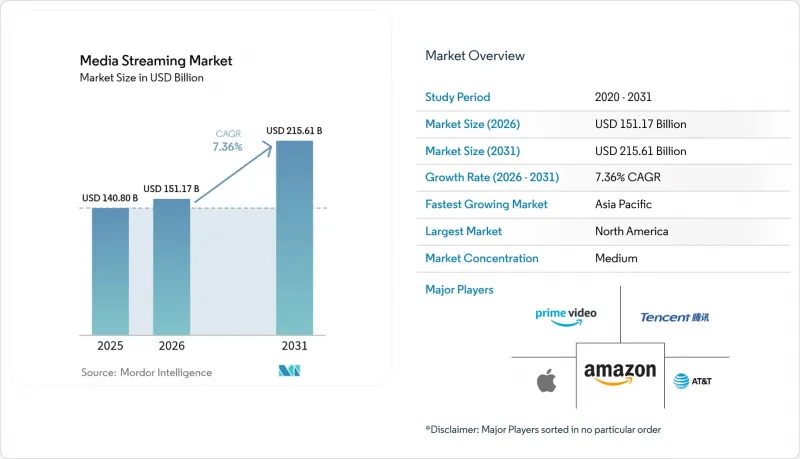
미디어 스트리밍 시장 규모는 2025년에 1,408억 달러로 평가되었습니다. 2026년 1,511억 7,000만 달러에서 2031년까지 2,156억 1,000만 달러에 이를 것으로 예상되며, 예측 기간(2026-2031년) CAGR은 7.36%를 나타낼 전망입니다.
본 보고서는 컨텐츠 유형(동영상 스트리밍, 음악 스트리밍), 서비스 유형(라이브 스트리밍, 온디맨드 스트리밍), 수익 모델(구독, 광고), 스트리밍 화질(SD, HD, 4K/UHD, 8K) 및 지역별로 분류되어 있습니다. 시장 전망은 금액(달러) 기준으로 제시되어 있습니다.
세계의 미디어 스트리밍 시장 동향 및 인사이트
아시아태평양의 저가형 5G 데이터 요금제 보급
저렴한 5G 네트워크의 구축으로 모바일 연결을 통한 HD 및 4K 스트리밍을 끊김 없이 이용할 수 있게 되어 소비 패턴이 완전히 바뀌었습니다. 통신 사업자들은 동영상 트래픽 증가가 프리미엄 네트워크에 대한 투자를 수익화할 수 있도록 데이터 요금제에 보조금을 제공합니다. 이를 통해 인프라 확충과 컨텐츠 참여도를 모두 촉진하는 선순환이 만들어지고 있습니다. 시청자 근처에 배치된 엣지 노드 덕분에 지연 시간이 더욱 단축되었으며, 개인화된 추천 컨텐츠가 실시간으로 업데이트되고 있습니다. 그 결과, 가격에 민감한 신흥 경제국에서 미디어 스트리밍 시장은 지속적인 성장을 이루고 있습니다.
북미 및 유럽의 SVOD 플랫폼, 2·3선 도시로 확장
주요 대도시권 시장이 포화 상태에 이르자, 주요 서비스 업체들은 광섬유망 구축 및 지방의 광대역 환경 개선을 통해 전송 비용이 낮아진 지방 도시를 타겟으로 삼고 있습니다. 현지 제작 예산은 세계적인 대작에 비해 적지만, 문화적으로 현지화된 시리즈는 그동안 서비스가 충분히 미치지 못했던 시청자층 사이에서 더 높은 충성도를 이끌어내고 있습니다. 지역 방언과 시청 시간을 고려한 정교한 추천 알고리즘을 통해 컨텐츠 지출을 늘리지 않고도 참여도를 유지하며, 미디어 스트리밍 시장에 추가 수익을 창출하고 있습니다.
컨텐츠 라이선싱 비용 급등이 이익률을 압박
2025년에 넷플릭스가 180억 달러를 투자했다는 사실은 규모 면에서 업계를 선도하는 기업조차도 수익성을 압박하는 인플레이션의 악순환을 여실히 드러내고 있습니다. 프리미엄 컨텐츠 라이브러리를 둘러싼 치열한 입찰 경쟁은 경쟁 서비스들이 비용의 일부만 가입자에게 전가할 수 있기 때문에 차별화를 저해하는 결과를 낳고 있습니다. 컨텐츠 공유 계약은 당장의 자금 유출을 억제하는 한편, 가입자 확보의 기반이 되는 독점권의 우위를 약화시켜 미디어 스트리밍 시장 전체의 경제성을 위협하고 있습니다.
부문별 분석
2025년, 동영상 서비스는 매출의 77.35%라는 압도적인 점유율을 유지했습니다. 이는 정착된 시청 습관과 사용자 유지를 위한 핵심 요소인 독점 시리즈에 대한 막대한 투자를 반영한 것입니다. 한편, 음악 서비스는 대역폭이 제한된 네트워크에서도 안정적으로 스트리밍할 수 있는 작은 파일 크기에 힘입어 연평균 성장률(CAGR) 8.82%로 성장하고 있습니다. AI를 활용한 플레이리스트가 일일 청취 빈도를 높이고, 광고 공간을 확대함에 따라 오디오 분야의 미디어 스트리밍 시장 규모는 확대되고 있습니다.
낮은 제작 비용과 국경을 초월한 매력 덕분에 음악 플랫폼은 전 세계 시청자를 신속하게 수익화할 수 있는 반면, 동영상 스트리밍 사업자들은 장편 컨텐츠 제작 예산 증가에 직면해 있습니다. 이러한 비용 불균형은 포맷을 초월한 번들링을 촉진하고 있으며, 시장 점유율을 지키기 위해 오디오와 동영상 서비스가 단일 앱 내에서 융합되어 갈 미래를 시사하고 있습니다.
2025년 수익 중 온디맨드 라이브러리가 86.76%를 차지했지만, 라이브 스트리밍의 연평균 성장률(CAGR) 9.44%는 실시간 경험에 대한 수요가 증가하고 있음을 보여줍니다. 스포츠 경기나 인기 리얼리티 프로그램은 광고주가 중요하게 여기는 ‘놓칠 수 없는 프로그램’을 만들어내며, 스트림당 수익을 온디맨드 평균을 상회하는 수준으로 끌어올리고 있습니다.
기술적 복잡성은 경쟁 우위를 강화하고 있습니다. 엣지 컴퓨팅과 맞춤형 프로토콜을 통해 트래픽 급증을 관리하며, 심리적 임계치인 2초 미만의 지연 시간을 확보하고 있습니다. 이러한 기능을 갖춘 플랫폼은 전 세계 주요 이벤트의 피크 시간대에 미디어 스트리밍 시장 점유율을 더욱 확대할 수 있는 위치에 있습니다.
지역별 분석
북미는 2025년 수익의 34.48%를 차지했으나, 시장은 성숙기에 접어들었으며, 각 사업자들은 신규 사용자 확보에서 고객 생애 가치(LTV) 향상으로 전략을 전환하고 있습니다. 버라이즌의 컨버전스 전략이 보여주듯이, 광섬유 및 모바일 요금제와의 번들링을 통해 막대한 마케팅 비용을 들이지 않고도 가입 가구를 확보하며 ARPU를 확대되고 있습니다. 스포츠 중계권 경쟁으로 인해 프로그램 제작비는 치솟고 있지만, 확립된 광고 시장의 존재가 하이브리드 요금제의 수익성을 뒷받침하고 있습니다.
아시아태평양은 정부의 현지 컨텐츠 제작 장려 및 5G 커버리지 확대에 힘입어 연평균 성장률(CAGR) 8.97%를 나타낼 것으로 예측됩니다. 넷플릭스는 문화적 특성을 고려한 오리지널 작품을 공개한 후, 해당 지역의 시청 건수가 20% 급증하며 현지 이야기가 탁월한 참여도를 이끌어낸다는 사실이 입증되었습니다. 각국 정부는 크리에이터를 위한 자금을 지원하고 있으며(인도의 10억 달러 규모 이니셔티브가 대표적입니다), 이는 신선한 컨텐츠 카탈로그를 풍부하게 하고 미디어 스트리밍 시장을 활성화시키고 있습니다. 하지만 다양한 데이터 현지화 규제로 인해 병행된 인프라 구축이 불가피해지면서, 중소 브랜드 시장 진입 장벽이 높아지고 있습니다. 유럽에서는 GDPR(EU 개인정보보호규정)(일반 데이터 보호 규정) 준수와 언어 시장의 세분화로 인해 운영 비용이 증가함에 따라 성장에 편차가 나타나고 있습니다. 넷플릭스와 TF1의 제휴와 같은 배급 계약은 규제 당국과 시청자 양측을 모두 만족시키기 위해 스트리밍 사업자와 기존 방송사가 협력하는 하이브리드 모델의 한 예를 보여줍니다. 라틴아메리카의 광섬유 보급률(브라질 77.2%, 칠레 70.9%)은 고화질 스트리밍 이용 확대로 이어지기 시작하며 새로운 수익원을 창출하고 있습니다. 아프리카에서는 여전히 모바일이 주류를 이루고 있어, 저대역폭 환경에서의 최적화와 다운로드 가능한 컨텐츠 선택지가 잠재적 수요를 자극하는 데 필수적입니다.
기타 혜택 :
- 엑셀 형식 시장 예측(ME) 시트
- 3개월간의 애널리스트 지원
자주 묻는 질문
목차
제1장 서론
제2장 조사 방법
제3장 주요 요약
제4장 시장 구도
제5장 시장 규모 및 성장 예측
제6장 경쟁 구도
제7장 시장 기회 및 향후 전망
KTH 26.09.14According to Mordor Intelligence, the media streaming market size was valued at USD 140.80 billion in 2025 and estimated to grow from USD 151.17 billion in 2026 to reach USD 215.61 billion by 2031, at a CAGR of 7.36% during the forecast period (2026-2031).
This report is Segmented by Content Type (Video Streaming, Music Streaming), Service Type (Live Streaming, On-Demand Streaming), Revenue Model (Subscription, Advertising), Streaming Quality (SD, HD, 4K/UHD, 8K), and Geography. The Market Forecasts are Provided in Terms of Value (USD).
Global Media Streaming Market Trends and Insights
Proliferation of Low-Cost 5G Data Plans Across Asia-Pacific
Deployment of affordable 5G networks has reshaped consumption patterns by supporting uninterrupted HD and 4K streams on mobile connections. Operators subsidize data packages because elevated video traffic monetizes premium network investments, creating a feedback loop that spurs both infrastructure build-out and content engagement. Edge nodes positioned close to viewers further trim latency, enabling personalized recommendations to refresh in real time. The result is sustained growth for the media streaming market in price-sensitive emerging economies.
SVOD Platform Expansion into Tier-II/III Cities in North America and Europe
Having saturated major metropolitan areas, leading services are targeting secondary cities where fiber rollout and improved rural broadband have lowered delivery cost. Localized production budgets are modest relative to global tent-pole titles, yet culturally tailored series drive higher loyalty among underserved audiences. Sophisticated recommendation algorithms that account for regional dialects and viewing times maintain engagement without raising content outlays, adding incremental revenue to the media streaming market.
Escalating Content-Licensing Costs Compressing Margins
Netflix's USD 18 billion outlay in 2025 underscores an inflationary spiral that squeezes profitability even for scale leaders. Fierce bidding for premium libraries diminishes differentiation because rival services can only pass a portion of costs to subscribers. Sharing agreements reduce immediate cash burn but blunt exclusivity advantages that underpin subscriber acquisition, challenging overall economics of the media streaming market.
Other drivers and restraints analyzed in the detailed report include:
- Exclusive Sports-Rights Wars Driving Premium Pricing
- Integration of Cloud-Native CDN and Edge Compute for Ultra-Low-Latency Live Streams
- Heightened Regulatory Scrutiny on Data Privacy and Localization
For complete list of drivers and restraints, kindly check the Table Of Contents.
Segment Analysis
Video maintained a commanding 77.35% revenue slice in 2025, reflecting entrenched viewing habits and heavy investment in exclusive series that anchor user retention. Music services, however, are expanding at an 8.82% CAGR aided by compact file sizes that stream reliably on constrained networks. The media streaming market size for audio is swelling as AI-driven playlists raise daily listening frequency and enlarge ad inventory.
Lower production costs and borderless appeal allow music platforms to monetize global audiences rapidly, while video players shoulder rising budgets for long-form content. This cost asymmetry encourages cross-format bundling, signalling a future where audio and video propositions converge within a single app to protect market share.
On-demand libraries accounted for 86.76% of 2025 revenue, yet live streaming's 9.44% CAGR illustrates growing appetite for real-time experiences. Sporting fixtures and tent-pole reality shows create appointment viewing that advertisers value, lifting revenue per stream above on-demand averages.
Technical complexity strengthens competitive moats: edge compute and custom protocols manage traffic spikes, ensuring latency below the two-second psychological threshold. Platforms mastering these capabilities are positioned to capture incremental media streaming market share during peak global events.
Complete Report Scope:
- By Content Type
- Video Streaming
- Music Streaming
- By Service Type
- Live Streaming
- On-Demand Streaming
- By Revenue Model
- Subscription (SVOD/AVOD/Hybrid)
- Advertising (AVOD/FAST)
- By Streaming Quality
- SD
- HD
- 4K / UHD
- 8K
- By Geography
- North America
- United States
- Canada
- Mexico
- South America
- Brazil
- Argentina
- Mexico
- Rest of South America
- Europe
- Germany
- United Kingdom
- France
- Italy
- Spain
- Rest of Europe
- Asia-Pacific
- China
- Japan
- South Korea
- India
- Australia
- New Zealand
- Rest of Asia-Pacific
- Middle East
- United Arab Emirates
- Saudi Arabia
- Rest of Middle East and Africa
- Africa
- South Africa
- Rest of Africa
- North America
Geography Analysis
North America generated 34.48% of 2025 revenue but is maturing, prompting operators to pivot from user acquisition toward higher lifetime value. Bundling with fiber and mobile contracts, as demonstrated by Verizon's convergence strategy, locks in households and widens ARPU without heavy marketing spend. Sports-rights competition inflates programming costs, yet the presence of established ad markets sustains hybrid-tier profitability.
Asia-Pacific is projected to expand at a 8.97% CAGR, buoyed by governmental encouragement of local content creation and accelerating 5G coverage. Netflix recorded a 20% regional viewing surge after debuting culturally tailored originals, confirming that local narratives unlock outsized engagement. Governments are offering creator funds-India's USD 1 billion initiative is emblematic-that feed fresh catalogs and stimulate the media streaming market. Nonetheless, diverse data-localization rules compel parallel infrastructure builds, raising entry barriers for smaller brands. Europe shows uneven growth as GDPR compliance and fragmented language markets inflate operational overheads. Carriage agreements such as Netflix's tie-up with TF1 illustrate a hybrid model where streaming and traditional broadcasters collaborate to satisfy regulators and audiences. Latin America's fiber penetration-77.2% in Brazil and 70.9% in Chile-has started translating into higher-resolution streaming uptake, creating fresh addressable revenue. Africa remains mobile-first; low-bandwidth optimizations and downloadable content options are crucial to unlock latent demand.
- Netflix Inc.
- Spotify Technology S.A.
- Apple Inc. (Apple TV+, Apple Music)
- Amazon.com Inc. (Prime Video, Amazon Music)
- Alphabet Inc. (YouTube, YouTube Music)
- Tencent Holdings Ltd. (Tencent Video, QQ Music)
- The Walt Disney Company (Disney+, ESPN+)
- AT&T Inc. (Max / HBO, DirecTV Stream)
- Comcast Corp. (Peacock, NOW TV)
- Roku Inc.
- Deezer S.A.
- Baidu Inc. (iQIYI, Qian Qian Music)
- British Broadcasting Corporation (BBC iPlayer)
- Hulu LLC
- Pandora Media LLC
- ViacomCBS Inc. (Paramount+)
- Sony Group Corp. (Crunchyroll, Sony LIV)
- Naspers Ltd. (Showmax)
- FuboTV Inc.
- DAZN Group Ltd.
Additional Benefits:
- The market estimate (ME) sheet in Excel format
- 3 months of analyst support
TABLE OF CONTENTS
1 INTRODUCTION
- 1.1 Study Assumptions and Market Definition
- 1.2 Scope of the Study
2 RESEARCH METHODOLOGY
3 EXECUTIVE SUMMARY
4 MARKET LANDSCAPE
- 4.1 Market Overview
- 4.2 Market Drivers
- 4.2.1 Proliferation of Low-Cost 5G Data Plans Across Asia-Pacific
- 4.2.2 SVOD Platform Expansion into Tier-II/III Cities in North America and Europe
- 4.2.3 Exclusive Sports-Rights Wars Driving Premium Pricing
- 4.2.4 Integration of Cloud-Native CDN andEdge Compute for Ultra-Low-Latency Live Streams
- 4.2.5 Rise of FAST (Free Ad-Supported TV) Channels Boosting Ad Inventory
- 4.2.6 Bundling of Telco andMedia Services Inducing Subscriber Stickiness
- 4.3 Market Restraints
- 4.3.1 Escalating Content-Licensing Costs Compressing Margins
- 4.3.2 Fragmented Rights Management Hindering Global Release Windows
- 4.3.3 Persistent Last-Mile Latency in Emerging Economies
- 4.3.4 Heightened Regulatory Scrutiny on Data Privacy andLocalization
- 4.4 Regulatory Outlook
- 4.5 Porters Five Forces Analysis
- 4.5.1 Bargaining Power of Suppliers
- 4.5.2 Bargaining Power of Buyers
- 4.5.3 Threat of New Entrants
- 4.5.4 Threat of Substitutes
- 4.5.5 Intensity of Competitive Rivalry
5 MARKET SIZE AND GROWTH FORECASTS (VALUE)
- 5.1 By Content Type
- 5.1.1 Video Streaming
- 5.1.2 Music Streaming
- 5.2 By Service Type
- 5.2.1 Live Streaming
- 5.2.2 On-Demand Streaming
- 5.3 By Revenue Model
- 5.3.1 Subscription (SVOD/AVOD/Hybrid)
- 5.3.2 Advertising (AVOD/FAST)
- 5.4 By Streaming Quality
- 5.4.1 SD
- 5.4.2 HD
- 5.4.3 4K / UHD
- 5.4.4 8K
- 5.5 By Geography
- 5.5.1 North America
- 5.5.1.1 United States
- 5.5.1.2 Canada
- 5.5.1.3 Mexico
- 5.5.2 South America
- 5.5.2.1 Brazil
- 5.5.2.2 Argentina
- 5.5.2.3 Mexico
- 5.5.2.4 Rest of South America
- 5.5.3 Europe
- 5.5.3.1 Germany
- 5.5.3.2 United Kingdom
- 5.5.3.3 France
- 5.5.3.4 Italy
- 5.5.3.5 Spain
- 5.5.3.6 Rest of Europe
- 5.5.4 Asia-Pacific
- 5.5.4.1 China
- 5.5.4.2 Japan
- 5.5.4.3 South Korea
- 5.5.4.4 India
- 5.5.4.5 Australia
- 5.5.4.6 New Zealand
- 5.5.4.7 Rest of Asia-Pacific
- 5.5.5 Middle East
- 5.5.5.1 United Arab Emirates
- 5.5.5.2 Saudi Arabia
- 5.5.5.3 Rest of Middle East and Africa
- 5.5.6 Africa
- 5.5.6.1 South Africa
- 5.5.6.2 Rest of Africa
- 5.5.1 North America
6 COMPETITIVE LANDSCAPE
- 6.1 Strategic Developments
- 6.2 Vendor Positioning Analysis
- 6.3 Company Profiles (includes Global level Overview, Market level overview, Core Segments, Financials as available, Strategic Information, Products andServices, and Recent Developments)
- 6.3.1 Netflix Inc.
- 6.3.2 Spotify Technology S.A.
- 6.3.3 Apple Inc. (Apple TV+, Apple Music)
- 6.3.4 Amazon.com Inc. (Prime Video, Amazon Music)
- 6.3.5 Alphabet Inc. (YouTube, YouTube Music)
- 6.3.6 Tencent Holdings Ltd. (Tencent Video, QQ Music)
- 6.3.7 The Walt Disney Company (Disney+, ESPN+)
- 6.3.8 AT&T Inc. (Max / HBO, DirecTV Stream)
- 6.3.9 Comcast Corp. (Peacock, NOW TV)
- 6.3.10 Roku Inc.
- 6.3.11 Deezer S.A.
- 6.3.12 Baidu Inc. (iQIYI, Qian Qian Music)
- 6.3.13 British Broadcasting Corporation (BBC iPlayer)
- 6.3.14 Hulu LLC
- 6.3.15 Pandora Media LLC
- 6.3.16 ViacomCBS Inc. (Paramount+)
- 6.3.17 Sony Group Corp. (Crunchyroll, Sony LIV)
- 6.3.18 Naspers Ltd. (Showmax)
- 6.3.19 FuboTV Inc.
- 6.3.20 DAZN Group Ltd.
7 MARKET OPPORTUNITIES AND FUTURE OUTLOOK
- 7.1 White-space and Unmet-Need Assessment


