

|
시장보고서
상품코드
2124505
클라우드 통신 플랫폼 : 시장 점유율 분석, 업계 동향 및 통계, 성장 예측(2026-2031년)Cloud Communication Platform - Market Share Analysis, Industry Trends & Statistics, Growth Forecasts (2026 - 2031) |
||||||
 Mordor Intelligence
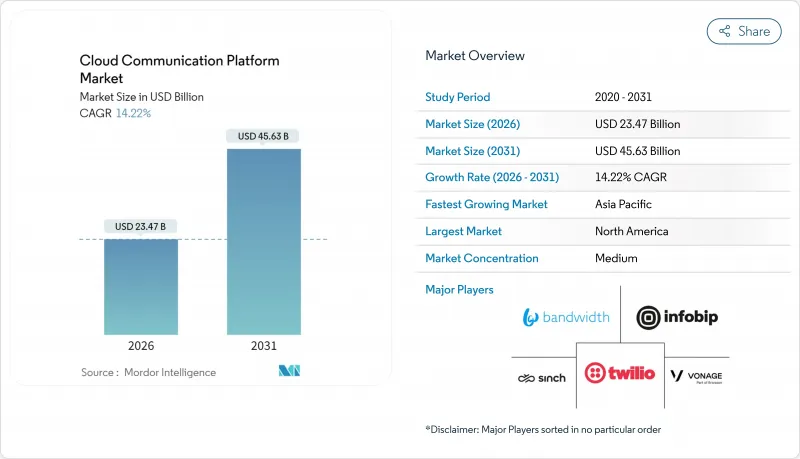
클라우드 통신 플랫폼 시장은 2026년에 234억 7,000만 달러에 이르고, CAGR 14.22%로 성장을 지속하여, 2031년까지 456억 3,000만 달러에 이를 것으로 예측됩니다.
본 보고서는 구성 요소별(솔루션(CPaaS, Ucaas, WebRTC 게이트웨이, 컨택 센터 API), 서비스(전문 서비스 및 관리형 서비스)),도입 형태별(퍼블릭 클라우드, 프라이빗 클라우드, 하이브리드 클라우드), 산업별(IT 및 통신, 은행, 금융서비스 및 보험(BFSI), 헬스케어, 소매 등), 기업 규모별(대기업 및 중소기업), 그리고 지역별로 분류되어 있습니다. 시장 예측은 금액(달러) 기준으로 제시되어 있습니다.
세계의 클라우드 통신 플랫폼 시장 동향 및 인사이트
CPaaS 및 옴니채널 API의 보급
기업들은 레거시 컨택 센터를 마이크로서비스로 분해하고, 통합된 API를 통해 SMS, WhatsApp, 음성, 비디오를 통합적으로 운영함으로써 마케팅 팀이 IT 부서의 지원 없이도 캠페인을 전개할 수 있도록 하고 있습니다. 노코드 워크플로우 빌더를 통해 아이디어에서 출시까지의 주기가 몇 개월에서 며칠로 단축되었으며, 소매 브랜드는 실시간 재고 정보와 연동된 ‘클릭 투 콜’ 버튼을 도입하여 전환율을 높이고 있습니다. Salesforce, Shopify, SAP용 기성 커넥터를 통해 맞춤형 코딩이 필요 없는 분야에서 채택률이 가장 높으며, 대규모 마켓플레이스를 보유한 플랫폼은 구조적인 우위를 점하고 있습니다. 이러한 옴니채널 API 덕분에 벤더 간의 차별화 요소는 단순한 전화 기능에서 생태계의 폭으로 이동하고 있습니다. 그 결과, 클라우드 통신 플랫폼 시장에서는 가치 실현까지의 시간을 단축하는 견고한 개발자 커뮤니티를 육성하는 제공업체가 높이 평가받고 있습니다.
하이브리드 및 원격 근무 모델의 급속한 확산
2025년에는 포춘 500대 기업의 68%에서 영구적인 하이브리드 근무 정책이 도입됨에 따라, VPN에 의존하는 소프트폰에서 온디맨드 방식으로 음성 및 영상 통신을 제공하는 브라우저 기반의 WebRTC 클라이언트로의 전환이 가속화되었습니다. Microsoft Teams Phone은 협업 워크플로우 내에 PSTN 통화를 통합함으로써 라이선스 수가 1,500만 개를 돌파했으며, 기업들은 유휴 용량의 위험을 공급업체에 전가하는 종량제 계약 체결을 점점 더 적극적으로 추진하고 있습니다. ISO 27001과 같은 보안 프레임워크는 기업의 방화벽 외부에 있는 홈 네트워크의 엔드포인트를 방어해야 하는 플랫폼에 있어 이제 기본적인 요구 사항이 되었습니다. 그 결과, 플랫폼 로드맵에서는 제로 트러스트 네트워크 액세스(Zero Trust Network Access)와 지속적인 기기 상태 점검이 중시되고 있습니다. 이러한 추세로 인해 기존의 하드웨어 업데이트 예산이 지속적인 API 이용으로 전환되면서 클라우드 통신 플랫폼 시장이 확대되고 있습니다.
데이터 보안 및 개인정보 보호 취약점
2024년 Snowflake 사고에서는 통화 상세 기록과 결제 데이터가 유출되어 SaaS 제공업체를 대상으로 한 사이버 보험료가 23% 급등했습니다. 현재 기업들은 다년간의 API 계약을 체결하기 전에 저장된 데이터의 암호화, 고객 관리형 키, 그리고 24시간 이내 침해 통지 조항을 요구하고 있습니다. 2024년에 공개된 Microsoft Teams의 취약점은 미국 공공 부문 고객을 확보하려는 벤더들 사이에서 제로 트러스트 도입 및 FedRAMP High 인증 취득을 위한 움직임을 가속화했습니다. 그 결과, SOC 2 Type II 및 FIPS 140-2 검증과 같은 제3자 인증을 제시할 수 있는 플랫폼으로의 전환이 진행되면서, 소규모 공급업체들은 통합으로 내몰리고 있습니다.
부문별 분석
2025년 매출의 66.78%는 솔루션이 차지했으나, 레거시 PBX 환경의 마이그레이션이나 통신 API를 CRM 워크플로우에 통합하는 데는 전문적인 기술이 요구되기 때문에 전문 서비스 및 관리형 서비스는 연평균 성장률(CAGR) 15.80%로 성장하고 있습니다. MiFID II 통화 녹음 규정을 준수하는 금융 기관이나 HIPAA를 준수하는 의료 기관은 아키텍처 설계 및 가동 시간 모니터링을 점점 더 외부에 위탁하고 있습니다. 2025년에는 CPaaS 이용 분수가 1조 2,000억 분을 넘어, 유선 전화에서 이벤트 기반 통신으로의 큰 전환을 보여주었습니다. 음성 텍스트 변환, 채팅, 이메일 스트림을 통합하는 컨택 센터 API는 평균 처리 시간을 단축하고 업무 효율화를 추구하는 기업들의 관심을 끌고 있습니다.
CPaaS 고유의 종량제 요금제는 자본 지출(Capex)을 줄이는 한편, 통합 작업의 부담을 증가시키기 때문에 각 벤더사는 컨설팅, 마이그레이션, 최적화를 정기 청구형 패키지에 포함시키고 있습니다. DevOps 담당자가 부족한 중견 기업들은 API 지연을 모니터링하고 통신 사업자 간의 상호 연결을 관리하는 매니지드 서비스 파트너에 의존하고 있습니다. 그 결과, Salesforce, SAP, Epic 등 여러 생태계에서 엔지니어 인증을 수행하는 서비스 제공업체들이 클라우드 통신 플랫폼 시장에서 차별화를 꾀하고 있는 반면, 기능의 상품화에 따라 순수 소프트웨어 사업의 이익률은 축소되고 있습니다.
기업들이 민첩성과 무한한 확장성을 중시한 결과, 2025년 도입 수익 중 퍼블릭 클라우드가 72.59%를 차지했습니다. 그러나 BFSI(은행 및 금융 및 보험) 워크로드에서는 10밀리초 미만의 왕복 전송 시간이 요구되는데, 퍼블릭 클라우드 리전에서는 이를 항상 보장할 수 없기 때문에 하이브리드 클라우드는 연평균 성장률(CAGR) 15.30%로 확대되고 있습니다. 하이브리드 구성에서는 시그널링 서버를 On-Premise에 유지하면서 분석 및 스토리지를 클라우드로 라우팅함으로써 제어성과 확장성을 양립시키고 있습니다. 마이크로소프트의 ‘소버린 클라우드’ 리전에서는 녹음 데이터 및 텍스트 변환 데이터를 EU 역내에 보관할 것을 약속하고 있으며, 이는 공공 부문 계약 수주로 이어지는 현지화 전략의 한 예입니다.
에어 갭 환경이 필요한 국방 기관에서는 여전히 프라이빗 클라우드가 사용되고 있지만, 많은 기밀 워크로드에서 제로 트러스트 오버레이가 충분하다는 것이 입증됨에 따라 그 점유율은 줄어들고 있습니다. 소규모 CPaaS 벤더들은 데이터센터를 건설하지 않고도 로컬 호스팅을 제공하기 위해 지역 인프라 제공업체와 제휴하여, 매출 총이익을 희생하면서 지리적 범위를 확대되고 있습니다. 따라서 하이브리드 도입은 전환의 과도기가 아닌 영구적인 전략이며, 혼합 환경을 아우르는 오케스트레이션 및 가시성 도구를 위한 클라우드 통신 플랫폼 시장 규모를 확대되고 있습니다.
지역별 분석
북미는 포춘 500대 기업의 UCaaS 전환과 CCaaS(Contact Center-as-a-Service) 스타트업에 대한 막대한 벤처 자금 조달에 힘입어 2025년 전 세계 매출의 38.47%를 차지했습니다. 미국 기업들은 자본 지출(Capex)을 줄이고 원격 근무자를 지원하기 위해 아바야(Avaya)와 시스코(Cisco)의 PBX를 폐지했습니다. 한편, 캐나다의 이중 언어 사용 의무화로 인해 이중 언어를 지원하는 IVR 및 상담원 라우팅에 대한 수요가 증가했습니다. 멕시코의 니어쇼어 BPO 부문은 비용 대비 효율이 높고 문화적 배경을 반영한 지원을 원하는 미국 소매업체로부터 스페인어 트래픽을 유치하며, 해당 지역의 클라우드 통신 플랫폼 시장을 더욱 확대했습니다.
아시아태평양은 인도의 12억 달러 규모의 ‘디지털 인디아(Digital India)’ 광대역 프로그램과, 국내 플랫폼과 다국적 플랫폼의 선택지를 양분하는 중국의 데이터 현지화법에 힘입어 2031년까지 연평균 성장률(CAGR) 15.00%를 나타낼 것으로 예측됩니다. 인도의 블록체인 기반 통화 인증 의무화로 인해 벤더들은 분산 원장 통합을 강요받게 되었으며, 시장 출시까지의 기간은 길어졌지만 신뢰성은 향상되었습니다. 동남아시아에서는 WhatsApp Business API를 통해 직접 거래를 진행함으로써 유선 통신을 뛰어넘고, 대화형 커머스를 통해 채팅 스레드 내에서 종단 간 주문이 정착되고 있습니다. 일본과 한국은 원격 의료 및 공장 자동화 분야에서 통화 품질을 보장하는 5G 슬라이싱 시범 사업을 주도하고 있으며, 클라우드 통신 플랫폼 시장을 지연이 허용되지 않는 시나리오로 확대되고 있습니다.
유럽에서의 보급은 번호 체계의 파편화와 국가별 도입을 강요하는 법적 통신 감청 규제로 인해 억제되고 있습니다. 브렉시트 이후의 분기로 인해 영국 고유의 데이터 보호 제도가 도입되면서 대서양을 가로지르는 플랫폼의 전개가 복잡해지고 있습니다. 독일에서 GDPR(EU 개인정보보호규정)을 엄격하게 해석함에 따라, 당초 AI 음성 분석 도입이 주춤했으나, 벤더들이 명확한 상호 동의 절차를 도입하면서 상황이 개선되었습니다. 프랑스와 이탈리아에서는 시민 대상 핫라인의 디지털화가 진행되고 있는 반면, 사우디아라비아와 아랍에미리트에서는 국가 디지털 아젠다에 따라 옴니채널형 행정 서비스의 도입이 의무화되어 있습니다. 아프리카의 성장은 광대역 환경이 불안정한 시장에서 SMS 및 USSD 이용이 중심을 이루고 있는 반면, 브라질에서는 상호 접속 요금 인상으로 인해 국내 통신 사업자가 우대받게 되어 남미 시장의 경제 구조가 현지 제공업체에 유리한 방향으로 기울고 있습니다.
기타 혜택 :
- 엑셀 형식 시장 예측(ME) 시트
- 3개월간의 애널리스트 지원
자주 묻는 질문
목차
제1장 서론
제2장 조사 방법
제3장 주요 요약
제4장 시장 구도
제5장 시장 규모 및 성장 예측
제6장 경쟁 구도
제7장 시장 기회 및 향후 전망
KTH 26.09.14According to Mordor Intelligence, the cloud communication platform market reached USD 23.47 billion in 2026 and, at a 14.22% CAGR, is projected to attain USD 45.63 billion by 2031.
This report is Segmented by Component (Solutions (CPaaS, Ucaas, Webrtc Gateways, Contact-Center APIs), Services (Professional, and Managed Services)), Deployment Type (Public, Private, and Hybrid Cloud), Industry Vertical (IT and Telecom, BFSI, Healthcare, Retail, and More), Enterprise Size (Large Enterprises, and SMEs), and Geography. The Market Forecasts are Provided in Terms of Value (USD).
Global Cloud Communication Platform Market Trends and Insights
Proliferation of CPaaS and Omni-Channel APIs
Enterprises are decomposing legacy contact centers into microservices that orchestrate SMS, WhatsApp, voice, and video through unified APIs, enabling marketing teams to launch campaigns without requiring IT support. No-code workflow builders shorten idea-to-launch cycles from months to days, and retail brands embed click-to-call buttons tied to live inventory feeds, boosting conversion rates. Adoption is highest where pre-built connectors to Salesforce, Shopify, and SAP eliminate the need for custom coding, giving platforms with large integration marketplaces a structural advantage. These omni-channel APIs shift vendor differentiation from raw telephony features toward ecosystem breadth. As a result, the cloud communication platform market rewards providers who cultivate robust developer communities that accelerate time-to-value.
Rapid Adoption of Hybrid and Remote Work Models
Permanent hybrid work policies at 68% of Fortune 500 firms in 2025 fueled migration from VPN-bound softphones to browser-based WebRTC clients that provision voice and video on demand. Microsoft Teams Phone has surpassed 15 million seats by bundling PSTN calling within collaboration workflows, and enterprises are increasingly negotiating usage-based contracts that shift idle-capacity risk to vendors. Security frameworks such as ISO 27001 are now baseline requirements for platforms that must defend home-network endpoints outside corporate firewalls. In turn, platform roadmaps emphasize zero-trust network access and continuous device posture checks. This trend enlarges the cloud communication platform market by converting erstwhile hardware refresh budgets into recurring API consumption.
Data-Security and Privacy Vulnerabilities
The 2024 Snowflake incident exposed call detail records and payment data, driving a 23% spike in cyber-insurance premiums for SaaS providers. Enterprises now demand encryption-at-rest, customer-managed keys, and 24-hour breach notification clauses before signing multi-year API contracts. Microsoft Teams vulnerabilities publicized in 2024 accelerated zero-trust adoption and FedRAMP High certification pursuits among vendors courting U.S. public sector buyers. The result is a flight to platforms that can display third-party attestations, such as SOC 2 Type II and FIPS 140-2 validation, pushing smaller providers toward consolidation.
Other drivers and restraints analyzed in the detailed report include:
- Edge Computing-Enabled Ultra-Low-Latency Experiences
- 5G Stand-Alone Network Slicing for QoS-Critical Traffic
- Fragmented Cross-Border Telecommunications Regulation
For complete list of drivers and restraints, kindly check the Table Of Contents.
Segment Analysis
Solutions controlled 66.78% of 2025 revenue, yet Professional and Managed Services are growing at a 15.80% CAGR, as migrating legacy PBX estates and integrating communication APIs into CRM workflows demand specialist skills. Financial institutions complying with MiFID II call-recording rules and healthcare providers adhering to HIPAA increasingly outsource architecture design and uptime monitoring. CPaaS usage minutes surpassed 1.2 trillion in 2025, marking a significant shift from desk phones to event-driven communications. Contact-center APIs that unify transcribed voice, chat, and email streams lower average handle time, attracting enterprises seeking operational efficiencies.
The consumption-based pricing inherent to CPaaS reduces capex yet raises integration workload, so vendors bundle consulting, migration, and optimization into recurring packages. Mid-market firms lacking DevOps staff lean on managed services partners that monitor API latency and handle carrier interconnects. Consequently, service providers that certify engineers on multiple ecosystems, such as Salesforce, SAP, and Epic, differentiate themselves in the cloud communication platform market, while pure software margins compress as functionality becomes commoditized.
Public Cloud accounted for 72.59% of 2025 deployment revenue as enterprises prized agility and limitless scaling. However, Hybrid Cloud is advancing at a 15.30% CAGR because BFSI workloads demand sub-10 millisecond round-trip times that public regions cannot always guarantee. Hybrid setups keep signaling servers on-premises while routing analytics and storage to the cloud, blending control with elasticity. Microsoft's Sovereign Cloud regions promise EU residency for recordings and transcripts, exemplifying localization tactics that win public-sector deals.
Private Cloud persists in defense agencies requiring air-gapped environments, yet its share diminishes as zero-trust overlays prove adequate for many confidential workloads. Smaller CPaaS vendors strike alliances with regional infrastructure providers to deliver local hosting without building data centers, trading gross margin for geographic reach. Hybrid adoption is therefore a permanent posture rather than a migration waypoint, expanding the cloud communication platform market size for orchestration and observability tools that span mixed estates.
Complete Report Scope:
- By Component
- Solutions
- Communications Platform as a Service (CPaaS)
- Unified Communications as a Service (UCaaS)
- WebRTC Gateways
- Contact-Center APIs
- Services
- Professional Services
- Managed Services
- Solutions
- By Deployment Type
- Public Cloud
- Private Cloud
- Hybrid Cloud
- By Industry Vertical
- Information Technology and Telecommunications
- Banking, Financial Services and Insurance
- Healthcare
- Retail and E-Commerce
- Government and Public Sector
- Manufacturing
- Travel and Hospitality
- Education
- By Enterprise Size
- Large Enterprises
- Small and Medium-Sized Enterprises
- By Geography
- North America
- United States
- Canada
- Mexico
- South America
- Brazil
- Argentina
- Rest of South America
- Europe
- United Kingdom
- Germany
- France
- Italy
- Spain
- Benelux
- Nordics
- Russia
- Rest of Europe
- Asia-Pacific
- China
- Japan
- India
- South Korea
- Australia and New Zealand
- Southeast Asian Nations
- Rest of Asia-Pacific
- Middle East
- Saudi Arabia
- United Arab Emirates
- Qatar
- Kuwait
- Turkey
- Rest of Middle East
- Africa
- South Africa
- Nigeria
- Kenya
- Egypt
- Rest of Africa
- North America
Geography Analysis
North America accounted for 38.47% of the 2025 global revenue, driven by Fortune 500 UCaaS migrations and substantial venture funding for contact-center-as-a-service startups. U.S. enterprises retired Avaya and Cisco PBXs to cut capex and accommodate remote workers, while Canada's bilingual mandates spurred demand for dual-language IVR and agent routing. Mexico's nearshore BPO sector captured Spanish-language traffic from U.S. retailers seeking cost-effective yet culturally aligned support, further enlarging the regional cloud communication platform market.
The Asia-Pacific region is forecast to grow at a 15.00% CAGR through 2031, driven by India's USD 1.2 billion Digital India broadband program and China's data localization statutes, which bifurcate domestic and multinational platform choices. India's blockchain-based call authentication mandate pushed vendors to integrate distributed ledgers, lengthening time-to-market but raising trust. Southeast Asia leapfrogged fixed telephony by transacting directly over WhatsApp Business APIs, with conversational commerce normalizing end-to-end ordering inside chat threads. Japan and South Korea are leading 5G slicing pilots that ensure call quality for telemedicine and factory automation, expanding the cloud communication platform market into latency-critical scenarios.
Europe's uptake is moderated by fragmented numbering and lawful-intercept rules that force country-specific deployments. Post-Brexit divergence introduced a separate UK data-protection regime, complicating the rollouts of transatlantic platforms. Germany's strict GDPR interpretation initially slowed the adoption of AI voice analytics until vendors implemented explicit dual-party consent flows. France and Italy are digitizing their citizen hotlines, while Saudi Arabia and the United Arab Emirates are mandating omnichannel government services under their national digital agendas. Africa's growth centers on SMS and USSD engagement in markets with sporadic broadband, whereas Brazil's interconnection fee hike favored domestic carriers, tilting South American market economics toward local providers.
- Twilio Inc.
- Vonage Holdings Corp.
- Cisco Systems Inc.
- 8x8 Inc.
- Sinch AB
- Infobip Ltd.
- Bandwidth Inc.
- RingCentral Inc.
- Amazon Web Services Inc.
- Microsoft Corp.
- Google LLC
- Mitel Networks Corp.
- Avaya Holdings Corp.
- NetFortris Inc.
- West IP Communications Inc.
- Telestax Inc.
- Plivo Inc.
- CallFire Inc.
- Ozonetel Communications Pvt. Ltd.
- MessageBird B.V.
- Telnyx LLC
Additional Benefits:
- The market estimate (ME) sheet in Excel format
- 3 months of analyst support
TABLE OF CONTENTS
1 INTRODUCTION
- 1.1 Study Assumptions and Market Definition
- 1.2 Scope of the Study
2 RESEARCH METHODOLOGY
3 EXECUTIVE SUMMARY
4 MARKET LANDSCAPE
- 4.1 Market Overview
- 4.2 Market Drivers
- 4.2.1 Proliferation of CPaaS and Omni-Channel APIs
- 4.2.2 Rapid Adoption of Hybrid and Remote Work Models
- 4.2.3 Growing Bring-Your-Own-Device Culture in Enterprises
- 4.2.4 Edge Computing-Enabled Ultra-Low-Latency Customer Experiences
- 4.2.5 5G Stand-Alone Network Slicing for QoS-Critical Traffic
- 4.2.6 Artificial Intelligence-Driven Voice Biometrics for Compliance
- 4.3 Market Restraints
- 4.3.1 Data-Security and Privacy Vulnerabilities
- 4.3.2 Fragmented Cross-Border Telecommunications Regulation
- 4.3.3 Emergence of Private 5G Networks Diluting Cloud Reliance
- 4.3.4 Carbon-Footprint Scrutiny on Hyperscale Data Centers
- 4.4 Industry Value Chain Analysis
- 4.5 Regulatory Landscape
- 4.6 Technological Outlook
- 4.7 Impact of Macroeconomic Factors on the Market
- 4.8 Porter's Five Forces Analysis
- 4.8.1 Bargaining Power of Suppliers
- 4.8.2 Bargaining Power of Buyers
- 4.8.3 Threat of New Entrants
- 4.8.4 Threat of Substitutes
- 4.8.5 Intensity of Competitive Rivalry
5 MARKET SIZE AND GROWTH FORECASTS (VALUE)
- 5.1 By Component
- 5.1.1 Solutions
- 5.1.1.1 Communications Platform as a Service (CPaaS)
- 5.1.1.2 Unified Communications as a Service (UCaaS)
- 5.1.1.3 WebRTC Gateways
- 5.1.1.4 Contact-Center APIs
- 5.1.2 Services
- 5.1.2.1 Professional Services
- 5.1.2.2 Managed Services
- 5.1.1 Solutions
- 5.2 By Deployment Type
- 5.2.1 Public Cloud
- 5.2.2 Private Cloud
- 5.2.3 Hybrid Cloud
- 5.3 By Industry Vertical
- 5.3.1 Information Technology and Telecommunications
- 5.3.2 Banking, Financial Services and Insurance
- 5.3.3 Healthcare
- 5.3.4 Retail and E-Commerce
- 5.3.5 Government and Public Sector
- 5.3.6 Manufacturing
- 5.3.7 Travel and Hospitality
- 5.3.8 Education
- 5.4 By Enterprise Size
- 5.4.1 Large Enterprises
- 5.4.2 Small and Medium-Sized Enterprises
- 5.5 By Geography
- 5.5.1 North America
- 5.5.1.1 United States
- 5.5.1.2 Canada
- 5.5.1.3 Mexico
- 5.5.2 South America
- 5.5.2.1 Brazil
- 5.5.2.2 Argentina
- 5.5.2.3 Rest of South America
- 5.5.3 Europe
- 5.5.3.1 United Kingdom
- 5.5.3.2 Germany
- 5.5.3.3 France
- 5.5.3.4 Italy
- 5.5.3.5 Spain
- 5.5.3.6 Benelux
- 5.5.3.7 Nordics
- 5.5.3.8 Russia
- 5.5.3.9 Rest of Europe
- 5.5.4 Asia-Pacific
- 5.5.4.1 China
- 5.5.4.2 Japan
- 5.5.4.3 India
- 5.5.4.4 South Korea
- 5.5.4.5 Australia and New Zealand
- 5.5.4.6 Southeast Asian Nations
- 5.5.4.7 Rest of Asia-Pacific
- 5.5.5 Middle East
- 5.5.5.1 Saudi Arabia
- 5.5.5.2 United Arab Emirates
- 5.5.5.3 Qatar
- 5.5.5.4 Kuwait
- 5.5.5.5 Turkey
- 5.5.5.6 Rest of Middle East
- 5.5.6 Africa
- 5.5.6.1 South Africa
- 5.5.6.2 Nigeria
- 5.5.6.3 Kenya
- 5.5.6.4 Egypt
- 5.5.6.5 Rest of Africa
- 5.5.1 North America
6 COMPETITIVE LANDSCAPE
- 6.1 Market Concentration
- 6.2 Strategic Moves and Funding Landscape
- 6.3 Market Share Analysis
- 6.4 Company Profiles (Includes Global Level Overview, Market Level Overview, Core Segments, Financials as Available, Strategic Information, Market Rank/Share for Key Companies, Products and Services, and Recent Developments)
- 6.4.1 Twilio Inc.
- 6.4.2 Vonage Holdings Corp.
- 6.4.3 Cisco Systems Inc.
- 6.4.4 8x8 Inc.
- 6.4.5 Sinch AB
- 6.4.6 Infobip Ltd.
- 6.4.7 Bandwidth Inc.
- 6.4.8 RingCentral Inc.
- 6.4.9 Amazon Web Services Inc.
- 6.4.10 Microsoft Corp.
- 6.4.11 Google LLC
- 6.4.12 Mitel Networks Corp.
- 6.4.13 Avaya Holdings Corp.
- 6.4.14 NetFortris Inc.
- 6.4.15 West IP Communications Inc.
- 6.4.16 Telestax Inc.
- 6.4.17 Plivo Inc.
- 6.4.18 CallFire Inc.
- 6.4.19 Ozonetel Communications Pvt. Ltd.
- 6.4.20 MessageBird B.V.
- 6.4.21 Telnyx LLC
7 MARKET OPPORTUNITIES AND FUTURE OUTLOOK
- 7.1 White-Space and Unmet-Need Assessment


