

|
시장보고서
상품코드
2124563
자동차용 스마트 글래스 : 시장 점유율 분석, 업계 동향 및 통계, 성장 예측(2026-2031년)Automotive Smart Glass - Market Share Analysis, Industry Trends & Statistics, Growth Forecasts (2026 - 2031) |
||||||
 Mordor Intelligence
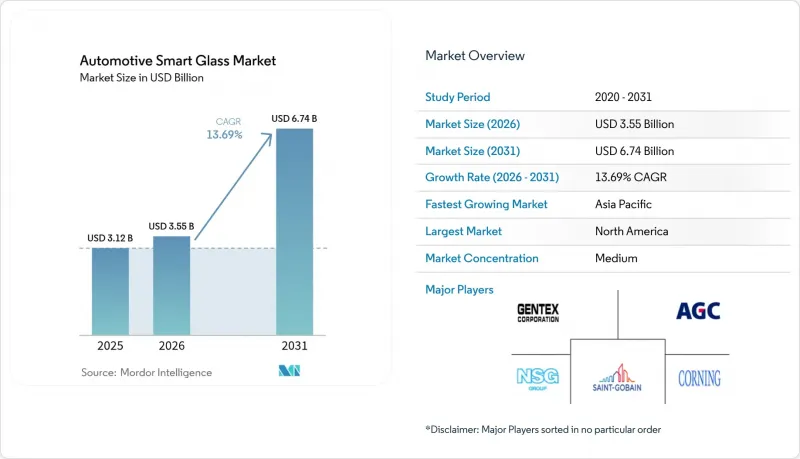
Mordor Intelligence에 의하면, 2026년 자동차용 스마트 글래스 시장 규모는 35억 5,000만 달러로 추정되고 2025년 31억 2,000만 달러에서 성장하여 2031년에는 67억 4,000만 달러에 이를 것으로 예측됩니다.
2026년부터 2031년까지 연평균 성장률(CAGR) 13.69%로 성장할 것으로 전망됩니다.
본 보고서는 기술 유형(일렉트로크로믹 등), 용도 유형(선루프 유리 등), 차량 유형(승용차 등), 추진 방식(내연기관 및 전기차), 판매 채널(OEM 및 애프터마켓), 지역별로 분류되어 있습니다. 시장 전망은 금액(달러) 기준으로 제시됩니다.
세계의 자동차용 스마트 글래스 시장 동향 및 인사이트
ADAS 지원 전면 유리가 조광식 HUD 유리 수요를 견인
첨단 운전자 지원 시스템(ADAS)은 직사광선 아래나 새벽의 눈부심, 터널 출구에서의 빛 변화와 같은 상황에서도 가시성을 유지해야 하는 헤드업 디스플레이(HUD)에 의존하고 있습니다. 생고뱅과 AGC는 HUD 표시 영역만 어둡게 하고, 나머지 앞유리의 투명도는 유지하는 얇은 일렉트로크로믹 중간층을 통합한 접합 유리 앞유리에 대한 검증을 공동으로 완료했습니다. 보호 유리 뒷면에 장착된 Lumineq사의 투명 TFEL 스택은 피크 외부 광도가 1만 cd/m2에 달하고,도 가독성이 보장되는 고대비 증강현실(AR) 화살표를 표시합니다. 더 높은 SAE 자동화 수준을 추구하는 자동차 제조업체들은 운전자의 부담을 줄이고 대시보드 조작을 최소화하기 위해 HUD 표시 영역의 밝기 조절 기능을 채택하고 있습니다. HUD의 표시 밀도가 확장 내비게이션 및 ADAS 경고를 위해 높아짐에 따라, 전면 유리의 스마트 유리는 단순한 편의성 향상을 넘어 기능 안전 구성 요소로 부상하고 있습니다.
배터리 팩의 열을 상쇄하기 위해 각 OEM 업체들이 전기차용 대형 파노라마 루프 채택을 추진하고 있습니다.
전기차 플랫폼은 급속 충전이나 고부하 조건에서 잉여 열을 발생시키기 때문에 수동 열 관리가 다시금 중요시되고 있습니다. 부유 입자 장치(SPD)를 사용하여 제조된 파노라마 루프는 밀리초 단위로 투명에서 불투명으로 전환되어, HVAC 컴프레서가 작동하기 전에 일사열의 유입을 대폭 저감합니다. 르노의 ‘Solarbay’ 프로토타입은 동적 불투명도 제어를 통해 여름철 주행 사이클에서 실제 주행 거리를 몇 퍼센트 포인트 향상시킬 수 있음을 입증했습니다. 배터리 냉각은 여전히 비용이 많이 드는 하위 시스템이기 때문에 OEM 엔지니어들은 스마트 글레이징을 새로운 히트 펌프 아키텍처를 보완하는 ‘손쉬운 수단’으로 보고 있습니다. 이를 통해 얻게 되는 설계의 자유도로 인해 기계식 차광 장치가 필요 없는 더 유선형인 루프 라인이 가능해지며, 고정 착색 유리로는 재현할 수 없는 전기차 특유의 스타일링 요소가 더욱 두드러지게 됩니다.
높은 초기 부품 비용 및 통합 비용
일렉트로크로믹 및 SPD 루프 모듈은 차량당 200-800달러의 추가 비용을 발생시키지만, 이러한 추가 비용은 B부문나 가격에 민감한 시장에서는 여전히 흡수하기 어렵습니다. 원자재 비용 외에도 OEM은 루프의 충돌 성능 재인증, 배선 추가, 그리고 차체 제어 모듈과 연동되는 소프트웨어 검증을 수행해야 합니다. 가파른 학습 곡선과 생산 라인 측의 금형 비용이 중소 자동차 제조업체의 조기 도입을 방해하고 있습니다. 그 때문에 Tier 1 공급업체는 우선 고수익률의 럭셔리 차량용 계약을 우선시하고 있으며, 그 결과 본래라면 가격 하락을 가속화했을 양산에 따른 규모의 경제 실현이 지연되고 있습니다. 지속적인 연구 개발을 통해 인라인 코팅 및 필름 온 롤(FONR) 공정의 실현이 기대되고 있지만, 단기적인 비용 장벽이 자동차용 스마트 글래스 시장의 저가 부문에서의 보급을 여전히 억제하고 있습니다.
부문별 분석
2025년, 일렉트로크로믹 유리는 자동차용 스마트 유리 시장 규모의 46.05%를 차지했으며, 그 점유율은 균형 잡힌 전환 속도, 수명 주기 내구성 및 단가 하락에 의해 뒷받침되고 있습니다. 부유 입자형 장치는 2031년까지 연평균 성장률(CAGR) 14.63%를 나타낼 것으로 예측됩니다. 부유 입자형 장치(SPD)는 1초 미만의 색조 변화와 더욱 풍부한 중간 톤의 그라데이션을 제공함으로써 그 격차를 좁혀가고 있습니다. 이러한 특성은 성능을 중시하는 인테리어 및 사용자가 제어할 수 있는 차광 프리셋에 부합합니다. 젠텍스(Gentex)사의 필름 기반 일렉트로크로믹 구조는 자동차 생산 라인의 속도에 맞추어 롤-투-롤 적층을 가능하게 함으로써, Tier 1 루프 공급업체의 학습 곡선을 더욱 평탄하게 만들고 있습니다.
예측 기간 동안, 고속 응답성을 실현하는 SPD와 높은 불투명도를 제공하는 일렉트로크로믹 층을 융합한 하이브리드 스택은 특히 눈부심 및 사생활 보호 대책이 요구되는 파노라마 루프에서 크로스오버 수요를 흡수할 가능성이 있습니다. 이러한 기술 간의 경쟁은 각 아키텍처가 공통적으로 직면한 ITO의 제약을 완화하려는 과정에서 차세대 투명 전도체에 대한 공동 투자를 촉진하고 있습니다. 이러한 경쟁 속에서 자동차용 스마트 글래스 시장은 전반적인 성능 기준을 높이는 상호 자극적인 획기적인 기술 혁신으로부터 지속적으로 혜택을 받고 있습니다.
이와 병행하여, 고분자 분산형 액정(PDLC) 및 열변색 필름은 비용 제약이 있는 트림 라인에서 수동적 조광이 적합한 틈새 역할을 담당하고 있습니다. 이러한 기술의 채택은 비교적 늦어지고 있지만, 적외선을 흡수하는 나노 입자가 혼합된 PDLC의 변형 제품은 고온 기후의 관광 노선을 운행하는 맞춤형 고급 셔틀버스에서 유망한 것으로 평가받고 있습니다. 열변색성 루프 패널은 전기적 입력 없이 35°C 이상에서 착색되어, 에너지 중립적인 차량 내 냉각을 추구하는 라스트 마일 배송용 밴에 매력적입니다. 이러한 소규모 기술 분야가 종합적으로 스마트 글래스의 적용 범위를 넓혀, 비용 장벽으로 인해 본래라면 이 기능을 탑재할 수 없었을 주류 모델에도 자동차용 스마트 글래스 시장이 대응할 수 있게 되었습니다. Tier 2 공급업체들이 선도 기업으로부터 주요 특허 라이선스를 취득함에 따라 가격 경쟁은 격화될 것으로 예상되며, 결국 이익률은 압박을 받겠지만 도입 대수는 확대될 전망입니다.
2025년, 자동차용 스마트 글래스 시장 규모의 73.42%를 선루프 탑재가 차지했습니다. 이는 전면 유리의 구조적 재인증이 필요 없이 간단한 루프 모듈 교체만으로도 가능하다는 장점 덕분입니다. 소셜 미디어 인플루언서의 컨텐츠를 통해 더욱 고조되는 개방감을 추구하는 소비자 수요로 인해, 파노라마 루프는 프리미엄 등급에서 거의 표준적인 업셀 옵션이 되었습니다. 스마트 글래스는 경치를 가리지 않으면서 눈부심을 줄여주는 등 구체적인 이점을 제공하며, 첨단 편의성을 주제로 한 브랜드 스토리텔링을 강화합니다. 한편, 스마트 HUD 및 디스플레이 패널은 업계가 증강현실(AR)을 활용한 내비게이션 및 운전자 모니터링 오버레이로 중심을 옮겨가는 가운데, 2031년까지 연평균 성장률(CAGR) 16.44%를 나타낼 것으로 전망됩니다. 자동차 제조업체들은 전면 유리에 표시되는 컨텐츠가 극단적인 조명 조건에서도 가시성을 유지해야 한다는 점을 인식하고 있으며, 조광 가능한 패치는 사치스러운 장식이 아니라 기능적으로 필수적인 요소가 되었습니다.
사이드 윈도우 및 리어 윈도우에 대한 2차적 적용은 사생활 보호와 차량 내 온도 균일화에 중점을 두고 있으며, 라이드셰어링 차량 운영 사업자들로부터 높은 평가를 받고 있습니다. 전면 유리는 적층 두께나 안전 기준으로 인해 기술적인 과제가 있는 반면, ADAS(첨단 운전자 지원 시스템)와의 호환성을 통해 차량 1대당 추가 수익을 창출하고 있습니다. 쿠라레의 ‘SkyViera’ 중간막은 최근 마힌드라의 ‘XUV 9e’에 채택되어, 루프의 조광 상태와 동기화되는 앰비언트 조명 홈을 통합함으로써 통일감 있는 시각적 경험을 제공합니다. 그 응용 범위는 단일 패널이 주는 참신함에서 여러 표면을 아우르는 생태계로 진화하고 있으며, 이러한 변화가 차량당 컨텐츠의 심화를 뒷받침하며 자동차용 스마트 글래스 시장을 주도하고 있습니다.
지역별 분석
북미는 2025년, 고급차의 높은 보급률, 급속히 진전되는 ADAS 규제, 그리고 미시간주와 온타리오주 주변에 집중된 광범위한 1차 공급업체 거점에 힘입어 자동차용 스마트 글래스 시장 규모의 41.92%를 차지했습니다. 테슬라의 ‘모델 Y’에 옵션으로 제공되는 조광 가능한 루프 패키지가 보여주듯이, 미국 소비자들은 기술로 강화된 편의성에 기꺼이 비용을 지불하는 경향이 있습니다. 혹독한 겨울을 맞이하는 캐나다의 차량 플릿에서는 적외선 흡수를 조절하여 제빙을 돕는 일렉트로크로믹 루프에 대한 시험이 진행되고 있으며, 이 기능은 현재 생고뱅(Saint-Gobain)사에 의해 적극적으로 검증되고 있습니다. 전면 유리용 HUD 매개변수에 대한 국경을 초월한 규제 조화로 인해 형식 승인이 간소화되었으며, 각 OEM사의 다면 스마트 유리에 대한 수요가 유지되고 있습니다.
유럽은 총 매출액 기준 2위이지만, 여전히 세계 기술 기준을 주도하고 있습니다. 독일의 고급차 브랜드는 새로운 적층 화학 기술을 선도하는 한편, 프랑스와 스웨덴의 규제 당국은 사용 후 발생할 수 있는 층간 박리 문제를 해결하기 위한 순환 경제 지표를 추진하고 있습니다. 이 지역이 저눈부심·저자외선 차량 내부 환경에 주력하고 있는 점이 B부문 해치백 차량에서의 채택을 뒷받침하고 있습니다. 폭스바겐의 ‘ID.3’ 페이스리프트 모델에서는 고객 편의성 조사 결과에 부응하기 위해 루프 일부를 조광할 수 있는 구역이 도입되었습니다. EU의 ‘호라이즌(Horizon)’ 연구 지원금은 탄소 중립 용해로에 자금을 지원하며, 향후 규모 확대를 뒷받침함으로써 전 세계 자동차용 스마트 글래스 시장에 파급 효과를 가져올 것입니다.
아시아태평양은 가장 빠르게 성장하는 시장으로, 2031년까지 연평균 성장률(CAGR)이 16.02%를 나타낼 것으로 예측됩니다. 세계 전기차 생산의 중심지인 중국은 푸야오(Fuyao)와 같은 국내 대형 유리 기업을 활용하여 공급망의 탄력성을 확보하고 있습니다. 정부의 신에너지차(NEV)용 선루프 도입 장려 정책에 힘입어, 여름철 도시 열섬 현상이 에어컨의 과도한 사용을 초래하는 1급 도시에서 루프용 스마트 글래스의 보급이 가속화되고 있습니다. 일본의 경차 부문에서는 리어 리프트게이트용 소형 SPD(스위칭형) 유리 패널에 대한 실증 시험이 진행되고 있으며, 공간적 제약이 있는 차량 내부에서 동적 차광 기능이 얼마나 중요하게 여겨지고 있는지를 여실히 보여주고 있습니다. 한국에서는 메모리 칩 주요 제조업체와 Tier 1 루프 공급업체 간의 전략적 제휴가 촉진되고 있으며, 운전자의 상태 감지와 루프 착색 조정을 통합함으로써 해당 지역의 시스템 수준 혁신 문화가 강화되고 있습니다.
현재로서는 규모는 작지만, 라틴아메리카와 중동에서도 틈새 시장 기회가 보입니다. 멕시코의 관광용 차량에서는 경치가 좋은 노선을 주행할 수 있도록 일렉트로크로믹 사이드 윈도우 개조가 이루어지고 있는 반면, 걸프 연안 국가의 고급 SUV에서는 최고 기온이 50°C에 달하는 환경에 대응하기 위해 3구역 착색 제어 기능이 채택되고 있습니다. 이러한 사례들은 전 세계 자동차 구매자들에게 스마트 글래스에 대한 기대가 머지않아 ‘표준’이 될 것임을 시사하며, 지역 간 보급 격차가 점차 줄어들 것으로 확실시됩니다.
기타 혜택 :
- 엑셀 형식 시장 예측(ME) 시트
- 3개월간의 애널리스트 지원
자주 묻는 질문
목차
제1장 서론
제2장 조사 방법
제3장 주요 요약
제4장 시장 구도
제5장 시장 규모 및 성장 예측
제6장 경쟁 구도
제7장 시장 기회 및 향후 전망
KTH 26.09.14According to Mordor Intelligence, the automotive smart glass market size in 2026 is estimated at USD 3.55 billion, growing from 2025 value of USD 3.12 billion with 2031 projections showing USD 6.74 billion, growing at 13.69% CAGR over 2026-2031.
This report is Segmented by Technology Type (Electrochromic and More), Application Type (Sunroof Glass and More), Vehicle Type (Passenger Cars and More), Propulsion Type (Internal Combustion Engine and Electric Vehicles), Sales Channel (OEM and Aftermarket), and Geography. The Market Forecasts are Provided in Terms of Value (USD).
Global Automotive Smart Glass Market Trends and Insights
ADAS-Ready Windshields Driving Demand for Dimmable HUD Glass
Advanced driver assistance suites depend on heads-up displays that must stay visible under direct sunlight, dawn glare, and tunnel exit transitions. Saint-Gobain and AGC have jointly validated laminated windshields incorporating a thin electrochromic interlayer that darkens only the HUD patch, preserving windshield clarity everywhere else . Lumineq's transparent TFEL stack, mounted behind the protective glass, delivers high-contrast augmented-reality arrows that remain legible at 10,000 cd/m2 peak exterior luminance. Automakers pursuing higher SAE automation levels embrace dimmable HUD zones to reduce driver workload and to keep dashboard operations minimal. As HUD content density rises toward augmented navigation and ADAS alerts, windshield smart glass emerges as a functional safety component rather than a mere comfort upgrade.
OEM Push for Larger Panoramic Roofs in EVs To Offset Battery-Pack Heat
Electric platforms generate surplus heat under fast-charge and high-load conditions, putting fresh emphasis on passive thermal management. Panoramic roofs fabricated with suspended particle devices can switch from clear to opaque in milliseconds, slashing solar heat gain before HVAC compressors engage . Renault's Solarbay prototype demonstrates that dynamic opacity scheduling can lift real-world EV range by several percentage points during summer cycles. Because battery cooling remains a cost-intensive subsystem, OEM engineers view smart glazing as a low-hanging lever that complements new heat-pump architectures. The resulting design freedom supports sleeker rooflines without mechanical shades, reinforcing distinctive EV styling cues that are impossible to replicate with fixed-tint glass.
High Initial Component and Integration Cost
Electrochromic and SPD roof modules add USD 200-800 per vehicle, a premium that remains difficult to absorb in B-segment or cost-sensitive markets . Beyond raw materials, OEMs must requalify roof crash performance, add wire routing, and validate software that interfaces with body-control modules. The steep learning curve and line-side tooling charges deter smaller automakers from early adoption. Tier-1 suppliers therefore pursue high-margin luxury contracts first, which postpones volume scale economies that would otherwise accelerate price declines. Although ongoing R&D promises inline coating and film-on-roll processes, the near-term cost hurdle continues to cap penetration in lower segments of the automotive smart glass market.
Other drivers and restraints analyzed in the detailed report include:
- Stricter EU Glare and UV Norms Encouraging Smart Glazing
- Tier-1 Suppliers Offering Integrated Smart-Roof Modules to Reduce Assembly Time
- Aftermarket Calibration Complexity for ADAS Windscreens
For complete list of drivers and restraints, kindly check the Table Of Contents.
Segment Analysis
Electrochromic glazing accounted for 46.05% of the automotive smart glass market size in 2025, a share supported by its balanced switching speed, lifecycle durability, and falling unit cost. Suspended particle devices are projected to grow at a CAGR of 14.63% through 2031. Suspended particle devices are closing the gap by offering sub-second tint changes and richer mid-tone gradients, attributes that resonate with performance-oriented interiors and user-controlled shading presets. Gentex's film-based electrochromic architecture further flattens the learning curve for tier-1 roof suppliers by enabling roll-to-roll lamination at automotive line speeds.
Over the forecast period, hybrid stacks that merge SPD for fast response with electrochromic layers for deep opacity could capture crossover demand, especially in panoramic roofs that must address glare and privacy. Competition among these technologies catalyzes co-investment in next-generation transparent conductors, as each architecture seeks to mitigate shared ITO constraints. Amid this race, the automotive smart glass market continuously benefits from cross-pollinated breakthroughs that raise overall performance benchmarks.
In parallel, polymer-dispersed liquid crystal and thermo-chromic films hold niche roles where passive modulation suits cost-constrained trim lines. Although their uptake is comparatively slower, PDLC variants with infrared-absorbing nanoparticles show promise for coach-built luxury shuttles serving hot-climate tourism routes. Thermo-chromic roof panels darken above 35 °C without electrical input and appeal to last-mile delivery vans seeking energy-neutral cabin cooling. These smaller technology slices collectively broaden the addressable spectrum for smart glass, allowing the automotive smart glass market to serve mainstream models that might otherwise miss the feature due to cost barriers. As tier-2 suppliers license key patents from early movers, pricing pressures are expected to sharpen, eventually compressing margins but expanding installed base.
Sunroof installations represented 73.42% of the automotive smart glass market size in 2025, benefiting from straightforward roof-module swaps that avoid structural windshield requalification. Consumer demand for open-air ambience, amplified by social-media influencer content, makes panoramic roofs a near-default upsell on premium trims. Smart glass delivers tangible benefits such as glare mitigation without blocking scenery, reinforcing brand storytelling around advanced comfort. Meanwhile, smart HUD and display panels are tracking a 16.44% CAGR through 2031, as the industry pivots toward augmented-reality guidance and driver monitoring overlays. Automakers recognize that windshield-level content must remain visible across lighting extremes, making dimmable patches a functional necessity rather than a luxury flourish.
Secondary applications on side and rear windows focus on privacy and uniform cabin temperature, prized by ride-sharing fleet operators. Front windshields, though technically more challenging due to lamination thickness and safety codes, unlock incremental revenue per vehicle thanks to ADAS compatibility. Kuraray's SkyViera interlayer, recently adopted by Mahindra's XUV 9e, integrates ambient lighting grooves synchronizing with the roof's dimming state, providing a cohesive visual experience. The application landscape is evolving from single-panel novelty to multi-surface ecosystems, a transformation that underpins deeper per-vehicle content and propels the automotive smart glass market.
Complete Report Scope:
- By Technology Type
- Electrochromic
- Suspended Particle Device (SPD)
- Polymer Dispersed Liquid Crystal (PDLC)
- Thermo/Photo-chromic
- Hybrid / Multi-stack
- By Application Type
- Sunroof Glass
- Rear & Side Windows
- Front & Rear Windshields
- Smart HUD / Display Panels
- By Vehicle Type
- Passenger Cars
- Light Commercial Vehicles
- Medium and Heavy Commercial Vehicles
- Bus and Coaches
- By Propulsion Type
- Internal Combustion Engine
- Electric Vehicles
- By Sales Channel
- Original Equipment Manufacturer (OEM)
- Aftermarket
- By Geography
- North America
- United States
- Canada
- Rest of North America
- South America
- Brazil
- Argentina
- Rest of South America
- Europe
- Germany
- United Kingdom
- France
- Italy
- Spain
- Russia
- Rest of Europe
- Asia-Pacific
- China
- Japan
- South Korea
- India
- Indonesia
- Vietnam
- Philippines
- Australia
- Rest of Asia-Pacific
- Middle East and Africa
- United Arab Emirates
- Saudi Arabia
- Turkey
- Egypt
- South Africa
- Rest of Middle East and Africa
- North America
Geography Analysis
North America retained 41.92% of the automotive smart glass market size in 2025, buoyed by luxury-vehicle density, fast-moving ADAS regulations, and extensive tier-1 supply footprints clustered around Michigan and Ontario. United States buyers are willing to pay for tech-enhanced comfort, as evidenced by Tesla's Model Y optional dimmable roof package. Canadian fleets, facing harsher winters, test electrochromic roofs for de-icing aid by modulating infrared absorption, a feature under active validation by Saint-Gobain. Cross-border regulatory alignment on windshield HUD parameters simplifies homologation, sustaining OEM appetite for multi-surface smart glass.
Europe ranks second in overall revenue but continues to shape global technical standards. German premium marques pioneer new stack chemistries, while French and Swedish regulators push circular-economy metrics that address end-of-life delamination. The region's laser focus on low-glare, low-UV cabins has propelled adoption across B-segment hatchbacks. Volkswagen's ID.3 facelift introduces a partial-roof dimming zone to meet customer comfort surveys. EU Horizon research grants fund carbon-neutral furnaces, underwriting future scale gains that will ripple across the automotive smart glass market worldwide.
Asia-Pacific represents the fastest-growing theater, charting a 16.02% CAGR through 2031. China, the epicenter of global EV production, leverages domestic glass giants like Fuyao to secure supply chain resilience. The government's sun-roof incentive for NEVs accelerates rooftop smart glass penetration in Tier-1 cities, where summer urban heat islands drive HVAC overuse. Japan's kei-car segment is pilot-testing compact SPD panes for rear liftgates, underscoring how space-constrained interiors value dynamic shading. South Korea fosters strategic alliances among memory-chip leaders and tier-1 roof suppliers to integrate driver-state sensing with roof tint adjustments, reinforcing the region's system-level innovation culture.
Although smaller today, Latin America and the Middle East illustrate niche opportunities. Tourism fleets in Mexico retrofit electrochromic side windows for scenic routes, while Gulf-state luxury SUVs adopt tri-zone tint control to cope with 50 °C ambient peaks. These examples signal an eventual Baseline of smart glass expectations among global car buyers, ensuring that regional adoption gaps narrow.
- Saint-Gobain S.A.
- AGC Inc.
- Nippon Sheet Glass Co. Ltd.
- Corning Inc.
- Guardian Industries
- Research Frontiers Inc.
- Gentex Corporation
- Gauzy Ltd.
- View Inc.
- Fuyao Glass Industry Group
- Xinyi Glass Holdings Limited
- AGP Group
- SYP Glass Group Co.,Ltd.
- SCHOTT AG
Additional Benefits:
- The market estimate (ME) sheet in Excel format
- 3 months of analyst support
TABLE OF CONTENTS
1 Introduction
- 1.1 Study Assumptions & Market Definition
- 1.2 Scope of the Study
2 Research Methodology
3 Executive Summary
4 Market Landscape
- 4.1 Market Overview
- 4.2 Market Drivers
- 4.2.1 Rising Adoption of Luxury and Premium Vehicles With Electro-Chromic Sunroofs
- 4.2.2 OEM Push for Larger Panoramic Roofs in EVs To Offset Battery-Pack Heat
- 4.2.3 ADAS-Ready Windshields Driving Demand for Dimmable HUD Glass
- 4.2.4 Stricter EU Glare & UV Norms Encouraging Smart Glazing
- 4.2.5 Tier-1 Suppliers Offering Integrated Smart-Roof Modules to Reduce Assembly Time
- 4.2.6 Emerging Carbon-Neutral Glass Furnaces Lowering Production Cost
- 4.3 Market Restraints
- 4.3.1 High Initial Component and Integration Cost
- 4.3.2 Limited Temperature Operability of PDLC Films in Extreme Climates
- 4.3.3 Scarcity of Auto-Grade Indium Tin Oxide Elevates Raw-Material Risk
- 4.3.4 Aftermarket Calibration Complexity for ADAS Windscreens
- 4.4 Value / Supply-Chain Analysis
- 4.5 Regulatory Landscape
- 4.6 Technological Outlook
- 4.7 Porter's Five Forces
- 4.7.1 Threat of New Entrants
- 4.7.2 Bargaining Power of Buyers/Consumers
- 4.7.3 Bargaining Power of Suppliers
- 4.7.4 Threat of Substitute Products
- 4.7.5 Intensity of Competitive Rivalry
5 Market Size and Growth Forecasts (Value (USD))
- 5.1 By Technology Type
- 5.1.1 Electrochromic
- 5.1.2 Suspended Particle Device (SPD)
- 5.1.3 Polymer Dispersed Liquid Crystal (PDLC)
- 5.1.4 Thermo/Photo-chromic
- 5.1.5 Hybrid / Multi-stack
- 5.2 By Application Type
- 5.2.1 Sunroof Glass
- 5.2.2 Rear & Side Windows
- 5.2.3 Front & Rear Windshields
- 5.2.4 Smart HUD / Display Panels
- 5.3 By Vehicle Type
- 5.3.1 Passenger Cars
- 5.3.2 Light Commercial Vehicles
- 5.3.3 Medium and Heavy Commercial Vehicles
- 5.3.4 Bus and Coaches
- 5.4 By Propulsion Type
- 5.4.1 Internal Combustion Engine
- 5.4.2 Electric Vehicles
- 5.5 By Sales Channel
- 5.5.1 Original Equipment Manufacturer (OEM)
- 5.5.2 Aftermarket
- 5.6 By Geography
- 5.6.1 North America
- 5.6.1.1 United States
- 5.6.1.2 Canada
- 5.6.1.3 Rest of North America
- 5.6.2 South America
- 5.6.2.1 Brazil
- 5.6.2.2 Argentina
- 5.6.2.3 Rest of South America
- 5.6.3 Europe
- 5.6.3.1 Germany
- 5.6.3.2 United Kingdom
- 5.6.3.3 France
- 5.6.3.4 Italy
- 5.6.3.5 Spain
- 5.6.3.6 Russia
- 5.6.3.7 Rest of Europe
- 5.6.4 Asia-Pacific
- 5.6.4.1 China
- 5.6.4.2 Japan
- 5.6.4.3 South Korea
- 5.6.4.4 India
- 5.6.4.5 Indonesia
- 5.6.4.6 Vietnam
- 5.6.4.7 Philippines
- 5.6.4.8 Australia
- 5.6.4.9 Rest of Asia-Pacific
- 5.6.5 Middle East and Africa
- 5.6.5.1 United Arab Emirates
- 5.6.5.2 Saudi Arabia
- 5.6.5.3 Turkey
- 5.6.5.4 Egypt
- 5.6.5.5 South Africa
- 5.6.5.6 Rest of Middle East and Africa
- 5.6.1 North America
6 Competitive Landscape
- 6.1 Market Concentration
- 6.2 Strategic Moves
- 6.3 Market Share Analysis
- 6.4 Company Profiles (Includes Global level Overview, Market level overview, Core Segments, Financials as available, Strategic Information, Market Rank/Share for key companies, Products & Services, and Recent Developments)
- 6.4.1 Saint-Gobain S.A.
- 6.4.2 AGC Inc.
- 6.4.3 Nippon Sheet Glass Co. Ltd.
- 6.4.4 Corning Inc.
- 6.4.5 Guardian Industries
- 6.4.6 Research Frontiers Inc.
- 6.4.7 Gentex Corporation
- 6.4.8 Gauzy Ltd.
- 6.4.9 View Inc.
- 6.4.10 Fuyao Glass Industry Group
- 6.4.11 Xinyi Glass Holdings Limited
- 6.4.12 AGP Group
- 6.4.13 SYP Glass Group Co.,Ltd.
- 6.4.14 SCHOTT AG


