

|
시장보고서
상품코드
2124781
인도의 전자 보안 : 시장 점유율 분석, 업계 동향 및 통계, 성장 예측(2026-2031년)India Electronic Security - Market Share Analysis, Industry Trends & Statistics, Growth Forecasts (2026 - 2031) |
||||||
 Mordor Intelligence
Mordor Intelligence에 의하면, 2026년 인도의 전자 보안 시장 규모는 33억 9,000만 달러로 추정되고 2025년 30억 5,000만 달러에서 확대해, 2031년에는 57억 1,000만 달러에 이를 것으로 예측됩니다.
2026-2031년 동안의 연평균 성장률(CAGR)은 11.02%가 될 것으로 전망됩니다.
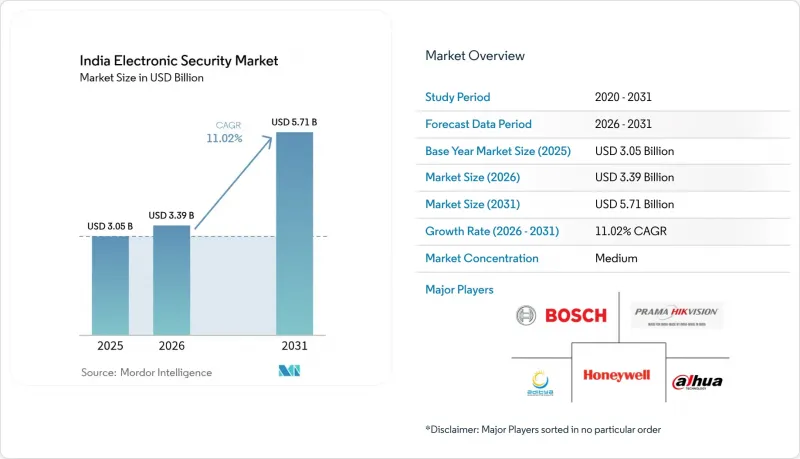
본 보고서는 솔루션(모니터링 카메라, 영상 관리 소프트웨어, 기타), 서비스(설치·통합, 유지보수·지원, 기타),구축 방식(On-Premise, 클라우드 기반, 하이브리드), 구성 요소(하드웨어, 소프트웨어·분석, 서비스), 최종 사용자 산업(정부·법 집행 기관, 상업용 건물, 기타), 지역별로 분류되어 있습니다.
인도의 전자 보안 시장 동향 및 인사이트
2027년 이후의 스마트 시티 프로젝트 계획
‘스마트 시티 미션’에 따른 정부 예산 배분은 현재 300개 이상의 도시권에 이르고 있으며, 모니터링, 교통 관리, 긴급 대응을 핵심 성과로 삼고 있습니다. 델리 국제공항 주식회사는 2025년 3월, AI를 활용한 에어사이드 관리 플랫폼을 공개했습니다. 이 플랫폼은 주변 보안 영상 데이터와 통합함으로써 택싱 아웃 시간을 단축했습니다. 인도 철도는 2024-25 회계연도 자본 계획에 2조 5,200억 루피(302억 달러)를 편성하여, GPS 탑재 차량과 4만 대의 카메라 업그레이드에 자금을 투입함으로써 차량 전반에 걸쳐 견고한 장비의 표준화를 도모했습니다. 위성 도시의 지자체들도 투자를 유치하기 위해 이러한 기준을 모방하고 있으며, 상호 운용 가능한 접근 제어 및 분석 소프트웨어에 대한 수요의 연쇄적인 확대를 뒷받침하고 있습니다. 더 장기적으로는 자이푸르나 인도르와 같은 2선 도시에서 제안되고 있는 도시 재생 계획에 영상 분석, 차량과 인프라 간의 신호 통신, 연결형 경보 시스템이 마스터 플랜에 포함되어 안정적인 장비 교체 주기가 뒷받침되고 있습니다. 이러한 누적적인 파급 효과로 인해 민간 개발업자에 대한 기본 사양이 상향 조정되었으며, 결과적으로 주택 구매자들 사이에서 요구되는 최소 기능에 대한 기대치도 높아지고 있습니다.
범죄 및 테러에 대한 우려 고조
국가범죄기록국의 데이터에 따르면, 도시 지역의 재산 범죄와 사이버 범죄가 지속적으로 증가하고 있으며, 이에 따라 시 및 주 기관들은 모니터링 예산을 증액할 수밖에 없는 상황입니다. 마하라슈트라 주 경찰은 2025년 중반에 MARVEL AI 플랫폼을 도입하여 5,000개의 라이브 스트림에 걸친 실시간 차량 번호판 대조 및 이상 행동 경보를 실현했습니다. 민간 기업들도 이러한 투자에 동참하고 있습니다. 라르센 앤드 투브로(Larsen & Toubro)는 2025년 5월, 디지털 자산과 물리적 자산을 모두 관리하는 통합형 SOC(보안 운영 센터)에 중점을 둔 80억 루피(960만 달러) 규모의 사이버·물리적 보안 프로그램을 발표했습니다. 여성 안전 대책의 일환으로, ‘닐바야 기금’의 보조금이 지하철역 CCTV 네트워크 및 비상 신고 버튼이 장착된 스마트 폴 도입에 지속적으로 투입되고 있습니다. 인증된 경계 감지 시스템을 갖추지 않은 시설에 대한 보험료 인상도 산업 사업자들이 예방적 센서 도입을 더욱 촉진하는 요인이 되고 있습니다.
규정 준수 및 데이터 거버넌스 관련 과제
‘개인 데이터 보호 법안’이 아직 최종 확정되지 않아 생체 인증 데이터의 보존 기간 및 국경을 넘는 클라우드 복제와 관련하여 회색 지대가 남아 있으며, 공공 기관은 기본적으로 On-Premise 아카이빙을 선택할 수밖에 없는 상황입니다. 금융 기관은 인도 중앙은행(Reserve Bank of India)의 사이버 보안 지침과, 거의 실시간으로 사고 기록을 의무화하는 신생 컴퓨터 비상 대응팀(CERT)의 권고 사항 간의 일관성을 확보해야 합니다. 법무 팀이 공급업체와의 데이터 처리 계약을 면밀히 검토하는 동안 조달 주기가 길어지면서, 클라우드 전환이 6-9개월 지연되는 경우가 흔합니다. 여러 거점을 보유한 사업자는 진화하는 데이터 현지화 초안을 충족하기 위해 주 경계를 넘어 데이터센터를 미러링함으로써 발생하는 추가 비용에 직면하고 있습니다. 통일된 개인정보 보호법이 제정되기 전까지는 특히 얼굴 인식 기술 분야에서 보수적인 기술 도입이 이루어질 것으로 예상되므로, 규제 대상 산업의 성장 여지는 제한적일 것으로 보입니다.
부문별 분석
2025년 매출에서 모니터링 카메라가 차지하는 비중은 38.35%로, 이는 솔루션 제공 측면에서 인도의 전자 보안 시장 규모의 기반을 이루는 부문임을 보여주었습니다. 그럼에도 불구하고, 지출은 기존 하드웨어에서 실행 가능한 인사이트를 도출하는 소프트웨어로 점차 이동하고 있습니다. 기업들이 포렌식 검색, 물체 분류, 사고 대응 자동화를 추구함에 따라 영상 관리 소프트웨어는 연평균 성장률(CAGR) 12.44%를 나타낼 것으로 예측됩니다. 번호판 인식 및 낙상 감지 분석을 제공하는 AI 엔진은 카메라 단위로 라이선싱이 가능하여 대규모 장비 교체를 수반하지 않고도 단계적인 업그레이드가 가능합니다. 3D LiDAR 및 분산형 음향 감지(DAS)와 같은 주변 보안 센서는 석유 파이프라인 시설에 도입되어 오경보를 70% 감소시킨 성과를 바탕으로, 중요 인프라 분야에서 지지를 얻고 있습니다. 출입 통제는 방문자 관리 키오스크와 통합되어, 주차장 게이트부터 사무실 회전식 개찰구에 이르기까지 단일 인증 정보로 통행할 수 있게 되었습니다.
2세대 소프트웨어 아키텍처는 개방형 REST API를 공개하여 시설의 보다 광범위한 IoT 스택에 필수적인 요소가 되었으며, 엘리베이터와 칠러에 이르는 예측 유지보수의 길을 열어주고 있습니다. 사이버 공격의 표적이 네트워크 연결 카메라로 이동함에 따라, 각 통합 업체들은 보안 부트 펌웨어와 제로 트러스트 세분화 템플릿을 제공함으로써 차별화를 꾀하고 있습니다. 국내 카메라 조립은 PLI(생산 연계형 인센티브)의 지원을 받고 있지만, 고성능 영상 분석은 대부분의 경우 수입된 GPU 가속기에 의존하고 있어, 소프트웨어 비중이 높은 제안에서 종합적인 이익률은 양호한 수준을 유지하고 있습니다. 그 결과, 다국적 기업들은 기능을 통합하기 위해 전문 분석 스타트업을 인수하고 있는 반면, 인도의 독립 기업들은 저비용 개발 인력을 활용하여 라이선스 비용을 낮게 유지하고 있습니다. 따라서 경쟁의 치열함은 규모와 전문화 사이에서 균형을 이루고 있습니다.
2025년, 공공 부문의 메가 프로젝트에서 수천 개의 엔드포인트에 이르는 전국 규모의 배포가 요구됨에 따라, 설치 및 통합은 인도 전자 보안 시장 규모의 48.05% 점유율을 유지했습니다. 그러나 기업들은 일상적인 모니터링, 펌웨어 패치 적용, 사고 분류 작업을 관리형 보안 서비스 제공업체(MSSP)에 위탁하는 경향이 강해지고 있으며, 이 수익원의 연평균 성장률(CAGR)은 12.22%에 달하고 있습니다. MSSP는 통합된 커맨드 센터에 분석가를 집결시키고 AI를 활용한 사고 분류를 통해 평균 대응 시간을 4분 미만으로 단축하고 있습니다. 이는 단일 테넌트 환경에서는 달성하기 어려운 성능 수준입니다. 고객들이 BIS 규정 준수 문서, 데이터 현지화 방안, 제로 트러스트 네트워크 아키텍처에 대한 지침을 요구함에 따라 교육 및 컨설팅 수익이 증가하고 있습니다. 유지보수 계약은 디스크 장애를 7일 전에 예측하는 내장형 헬스 프로브를 활용한 예측 모델로 전환되어, 예기치 못한 다운타임을 대폭 줄이고 있습니다.
경쟁이 치열해지는 가운데, 각 통합 업체들은 사업 전개 지역을 확대하고 업종별 전문 지식을 다각화하기 위해 합병을 추진하고 있습니다. 가격 책정 모델은 정액 월정액 요금에서 인시던트 감소율에 연동된 성과 기반 계약으로 진화하고 있습니다. 정부 입찰에서는 5년간의 매니지드 서비스 조항이 세트로 포함되는 사례가 늘어나고 있어, 벤더의 수익 전망은 안정되는 반면 기술 인증의 문턱도 높아지고 있습니다. MDR(Managed Detection and Response) 하위 부문은 물리적 보안 부문으로도 진출하고 있으며, 배지 리더의 로그와 방화벽 경보를 함께 분석하여 내부자에 의한 위협을 감지하고 있습니다. 이러한 동향이 맞물리면서 업계는 라이프사이클 중심의 관여 방식으로 전환되고 있으며, 고객 생애 가치는 초기 하드웨어 도입 단계를 훨씬 넘어 확대되고 있습니다.
기타 혜택
- 엑셀 형식 시장 예측(ME) 시트
- 3개월간의 애널리스트 지원
자주 묻는 질문
목차
제1장 서론
제2장 조사 방법
제3장 주요 요약
제4장 시장 구도
제5장 시장 규모 및 성장 예측
제6장 경쟁 구도
제7장 시장 기회 및 향후 전망
KTH 26.09.14According to Mordor Intelligence, India electronic security market size in 2026 is estimated at USD 3.39 billion, growing from 2025 value of USD 3.05 billion with 2031 projections showing USD 5.71 billion, growing at 11.02% CAGR over 2026-2031.
This report is Segmented by Solution (Video Surveillance Cameras, Video Management Software, and More), Services (Installation and Integration, Maintenance and Support, and More), Deployment Mode (On-Premise, Cloud-Based, and Hybrid), Component (Hardware, Software and Analytics, and Services), End-User Vertical (Government and Law-Enforcement, Commercial Buildings, and More), and Region.
India Electronic Security Market Trends and Insights
Smart-City Project Pipeline Beyond 2027
Government allocations under the Smart Cities Mission now span more than 300 urban centers and earmark surveillance, traffic management, and emergency response as core deliverables. Delhi International Airport Limited showcased an AI-powered airside management platform in March 2025 that cut taxi-out times while integrating with perimeter security feeds. Indian Railways set aside INR 2.52 lakh crore (USD 30.2 billion) in its 2024-25 capital plan, reserving funds for GPS-enabled coaches and 40,000 camera upgrades, thereby standardizing ruggedized devices across rolling stock. Municipal corporations in satellite towns emulate these benchmarks to attract investment, driving cascading demand for interoperable access control and analytics software. Longer-term, proposed urban renewals in Tier-2 centers such as Jaipur and Indore embed video analytics, vehicle-to-infrastructure signaling, and connected alarm systems into master plans, supporting steady equipment refresh cycles. The cumulative multiplier effect elevates baseline specifications for private developers, which, in turn, reinforces minimum-feature expectations among residential buyers.
Rising Crime and Terrorism Concerns
National Crime Records Bureau data show persistent upticks in urban property offenses and cyber-enabled crimes, compelling city and state agencies to increase surveillance budgets. Maharashtra Police deployed the MARVEL AI platform in mid-2025, enabling real-time license-plate matching and behavioral anomaly alerts across 5,000 live streams. Private enterprises mirror these investments: Larsen & Toubro announced an INR 800 crore (USD 9.6 million) cyber-physical security program in May 2025 focused on integrated SOCs that manage both digital and perimeter assets. Women's safety initiatives continue funneling Nirbhaya Fund grants toward CCTV networks in metro stations and smart poles fitted with emergency call buttons. Rising insurance premiums for facilities lacking certified perimeter detection further nudge industrial operators toward proactive sensor deployment.
Compliance and Data-Governance Hurdles
The absence of a finalized Personal Data Protection Bill leaves gray areas around biometric retention periods and cross-border cloud replication, prompting public agencies to default to on-premise archives. Financial institutions must reconcile Reserve Bank of India cybersecurity directives with emerging Computer Emergency Response Team advisories that mandate near-real-time incident logging. Procurement cycles lengthen while legal teams vet vendor data-processing agreements, often delaying cloud migrations by 6-9 months. Multisite operators confront the added cost of mirroring data centers across state lines to satisfy evolving data-localization drafts. Until a unified privacy statute is enacted, conservative technology adoption, especially for facial recognition, will cap upside in regulated verticals.
Other drivers and restraints analyzed in the detailed report include:
- Mandatory BIS Re-Certification for CCTV (April 2025)
- AI-Enabled Video Analytics Lowering Guard Costs
- High Cap-Ex Sensitivity of SMEs
For complete list of drivers and restraints, kindly check the Table Of Contents.
Segment Analysis
Video surveillance cameras continued to represent 38.35% of 2025 revenue, signifying the foundational layer of the India Electronic Security market size for solution offerings. Nevertheless, spending is tilting toward software that extracts actionable insight from existing hardware; video management software is forecast to grow at a 12.44% CAGR as firms pursue forensic search, object classification, and incident-response automation. AI engines that deliver license-plate recognition or fall-detection analytics can be licensed per-camera, allowing incremental upgrades without forklift replacements. Perimeter security sensors such as 3D LiDAR and distributed acoustic sensing are gaining favor in critical infrastructure after trial deployments cut false alarms by 70% at oil-pipeline sites. Access control is converging with visitor-management kiosks, enabling single-credential passage from parking gate to office turnstile.
Second-generation software architectures expose open REST APIs, making them integral to facilities' wider IoT stacks and paving the way for predictive maintenance across elevators and chillers. As cyber-attack vectors migrate to networked cameras, integrators differentiate by offering secure-boot firmware and zero-trust segmentation templates. While domestic camera assembly enjoys PLI support, high-performance video analytics often rely on imported GPU accelerators, which keeps blended margins favorable for software-heavy propositions. Consequently, multinationals are acquiring specialist analytics startups to bundle capabilities, while Indian independents leverage lower-cost development talent to undercut license fees. Competitive intensity, therefore, remains balanced between scale and specialization.
Installation and integration retained 48.05% share of the India Electronic Security market size in 2025 as public-sector mega-projects demanded nationwide roll-outs spanning thousands of endpoints. Yet enterprises increasingly offload daily monitoring, firmware patching, and incident triage to managed security service providers (MSSPs), driving a 12.22% CAGR for this revenue stream. MSSPs pool analysts in centralized command centers and leverage AI triage to shrink average response time to under four minutes, a performance level difficult for single-tenant setups. Training and consulting revenues climb as customers seek guidance on BIS compliance documentation, data-localization schemas, and zero-trust network architecture. Maintenance contracts are shifting toward predictive models powered by embedded health probes that forecast disk failures seven days in advance, slashing unexpected downtime.
As competition intensifies, integrators pursue mergers to widen geographic footprints and diversify vertical expertise. Pricing models evolve from flat monthly fees to outcome-based contracts pegged to incident-reduction percentages. Government tenders increasingly bundle five-year managed-service clauses, stabilizing revenue visibility for vendors while raising the bar for technical certifications. The Managed Detection and Response (MDR) sub-segment edges into physical security, analyzing badge-reader logs alongside firewall alerts to spot insider threats. Collectively, these trends move the industry toward lifecycle-centric engagement, extending customer lifetime value well beyond initial hardware deployment.
Complete Report Scope:
- By Solution
- Video Surveillance Cameras
- Video Management Software (VMS)
- Access Control Systems
- Biometric Readers and Terminals
- Intrusion Detection and Alarms
- Perimeter Security Sensors
- By Services
- Installation and Integration
- Maintenance and Support
- Monitoring and Response (Command-Centre)
- Managed Security Services
- Training and Consulting
- By Deployment Mode
- On-premise
- Cloud-based
- Hybrid
- By Component
- Hardware
- Software and Analytics
- Services
- By End-user Vertical
- Government and Law-Enforcement
- Commercial Buildings
- Industrial and Manufacturing
- BFSI
- Transportation and Logistics
- Residential
- Retail and Hospitality
- Healthcare Facilities
- Other End-user Verticals
- By Region
- North India
- West India
- South India
- East and North-East India
- Central India
List of Companies Covered in this Report:
- PRAMA Hikvision India Pvt. Ltd.
- Dahua Technology India Pvt. Ltd.
- Aditya Infotech Ltd. (CP PLUS)
- Honeywell Automation India Ltd.
- Bosch Ltd.
- Axis Communications AB
- Godrej and Boyce Mfg Co Ltd.
- Johnson Controls (Tyco Security Products India Pvt. Ltd.)
- ASSA ABLOY India Pvt. Ltd.
- dormakaba India Pvt. Ltd.
- Zicom Electronic Security Systems Ltd.
- SIS Prosegur Alarm Monitoring and Response Services Pvt. Ltd.
- Securens Systems Pvt. Ltd.
- Sparsh Systems Pvt. Ltd.
- Videonetics Technology Pvt. Ltd.
- Vehant Technologies Pvt. Ltd.
- Matrix Comsec Pvt. Ltd.
- Alba Urmet Systems Pvt. Ltd.
- Qognify Ltd.
- Genetec Inc.
- HID Global India Pvt. Ltd.
- Secureye (Fortune Marketing Pvt. Ltd.)
Additional Benefits:
- The market estimate (ME) sheet in Excel format
- 3 months of analyst support
TABLE OF CONTENTS
1 INTRODUCTION
- 1.1 Study Assumptions and Market Definition
- 1.2 Scope of the Study
2 RESEARCH METHODOLOGY
3 EXECUTIVE SUMMARY
4 MARKET LANDSCAPE
- 4.1 Market Overview
- 4.2 Market Drivers
- 4.2.1 Smart-city project pipeline beyond 2027
- 4.2.2 Rising crime and terrorism concerns
- 4.2.3 Mandatory BIS re-certification for CCTV (Apr-2025)
- 4.2.4 AI-enabled video analytics lowering guard costs
- 4.2.5 Domestic PLI incentives for security hardware
- 4.2.6 IoT-integrated building platforms in Tier-2/3 cities
- 4.3 Market Restraints
- 4.3.1 Compliance and data-governance hurdles
- 4.3.2 High cap-ex sensitivity of SMEs
- 4.3.3 Shortage of accredited BIS test labs
- 4.3.4 Privacy litigation slowing facial-ID roll-outs
- 4.4 Industry Value Chain Analysis
- 4.5 Regulatory Landscape
- 4.6 Technological Outlook
- 4.7 Porter's Five Forces Analysis
- 4.7.1 Threat of New Entrants
- 4.7.2 Bargaining Power of Suppliers
- 4.7.3 Bargaining Power of Buyers
- 4.7.4 Threat of Substitutes
- 4.7.5 Intensity of Competitive Rivalry
- 4.8 Impact of Macroeconomic Factors on the Market
5 MARKET SIZE AND GROWTH FORECASTS (VALUES)
- 5.1 By Solution
- 5.1.1 Video Surveillance Cameras
- 5.1.2 Video Management Software (VMS)
- 5.1.3 Access Control Systems
- 5.1.4 Biometric Readers and Terminals
- 5.1.5 Intrusion Detection and Alarms
- 5.1.6 Perimeter Security Sensors
- 5.2 By Services
- 5.2.1 Installation and Integration
- 5.2.2 Maintenance and Support
- 5.2.3 Monitoring and Response (Command-Centre)
- 5.2.4 Managed Security Services
- 5.2.5 Training and Consulting
- 5.3 By Deployment Mode
- 5.3.1 On-premise
- 5.3.2 Cloud-based
- 5.3.3 Hybrid
- 5.4 By Component
- 5.4.1 Hardware
- 5.4.2 Software and Analytics
- 5.4.3 Services
- 5.5 By End-user Vertical
- 5.5.1 Government and Law-Enforcement
- 5.5.2 Commercial Buildings
- 5.5.3 Industrial and Manufacturing
- 5.5.4 BFSI
- 5.5.5 Transportation and Logistics
- 5.5.6 Residential
- 5.5.7 Retail and Hospitality
- 5.5.8 Healthcare Facilities
- 5.5.9 Other End-user Verticals
- 5.6 By Region
- 5.6.1 North India
- 5.6.2 West India
- 5.6.3 South India
- 5.6.4 East and North-East India
- 5.6.5 Central India
6 COMPETITIVE LANDSCAPE
- 6.1 Market Concentration
- 6.2 Strategic Moves
- 6.3 Market Share Analysis
- 6.4 Company Profiles (includes Global level Overview, Market level overview, Core Segments, Financials as available, Strategic Information, Market Rank/Share for key companies, Products and Services, and Recent Developments)
- 6.4.1 PRAMA Hikvision India Pvt. Ltd.
- 6.4.2 Dahua Technology India Pvt. Ltd.
- 6.4.3 Aditya Infotech Ltd. (CP PLUS)
- 6.4.4 Honeywell Automation India Ltd.
- 6.4.5 Bosch Ltd.
- 6.4.6 Axis Communications AB
- 6.4.7 Godrej and Boyce Mfg Co Ltd.
- 6.4.8 Johnson Controls (Tyco Security Products India Pvt. Ltd.)
- 6.4.9 ASSA ABLOY India Pvt. Ltd.
- 6.4.10 dormakaba India Pvt. Ltd.
- 6.4.11 Zicom Electronic Security Systems Ltd.
- 6.4.12 SIS Prosegur Alarm Monitoring and Response Services Pvt. Ltd.
- 6.4.13 Securens Systems Pvt. Ltd.
- 6.4.14 Sparsh Systems Pvt. Ltd.
- 6.4.15 Videonetics Technology Pvt. Ltd.
- 6.4.16 Vehant Technologies Pvt. Ltd.
- 6.4.17 Matrix Comsec Pvt. Ltd.
- 6.4.18 Alba Urmet Systems Pvt. Ltd.
- 6.4.19 Qognify Ltd.
- 6.4.20 Genetec Inc.
- 6.4.21 HID Global India Pvt. Ltd.
- 6.4.22 Secureye (Fortune Marketing Pvt. Ltd.)
7 MARKET OPPORTUNITIES AND FUTURE OUTLOOK
- 7.1 White-space and Unmet-need Assessment


