

|
시장보고서
상품코드
2124967
보안용 이미지 센서 : 시장 점유율 분석, 업계 동향 및 통계, 성장 예측(2026-2031년)Image Sensor For Security Application - Market Share Analysis, Industry Trends & Statistics, Growth Forecasts (2026 - 2031) |
||||||
 Mordor Intelligence
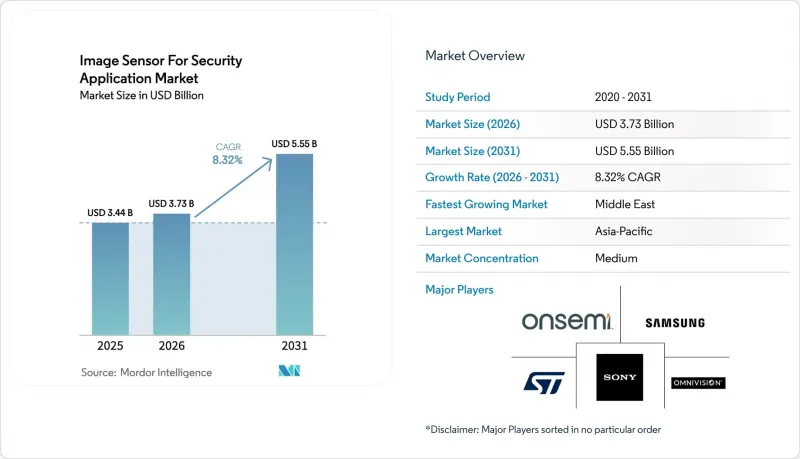
Mordor Intelligence에 의하면, 보안용 이미지 센서 시장 규모는 2025년에 34억 4,000만 달러로 평가되었습니다. 2026년 37억 3,000만 달러에서 2031년까지 55억 5,000만 달러에 이를 것으로 예상되며, 예측 기간(2026-2031년) CAGR은 8.32%를 나타낼 전망입니다.
본 보고서는 용도(가정용 방범 카메라, 기타), 기술(CCD 이미지 센서, 기타),스펙트럼(가시광 스펙트럼 센서, 기타), 처리 방식(2D 이미지 센서, 3D/비행시간(ToF) 이미지 센서, 기타), 최종 용도 분야(주택, 중요 인프라, 기타), 지역별로 분류되어 있습니다. 시장 예측은 금액(달러) 기준으로 제시되어 있습니다.
세계의 보안용 이미지 센서 시장 동향 및 인사이트
스마트 시티에서 수요 증가
리야드, 두바이, 선전, 하이데라바드의 스마트 시티 계획에서는 각각 1제곱킬로미터당 1,000노드를 초과하는 카메라 밀도가 도입되어 있으며, 온칩 추론 기능과 내장 DRAM을 갖춘 센서만이 효과적으로 처리할 수 있을 정도의 처리량 부하가 발생하고 있습니다. 사우디아라비아의 NEOM 프로젝트만 해도 2024년에 2만 6,500km²에 걸쳐 실시간 군중 흐름 분석이 가능한 AI 지원 카메라 5만 대에 대한 계약을 체결했습니다. 이러한 도입에서는 적층형 CMOS 아키텍처가 우선적으로 채택되고 있습니다. 이는 DRAM 레이어가 센서 외부의 메모리를 사용하지 않고도 60fps로 4K 스트림을 버퍼링하여 백홀 대역폭을 70% 절감할 수 있기 때문입니다. 인도의 ‘스마트 시티 미션’에서는 2024년까지 4,800억 루피(58억 달러)의 예산이 편성되었으며, 조달 지침에 따라 프로젝트 지출의 최대 22%를 센서에 할당하도록 규정되어 있어 거대한 잠재 시장이 형성되었습니다. 모든 시장에서 데이터 주권에 관한 규제로 인해 설계자는 암호화된 온다이 스토리지(on-die storage)를 채택해야 하며, 이를 통해 생체 인식 영상이 국경을 넘어가지 않도록 보장됩니다.
엣지에서의 AI 기반 영상 분석 통합
추론 처리를 클라우드에서 카메라 측으로 이전함으로써, 감지 지연을 800밀리초에서 50밀리초 미만으로 단축할 수 있습니다. 이는 침입자가 수 초 만에 중요한 거리를 돌파할 수 있는 경계 경비에서 매우 중요합니다. 소니의 IMX500 센서는 이러한 모델을 구현하고 있으며, 1W 미만의 전력 소비로 MobileNet과 EfficientNet을 12fps로 실행하여 배터리 구동 장치가 한 번의 충전으로 18개월간 작동할 수 있게 합니다. 이러한 설계의 전환으로 인해 시장의 판도가 재편되고 있습니다. 센서 공급업체들은 현재 AI 소프트웨어 기업과 제휴하여 턴키 방식의 스택을 제공하고 있으며, 카메라 OEM 업체들은 메가픽셀 수가 아닌 모델 라이브러리를 통해 차별화를 꾀하고 있습니다. 유럽연합(EU)의 AI법 등 규정 준수 프레임워크에서는 임베디드 추론의 메타데이터 로그 및 안전한 무선 펌웨어 업데이트가 의무화되어 있으며, 이로 인해 서버가 아닌 실리콘에 가치가 더욱 공고해질 것입니다.
대형 칩 이미지 센서의 높은 제조 비용
12mm×12mm를 초과하는 다이 크기의 경우, 300mm 웨이퍼에서의 수율이 60% 미만으로 떨어지는 경우가 많아, 그 결과 단가가 40달러를 초과하게 되어 가격에 민감한 도입은 현실적으로 어려워집니다. 적층 아키텍처에서는 패키징 비용이 8-15달러 증가하기 때문에 엣지 AI나 초고속 프레임 레이트가 필수적인 경우에만 투자 대비 효과가 정당화됩니다. 소니와 타워가 적층형 이미지 센서 생산 능력의 대부분을 차지하고 있으며, 두 회사 모두 이익률이 높은 휴대전화 및 자동차 부문의 고객을 우선시하고 있기 때문에 보안 부문의 구매자는 성수기에는 26주 이상에 달하는 대기열에 줄을 서야만 하는 상황입니다. 따라서 시스템 통합사업자들은 틈새 시장인 저조도 용도를 위해 더 작은 다이(die)나 심지어 CCD 설계까지 재검토하고 있으며, 이는 제조상의 경제성이 솔루션 설계에 어떻게 파급되는지를 보여줍니다.
부문별 분석
방위 및 국경 감시용 수주는 수량은 적지만, 보안용 이미지 센서 시장에 프리미엄 가치를 부여하고 있습니다. 이는 조달 과정에서 상용 CMOS의 3-5배 가격대에 해당하는 열화상 및 SWIR 모델이 우선적으로 채택되기 때문입니다. 이 부문은 동유럽, 남중국해, 중동의 긴장 고조를 반영하여 모든 용도 부문 중 가장 높은 연평균 성장률(CAGR) 11.05%를 나타낼 것으로 예측됩니다. 2025년 보안용 이미지 센서 시장 점유율의 45.98%를 차지한 상업용 감시는 쇼핑몰, 물류 허브, 기업 캠퍼스에서 계속해서 지배적인 위치를 유지했지만, 포화 상태에 가까워짐에 따라 북미와 유럽에서는 시장이 성숙 단계로 접어들고 있습니다. 홈 보안은 하드웨어 비용을 상쇄하고 지속적인 수익원을 제공하는 구독 모델에 힘입어 2024년에 급성장했습니다. 또한 새로운 엣지 AI 기능을 위한 중요한 공급원으로 계속 자리 잡고 있습니다. 인프라 및 교통 모니터링는 균형 잡힌 중간 수준의 성장세를 보이는 부문입니다. 싱가포르, 도쿄, 두바이의 지능형 교통 시스템(ITS)에서는 눈부심이나 야간에도 차량 번호판을 인식하기 위해 현재 4메가픽셀 해상도와 넓은 다이내믹 레인지가 요구되고 있습니다.
방위 하위 부문의 동향 또한 기술 간 상호 교류를 반영하고 있습니다. 비냉각형 마이크로볼로미터 어레이와 InGaAs 초점면 장치가 항공우주 부문에서 지상 용도로 점차 확산되고 있습니다. 2024년 미국 국방부로부터 수주한 3억 4,000만 달러 상당의 계약을 통해 국내 제조 센서에 대한 수요가 유도되고, 안정적인 공급망이 확보되고 있습니다. 대조적으로, 민간 구매자들은 오경보를 최대 80%까지 줄이고 감시 센터의 인건비를 대폭 절감하는 신경망 가속기가 내장된 이미지 센서를 선호하고 있습니다. 이러한 아키텍처는 평균 판매 가격을 끌어올리지만, 총 소유 비용(TCO)을 절감합니다. 새로운 전환 양상이 뚜렷합니다. 즉, 첨단 기능은 국방 부문에서 처음 등장하여 중요 인프라로 확산되고, 비용 곡선이 낮아짐에 따라 최종적으로 가정용 기기로 보급되는 것입니다.
CMOS는 2025년 보안용 이미지 센서 시장 규모의 91.62%라는 압도적인 점유율을 차지했으며, 실리콘 미세화로 인해 픽셀당 비용이 지속적으로 하락함에 따라 여전히 견조한 출하량 증가세를 기록하고 있습니다. 그러나 그 강세 뒤에는 균열도 도사리고 있습니다. InGaAs 단파장 적외선 디바이스는 점유율이 한 자릿수에 그치지만, 국경 경비 기관이 은밀성이 높은 야간 투시 옵션을 지정함에 따라 연평균 성장률(CAGR) 9.28%로 확대되고 있습니다. 한때 주류를 이루었던 CCD는 2024년 출하량이 12% 감소했음에도 불구하고, 시장에서 완전히 철수할 기미는 보이지 않습니다. 뛰어난 양자 효율 덕분에, 양자 한계 감지가 필수적인 과학 감시 부문에서 지속적인 수요가 유지되고 있습니다. CMOS 웨이퍼 위에 양자점을 적층한 기술이 InGaAs에 대항하는 비용 면에서의 경쟁자로 등장하고 있으며, 감도는 다소 떨어지지만 단가를 40%에서 60%까지 낮추고 있습니다.
텔레다인(Teledyne)은 타워 세미컨덕터(Tower Semiconductor)의 300mm 제조 라인을 인수한 후, 2024년에 InGaAs 생산 능력을 30% 확대하며 방위 부문 수요에 대한 자신감을 나타냈습니다. 한편, 적층형 CMOS는 로직과 화소의 분리를 통해 고해상도와 AI 통합을 모두 실현할 수 있기 때문에 계속해서 연구 개발의 주목을 받고 있습니다. 웨이퍼의 만성적인 부족으로 인해 많은 중견 시스템 통합사업자들은 비용, 가용성, 성능의 균형을 고려하여 200mm 공정으로의 회귀를 피할 수 없게 되었습니다. 2026년에 파운드리 각사가 CMOS 이미지 센서용 300mm 라인을 가동하면 이러한 상충 관계의 격차는 줄어들 수 있겠지만, 그때까지는 틈새 시장에서의 혁신이 전략적 중요성을 계속 지닐 것입니다. 그 결과, CMOS가 여전히 주류를 이루는 한편, 구매자들의 특수 기술에 대한 분산 투자가 진행됨에 따라 기존 제조업체들의 경쟁 장벽은 높아질 것으로 보입니다.
지역별 분석
2025년, 아시아태평양은 보안용 이미지 센서 시장에서 42.05%의 점유율을 차지하며 시장을 휩쓸었습니다. 그 배경에는 7억 대를 넘어선 중국의 방대한 사회 신용 카메라 네트워크와 4,800억 루피(58억 달러)의 예산이 투입된 인도의 ‘세이프 시티 미션’이 있습니다. GalaxyCore나 SmartSens와 같은 국내 공급업체들은 비용 면에서의 우위를 활용하여 5메가픽셀 센서를 6-8달러에 판매함으로써 기존 제조업체들 시장 점유율을 빼앗고 있습니다. 일본과 한국은 AI를 활용한 노인 돌봄 분야 도입에 주력하고 있으며, 도쿄가 2024년에 실시한 1만 5,000대의 낙상 감지 카메라 입찰은 초고령 사회에 적용된 모범 사례가 되고 있습니다.
중동은 연평균 성장률(CAGR) 10.42%로 가장 높은 성장률을 기록하고 있으며, 사우디아라비아의 ‘NEOM’이나 두바이의 ‘스마트 시티’ 계획과 같은 메가 프로젝트가 성장의 견인차 역할을 하고 있습니다. 이 프로젝트들은 모두 엄격한 데이터 현지화 규정을 준수하기 위해 AI 분석과 온디스크 암호화를 의무화하고 있습니다. 이스라엘과 튀르키예는 국경 감시를 목적으로 한 열화상 및 SWIR 키트의 국방 조달을 확대하고 있는 반면, 걸프협력회의(GCC) 회원국들은 카메라 설치 밀도와 시설의 위험 평가를 연계하는 입찰을 실시했습니다. 모래 먼지, 고온, 저명암도의 야간 장면과 같은 기후 조건은 적층형 CMOS 및 InGaAs 방식의 채택을 촉진하고 있으며, 이 지역의 수주에 부가가치를 더하고 있습니다. 북미와 유럽을 합치면 2025년 매출의 37.55%를 차지했지만, 개인정보 보호 관련 소송으로 인해 조달 주기가 장기화되면서 성장세는 둔화되고 있습니다. 미국에는 연방 차원의 개인정보 보호법이 없지만, 캘리포니아주의 ‘Delete Act’와 일리노이주의 ‘BIPA’로 인해 1개 거점당 규정 준수 비용이 5만 달러에서 20만 달러까지 증가하고 있습니다. 현재 유럽의 구매자들은 GDPR(EU 개인정보보호규정)의 제재를 피하기 위해 엣지 전용 도입을 선호하는 경향을 보이고 있으며, 여러 도시에서 통합된 얼굴 인식 시스템이 중단되었습니다. 국방 및 중요 인프라 프로젝트는 여전히 호조를 보이고 있습니다. 미국 국토안보부는 2024년에 국경 관리 시스템에 4억 2,000만 달러를 지원했으며, EU의 NIS2 지침이 공항 내 분석 시스템에 대한 지출을 뒷받침하고 있습니다.
기타 혜택
- 엑셀 형식 시장 예측(ME) 시트
- 3개월간의 애널리스트 지원
자주 묻는 질문
목차
제1장 서론
제2장 조사 방법
제3장 주요 요약
제4장 시장 구도
제5장 시장 규모 및 성장 예측
제6장 경쟁 구도
제7장 시장 기회 및 향후 전망
KTH 26.09.14According to Mordor Intelligence, the image sensor for security application market size was valued at USD 3.44 billion in 2025 and estimated to grow from USD 3.73 billion in 2026 to reach USD 5.55 billion by 2031, at a CAGR of 8.32% during the forecast period (2026-2031).

This report is Segmented by Application (Home Security Cameras, and More), Technology (CCD Image Sensors, and More), Spectrum (Visible Spectrum Sensors, and More), Processing Type (2D Image Sensors, 3D/Time-of-Flight Image Sensors, and More), End-Use Sector (Residential, Critical Infrastructure, and More), and Geography. The Market Forecasts are Provided in Terms of Value (USD).
Global Image Sensor For Security Application Market Trends and Insights
Growing Demand From Smart Cities
Smart-city programs in Riyadh, Dubai, Shenzhen, and Hyderabad each deploy camera densities exceeding 1,000 nodes per square kilometer, creating a throughput burden that only sensors with on-chip inference and embedded DRAM can manage effectively. Saudi Arabia's NEOM project alone awarded contracts in 2024 for 50 000 AI-ready cameras capable of real-time crowd-flow analysis across 26 500 km2. These rollouts prioritize stacked CMOS architectures because DRAM layers buffer 4K streams at 60 fps without off-sensor memory, slashing backhaul bandwidth by 70%. India's Smart Cities Mission has budgeted INR 480 billion (USD 5.8 billion) through 2024, and procurement guidelines earmark up to 22% of project spending for sensors, thereby establishing a vast addressable base. In all markets, data-sovereignty rules drive architects toward encrypted on-die storage, ensuring that biometric footage never crosses borders.
Integration of AI-Powered Video Analytics at the Edge
Moving inference from the cloud to the camera reduces detection latency from 800 ms to under 50 ms, which is vital for perimeters where intruders can cross critical distances in seconds. Sony's IMX500 sensor showcases the model, executing MobileNet and EfficientNet at 12 fps on less than 1 W and enabling battery-powered units to run 18 months on a single charge. The design shift realigns market power: sensor vendors now partner with AI software firms to deliver turnkey stacks, and camera OEMs differentiate on model libraries rather than megapixels. Compliance frameworks such as the European Union AI Act require embedded inference metadata logs and secure over-air firmware, which further cements value in the silicon rather than the server.
High Manufacturing Costs of Large-Chip Image Sensors
Die sizes beyond 12 mm by 12 mm often see yields under 60% on 300 mm wafers, pushing unit costs above USD 40 and making price-sensitive deployments infeasible. Stacked architectures add USD 8 to USD 15 in packaging, so the return on investment becomes defensible only when edge AI or ultra-high frame rates are mandatory. Sony and Tower command most of the stacked capacity, and both prioritize higher-margin handset and automotive customers, leaving security buyers in a queue that stretches past 26 weeks in peak quarters. Integrators, therefore, revisit smaller die options or even CCD designs for niche low-light needs, demonstrating how manufacturing economics ripple through solution design.
Other drivers and restraints analyzed in the detailed report include:
- Proliferation of IoT-Enabled Home Security Cameras
- Regulatory Mandates for Public Safety Camera Installations
- Increasing Concerns Over Data Privacy and Surveillance Regulations
For complete list of drivers and restraints, kindly check the Table Of Contents.
Segment Analysis
Defense and border surveillance orders, while smaller in unit volume, add premium value to the image sensor for security application market because procurement favors thermal and SWIR models with pricing multiples of three to five times commercial CMOS. The segment is forecast to post an 11.05% CAGR, the fastest among all application verticals, reflecting heightened tensions in Eastern Europe, the South China Sea, and the Middle East. Commercial surveillance, which owned 45.98% of the image sensor for security application market share in 2025, continues to dominate shopping malls, logistics hubs, and corporate campuses but is maturing in North America and Europe as saturation nears. Home security grew briskly in 2024, supported by subscription economics that subsidize hardware and add recurring revenue streams, and it remains a vital feeder for new edge-AI features. Infrastructure and traffic monitoring represents a balanced, medium-growth pocket: intelligent transportation systems in Singapore, Tokyo, and Dubai now require 4-MP resolution with wide dynamic range to register plates in glare and at night.
The defense sub-segment's performance also reflects technology cross-pollination: uncooled microbolometer arrays and InGaAs focal-plane devices trickling from aerospace into ground-based applications. Contracts from the U.S. Department of Defense worth USD 340 million in 2024 channel demand toward domestically fabricated sensors, locking in secure supply chains. Commercial buyers, by contrast, lean on image sensors with embedded neural accelerators that lower false alarms by as much as 80%, saving significant labor in monitoring centers. These architectures increase the average selling price but reduce the total cost of ownership. The emerging migration pattern is clear: advanced capabilities debut in defense, cascade into critical infrastructure, and finally arrive in residential devices as cost curves bend.
CMOS captured an overwhelming 91.62% of the image sensor for security application market size in 2025 and still records healthy unit growth because silicon scaling keeps reducing cost per pixel. Yet the same strength hides cracks. InGaAs shortwave infrared devices, though accounting for a single-digit share, are expanding at 9.28% CAGR as border agencies specify covert night-vision options. CCD, once the incumbent, declined 12% in shipments during 2024 but refuses to exit entirely; its superior quantum efficiency underpins persistent demand from scientific surveillance where quantum-limited detection is essential. Quantum-dot overlays on CMOS wafers debut as an economic challenger to InGaAs, offering 40% to 60% lower unit cost albeit at reduced sensitivity.
Teledyne ramped InGaAs capacity by 30% in 2024 after acquiring a Tower Semiconductor 300 mm line, signaling confidence in defense requirements. Meanwhile, stacked CMOS continues to attract R&D efforts because its logic-pixel separation enables both high resolution and integrated AI. The persistent wafer shortage pushes many mid-tier integrators back toward 200 mm flows, balancing cost, availability, and performance. As foundries bring 300 mm lines online for CMOS image sensors in 2026, the trade-off gap may close, but until then niche disruptions hold strategic relevance. The net result is that while CMOS remains dominant, buyer diversification into specialty technologies will raise the competitive stakes for incumbents.
Complete Report Scope:
- By Application
- Home Security Cameras
- Commercial Surveillance Cameras
- Infrastructure and Traffic Cameras
- Defense and Border Surveillance Cameras
- By Technology
- CMOS Image Sensors
- CCD Image Sensors
- Emerging Technologies (e.g., InGaAs, SWIR)
- By Spectrum
- Visible Spectrum Sensors
- Infrared and Near-Infrared Sensors
- Thermal Sensors
- Multispectral and Hyperspectral Sensors
- By Processing Type
- 2D Image Sensors
- 3D/Time-of-Flight Image Sensors
- AI-Enabled On-Chip Image Sensors
- Neuromorphic Event-Based Sensors
- By End-Use Sector
- Residential
- Commercial and Industrial
- Critical Infrastructure
- Government and Law Enforcement
- Defense and Military
- By Geography
- North America
- United States
- Canada
- Mexico
- Europe
- United Kingdom
- Germany
- France
- Italy
- Rest of Europe
- Asia-Pacific
- China
- Japan
- India
- South Korea
- Rest of Asia
- Middle East and Africa
- Middle East
- Saudi Arabia
- United Arab Emirates
- Rest of Middle East
- Africa
- South Africa
- Egypt
- Rest of Africa
- Middle East
- South America
- Brazil
- Argentina
- Rest of South America
- North America
Geography Analysis
Asia Pacific dominated with 42.05% share of the image sensor for security application market in 2025, underpinned by China's vast social-credit camera network that topped 700 million units and India's Safe City Mission funding of INR 480 billion (USD 5.8 billion). Domestic suppliers such as GalaxyCore and SmartSens leverage cost advantages, pricing 5-MP sensors at USD 6 to USD 8 and taking share from incumbents. Japan and South Korea focus on AI-enhanced elder-care deployments: Tokyo's 2024 tender for 15,000 fall-detection cameras sets a template for super-aging societies.
The Middle East clocks the fastest growth at 10.42% CAGR, propelled by mega-projects like Saudi Arabia's NEOM and Dubai's Smart City scheme, both mandating AI analytics and on-die encryption to observe strict data-localization rules. Israel and Turkey expand defense purchases for thermal and SWIR kits aimed at border surveillance, while Gulf Cooperation Council states issue tenders linking camera density to facility risk ratings. The climate, characterized by dust, heat, and low-contrast night scenes, favors stacked CMOS and InGaAs options, adding premium value to regional orders. North America and Europe jointly represented 37.55% of 2025 revenue but show slower gains because privacy litigation lengthens procurement cycles. The U.S. lacks a federal privacy law, yet California's Delete Act and Illinois' BIPA raise compliance costs per site by USD 50,000 to USD 200,000. European buyers now lean toward edge-only deployments to skirt GDPR penalties, suspending centralized facial recognition in multiple cities. That said, defense and critical-infrastructure projects remain vibrant: the U.S. Department of Homeland Security awarded USD 420 million for border systems in 2024, and the EU's NIS2 directive underpins airport analytics spending.
- Sony Semiconductor Solutions Corporation
- Samsung Electronics Co., Ltd.
- OmniVision Technologies, Inc.
- ON Semiconductor Corporation
- STMicroelectronics N.V.
- GalaxyCore Shanghai Limited Corporation
- SmartSens Technology (Shanghai) Co., Ltd.
- SK hynix Inc.
- Canon Inc.
- Panasonic Holdings Corporation
- Toshiba Electronic Devices & Storage Corporation
- PixArt Imaging Inc.
- Hamamatsu Photonics K.K.
- Teledyne Technologies Incorporated
- ams-OSRAM AG
- Himax Technologies, Inc.
- Teledyne e2v Semiconductors SAS
- Gpixel Inc.
- Tower Semiconductor Ltd.
- Forza Silicon Corporation
Additional Benefits:
- The market estimate (ME) sheet in Excel format
- 3 months of analyst support
TABLE OF CONTENTS
1 INTRODUCTION
- 1.1 Study Assumptions and Market Definition
- 1.2 Scope of the Study
2 RESEARCH METHODOLOGY
3 EXECUTIVE SUMMARY
4 MARKET LANDSCAPE
- 4.1 Market Overview
- 4.2 Market Drivers
- 4.2.1 Growing Demand from Smart Cities
- 4.2.2 Integration of AI-Powered Video Analytics at the Edge
- 4.2.3 Proliferation of IoT-Enabled Home Security Cameras
- 4.2.4 Regulatory Mandates for Public Safety Camera Installations
- 4.2.5 Adoption of Event-Based Neuromorphic Image Sensors for Low-Power Surveillance
- 4.2.6 Growth of SWIR and Multispectral Sensors for Covert Night Surveillance
- 4.3 Market Restraints
- 4.3.1 High Manufacturing Costs of Large-Chip Image Sensors
- 4.3.2 Increasing Concerns over Data Privacy and Surveillance Regulations
- 4.3.3 Shortage of 300 mm Wafer Capacity for Stacked CMOS Sensors
- 4.3.4 Vulnerabilities in Sensor Firmware Leading to Cybersecurity Risks
- 4.4 Value-Chain Analysis
- 4.5 Regulatory Landscape
- 4.6 Technological Outlook
- 4.7 Impact of Macroeconomic Factors on the Market
- 4.8 Porter's Five Forces Analysis
- 4.8.1 Bargaining Power of Buyers/Consumers
- 4.8.2 Bargaining Power of Suppliers
- 4.8.3 Threat of New Entrants
- 4.8.4 Threat of Substitute Products
- 4.8.5 Intensity of Competitive Rivalry
5 MARKET SIZE AND GROWTH FORECASTS (VALUE)
- 5.1 By Application
- 5.1.1 Home Security Cameras
- 5.1.2 Commercial Surveillance Cameras
- 5.1.3 Infrastructure and Traffic Cameras
- 5.1.4 Defense and Border Surveillance Cameras
- 5.2 By Technology
- 5.2.1 CMOS Image Sensors
- 5.2.2 CCD Image Sensors
- 5.2.3 Emerging Technologies (e.g., InGaAs, SWIR)
- 5.3 By Spectrum
- 5.3.1 Visible Spectrum Sensors
- 5.3.2 Infrared and Near-Infrared Sensors
- 5.3.3 Thermal Sensors
- 5.3.4 Multispectral and Hyperspectral Sensors
- 5.4 By Processing Type
- 5.4.1 2D Image Sensors
- 5.4.2 3D/Time-of-Flight Image Sensors
- 5.4.3 AI-Enabled On-Chip Image Sensors
- 5.4.4 Neuromorphic Event-Based Sensors
- 5.5 By End-Use Sector
- 5.5.1 Residential
- 5.5.2 Commercial and Industrial
- 5.5.3 Critical Infrastructure
- 5.5.4 Government and Law Enforcement
- 5.5.5 Defense and Military
- 5.6 By Geography
- 5.6.1 North America
- 5.6.1.1 United States
- 5.6.1.2 Canada
- 5.6.1.3 Mexico
- 5.6.2 Europe
- 5.6.2.1 United Kingdom
- 5.6.2.2 Germany
- 5.6.2.3 France
- 5.6.2.4 Italy
- 5.6.2.5 Rest of Europe
- 5.6.3 Asia-Pacific
- 5.6.3.1 China
- 5.6.3.2 Japan
- 5.6.3.3 India
- 5.6.3.4 South Korea
- 5.6.3.5 Rest of Asia
- 5.6.4 Middle East and Africa
- 5.6.4.1 Middle East
- 5.6.4.1.1 Saudi Arabia
- 5.6.4.1.2 United Arab Emirates
- 5.6.4.1.3 Rest of Middle East
- 5.6.4.2 Africa
- 5.6.4.2.1 South Africa
- 5.6.4.2.2 Egypt
- 5.6.4.2.3 Rest of Africa
- 5.6.4.1 Middle East
- 5.6.5 South America
- 5.6.5.1 Brazil
- 5.6.5.2 Argentina
- 5.6.5.3 Rest of South America
- 5.6.1 North America
6 COMPETITIVE LANDSCAPE
- 6.1 Market Concentration
- 6.2 Strategic Moves
- 6.3 Market Share Analysis
- 6.4 Company Profiles (includes Global Level Overview, Market Level Overview, Core Segments, Financials as Available, Strategic Information, Market Rank/Share for Key Companies, Products and Services, and Recent Developments)
- 6.4.1 Sony Semiconductor Solutions Corporation
- 6.4.2 Samsung Electronics Co., Ltd.
- 6.4.3 OmniVision Technologies, Inc.
- 6.4.4 ON Semiconductor Corporation
- 6.4.5 STMicroelectronics N.V.
- 6.4.6 GalaxyCore Shanghai Limited Corporation
- 6.4.7 SmartSens Technology (Shanghai) Co., Ltd.
- 6.4.8 SK hynix Inc.
- 6.4.9 Canon Inc.
- 6.4.10 Panasonic Holdings Corporation
- 6.4.11 Toshiba Electronic Devices & Storage Corporation
- 6.4.12 PixArt Imaging Inc.
- 6.4.13 Hamamatsu Photonics K.K.
- 6.4.14 Teledyne Technologies Incorporated
- 6.4.15 ams-OSRAM AG
- 6.4.16 Himax Technologies, Inc.
- 6.4.17 Teledyne e2v Semiconductors SAS
- 6.4.18 Gpixel Inc.
- 6.4.19 Tower Semiconductor Ltd.
- 6.4.20 Forza Silicon Corporation
7 MARKET OPPORTUNITIES AND FUTURE OUTLOOK
- 7.1 White-Space and Unmet-Need Assessment


