

|
시장보고서
상품코드
2125377
자동차 비파괴 검사(NDT) : 시장 점유율 분석, 업계 동향 및 통계, 성장 예측(2026-2031년)Automotive NDT - Market Share Analysis, Industry Trends & Statistics, Growth Forecasts (2026 - 2031) |
||||||
 Mordor Intelligence
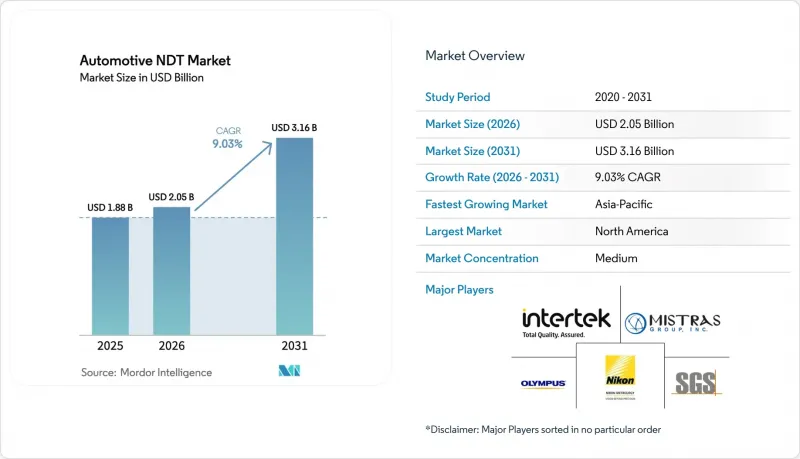
Mordor Intelligence에 의하면, 자동차 비파괴 검사(NDT) 시장 규모는 2025년에 18억 8,000만 달러로 평가되었습니다. 2026년 20억 5,000만 달러에서 2031년까지 31억 6,000만 달러에 이를 것으로 예상되며, 예측 기간(2026-2031년) CAGR은 9.03%를 나타낼 전망입니다.
본 보고서는 구성 요소(장비, 소프트웨어 등), 검사 방법(초음파 검사, 방사선 검사, 자분 검사 등), 기법(기존/기존 방식 및 AI 지원), 지역(북미, 남미, 유럽, 아시아태평양, 중동 및 아프리카)별로 분류되어 있습니다. 시장 예측은 금액(달러) 기준으로 제시되어 있습니다.
세계의 자동차 비파괴 검사(NDT) 시장 동향 및 인사이트
첨단 경량 소재의 활용 확대
각 자동차 제조업체는 기존의 강철 구조에서 알루미늄 합금 및 탄소섬유 강화 플라스틱(CFRP)으로의 전환을 추진하고 있으며, 이로 인해 연비는 향상되는 한편, 더욱 정교한 검사가 요구되고 있습니다. 현재, 초음파 위상 배열 시스템을 사용하여 접착 접합부를 스캔하고, 충돌 하중 하에서 접착 불량을 유발할 가능성이 있는 박리를 감지하고 있습니다. 생산 컨베이어에 설치된 인라인 CT 장치를 통해 타크트 스케줄에서 부품을 분리하지 않고도 100% 체적 검사가 가능해졌으며, BMW는 탄소섬유 루프 프레임 검사에 이 기법을 채택하고 있습니다. AI를 활용한 분석을 통해 알루미늄 주조품의 공극 검출 재현성은 97.25%로 향상되었으나, 두께 변화 부위의 정밀도에 대해서는 재현성이 86.97%에 그치고 있습니다. ISO 9001 및 IATF 16949 인증에서는 공급업체에 대해 완벽한 추적성 증명을 요구하고 있으며, 이에 따라 디지털 아카이브 및 바코드 연동형 이미지 저장의 보급이 촉진되고 있습니다. 경량화 추세가 가속화되는 가운데, 자동차 비파괴 검사(NDT) 시장은 신모델 출시마다 장비 기반을 확대해 나갈 것입니다.
전기차용 배터리 검사의 급증
리튬 이온 배터리 팩에는 열폭주 위험이 있어, 각 OEM 업체들은 셀 용접부, 전극의 정렬, 냉각판과의 접합에 대해 엄격한 CT 및 초음파 검사를 통한 검증을 통해 이러한 위험을 완화하고 있습니다. 헥사곤은 시간당 1,000개의 셀을 촬영할 수 있는 고에너지 CT 라인을 도입한 반면, 비시컨설트는 각형 모듈용 인라인 CT를 상용화하기 위해 110만 유로의 자금 조달에 성공했습니다. UN 38.3 운송 규정 및 IEC 62660 표준 초안에 따라 운송 전에 셀의 무결성을 입증해야 할 의무가 부과됨에 따라, 휴대용 X선 촬영 장치 및 와전류 스캐너에 대한 단기적인 수요가 급증하고 있습니다. 가동 중인 진단 기술도 발전하여, 저주파 초음파를 이용하여 노후화가 진행된 팩의 전해액량 감소를 매핑함으로써 보증 청구를 미연에 방지하고 있습니다. 이러한 요인들로 인해 자동차 비파괴 검사(NDT) 시장의 연평균 성장률(CAGR) 기여율은 2.8%로 상승했습니다.
첨단 비파괴 검사 장비의 높은 자본 비용
225kV 스캔이 가능한 산업용 CT 캐비닛의 가격은 50만 달러를 초과하며 컨베이어, 차폐 장치, 로봇 로더를 추가하면 그 비용은 종종 2배로 늘어나, 2차 공급업체의 투자 수익률(ROI) 기준을 충족하는 것이 과제가 됩니다. 센서의 급속한 발전으로 인해 감가상각이 끝나기 전에 구식이 될 위험이 있는 반면, 방사선 촬영실에는 고가의 납 라이닝과 출입 금지 구역이 필요하여 린(Lean) 레이아웃을 방해합니다. NHTSA가 2029년에 도입할 예정인 AEB(자동 긴급 제동) 의무화로 인해, 각 OEM사는 브랜드별로 4억 3,000만 달러를 센서 업그레이드에 할당해야 하며, 이로 인해 병행 검사 비용이 증가하고 있습니다. 자금 조달 제약은 현지 조달 규정과 외화 표시 설비 가격이 충돌하는 신흥 시장의 공장에서 가장 큰 부담으로 작용하고 있으며, 단기적으로는 자동차 비파괴 검사(NDT) 시장의 연평균 성장률(CAGR)을 1.8포인트 끌어내리는 요인이 되고 있습니다.
부문별 분석
2025년, 자동차 비파괴 검사(NDT) 시장에서 장비가 시장 점유율의 48.10%를 차지했으며, 이는 이 분야가 자본 집약적임을 반영합니다. 각 OEM 업체들이 EV 플랫폼을 위해 CT 라인 개조를 추진하는 가운데, 니콘,Yxlon, North Star Imaging은 수년 치의 수주 잔고를 보유하고 있는 것으로 보고되고 있습니다. 한편, 소프트웨어 매출액은 결함 분류를 자동화하는 AI 엔진과 테라바이트 규모의 DICONDE 이미지를 저장하는 클라우드 포털에 힘입어 연평균 성장률(CAGR) 10.05%를 나타낼 것으로 예측됩니다. 서비스와 관련된 자동차 비파괴 검사 시장 규모는 기술자 부족을 보완하기 위한 아웃소싱과 공급업체 감사에서의 중립성 확보로 인해 견조한 모습을 유지하고 있습니다. 소모품의 경우 규모는 작지만, 정기적인 플랫 필드 보정이 필요한 디지털 검출기의 도입 대수가 증가하고 있어 수요가 확대되고 있습니다.
ISO 17025 등의 규제 체계에서는 시험소에 대해 측정기의 연례 재교정을 의무화하고 있으며, 이로 인해 인증 블록 및 검증용 쿠폰에 대한 안정적인 수요가 발생하고 있습니다. 현대자동차가 에어백 이니시에이터 검증을 위해 니콘사의 X선 CT 장비를 구매한 사례는 자본 설비의 판매가 밸류체인을 따라 하류 서비스 및 소모품 수요를 견인하는 구조를 보여줍니다. 한편, VisiConsult사의 유럽지역개발기금(ERDF) 지원을 받은 연구 개발은 하드웨어 공급업체와 알고리즘 전문가 간의 공생 관계를 부각시키고 있으며, 자동차 비파괴 검사(NDT) 시장에서의 장기적인 수익 다각화를 공고히 하고 있습니다.
지역별 분석
북미는 NHTSA(미국 도로교통안전국)의 안전 규제와 디트로이트의 OEM 기업들 및 중서부 지역의 시험소 간의 긴밀한 피드백 루프에 힘입어 2025년 매출의 37.45%를 차지했습니다. 한편, 아시아태평양은 중국, 일본, 한국이 기가팩토리를 건설하고 전 세계로 전기차용 드라이브트레인을 수출하고 있어 연평균 10.12%의 성장이 예상됩니다. 유럽 시장 규모는 복합재 모노코크 및 바이오 수지 개발을 선도하는 프리미엄 브랜드에 힘입어 안정적인 모습을 보이고 있습니다. 남미 및 중동·북아프리카(MENA) 지역은 뒤처져 있지만, 설립 초기부터 최신 검사 기술을 접목한 그린필드 공장을 유치함으로써 구식 설비로 인한 문제를 피하고 있습니다.
미국은 로봇 대응 CT 셀에 대한 투자를 주도하고 있으며, 캐나다는 복합재료 조사를 전문으로 하고, 멕시코는 비용 최적화된 서비스 센터에 주력하고 있습니다. 아시아태평양의 자동차 비파괴 검사(NDT) 시장 규모는 중국의 기가팩토리 붐과 고체 배터리 내 30마이크론의 공극을 가시화하는 고주파 위상 배열 분야에서 일본의 기술적 돌파구 덕분에 가장 빠른 속도로 확대되고 있습니다. 인도는 기술자 부족을 보완하기 위해 ASNT와 협력하여 교육 프로그램을 전개하고 있으며, 새로운 서비스 아웃소싱 수요를 창출하고 있습니다. 유럽은 하이최종 용도의 거점으로 자리 잡고 있으며, 독일에서는 디젤 엔진 블록의 CT 스캔을 위해 9MeV 선형 가속기를 도입한 반면, 영국에서는 AI를 활용한 결함 분할 소프트웨어 개발이 진행되고 있습니다. 통일된 Euro NCAP 프로토콜 덕분에 국경을 초월한 공급업체 승인 절차가 간소화되어, 유럽 전역에 걸친 검사 캠페인 수요가 촉진되고 있습니다. 남미와 아프리카는 규모는 작지만, 유럽의 고객 감사에 부합하기 위해 수출 지향적인 섀시 공장에서 휴대용 초음파 크롤러가 채택되는 등 틈새 시장의 성장이 나타나고 있습니다. 이러한 동향들이 맞물려 고객 구성이 다양화되면서, 자동차 비파괴 검사(NDT) 시장의 리스크가 성숙한 경제권과 신흥 경제권 양쪽으로 분산되고 있습니다.
기타 혜택 :
- 엑셀 형식 시장 예측(ME) 시트
- 3개월간의 애널리스트 지원
자주 묻는 질문
목차
제1장 서론
제2장 조사 방법
제3장 주요 요약
제4장 시장 구도
제5장 시장 규모 및 성장 예측
제6장 경쟁 구도
제7장 시장 기회 및 향후 전망
KTH 26.09.14According to Mordor Intelligence, the automotive NDT market size was valued at USD 1.88 billion in 2025 and estimated to grow from USD 2.05 billion in 2026 to reach USD 3.16 billion by 2031, at a CAGR of 9.03% during the forecast period (2026-2031).
This report is Segmented by Component (Equipment, Software, and More), Testing Method (Ultrasonic Testing, Radiographic Testing, Magnetic Particle Testing, and More), Technique (Traditional/Conventional and AI-Enabled), and Geography (North America, South America, Europe, Asia Pacific, Middle East, and Africa). The Market Forecasts are Provided in Terms of Value (USD).
Global Automotive NDT Market Trends and Insights
Rising Use of Advanced Lightweight Materials
Automakers are swapping traditional steel structures for aluminum alloys and carbon-fiber-reinforced polymers, which boost fuel economy but demand more sophisticated inspection. Ultrasonic phased-array systems now scan bonded joints to catch delamination that could trigger adhesive failure under crash loads. Inline CT units mounted on production conveyors enable 100% volumetric checks without removing parts from the takt schedule, a method BMW employs for carbon-fiber roof frames. AI-powered analytics have lifted void-detection repeatability for aluminum casting to 97.25%, though accuracy in thickness transitions still lags at 86.97% repeatability. ISO 9001 and IATF 16949 certifications require suppliers to demonstrate full traceability, thereby promoting the wider adoption of digital archiving and barcode-linked image storage. As lightweighting trends accelerate, the Automotive NDT market will broaden its equipment base across every new model launch.
Surge in Electric-Vehicle Battery Inspections
Lithium-ion packs introduce thermal-runaway risk that OEMs mitigate through rigorous CT and ultrasonic validation of cell welds, electrode alignment, and coolant-plate bonding. Hexagon has rolled out high-energy CT lines that image 1,000 cells per hour, while VisiConsult secured EUR 1.1 million to commercialize inline CT for prismatic modules. UN 38.3 shipping rules and draft IEC 62660 standards force proof of cell integrity before transportation, generating near-term demand spikes for portable radiography and eddy-current scanners. In-service diagnostics are also advancing: low-frequency ultrasound maps electrolyte volume loss in aging packs to pre-empt warranty claims. These factors reinforce a 2.8% positive contribution to the Automotive NDT market's CAGR.
High Capital Cost of Advanced NDT Equipment
Industrial CT cabinets capable of 225-kV scans cost over USD 500,000, and adding conveyors, shielding, and robotic loaders often doubles the expenditure, challenging the ROI thresholds of tier-two suppliers. Rapid sensor evolution risks obsolescence before depreciation ends, while radiographic rooms demand costly lead lining and exclusion zones that interrupt lean layouts. NHTSA's forthcoming 2029 AEB mandate already requires OEMs to allocate USD 430 million per brand for sensor upgrades, thereby inflating parallel inspection costs. Financing constraints weigh heaviest on emerging-market plants where local content rules collide with foreign-currency equipment pricing, shaving 1.8 points off the Automotive NDT market CAGR in the near term.
Other drivers and restraints analyzed in the detailed report include:
- Stringent Global Vehicle Safety Mandates
- Robotics Driven Inline NDT Automation
- Shortage of Certified NDT Technicians
For complete list of drivers and restraints, kindly check the Table Of Contents.
Segment Analysis
Equipment accounted for 48.10% of the Automotive NDT market share in 2025, reflecting the sector's capital-intensive backbone. Nikon, Yxlon, and North Star Imaging report multi-year order backlogs as OEMs refurbish CT lines for EV platforms. Conversely, software revenue is projected to grow at a 10.05% CAGR, driven by AI engines that automate defect classification and cloud portals that store terabytes of DICONDE images. The Automotive NDT market size tied to services remains resilient because outsourcing fills technician gaps and ensures neutrality during supplier audits. Consumables, although smaller, gain from the swelling installed base of digital detectors that require periodic flat-field calibrations.
Regulatory frameworks, such as ISO 17025, require laboratories to recalibrate gauges annually, generating steady demand for certified blocks and verification coupons. Hyundai's purchase of Nikon X-ray CT units to verify airbag initiators demonstrates how capital equipment sales pull downstream services and consumables along the value chain. Meanwhile, VisiConsult's ERDF-backed R&D underscores the symbiosis between hardware providers and algorithm specialists, anchoring long-term revenue diversity within the Automotive NDT market.
Complete Report Scope:
- By Component
- Equipment
- Software
- Services
- Consumables
- By Testing Method
- Ultrasonic Testing
- Radiographic Testing
- Magnetic Particle Testing
- Liquid Penetrant Testing
- Visual Inspection Testing
- Eddy-Current Testing
- Acoustic Emission Testing
- Thermography / Infrared Testing
- Computed Tomography Testing
- By Technique
- Traditional / Conventional
- AI-enabled
- By Geography
- North America
- United States
- Canada
- Mexico
- South America
- Brazil
- Argentina
- Rest of South America
- Europe
- Germany
- United Kingdom
- France
- Italy
- Spain
- Rest of Europe
- Asia Pacific
- China
- Japan
- India
- South Korea
- South-East Asia
- Rest of Asia Pacific
- Middle East
- Saudi Arabia
- United Arab Emirates
- Turkey
- Rest of Middle East
- Africa
- South Africa
- Nigeria
- Rest of Africa
- North America
Geography Analysis
North America generated 37.45% of 2025 revenue, buoyed by NHTSA's safety regime and a tight feedback loop between Detroit OEMs and Midwest testing labs. Asia Pacific, however, is projected to grow 10.12% annually as China, Japan, and South Korea forge giga-factories and export EV drivetrains worldwide. European volume remains stable, underpinned by premium brands that pioneer composite monocoques and bio-based resins. South America and the MENA region trail, but attract Greenfield plants that embed modern inspection from day one, avoiding legacy equipment pitfalls.
The United States leads investment in robotics-ready CT cells, while Canada specializes in composite research and Mexico focuses on cost-optimized service centers. The Asia Pacific's Automotive NDT market size is expanding at the fastest rate, thanks to China's giga-factory boom and Japanese breakthroughs in high-frequency phased arrays that visualize 30-micron voids in solid-state batteries. India is rolling out training schemes with ASNT to fill its technician gap, creating new service outsourcing streams. Europe anchors high-end applications; Germany deploys 9-MeV linear accelerators for CT scanning of diesel-engine blocks, while the United Kingdom advances AI-based defect segmentation software. Harmonized Euro NCAP protocols simplify cross-border supplier approvals, driving demand for pan-European inspection campaigns. South America and Africa, although smaller, are seeing niche growth around export-oriented chassis plants adopting portable ultrasonic crawlers to comply with European customer audits. Collectively, these dynamics diversify the customer mix, spreading Automotive NDT market risk across mature and emerging economies.
- Baker Hughes Company
- Mistras Group Inc.
- SGS SA
- Intertek Group plc
- Applus Services SA
- Olympus Corporation
- YXLON International (Comet Group)
- Magnaflux (Illinois Tool Works Inc.)
- Zetec Inc.
- Sonatest Ltd.
- Eddyfi Technologies
- Ashtead Technology Ltd.
- TUV Rheinland AG
- Bureau Veritas S.A.
- DEKRA SE
- Nikon Corporation (Nikon Metrology)
- FUJIFILM Corporation (FUJIFILM NDT Systems)
- Rohmann GmbH
- NDT Global (Eddyfi/NDT)
- Carl Zeiss Industrielle Messtechnik GmbH
- Comet Group AG (Vega Imaging)
- TSC Subsea Ltd.
- LynX Inspection Inc.
- Cygnus Instruments Ltd.
Additional Benefits:
- The market estimate (ME) sheet in Excel format
- 3 months of analyst support
TABLE OF CONTENTS
1 INTRODUCTION
- 1.1 Study Assumptions and Market Definition
- 1.2 Scope of the Study
2 RESEARCH METHODOLOGY
3 EXECUTIVE SUMMARY
4 MARKET LANDSCAPE
- 4.1 Market Overview
- 4.2 Market Drivers
- 4.2.1 Rising use of advanced lightweight materials
- 4.2.2 Surge in electric vehicle battery inspections
- 4.2.3 Stringent global vehicle safety mandates
- 4.2.4 Robotics driven inline NDT automation
- 4.2.5 Shift to full-CT for additively manufactured auto parts
- 4.2.6 Insurance-led demand for in-service portable NDT
- 4.3 Market Restraints
- 4.3.1 High capital cost of advanced NDT equipment
- 4.3.2 Shortage of certified NDT technicians
- 4.3.3 Production downtime due to radiographic safety zones
- 4.3.4 IP concerns over cloud based AI-enabled analytics
- 4.4 Industry Value Chain Analysis
- 4.5 Impact of Macroeconomic Factors
- 4.6 Regulatory Landscape
- 4.7 Technological Outlook
- 4.8 Porter's Five Forces Analysis
- 4.8.1 Competitive Rivalry
- 4.8.2 Threat of New Entrants
- 4.8.3 Bargaining Power of Buyers
- 4.8.4 Bargaining Power of Suppliers
- 4.8.5 Threat of Substitutes
5 MARKET SIZE AND GROWTH FORECASTS (VALUE)
- 5.1 By Component
- 5.1.1 Equipment
- 5.1.2 Software
- 5.1.3 Services
- 5.1.4 Consumables
- 5.2 By Testing Method
- 5.2.1 Ultrasonic Testing
- 5.2.2 Radiographic Testing
- 5.2.3 Magnetic Particle Testing
- 5.2.4 Liquid Penetrant Testing
- 5.2.5 Visual Inspection Testing
- 5.2.6 Eddy-Current Testing
- 5.2.7 Acoustic Emission Testing
- 5.2.8 Thermography / Infrared Testing
- 5.2.9 Computed Tomography Testing
- 5.3 By Technique
- 5.3.1 Traditional / Conventional
- 5.3.2 AI-enabled
- 5.4 By Geography
- 5.4.1 North America
- 5.4.1.1 United States
- 5.4.1.2 Canada
- 5.4.1.3 Mexico
- 5.4.2 South America
- 5.4.2.1 Brazil
- 5.4.2.2 Argentina
- 5.4.2.3 Rest of South America
- 5.4.3 Europe
- 5.4.3.1 Germany
- 5.4.3.2 United Kingdom
- 5.4.3.3 France
- 5.4.3.4 Italy
- 5.4.3.5 Spain
- 5.4.3.6 Rest of Europe
- 5.4.4 Asia Pacific
- 5.4.4.1 China
- 5.4.4.2 Japan
- 5.4.4.3 India
- 5.4.4.4 South Korea
- 5.4.4.5 South-East Asia
- 5.4.4.6 Rest of Asia Pacific
- 5.4.5 Middle East
- 5.4.5.1 Saudi Arabia
- 5.4.5.2 United Arab Emirates
- 5.4.5.3 Turkey
- 5.4.5.4 Rest of Middle East
- 5.4.6 Africa
- 5.4.6.1 South Africa
- 5.4.6.2 Nigeria
- 5.4.6.3 Rest of Africa
- 5.4.1 North America
6 COMPETITIVE LANDSCAPE
- 6.1 Market Concentration
- 6.2 Strategic Moves
- 6.3 Market Share Analysis
- 6.4 Company Profiles (includes Global level Overview, Market level overview, Core Segments, Financials as available, Strategic Information, Market Rank/Share for key companies, Products and Services, and Recent Developments)
- 6.4.1 Baker Hughes Company
- 6.4.2 Mistras Group Inc.
- 6.4.3 SGS SA
- 6.4.4 Intertek Group plc
- 6.4.5 Applus Services SA
- 6.4.6 Olympus Corporation
- 6.4.7 YXLON International (Comet Group)
- 6.4.8 Magnaflux (Illinois Tool Works Inc.)
- 6.4.9 Zetec Inc.
- 6.4.10 Sonatest Ltd.
- 6.4.11 Eddyfi Technologies
- 6.4.12 Ashtead Technology Ltd.
- 6.4.13 TUV Rheinland AG
- 6.4.14 Bureau Veritas S.A.
- 6.4.15 DEKRA SE
- 6.4.16 Nikon Corporation (Nikon Metrology)
- 6.4.17 FUJIFILM Corporation (FUJIFILM NDT Systems)
- 6.4.18 Rohmann GmbH
- 6.4.19 NDT Global (Eddyfi/NDT)
- 6.4.20 Carl Zeiss Industrielle Messtechnik GmbH
- 6.4.21 Comet Group AG (Vega Imaging)
- 6.4.22 TSC Subsea Ltd.
- 6.4.23 LynX Inspection Inc.
- 6.4.24 Cygnus Instruments Ltd.
7 MARKET OPPORTUNITIES AND FUTURE OUTLOOK
- 7.1 White-space and Unmet-need Assessment

(주말 및 공휴일 제외)


