

|
시장보고서
상품코드
2125379
병원 자산 추적 및 재고 관리 시스템 : 시장 점유율 분석, 업계 동향 및 통계, 성장 예측(2026-2031년)Hospital Asset Tracking And Inventory Management Systems - Market Share Analysis, Industry Trends & Statistics, Growth Forecasts (2026 - 2031) |
||||||
 Mordor Intelligence
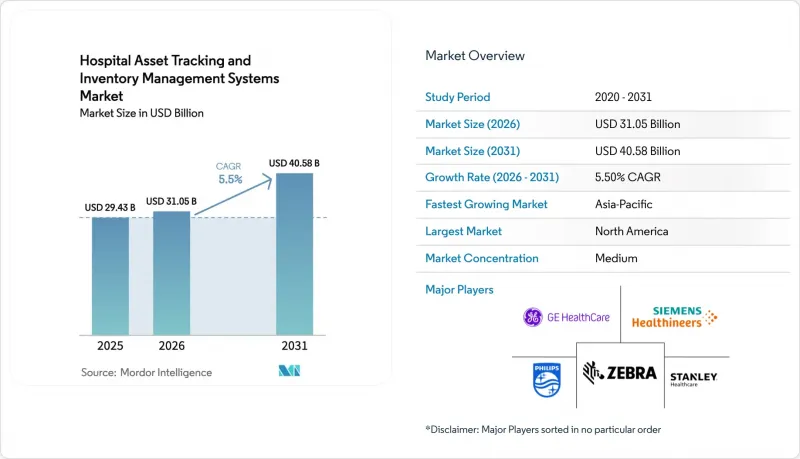
Mordor Intelligence에 의하면, 병원 자산 추적 및 재고 관리 시스템 시장 규모는 2025년 294억 3,000만 달러로 평가되었습니다. 2026년 310억 5,000만 달러에서 2031년까지 405억 8,000만 달러로 확대되어 2026년부터 2031년에 걸쳐 CAGR 5.5%를 나타낼 것으로 예측됩니다.
본 보고서는 기술별(RFID, RTLS, 바코드, 초음파, BLE), 구성 요소별(하드웨어, 소프트웨어, 서비스), 제품 유형별(모바일, 고정식, 기타), 용도별(의료기기, 직원, 환자, 환경 추적),최종 사용자(병원, 당일 수술센터(ASC), 장기 요양 시설(LTCF), 기타), 지역(북미, 유럽, 아시아태평양(APAC), 중동 및 아프리카(MEA), 남미)별로 분류되어 있습니다. 예측치는 금액(달러)으로 표시되어 있습니다.
세계의 병원 자산 추적 및 재고 관리 시스템 시장 동향 및 인사이트
병원 환경에서의 RFID 및 RTLS 도입 확대
패시브형 RFID 태그의 단가는 현재 개당 0.10달러 미만으로, 병원 캠퍼스 전체에 경제적으로 태그를 설치할 수 있게 되었습니다. RWJ 바나바스 헬스가 뉴저지주의 12개 병원에 8만 5,000개의 태그를 도입한 결과, 검색 시간이 72% 단축되고, 분실되었던 420만 달러 상당의 장비가 회수되어 투자 수익률(ROI)이 입증되었습니다. 액티브형 RTLS는 수술실에서 요구되는 1미터 미만의 정확도를 실현합니다. 뉴캐슬어폰타인 병원 NHS 재단 트러스트의 사례에서는 초광대역(UWB) 도입 후 수술 기구 트레이의 오류가 41% 감소한 것으로 나타났습니다. 전력 소비가 60% 적은 블루투스 저에너지(Bluetooth Low Energy) 태그는 초광대역의 3분의 1 비용으로 3미터의 정확도를 제공하여 도입 범위를 넓히고 있습니다. 이러한 시너지 효과로 인해 가시선 및 수동 스캔이 필요한 바코드의 대체가 가속화되고 있으며, 업무가 가장 바쁠 때 임상의들이 일상적으로 생략하던 절차가 점차 해소되고 있습니다.
자산 활용률과 재고 정확도의 최적화 필요
일반적인 이동식 의료기기의 이용률은 40%에서 60% 사이를 오가고 있으며, 보관소에는 수십억 상당의 유휴 자산이 방치된 채로 남아 있습니다. RTLS와 수요 예측 알고리즘을 결합함으로써, 병동의 실시간 수요에 따라 인공호흡기나 펌프를 동적으로 재분배하여 이용률을 75% 이상으로 높일 수 있습니다. 쿠 테크 푸아트 병원은 2024년에 RTLS를 ERP와 통합하여 이동식 기기의 재고를 22% 줄이는 동시에 380만 싱가포르 달러를 환자 치료 프로젝트에 재투자했습니다. 또한, 자동 기록 기능을 통해 생명 유지 장치의 위치 정보 및 유지보수 현황을 문서화하도록 요구하는 조인트 커미션(Joint Commission)의 2025년 안전 목표 준수도 강화되었습니다. 수기 기록으로 인한 감사 부적합률은 30%에 달했으나, 현재 병원에서는 정기적인 종이 기반 점검 대신 지속적인 원격 모니터링을 통해 이러한 위험을 완화하고 있습니다.
높은 도입 및 유지 관리 비용
300병상 규모의 병원에서는 RTLS 하드웨어와 소프트웨어에 80만-150만 달러를 지출하고, 이후 지원 비용으로 연간 15만-25만 달러를 지출하게 됩니다. 이는 자금 사정이 어려운 환경에서 프로젝트의 발목을 잡는 장벽이 됩니다. 인도의 소규모 민간 병원 체인에서는 RTLS 도입보다 병상 수 확대를 우선시하는 경향이 있습니다. 이는 병상 가동률을 높이는 편이 투자 회수 기간이 더 짧기 때문입니다. Zebra사가 2025년에 도입할 ‘Tracking-as-a-Service’는 지불을 5년에 걸쳐 분산함으로써 초기 비용을 60% 절감하고, 중견 의료 제공업체도 이 기술을 이용할 수 있도록 합니다. 또한, 구독형 모델을 통한 수익 구조는 벤더에게 지속적인 수익원을 보장하며, 경쟁의 초점을 하드웨어 이익률에서 고객 생애 가치(LTV)로 전환시키고 있습니다.
부문별 분석
RFID는 2025년 매출의 47.87%를 차지했으나, 병원이 정적 집계보다 실시간 상황을 중시하게 됨에 따라 RTLS는 연평균 성장률(CAGR) 6.34%로 가장 빠르게 성장하며 병원 자산 추적 및 재고 관리 시스템 시장을 주도하고 있습니다. 패시브형 RFID는 태그 가격이 0.08-0.15달러이고 배터리가 필요하지 않기 때문에 소모품이나 약국 키트에서는 여전히 타의 추종을 불허하는 선택지이며, 소프트웨어 이익률이 압박받는 상황에서도 하드웨어 시장 점유율을 유지하고 있습니다. 그러나 패시브형 시스템은 실시간 위치 정보를 제공할 수 없기 때문에 20분마다 장비 배치가 바뀌는 응급실에서는 유용성이 제한적입니다. RTLS는 몇 초마다 위치 정보를 갱신하는 삼각측량 알고리즘을 통해 이러한 기능적 격차를 메우고, 요청이 기록될 때 자동으로 간호사 호출 워크플로우를 실행할 수 있습니다.
규제 환경이 도입 구성을 좌우하고 있습니다. FDA의 UDI와 EU의 MDR은 기계 판독 가능 식별자(MRI)를 의무화하고 있지만, 실시간 추적까지는 의무화하지 않기 때문에 RTLS는 규정 준수가 아닌 운영상의 ROI에 의해 정당화되는 선택적 업그레이드가 되고 있습니다. 지역에 따라 선호도 차이도 나타납니다. 북미의 시스템에서는 고밀도 무선 네트워크를 병용하는 Wi-Fi RTLS가 선호되는 반면, 유럽의 병원에서는 텔레메트리 대역과의 간섭을 피하기 위해 초광대역(UWB)이 선호되고 있습니다. 아시아태평양에서는 공공 부문에서 저비용 RFID가, 고급 사립 병원 체인에서는 RTLS가 채택되고 있으며, 중국의 스마트 병원 도입 의무화로 인해 RTLS의 보급이 가속화될 것으로 예측됩니다.
2025년 매출에서 하드웨어가 차지하는 비중은 42.45%였으나, 소프트웨어 및 분석 분야는 연평균 성장률(CAGR) 6.41%로 확대되고 있으며, 병원이 실행 가능한 인사이트를 추구함에 따라 매출 총이익률도 높아지고 있습니다. 이는 병원 자산 추적 및 재고 관리 시스템 시장에서 데이터 서비스가 시장 규모의 상당 부분을 차지하고 있음을 강조합니다. 태그와 센서의 상품화로 인해 제조는 동남아시아로 이동했으며, 공급업체의 이익률은 30%-40%로 축소되었습니다. 대조적으로, 소프트웨어 구독은 예측 유지보수, 수요 예측 및 전자 건강 기록(EHR)과의 원활한 통합을 실현함으로써 65%-75%의 이익률을 확보하고 있습니다.
상호 운용성 의무화로 인해 소프트웨어에 대한 수요가 증가하고 있습니다. ‘21세기 치료법(21st Century Cures Act)’에 따라 자산 위치 정보 피드에 대한 표준화된 API가 공개되어, 타사 분석 도구가 별도의 코딩 없이 RTLS 데이터를 가져올 수 있게 되었습니다. Philips는 ‘IntelliSpace Connect’를 통해 이러한 기회를 활용하고, 자산, 환자, 재무 데이터를 통합하는 클라우드 라이크를 통해 휠체어 분실로 인한 퇴원 지연 등 그동안 간과되었던 비용 요인을 밝혀내고 있습니다. 서비스(도입, 교육, 운영 관리)는 하드웨어 배포에 맞추어 규모가 확대되지만, 벤더들은 수익을 안정화하기 위해 이를 구독 모델에 포함시키는 경향이 강해지고 있습니다.
지역별 분석
2025년, 북미는 40.78%의 시장 점유율을 차지했습니다. 이는 여러 주에 걸쳐 있는 거점에서 RTLS 비용을 분산시키는 통합 의료 제공 네트워크와, 디지털 등록 제도를 의무화한 FDA의 UDI(의료기기 고유 식별자) 완전 시행에 힘입은 결과입니다. EHR(전자건강기록) 보급률이 95%를 넘어서면서 플러그 앤 플레이 방식의 RTLS 통합이 가능해졌으나, 각 의료시설이 초기 도입에서 단계적 확장으로 전환함에 따라 성장세는 완만해지고 있습니다. 캐나다에서는 76개 병원을 대상으로 1억 8,000만 캐나다 달러의 자금이 투입되고 있으며, 멕시코에서는 IMSS(멕시코 사회보험원) 산하 20개 시설에서 RFID 시범 운영이 진행되고 있어, 미국을 넘어 북미 대륙 전체로 확산되는 추세를 보이고 있습니다.
아시아태평양은 연평균 성장률(CAGR) 6.71%로 가장 빠른 성장을 보이고 있으며, 그 원동력은 2,800개 3차 의료기관을 대상으로 하는 중국의 1,200억 위안 규모의 스마트 병원 구상과,인도의 ‘아유슈만 바라트’ 프로그램 내 보상 연계형 RFID 요건입니다. 후자의 경우, 지급 자격을 얻기 위해 자산 등록이 의무화되어 있습니다. 아폴로 병원(Apollo Hospitals)은 2024년에 71개 시설에서 설비 투자를 19% 절감함으로써 RTLS의 투자 수익률(ROI)을 입증하여, 민간 동종 업계에도 영향을 미치고 있습니다. 한국의 ‘2025 스마트 병원 인증’에서는 RTLS 도입 시 보험 환급 우대 조치가 마련되어 있는 반면, 호주의 민간 병원 체인은 처리 능력 지표에서의 경쟁력을 높이기 위해 자산 추적 시스템을 도입하고 있습니다.
유럽에서는 중간 정도의 성장이 나타나고 있습니다. 독일의 ‘병원 미래법(Hospital Future Act)’에 따라 43억 유로의 자금이 RFID 도입 요건을 충족하기 위해 배정되었으며, 잉글랜드 국민보건서비스(NHS)는 물리적 시설 확장이 아닌 디지털화에 12억 파운드를 투입하고 있습니다. 프랑스의 ‘Ma Sante 2022’에서는 디지털 등록 의무화가 2025년까지 연장되었으며, 성과 연계형 지불이 RTLS 도입과 연계되어 있습니다. 중동에서는 ‘사우디 비전 2030’에 따른 120억 사우디 리얄의 예산 배정과 UAE의 건축기준법이 모든 신축 병원에 RTLS 도입을 의무화함에 따라 도입이 가속화되고 있습니다. 남미는 다소 뒤처져 있지만, 브라질의 민간 병원 체인은 공공 예산의 제약 속에서 품질 면에서의 차별화를 꾀하기 위해 RTLS를 도입하고 있습니다.
기타 혜택 :
- 엑셀 형식 시장 예측(ME) 시트
- 3개월간의 애널리스트 지원
자주 묻는 질문
목차
제1장 서론
제2장 조사 방법
제3장 주요 요약
제4장 시장 구도
제5장 시장 규모 및 성장 예측
제6장 경쟁 구도
제7장 시장 기회 및 향후 전망
KTH 26.09.14According to Mordor Intelligence, the hospital asset tracking and inventory management systems market size is projected to expand from USD 29.43 billion in 2025 and USD 31.05 billion in 2026 to USD 40.58 billion by 2031, registering a CAGR of 5.5% between 2026 and 2031.
This report is Segmented by Technology (RFID, RTLS, Barcode, Ultrasound, BLE), Component (Hardware, Software, Services), Product Type (Mobile, Fixed, Other), Application (Device, Staff, Patient, Environmental Tracking), End-User (Hospitals, Ascs, Ltcfs, Others), and Geography (North America, Europe, APAC, MEA, South America). Forecasts are in Value (USD).
Global Hospital Asset Tracking And Inventory Management Systems Market Trends and Insights
Rising Adoption of RFID & RTLS Across Hospital Settings
Passive RFID tags now cost under USD 0.10 each, allowing entire campuses to be tagged economically. RWJBarnabas Health's 85,000-tag rollout across 12 New Jersey hospitals cut search time by 72% and recovered USD 4.2 million in misplaced equipment, validating the return on investment. Active RTLS delivers sub-meter accuracy required in surgical suites, as shown by Newcastle upon Tyne Hospitals NHS Foundation Trust where instrument-tray errors dropped 41% after ultra-wideband deployment. Bluetooth Low Energy tags, consuming 60% less power, offer 3-meter precision at one-third the cost of ultra-wideband, widening the adoption funnel. The collective effect is accelerated replacement of barcodes that demand line-of-sight and manual scans, steps clinicians routinely skip during peak workloads.
Need to Optimize Asset Utilization & Inventory Accuracy
Typical mobile-equipment utilization hovers between 40% and 60%, leaving billions in idle assets locked in storage closets. RTLS coupled with demand-forecast algorithms lifts utilization beyond 75% by dynamically reallocating ventilators and pumps according to real-time ward needs. Khoo Teck Puat Hospital integrated RTLS with ERP in 2024, trimming mobile-equipment inventory by 22% and redirecting SGD 3.8 million to patient-care projects. Automated logs also shore up compliance with the Joint Commission's 2025 safety goals that require documented location and maintenance status for life-support devices. Audit failures tied to manual logs run at 30%, a risk hospitals now mitigate through continuous telemetry rather than periodic paper checks.
High Installation & Maintenance Costs
A 300-bed hospital spends USD 800,000-1.5 million for RTLS hardware and software, then USD 150,000-250,000 annually on support, a barrier that stalls projects in cash-constrained settings. Smaller Indian private chains often favor bed expansion over RTLS because occupancy gains offer faster payback. Zebra's 2025 "tracking-as-a-service" spreads payments over five years, slashing upfront outlay by 60% and making the technology accessible to mid-tier providers. Subscription economics also guarantee vendors an annuity stream, reshaping competition around lifetime value rather than hardware margin.
Other drivers and restraints analyzed in the detailed report include:
- Growing Smart-Hospital Infrastructure Spending
- Regulatory Push for Device Traceability & Patient Safety
- Data Security & Privacy Concerns
For complete list of drivers and restraints, kindly check the Table Of Contents.
Segment Analysis
RFID generated 47.87% of 2025 revenue, yet RTLS is growing fastest at 6.34% CAGR as hospitals value real-time snapshots over static counts, propelling the hospital asset tracking and inventory management systems market forward. Passive RFID remains unmatched for consumables and pharmacy kits because tags cost USD 0.08-0.15 and need no batteries, maintaining hardware share even as software margins compress. However, the inability of passive systems to deliver live coordinates restricts their usefulness in emergency departments where equipment shifts every 20 minutes. RTLS fills that capability gap with triangulation algorithms that refresh locations every few seconds and can trigger nurse-call workflows automatically when requests are logged.
Regulatory backdrop shapes the mix: FDA UDI and EU MDR require machine-readable identifiers but stop short of mandating real-time tracking, leaving RTLS as a discretionary upgrade justified by operational ROI rather than compliance. Geography also tilts preferences. North American systems favor Wi-Fi RTLS piggybacking on dense wireless networks, whereas European hospitals lean toward ultra-wideband to avoid interference with telemetry bands. Asia-Pacific splits between low-cost RFID in public sectors and RTLS in premium private chains, with China's smart-hospital mandate expected to accelerate RTLS penetration.
Hardware contributed 42.45% of 2025 revenue, but software & analytics is expanding at 6.41% CAGR, claiming higher gross margins as hospitals pursue actionable insights, underscoring the hospital asset tracking and inventory management systems market size premium on data services. Commoditization of tags and sensors shifted manufacturing to Southeast Asia, compressing vendor margins to 30%-40%. In contrast, software subscriptions command 65%-75% margins because they deliver predictive maintenance, demand forecasting, and seamless EHR integration.
Interoperability mandates amplify software demand. The 21st Century Cures Act opened standardized APIs for asset-location feeds, enabling third-party analytics to ingest RTLS data without custom coding. Philips capitalized through IntelliSpace Connect, a cloud lake that blends asset, patient, and financial data to reveal previously hidden cost drivers like delayed discharges tied to missing wheelchairs. Services-installation, training, managed operations-scale in line with hardware rollout, but vendors increasingly bundle them under subscription models to smooth revenue.
Complete Report Scope:
- By Technology
- Radio-Frequency Identification (RFID)
- Real-Time Location Systems (RTLS)
- Barcode Scanners
- Ultrasound & Infrared Tags
- Bluetooth Low Energy (BLE)
- By Component
- Hardware
- Software & Analytics
- Services
- By Product Type
- Mobile Equipment
- Fixed Equipment
- Other Inventories
- By Application
- Device and Instruments Tracking
- Staff & Supplies Tracking
- Patient & Visitor Tracking
- Environmental & Condition Monitoring
- By End-User
- Hospitals
- Ambulatory Surgical Centres
- Long-Term Care Facilities
- Others
- By Geography
- North America
- United States
- Canada
- Mexico
- Europe
- Germany
- United Kingdom
- France
- Italy
- Spain
- Rest of Europe
- Asia-Pacific
- China
- Japan
- India
- Australia
- South Korea
- Rest of Asia-Pacific
- Middle East and Africa
- GCC
- South Africa
- Rest of Middle East and Africa
- South America
- Brazil
- Argentina
- Rest of South America
- North America
Geography Analysis
North America held 40.78% market share in 2025, buoyed by integrated delivery networks that spread RTLS cost across multi-state footprints and by full FDA UDI enforcement that made digital registries non-negotiable. EHR penetration north of 95% enables plug-and-play RTLS integrations, yet growth moderates as campuses shift from first installs to incremental expansions. Canada presses ahead with CAD 180 million funding for 76 hospitals, while Mexico pilots RFID in 20 IMSS facilities, illustrating continental diffusion beyond the United States.
Asia-Pacific is the velocity leader at 6.71% CAGR, propelled by China's CNY 120 billion smart-hospital mandate covering 2,800 tertiary facilities and India's reimbursement-linked RFID requirement under Ayushman Bharat, which compels asset registries for payment eligibility. Apollo Hospitals validated RTLS ROI by trimming equipment capex 19% across 71 sites in 2024, influencing private peers. South Korea's 2025 Smart Hospital Certification attaches reimbursement bonuses to RTLS adoption, while Australia's private hospital chains adopt asset tracking to compete on throughput metrics.
Europe shows mid-tier growth as Germany's EUR 4.3 billion Hospital Future Act funds RFID eligibility, and NHS England diverts GBP 1.2 billion toward digital instead of bricks-and-mortar expansion. France's Ma Sante 2022 extends digital registry mandates through 2025, tying performance-based payments to RTLS adoption. The Middle East accelerates under Saudi Vision 2030's SAR 12 billion allocation and UAE construction codes that obligate RTLS in all new hospitals. South America lags but private Brazilian chains deploy RTLS to differentiate on quality amid public budget constraints.
- AiRISTA Flow
- Awarepoint Corporation
- Borda Technology
- CenTrak
- Cybra
- Elpas Solutions
- GE Healthcare
- Honeywell International
- Impinj Inc.
- Jadak - A Novanta Company (ThingMagic)
- Midmark
- Koninklijke Philips
- Qorvo
- Siemens Healthineers
- Sonitor Technologies
- Stanley Healthcare (Securitas Healthcare)
- TeleTracking Technologies
- Versus Technology
- Vizzia Technologies
- Zebra Technologies
Additional Benefits:
- The market estimate (ME) sheet in Excel format
- 3 months of analyst support
TABLE OF CONTENTS
1 Introduction
- 1.1 Study Assumptions & Market Definition
- 1.2 Scope of the Study
2 Research Methodology
3 Executive Summary
4 Market Landscape
- 4.1 Market Overview
- 4.2 Market Drivers
- 4.2.1 Rising adoption of RFID & RTLS across hospital settings
- 4.2.2 Need to optimise asset utilisation & inventory accuracy
- 4.2.3 Growing smart-hospital infrastructure spending
- 4.2.4 Regulatory push for device traceability & patient safety
- 4.2.5 AI-driven predictive-maintenance analytics adoption
- 4.2.6 Hybrid-cloud RTLS enabling multi-site benchmarking
- 4.3 Market Restraints
- 4.3.1 High installation & maintenance costs
- 4.3.2 Data security & privacy concerns
- 4.3.3 Battery-life management of active tags
- 4.3.4 RF signal interference in device-dense wards
- 4.4 Value / Supply-Chain Analysis
- 4.5 Regulatory Landscape
- 4.6 Technological Outlook
- 4.7 Porter's Five Forces Analysis
- 4.7.1 Threat of New Entrants
- 4.7.2 Bargaining Power of Buyers/Consumers
- 4.7.3 Bargaining Power of Suppliers
- 4.7.4 Threat of Substitute Products
- 4.7.5 Intensity of Competitive Rivalry
5 Market Size & Growth Forecasts (Value, USD)
- 5.1 By Technology
- 5.1.1 Radio-Frequency Identification (RFID)
- 5.1.2 Real-Time Location Systems (RTLS)
- 5.1.3 Barcode Scanners
- 5.1.4 Ultrasound & Infrared Tags
- 5.1.5 Bluetooth Low Energy (BLE)
- 5.2 By Component
- 5.2.1 Hardware
- 5.2.2 Software & Analytics
- 5.2.3 Services
- 5.3 By Product Type
- 5.3.1 Mobile Equipment
- 5.3.2 Fixed Equipment
- 5.3.3 Other Inventories
- 5.4 By Application
- 5.4.1 Device and Instruments Tracking
- 5.4.2 Staff & Supplies Tracking
- 5.4.3 Patient & Visitor Tracking
- 5.4.4 Environmental & Condition Monitoring
- 5.5 By End-User
- 5.5.1 Hospitals
- 5.5.2 Ambulatory Surgical Centres
- 5.5.3 Long-Term Care Facilities
- 5.5.4 Others
- 5.6 By Geography
- 5.6.1 North America
- 5.6.1.1 United States
- 5.6.1.2 Canada
- 5.6.1.3 Mexico
- 5.6.2 Europe
- 5.6.2.1 Germany
- 5.6.2.2 United Kingdom
- 5.6.2.3 France
- 5.6.2.4 Italy
- 5.6.2.5 Spain
- 5.6.2.6 Rest of Europe
- 5.6.3 Asia-Pacific
- 5.6.3.1 China
- 5.6.3.2 Japan
- 5.6.3.3 India
- 5.6.3.4 Australia
- 5.6.3.5 South Korea
- 5.6.3.6 Rest of Asia-Pacific
- 5.6.4 Middle East and Africa
- 5.6.4.1 GCC
- 5.6.4.2 South Africa
- 5.6.4.3 Rest of Middle East and Africa
- 5.6.5 South America
- 5.6.5.1 Brazil
- 5.6.5.2 Argentina
- 5.6.5.3 Rest of South America
- 5.6.1 North America
6 Competitive Landscape
- 6.1 Market Concentration
- 6.2 Market Share Analysis
- 6.3 Company Profiles (includes Global level Overview, Market level overview, Core Segments, Financials as available, Strategic Information, Market Rank/Share, Products & Services, Recent Developments)
- 6.3.1 AiRISTA Flow Inc.
- 6.3.2 Awarepoint Corporation
- 6.3.3 Borda Technology
- 6.3.4 CenTrak Inc.
- 6.3.5 Cybra Corporation
- 6.3.6 Elpas Solutions
- 6.3.7 GE Healthcare
- 6.3.8 Honeywell International Inc.
- 6.3.9 Impinj Inc.
- 6.3.10 Jadak - A Novanta Company (ThingMagic)
- 6.3.11 Midmark Corporation
- 6.3.12 Philips Healthcare
- 6.3.13 Qorvo Inc.
- 6.3.14 Siemens Healthineers
- 6.3.15 Sonitor Technologies
- 6.3.16 Stanley Healthcare (Securitas Healthcare)
- 6.3.17 TeleTracking Technologies
- 6.3.18 Versus Technology
- 6.3.19 Vizzia Technologies
- 6.3.20 Zebra Technologies Corp.
7 Market Opportunities & Future Outlook
- 7.1 White-Space & Unmet-Need Assessment


