

|
시장보고서
상품코드
2125530
유럽의 석유 및 가스 저장 탱크 : 시장 점유율 분석, 업계 동향 및 통계, 성장 예측(2026-2031년)Europe Oil And Gas Storage Tank - Market Share Analysis, Industry Trends & Statistics, Growth Forecasts (2026 - 2031) |
||||||
 Mordor Intelligence
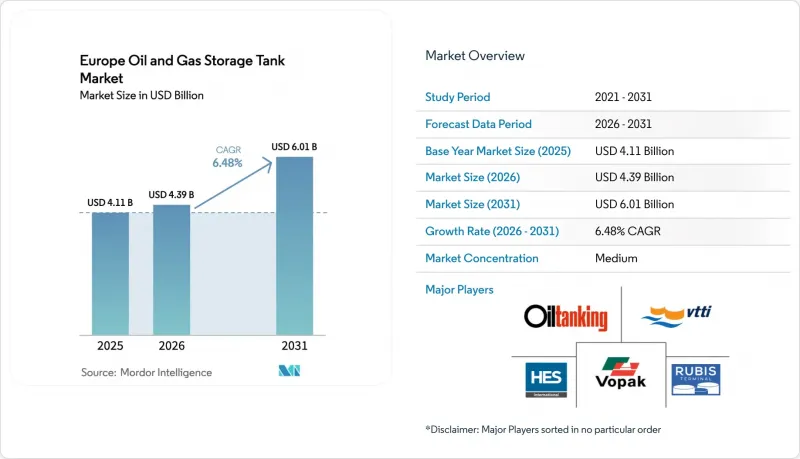
Mordor Intelligence에 의하면, 유럽의 석유 및 가스 저장 탱크 시장 규모는 2025년에 41억 1,000만 달러로 평가되었습니다. 2026년에 43억 9,000만 달러에 달하고, 2031년까지 60억 1,000만 달러에 이를 것으로 예상되며, 2026년부터 2031년에 걸쳐 CAGR 6.48%로 성장할 전망입니다.
본 보고서는 설계(플로팅 루프 탱크, 구형 탱크 등), 탱크 유형(지상 저장 탱크(AST), 지하 저장 탱크(UST), 이동식/모듈식 탱크), 재질(탄소강, FRP 등),용량 범위(5,000m³ 이하, 5만-15만m³ 등), 제품(원유, 천연가스 액체 등), 최종 사용자(정유시설·석유화학 플랜트 등), 지역(독일, 영국, 러시아 등)
유럽의 석유 및 가스 저장 탱크 시장 동향 및 인사이트
전략적 석유 비축에 대한 수요 증가
2025년 12월 시점에서 유럽연합(EU) 회원국들은 총 90일 분의 순수입량을 충당할 수 있는 비축량을 보유하고 있었으나, 현재 일부 정부는 2028년까지 120일 분을 목표로 하고 있습니다. 독일은 2025년에 320만 m3의 신규 용량을 추가하여, 주로 5만-15만m3라는 최적의 용량 범위에 해당하는 탱크를 빌헬름스하펜과 니더작센주에서 가동했습니다. 스페인은 카르타헤나·타라고나 인근 지상 탱크 건설 계약으로 1억 8,000만 유로(1억 9,500만 달러)를 발주하고, 점검 주기를 15년으로 연장하는 내식성 코팅을 지정했습니다. 프랑스의 SAGESS사는 2024년 중 180만 m3 규모의 입찰을 진행하여, 휘발유 소비량이 정체되어 있음에도 불구하고 대구경 탄소강 탱크에 대한 안정적인 수요를 입증했습니다. 이로 인해 지역 철강 제조업체의 생산 파이프라인이 안정화되었으며, 정제 제품 처리량이 정체되어 있음에도 불구하고 단위당 수익성이 향상되고 있습니다.
LNG 수입 터미널 및 극저온 탱크 확장
독일에서는 2023년부터 2025년에 걸쳐 4기의 부유식 저장 재기화 설비(FSRU)가 가동을 시작했습니다. 이 4기의 가동에 따라 총 48만 m³ 규모의 육상 영하 162°C 저장 탱크가 필요하게 되었습니다. 2025년 5월, 로테르담의 게이트 터미널에서는 EN 14620 규격에 부합하는 9% 니켈강으로 제작된 18만 m³ 규모의 탱크(제3호 탱크)가 완공되었습니다. 핀란드의 인쿠 시설에서는 2025년 9월에 5만 m³의 탄환형 탱크가 추가되었으며, 북유럽 국가들이 모듈식 방식으로 단계적인 용량 확대를 선호하는 경향을 엿볼 수 있습니다. 1m³당 1,200-1,800달러에 달하는 극저온 설비의 건설 비용은 원유에 비해 약 3배에 달하지만, 러시아산 파이프라인 가스를 대체해야 하는 전략적 필요성에 의해 정당화되고 있습니다. 이러한 LNG 수요의 급증은 천연가스 액체(NGL) 탱크 수요의 연평균 성장률(CAGR) 8.2%라는 예측의 근거가 되고 있습니다.
유럽의 석유 수요 감소
2025년, 지역 전체 수요는 1,240만 배럴/일로 감소하여 전년 대비 2.1% 감소했습니다. 이는 전기자동차 보급률이 신차 등록 대수의 22%에 달한 것이 원인입니다. 독일의 휘발유 및 디젤 소비량은 각각 3.8%, 2.9% 감소하여 정유시설의 가동률을 80% 미만으로 떨어뜨렸습니다. 갠볼(Gamvol)사는 2025년 초, 로테르담에 위치한 중류분 생산 능력 40만 m³를 중단했습니다. 그 이유로 콘탱고가 약화되어 저장 차익 거래에 따른 수익을 기대할 수 없게 된 점을 꼽고 있습니다. 원유 탱크의 용도 변경이 이루어지지 않는 한, 2030년까지 프랑스에서 약 120만 m³가 유휴화될 위험이 있습니다.
부문별 분석
2025년, 유럽의 석유 및 가스 저장 탱크 시장 매출의 35.9%를 플로팅 루프식 탱크가 차지했으며, 2031년까지 연평균 성장률(CAGR) 7.5%를 기록할 전망입니다. 2024년 EEA 지침에 따라 2027년 12월까지 리드 증기압이 10 kPa를 초과하는 액체의 경우, 내부 또는 외부의 플로팅 루프 채택이 의무화되어 약 1,800기의 고정 지붕 탱크 개조 또는 교체가 시급한 상황입니다. 로열 보팩(Royal Vopak)사는 2025년 로테르담에서 14기의 탱크를 개조하여 VOC(휘발성 유기 화합물) 배출을 연간 1,450톤 감축함과 동시에 ETS(배출권 거래 제도)에 따른 과태료를 회피했습니다. 고정 지붕식 탱크는 여전히 저휘발성 연료의 저장에 사용되고 있지만, 돔 지붕식은 핀란드의 큰 적설 하중이 가해지는 지역에 적합하며, 배럿형 탱크는 스페인의 모듈식 LNG 위성 스테이션을 지원하고 있습니다.
돔형 지붕은 5 kPa의 적설 하중을 견딜 수 있으며, 이는 -20°C에서 운영될 것으로 가정하여 설계된 네스테(Neste)사의 6만 m3 포르보(Porvoo) 바이오디젤 탱크를 통해 입증되었습니다. 일반적으로 1기당 200 m³의 용량을 가진 배럿 탱크는 분산형 LNG 수요를 뒷받침하고 있습니다. 에나가스(Enagas)는 2025년에 스페인 농촌 지역에 18기를 도입했습니다. 배출 규제 준수와 재고 효율화의 융합으로 인해, 2031년까지는 휘발성 액체 저장 분야에서 플로팅 루프가 표준적인 선택지로 자리 잡을 전망입니다.
2025년에는 건설 비용이 낮고 점검이 용이하다는 점으로 인해 지상 탱크가 시장 점유율의 70.2%를 차지하며 주류가 되었습니다. 지하 신규 탱크는 지하수 보호 규제로 인해 감소 추세를 보이고 있습니다. 네덜란드에서는 2024년부터 음용수 우물에서 100m 이내의 지하 탱크 설치가 금지되었습니다. 재난 대응 기관 및 LNG 피크 셰이빙 사업자 등이 50-1,000m³ 규모의 트레일러 탑재형 유닛을 선호함에 따라, 이동식·모듈식 탱크는 연평균 성장률(CAGR) 8.9%로 성장하고 있습니다. 독일 연방기술구호청은 2025년에 정유시설의 턴어라운드(정기 점검·수리) 용도로 24기를 구매했습니다. 핀란드의 가스그리드(GasGrid)사는 2025년 초 HOYER사로부터 500m³ 용량의 LNG 탱크 6기를 임대하여, 자본 지출을 미루면서도 공급을 확보했습니다.
지상 설치형 탱크는 연안 터미널에서 선호되는 5만-15만 m3 용량대에 적합하지만, 지하 설치형의 경우 지질 조건이 갖춰져야 하며 굴착 비용도 높아집니다. 이동성 덕분에 자산 부담이 적은 유연성이 실현되어, 사업자는 48시간 이내에 계절적 수요 피크가 발생하는 지역으로 용량을 재배치할 수 있게 됩니다.
기타 혜택 :
- 엑셀 형식 시장 예측(ME) 시트
- 3개월간의 애널리스트 지원
자주 묻는 질문
목차
제1장 서론
제2장 조사 방법
제3장 주요 요약
제4장 시장 구도
제5장 시장 규모 및 성장 예측
제6장 경쟁 구도
제7장 시장 기회 및 향후 전망
KTH 26.09.16According to Mordor Intelligence, the Europe oil and gas storage tank market size is projected to be USD 4.11 billion in 2025, USD 4.39 billion in 2026, and reach USD 6.01 billion by 2031, growing at a CAGR of 6.48% from 2026 to 2031.

This report is Segmented by Design (Floating-Roof Tanks, Spherical Tanks, and More), Tank Type (ASTs, Usts, and Mobile/Modular Tanks), Material (Carbon Steel, FRP, and More), Capacity Range (Up To 5k M3, 50 To 150k M3, and More), Product (Crude Oil, Natural Gas Liquids, and More), End-User (Refineries and Petrochemical Plants, and More), and Geography (Germany, United Kingdom, Russia, and More)
Europe Oil And Gas Storage Tank Market Trends and Insights
Rising Need for Strategic Petroleum Reserves
European Union members collectively held 90 days of net import cover in December 2025, yet several governments now target 120 days by 2028. Germany added 3.2 million m3 of new capacity in 2025, commissioning tanks in Wilhelmshaven and Lower Saxony that primarily fall in the 50,000-150,000 m3 sweet spot. Spain awarded EUR 180 million (USD 195 million) in above-ground tank contracts near Cartagena and Tarragona, specifying corrosion-resistant coatings that extend inspection intervals to 15 years. France's SAGESS tendered for 1.8 million m3 during 2024, reinforcing consistent demand for large-diameter carbon-steel tanks even as gasoline consumption plateaus. The resulting offtake stabilizes fabrication pipelines for regional steel shops and lifts per-unit profitability despite muted refined-product throughput.
Expansion of LNG Import Terminals & Cryogenic Tanks
Germany commissioned four floating storage and regasification units (FSRUs) between 2023 and 2025, which together required 480,000 m3 of onshore minus-162 °C storage. In May 2025, the Gate terminal in Rotterdam finished a third 180,000 m3 tank built from 9-percent-nickel steel that meets EN 14620. Finland's Inkoo facility added a 50,000 m3 bullet tank in September 2025, illustrating Nordic preference for modular, incremental capacity. Cryogenic construction costs of USD 1,200-1,800 per m3, roughly triple crude-oil equivalents, are nevertheless justified by the strategic imperative to displace Russian pipeline gas. This LNG surge underpins the 8.2% CAGR forecast for natural-gas-liquid tank demand.
Declining Petroleum Demand in Europe
Regional demand fell to 12.4 million b/d in 2025, shaving 2.1% year-on-year as electric-vehicle uptake hit 22% of new car registrations. Germany's gasoline and diesel consumption slipped 3.8% and 2.9%, respectively, depressing refinery utilization below 80%. Gunvor idled 400,000 m3 of middle-distillate capacity in Rotterdam early 2025, citing weak contango that no longer funds storage arbitrage. Unless crude tanks are repurposed, an estimated 1.2 million m3 will risk stranding in France by 2030.
Other drivers and restraints analyzed in the detailed report include:
- Aging Storage Infrastructure Replacement Demand
- Growth in Biofuels & Hydrogen Storage Tanks
- Stringent Environmental Regulations & Compliance Cost
For complete list of drivers and restraints, kindly check the Table Of Contents.
Segment Analysis
Floating-roof vessels accounted for 35.9% of Europe's oil & gas storage tank market revenue in 2025 and are on track for a 7.5% CAGR through 2031. The 2024 EEA directive compels internal or external floating roofs for liquids above 10 kPa Reid vapor pressure by December 2027, forcing the retrofit or replacement of roughly 1,800 fixed-roof tanks. Royal Vopak converted 14 tanks at Rotterdam in 2025, cutting VOC releases by 1,450 t/yr and avoiding ETS penalties. Fixed-roof vessels still serve low-volatility fuels, while dome-roof designs handle high snow-load sites in Finland, and bullet tanks support modular LNG satellite stations in Spain.
Dome roofs resist 5 kPa snow loads, demonstrated by Neste's 60,000 m3 Porvoo biodiesel tank engineered for -20 °C operations. Bullet tanks, typically 200 m3 each, support distributed LNG demand; Enagas deployed 18 in rural Spain during 2025. The convergence of emission compliance and inventory efficiency cements floating roofs as the default for volatile liquids through 2031.
Above-ground tanks dominated with a 70.2% market share in 2025, reflecting lower construction costs and inspection ease. Underground newbuilds decline due to groundwater-protection rules; the Netherlands banned such tanks within 100 m of drinking-water wells in 2024. Mobile and modular tanks grow at an 8.9% CAGR as disaster-response agencies and LNG peak-shaving operators favor 50-1,000 m3 trailer-mounted units. Germany's Federal Agency for Technical Relief bought 24 in 2025 for refinery turnarounds. Finland's Gasgrid leased six 500 m3 LNG tanks from HOYER in early 2025, deferring capital while securing supply.
Above-ground vessels fit the 50,000-150,000 m3 capacity band favored at coastal terminals, whereas underground options require favorable geology and face costlier excavation. Mobility offers asset-light flexibility, enabling operators to redeploy capacity within 48 hours to seasonal hotspots.
Complete Report Scope:
- By Design
- Fixed-Roof Tanks
- Floating-Roof Tanks
- Dome-Roof Tanks
- Spherical Tanks
- Bullet Tanks and Others
- By Tank Type
- Aboveground Storage Tanks (ASTs)
- Underground Storage Tanks (USTs)
- Mobile/Modular Tanks
- By Material
- Carbon Steel
- Stainless Steel
- Fiberglass-Reinforced Plastic (FRP)
- Concrete
- Others
- By Capacity Range
- Up to 5k m3
- 5 to 50k m3
- 50 to 150k m3
- Above 150k m3
- By Product
- Crude Oil
- Refined Petroleum Products
- Natural Gas Liquids (e.g., LPG, LNG)
- Aviation Fuel and Middle Distillates
- Specialty Hydrocarbons/Petrochemicals
- By End-User
- Oil and Gas Producers
- Refineries and Petrochemical Plants
- Traders and Distributors
- Strategic Petroleum Reserve Agencies (SPRs)
- Logistics/Transportation companies
- By Geography
- Germany
- United Kingdom
- France
- Italy
- Spain
- NORDIC Countries
- Russia
- Rest of Europe
List of Companies Covered in this Report:
- Royal Vopak NV
- Oiltanking GmbH
- HOYER GmbH
- Vitol Tank Terminals International BV (VTTI)
- Eisenbau Heilbronn GmbH
- Lapesa Grupo Empresarial SL
- GLS Tanks International GmbH
- ROSEN Group
- Dyer Gas GmbH
- Virtor Oy
- HES International BV
- Odfjell SE (Terminals)
- Rubis Terminal
- Navigator Terminals
- Gunvor Petroleum Rotterdam BV
- LBC Tank Terminals
- PetroIneos
- Alkion Terminals
- Decal Spain
- TotalEnergies Raffinerie Mitteldeutschland GmbH
Additional Benefits:
- The market estimate (ME) sheet in Excel format
- 3 months of analyst support
TABLE OF CONTENTS
1 Introduction
- 1.1 Study Assumptions & Market Definition
- 1.2 Scope of the Study
2 Research Methodology
3 Executive Summary
4 Market Landscape
- 4.1 Market Overview
- 4.2 Market Drivers
- 4.2.1 Rising need for strategic petroleum reserves
- 4.2.2 Expansion of LNG import terminals & cryogenic tanks
- 4.2.3 Aging storage infrastructure replacement demand
- 4.2.4 Growth in biofuels & hydrogen storage tanks
- 4.2.5 Repurposing decommissioned tanks for CCS storage
- 4.2.6 Digital-twin-driven predictive maintenance retrofits
- 4.3 Market Restraints
- 4.3.1 Declining petroleum demand in Europe
- 4.3.2 Stringent environmental regulations & compliance cost
- 4.3.3 Community opposition & permitting delays
- 4.4 Supply-Chain Analysis
- 4.5 Regulatory Landscape
- 4.6 Technological Outlook
- 4.7 Porter's Five Forces
- 4.7.1 Bargaining Power of Suppliers
- 4.7.2 Bargaining Power of Buyers
- 4.7.3 Threat of New Entrants
- 4.7.4 Threat of Substitutes
- 4.7.5 Intensity of Competitive Rivalry
5 Market Size & Growth Forecasts
- 5.1 By Design
- 5.1.1 Fixed-Roof Tanks
- 5.1.2 Floating-Roof Tanks
- 5.1.3 Dome-Roof Tanks
- 5.1.4 Spherical Tanks
- 5.1.5 Bullet Tanks and Others
- 5.2 By Tank Type
- 5.2.1 Aboveground Storage Tanks (ASTs)
- 5.2.2 Underground Storage Tanks (USTs)
- 5.2.3 Mobile/Modular Tanks
- 5.3 By Material
- 5.3.1 Carbon Steel
- 5.3.2 Stainless Steel
- 5.3.3 Fiberglass-Reinforced Plastic (FRP)
- 5.3.4 Concrete
- 5.3.5 Others
- 5.4 By Capacity Range
- 5.4.1 Up to 5k m3
- 5.4.2 5 to 50k m3
- 5.4.3 50 to 150k m3
- 5.4.4 Above 150k m3
- 5.5 By Product
- 5.5.1 Crude Oil
- 5.5.2 Refined Petroleum Products
- 5.5.3 Natural Gas Liquids (e.g., LPG, LNG)
- 5.5.4 Aviation Fuel and Middle Distillates
- 5.5.5 Specialty Hydrocarbons/Petrochemicals
- 5.6 By End-User
- 5.6.1 Oil and Gas Producers
- 5.6.2 Refineries and Petrochemical Plants
- 5.6.3 Traders and Distributors
- 5.6.4 Strategic Petroleum Reserve Agencies (SPRs)
- 5.6.5 Logistics/Transportation companies
- 5.7 By Geography
- 5.7.1 Germany
- 5.7.2 United Kingdom
- 5.7.3 France
- 5.7.4 Italy
- 5.7.5 Spain
- 5.7.6 NORDIC Countries
- 5.7.7 Russia
- 5.7.8 Rest of Europe
6 Competitive Landscape
- 6.1 Market Concentration
- 6.2 Strategic Moves (M&A, Partnerships, PPAs)
- 6.3 Market Share Analysis (Market Rank/Share for key companies)
- 6.4 Company Profiles (includes Global level Overview, Market level overview, Core Segments, Financials as available, Strategic Information, Products & Services, and Recent Developments)
- 6.4.1 Royal Vopak NV
- 6.4.2 Oiltanking GmbH
- 6.4.3 HOYER GmbH
- 6.4.4 Vitol Tank Terminals International BV (VTTI)
- 6.4.5 Eisenbau Heilbronn GmbH
- 6.4.6 Lapesa Grupo Empresarial SL
- 6.4.7 GLS Tanks International GmbH
- 6.4.8 ROSEN Group
- 6.4.9 Dyer Gas GmbH
- 6.4.10 Virtor Oy
- 6.4.11 HES International BV
- 6.4.12 Odfjell SE (Terminals)
- 6.4.13 Rubis Terminal
- 6.4.14 Navigator Terminals
- 6.4.15 Gunvor Petroleum Rotterdam BV
- 6.4.16 LBC Tank Terminals
- 6.4.17 PetroIneos
- 6.4.18 Alkion Terminals
- 6.4.19 Decal Spain
- 6.4.20 TotalEnergies Raffinerie Mitteldeutschland GmbH
7 Market Opportunities & Future Outlook
- 7.1 White-space & Unmet-Need Assessment


