

|
시장보고서
상품코드
2154253
모듈러 트레일러 : 시장 점유율 분석, 업계 동향과 통계, 성장 예측(2026-2031년)Modular Trailer - Market Share Analysis, Industry Trends & Statistics, Growth Forecasts (2026 - 2031) |
||||||
 Mordor Intelligence
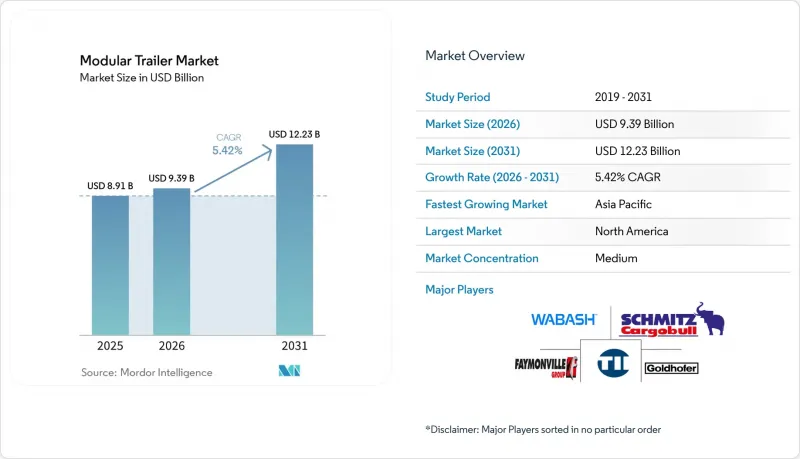
에 따르면 모듈러식 트레일러 시장 규모는 2025년 89억 1,000만 달러에서 2026년에는 93억 9,000만 달러로 확대하며, 2031년까지 122억 3,000만 달러에 달할 것으로 예상되고 있으며, 2026-2031년에 CAGR 5.42%로 성장할 것으로 전망되고 있습니다.
글로벌 모듈식 트레일러 시장의 동향 및 인사이트
풍력발전용 블레이드의 물류 분야로의 전환이 신축식 모듈형 트레일러 수요를 견인
현대 풍력 터빈 블레이드는 길이가 80미터를 넘고, 전체 조립체의 무게는 700톤을 초과하므로 이러한 블레이드를 운송하기 위한 요건이 트레일러의 설계 사양을 근본적으로 변화시키고 있습니다. 뉴질랜드의 사우스랜드 풍력발전단지와 호주의 골든 플레인즈 풍력발전단지의 사례에서 볼 수 있듯이, 인프라 제약을 피하기 위해 여러 차례의 육안 검사 및 스윕 패스 분석이 필요한 프로젝트가 늘어남에 따라 경로 계획의 복잡성도 증가하고 있습니다. 북미에서는 2025년에 8.2GW의 풍력발전 용량이 도입되어 전년 대비 49% 증가했습니다. 2026년에는 11 GW, 2030년까지 48 GW가 도입될 것으로 예상되어, 운송 장비의 지속적인 갱신 주기가 형성되고 있습니다. 이에 대응하기 위해 각 제조사는 초대형 부품 운송시 구조적 무결성을 확보하면서도 기존의 길이 제한 한계를 넓히는 모듈식 시스템을 개발하고 있습니다. 풍력 블레이드 운송에 수반되는 복잡한 물류는 소규모 제조업체에게 과제가 되고 있으며, 그 결과 엔지니어링 전문 지식을 갖춘 전문 중량물 운송업체에 의한 시장 점유율 집중이 진행되고 있습니다.
동남아시아의 메가 인프라 회랑 프로젝트의 성장
동남아시아의 인프라 변혁을 위해서는 2030년까지 26조 달러가 넘는 운송 투자가 필요할 것으로 예상되며, 화물 운송 수요는 2015-2030년 사이에 80% 가까이 증가할 것으로 전망됩니다. 방콕, 프놈펜, 호치민시를 연결하는 ‘남부 경제 회랑’은 국경을 초월한 무역을 촉진하고 물류 인프라에 대한 민간 투자를 장려함으로써 이 지역의 진화하는 경제 상황을 상징하고 있습니다. 태국의 야심 찬 ‘랜드브리지’ 프로젝트는 약 90킬로미터에 걸쳐 라농의 안다만해에서 촘폰의 태국만까지 매끄럽게 연결하고 있습니다. 이 광대한 회랑에는 2개의 심해항구 외에도 철도와 고속도로가 통합된 인프라가 구축되어 있습니다. 총 사업비는 약 9,970억 바트(280억-360억 달러 상당)로 추정되며, 이 프로젝트는 동남아시아에서 가장 웅장한 인프라 사업 중 하나입니다. 또한 해당 지역에서는 경제특구 개발과 통관 절차 간소화에 주력하고 있으며, 이에 따라 컨테이너 섀시 및 인터모달 트레일러에 대한 수요가 더욱 증가하고 있습니다.
철강 가격 변동이 지역내 소규모 제조업체에 부담을 주고 있습니다.
지역의 중소 제조업체들은 대형 OEM 제조사와 달리 헤지 능력이 제한적이고, 철강 공급업체에 대한 협상력도 약해 어려움을 겪고 있습니다. 철강 및 알루미늄 수입 관세가 계속해서 비용 압박을 가중시키고 있으며, 이러한 격차는 더욱 두드러지고 있습니다. 이에 대응하기 위해 일부 제조업체는 공급망 혼란에 대비하여 공급업체 다각화 전략이나 생산의 국내 복귀(리쇼어링) 조치를 채택하고 있습니다. 관세 시행이 2025년 4월까지 연기되면서 일시적인 완화는 얻었지만, 생산 계획 및 가격 전략에 대한 불확실성은 여전히 남아 있습니다. 시장 점유율의 70.95%를 차지하는 탄소강을 고려할 때, 특히 대체 재료 선택지가 적은 중소 제조업체를 중심으로 업계 전반의 가격 민감도가 높아지고 있음이 분명합니다. 이러한 과제에 대처하기 위해 각 제조업체는 재고 관리 프로세스의 최적화와 전략적 공급업체와의 파트너십 구축에 힘쓰고 있습니다. 그러나 시장 변동이 심한 시기에는 이익률 압박을 피할 수 없는 실정입니다.
부문별 분석
2025년, 플랫베드 트레일러는 시장 점유율의 39.05%를 차지하고 있으며, 일반 화물 운송에서의 적응성과 공급망 내에서의 확고한 통합이 두드러지고 있습니다. 한편, 로우보이형 트레일러는 인상적인 성장을 달성하고 있으며, 2031년까지의 연평균 성장률(CAGR)은 8.20%로 예측됩니다. 이러한 성장은 풍력발전 물류 및 중장비 운송에 대한 수요 증가에 의해 주도되고 있으며, 이 두 분야 모두 특수한 적재 능력을 필요로 합니다. 플랫베드 트레일러는 건설 및 인프라 프로젝트에서 계속해서 중요한 역할을 수행하고 있으며, 아시아태평양의 26조 달러 규모 인프라 투자 계획으로부터 큰 혜택을 받고 있습니다. 드롭 데크 및 스텝 데크 사양은 높이 제약이 있는 화물의 요구 사항을 효과적으로 충족시키면서, 산업용 장비 운송시 적재 효율을 유지하고 있습니다.
컨테이너 섀시 수요는 해상 무역량과 밀접한 관련이 있으며, 특히 동남아시아의 화물 운송량은 2031년까지 80% 증가할 것으로 예상됩니다. 탱크 트레일러는 석유 및 가스 부문의 호황으로 인해 계속해서 혜택을 보고 있지만, 전 세계적인 에너지 전환에 따른 압박으로 인해 그 성장세는 둔화되고 있습니다. ZF의 ‘TrailTrax’ 전동화 시스템은 여러 부문에 걸쳐 적용 가능성을 입증했으며, 디젤 차량에서는 16%의 에너지 절감을, 플러그인 충전 방식에서는 40%의 개선을 달성했습니다. 이 부문의 진화는 전문화 추세를 반영하고 있으며, 제조사들은 범용적인 접근 방식을 채택하기보다는 용도에 특화된 솔루션 개발에 점점 더 집중하고 있습니다.
2025년에는 탠덤 액슬 구성이 시장 점유율의 46.28%라는 큰 비중을 차지하며, 다양한 도로 상황에서 표준 화물 운송에 있으며, 최적의 중량 배분과 기동성 향상을 보장하고 있습니다. 쿼드 액슬 및 그 이상의 구성은 7.55%라는 눈에 띄는 연평균 성장률(CAGR)을 기록하고 있으며, 이는 초중량 화물 운송 및 풍력 터빈 부품 배송에 대한 수요 증가에 힘입은 결과입니다. 이 모든 경우 최적의 하중 분배가 요구됩니다. 단축 시스템은 주로 경량 용도나 도시 지역내 배송에 사용되는 반면, 트라이뎀 구성은 특수 산업 운송 분야에서 적재 능력의 격차를 효과적으로 해소하고 있습니다.
화물의 중량화가 진행되는 가운데, 첨단 차축 기술의 도입이 가속화되고 있습니다. 2024년, 슈미츠 카고불(Schmitz Cargobull)사는 효율 향상을 위해 완전 자동화된 제조 공정을 도입하는 동시에, 차축 생산 대수 200만 대라는 이정표를 달성했습니다. 텔레매틱스 통합이 진행되는 것을 배경으로, 발전 기능이 탑재된 차축의 채택이 탄력을 받고 있으며, 이를 통해 스마트 트레일러의 기능과 예측 유지보수가 강화되고 있습니다. 규제 준수는 여전히 중요한 요소이며, EU의 CO₂ 배출 기준에 따라 제조사는 중량 배분과 공기역학적 효율의 균형을 맞추면서 차축 구성을 최적화해야 합니다. 또한 다축 시스템은 모듈식 설계의 유연성을 제공하여, 사업자는 특정 화물 요건이나 노선상의 제약에 맞춰 트레일러를 구성할 수 있게 됩니다.
지역별 분석
2025년에는 북미가 32.05%의 시장 점유율을 차지할 것으로 예측되며, 이는 해당 지역의 잘 정비된 중량물 운송 인프라와 주 경계를 넘는 초대형 화물 운송을 촉진하는 확립된 규제 체계를 반영한 것입니다. 미국은 8만 명 이상의 운전기사 부족이라는 중대한 과제에 직면해 있으며, 이 수치는 2031년까지 두 배로 증가할 것으로 예상됩니다. 이러한 상황으로 인해 자율주행 트럭 개발이 가속화되고 있으며, 2035년까지 도입률은 13%에 달할 것으로 예측됩니다. 화물 운송의 병목 현상으로 인해 연간 약 2억 4,300만 트럭시간의 지연이 발생하고 있으며, 이로 인한 비용은 약 78억 달러에 달하는 것으로 추정되어 인프라 확충을 위한 노력이 촉진되고 있습니다. 캐나다에서는 특수한 운송 솔루션이 필요한 자원 채굴 활동이 시장을 주도하고 있는 반면, 멕시코에서는 제조업의 확장이 트레일러 수요 증가를 지원하고 있습니다.
아시아태평양은 2031년까지 연평균 성장률(CAGR)이 7.80%에 달할 것으로 예측되며, 가장 빠르게 성장하는 지역으로 부상하고 있습니다. 이러한 성장은 2030년까지 26조 달러 이상의 운송 투자가 필요한 동남아시아의 눈부신 인프라 개발에 의해 주도되고 있습니다. 2015-2030년에 화물 운송 수요는 80% 가까이 증가할 것으로 예상됩니다. 해상 운송이 주류를 이루며 화물 톤킬로미터의 90%를 차지할 것으로 전망되는데, 이로 인해 항만에서 내륙으로의 운송 기회가 창출되고 있습니다. 방콕, 프놈펜, 호치민시를 연결하는 ‘남부 경제 회랑’은 국경을 넘는 무역과 물류 인프라 구축을 촉진하고 있습니다. 중국 제조업의 우위와 인도의 인프라 개발이 맞물려 트레일러에 대한 수요를 크게 끌어올리고 있습니다. 또한 인도네시아와 기타 아세안(ASEAN) 국가들도 지역 간 연결성 향상으로 인한 혜택을 누리고 있습니다.
유럽은 엄격한 CO₂ 배출 규제에 대응해 나가면서도 시장에서 여전히 중요한 입지를 유지하고 있습니다. 2030년까지 규제에 따라 드로버 트레일러의 배출량을 7.5%, 세미트레일러의 배출량을 10% 감축해야 합니다. 남미 및 중동 및 아프리카에서는 인프라 격차와 허가 취득의 병목 현상으로 인해 성장 속도가 둔화되고 있지만, 틈새 시장에서의 비즈니스 기회가 점차 생겨나고 있습니다. 남미에서는 브라질의 풍력발전 프로젝트와 멕시코의 니어쇼어링 주도 건설 사업이 주요 성장 요인으로 작용하고 있습니다.
기타 혜택:
- 엑셀 형식의 시장 예측(ME) 시트
- 3개월간의 애널리스트 지원
자주 묻는 질문
목차
제1장 서론
- 조사 전제조건과 시장 정의
- 조사 범위
제2장 조사 방법
제3장 개요
제4장 시장 구도
- 시장 개요
- 시장 성장 촉진요인
- 시장 성장 억제요인
- 밸류·공급망 분석
- 규제 상황
- 기술 전망
- Porter's Five Forces
제5장 시장 규모와 성장 예측
- 트레일러 유형별
- 차축 구성별
- 소재별
- 길이별
- 최종사용자 산업별
- 지역별
- 북미
- 미국
- 캐나다
- 기타 북미 국가
- 남미
- 브라질
- 멕시코
- 기타 남미 국가
- 유럽
- 독일
- 영국
- 프랑스
- 이탈리아
- 스페인
- 러시아
- 기타 유럽 국가
- 아시아태평양
- 중국
- 인도
- 일본
- 한국
- 인도네시아
- 기타 아시아태평양 국가
- 중동 및 아프리카
- 아랍에미리트
- 사우디아라비아
- 튀르키예
- 이집트
- 남아프리카공화국
- 기타 중동 및 아프리카 국가
- 북미
제6장 경쟁 구도
- 시장 집중도
- 전략적 동향
- 시장 점유율 분석
- 기업 개요
- Schmitz Cargobull
- Krone
- CIMC Vehicles
- Wielton
- Goldhofer
- Broshuis
- Kassbohrer
- Pacton
- Nooteboom
- Unitrailer
- Fliegl Fahrzeugbau
- Chereau
- Faymonville
- Scheuerle(TII Group)
- Wabash National Corporation
- Great Dane
- Kogel Trailer
- Hyundai Translead
- Tiger Trailers
- Schwarzmuller
제7장 시장 기회와 향후 전망
KSA 26.10.23According to Mordor Intelligence, the modular trailer market size is expected to increase from USD 8.91 billion in 2025 to USD 9.39 billion in 2026 and reach USD 12.23 billion by 2031, growing at a CAGR of 5.42% over 2026-2031.
Global Modular Trailer Market Trends and Insights
Shift to Wind-Blade Logistics Driving Extendable Modular Trailers
As modern wind turbine blades stretch beyond 80 meters and entire assemblies tip the scales at over 700 tons, the demands of transporting these blades are fundamentally reshaping trailer design specifications. Route planning complexity intensifies with each project that requires multiple visual inspections and swept-path analyses to navigate infrastructure constraints, as demonstrated by the Southland Wind Farm in New Zealand and the Golden Plains Wind Farm in Australia . North America installed 8.2 GW of wind capacity in 2025, up 49% year-over-year, with 11 GW expected in 2026 and 48 GW scheduled through 2030, creating a sustained replacement cycle for transport equipment. In response, manufacturers are crafting modular systems that push the boundaries of traditional length limits, all while ensuring structural integrity for the delivery of oversized components. The intricate logistics of wind blade transportation pose challenges for smaller fabricators, leading to a consolidation of market share among specialized heavy-haul providers equipped with engineering expertise.
Growth of South-East Asian Mega-Infrastructure Corridor Projects
Southeast Asia's infrastructure transformation requires over USD 26 trillion in transport investments through 2030, with freight transport demand projected to increase nearly 80% between 2015 and 2030. Connecting Bangkok, Phnom Penh, and Ho Chi Minh City, the Southern Economic Corridor exemplifies the region's evolving economic landscape by facilitating cross-border trade and encouraging private sector investment in logistics infrastructure. Thailand's ambitious Land Bridge project spans approximately 90 kilometers, seamlessly connecting the Andaman Sea at Ranong to the Gulf of Thailand at Chumphon. This extensive corridor boasts dual deep-sea ports, alongside integrated rail and highway infrastructure. With an estimated price tag of around THB 997 billion (equivalent to USD 28-36 billion), the project stands as one of Southeast Asia's most monumental infrastructure undertakings. Additionally, the region's focus on developing special economic zones and implementing simplified customs procedures is further increasing demand for container chassis and intermodal trailer configurations.
Volatile Steel Prices Squeezing Small Regional Fabricators
Small regional fabricators, unlike their larger OEM counterparts, face challenges due to their limited hedging capabilities and reduced negotiating power with steel suppliers. This disparity becomes more significant as tariffs on steel and aluminum imports continue to exert cost pressures. In response, some manufacturers are adopting supplier diversification strategies and reshoring initiatives to address potential supply chain disruptions. Although the delay in tariff implementation until April 2025 provides temporary relief, it perpetuates uncertainty regarding production planning and pricing strategies. With carbon steel accounting for 70.95% of the market, the industry's heightened price sensitivity is evident, particularly for smaller players with fewer material alternatives. To address these challenges, manufacturers are optimizing inventory management processes and establishing strategic supplier partnerships. However, margin compression remains an unavoidable outcome during periods of market volatility.
Other drivers and restraints analyzed in the detailed report include:
- OEM Pivot to Lightweight Aluminum-Steel Hybrid Chassis
- Tightening EU CO2 Trailer Compliance Rules (EU 2019/1242)
- Shortage of Certified Heavy-Haul Drivers Globally
For complete list of drivers and restraints, kindly check the Table Of Contents.
Segment Analysis
In 2025, flatbed trailers accounted for a 39.05% share of the market, highlighting their adaptability in general freight applications and their established integration within supply chains. At the same time, low-boy configurations are experiencing significant growth, with a 8.20% CAGR projected through 2031. This growth is driven by the increasing demand for wind energy logistics and the transportation of heavy machinery, both of which require specialized loading capabilities. Flatbed trailers continue to play a critical role in construction and infrastructure projects, benefiting significantly from the Asia-Pacific's USD 26 trillion infrastructure investment pipeline. Drop-deck and step-deck configurations effectively meet the requirements of height-sensitive cargo while maintaining payload efficiency for transporting industrial equipment.
The demand for container chassis is closely aligned with maritime trade volumes, particularly as freight transport in Southeast Asia is expected to grow by 80% through 2031. Tanker trailers continue to benefit from activity in the oil and gas sector; however, their growth is moderating due to pressures associated with the global energy transition. ZF's TrailTrax electrification system demonstrates its applicability across multiple segments, achieving 16% energy savings in diesel applications and a 40% improvement with plug-in charging. The evolution of this segment reflects a trend toward specialization, with manufacturers increasingly focusing on developing purpose-built solutions rather than adopting generalized approaches.
In 2025, tandem axle configurations account for a significant 46.28% market share, ensuring optimal weight distribution and improved maneuverability for standard freight operations across various road conditions. Quad and larger configurations are experiencing a notable 7.55% CAGR, driven by increasing demand for super-heavy cargo transport and the delivery of wind turbine components, both of which require optimal load distribution. Single-axle systems are primarily used for lighter applications and urban deliveries, while tridem configurations effectively address capacity gaps in specialized industrial transport.
The increasing shift toward heavier cargo loads is driving the adoption of advanced axle technologies. In 2024, Schmitz Cargobull achieved the production milestone of its 2,000,000th axle while implementing fully automated manufacturing processes to enhance efficiency. The adoption of electric generator axles is gaining momentum, supported by the growing integration of telematics, which enhances smart-trailer capabilities and predictive maintenance. Regulatory compliance remains a critical factor, with EU CO2 standards compelling manufacturers to optimize axle configurations by balancing weight distribution with aerodynamic efficiency. Furthermore, multi-axle systems offer modular design flexibility, allowing operators to configure trailers to meet specific cargo requirements and route constraints.
Complete Report Scope:
- By Trailer Type
- Flatbed
- Drop-deck
- Step-deck
- Low-boy
- Tanker
- Container Chassis
- By Axle Configuration
- Single
- Tandem
- Tridem
- Quad and Above
- By Material
- Carbon-steel
- Aluminium
- Hybrid Aluminium-Steel
- By Length
- Less than 48 ft
- 48 to 53 ft
- 53 to 60 ft
- More than 60 ft
- By End-user Industry
- Construction and Infrastructure
- Wind-Energy
- Oil and Gas
- Mining and Metals
- Defense and Aerospace
- By Geography
- North America
- United States
- Canada
- Rest of North America
- South America
- Brazil
- Mexico
- Rest of South America
- Europe
- Germany
- United Kingdom
- France
- Italy
- Spain
- Russia
- Rest of Europe
- Asia-Pacific
- China
- India
- Japan
- South Korea
- Indonesia
- Rest of Asia-Pacific
- Middle-East and Africa
- United Arab Emirates
- Saudi Arabia
- Turkey
- Egypt
- South Africa
- Rest of Middle-East and Africa
- North America
Geography Analysis
In 2025, North America is projected to hold a 32.05% market share, highlighting the region's well-developed heavy-haul infrastructure and established regulatory frameworks that facilitate the transportation of oversized cargo across state boundaries. The United States is facing a significant challenge: a driver shortage exceeding 80,000, a figure expected to double by 2031. This situation is accelerating the development of autonomous trucking, with adoption rates anticipated to reach 13% by 2035. Freight bottlenecks result in approximately 243 million truck-hours of delays annually, leading to an estimated USD 7.8 billion in costs and spurring efforts to improve infrastructure. Canada benefits from resource extraction activities that require specialized transport solutions, while the expansion of Mexico's manufacturing sector supports the growth in trailer demand.
Asia-Pacific is emerging as the fastest-growing region, with a 7.80% CAGR projected through 2031. This growth is driven by Southeast Asia's significant infrastructure development, which requires over USD 26 trillion in transport investments by 2030. Freight transport demand is expected to increase by nearly 80% between 2015 and 2030. Maritime shipping is anticipated to dominate, accounting for 90% of freight tonne-kilometers, thereby creating opportunities for port-to-inland transport. The Southern Economic Corridor, which connects Bangkok, Phnom Penh, and Ho Chi Minh City, is facilitating cross-border trade and the development of logistics infrastructure. China's manufacturing dominance, combined with India's infrastructure development, is driving substantial demand for trailers. Additionally, Indonesia and other ASEAN nations are benefiting from improvements in regional connectivity.
Europe maintains a significant market presence while addressing stringent CO2 compliance requirements. By 2030, regulations mandate a 7.5% reduction in emissions for drawbar trailers and a 10% reduction for semi-trailers. South America and the Middle East-Africa regions exhibit slower growth, constrained by infrastructure gaps and permit bottlenecks, yet niche opportunities are emerging. Brazil's wind-energy pipeline and Mexico's nearshoring-driven construction are the primary drivers in South America.
- Schmitz Cargobull
- Krone
- CIMC Vehicles
- Wielton
- Goldhofer
- Broshuis
- Kassbohrer
- Pacton
- Nooteboom
- Unitrailer
- Fliegl Fahrzeugbau
- Chereau
- Faymonville
- Scheuerle (TII Group)
- Wabash National Corporation
- Great Dane
- Kogel Trailer
- Hyundai Translead
- Tiger Trailers
- Schwarzmuller
Additional Benefits:
- The market estimate (ME) sheet in Excel format
- 3 months of analyst support
TABLE OF CONTENTS
1 Introduction
- 1.1 Study Assumptions and Market Definition
- 1.2 Scope of the Study
2 Research Methodology
3 Executive Summary
4 Market Landscape
- 4.1 Market Overview
- 4.2 Market Drivers
- 4.2.1 Shift to wind-blade logistics driving extendable modular trailers
- 4.2.2 Growth of South-East Asian mega-infrastructure corridor projects
- 4.2.3 OEM pivot to lightweight aluminium-steel hybrid chassis
- 4.2.4 Tightening EU CO2 trailer compliance rules (EU 2019/1242)
- 4.2.5 Smart-sensor telematics lowering TCO for heavy-haul fleets
- 4.2.6 Rare-earth-free e-axle modules enabling self-propelled growth
- 4.3 Market Restraints
- 4.3.1 Volatile steel prices squeezing small regional fabricators
- 4.3.2 Shortage of certified heavy-haul drivers globally
- 4.3.3 Port bottlenecks delaying oversized-cargo permits
- 4.3.4 Slow homologation of autonomous trailer control systems
- 4.4 Value/Supply-Chain Analysis
- 4.5 Regulatory Landscape
- 4.6 Technological Outlook
- 4.7 Porter's Five Forces
- 4.7.1 Bargaining Power of Suppliers
- 4.7.2 Bargaining Power of Buyers
- 4.7.3 Threat of New Entrants
- 4.7.4 Threat of Substitutes
- 4.7.5 Intensity of Rivalry
5 Market Size and Growth Forecasts (Value (USD))
- 5.1 By Trailer Type
- 5.1.1 Flatbed
- 5.1.2 Drop-deck
- 5.1.3 Step-deck
- 5.1.4 Low-boy
- 5.1.5 Tanker
- 5.1.6 Container Chassis
- 5.2 By Axle Configuration
- 5.2.1 Single
- 5.2.2 Tandem
- 5.2.3 Tridem
- 5.2.4 Quad and Above
- 5.3 By Material
- 5.3.1 Carbon-steel
- 5.3.2 Aluminium
- 5.3.3 Hybrid Aluminium-Steel
- 5.4 By Length
- 5.4.1 Less than 48 ft
- 5.4.2 48 to 53 ft
- 5.4.3 53 to 60 ft
- 5.4.4 More than 60 ft
- 5.5 By End-user Industry
- 5.5.1 Construction and Infrastructure
- 5.5.2 Wind-Energy
- 5.5.3 Oil and Gas
- 5.5.4 Mining and Metals
- 5.5.5 Defense and Aerospace
- 5.6 By Geography
- 5.6.1 North America
- 5.6.1.1 United States
- 5.6.1.2 Canada
- 5.6.1.3 Rest of North America
- 5.6.2 South America
- 5.6.2.1 Brazil
- 5.6.2.2 Mexico
- 5.6.2.3 Rest of South America
- 5.6.3 Europe
- 5.6.3.1 Germany
- 5.6.3.2 United Kingdom
- 5.6.3.3 France
- 5.6.3.4 Italy
- 5.6.3.5 Spain
- 5.6.3.6 Russia
- 5.6.3.7 Rest of Europe
- 5.6.4 Asia-Pacific
- 5.6.4.1 China
- 5.6.4.2 India
- 5.6.4.3 Japan
- 5.6.4.4 South Korea
- 5.6.4.5 Indonesia
- 5.6.4.6 Rest of Asia-Pacific
- 5.6.5 Middle-East and Africa
- 5.6.5.1 United Arab Emirates
- 5.6.5.2 Saudi Arabia
- 5.6.5.3 Turkey
- 5.6.5.4 Egypt
- 5.6.5.5 South Africa
- 5.6.5.6 Rest of Middle-East and Africa
- 5.6.1 North America
6 Competitive Landscape
- 6.1 Market Concentration
- 6.2 Strategic Moves
- 6.3 Market Share Analysis
- 6.4 Company Profiles (Includes Global level Overview, Market level overview, Core Segments, Financials as available, Strategic Information, Market Rank/Share for key companies, Products and Services, and Recent Developments)
- 6.4.1 Schmitz Cargobull
- 6.4.2 Krone
- 6.4.3 CIMC Vehicles
- 6.4.4 Wielton
- 6.4.5 Goldhofer
- 6.4.6 Broshuis
- 6.4.7 Kassbohrer
- 6.4.8 Pacton
- 6.4.9 Nooteboom
- 6.4.10 Unitrailer
- 6.4.11 Fliegl Fahrzeugbau
- 6.4.12 Chereau
- 6.4.13 Faymonville
- 6.4.14 Scheuerle (TII Group)
- 6.4.15 Wabash National Corporation
- 6.4.16 Great Dane
- 6.4.17 Kogel Trailer
- 6.4.18 Hyundai Translead
- 6.4.19 Tiger Trailers
- 6.4.20 Schwarzmuller
7 Market Opportunities and Future Outlook
- 7.1 White-space and Unmet-need Assessment


