

|
시장보고서
상품코드
2154254
자동차용 크롬 피니싱 : 시장 점유율 분석, 업계 동향과 통계, 성장 예측(2026-2031년)Automotive Chromium Finishing - Market Share Analysis, Industry Trends & Statistics, Growth Forecasts (2026 - 2031) |
||||||
 Mordor Intelligence
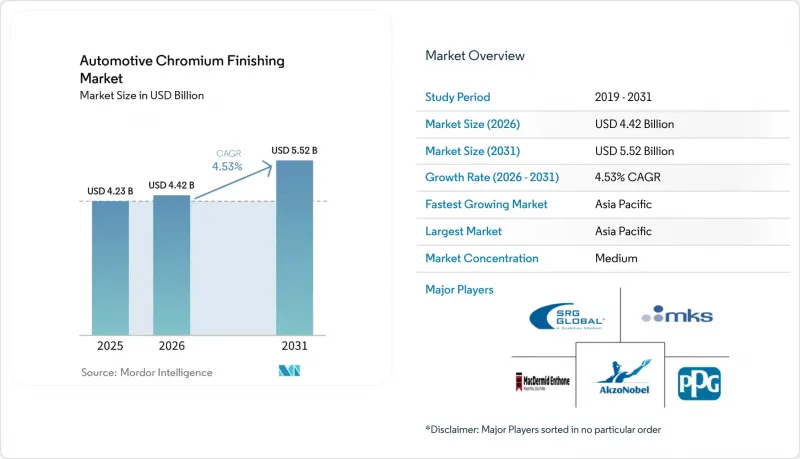
에 따르면 자동차용 크롬 피니싱 시장 규모는 2025년에 42억 3,000만 달러로 평가되며, 2026년 44억 2,000만 달러에서 2031년까지 55억 2,000만 달러에 달할 것으로 추정되고 있으며, 예측 기간(2026-2031년)에 CAGR은 4.53%에 달할 전망입니다.
전 세계 자동차용 크롬 피니싱 시장의 동향 및 인사이트
프리미엄 등급 외관 미관에 대한 수요 급증
크롬 도금은 자동차의 이미지를 지속적으로 향상시키며, 자동차 제조사가 프리미엄 가격 책정을 정당화하는 데 일조하고 있습니다. 고급차 브랜드는 깊은 반사성을 유지하면서 금속 사용량을 줄이는 다층 3가 크롬 도금을 지정하고 있으며, 대중차 제조사들도 그릴이나 윈도우 서라운드에 부분적인 크롬 도금을 적용하여 지각 가치(perceived value)를 높이고 있습니다. 마그나 인터내셔널의 ‘차체 외장 및 구조’ 부문은 2024년에 170억 달러의 매출을 기록했으며, 프로그램 수명 주기 종료에 따른 역풍에도 불구하고 조정 후 EBIT 마진을 7.5%로 유지했습니다. 이는 Tier 1 공급업체 전반에 걸쳐 외장 마감 서비스에 대한 수요가 지속되고 있음을 지원합니다. 팬데믹 이후 구매 경향이 고급 모델로 쏠리면서, 규제 당국이 기존 전해액의 사용을 제한했음에도 불구하고 차량당 크롬 사용량은 증가했습니다. Huf Group의 ‘Signocrom’과 같은 레이저 강화 처리를 통해 크롬 층 내에서 브랜드 고유의 색조를 구현할 수 있게 되었으며, 이는 혁신이 파괴적이기보다는 점진적임을 보여줍니다. 따라서 이 분야가 기술적 변혁을 겪고 있음에도 불구하고 견고한 외관에 대한 수요가 판매량의 안정성을 지원하고 있습니다.
3가 크롬 및 PVD에 관한 OEM 의무화(PFAS 무함유 인테리어)
캘리포니아주의 개정된 ‘대기 유해 물질 규제 조치(ATCM)’에 따르면 2024년 이후 6가 크롬의 신규 허가가 중단되며, 장식 가공 업체에 대해 2030년까지 3가 크롬으로의 전환이 의무화되었습니다. EU는 연간 배출량을 17톤 감축하는 것을 목표로 한 규제안을 공표했으며, 주요 자동차 그룹들은 2025-2027년 사이에 사내 전환 기한을 설정하고 있습니다. 포드, 제너럴 모터스, 도요타, 그리고 맥더미드 엔손 및 플렉스 앤 게이트를 포함한 1차 공급업체로 구성된 ‘자동차 산업 행동 그룹(AIAG)’의 전기 도금 작업 분과위원회는 발암성 물질 노출 및 직장 안전 대책의 일환으로, 장식용 크롬 피니싱에서 6가 크롬을 3가 크롬으로 대체하고 PFAS를 배제하는 데 특히 주력하고 있습니다.
6가 크롬에 대한 전 세계적 규제 강화
6가 크롬 화합물에 대한 규제 제한으로 인해 기존의 전기 도금용 화학 약품의 대상 시장은 축소되고 있으며, 자본 집약적인 공정 전환이 불가피한 상황입니다. REACH 부속서 XVII에 따라 6가 크롬(VI) 물질을 규제하는 ECHA의 2025년 4월 제안은 금속 및 플라스틱 기판에 대한 전기 도금을 대상으로 하며, 다음과 같은 3가지 규제 옵션이 제시되었습니다. : 가장 엄격한 옵션(RO3)에서는 근로자 노출 한계치를 0.1-0.5µg/m³(8시간 TWA), 대기 배출량을 0.025 kg/년, 수질 배출량을 0.15 kg/년으로 규정하고 있으며, 개조 비용으로 인해 업계에서 대규모 가동 중단이 발생할 가능성이 있습니다.
부문 분석
2025년, 자동차용 크롬 피니싱 시장에서 장식용 크롬은 67.13%라는 큰 점유율을 차지했습니다. 예측에 따르면 2031년까지 연평균 성장률(CAGR) 4.95%로 꾸준한 성장이 예상되며, 외관 브랜딩을 결정하는 데 중요한 역할을 하고 있음이 강조되고 있습니다. 이 부문은 SUV 그릴 크기의 확대나 라이트워크에 조명을 통합하는 등의 요인으로부터 직접적인 혜택을 받고 있으며, 이 모든 요인이 표면적 증가에 기여하고 있습니다. 마감 업체들은 펄스 역정류 기술을 채택하여 금속 두께를 줄이면서도 더 선명한 미세 거칠기를 구현하고, 강한 햇빛 아래에서도 광택을 유지할 수 있도록 하고 있습니다. 경질 크롬은 비교적 작은 부문이지만, 마찰학 성능이 중요한 결정 요인이 되는 피스톤 로드, 베어링 레이스, 배터리 냉각판 등의 용도에서는 여전히 필수적인 존재입니다. 마이크로 크랙 경질 크롬 도금 분야의 최근 기술 혁신으로 인해 피로 수명이 25% 향상되어, 차세대 eAxle 샤프트에 대한 채택이 확대되고 있습니다.
장식용 크롬 도금 공급업체들은 사내 설계 서비스를 통합하기 위해 사업 재편을 추진하고 있습니다. 또한 초박막으로 구리나 양극 산화 알루미늄의 외관을 재현하는 색조를 조정한 PVD 다층 코팅 개발도 진행 중입니다. 이 기술은 독창적이고 개성 있는 마감을 원하는 기업과, 도장 공장에 투자할 인프라가 부족한 전기자동차(EV) 스타트업 기업의 관심을 끌고 있습니다. 동시에 경질 크롬 전문 기업은 재생산된 구동계 부품을 대상으로 수리와 재도금을 결합한 서비스를 제공함으로써 사업 다각화를 꾀하고 있으며, 이를 통해 내연기관 차량 생산 대수 감소로 인한 영향을 완화하고 있습니다. 이 두 부문이 결합되어 자동차용 크롬 피니싱 시장을 강화하고 있습니다. 그러나 장식용 부문은 미적 매력과 지속가능성의 균형을 유지하는 능력을 바탕으로, 밸류체인 내에서 주요 가치 창출원으로서의 입지를 공고히 하고 있습니다.
2025년에는 자동차 외장이 자동차용 크롬 피니싱 시장의 46.17%를 차지할 것으로 예상되며, 연평균 성장률(CAGR)은 5.18%로 전망됩니다. 이러한 성장은 SUV용 그릴의 보급 확대와 발광식 페시아 바의 채택 증가에 기인합니다. 각 공급업체는 현재 레이더 윈도우가 내장된, 미리 도금 처리된 대형 ABS 그릴을 공급하고 있습니다. 이러한 혁신을 통해 생산 공정이 합리화되어, OEM의 하류 공정에서 추가 하위 조립의 필요성이 최소화되고 있습니다. ‘코트 위드인 몰드(CWM)’라고 불리는 하이브리드 기술을 채택함으로써, 가열된 플라스틱 인서트에 크롬을 분사할 수 있게 되어 추가 금형이나 절단 공정이 필요 없어집니다. 인테리어의 브라이트워크도 주목을 받고 있으며, 콘솔 노브, 에어 벤트 링, 시프트 레버 베젤 등의 장비가 주류 크로스오버 차량에서도 표준 사양으로 자리 잡아가고 있으며, 이에 따라 차량당 크롬 사용량이 증가하고 있습니다.
크롬 가공의 용도는 부품 수준에서도 확대되고 있습니다. 배터리용 열판이나 헤어핀형 스테이터에는 현재 유전성 냉각액에 견딜 수 있는 얇고 단단한 코팅이 요구되고 있습니다. 알루미늄과 동등한 경량화를 실현하는 것은 여전히 필수적입니다. 이러한 요구 사항을 충족하기 위해 3가 경질 크롬 오버레이가 활용되고 있습니다. 이러한 오버레이는 기존 경질 크롬 두께의 50%에 불과한 얇은 두께로 내식성을 제공하여, 이를 통해 패키지 공간을 최적화합니다. 장식용 외장 트림에 대한 지속적인 수요와 전동 파워트레인의 기능적 요구 사항 증가가 맞물리면서, 자동차용 크롬 피니싱 시장에서 다양한 용도가 확보되고 있습니다.
지역별 분석
2025년, 아시아태평양은 세계 수요의 43.86%를 차지할 것으로 예상되며, 2031년까지 연평균 성장률(CAGR) 5.83%로 성장할 것으로 전망됩니다. 3,000만개 이상을 생산하는 중국은 국내 시장과 수출 시장을 모두 충족하고 있으며, 광둥성과 장쑤성에서는 장식용 ABS 도금 라인에서 다교대 근무가 이루어지고 있습니다. 유압 로드용 미세 균열 경질 크롬 도금 기술의 발전을 주도하는 일본 공급업체들은 이러한 혁신 기술을 아세안(ASEAN) 지역의 위탁 가공업체들에 제공하고 있습니다. 인도에서는 푸네 근교에 위치한 도장 및 도금 전문 산업단지가 국내 브랜드와 유럽 및 미국의 전기자동차(EV) 신규 진입 기업 모두로부터 관심을 받고 있으며, 이들 모두 트림 부품의 현지 조달을 목표로 하고 있습니다. 공공 정책은 환경 보호 조치와 실용적인 전환 보조금을 통합하여 균형을 유지하고 있으며, 도금 공장이 가동을 중단하지 않고도 3가 도금액으로의 전환을 가능하게 하고 있습니다.
북미에서는 기술 발전을 원동력으로 규제 및 시장 측면에서 큰 변화가 일어나고 있습니다. 캘리포니아주는 3가 크롬 법안으로의 전환을 가속화하고 있는 반면, 캐나다의 공급업체들은 디트로이트 3사와의 계약을 확보하기 위해 PFAS가 포함되지 않은 화학 약품의 인증을 적극적으로 추진하고 있습니다. 크라이슬러의 모회사인 스텔란티스는 향후 출시될 승용차 브랜드에서 크롬 도금을 단계적으로 폐지하고 있지만, RAM 및 지프 트럭에는 여전히 다량의 도금 부품이 필요하므로 제품 전략이 양극화되고 있습니다. 미국에서는 크롬 원료에 대한 새로운 투자도 나타나고 있으며, 수입 의존도를 낮추기 위한 목적으로 AMG의 국내 공장이 최근 인가를 받은 것이 대표적인 사례입니다. 한편, 유럽에서는 점점 더 엄격해지는 규제에 대한 대응이 진행되고 있습니다. REACH 규정 개정안에 따라 6가 크롬의 장식 용도에 대해 일률적으로 SVHC(고위험물질)로 분류될 가능성이 있습니다. 이에 대응하여 독일의 도금 제조사들은 탄소 예산 요건을 충족하기 위해 에너지 회수 모듈을 갖춘 수백만 유로 규모의 PVD 셀에 막대한 투자를 하고 있습니다. 스칸디나비아의 OEM 기업은 크롬을 배제한 디자인 동향을 모색하고 있지만, 전통적 프리미엄 세단에서의 크롬 수요는 여전히 견고합니다. 동유럽의 비용 효율이 뛰어난 도금 거점들은 독일과 프랑스에 제품을 공급하고 있지만, EU가 지원하는 현대화 자금을 활용하려면 3가 크롬 기준을 준수함을 입증해야 합니다.
중동 및 아프리카에서는 자동차 부문이 소규모로 시작해 지속적으로 성장하고 있습니다. 터키의 공급업체들은 현지 조립용 및 서유럽 수출용 예비 부품 모두에 크롬 그릴을 공급하고 있습니다. 반도체 부족과 관련된 문제를 겪은 후, 남미는 안정화되고 있으며, 브라질의 표면 처리 업체들은 EU 기준을 채택한 현지 규제 당국의 방침에 따라 3가 크롬 공법으로의 전환을 추진하고 있습니다. 전반적으로 자동차용 크롬 표면 처리 시장은 지역별 규제 체계와 끊임없이 변화하는 자동차 선호도에 의해 형성되고 있습니다.
기타 혜택:
- 엑셀 형식의 시장 예측(ME) 시트
- 3개월간의 애널리스트 지원
자주 묻는 질문
목차
제1장 서론
- 조사 전제조건과 시장 정의
- 조사 범위
제2장 조사 방법
제3장 개요
제4장 시장 구도
- 시장 개요
- 시장 성장 촉진요인
- 시장 성장 억제요인
- 밸류·공급망 분석
- 규제 상황
- 기술 전망
- Porter's Five Forces
- COVID-19의 영향 분석
제5장 시장 규모와 성장 예측
- 크롬 피니싱 유형별
- 용도별
- 기판 재료별
- 차종별
- 기술별
- 지역별
- 북미
- 미국
- 캐나다
- 기타 북미 국가
- 남미
- 브라질
- 아르헨티나
- 기타 남미 국가
- 유럽
- 독일
- 영국
- 프랑스
- 이탈리아
- 스페인
- 러시아
- 기타 유럽 국가
- 아시아태평양
- 중국
- 인도
- 일본
- 한국
- 기타 아시아태평양 국가
- 중동 및 아프리카
- 사우디아라비아
- 아랍에미리트
- 남아프리카공화국
- 기타 중동 및 아프리카 국가
- 북미
제6장 경쟁 구도
- 시장 집중도
- 전략적 동향
- 시장 점유율 분석
- 기업 개요
- SRG Global
- Atotech(MKS Instruments)
- MacDermid Enthone Industrial Solutions
- AkzoNobel
- Axalta Coating Systems
- Eakas Corporation
- PPG Industries, Inc.
- Henkel AG & Co. KGaA
- Borough Ltd.
- Nippon Paint Holdings
- Allied Finishing Solutions, Inc.
- U.S. Chrome
- Techmetals Inc.
- Solvay SA
- Kakihara Industries Co., Ltd.
제7장 시장 기회와 향후 전망
KSA 26.10.23According to Mordor Intelligence, the automotive chromium finishing market size was valued at USD 4.23 billion in 2025 and is estimated to grow from USD 4.42 billion in 2026 to reach USD 5.52 billion by 2031, at a CAGR of 4.53% during the forecast period (2026-2031).
Global Automotive Chromium Finishing Market Trends and Insights
Surging Demand for Premium-Grade Exterior Aesthetics
Chrome brightwork continues to elevate the perception of vehicles and allows automakers to justify premium pricing. Luxury brands specify multi-layer trivalent stacks that reduce metal usage while preserving deep reflectivity, and mass-market OEMs add selective chrome to grilles and window surrounds to lift perceived value. Magna International's Body Exteriors & Structures segment generated USD 17.0 billion in sales during 2024, maintaining a 7.5 percent adjusted EBIT margin despite program end-of-life headwinds, underscoring sustained demand for exterior finishing services across tier-1 suppliers. Post-pandemic purchasing patterns skewed toward higher-trim models, which lifted per-vehicle chrome content even as regulators restricted the use of legacy electrolytes. Laser-enhanced treatments such as Huf Group's Signocrom enable brand-specific hues within a chrome layer, demonstrating that innovation is incremental rather than disruptive . Resilient aesthetic demand therefore underwrites volume stability while the sector undergoes technology change.
OEM Mandates for Trivalent Cr and PVD (PFAS-Free Interiors)
California's updated Airborne Toxic Control Measure blocks new hexavalent permits starting in 2024 and requires decorative shops to convert to trivalent by 2030 . The EU published draft restrictions that target a 17-ton annual emissions cut, and major vehicle groups have internal cut-off dates between 2025 and 2027. The Automotive Industry Action Group's Electroplating Work Group-comprising Ford, General Motors, Toyota, and tier suppliers, including MacDermid Enthone and Flex-N-Gate-focuses explicitly on replacing hexavalent chromium with trivalent chromium and eliminating PFAS in decorative chrome finishing to address carcinogen exposure and workplace safety.
Tightening Global Bans on Hexavalent Chromium
Regulatory restrictions on hexavalent chromium compounds are compressing the addressable market for traditional electroplating chemistries and forcing capital-intensive process conversions. ECHA's April 2025 proposal to restrict chromium(VI) substances under REACH Annex XVII targets electroplating on metal and plastic substrates with three regulatory options: the strictest (RO3) imposes worker exposure limits of 0.1-0.5 µg/m3 (8-hour TWA), air emissions of 0.025 kg/year, and water releases of 0.15 kg/year, potentially causing significant industry shutdowns due to retrofit costs.
Other drivers and restraints analyzed in the detailed report include:
- Light-Weight Plated Plastics Adoption in OEM Trims
- Post-Pandemic Rebound in Global Vehicle Builds
- Chromium Price Volatility and Ferrochrome Supply Risk
For complete list of drivers and restraints, kindly check the Table Of Contents.
Segment Analysis
In 2025, decorative chrome accounted for a significant 67.13% share of the automotive chromium finishing market. Projections indicate a steady growth at a 4.95% CAGR through 2031, emphasizing its critical role in defining exterior branding. This segment benefits directly from the increasing grille sizes of SUVs and the integration of lighting into brightwork, both of which contribute to higher surface area requirements. Finishing houses employ pulse-reverse rectification techniques to reduce metal thickness while achieving sharper micro-roughness, ensuring the preservation of luster under intense daylight conditions. Although hard chromium represents a smaller segment, it remains essential for applications such as piston rods, bearing races, and battery-cooling plates, where tribological performance is a key determinant. Recent innovations in micro-cracked hard chrome have enhanced fatigue life by 25%, driving its adoption in next-generation e-axle shafts.
Suppliers of decorative chrome are increasingly consolidating their operations to incorporate in-house design services. They are also developing color-tuned PVD stacks that replicate the appearance of copper or anodized aluminum in ultra-thin layers. This capability has attracted electric vehicle startups, which often seek distinctive signature finishes but lack the infrastructure for paint-shop investments. Concurrently, hard chrome specialists are pursuing diversification by offering bundled repair and replate services for remanufactured driveline components, thereby mitigating the impact of declining internal combustion engine volumes. Together, these two segments strengthen the automotive chromium finishing market. However, the decorative segment's ability to balance aesthetic appeal with sustainability ensures its position as the primary value driver within the supply chain.
In 2025, automotive exteriors accounted for 46.17% of the automotive chromium finishing market, with a projected CAGR of 5.18%. This growth is attributed to the increasing prevalence of SUV grilles and the rising adoption of illuminated fascia bars. Suppliers are now delivering pre-plated large ABS grilles equipped with integrated radar windows. This innovation streamlines the production process, minimizing the need for additional downstream subassemblies by OEMs. The use of coat-within-mold hybrid techniques allows chromium to be sprayed onto warm plastic inserts, eliminating the need for additional tooling and cutting steps. Interior brightwork has also gained prominence, with features such as console knobs, air-vent rings, and shifter bezels becoming standard even in mainstream crossovers, thereby increasing the chrome content per cabin.
Chrome applications are also expanding at the component level. Battery thermal plates and hairpin stators now require thin, hard coatings to withstand dielectric coolants. Achieving weight parity with aluminum remains essential. To address this requirement, trivalent hard-chrome overlays are being utilized. These overlays provide corrosion resistance at a thickness that is 50% of that of traditional hard chrome, thereby optimizing package space. The sustained demand for decorative exterior trims, combined with the increasing functional requirements of electric powertrains, ensures a diverse range of applications within the automotive chromium finishing market.
Complete Report Scope:
- By Type of Chromium Finishing
- Decorative Chromium Finishing
- Hard Chromium Finishing
- By Application
- Automotive Interiors
- Automotive Exteriors
- Automotive Components
- By Substrate Material
- Steel
- Aluminum
- Plastics
- Other Materials
- By Vehicle Type
- Passenger Vehicles
- Commercial Vehicles
- By Technology
- Electroplating - Hexavalent
- Electroplating - Trivalent
- Physical Vapour Deposition (PVD)
- By Geography
- North America
- United States
- Canada
- Rest of North America
- South America
- Brazil
- Argentina
- Rest of South America
- Europe
- Germany
- United Kingdom
- France
- Italy
- Spain
- Russia
- Rest of Europe
- Asia-Pacific
- China
- India
- Japan
- South Korea
- Rest of Asia-Pacific
- Middle East and Africa
- Saudi Arabia
- United Arab Emirates
- South Africa
- Rest of Middle East and Africa
- North America
Geography Analysis
In 2025, the Asia-Pacific region accounted for 43.86% of global demand and is projected to experience a 5.83% CAGR through 2031. China, producing over 30 million units, caters to both local and export markets, facilitating multi-shift operations for decorative ABS plating cells in Guangdong and Jiangsu. Japanese suppliers, leading the advancement of micro-crack hard chrome for hydraulic rods, are channeling their innovations to contract shops in ASEAN. In India, industrial parks focused on paint and plating near Pune are attracting interest from both domestic brands and Western EV entrants, all aiming to localize trim supply. Public policies are maintaining a balance by integrating environmental safeguards with practical conversion grants, enabling plating plants to transition to trivalent baths without halting operations.
North America, driven by technological advancements, is experiencing significant regulatory and market shifts. California is accelerating the transition to trivalent methods, while Canadian suppliers are proactively qualifying PFAS-free chemistries to secure contracts with the Detroit Three. Although Chrysler's parent company, Stellantis, has phased out chrome for its upcoming passenger brands, both RAM and Jeep trucks continue to require substantial brightwork, resulting in a divided product strategy. The United States is also witnessing new investments in chrome raw materials, highlighted by AMG's recently approved domestic plant, which aims to reduce reliance on imports. Europe, however, is navigating through increasingly stringent regulations. Proposed revisions to REACH could impose a blanket SVHC classification on decorative applications of hexavalent chromium. In response, German coaters are making significant investments in multi-million-euro PVD cells, complemented by energy-recovery modules, to comply with carbon budgeting mandates. While Scandinavian OEMs are exploring chrome-delete design trends, the demand for chrome remains strong in traditional premium sedans. Eastern Europe's cost-effective plating hubs are catering to Germany and France, but accessing EU-backed modernization funds requires demonstrable compliance with trivalent standards.
In the Middle East and Africa, the automotive sector is expanding from modest beginnings. Turkish suppliers are delivering chrome grilles for both local assemblies and Western European spare parts. After experiencing challenges related to chip shortages, South America is stabilizing, with Brazilian finishers transitioning to trivalent methods in alignment with local regulators who have adopted EU standards. Overall, the automotive chromium finishing market is being shaped by region-specific regulatory frameworks and evolving vehicle preferences.
- SRG Global
- Atotech (MKS Instruments)
- MacDermid Enthone Industrial Solutions
- AkzoNobel
- Axalta Coating Systems
- Eakas Corporation
- PPG Industries, Inc.
- Henkel AG & Co. KGaA
- Borough Ltd.
- Nippon Paint Holdings
- Allied Finishing Solutions, Inc.
- U.S. Chrome
- Techmetals Inc.
- Solvay SA
- Kakihara Industries Co., Ltd.
Additional Benefits:
- The market estimate (ME) sheet in Excel format
- 3 months of analyst support
TABLE OF CONTENTS
1 Introduction
- 1.1 Study Assumptions and Market Definition
- 1.2 Scope of the Study
2 Research Methodology
3 Executive Summary
4 Market Landscape
- 4.1 Market Overview
- 4.2 Market Drivers
- 4.2.1 Surging demand for premium-grade exterior aesthetics
- 4.2.2 OEM mandates for trivalent Cr and PVD (PFAS-free interiors)
- 4.2.3 Light-weight plated plastics adoption in OEM trims
- 4.2.4 Post-pandemic rebound in global vehicle builds
- 4.2.5 Illuminated chrome trims for EV brand differentiation
- 4.2.6 Chrome-finished sensor housings in L3+ ADAS suites
- 4.3 Market Restraints
- 4.3.1 Tightening global bans on hexavalent chromium
- 4.3.2 Chromium price volatility and ferrochrome supply risk
- 4.3.3 Self-healing clear-coat substitutes for brightwork
- 4.3.4 High CAPEX for energy-intensive PVD lines
- 4.4 Value/Supply-Chain Analysis
- 4.5 Regulatory Landscape
- 4.6 Technological Outlook
- 4.7 Porter's Five Forces
- 4.7.1 Bargaining Power of Suppliers
- 4.7.2 Bargaining Power of Buyers
- 4.7.3 Threat of New Entrants
- 4.7.4 Threat of Substitutes
- 4.7.5 Intensity of Rivalry
- 4.8 COVID-19 Impact Analysis
5 Market Size and Growth Forecasts (Value (USD))
- 5.1 By Type of Chromium Finishing
- 5.1.1 Decorative Chromium Finishing
- 5.1.2 Hard Chromium Finishing
- 5.2 By Application
- 5.2.1 Automotive Interiors
- 5.2.2 Automotive Exteriors
- 5.2.3 Automotive Components
- 5.3 By Substrate Material
- 5.3.1 Steel
- 5.3.2 Aluminum
- 5.3.3 Plastics
- 5.3.4 Other Materials
- 5.4 By Vehicle Type
- 5.4.1 Passenger Vehicles
- 5.4.2 Commercial Vehicles
- 5.5 By Technology
- 5.5.1 Electroplating - Hexavalent
- 5.5.2 Electroplating - Trivalent
- 5.5.3 Physical Vapour Deposition (PVD)
- 5.6 By Geography
- 5.6.1 North America
- 5.6.1.1 United States
- 5.6.1.2 Canada
- 5.6.1.3 Rest of North America
- 5.6.2 South America
- 5.6.2.1 Brazil
- 5.6.2.2 Argentina
- 5.6.2.3 Rest of South America
- 5.6.3 Europe
- 5.6.3.1 Germany
- 5.6.3.2 United Kingdom
- 5.6.3.3 France
- 5.6.3.4 Italy
- 5.6.3.5 Spain
- 5.6.3.6 Russia
- 5.6.3.7 Rest of Europe
- 5.6.4 Asia-Pacific
- 5.6.4.1 China
- 5.6.4.2 India
- 5.6.4.3 Japan
- 5.6.4.4 South Korea
- 5.6.4.5 Rest of Asia-Pacific
- 5.6.5 Middle East and Africa
- 5.6.5.1 Saudi Arabia
- 5.6.5.2 United Arab Emirates
- 5.6.5.3 South Africa
- 5.6.5.4 Rest of Middle East and Africa
- 5.6.1 North America
6 Competitive Landscape
- 6.1 Market Concentration
- 6.2 Strategic Moves
- 6.3 Market Share Analysis
- 6.4 Company Profiles (Includes Global Level Overview, Market Level Overview, Core Segments, Financials as Available, Strategic Information, Market Rank/Share for Key Companies, Products and Services, SWOT Analysis, and Recent Developments)
- 6.4.1 SRG Global
- 6.4.2 Atotech (MKS Instruments)
- 6.4.3 MacDermid Enthone Industrial Solutions
- 6.4.4 AkzoNobel
- 6.4.5 Axalta Coating Systems
- 6.4.6 Eakas Corporation
- 6.4.7 PPG Industries, Inc.
- 6.4.8 Henkel AG & Co. KGaA
- 6.4.9 Borough Ltd.
- 6.4.10 Nippon Paint Holdings
- 6.4.11 Allied Finishing Solutions, Inc.
- 6.4.12 U.S. Chrome
- 6.4.13 Techmetals Inc.
- 6.4.14 Solvay SA
- 6.4.15 Kakihara Industries Co., Ltd.
7 Market Opportunities and Future Outlook
- 7.1 White-space and Unmet-Need Assessment


