

|
시장보고서
상품코드
2154262
북미의 자동차용 강판 프레스 시장 : 시장 점유율 분석, 업계 동향과 통계, 성장 예측(2026-2031년)North America Automotive Steel Stamping - Market Share Analysis, Industry Trends & Statistics, Growth Forecasts (2026 - 2031) |
||||||
 Mordor Intelligence
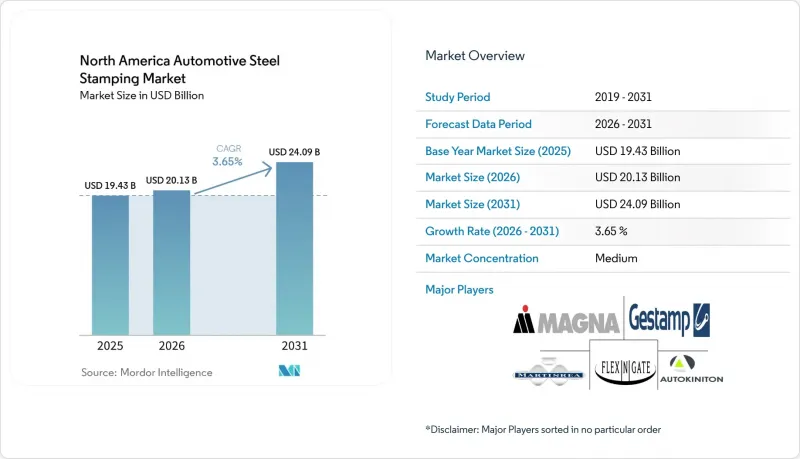
에 따르면 북미의 자동차용 강판 프레스 가공 시장 규모는 2025년에 194억 3,000만 달러로 평가되며, 2026년에는 201억 3,000만 달러로 추정되고 있습니다.
또한 2026-2031년까지 연평균 성장률(CAGR) 3.65%로 성장하여 2031년까지 240억 9,000만 달러에 달할 것으로 예측됩니다.
북미 자동차용 강판 프레스 성형 시장의 동향 및 인사이트
OEM의 경량화 추진이 AHSS 및 UHSS 프레스 부품 수요를 견인
클리블랜드 클리프스(Cleveland Cliffs)는 2025년에 1,500 MPa 프레스 경화강 인증을 획득하여, 이를 통해 B필러 및 도어 링에서 기존 등급에 비해 20-25%의 경량화가 가능해졌습니다. 마찬가지로 SSAB사의 ‘Docol 2200 MPa’나 타타 스틸사의 2.2GPa 제품도 시판되고 있으나, 이를 채택하기 위해서는 1기당 800만-1,200만 달러의 비용이 드는 고가의 핫 스탬핑 라인이 필수적입니다. 산 루이스 포토시에 위치한 게스탬프(Ges-Stamp)사의 7,400만 유로 규모의 핫 스탬핑 공장에서는 이 회사의 ‘Ges-Multistep’ 기술을 활용하여 성형과 담금을 단일 사이클로 결합함으로써 금형 비용을 절감하고 치수 정밀도의 재현성을 향상시킵니다. 이러한 설비 현대화에 자금을 투자할 수 있는 Tier 1 공급업체는 고수익률의 UHSS(초고장력강) 프로그램을 확보할 수 있는 반면, 소규모의 지역 밀착형 프레스 가공업체는 기존의 연강 패널에서 발생하는 상품화 위험에 직면하게 될 것입니다.
USMCA의 지역내 조달 요건 강화가 현지 강판 프레스 가공업체에 유리하게 작용할 것입니다.
USMCA의 지역 부가가치 요건 및 철강 조달 요건이 완전히 발효됨에 따라 멕시코 바히오 회랑에 위치한 OEM 거점이나 미국 국경 인근 주에 있는 제조 공장 근처에 위치한 공급업체로 업무가 집중되고 있습니다. 멕시코는 미국 자동차 부품 수입의 주요 공급원으로서의 지위를 강화하고, 다른 공급국에 비해 시장 점유율을 확대하는 한편, 자동차 분야에서 막대한 규모의 신규 외국인 직접 투자를 유치하고 있습니다. 이러한 동향은 지역 밸류체인의 중요성 증대, OEM 생산 거점과의 근접성, 그리고 USMCA 조달 요건 준수를 반영하고 있습니다. 향후 협정 재검토로 인해 정책적 불확실성이 발생할 수 있으나, 노동 부가가치 비율에 관한 규정이 더욱 엄격해지면 니어쇼어링이 더욱 촉진되어 미국, 멕시코, 캐나다 전역에 확립된 제조 거점을 보유한 프레스 가공 제조업체에 혜택을 줄 가능성이 높습니다.
예상보다 낮은 BEV 보급률이 프레스 가공의 증분 생산량을 억제
2025년 말 연방 정부의 전기자동차(EV) 인센티브 폐지로 인해 판매 대수는 전 분기 대비 대폭 감소했습니다. 또한 2026년 초에는 BEV의 시장 점유율도 전년 대비 하락했습니다. 포드는 여러 전기자동차 프로그램에 대해 감손 처리를 단행한 반면, GM은 생산 능력 확대 계획을 연기하고 단기적인 중점을 하이브리드차량으로 전환했습니다. 하이브리드차량은 더 소형인 배터리 케이스와 초고장력강(UHSS)으로 제작된 프레스 부품의 사용량이 적기 때문입니다. 정책적 지원이 없는 상황에서 공급업체들은 전기자동차 전용 금형이 유휴 자산이 될 위험에 직면해 있습니다. 그러나 내연기관(ICE)과 BEV 프로그램 모두에 대응할 수 있는 범용 금형에는 훨씬 더 많은 초기 투자가 필요합니다.
부문 분석
블랭킹은 브래킷, 플랫 블랭크, 후공정에서 사용되는 프리폼 등 폭넓은 용도로 보급되며, 2025년 매출의 31.28%를 차지했습니다. 한편, 엠보싱 공정은 각 OEM 업체가 용접을 통한 보강을 불필요하게 만드는 보강 리브를 추가함으로써 패널 1장당 8-12%의 경량화를 실현하고 있으며, 연평균 성장률(CAGR) 4.67%로 확대될 것으로 예측됩니다. UHSS의 엠보싱 가공은 금형 마모를 최대 50% 가속화시켜, 대량 생산 라인에서는 연간 금형 유지보수 예산이 20만 달러에 달할 가능성도 있습니다. 그러나 예측 유지보수를 확립한 프레스 가공 업체는 그 프리미엄을 확실히 확보하고 있습니다. 코이닝, 플랜징, 벤딩은 여전히 틈새 분야이지만, 각각 정밀 접점, 에지 가공, 섀시 레일에 있으며, 필수적인 공정입니다.
이와 병행하여 블랭킹, 엠보싱, 플랜징 공정을 1회 스트로크로 통합하는 멀티 스테이션 프레스로의 전환이 진행되고 있으며, 이를 통해 핸들링 공정이 축소되고 IATF 16949의 추적성이 확보됩니다. Trans-Matic사는 이미 북미에서 이러한 통합이 가능한 119대의 트랜스퍼 프레스를 공급하고 있으며, 각 OEM 업체는 공급업체의 패널을 합리화하여 비용 절감을 확실하게 실현할 수 있습니다.
판금 성형은 대량 생산되는 외장 패널 및 클로저 부품을 배경으로 2025년 매출의 38.15%를 계속 차지했습니다. 핫 스탬핑은 연평균 성장률(CAGR) 4.69%로 확대될 것으로 예상되며, 1,500-2,200 MPa의 강도가 필요한 구조 부품 분야에서 수요가 증가하고 있습니다. 게스탐프(Gestamp)가 2026년 가동을 시작할 예정인 산 루이스 포토시의 신규 라인은 GM 및 스텔란티스에 냉간 프레스 성형품에 비해 20-25% 경량화된 프레스 경화 도어 링을 공급할 예정입니다. 막대한 설비 투자가 필요하므로 핫 스탬핑 생산 능력은 대형 Tier 1 공급업체에 집중되어 있는 반면, 판금 성형은 범용 부품의 대량 생산을 계속해서 담당하고 있습니다. 두 공정을 결합한 공급업체는 더 광범위한 프로그램에 참여하고 더 강력한 협상력을 확보할 수 있습니다.
롤 성형과 금속 가공은 각각 장형 프로파일이나 소량 생산과 같은 주변 분야를 다루고 있습니다. 하지만 OEM의 부품 수 축소 추세는 통합형 메가 스탬핑을 유리하게 만들고 있으며, 이러한 2차 가공 공정은 틈새 시장인 전기 상용차 플랫폼과 연계되지 않는 한 더 큰 압박에 직면하게 될 것입니다.
기타 혜택:
- 엑셀 형식의 시장 예측(ME) 시트
- 3개월간의 애널리스트 지원
자주 묻는 질문
목차
제1장 서론
- 조사 전제조건과 시장 정의
- 조사 범위
제2장 조사 방법
제3장 개요
제4장 시장 구도
- 시장 개요
- 시장 성장 촉진요인
- 시장 성장 억제요인
- 밸류·공급망 분석
- 규제 상황
- 기술 전망
- Porter's Five Forces 분석
제5장 시장 규모와 성장 예측
- 기술별
- 프로세스별
- 차종별
- 추진력별
- 국가별
- 미국
- 캐나다
- 멕시코
- 기타 북미 국가
제6장 경쟁 구도
- 시장 집중도
- 전략적 동향
- 시장 점유율 분석
- 기업 개요
- Magna International Inc.
- Gestamp Automocion S.A.
- Martinrea International Inc.
- Autokiniton US Holdings, Inc.
- Shiloh Industries LLC
- Flex-N-Gate Corporation
- Aisin World Corp. of America
- Trans-Matic Manufacturing Co.
- Anchor Manufacturing Group Inc.
- Worthington Industries Inc.
- Multimatic Inc.
- American Axle and Manufacturing Holdings Inc.
- ThyssenKrupp North America
- Kenmode Precision Metal Stamping
- NIDEC ARISA(press solutions)
- U.S. Steel Automotive Center
- ArcelorMittal Tailored Blanks
- JIER North America(press lines)
제7장 시장 기회와 향후 전망
KSA 26.10.23According to Mordor Intelligence, the North American automotive steel stamping market size was valued at USD 19.43 billion in 2025 and is estimated at USD 20.13 billion in 2026, and is projected to reach USD 24.09 billion by 2031, growing at a CAGR of 3.65% from 2026 to 2031.
North America Automotive Steel Stamping Market Trends and Insights
OEM Lightweighting Push Spurring Demand for AHSS and UHSS Stampings
Cleveland-Cliffs certified 1,500 MPa press-hardened steel in 2025, enabling 20-25% mass savings in B-pillars and door rings compared with conventional grades. Likewise, SSAB's Docol 2200 MPa and Tata Steel's 2.2 GPa offerings are commercially available, but adoption hinges on expensive hot-stamping lines that can cost USD 8-12 million each. Gestamp's EUR 74 million hot-stamping plant in San Luis Potosi will leverage its Ges-Multistep technology to combine forming and quenching in a single cycle, cutting tooling expenses and improving dimensional repeatability. Tier-1s with the capital to fund such upgrades will capture high-margin UHSS programs, while smaller regional stampers risk commodity status on legacy mild-steel panels.
Tighter USMCA Regional-Content Rules Favoring Local Steel Stampers
USMCA's regional value-content and steel procurement requirements have fully taken effect, directing work toward suppliers located near OEM hubs in Mexico's Bajio Corridor and manufacturing plants in US border states. Mexico has strengthened its position as a leading source of US auto parts imports, gaining share relative to other supplying countries and attracting substantial new automotive foreign direct investment. This trend reflects the growing importance of regional supply chains, proximity to OEM production centers, and compliance with USMCA sourcing requirements. The upcoming treaty review introduces policy uncertainty; however, stricter labor value-content rules would likely further encourage nearshoring and benefit stampers with established manufacturing footprints across the United States, Mexico, and Canada.
Slower-Than-Expected BEV Adoption Curbing Incremental Stamping Volumes
The repeal of federal EV incentives in late 2025 led to a significant quarter-over-quarter decline in sales. BEV market share also declined in early 2026 compared with the previous year. Ford wrote down several EV programs, while GM deferred capacity expansion plans and shifted its near-term focus toward hybrids, which require smaller battery enclosures and fewer ultra-high-strength steel (UHSS) stampings. In the absence of policy support, suppliers face the risk of stranded EV-specific tooling. However, flexible dies that can support both ICE and BEV programs require substantially higher upfront investment.
Other drivers and restraints analyzed in the detailed report include:
- Surge in North American Light-Vehicle Production Rebound Post-Pandemic
- Automation Investments Lowering Per-Part Cost in Stamping Presses
- Volatility in North American Flat-Steel Prices
For complete list of drivers and restraints, kindly check the Table Of Contents.
Segment Analysis
Blanking generated 31.28% of 2025 revenue due to its ubiquity across brackets, flat blanks, and pre-forms used downstream. Embossing, however, is projected to expand at a 4.67% CAGR as OEMs add stiffening ribs that eliminate weld-on reinforcements, trimming mass by 8-12% per panel. Embossing UHSS accelerates die wear by up to 50%, pushing annual tool-maintenance budgets as high as USD 200,000 for high-volume lines, yet stampers mastering predictive maintenance capture the premium. Coining, flanging, and bending remain niche yet essential for precision contacts, edge preparation, and chassis rails, respectively.
A parallel shift is unfolding toward integrated multi-station presses that combine blanking, embossing, and flanging in a single stroke, cutting handling steps and ensuring IATF 16949 traceability. Trans-Matic already offers 119 transfer presses in North America capable of such consolidation, allowing OEMs to rationalize supplier panels and lock in cost savings.
Sheet-metal forming retained 38.15% of 2025 revenue on the back of high-volume outer panels and closure parts. Hot stamping is set to advance at a 4.69% CAGR, capturing structural roles demanding 1,500-2,200 MPa strength. Gestamp's new San Luis Potosi line, due online in 2026, will supply GM and Stellantis with press-hardened door rings that cut weight 20-25% over cold-stamped counterparts. High capex keeps hot-stamping capacity concentrated among large Tier-1s, while sheet-metal forming continues to own commodity volumes. Suppliers that combine both processes secure broader program coverage and greater negotiating clout.
Roll forming and metal fabrication cover the long-profile and low-volume fringes, respectively. Still, OEM part-count reduction favors integrated megastampings, putting incremental pressure on these secondary processes unless they align with niche electrified commercial platforms.
Complete Report Scope:
- By Technology
- Blanking
- Embossing
- Coining
- Flanging
- Bending
- Other Technologies
- By Process
- Roll Forming
- Hot Stamping
- Sheet-Metal Forming
- Metal Fabrication
- Other Processes
- By Vehicle Type
- Passenger Car
- Light Commercial Vehicle
- Heavy Commercial Vehicle
- By Propulsion
- Internal Combustion Engine (ICE)
- Electric Vehicle (EV)
- By Country
- United States
- Canada
- Mexico
- Rest of North America
List of Companies Covered in this Report:
- Magna International Inc.
- Gestamp Automocion S.A.
- Martinrea International Inc.
- Autokiniton US Holdings, Inc.
- Shiloh Industries LLC
- Flex-N-Gate Corporation
- Aisin World Corp. of America
- Trans-Matic Manufacturing Co.
- Anchor Manufacturing Group Inc.
- Worthington Industries Inc.
- Multimatic Inc.
- American Axle and Manufacturing Holdings Inc.
- ThyssenKrupp North America
- Kenmode Precision Metal Stamping
- NIDEC ARISA (press solutions)
- U.S. Steel Automotive Center
- ArcelorMittal Tailored Blanks
- JIER North America (press lines)
Additional Benefits:
- The market estimate (ME) sheet in Excel format
- 3 months of analyst support
TABLE OF CONTENTS
1 Introduction
- 1.1 Study Assumptions and Market Definition
- 1.2 Scope of the Study
2 Research Methodology
3 Executive Summary
4 Market Landscape
- 4.1 Market Overview
- 4.2 Market Drivers
- 4.2.1 OEM Lightweighting Push Spurring Demand for AHSS and UHSS Stampings
- 4.2.2 Tighter USMCA Regional-Content Rules Favouring Local Steel Stampers
- 4.2.3 Surge in North-American Light-Vehicle Production Rebound Post-Pandemic
- 4.2.4 On-Shoring of Battery-Pack Enclosure Stamping for IRA Compliance
- 4.2.5 Automation Investments Lowering Per-Part Cost in Stamping Presses
- 4.2.6 Demand for "Gigacasting-Replacement" Steel Megastampings in EV Frames
- 4.3 Market Restraints
- 4.3.1 Slower-Than-Expected BEV Adoption Curbing Incremental Stamping Volumes
- 4.3.2 Volatility in North-American Flat-Steel Prices
- 4.3.3 Tier-1 Cash-Flow Squeeze from OEM "Cost-Down" Mandates on Tooling
- 4.3.4 Competition from Aluminium Extrusion and Composite Moulding Substitutes
- 4.4 Value / Supply-Chain Analysis
- 4.5 Regulatory Landscape
- 4.6 Technological Outlook
- 4.7 Porter's Five Forces Analysis
- 4.7.1 Threat of New Entrants
- 4.7.2 Bargaining Power of Suppliers
- 4.7.3 Bargaining Power of Buyers
- 4.7.4 Threat of Substitutes
- 4.7.5 Competitive Rivalry
5 Market Size and Growth Forecasts (Value (USD))
- 5.1 By Technology
- 5.1.1 Blanking
- 5.1.2 Embossing
- 5.1.3 Coining
- 5.1.4 Flanging
- 5.1.5 Bending
- 5.1.6 Other Technologies
- 5.2 By Process
- 5.2.1 Roll Forming
- 5.2.2 Hot Stamping
- 5.2.3 Sheet-Metal Forming
- 5.2.4 Metal Fabrication
- 5.2.5 Other Processes
- 5.3 By Vehicle Type
- 5.3.1 Passenger Car
- 5.3.2 Light Commercial Vehicle
- 5.3.3 Heavy Commercial Vehicle
- 5.4 By Propulsion
- 5.4.1 Internal Combustion Engine (ICE)
- 5.4.2 Electric Vehicle (EV)
- 5.5 By Country
- 5.5.1 United States
- 5.5.2 Canada
- 5.5.3 Mexico
- 5.5.4 Rest of North America
6 Competitive Landscape
- 6.1 Market Concentration
- 6.2 Strategic Moves
- 6.3 Market Share Analysis
- 6.4 Company Profiles (Includes Global Level Overview, Market Level Overview, Core Segments, Financials as Available, Strategic Information, Market Rank/Share for Key Companies, Products and Services, SWOT Analysis, and Recent Developments)
- 6.4.1 Magna International Inc.
- 6.4.2 Gestamp Automocion S.A.
- 6.4.3 Martinrea International Inc.
- 6.4.4 Autokiniton US Holdings, Inc.
- 6.4.5 Shiloh Industries LLC
- 6.4.6 Flex-N-Gate Corporation
- 6.4.7 Aisin World Corp. of America
- 6.4.8 Trans-Matic Manufacturing Co.
- 6.4.9 Anchor Manufacturing Group Inc.
- 6.4.10 Worthington Industries Inc.
- 6.4.11 Multimatic Inc.
- 6.4.12 American Axle and Manufacturing Holdings Inc.
- 6.4.13 ThyssenKrupp North America
- 6.4.14 Kenmode Precision Metal Stamping
- 6.4.15 NIDEC ARISA (press solutions)
- 6.4.16 U.S. Steel Automotive Center
- 6.4.17 ArcelorMittal Tailored Blanks
- 6.4.18 JIER North America (press lines)
7 Market Opportunities and Future Outlook
- 7.1 White-space and Unmet-Need Assessment


