

|
시장보고서
상품코드
2154304
척추 수술용 디바이스 : 시장 점유율 분석, 업계 동향과 통계, 성장 예측(2026-2031년)Spinal Surgery Device - Market Share Analysis, Industry Trends & Statistics, Growth Forecasts (2026 - 2031) |
||||||
 Mordor Intelligence
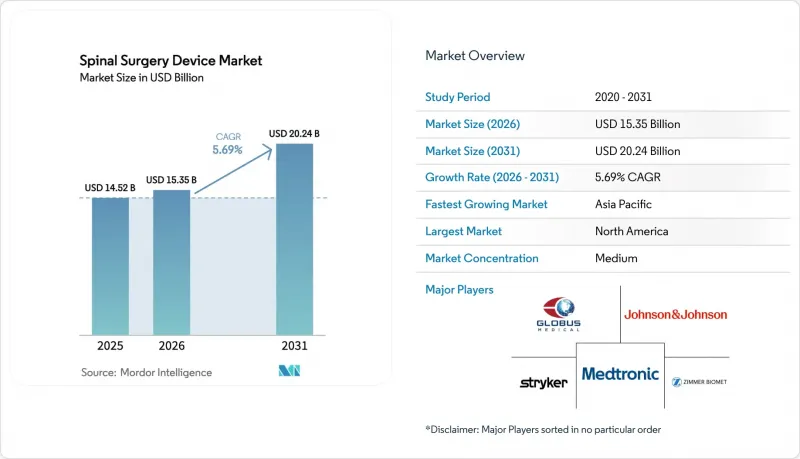
에 따르면 척추 수술 기기 시장 규모는 2025년 145억 2,000만 달러에서 2026년에는 153억 5,000만 달러로 확대하며, 2026-2031년에 CAGR 5.69%로 추이하며, 2031년에는 202억 4,000만 달러에 달할 것으로 예측됩니다.
전 세계 척추 수술 기기 시장의 동향 및 인사이트
척추 퇴행성 질환 및 비만 유병률의 증가
요통으로 인한 DALY(장애 조정 생명년)는 1990년 550만에서 2021년 980만으로 증가했으며, 2050년까지 1,160만을 넘어설 것으로 예측되며, 외과적 개입에 대한 지속적인 수요를 보여주고 있습니다. 65세 이상 인구층은 2050년까지 8,900만 명에 달할 것으로 예상되며, 이미 약 2,750만 명이 척추 변형을 앓고 있습니다. BMI가 높으면 척추 고정술 후 인접 추간 관절의 퇴행이 가속화되므로, 가동성 보존형 임플란트의 채택이 확대되고 있습니다. 2050년까지의 메디케어 시술 건수 예측에 따르면 기구를 이용한 수술 건수가 꾸준히 증가하고 있으며, 수술 체계에 대한 부담이 커지고 있습니다. 이에 따라 의료 제공자들은 치료 성과를 저해하지 않으면서 더 많은 사례를 처리할 수 있는 최소 침습 전략을 채택하고 있습니다.
최소 침습 및 로봇 보조 척추 수술의 도입 확대
로봇 플랫폼은 외과 전공의들 사이에서 97%에 가까운 임상 수용률을 달성했을 뿐만 아니라, 복잡한 증례에서 수술 시간을 최대 62분 단축하고 있습니다. 완전 내시경 경추 수술은 개복 수술보다 합병증이 적으며, 환자 만족도는 85%를 초과합니다. 병원 보고에 따르면 다단계 증례에 로봇을 도입함으로써 환자 1인당 1,500 싱가포르 달러(SGD)의 비용 절감을 실현하고 있습니다. CMS는 ASC(외래 수술 센터)의 수술 리스트을 지속적으로 확대하고 있으며, 척추 수술 전용 진료 코드의 승인을 기다리고 있음에도 불구하고 외래 척추 수술을 향한 정책적 추진력이 드러나고 있습니다. 의료 시스템은 미니 액세스 수술과 정밀 안내 기술을 결합하여 차별화를 꾀하고, 측정 가능한 가치 창출을 추진하고 있습니다.
신흥 시장의 높은 수술 및 임플란트 비용과 제한적인 보험 적용 범위
프랑스에서는 정형외과용 임플란트의 환급액을 25% 삭감하여 2억 3,100만 유로의 비용 절감을 목표로 했으나, 이로 인해 의료기기 공급 부족이 발생하고 있습니다. 비용-효용 분석에 따르면 동종 이식편을 사용한 경추 고정술의 QALY당 비용은 2,492달러인 반면, PEEK 케이지는 3,328달러로 나타나 프리미엄 전략에 있으며, 과제로 대두되고 있습니다. 라틴아메리카에서 최소 침습 플랫폼에 대한 접근은 여전히 고액의 설비 투자와 단편적인 보험 적용 범위로 인해 제한받고 있습니다. 각 공급업체들은 초기 비용을 절감하면서도 핵심적인 임상적 이점을 유지하는 가치 공학(Value Engineering)을 적용한 설계로 이에 대응하고 있습니다.
부문 분석
2025년, 척추 수술용 기기 시장에서 척추 고정용 기기는 매출 점유율의 38.46%를 차지했습니다. ALIF 및 TLIF와 같은 추체간 수술법이 재현 가능한 생체역학적 특성과 외과의사의 폭넓은 숙련도를 바탕으로 이러한 우위를 지원하고 있습니다. 한편, 관절 성형술용 솔루션은 가동성 보존이 인접 척추관절의 퇴행을 완화한다는 증거에 힘입어 연평균 성장률(CAGR) 6.75%로 성장하고 있습니다. 요추 추간판 치환술은 현재 가동성을 유지하면서도 고정술과 동등한 통증 완화 효과를 제공하고 있습니다. 가동성 보존형 임플란트를 활용한 척추 수술용 기기 시장 규모는 장기적인 치료 성과를 통해 안전성 프로파일이 더욱 입증됨에 따라 급속히 확대될 것으로 전망됩니다.
생체활성 표면에 대한 임상적 수요가 고정술 및 가동성 보존술 양 분야에서 소재 혁신을 촉진하고 있습니다. 나노 텍스처드 티타늄과 다공성 PEEK는 다단계 고정술에서 관찰되는 10%의 비유합률을 낮추는 것을 목표로 합니다. 각 공급업체는 이러한 기능을 치료 결과 추적 소프트웨어와 결합하여 포괄적인 가치 제안을 구축하고 있습니다. 이를 통해 고정술의 신뢰성에 대한 외과의사의 우려를 해소하는 동시에 프리미엄 가격 책정을 촉진하고 있습니다.
개방 수술은 변형 교정이나 대규모 재건 수술에서 여전히 필수적이기 때문에 2025년 매출의 56.58%를 차지하고 있습니다. 그러나 빠른 회복을 원하는 환자의 수요와 입원 기간 단축을 요구하는 보험사의 압박에 힘입어, 최소 침습 척추 수술은 연평균 성장률(CAGR) 5.91%로 확대되고 있습니다. 메디케어의 외래 환자 데이터에 따르면 2010-2021년에 척추 수술 건수가 193% 급증했으며, 이는 효율성이 중시되는 의료 현장으로의 수술 전환을 여실히 보여주고 있습니다.
내시경 하 추간판 절제술의 보급은 이러한 변화를 여실히 보여주고 있습니다. 2017-2021년에 해당 시술 건수는 8.58% 증가한 반면, 개방형 미세 추간판 절제술은 27.78% 감소했습니다. 병원들은 복잡한 병태에 대한 최소 침습 수술(MIS)의 적용 범위를 확대하는 로봇 및 내비게이션 플랫폼에 투자하고 있으며, 교정 효과를 저해하지 않으면서 절개 부위를 줄이는 방향으로의 척추 수술 기기 시장 전환을 지원하고 있습니다.
지역별 분석
2025년, 북미는 전 세계 매출의 44.36%를 차지했습니다. 지원적인 보험 환급 제도, 견고한 임상 연구 네트워크, 그리고 정밀 기술의 조기 도입이 이 지역의 선도적 지위를 지원하고 있습니다. FDA의 지침은 예측 가능한 승인 절차를 제공하며, 의료기기의 지속적인 개선을 촉진하고 있습니다. 시장 참여 기업은 경쟁 우위를 유지하기 위해 AI를 활용한 수술 전 계획에 대한 연구개발을 강화하고 있습니다.
아시아태평양은 수술 역량의 확대와 첨단 의료 서비스를 추구하는 중산층의 수요 증가에 힘입어 연평균 성장률(CAGR) 6.46%라는 가장 빠른 성장 궤도를 그리고 있습니다. 중국과 인도의 도시 지역에서는 로봇 수술실에 대한 투자가 진행되고 있지만, 지방 지역에서는 도입 격차가 여전히 존재합니다. 현지 제조 파트너십은 수입 관세를 상쇄하고 가격에 걸맞은 제품 포트폴리오를 구축하는 데 도움이 되며, 인프라가 성숙해짐에 따라 공급업체가 판매량 증가를 포착할 수 있도록 자리매김하고 있습니다.
유럽에서는 MDR로 인한 규제상의 역풍에도 불구하고 상당한 성장을 유지하고 있습니다. 각국은 비용 관리를 강화하고 있으며, 프랑스의 경우 환급액 삭감으로 인해 이미 임플란트의 가용성이 낮아지고 있습니다. 우수한 치료 성과를 입증할 수 있는 공급업체는 프리미엄 가격을 유지할 수 있지만, 인증 절차의 장기화에 대응해야 합니다. 남미 및 중동 및 아프리카(MEA) 지역은 공중보건 정책과 민간 부문의 투자를 바탕으로 놀라운 성장률을 보이고 있습니다. 보험사의 보장 범위가 제한적이기 때문에 고급 시스템의 보급은 여전히 제약을 받고 있으며, 공급업체들은 필수 기능을 유지하면서도 모듈식 저비용 구성으로 방향을 전환하고 있습니다.
기타 혜택:
- 엑셀 형식의 시장 예측(ME) 시트
- 3개월간의 애널리스트 지원
자주 묻는 질문
목차
제1장 서론
- 조사 전제조건과 시장 정의
- 조사 범위
제2장 조사 방법
제3장 개요
제4장 시장 구도
- 시장 개요
- 시장 성장 촉진요인
- 시장 성장 억제요인
- 밸류·공급망 분석
- 규제 상황
- Porter's Five Forces 분석
제5장 시장 규모와 성장 예측
- 디바이스 유형별
- 시술 유형별
- 외과 기술별
- 수술 환경별
- 지역
제6장 경쟁 구도
- 시장 집중도
- 시장 점유율 분석
- 기업 개요
- Alphatec Spine
- AMTEC Co., Ltd.
- Aspen Medical Products
- B. Braun Melsungen AG
- Baumer S.A.
- Camber Spine
- CoreLink Surgical
- Exactech
- Globus Medical
- HighRidge Inc.
- Johnson & Johnson Services, Inc.
- Medtronic plc
- Orthofix-SeaSpine Holdings
- Orthopedic Implant Company(OIC)
- RTI Surgical
- SpineWave
- Stryker Corporation
- Vincula Biomedica
- Xtant Medical
- Zimmer Biomet Holdings
제7장 시장 기회와 향후 전망
KSA 26.10.23According to Mordor Intelligence, the spinal surgery device market size is expected to grow from USD 14.52 billion in 2025 to USD 15.35 billion in 2026 and is forecast to reach USD 20.24 billion by 2031 at 5.69% CAGR over 2026-2031.
Global Spinal Surgery Device Market Trends and Insights
Growing Prevalence of Degenerative Spine Disorders & Obesity
Low-back-pain DALYs climbed from 5.5 million in 1990 to 9.8 million in 2021 and are projected to exceed 11.6 million by 2050, signaling sustained demand for surgical intervention. The >= 65-year cohort is set to reach 89 million by 2050, and roughly 27.5 million people already live with spinal deformities. High BMI accelerates adjacent-segment degeneration following fusion, fueling uptake of motion-preservation implants. Medicare volume forecasts through 2050 indicate steady growth in instrumented procedures, amplifying pressure on surgical capacity. Providers, therefore, embrace minimally invasive strategies capable of treating larger caseloads without compromising outcomes.
Rising Adoption of Minimally-Invasive & Robotic-Assisted Spine Procedures
Robotic platforms achieve clinical acceptance rates approaching 97% among surgical trainees while trimming complex-case operating times by up to 62 minutes. Complete endoscopic cervical surgery delivers more than 85% patient satisfaction with fewer complications than open surgery. Hospitals report SGD 1,500 cost savings per patient when deploying robotics in multilevel cases. CMS continues to broaden ASC procedure lists, signaling policy momentum toward outpatient spine even though dedicated spine codes await approval. Health systems differentiate by coupling mini-access techniques with precision guidance to drive measurable value.
High Procedure & Implant Cost; Limited Payor Coverage in Emerging Markets
France cut orthopedic implant reimbursement by 25%, targeting EUR 231 million savings and triggering device shortages. Cost-utility analysis places allograft cervical fusion at USD 2,492 per QALY versus USD 3,328 for PEEK cages, challenging premium strategies. Latin American access to minimally invasive platforms remains constrained by high capital outlays and fragmented insurance coverage. Vendors respond with value-engineered designs that retain core clinical benefits while trimming upfront spend.
Other drivers and restraints analyzed in the detailed report include:
- Breakthroughs in Real-Time AR/VR Navigation & 3-D Printed Implants
- Continuous Advancements in Implant Materials
- Stringent Multi-Jurisdictional Regulatory Clearance Timelines
For complete list of drivers and restraints, kindly check the Table Of Contents.
Segment Analysis
Spinal fusion devices held a 38.46% revenue share in 2025 within the spinal surgery device market. Interbody techniques such as ALIF and TLIF underpin this dominance, offering reproducible biomechanics and broad surgeon familiarity. Arthroplasty solutions, however, are climbing at a 6.75% CAGR, driven by evidence that motion preservation mitigates adjacent-segment degeneration. Lumbar disc replacement now delivers comparable pain reduction to fusion while preserving mobility. The spinal surgery device market size for motion-preservation implants is projected to scale rapidly as long-term outcomes further validate their safety profile.
Clinical demand for biologically active surfaces fuels material innovation across both fusion and motion segments. Nano-textured titanium and porous PEEK aim to lower the 10% non-union rate observed in multi-level fusion. Vendors bundle these features with outcome-tracking software to create comprehensive value propositions that incentivize premium list pricing while addressing surgeon concerns over fusion reliability.
Open procedures still generated 56.58% of 2025 revenues, reflecting their necessity for deformity corrections and extensive reconstructions. Yet minimally invasive spine surgery advances at a 5.91% CAGR, propelled by patient demand for faster recovery and payer pressure to reduce inpatient stays. Medicare outpatient data revealed a 193% surge in spine cases from 2010-2021, underscoring procedural migration to settings that reward efficiency.
Endoscopic discectomy adoption illustrates this shift: its volume rose 8.58% between 2017-2021 while open microdiscectomy fell 27.78%. Hospitals invest in robotic and navigation platforms that extend MIS applicability to complex pathology, supporting the spinal surgery device market's transition toward smaller incisions without sacrificing corrective potential.
Complete Report Scope:
- By Device Type
- Spinal Decompression Devices
- Corpectomy Systems
- Discectomy Systems
- Facetectomy Systems
- Foraminotomy Systems
- Laminotomy Systems
- Spinal Fusion Devices
- Cervical Fusion
- Interbody Fusion
- Thoracolumbar Fusion
- Others
- Arthroplasty / Disc Replacement Devices
- Fracture Repair & VCF Devices
- Motion-Preservation / Non-fusion Devices
- Spinal Decompression Devices
- By Procedure Type
- Open Spine Surgery
- Minimally-Invasive Spine Surgery (MISS)
- By Surgical Technology
- Robotic-Assisted Systems
- AR/VR-Navigated Systems
- Traditional Navigation & Imaging-Guided
- By Surgery Setting
- Hospitals
- Ambulatory Surgery Centers (ASCs)
- Specialty Orthopedic & Spine Clinics
- Geography
- North America
- United States
- Canada
- Mexico
- Europe
- Germany
- United Kingdom
- France
- Italy
- Spain
- Rest of Europe
- Asia-Pacific
- China
- Japan
- India
- Australia
- South Korea
- Rest of Asia-Pacific
- Middle East & Africa
- GCC
- South Africa
- Rest of Middle East & Africa
- South America
- Brazil
- Argentina
- Rest of South America
- North America
Geography Analysis
North America commanded 44.36% of global revenue in 2025. Supportive reimbursement, robust clinical research networks, and early adoption of precision technologies underpin regional leadership. FDA guidance offers predictable clearance pathways that encourage continuous device iteration. Market players intensify R&D around AI-enabled planning to preserve competitive moats.
Asia-Pacific marks the fastest trajectory at 6.46% CAGR, propelled by expanding surgical capacity and rising middle-class demand for advanced care. Urban centers in China and India invest in robotic suites, yet adoption disparities persist across rural regions. Local manufacturing partnerships help offset import tariffs and build price-appropriate portfolios, positioning vendors to capture incremental volumes as infrastructure matures.
Europe sustains significant growth despite regulatory headwinds from MDR. Countries tighten cost controls; France's reimbursement cuts already reduce implant availability. Suppliers that validate superior outcomes can maintain premium pricing, but must navigate lengthened certification timelines. South America and MEA grow at a significant percentage buoyed by public-health initiatives and private-sector investment. Limited payor coverage still constrains high-end system penetration, steering suppliers toward modular, lower-cost constructs that preserve essential functionality.
- Alphatec Spine
- AMTEC Co., Ltd.
- Aspen Medical Products
- B. Braun
- Baumer S.A.
- Camber Spine
- CoreLink Surgical
- Exactech
- Globus Medical
- HighRidge Inc.
- Johnson & Johnson
- Medtronic
- Orthofix-SeaSpine Holdings
- Orthopedic Implant Company (OIC)
- RTI Surgical
- SpineWave
- Stryker
- Vincula Biomedica
- Xtant Medical
- Zimmer Biomet
Additional Benefits:
- The market estimate (ME) sheet in Excel format
- 3 months of analyst support
TABLE OF CONTENTS
1 Introduction
- 1.1 Study Assumptions & Market Definition
- 1.2 Scope of the Study
2 Research Methodology
3 Executive Summary
4 Market Landscape
- 4.1 Market Overview
- 4.2 Market Drivers
- 4.2.1 Growing Prevalence of Degenerative Spine Disorders & Obesity
- 4.2.2 Rising Adoption of Minimally-Invasive & Robotic-Assisted Spine Procedures
- 4.2.3 Breakthroughs in Real-Time AR/VR Navigation & 3-D Printed Implants
- 4.2.4 ASC-Friendly Reimbursement for Outpatient Spinal Surgeries
- 4.2.5 Continuous Advancements in Implant Materials
- 4.2.6 AI-Driven Predictive Analytics Improving Surgical Planning & Outcomes
- 4.3 Market Restraints
- 4.3.1 High Procedure & Implant Cost; Limited Payor Coverage in Emerging Markets
- 4.3.2 Stringent Multi-Jurisdictional Regulatory Clearance Timelines
- 4.3.3 Supply-Chain Pressure on Titanium & PEEK Feedstocks
- 4.3.4 Data-Security and Liability Concerns Surrounding Cloud-Connected Robotic and AR Navigation Systems
- 4.4 Value / Supply-Chain Analysis
- 4.5 Regulatory Landscape
- 4.6 Porter's Five Forces Analysis
- 4.6.1 Threat of New Entrants
- 4.6.2 Bargaining Power of Buyers
- 4.6.3 Bargaining Power of Suppliers
- 4.6.4 Threat of Substitutes
- 4.6.5 Competitive Rivalry
5 Market Size & Growth Forecasts (Value, USD)
- 5.1 By Device Type
- 5.1.1 Spinal Decompression Devices
- 5.1.1.1 Corpectomy Systems
- 5.1.1.2 Discectomy Systems
- 5.1.1.3 Facetectomy Systems
- 5.1.1.4 Foraminotomy Systems
- 5.1.1.5 Laminotomy Systems
- 5.1.2 Spinal Fusion Devices
- 5.1.2.1 Cervical Fusion
- 5.1.2.2 Interbody Fusion
- 5.1.2.3 Thoracolumbar Fusion
- 5.1.2.4 Others
- 5.1.3 Arthroplasty / Disc Replacement Devices
- 5.1.4 Fracture Repair & VCF Devices
- 5.1.5 Motion-Preservation / Non-fusion Devices
- 5.1.1 Spinal Decompression Devices
- 5.2 By Procedure Type
- 5.2.1 Open Spine Surgery
- 5.2.2 Minimally-Invasive Spine Surgery (MISS)
- 5.3 By Surgical Technology
- 5.3.1 Robotic-Assisted Systems
- 5.3.2 AR/VR-Navigated Systems
- 5.3.3 Traditional Navigation & Imaging-Guided
- 5.4 By Surgery Setting
- 5.4.1 Hospitals
- 5.4.2 Ambulatory Surgery Centers (ASCs)
- 5.4.3 Specialty Orthopedic & Spine Clinics
- 5.5 Geography
- 5.5.1 North America
- 5.5.1.1 United States
- 5.5.1.2 Canada
- 5.5.1.3 Mexico
- 5.5.2 Europe
- 5.5.2.1 Germany
- 5.5.2.2 United Kingdom
- 5.5.2.3 France
- 5.5.2.4 Italy
- 5.5.2.5 Spain
- 5.5.2.6 Rest of Europe
- 5.5.3 Asia-Pacific
- 5.5.3.1 China
- 5.5.3.2 Japan
- 5.5.3.3 India
- 5.5.3.4 Australia
- 5.5.3.5 South Korea
- 5.5.3.6 Rest of Asia-Pacific
- 5.5.4 Middle East & Africa
- 5.5.4.1 GCC
- 5.5.4.2 South Africa
- 5.5.4.3 Rest of Middle East & Africa
- 5.5.5 South America
- 5.5.5.1 Brazil
- 5.5.5.2 Argentina
- 5.5.5.3 Rest of South America
- 5.5.1 North America
6 Competitive Landscape
- 6.1 Market Concentration
- 6.2 Market Share Analysis
- 6.3 Company Profiles (includes Global level Overview, Market level overview, Core Business Segments, Financials, Headcount, Key Information, Market Rank, Market Share, Products and Services, and analysis of Recent Developments)
- 6.3.1 Alphatec Spine
- 6.3.2 AMTEC Co., Ltd.
- 6.3.3 Aspen Medical Products
- 6.3.4 B. Braun Melsungen AG
- 6.3.5 Baumer S.A.
- 6.3.6 Camber Spine
- 6.3.7 CoreLink Surgical
- 6.3.8 Exactech
- 6.3.9 Globus Medical
- 6.3.10 HighRidge Inc.
- 6.3.11 Johnson & Johnson Services, Inc.
- 6.3.12 Medtronic plc
- 6.3.13 Orthofix-SeaSpine Holdings
- 6.3.14 Orthopedic Implant Company (OIC)
- 6.3.15 RTI Surgical
- 6.3.16 SpineWave
- 6.3.17 Stryker Corporation
- 6.3.18 Vincula Biomedica
- 6.3.19 Xtant Medical
- 6.3.20 Zimmer Biomet Holdings
7 Market Opportunities & Future Outlook
- 7.1 White-space & Unmet-need Assessment


