

|
시장보고서
상품코드
2154310
기관지 경련 : 시장 점유율 분석, 업계 동향과 통계, 성장 예측(2026-2031년)Bronchial Spasm - Market Share Analysis, Industry Trends & Statistics, Growth Forecasts (2026 - 2031) |
||||||
 Mordor Intelligence
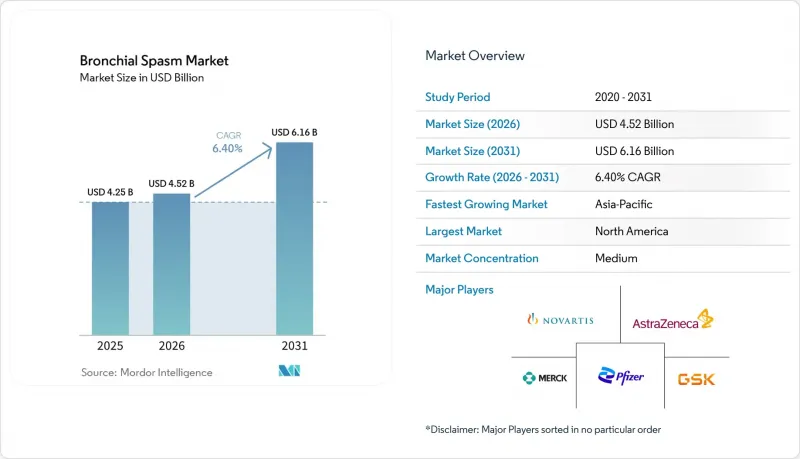
에 따르면 기관지 경련 시장 규모는 2025년에 42억 5,000만 달러로 평가되며, 2026년 45억 2,000만 달러에서 2031년까지 61억 6,000만 달러에 달할 것으로 예측되고 있으며, 예측 기간(2026-2031년)에 CAGR은 6.40%에 달할 전망입니다.
전 세계 기관지 경련 시장의 동향 및 인사이트
천식 및 COPD의 부담 증가가 지속적인 수요의 기반이 될 전망
기관지 경련 시장은 장기적인 호흡기 치료에 대한 지속적인 수요의 혜택을 받고 있습니다. 세계보건기구(WHO)는 2025년 전 세계에서 2억 5,000만 명 이상이 천식을 앓고 있다고 발표했습니다. 저·중소득국의 약국 및 병원의 3분의 2 이상에서는 필수 흡입제를 구할 수 없는 상황이 지속되어 치료 접근성이 제한되고 있습니다. 증례 발견 체계의 개선과 질환 등록 제도의 정비를 통해 치료를 받는 환자층을 확대할 수 있는 반면, WHO 유럽지역사무국의 보고에 따르면 전 세계 COPD 환자 수는 2020-2050년 사이에 23% 증가할 것으로 예측됩니다.
병용 요법 및 장시간 작용형 기관지확장제 요법으로의 전환을 통해 환자 1인당 평균 수익이 향상되었습니다.
기관지 경련 치료 시장은 보다 강력한 증상 관리가 필요한 환자를 대상으로 한 병용 요법으로 전환되고 있습니다. 2026년 2월에 발표된 KALOS 및 LOGOS 3상 임상시험에서는 부데소니드, 글리코피로늄, 포르모테롤의 병용 요법이 ICS-LABA 2제 병용 요법과 비교하여 트래프 FEV1을 76mL 개선하고, 중증 악화를 14% 감소시킨 것으로 나타났습니다. 미국흉부학회(ACCP)는 2026년 1월, 중증 천식에서 생물제제를 이용한 관리에 관한 지침을 발표하며 체계적인 치료 전환 결정을 지지했습니다. 이러한 동향은 의약품, 기기 설계, 임상적 근거를 통합한 단일 흡입기 요법의 상업적 가치를 높이고 있습니다.
흡입기의 오용과 치료 순응도 저하가 치료 성과를 저해
흡입기 사용법 오류나 치료 순응도 저하는 여전히 기관지 경련 치료 시장에 있으며, 중대한 제약 요인으로 작용하고 있습니다. 2025년에 실시된 커넥티드 흡입기 데이터 검토에 따르면 구급약 사용 빈도가 높은 것은 COPD 악화를 예측하는 요인임이 밝혀졌으나, 일상적인 진료에서는 이러한 지표가 간과되기 쉬웠습니다. 잘못된 사용은 처방약이 적절하게 조제된 경우라도 유지약이나 구급약의 효능을 저하시켜, 본래 피할 수 있었던 급성기 의료 이용으로 이어졌습니다. 제조사와 의료 제공자는 환자 교육, 기기 사용 지도, 적절한 사후 관리를 통해 의약품 접근성을 지원해야 합니다.
부문 분석
기관지확장제는 증상의 신속한 완화 및 장기적인 유지 요법에서의 광범위한 사용에 힘입어 2025년 치료 총매출의 52.56%를 차지했습니다. 단시간 작용형 β2 작용제는 여전히 급성 기관지 경련 관리에 필수적인 반면, 장시간 작용형 β2 작용제는 유지 요법을 지원하고 있습니다. 항콜린제는 특히 COPD에 수반되는 기관지 경련에 대해 확립된 역할을 유지하고 있습니다. 이러한 폭넓은 치료 기반이 1차 진료, 전문 의료 및 급성기 의료 현장에서의 수요를 견인하고 있습니다.
코르티코스테로이드는 가장 빠르게 성장하는 치료 범주이며, 이 부문은 2031년까지 연평균 성장률(CAGR) 9.15%로 확대될 것으로 예측됩니다. 이러한 성장은 호산구 천식 및 T2형 고천식에 대한 의식의 향상와 흡입용 코르티코스테로이드 및 표적 추가 요법의 병용에 의해 지원되고 있습니다. 미국흉부학회(American College of Chest Physicians)가 발행한 2025년판 CHEST 가이드라인에는 중증 천식 관리에 대한 항 IL-5 요법 및 IL-4 수용체 길항제가 포함되어 있습니다. 또한 병용 흡입제 및 생물제제의 등장으로 인해 임상적 근거, 적격성 평가, 그리고 보험 급여의 중요성이 더욱 커지고 있습니다.
흡입 투여는 작용 발현이 빠르고 폐에 직접 도달한다는 장점에 힘입어 2025년 치료 총매출의 47.76%를 차지했습니다. 정량 분무식 흡입기(MDI)와 건식 분말 흡입기(DPI)는 여전히 주요 기기 형태입니다. GSK에 따르면 전 세계에서 매년 3억 개의 살부타몰 정량 분무식 흡입기가 처방되고 있다고 합니다. 또한 각 제조사들은 흡입기의 추진제가 환경에 미치는 영향을 줄이고 있습니다. 아스트라제네카는 2025년, 현행 추진제에 비해 지구온난화지수가 99.9% 낮은 추진제 ‘HFO-1234ze(E)’를 사용한 ‘Trixeo Aerosphere’에 대해 영국에서 승인을 획득했습니다.
경구 투여는 2031년까지 연평균 성장률(CAGR) 8.80%로 성장할 것으로 예측되며, 기관지 경련 시장에서 투여 경로 중 가장 높은 성장률을 보이고 있습니다. 흡입 요법으로는 대처할 수 없는 염증 경로를 표적으로 하는 전신 요법에 대한 수요가 증가하고 있습니다. 이 투여 경로 범주에 속하는 주사용 바이오의약품은 중증 천식 치료의 구도를 변화시키고 있습니다. 정맥내 투여는 응급 현장이나 병원 환경에서 여전히 중요한 위치를 차지하고 있지만, 네뷸라이저의 성능과 에어로졸 품질 기준은 병원의 구매 결정 및 장비 사양에 계속해서 영향을 미치고 있습니다.
지역별 분석
2025년, 북미는 총 치료 매출의 42.44%를 차지하며 지역별로는 가장 큰 기여도를 보였습니다. 미국에는 2,700만 명의 천식 환자가 있으며, 연간 약 1,000만 건의 천식 발작이 발생하고 있습니다. 아스트라제네카는 2026년 4월 28일 FDA 승인을 받은 후, 2026년 7월 미국에서 천식 치료제 ‘BREZTRI Aerosphere’를 출시했습니다. 키에지(Kieji)사의 ‘TRIMBOW’는 2026년 5월 성인 천식 유지 요법으로 승인되었습니다.
유럽은 기관지 경련 치료제 시장에서 두 번째로 큰 규모를 자랑하는 지역이었습니다. 이 지역의 의료제도는 호흡기 질환 치료에 대한 폭넓은 접근성을 제공했으나, 입찰 및 제네릭 의약품으로의 전환으로 인해 오리지널 의약품 가격에 압박이 가해지고 있었습니다. WHO 유럽지역사무소의 보고에 따르면 30-74세 인구에서 만성 호흡기 질환으로 인한 생산성 손실은 207억 달러에 달했습니다. 키에시(Kieesi)는 2026년 7월 31일, 천식을 앓는 성인을 대상으로 한 단일 흡입기를 이용한 3제 병용 요법 ‘NEXThaler’에 대해 유럽집행위원회로부터 승인을 획득했습니다. 독일, 영국, 프랑스, 이탈리아, 스페인이 해당 지역의 치료량에서 큰 비중을 차지했습니다.
아시아태평양은 2031년까지 연평균 성장률(CAGR) 10.88%로 확대될 것으로 예측되며, 이는 기관지 경련 치료제 시장에서 가장 높은 성장률입니다. 중국과 인도는 호흡기 질환의 부담이 극히 크기 때문에 이러한 성장의 중심적인 역할을 하고 있습니다. GSK의 ‘트렐레지 엘립타’는 2026년 1월 23일, 중국 국가의약품감독관리국으로부터 성인 천식 치료제로 승인을 받았습니다. GSK에 따르면 중국에는 4,600만 명의 성인 천식 환자가 있습니다. 인도의 ‘Jan Aushadhi’ 프로그램은 저가 흡입기에 대한 접근성을 확대하고 있는 반면, 브라질의 2025년 공공 의료제도 관련 결정과 칠레에서 2025년 12월 GES(일반 의약품 제도)에 따라 도입된 생물제제의 보험 적용으로 인해 남미 지역에서의 접근성이 확대되었습니다.
기타 혜택:
- 엑셀 형식의 시장 예측(ME) 시트
- 3개월간의 애널리스트 지원
자주 묻는 질문
목차
제1장 서론
- 조사 전제조건과 시장 정의
- 조사 범위
제2장 조사 방법
제3장 개요
제4장 시장 구도
- 시장 개요
- 시장 성장 촉진요인
- 시장 성장 억제요인
- 밸류·공급망 분석
- 규제 상황
- 기술 전망
- Porter's Five Forces 분석
제5장 시장 규모와 성장 예측
- 치료별
- 투여 경로별
- 환자 연령별
- 최종사용자별
- 지역별
- 북미
- 미국
- 캐나다
- 멕시코
- 유럽
- 독일
- 영국
- 프랑스
- 이탈리아
- 스페인
- 기타 유럽 국가
- 아시아태평양
- 중국
- 인도
- 일본
- 호주
- 한국
- 기타 아시아태평양 국가
- 중동 및 아프리카
- GCC
- 남아프리카공화국
- 기타 중동 및 아프리카 국가
- 남미
- 브라질
- 아르헨티나
- 기타 남미 국가
- 북미
제6장 경쟁 구도
- 시장 집중도
- 시장 점유율 분석
- 기업 개요
- Amphastar Pharmaceuticals, Inc.
- AstraZeneca PLC
- Boehringer Ingelheim International GmbH
- Chiesi Farmaceutici S.p.A.
- Cipla Limited
- Dr. Reddy's Laboratories Limited
- GSK plc
- Hikma Pharmaceuticals PLC
- Lupin Limited
- Merck & Co., Inc.
- Nephron Pharmaceuticals Corporation
- Novartis AG
- Organon & Co.
- Pfizer Inc.
- Sandoz Group AG
- Sanofi
- Sun Pharmaceutical Industries Limited
- Teva Pharmaceutical Industries Limited
- Viatris Inc.
- Zydus Lifesciences Limited
제7장 시장 기회와 향후 전망
KSA 26.10.23According to Mordor Intelligence, the bronchial spasm market size was valued at USD 4.25 billion in 2025 and is estimated to grow from USD 4.52 billion in 2026 to reach USD 6.16 billion by 2031, at a CAGR of 6.40% during the forecast period (2026-2031).
Global Bronchial Spasm Market Trends and Insights
Rising Asthma and COPD Burden Creates a Durable Demand Floor
The bronchial spasm market benefits from sustained demand for long-term respiratory treatment. The World Health Organization stated in 2025 that more than 250 million people lived with asthma worldwide. Essential inhaled medicines remained unavailable in more than two-thirds of pharmacies and hospitals in low- and middle-income countries, limiting treatment access. Improved case finding and disease registries can expand the treated patient base, while the WHO European Region reported that global COPD cases are projected to increase by 23% between 2020 and 2050.
Shift Toward Combination and Long-Acting Bronchodilator Therapy Lifts Average Revenue Per Patient
The bronchial spasm market is shifting toward combination therapies for patients requiring stronger symptom control. The KALOS and LOGOS Phase 3 trials, published in February 2026, showed that budesonide, glycopyrronium, and formoterol improved trough FEV1 by 76 mL versus dual ICS-LABA therapy and reduced severe exacerbations by 14%. The American College of Chest Physicians issued a guideline on biologic management in severe asthma in January 2026, supporting structured treatment-switching decisions. These developments strengthen the commercial value of single-inhaler therapies that integrate medicines, device design, and clinical evidence.
Inhaler-Use Errors and Treatment-Adherence Gaps Suppress Therapeutic Outcomes
Inhaler technique errors and adherence gaps remained material constraints for the bronchial spasm market. A 2025 review of connected inhaler data found that high reliever use predicted COPD exacerbations, although routine care often missed these indicators. Incorrect use reduced the effectiveness of controller and rescue medicines, even when prescriptions were filled, leading to avoidable acute care utilization. Manufacturers and providers must support medicine access with patient education, device guidance, and appropriate follow-up.
Other drivers and restraints analyzed in the detailed report include:
- Increasing Diagnosis of Severe and Eosinophilic Asthma Redefines Market Ceiling
- Greater Use of Connected Inhalers and Home-Based Respiratory Care Reshapes Adherence Economics
- Unequal Availability of Essential Inhaled Medicines Caps Geographic Expansion
For complete list of drivers and restraints, kindly check the Table Of Contents.
Segment Analysis
Bronchodilators held 52.56% of total treatment revenue in 2025, supported by their broad use in rapid symptom relief and long-term maintenance. Short-acting beta-2 agonists remain critical for acute bronchospasm management, while long-acting beta-2 agonists support maintenance regimens. Anticholinergics maintain an established role, particularly for COPD-associated bronchospasm. This broad treatment base drives demand across primary care, specialist care, and acute-care settings.
Corticosteroids are the fastest-growing treatment category, with this segment projected to expand at a 9.15% CAGR through 2031. Growth is supported by greater recognition of eosinophilic and T2-high asthma and the use of inhaled corticosteroids with targeted add-on therapies. The 2025 CHEST guideline issued by the American College of Chest Physicians includes anti-IL-5 therapies and IL-4 receptor antagonists for severe asthma management. Combination inhalers and biologics also increase the importance of clinical evidence, eligibility testing, and reimbursement support.
Inhalational delivery accounted for 47.76% of total treatment revenue in 2025, supported by rapid onset and direct pulmonary delivery. Metered-dose inhalers and dry-powder inhalers remain the leading device formats. GSK stated that 300 million salbutamol metered-dose inhalers are dispensed each year globally. Manufacturers are also reducing the environmental impact of inhaler propellants. AstraZeneca received approval in 2025 for Trixeo Aerosphere in the United Kingdom using HFO-1234ze(E), a propellant with 99.9% lower global warming potential than current propellants.
Oral administration is projected to grow at an 8.80% CAGR through 2031, the fastest rate among routes in the bronchial spasm market. Demand is increasing for systemic treatments that target inflammatory pathways not addressed by inhaled therapies. Injectable biologics, included within this route category, are changing the treatment mix for severe asthma. Intravenous administration remains relevant in emergency and hospital settings, while nebulizer performance and aerosol quality standards continue to influence hospital purchasing decisions and device specifications.
Complete Report Scope:
- By Treatment
- Bronchodilators
- Short-Acting Beta-2 Agonists
- Long-Acting Beta-2 Agonists
- Anticholinergics
- Corticosteroids
- Combination Therapies
- Others
- Bronchodilators
- By Route of Administration
- Inhalational Administration
- Oral Administration
- Intravenous Administration
- By Patient Age
- Pediatric Patients
- Adult Patients
- Geriatric Patients
- By End User
- Hospitals
- Specialty Clinics
- Homecare Settings
- Ambulatory Surgical Centers
- Others
- By Geography
- North America
- United States
- Canada
- Mexico
- Europe
- Germany
- United Kingdom
- France
- Italy
- Spain
- Rest of Europe
- Asia-Pacific
- China
- India
- Japan
- Australia
- South Korea
- Rest of Asia-Pacific
- Middle East and Africa
- GCC
- South Africa
- Rest of Middle East and Africa
- South America
- Brazil
- Argentina
- Rest of South America
- North America
Geography Analysis
North America held 42.44% of total treatment revenue in 2025, making it the largest regional contributor. The United States had 27 million asthma patients and nearly 10 million asthma attacks annually. AstraZeneca launched BREZTRI Aerosphere for asthma in the United States in July 2026, following FDA approval on April 28, 2026. Chiesi's TRIMBOW was approved for the maintenance treatment of asthma in adults in May 2026.
Europe was the second-largest region in the bronchial spasm market. Its healthcare systems provided broad access to respiratory treatments, although tendering and generic substitution pressured originator prices. The WHO European Region reported USD 20.7 billion in productivity losses from chronic respiratory diseases among people aged 30-74 years. Chiesi received European Commission authorization for its NEXThaler single-inhaler triple therapy for adults with asthma on July 31, 2026. Germany, the United Kingdom, France, Italy, and Spain accounted for a significant share of the region's treatment volume.
Asia-Pacific is forecast to expand at a CAGR of 10.88% through 2031, the fastest growth rate in the bronchial spasm market. China and India are central to this growth due to their substantial respiratory disease burden. GSK's Trelegy Ellipta received approval from China's National Medical Products Administration for adult asthma on January 23, 2026. GSK stated that China had 46 million adults with asthma. India's Jan Aushadhi program is expanding access to lower-cost inhalers, while Brazil's 2025 public-system decisions and Chile's December 2025 biologic coverage under GES broadened access in South America.
- Amphastar Pharmaceuticals
- AstraZeneca
- Boehringer Ingelheim
- Chiesi Farmaceutici
- Cipla
- Dr. Reddy's Laboratories
- GlaxoSmithKline
- Hikma Pharmaceuticals
- Lupin
- Merck
- Nephron Pharmaceuticals Corporation
- Novartis
- Organon
- Pfizer
- Sandoz Group AG
- Sanofi
- Sun Pharmaceuticals Industries
- Teva Pharmaceutical Industries
- Viatris
- Zydus Lifesciences Limited
Additional Benefits:
- The market estimate (ME) sheet in Excel format
- 3 months of analyst support
TABLE OF CONTENTS
1 INTRODUCTION
- 1.1 Study Assumptions and Market Definition
- 1.2 Scope of the Study
2 RESEARCH METHODOLOGY
3 EXECUTIVE SUMMARY
4 MARKET LANDSCAPE
- 4.1 Market Overview
- 4.2 Market Drivers
- 4.2.1 Rising Asthma and Chronic Obstructive Pulmonary Disease Burden
- 4.2.2 Increasing Exposure to Air Pollution and Occupational Irritants
- 4.2.3 Shift Toward Combination and Long-Acting Bronchodilator Therapy
- 4.2.4 Expansion of Affordable Generic Inhaler Supply
- 4.2.5 Increasing Diagnosis of Severe and Eosinophilic Asthma
- 4.2.6 Greater Use of Connected Inhalers and Home-Based Respiratory Care
- 4.3 Market Restraints
- 4.3.1 Inhaler-Use Errors and Treatment-Adherence Gaps
- 4.3.2 Safety Concerns Associated With Corticosteroids and Bronchodilators
- 4.3.3 Pricing Pressure From Generic and Tender-Based Procurement
- 4.3.4 Unequal Availability of Essential Inhaled Medicines
- 4.4 Value/Supply-Chain Analysis
- 4.5 Regulatory Landscape
- 4.6 Technological Outlook
- 4.7 Porter's Five Forces Analysis
- 4.7.1 Bargaining Power of Suppliers
- 4.7.2 Bargaining Power of Buyers
- 4.7.3 Threat of New Entrants
- 4.7.4 Threat of Substitutes
- 4.7.5 Competitive Rivalry
5 MARKET SIZE AND GROWTH FORECASTS (VALUE, USD)
- 5.1 By Treatment
- 5.1.1 Bronchodilators
- 5.1.1.1 Short-Acting Beta-2 Agonists
- 5.1.1.2 Long-Acting Beta-2 Agonists
- 5.1.2 Anticholinergics
- 5.1.3 Corticosteroids
- 5.1.4 Combination Therapies
- 5.1.5 Others
- 5.1.1 Bronchodilators
- 5.2 By Route of Administration
- 5.2.1 Inhalational Administration
- 5.2.2 Oral Administration
- 5.2.3 Intravenous Administration
- 5.3 By Patient Age
- 5.3.1 Pediatric Patients
- 5.3.2 Adult Patients
- 5.3.3 Geriatric Patients
- 5.4 By End User
- 5.4.1 Hospitals
- 5.4.2 Specialty Clinics
- 5.4.3 Homecare Settings
- 5.4.4 Ambulatory Surgical Centers
- 5.4.5 Others
- 5.5 By Geography
- 5.5.1 North America
- 5.5.1.1 United States
- 5.5.1.2 Canada
- 5.5.1.3 Mexico
- 5.5.2 Europe
- 5.5.2.1 Germany
- 5.5.2.2 United Kingdom
- 5.5.2.3 France
- 5.5.2.4 Italy
- 5.5.2.5 Spain
- 5.5.2.6 Rest of Europe
- 5.5.3 Asia-Pacific
- 5.5.3.1 China
- 5.5.3.2 India
- 5.5.3.3 Japan
- 5.5.3.4 Australia
- 5.5.3.5 South Korea
- 5.5.3.6 Rest of Asia-Pacific
- 5.5.4 Middle East and Africa
- 5.5.4.1 GCC
- 5.5.4.2 South Africa
- 5.5.4.3 Rest of Middle East and Africa
- 5.5.5 South America
- 5.5.5.1 Brazil
- 5.5.5.2 Argentina
- 5.5.5.3 Rest of South America
- 5.5.1 North America
6 COMPETITIVE LANDSCAPE
- 6.1 Market Concentration
- 6.2 Market Share Analysis
- 6.3 Company Profiles (includes Global Level Overview, Market Level Overview, Core Segments, Financials as available, Strategic Information, Market Rank/Share, Products and Services, Recent Developments)
- 6.3.1 Amphastar Pharmaceuticals, Inc.
- 6.3.2 AstraZeneca PLC
- 6.3.3 Boehringer Ingelheim International GmbH
- 6.3.4 Chiesi Farmaceutici S.p.A.
- 6.3.5 Cipla Limited
- 6.3.6 Dr. Reddy's Laboratories Limited
- 6.3.7 GSK plc
- 6.3.8 Hikma Pharmaceuticals PLC
- 6.3.9 Lupin Limited
- 6.3.10 Merck & Co., Inc.
- 6.3.11 Nephron Pharmaceuticals Corporation
- 6.3.12 Novartis AG
- 6.3.13 Organon & Co.
- 6.3.14 Pfizer Inc.
- 6.3.15 Sandoz Group AG
- 6.3.16 Sanofi
- 6.3.17 Sun Pharmaceutical Industries Limited
- 6.3.18 Teva Pharmaceutical Industries Limited
- 6.3.19 Viatris Inc.
- 6.3.20 Zydus Lifesciences Limited
7 MARKET OPPORTUNITIES AND FUTURE OUTLOOK
- 7.1 White-Space and Unmet-Need Assessment


