

|
시장보고서
상품코드
2154315
심혈관 OCT 이미징 : 시장 점유율 분석, 업계 동향과 통계, 성장 예측(2026-2031년)Cardiovascular OCT Imaging - Market Share Analysis, Industry Trends & Statistics, Growth Forecasts (2026 - 2031) |
||||||
 Mordor Intelligence
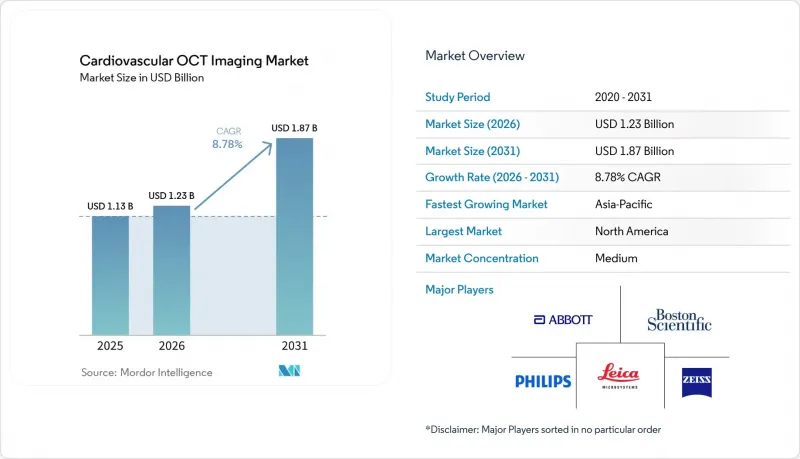
에 따르면 심혈관 OCT 이미징 시장 규모는 2025년 11억 3,000만 달러에서 2026년에는 12억 3,000만 달러로 확대하며, 2026-2031년에 CAGR 8.78%로 추이하며, 2031년에는 18억 7,000만 달러에 달할 것으로 예측됩니다.
전 세계 심혈관 OCT 이미징 시장의 동향 및 인사이트
복잡한 PCI 시술에서 혈관내 영상 기술의 활용 확대
복잡한 관상동맥 병변에 대한 OCT 유도 PCI가 점차 정착됨에 따라 심혈관 OCT 영상 시장은 성장세를 보이고 있습니다. 2025년에 실시된 13,751명의 환자를 대상으로 한 17건의 무작위 임상시험에 대한 네트워크 메타분석에 따르면 OCT 유도술은 혈관조영술 단독과 비교하여 주요 심혈관 유해사건을 37% 감소시키는 것으로 밝혀졌으며, 만성 완전 폐색, 좌주동맥 병변, 분지병변, 중증 석회화 등 모든 경우에서 일관된 결과가 나타났습니다. 2025년 ECLIPSE 연구에서는 중증 석회화 병변을 가진 2,005명의 환자가 등록되었으며, OCT 유도 하에서는 1년 후 표적 혈관 실패율이 7.7%였던 반면, 혈관조영술 단독 유도 하에서는 13.2%였던 것으로 보고되었습니다. 다지 병변, 다중 스텐트 삽입, 중증 석회화 병변을 동반한 복잡한 PCI 시술이 증가함에 따라 의료 기관들은 영상 진단 시스템에 대한 투자와 시술자 교육에 더욱 적극적인 의지를 보이고 있습니다.
AI를 활용한 스텐트 크기 결정 및 최적화
인공지능(AI)은 경험이 부족한 의사의 영상 해석 부담을 줄여줌으로써 심혈관 OCT 영상 시장의 잠재적 사용자층을 확대하고 있습니다. 2025년 연구에 따르면 애보트(Abbott)사의 AI 소프트웨어 ‘Ultreon’은 기존 OCT 소프트웨어에 비해 의사의 스텐트 직경 선택 정확도를 2.83배 향상시키고, 랜딩 존 평가 시의 편차를 줄인 것으로 밝혀졌습니다. 애보트사는 2026년 4월 28일, Ultreon 3.0에 대해 FDA의 510(k) 승인 및 CE 마크를 획득했습니다. 이 제품은 플라크 조직의 자동 특성 평가, 스텐트 크기 권장, 그리고 조영제 사용량을 최소화하거나 전혀 사용하지 않는 1초 풀백 기능을 제공합니다. 표준화된 워크플로우, 통합 보고 기능, 정합(co-registration), 그리고 소프트웨어 업데이트를 통해 병원 네트워크는 카테터 검사실 전반에 걸쳐 일관성을 높일 수 있습니다.
기존 OCT 워크플로우에서 조영제 사용 및 신장 관련 위험에 대한 우려
심혈관 OCT 영상 시장에서는 생리식염수 사용을 지원하는 근거와 카테터 검사실 프로토콜 간에 괴리가 나타납니다. 여러 번의 OCT 풀백이 수반되는 복잡한 시술의 경우, 진단용 혈관조영술과 병행할 때 200mL 이상의 요오드 조영제가 필요할 수 있으며, 이는 신장 기능 장애, 당뇨병 또는 심부전이 있는 환자에서 급성 신장 손상 위험을 높입니다. 대부분의 펠로우십 프로그램에서는 생리식염수를 이용한 OCT에 대한 표준화된 교육이 제공되지 않아, 시술자가 워크플로우에 숙달되는 데 한계가 있습니다. 지침 개정, 공급업체의 교육 지원, 그리고 각 기관별 프로토콜을 통해 조영제 사용을 최소화하는 관행이 확립될 때까지 병원 측은 상세한 영상 진단의 혜택을 받을 수 있는 환자들에게도 계속해서 OCT 시행을 자제할 가능성이 있습니다.
부문 분석
2025년, 혈관내 OCT 영상 시스템은 심혈관 OCT 영상 시장의 58.66%를 차지할 것으로 예상되며, 이는 카테터 검사실 하드웨어에 막대한 초기 투자가 필요함을 반영합니다. 병원은 일반적으로 수년에 걸친 서비스 계약, 소프트웨어 로드맵 및 임상 교육이 포함된 콘솔을 조달하므로 공급업체와의 관계 및 시스템 통합은 구매시 중요한 고려 사항이 됩니다. 이미 도입된 장비 기반이 존재하므로 교체 주기가 길고 전환 비용도 높습니다. OCT 영상 카테터는 가장 빠르게 성장하는 제품 카테고리로, PCI 시술 건수와 지속적인 수요에 힘입어 2031년까지 연평균 성장률(CAGR) 10.12%로 확대될 것으로 예측됩니다.
Gentuity사는 2025년 1월, 자사의 HF-OCT 이미징 시스템과 병용하는 ‘Vis-Rx PRIME’ 마이크로 이미징 카테트에 대해 FDA의 510(k) 승인을 획득했습니다. 1.8F의 얇은 직경 덕분에 사전 확장 없이도 중증 협착 혈관의 영상 촬영이 가능하며, 1초 만에 100mm의 관상동맥을 커버합니다. 액세서리 및 소모품은 연결 및 세척 워크플로우를 지원하며, 이에 대한 수요는 일반적으로 카테터 채택 추세를 따르는 경향이 있습니다. FDA 분류에 따르면 21 CFR 870.1200에 기반한 진단용 혈관내 카테터와 21 CFR 892.1560에 기반한 영상 시스템이 구분되며, 이는 소프트웨어 변경 요건 및 사전 결정 변경 관리 계획(PDCCP)의 적용 자격에 영향을 미칩니다.
2025년에는 주파수 영역 OCT 및 푸리에 영역 OCT가 47.76%의 점유율을 차지할 것으로 예상되며, 확립된 임상적 근거와 광범위한 상용화가 이를 지원했습니다. 그러나 지질이 풍부하거나 고도로 석회화된 플라크에 대한 침투가 제한적이며, 조영제 주입이 필요하다는 점 등이 여전히 주요 제약 요인으로 남아 있습니다. 고주파 OCT는 카테터 프로파일의 소형화와 혈관 준비 요건의 완화로 인해 2031년까지 연평균 성장률(CAGR) 9.80%로 성장할 것으로 예측됩니다. 또한 광주파수 영역 이미징은 대혈관 평가시 영상 획득 속도도 향상시킵니다.
Gentuity사의 HF-OCT 시스템은 1.8F 카테터 프로파일을 특징으로 하며, 기존 OCT 카테터로는 혈관 준비가 필요한 경우도 있는 사전 확장 전 협착 병변의 영상 촬영이 가능합니다. 필립스(Philips)는 2025년 12월 스펙트라웨이브(SpectraWAVE)를 인수하여, DeepOCT, 근적외선 분광법 및 X1-FFR 단일 혈관조영술 무선 FFR 기술을 결합한 HyperVue 시스템을 제품 라인업에 추가했습니다. Conavi Medical사는 2026년 4월, Novasight Hybrid System에 대해 FDA의 510(k) 승인을 획득했습니다. 이 시스템은 한 번의 후퇴 조작으로 IVUS와 OCT 이미지를 정렬하여 동시에 획득할 수 있게 해줍니다. 이러한 발전에 힘입어 심혈관 OCT 이미징 시장은 통합형 멀티모달 플랫폼으로 나아가고 있습니다.
지역별 분석
북미는 확립된 보험 환급 제도, 높은 카테터실 처리 능력, 그리고 임상 시험 참여에 힘입어 2025년 심혈관 OCT 이미징 시장 점유율의 39.44%를 차지했습니다. 미국에서는 연간 60만 건 이상의 PCI 시술이 이루어지고 있으며, 2025년 미국 지침에서 복잡한 병변에 대한 혈관내 영상 검사를 권장함에 따라 의료 기관에서의 도입이 더욱 확대되었습니다. 캐나다와 멕시코의 기여도는 비교적 낮았으나, 토론토와 몬트리올의 심장 센터에서는 미국의 임상 근거에 부합하는 진료 방식이 채택되었습니다. 유럽은 2위 지역 시장으로, 독일, 영국, 프랑스가 주도적인 역할을 했으나, 2024년 ESC 클래스 I, 레벨 A 권고에도 불구하고 보험 환급 제도에는 여전히 편차가 나타났습니다.
아시아태평양은 가장 빠르게 성장하는 지역으로, 심혈관 OCT 영상 시장은 2031년까지 연평균 성장률(CAGR) 11.88%로 확대될 것으로 예측됩니다. 일본에서는 국민건강보험 제도 하에서 혈관내 영상 검사에 대한 보험 적용이 이루어지고 있으며, 2025년 임상 지침에서는 석회화 평가 및 회전식 아테렉토미 수술 계획 수립을 위한 OCT 권장 사항이 제시되었습니다. 중국에서는 시술 건수의 증가에 힘입어 국내 OCT 공급업체가 등장한 반면, 한국과 인도에서는 카테터 검사실의 수용 능력이 확대되었습니다. 그러나 보험 환급, 규제 당국의 승인, 그리고 시술자 교육 현황에 차이가 있으며, 지역 전체의 도입 현황에는 여전히 큰 격차가 나타났습니다.
중동 및 아프리카 및 남미는 심혈관 OCT 영상 시장의 규모는 작지만 성장 여지가 있는 지역이었습니다. 사우디아라비아의 ‘비전 2030’은 리야드와 제다에 심장 센터 설립을 지원했으며, 두바이에서는 심장 의료 인프라가 확충되었습니다. 남아프리카는 사하라 이남 아프리카 지역의 도입을 주도했으나, 보험 환급 및 교육 측면의 제약은 여전히 남아 있었습니다. 브라질은 민관 협력 기반의 심혈관 의료 시스템과 상파울루 및 리우데자네이루에 위치한 주요 심장 센터를 통해 남미 지역의 도입을 주도했으나, 아르헨티나에서는 보급률이 낮았습니다. 시장 진입을 위해서는 ANVISA, INVIMA 및 SAHPRA의 요건을 준수해야 하며, 이로 인해 FDA 또는 CE 인증을 획득한 제품의 도입 일정이 장기화될 가능성이 있습니다.
기타 혜택:
- 엑셀 형식의 시장 예측(ME) 시트
- 3개월간의 애널리스트 지원
자주 묻는 질문
목차
제1장 서론
- 조사 전제조건과 시장 정의
- 조사 범위
제2장 조사 방법
제3장 개요
제4장 시장 구도
- 시장 개요
- 시장 성장 촉진요인
- 시장 성장 억제요인
- 밸류·공급망 분석
- 규제 상황
- 기술 전망
- Porter's Five Forces 분석
제5장 시장 규모와 성장 예측
- 제품 유형별
- 기술/ 이미징 아키텍처별
- 용도별
- 최종사용자별
- 지역별
- 북미
- 미국
- 캐나다
- 멕시코
- 유럽
- 독일
- 영국
- 프랑스
- 이탈리아
- 스페인
- 기타 유럽 국가
- 아시아태평양
- 중국
- 인도
- 일본
- 호주
- 한국
- 기타 아시아태평양 국가
- 중동 및 아프리카
- GCC
- 남아프리카공화국
- 기타 중동 및 아프리카 국가
- 남미
- 브라질
- 아르헨티나
- 기타 남미 국가
- 북미
제6장 경쟁 구도
- 시장 집중도
- 시장 점유율 분석
- 기업 개요
- Abbott Laboratories
- Boston Scientific Corporation
- Canon Medical Systems Corporation
- Carl Zeiss Meditec AG
- CONAVI Medical Inc.
- Forssmann Medical Technology Co., Ltd.
- Gentuity
- Heidelberg Engineering GmbH
- Koninklijke Philips N.V.
- Leica Microsystems GmbH
- LightLab Imaging, Inc.
- Medtronic plc
- MicroPort Scientific Corporation
- NIPRO CORPORATION
- Olympus Corporation
- Shenzhen Vivolight Medical Device & Technology Co., Ltd.
- SpectraWAVE, Inc.
- Terumo Corporation
- Thorlabs, Inc.
- TOPCON CORPORATION
제7장 시장 기회와 향후 전망
KSA 26.10.23According to Mordor Intelligence, the cardiovascular OCT imaging market size is expected to grow from USD 1.13 billion in 2025 to USD 1.23 billion in 2026 and is forecast to reach USD 1.87 billion by 2031 at 8.78% CAGR over 2026-2031.
Global Cardiovascular OCT Imaging Market Trends and Insights
Increasing Use of Intravascular Imaging in Complex PCI
The cardiovascular OCT imaging market is gaining traction as OCT-guided PCI becomes more established for complex coronary lesions. A 2025 network meta-analysis of 17 randomized trials involving 13,751 patients found that OCT guidance reduced major adverse cardiovascular events by 37% compared with angiography alone, with consistent outcomes across chronic total occlusions, left main disease, bifurcations, and severe calcification. The 2025 ECLIPSE trial enrolled 2,005 patients with severely calcified lesions and reported a 1-year target vessel failure rate of 7.7% with OCT guidance, compared with 13.2% with angiography guidance alone. As complex PCI procedures involving multivessel disease, multiple stents, and heavily calcified lesions increase, hospitals have stronger incentives to invest in imaging systems and operator training.
AI-Assisted Stent Sizing and Optimization
Artificial intelligence is expanding the potential user base for the cardiovascular OCT imaging market by reducing the interpretation burden on less experienced physicians. A 2025 study found that Abbott's Ultreon AI software improved physician accuracy in selecting stent diameter by a factor of 2.83 compared with conventional OCT software and reduced variation in landing-zone assessment. Abbott received FDA 510(k) clearance and CE Mark for Ultreon 3.0 on April 28, 2026, offering automated plaque tissue characterization, stent-size recommendations, and a 1-second pullback using low or zero contrast. Standardized workflows, integrated reporting, co-registration, and software updates can help hospital networks improve consistency across catheterization laboratories.
Contrast Use and Renal-Risk Concerns in Conventional OCT Workflows
The cardiovascular OCT imaging market faces a gap between evidence supporting saline use and catheterization laboratory protocols. Complex procedures involving multiple OCT pullbacks can require more than 200 mL of iodinated contrast when combined with diagnostic angiography, increasing acute kidney injury risk in patients with renal impairment, diabetes, or heart failure. Most fellowship programs do not offer standardized saline-based OCT training, limiting operator familiarity with the workflow. Hospitals may continue to avoid OCT for patients who could benefit from detailed imaging until guideline updates, vendor-supported education, and local protocols establish contrast-minimizing practices.
Other drivers and restraints analyzed in the detailed report include:
- Rising Cardiovascular Disease and Complex Lesion Burden
- Saline-Compatible and Low-Contrast OCT Workflows
- Procedure-Time, Training, Reimbursement, and Governance Variability
For complete list of drivers and restraints, kindly check the Table Of Contents.
Segment Analysis
Intravascular OCT imaging systems held 58.66% of the cardiovascular OCT imaging market in 2025, reflecting the high upfront investment required for catheterization laboratory hardware. Hospitals typically procure consoles with multiyear service agreements, software road maps, and clinical training, making vendor relationships and system integration key purchasing considerations. The installed base results in long replacement cycles and high switching costs. OCT imaging catheters are the fastest-growing product category and are projected to expand at a 10.12% CAGR through 2031, supported by PCI procedure volumes and recurring demand.
Gentuity received FDA 510(k) clearance in January 2025 for the Vis-Rx PRIME micro-imaging catheter for use with its HF-OCT imaging system. Its 1.8F profile enables imaging of severely stenotic vessels without pre-dilation and provides 100 mm of coronary coverage in 1 second. Accessories and consumables support connection and flushing workflows, with demand generally following catheter adoption. FDA classification distinguishes diagnostic intravascular catheters under 21 CFR 870.1200 from imaging systems under 21 CFR 892.1560, affecting software modification requirements and Predetermined Change Control Plan eligibility.
Frequency-domain OCT and Fourier-domain OCT held a 47.76% share in 2025, supported by an established clinical evidence base and broad commercial availability. However, limited penetration through lipid-rich or heavily calcified plaque and the need for contrast flushing remain key limitations. High-frequency OCT is projected to grow at a 9.80% CAGR through 2031, driven by smaller catheter profiles and reduced vessel-preparation requirements. Optical frequency-domain imaging also improves imaging speed for larger-vessel assessment.
Gentuity's HF-OCT system features a 1.8F catheter profile that images narrow lesions before pre-dilation, where conventional OCT catheters may require vessel preparation. Philips acquired SpectraWAVE in December 2025, adding the HyperVue system, which combines DeepOCT, near-infrared spectroscopy, and X1-FFR single-angiogram wire-free FFR technology. Conavi Medical received FDA 510(k) clearance in April 2026 for the Novasight Hybrid System, which supports co-registered, simultaneous IVUS and OCT imaging in a single pullback. These developments position the cardiovascular OCT imaging market toward integrated multimodal platforms.
Complete Report Scope:
- By Product Type
- Intravascular OCT Imaging Systems
- OCT Imaging Catheters
- Accessories and Consumables
- By Technology / Imaging Architecture
- Frequency-Domain OCT / Fourier-Domain OCT
- Optical Frequency Domain Imaging
- High-Frequency OCT
- OCT-NIRS Hybrid Imaging
- OCT-IVUS Hybrid Imaging
- By Application
- Pre-PCI Lesion and Vessel Assessment
- Stent Optimization
- Expansion Failure Assessment
- Plaque Characterization and Vulnerable Plaque Assessment
- Acute Coronary Syndrome and MINOCA Assessment
- By End User
- Hospitals and Tertiary Care Centers
- Ambulatory Surgical Centers
- Specialty Cardiology Clinics
- Academic and Research Institutes
- Others
- By Geography
- North America
- United States
- Canada
- Mexico
- Europe
- Germany
- United Kingdom
- France
- Italy
- Spain
- Rest of Europe
- Asia-Pacific
- China
- India
- Japan
- Australia
- South Korea
- Rest of Asia-Pacific
- Middle East and Africa
- GCC
- South Africa
- Rest of Middle East and Africa
- South America
- Brazil
- Argentina
- Rest of South America
- North America
Geography Analysis
North America held 39.44% of the cardiovascular OCT imaging market share in 2025, supported by established reimbursement systems, high catheterization laboratory capacity, and clinical trial participation. The United States performed more than 600,000 PCI procedures annually, and the 2025 U.S. guideline recommendation for intravascular imaging in complex lesions supported broader institutional adoption. Canada and Mexico were smaller contributors, while cardiac centers in Toronto and Montreal adopted practices aligned with U.S. clinical evidence. Europe was the second-largest regional market, led by Germany, the United Kingdom, and France, although reimbursement remained inconsistent despite the 2024 ESC Class I, Level A recommendation.
Asia-Pacific was the fastest-growing region, with the cardiovascular OCT imaging market projected to expand at a CAGR of 11.88% through 2031. Japan reimbursed intravascular imaging under its national health insurance system, and its 2025 clinical guidance provided OCT recommendations for calcium assessment and rotational atherectomy planning. China drove procedure-volume growth and saw the emergence of domestic OCT suppliers, while South Korea and India expanded catheterization laboratory capacity. However, uneven reimbursement, regulatory approvals, and operator training continued to create significant variation in adoption across the region.
The Middle East and Africa and South America represented smaller but improving opportunities for the cardiovascular OCT imaging market. Saudi Arabia's Vision 2030 supported cardiac center installations in Riyadh and Jeddah, while Dubai expanded cardiac care infrastructure; South Africa led adoption in Sub-Saharan Africa, although reimbursement and training limitations persisted. Brazil led South American adoption through its public-private cardiology system and major cardiac centers in Sao Paulo and Rio de Janeiro, while Argentina had lower penetration. Market entry required compliance with ANVISA, INVIMA, and SAHPRA requirements, which could extend the introduction timeline for FDA- or CE-certified products.
- Abbott Laboratories
- Boston Scientific
- Canon
- Carl Zeiss
- CONAVI Medical Inc.
- Forssmann Medical Technology Co., Ltd.
- Gentuity
- Heidelberg Engineering
- Koninklijke Philips
- Danaher
- LightLab Imaging, Inc.
- Medtronic
- MicroPort
- NIPRO CORPORATION
- Olympus
- Shenzhen Vivolight Medical Device & Technology Co., Ltd.
- SpectraWAVE, Inc.
- Terumo
- Thorlabs
- TOPCON CORPORATION
Additional Benefits:
- The market estimate (ME) sheet in Excel format
- 3 months of analyst support
TABLE OF CONTENTS
1 INTRODUCTION
- 1.1 Study Assumptions and Market Definition
- 1.2 Scope of the Study
2 RESEARCH METHODOLOGY
3 EXECUTIVE SUMMARY
4 MARKET LANDSCAPE
- 4.1 Market Overview
- 4.2 Market Drivers
- 4.2.1 Increasing Use of Intravascular Imaging in Complex PCI
- 4.2.2 AI-Assisted Stent Sizing and Optimization
- 4.2.3 Rising Cardiovascular Disease and Complex Lesion Burden
- 4.2.4 Saline-Compatible and Low-Contrast OCT Workflows
- 4.2.5 Cath-Lab Integration, Co-Registration, and Automated Reporting
- 4.3 Market Restraints
- 4.3.1 Contrast Use and Renal-Risk Concerns in Conventional OCT Workflows
- 4.3.2 Procedure-Time, Radiation, and Operator-Training Burden
- 4.3.3 Evidence, Reimbursement, and Governance Variability
- 4.4 Value / Supply-Chain Analysis
- 4.5 Regulatory Landscape
- 4.6 Technological Outlook
- 4.7 Porter's Five Forces Analysis
- 4.7.1 Threat of New Entrants
- 4.7.2 Bargaining Power of Suppliers
- 4.7.3 Bargaining Power of Buyers
- 4.7.4 Threat of Substitutes
- 4.7.5 Competitive Rivalry
5 MARKET SIZE AND GROWTH FORECASTS (VALUE, USD)
- 5.1 By Product Type
- 5.1.1 Intravascular OCT Imaging Systems
- 5.1.2 OCT Imaging Catheters
- 5.1.3 Accessories and Consumables
- 5.2 By Technology / Imaging Architecture
- 5.2.1 Frequency-Domain OCT / Fourier-Domain OCT
- 5.2.2 Optical Frequency Domain Imaging
- 5.2.3 High-Frequency OCT
- 5.2.4 OCT-NIRS Hybrid Imaging
- 5.2.5 OCT-IVUS Hybrid Imaging
- 5.3 By Application
- 5.3.1 Pre-PCI Lesion and Vessel Assessment
- 5.3.2 Stent Optimization
- 5.3.3 Expansion Failure Assessment
- 5.3.4 Plaque Characterization and Vulnerable Plaque Assessment
- 5.3.5 Acute Coronary Syndrome and MINOCA Assessment
- 5.4 By End User
- 5.4.1 Hospitals and Tertiary Care Centers
- 5.4.2 Ambulatory Surgical Centers
- 5.4.3 Specialty Cardiology Clinics
- 5.4.4 Academic and Research Institutes
- 5.4.5 Others
- 5.5 By Geography
- 5.5.1 North America
- 5.5.1.1 United States
- 5.5.1.2 Canada
- 5.5.1.3 Mexico
- 5.5.2 Europe
- 5.5.2.1 Germany
- 5.5.2.2 United Kingdom
- 5.5.2.3 France
- 5.5.2.4 Italy
- 5.5.2.5 Spain
- 5.5.2.6 Rest of Europe
- 5.5.3 Asia-Pacific
- 5.5.3.1 China
- 5.5.3.2 India
- 5.5.3.3 Japan
- 5.5.3.4 Australia
- 5.5.3.5 South Korea
- 5.5.3.6 Rest of Asia-Pacific
- 5.5.4 Middle East and Africa
- 5.5.4.1 GCC
- 5.5.4.2 South Africa
- 5.5.4.3 Rest of Middle East and Africa
- 5.5.5 South America
- 5.5.5.1 Brazil
- 5.5.5.2 Argentina
- 5.5.5.3 Rest of South America
- 5.5.1 North America
6 COMPETITIVE LANDSCAPE
- 6.1 Market Concentration
- 6.2 Market Share Analysis
- 6.3 Company Profiles (includes Global Level Overview, Market Level Overview, Core Segments, Financials as available, Strategic Information, Market Rank/Share, Products and Services, Recent Developments)
- 6.3.1 Abbott Laboratories
- 6.3.2 Boston Scientific Corporation
- 6.3.3 Canon Medical Systems Corporation
- 6.3.4 Carl Zeiss Meditec AG
- 6.3.5 CONAVI Medical Inc.
- 6.3.6 Forssmann Medical Technology Co., Ltd.
- 6.3.7 Gentuity
- 6.3.8 Heidelberg Engineering GmbH
- 6.3.9 Koninklijke Philips N.V.
- 6.3.10 Leica Microsystems GmbH
- 6.3.11 LightLab Imaging, Inc.
- 6.3.12 Medtronic plc
- 6.3.13 MicroPort Scientific Corporation
- 6.3.14 NIPRO CORPORATION
- 6.3.15 Olympus Corporation
- 6.3.16 Shenzhen Vivolight Medical Device & Technology Co., Ltd.
- 6.3.17 SpectraWAVE, Inc.
- 6.3.18 Terumo Corporation
- 6.3.19 Thorlabs, Inc.
- 6.3.20 TOPCON CORPORATION
7 MARKET OPPORTUNITIES AND FUTURE OUTLOOK
- 7.1 White-Space and Unmet-Need Assessment


