

|
시장보고서
상품코드
2154378
추진제 : 시장 점유율 분석, 업계 동향과 통계, 성장 예측(2026-2031년)Propellant - Market Share Analysis, Industry Trends & Statistics, Growth Forecasts (2026 - 2031) |
||||||
 Mordor Intelligence
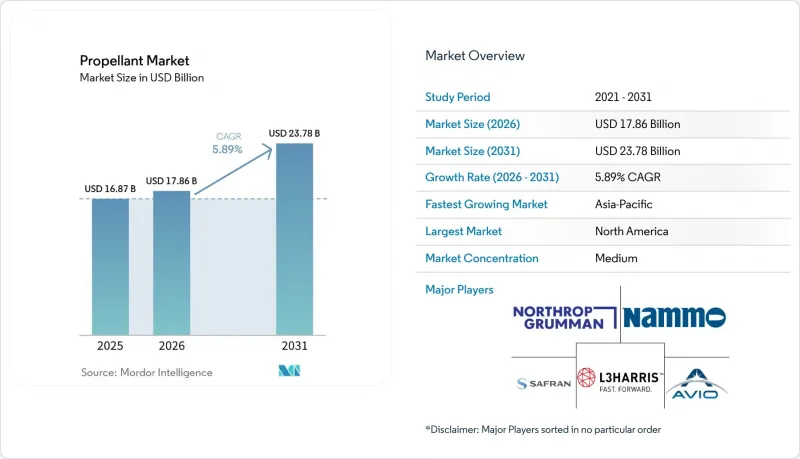
에 따르면 추진제 시장 규모는 2025년에 168억 7,000만 달러로 평가되며, 2026년 178억 6,000만 달러에서 2031년까지 237억 8,000만 달러에 달할 것으로 예측되고 있으며, 예측 기간(2026-2031년)에 CAGR은 5.89%에 달할 전망입니다.
전 세계 추진제 시장의 동향 및 인사이트
상업용 발사 및 위성 군집 프로그램의 확대
상업용 위성 군집은 발사 빈도를 높이고 있으며, 이는 추진제 시장에 더 지속가능한 수요 기반을 창출하고 있습니다. Amazon Leo는 100회 이상의 발사 계약을 확보했으며, 연방통신위원회(FCC)의 요건을 충족하기 위해 전개 2년 차에는 20회 이상의 임무를 수행할 계획입니다. 중국의 ‘국망(Guowang)’ 및 ‘천판(Qianfan)’ 프로그램은 총 28,000기 이상의 위성을 발사하는 것을 목표로 하고 있으며, 이로 인해 발사 서비스 및 관련 추진제 공급에 대한 수요가 증가하고 있습니다. 또한 발사 사업자 입장에서는 발사 현장과 가까운 곳에서 저장, 운송, 처리 능력을 확보해야 한다는 압박도 커지고 있습니다. 발사 빈도의 증가로 인해 특히 대량의 극저온 유체를 사용하는 대형 로켓 시스템의 경우, 추진제 보급이 운영상의 제약 요인이 될 가능성이 있습니다. 이러한 수요로 인해 생산 및 물류를 발사 인프라와 통합할 수 있는 공급업체가 유리한 입장에 서게 됩니다.
재사용 발사체의 도입과 신속한 운영 주기
재사용 발사체은 1기당 임무 빈도를 높일 수 있으므로 추진제 처리 능력을 향상시킬 수 있습니다. 스페이스X(SpaceX)는 2025년에 ‘팔콘 9’ 부스터의 9일 터너라운드(턴어라운드)를 달성했으며, 상업 운영에서는 20-30일의 터너라운드 간격을 일반적인 운영 패턴으로 채택했습니다. 스페이스X는 2025년까지 스타십에 150억 달러 이상을 투자하고, 플로리다주의 발사대, 처리 시설, 추진제 인프라에 최소 18억 달러를 추가로 투자하겠다고 발표했습니다. 이러한 투자는 로켓 재사용을 통해 대용량 지상 시스템 및 신뢰성 높은 공급 체계에 대한 지출이 촉진될 것임을 시사합니다. 린데(Linde)사는 스타베이스(Starbase)의 운영을 지원하기 위해 텍사스주 브라운스빌에 1억 달러 규모의 액체 산소·액체 질소 시설을 건설할 것이라고 발표했습니다. 따라서 추진제 시장은 발사 횟수의 증가뿐만 아니라, 짧은 턴어라운드 타임을 지원하기 위해 필요한 인프라로부터도 혜택을 받게 될 것입니다.
첨단 적격성 평가, 안전성 시험 및 인증에 소요되는 비용
추진제 시장에서 추진제의 인증은 여전히 뿌리 깊은 비용 장벽으로 남아 있습니다. 새로운 배합의 경우, 일반적으로 상업 프로그램이나 정부 프로그램이 운영 위험을 수용하기 전에 구성 부품 시험, 시스템 통합 검증 및 비행 실적이 필요합니다. ‘Advanced Spacecraft Energetic Non-Toxic’ 프로그램은 미국 공군 연구소(AFRL)의 선행 연구를 거쳐, ‘Green Propulsion Dual Mode’ 임무를 통해 기술 준비도 수준 7(TRL 7) 달성을 목표로 하고 있습니다. 또한 안전성 시험을 위해서는 전용 시설, 훈련을 받은 인력, 출입 금지 구역, 그리고 상세한 위험성 관련 문서화도 필요합니다. 노스롭 그루먼사와 L3 해리스 테크놀러지스는 확립된 인증 실적을 바탕으로 신규 프로그램에서의 재인증 요건을 완화할 수 있으며, 우위를 유지하고 있습니다. 적층 제조 분야에 진출하는 기업은 과거의 인증 데이터를 활용할 수 있을 가능성이 있지만, 3D 프린팅된 추진제의 형상이 수용되기까지는 기술적 및 절차적 측면에서 여전히 높은 장벽이 존재합니다.
부문 분석
2025년, 액체 추진제는 추진제 시장 점유율의 44.13%를 차지했습니다. 이는 궤도 발사 로켓에는 제어 가능한 추력, 재점화 능력 및 높은 비추력이 요구되기 때문입니다. 이러한 특성 덕분에 임무 제어 요건이 까다로운 상단 로켓이나 우주 공간에서의 추진에 액체 추진제의 사용이 지원되고 있습니다. 고체 추진제는 1단 부스터, 전술 미사일, 에어백용 인플레이터에 사용됩니다. AVIO SPA와 ArianeGroup은 2026년 6월 아리안 64에서 P160C의 운용을 시작할 예정이며, 이 부스터 세트는 156메트릭톤의 추진제를 탑재하고 있습니다. 또한 에어로졸 추진제는 소비재 및 의약품 분야에서도 활용되고 있으며, 이에 따라 추진제 시장의 수요는 발사 및 방위 프로그램의 범위를 넘어 확대되고 있습니다.
하이브리드 추진제는 2031년까지 연평균 성장률(CAGR) 6.73%로 성장할 것으로 예측됩니다. 미국 항공우주국(NASA)의 마셜 우주비행센터는 달 착륙 시의 분사 흐름에 관한 연구를 위해 2025년에 3D 프린팅된 하이브리드 로켓 모터의 핫파이어 시험을 30회 이상 시행했습니다. 또한 파이어호크 에어로스페이스(Firehawk Aerospace)는 미 육군 응용연구소의 지원하에 적층 제조 기술을 이용하여 제조된 ‘유도형 다연장 로켓 시스템(GMLS)’급 하이브리드 엔진 시스템의 비행 시험을 완료했습니다. 이온 액체 및 과산화수소를 기반으로 한 이 시스템은 미국 공군의 사격장 안전 기준 및 군사 규격 882E의 요건에 따라 히드라진보다 낮은 위험 등급을 받을 수 있습니다. 콜드 가스, 가스 발생 장치 및 화약의 배합은 자세 제어, 자동차 안전 및 산업용 가스 발생 용도에서 계속해서 활용되고 있습니다.
지역별 분석
북미는 미국 국방 예산과 빈번한 상업용 발사 생태계의 지원을 받아 2025년 추진제 시장 점유율의 38.27%를 차지했습니다. 노스롭 그루먼은 2027년까지 웨스트버지니아주 알레게니 탄도 연구소에서 전술용 고체 로켓 모터의 생산 능력을 3배로 확대할 계획입니다. 스페이스X의 18억 달러 규모 플로리다주 확장 계획과 린데의 1억 달러 규모 브라운스빌 시설은 발사 관련 인프라에 대한 투자 규모를 보여줍니다. 캐나다는 북대서양조약기구(NATO)에 대한 기여와 보다 친환경적인 배합에 초점을 맞춘 항공우주 활동을 통해 시장에 기여하고 있습니다. 멕시코는 추진제 시장에서 떠오르는 하류 제조 거점으로 자리매김하고 있습니다.
아시아태평양은 2031년까지 연평균 성장률(CAGR) 6.87%로 성장할 것으로 예측되며, 이는 추진제 시장에서 지역별 가장 높은 성장률입니다. 중국은 2025년에 92회의 궤도 투입 발사를 완료하고, 하이난섬에서 상업용 우주항 인프라를 확충하고 있습니다. 중국에서는 2026년 말까지 발사대 2기가 추가로 가동될 전망이며, 이에 따라 액체 추진제의 수요가 증가할 가능성이 있습니다. 2026-2030년의 중국의 ‘제15차 5개년 계획’에서는 재사용 가능한 대형 발사체가 국가 개발의 우선 과제로 자리매김하고 있습니다. 인도의 민간 우주 부문도 확대되고 있으며, Astrobase Space Technologies사는 800킬로뉴턴의 추력을 발생시키는 풀플로우 방식의 단계 연소형 액체 산소·메탄 엔진을 발표했습니다.
유럽의 추진제 시장은 아리안 6 계획과 그 산업 생태계에 의해 지원되고 있습니다. 아리안 그룹과 AVIO SPA가 50대 50으로 출자한 합작 회사인 유로프로펠션은 2025년 12월에 P160C 인증을 획득하고, 2026년 6월에 운영을 시작했습니다. 아리안 그룹은 발사 빈도 증가에 따라 툴루즈의 과염소산 암모늄 생산 능력을 60% 이상 확대하고 있습니다. 남미는 브라질의 상업 우주 계획 및 아르헨티나의 국방 현대화 활동과 관련이 있습니다. 중동 및 아프리카는 사우디아라비아의 ‘비전 2030’에 따른 항공우주 투자와 남아프리카공화국의 방위 산업 기반에 의해 지원되고 있습니다.
기타 혜택:
- 엑셀 형식의 시장 예측(ME) 시트
- 3개월간의 애널리스트 지원
자주 묻는 질문
목차
제1장 서론
- 조사 전제조건과 시장 정의
- 조사 범위
제2장 조사 방법
제3장 개요
제4장 시장 구도
- 시장 개요
- 시장 성장 촉진요인
- 시장 성장 억제요인
- 밸류체인 분석
- Porter's Five Forces 분석
제5장 시장 규모와 성장 예측
- 추진제 유형별
- 용도별
- 최종 용도 산업별
- 지역별
- 아시아태평양
- 중국
- 인도
- 일본
- 한국
- ASEAN 국가
- 기타 아시아태평양 국가
- 북미
- 미국
- 캐나다
- 멕시코
- 유럽
- 독일
- 영국
- 프랑스
- 이탈리아
- 북유럽 국가
- 러시아
- 기타 유럽 국가
- 남미
- 브라질
- 아르헨티나
- 기타 남미 국가
- 중동 및 아프리카
- 사우디아라비아
- 남아프리카공화국
- 기타 중동 및 아프리카 국가
- 아시아태평양
제6장 경쟁 구도
- 시장 집중도
- 전략적 동향
- 시장 점유율·순위 분석
- 기업 개요
- ArianeGroup
- AVIO SPA
- Blue Origin Enterprises, L.P.
- Busek Co. Inc.
- Exotrail
- IHI AEROSPACE Co., Ltd.
- L3Harris Technologies, Inc.
- Lockheed Martin Corporation
- Moog Inc.
- Nammo AS
- Northrop Grumman
- Safran S.A.
- SpaceX
- Ursa Major Technologies, Inc.
제7장 시장 기회와 향후 전망
KSA 26.10.23According to Mordor Intelligence, the propellant market size was valued at USD 16.87 billion in 2025 and is estimated to grow from USD 17.86 billion in 2026 to reach USD 23.78 billion by 2031, at a CAGR of 5.89% during the forecast period (2026-2031).
Global Propellant Market Trends and Insights
Expansion of Commercial Launch and Satellite Constellation Programs
Commercial satellite constellations are increasing launch frequency and creating a more sustained demand base for the propellant market. Amazon Leo secured contracts for more than 100 launches and plans to exceed 20 missions in its second deployment year to meet Federal Communications Commission requirements. China's Guowang and Qianfan programs target more than 28,000 satellites combined, which has increased the need for launch services and related propellant supply. Launch providers also face greater pressure to secure storage, transport, and processing capacity close to launch sites. Higher launch cadence can make propellant resupply a limiting operational factor, particularly for heavy-lift systems that use large volumes of cryogenic fluids. This need favors suppliers that can integrate production and logistics with launch infrastructure.
Adoption of Reusable Launch Vehicles and Rapid-Turnaround Operations
Reusable launch vehicles can increase propellant throughput because each vehicle can support more frequent missions. SpaceX achieved a 9-day Falcon 9 booster turnaround in 2025, and its commercial operations used 20-30-day turnaround intervals as a regular operating pattern. SpaceX invested more than USD 15 billion in Starship by 2025 and announced a further minimum USD 1.8 billion investment in Florida launchpads, processing facilities, and propellant infrastructure. This investment shows how vehicle reuse can move spending toward high-capacity ground systems and dependable supply arrangements. Linde announced a USD 100 million liquid oxygen and nitrogen facility in Brownsville, Texas, to support Starbase operations. The propellant market, therefore, benefits not only from more launches but also from the infrastructure required to support short turnaround times.
High Qualification, Safety Testing, and Certification Costs
Energetic material qualification remains a durable cost barrier in the propellant market. New formulations usually require component testing, system integration validation, and flight heritage before commercial or government programs accept operational risk. The Advanced Spacecraft Energetic Non-Toxic program is targeting Technology Readiness Level 7 through the Green Propulsion Dual Mode mission after earlier work at the U.S. Air Force Research Laboratory. Safety testing also requires specialized facilities, trained personnel, exclusion zones, and extensive hazard documentation. Northrop Grumman and L3Harris Technologies, Inc. retain an advantage because their established qualification portfolios can reduce recertification requirements for new programs. Additive manufacturing entrants may use prior qualification data, but acceptance of 3D-printed propellant geometries remains technically and procedurally demanding.
Other drivers and restraints analyzed in the detailed report include:
- Government-Funded Missile Modernization and Hypersonic Systems
- Transition Toward Green and Lower-Toxicity Propellants
- Cryogenic Infrastructure and Energetic-Material Supply Bottlenecks
For complete list of drivers and restraints, kindly check the Table Of Contents.
Segment Analysis
Liquid propellants held 44.13% of the propellant market share in 2025 because orbital launch vehicles require controllable thrust, restart capability, and high specific impulse. These characteristics support their use in upper stages and in-space propulsion, where mission control requirements are demanding. Solid propellants are used in first-stage boosters, tactical missiles, and airbag inflators. AVIO SPA and ArianeGroup introduced the P160C operationally on Ariane 64 in June 2026, and the booster set carries 156 metric tons of propellant. Aerosol propellants also support consumer goods and pharmaceutical applications, which gives the propellant market demand beyond launch and defense programs.
Hybrid propellants are projected to advance at a 6.73% CAGR through 2031. The National Aeronautics and Space Administration's Marshall Space Flight Center conducted more than 30 hot-fire tests of a 3D-printed hybrid rocket motor in 2025 for lunar landing plume studies. Firehawk Aerospace also completed a flight test of an additively manufactured Guided Multiple Launch Rocket System-class hybrid engine system under U.S. Army Applications Laboratory support. Ionic-liquid and hydrogen-peroxide-based systems can receive lower hazard classifications than hydrazine under U.S. Air Force Range Safety and Military Standard 882E requirements. Cold-gas, gas-generator, and pyrotechnic formulations continue to support attitude control, automotive safety, and industrial gas-generation uses.
Complete Report Scope:
- By Propellant Type
- Liquid Propellants
- Solid Propellants
- Aerosol Propellants
- Hybrid Propellants
- Other Propellant Types (Cold-Gas Propellants, Gas-Generator and Pyrotechnic Propellants)
- By Application
- Space Launch Vehicles
- Missiles and Defense Systems
- Satellite Propulsion
- Automotive Airbags and Safety Systems
- Aerosol Products
- Other Applications (Industrial Gas Generators and Pyrotechnics)
- By End-Use Industry
- Aerospace and Defense
- Consumer Goods
- Automotive
- Other End-Use Industries (Industrial, Research, Mining and Energy)
- By Geography
- Asia-Pacific
- China
- India
- Japan
- South Korea
- ASEAN Countries
- Rest of Asia-Pacific
- North America
- United States
- Canada
- Mexico
- Europe
- Germany
- United Kingdom
- France
- Italy
- NORDIC Countries
- Russia
- Rest of Europe
- South America
- Brazil
- Argentina
- Rest of South America
- Middle-East and Africa
- Saudi Arabia
- South Africa
- Rest of Middle-East and Africa
- Asia-Pacific
Geography Analysis
North America held 38.27% of the propellant market share in 2025, supported by the United States defense budget and its high-frequency commercial launch ecosystem. Northrop Grumman plans to triple tactical solid rocket motor production capacity at the Allegany Ballistics Laboratory in West Virginia by 2027. SpaceX's USD 1.8 billion Florida expansion and Linde's USD 100 million Brownsville facility indicate the scale of launch-related infrastructure investment. Canada contributes through North Atlantic Treaty Organization commitments and aerospace activity focused on cleaner formulations. Mexico is an emerging downstream manufacturing location for the propellant market.
Asia-Pacific is projected to advance at a 6.87% CAGR through 2031, the highest regional growth rate in the propellant market. China completed 92 orbital launches in 2025 and is expanding commercial spaceport infrastructure at Hainan. The country expects 2 additional launch pads to become launch-capable by the end of 2026, which may increase liquid-propellant demand. China's Fifteenth Five-Year Plan for 2026-2030 identifies reusable heavy lift launch vehicles as a national development priority. India's private space sector is also expanding, with Astrobase Space Technologies unveiling a full-flow staged-combustion liquid oxygen-methane engine producing 800 kilonewtons of thrust.
Europe's propellant market is supported by the Ariane 6 program and its industrial ecosystem. Europropulsion, a 50-50 joint venture of ArianeGroup and AVIO SPA, qualified the P160C in December 2025 and introduced it operationally in June 2026. ArianeGroup is expanding Toulouse ammonium perchlorate capacity by more than 60% as launch rates rise. South America is associated with Brazil's commercial space plans and Argentina's defense modernization activity. The Middle-East and Africa are supported by Saudi Arabia's Vision 2030 aerospace investments and South Africa's defense industrial base.
- ArianeGroup
- AVIO SPA
- Blue Origin Enterprises, L.P.
- Busek Co. Inc.
- Exotrail
- IHI AEROSPACE Co., Ltd.
- L3Harris Technologies, Inc.
- Lockheed Martin Corporation
- Moog Inc.
- Nammo AS
- Northrop Grumman
- Safran S.A.
- SpaceX
- Ursa Major Technologies, Inc.
Additional Benefits:
- The market estimate (ME) sheet in Excel format
- 3 months of analyst support
TABLE OF CONTENTS
1 Introduction
- 1.1 Study Assumptions and Market Definition
- 1.2 Scope of the Study
2 Research Methodology
3 Executive Summary
4 Market Landscape
- 4.1 Market Overview
- 4.2 Market Drivers
- 4.2.1 Expansion of Commercial Launch and Satellite Constellation Programs
- 4.2.2 Adoption of Reusable Launch Vehicles and Rapid-Turnaround Operations
- 4.2.3 Government-Funded Missile Modernization and Hypersonic Systems
- 4.2.4 Transition Toward Green and Lower-Toxicity Propellants
- 4.2.5 Responsive Spacecraft Maneuvering and In-Orbit Servicing
- 4.2.6 Domestic Propulsion Capacity and Additive Manufacturing Investments
- 4.3 Market Restraints
- 4.3.1 High Qualification, Safety Testing, and Certification Costs
- 4.3.2 Cryogenic Infrastructure and Energetic-Material Supply Bottlenecks
- 4.3.3 Export Controls and Technology-Transfer Restrictions
- 4.3.4 Limited Flight Heritage and Material Compatibility of Alternative Propellants
- 4.4 Value Chain Analysis
- 4.5 Porter's Five Forces Analysis
- 4.5.1 Threat of New Entrants
- 4.5.2 Bargaining Power of Suppliers
- 4.5.3 Bargaining Power of Buyers
- 4.5.4 Threat of Substitutes
- 4.5.5 Competitive Rivalry
5 Market Size and Growth Forecasts (Value)
- 5.1 By Propellant Type
- 5.1.1 Liquid Propellants
- 5.1.2 Solid Propellants
- 5.1.3 Aerosol Propellants
- 5.1.4 Hybrid Propellants
- 5.1.5 Other Propellant Types (Cold-Gas Propellants, Gas-Generator and Pyrotechnic Propellants)
- 5.2 By Application
- 5.2.1 Space Launch Vehicles
- 5.2.2 Missiles and Defense Systems
- 5.2.3 Satellite Propulsion
- 5.2.4 Automotive Airbags and Safety Systems
- 5.2.5 Aerosol Products
- 5.2.6 Other Applications (Industrial Gas Generators and Pyrotechnics)
- 5.3 By End-Use Industry
- 5.3.1 Aerospace and Defense
- 5.3.2 Consumer Goods
- 5.3.3 Automotive
- 5.3.4 Other End-Use Industries (Industrial, Research, Mining and Energy)
- 5.4 By Geography
- 5.4.1 Asia-Pacific
- 5.4.1.1 China
- 5.4.1.2 India
- 5.4.1.3 Japan
- 5.4.1.4 South Korea
- 5.4.1.5 ASEAN Countries
- 5.4.1.6 Rest of Asia-Pacific
- 5.4.2 North America
- 5.4.2.1 United States
- 5.4.2.2 Canada
- 5.4.2.3 Mexico
- 5.4.3 Europe
- 5.4.3.1 Germany
- 5.4.3.2 United Kingdom
- 5.4.3.3 France
- 5.4.3.4 Italy
- 5.4.3.5 NORDIC Countries
- 5.4.3.6 Russia
- 5.4.3.7 Rest of Europe
- 5.4.4 South America
- 5.4.4.1 Brazil
- 5.4.4.2 Argentina
- 5.4.4.3 Rest of South America
- 5.4.5 Middle-East and Africa
- 5.4.5.1 Saudi Arabia
- 5.4.5.2 South Africa
- 5.4.5.3 Rest of Middle-East and Africa
- 5.4.1 Asia-Pacific
6 Competitive Landscape
- 6.1 Market Concentration
- 6.2 Strategic Moves
- 6.3 Market Share (%)/Ranking Analysis
- 6.4 Company Profiles (includes Global Overview, Market Overview, Core Segments, Financials as available, Strategic Information, Products and Services, and Recent Developments)
- 6.4.1 ArianeGroup
- 6.4.2 AVIO SPA
- 6.4.3 Blue Origin Enterprises, L.P.
- 6.4.4 Busek Co. Inc.
- 6.4.5 Exotrail
- 6.4.6 IHI AEROSPACE Co., Ltd.
- 6.4.7 L3Harris Technologies, Inc.
- 6.4.8 Lockheed Martin Corporation
- 6.4.9 Moog Inc.
- 6.4.10 Nammo AS
- 6.4.11 Northrop Grumman
- 6.4.12 Safran S.A.
- 6.4.13 SpaceX
- 6.4.14 Ursa Major Technologies, Inc.
7 Market Opportunities and Future Outlook
- 7.1 White-Space and Unmet-Need Assessment


