

|
시장보고서
상품코드
2154434
디지털 교정 치과 : 시장 점유율 분석, 업계 동향과 통계, 성장 예측(2026-2031년)Digital Orthodontics - Market Share Analysis, Industry Trends & Statistics, Growth Forecasts (2026 - 2031) |
||||||
 Mordor Intelligence
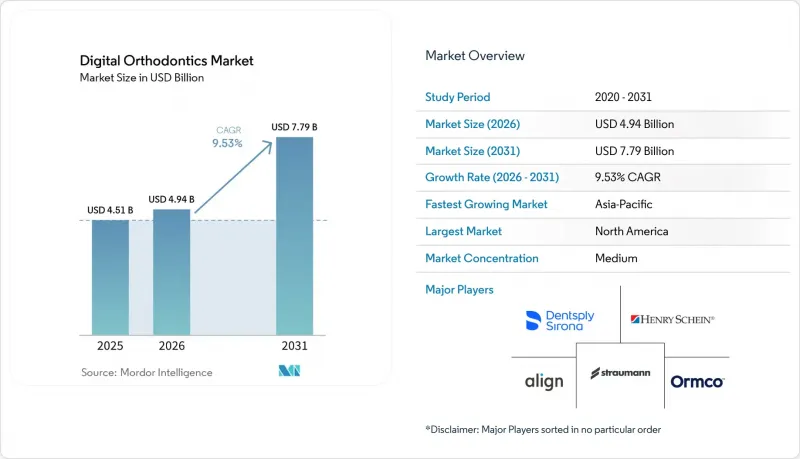
에 따르면 디지털 교정 치과 시장 규모는 2025년에 45억 1,000만 달러로 평가되며, 2026년 49억 4,000만 달러에서 2031년까지 77억 9,000만 달러에 달할 것으로 예측되고 있으며, 예측 기간(2026-2031년)에 CAGR은 9.53%에 달할 전망입니다.
글로벌 디지털 교정 치과 시장의 동향 및 인사이트
투명교정 치료의 보급 확대
투명교정 치료의 대상 환자층이 확대됨에 따라 디지털 교정 시장은 성장했습니다. 얼라인 테크놀러지(Align Technology)는 2025년, 10대 청소년 및 성장기 어린이를 위한 ‘인비절라인(Invisalign)’을 93만 5,800건 출하하여 2024년 대비 7.8% 증가했습니다. 한편, 성인용 케이스 수는 2025년 4분기에 8% 증가했습니다. 영국 교정 치과의사의 70% 이상이 지난 3년간 성인 환자의 수요가 증가했다고 보고했습니다. 일반 치과의사들은 교정 치과의사의 감독 하에 진행되는 프로그램을 통해 치료 접근성을 확대했으며, 얼라인 테크놀러지사는 2025년 4분기 일반 치과의사 채널에서 전년 대비 5.3%의 성장을 기록했습니다. 원격 모니터링, AI를 활용한 치료 계획, 그리고 구독형 서비스 제공을 통해 얼라이너 사례를 관리하는 데 필요한 인프라 부담이 경감되었습니다.
구강내 스캐너 보급률 향상
선진국에서 구강내 스캐너가 진료의 표준 인프라로 자리 잡으면서 시장은 그 혜택을 누렸습니다. 2025년에는 전 세계 스캐너 도입률이 35%에 달할 것으로 예상되며, 신흥 시장에는 여전히 큰 성장 여지가 남아 있습니다. 한편, 3Shape사는 2,650만 건의 환자 스캔을 기록했으며, 스캔 사례 수는 2024년 대비 39% 증가했습니다. STL 형식의 개방형 데이터 내보내기 기능을 갖춘 저가형 한국 및 중국산 스캐너는 디지털 워크플로우에 대한 접근성을 개선하는 동시에, 하이엔드 시장에서의 경쟁을 심화시켰습니다. 디지털 인상 덕분에 기존 방식에 대한 의존도가 낮아졌으며, 재사용 가능한 스캔 데이터가 진단, 치료 계획, 경과 관찰 및 후속 치료 방침 결정에 도움을 주었습니다.
스캐너, 소프트웨어, 3D 프린팅 인프라에 드는 고액의 초기 비용
디지털 교정 시장에서는 완전한 디지털 워크플로우의 초기 비용이 높기 때문에 도입 장벽에 직면해 있습니다. 스캐너, 치료 계획 소프트웨어 라이선스, 병원용 3D 프린터 및 인증된 재료에는 3만-5만 달러의 초기 투자가 필요하며, 특히 남아시아, 동남아시아, 라틴아메리카의 지방 도시에 위치한 의사 1명만 근무하는 진료소에 큰 영향을 미치고 있습니다. EU 의료기기 규정 및 FDA 510(k) 절차에 대한 규제 준수는 비용을 더욱 상승시킵니다. 모듈식 도입 모델을 채택하면, 클리닉은 원내 프린팅에 투자하기 전에 스캔 및 클라우드 기반 계획부터 시작할 수 있습니다.
부문 분석
2025년, 투명교정는 제품 유형별 매출의 49.88%를 차지하며 디지털 교정 시장의 주요 카테고리가 되었습니다. Align Technology는 사상 최대인 261만 1,000건의 인비절라인(Invisalign) 케이스 출하와 누적 2,200만 명 이상의 환자 수를 바탕으로, 투명 교정기의 순매출으로 32억 4,500만 달러를 보고했습니다. 스캔, 치료 계획, 얼라이너 제공을 연계하는 통합 플랫폼이 이 부문의 입지를 더욱 공고히 하고 있습니다.
구강내 스캐너는 2031년까지 연평균 성장률(CAGR)이 10.55%에 달하며, 가장 빠르게 성장하는 제품 하위 부문이 될 것으로 예측됩니다. Medit, 3Shape 및 Dentsply Sirona는 IDS 2025에서 스캐너 모델의 신제품 발표 및 업그레이드를 통해 이미 도입된 장비의 기능 강화를 도모했습니다. 디지털 치료 계획 소프트웨어, CAD/CAM 교정 장치 및 제조 시스템은 추가적인 수입원이 되고 있습니다. LuxCreo사와 Graphy사의 FDA 승인을 받은 다이렉트 프린팅용 얼라이너 수지는 3D 프린터 수요를 지원하고 있으며, 한편 LuxCreo사가 2025년 10월 Angelalign Technology사와 체결한 제휴를 통해 소재 개발과 임상 규모의 실증 및 데이터 수집이 통합되었습니다.
2025년에는 광학식 구강내 스캔이 기술 수익의 34.55%를 차지하며, 디지털 교정 시장에서 주요 데이터 수집 수단으로서의 입지를 확고히 했습니다. 3Shape는 IDS 2025에서 TRIOS 6을 발표했는데, 기존 TRIOS 모델에 비해 스캔 해상도가 최대 110% 향상되었으며, 하이퍼스펙트럼 이미징이 통합되었습니다. Medit사는 스캔 깊이를 확대하고 속도와 정확도를 향상시킨 ‘i900 Classic’을 출시했습니다. 한편, Dentsply Sirona사는 ‘Primescan 2’에서 대역폭 사용량을 50% 줄이고 ‘SureSmile’의 시뮬레이션 속도를 90% 향상시켰다고 보고했습니다.
CAD/CAM은 2031년까지 연평균 성장률(CAGR)이 11.56%에 달할 것으로 예측되며, 가장 빠르게 성장하는 기술 하위 부문이 될 전망입니다. 원내 밀링, 클라우드 기반 설계 플랫폼, 그리고 다이렉트 프린트 시스템의 통합이 이러한 성장을 지원하고 있습니다. 콘빔 CT, 3D 안면 스캔, AI를 활용한 랜드마크 감지를 통해 수작업 판정의 필요성이 줄어들고 있습니다. 2026년 2월, 3Shape사는 EU 및 EEA 지역에서 해당 TRIOS 6 스캐너를 대상으로 완전한 하이퍼스펙트럼 이미징 기능을 제공하기 시작했습니다. 여기에는 충치, 마모, 치은 퇴축 및 치태에 대한 AI 지원 시각화가 포함됩니다.
지역별 분석
북미는 성숙한 교정치과 수요와 잘 구축된 치과 서비스 조직 네트워크에 힘입어 2025년 매출의 39.56%를 차지했습니다. AAO(미국 교정치과의사협회) 보고서에 따르면 2024년 회원 1인당 활성 환자 수는 696명으로, 해당 조사 사상 최고 환자 수를 기록했습니다. 캐나다에서는 전문의에 대한 수요가 안정적으로 유지된 반면, 멕시코에서는 자비 진료에 대한 접근성 확대와 도시 지역에서의 투명 교정 장치에 대한 인지도 향상으로 시장이 확대되었습니다. 미국의 디지털 교정 시장은 여전히 경쟁이 치열하며, 얼라인 테크놀러지(Align Technology)는 2026년 투명 교정기 판매량에 대해 한 자릿수 중반대의 성장률을 전망하고 있습니다. 또한 오무코(Ohmco)사는 2026년 5월 AAO 연간 총회에서 ‘디지털 본딩’의 적용 대상을 더 많은 브라켓 시스템으로 확대했습니다.
유럽에서는 계속해서 안정적인 수요가 나타나고 있으며, 독일, 영국, 프랑스, 이탈리아가 프리미엄 스캐너 및 플래닝 시스템의 주요 시장이 되었습니다. EU 의료기기 규정(MDR)은 디지털 기기 공급업체에 대한 진입 요건을 높이는 동시에 안전성 및 상호운용성 기준을 강화했습니다. LuxCreo사의 ‘4D Aligner’는 2025년 3월 MDR 클래스 IIa CE 인증을 획득하여, 유럽내 다이렉트 프린트 방식 얼라이너 분야에서 획기적인 사건이 되었습니다. DentalMonitoring사는 사업 확대와 AI 제품 개발을 지원하기 위해 2026년 2월 1억 달러의 자금 조달에 성공했습니다. 남유럽에서는 치과 의료비 지출이 낮고 민간 치과 병원이 분산되어 있으며, 디지털 워크플로우 도입 속도가 완만했습니다. 반면, 브라질에서는 민간 치과 의료에 대한 접근성이 확대되면서 남미 전체의 수요를 지원했습니다.
아시아태평양은 2031년까지 연평균 성장률(CAGR)이 12.98%에 달할 것으로 예측되어, 가장 빠르게 성장하는 지역이 될 것으로 전망됩니다. 중국에서는 높은 부정교합 유병률, 낮은 치료 보급률, 그리고 연안 지역의 1급 도시에 전문의가 집중되어 있는 등의 요인이 맞물려, 전문의의 진료 범위를 확대하는 원격 진료 모델이 지원되었습니다. 디지털 교정치과 시장은 스캔 기술 및 다이렉트 프린팅용 소재 분야에서 한국의 혁신으로부터도 혜택을 받았습니다. 메디트(Medit)는 2025년 9월, iPad 전용 앱 ‘Medit Link Express’가 탑재된 ‘i900 Mobility’ 스캐너의 출하를 시작했습니다. 인도에서는 인프라가 2·3급 도시로 확대되었으며, 중동 및 아프리카, 특히 GCC 국가들에서는 병원 및 치과에 대한 민간 투자가 활발해졌습니다.
기타 혜택:
- 엑셀 형식의 시장 예측(ME) 시트
- 3개월간의 애널리스트 지원
자주 묻는 질문
목차
제1장 서론
- 조사 전제조건과 시장 정의
- 조사 범위
제2장 조사 방법
제3장 개요
제4장 시장 구도
- 시장 개요
- 시장 성장 촉진요인
- 시장 성장 억제요인
- 공급망 분석
- 규제 상황
- 기술 전망
- Porter's Five Forces 분석
제5장 시장 규모와 성장 예측
- 제품 유형별
- 기술별
- 환자 그룹별
- 최종사용자별
- 지역별
- 북미
- 미국
- 캐나다
- 멕시코
- 유럽
- 독일
- 영국
- 프랑스
- 이탈리아
- 스페인
- 기타 유럽 국가
- 아시아태평양
- 중국
- 인도
- 일본
- 호주
- 한국
- 기타 아시아태평양 국가
- 중동 및 아프리카
- GCC
- 남아프리카공화국
- 기타 중동 및 아프리카 국가
- 남미
- 브라질
- 아르헨티나
- 기타 남미 국가
- 북미
제6장 경쟁 구도
- 시장 집중도
- 시장 점유율 분석
- 기업 개요
- 3Shape A/S
- Align Technology, Inc.
- Carbon, Inc.
- Carestream Dental LLC
- ClearCorrect AG
- DentalMonitoring SAS
- DENTSPLY SIRONA Inc.
- Desktop Metal, Inc.
- Envista Holdings Corporation
- Formlabs Inc.
- Graphy Inc.
- Institut Straumann AG
- Ivoclar Vivadent AG
- LuxCreo, Inc.
- Medit Corp.
- Ormco Corporation
- Planmeca Oy
- Shofu Inc.
- Solventum Corporation
- uLab Systems Inc.
제7장 시장 기회와 향후 전망
KSA 26.10.23According to Mordor Intelligence, the digital orthodontics market size was valued at USD 4.51 billion in 2025 and is estimated to grow from USD 4.94 billion in 2026 to reach USD 7.79 billion by 2031, at a CAGR of 9.53% during the forecast period (2026-2031).
Global Digital Orthodontics Market Trends and Insights
Growing Adoption of Clear Aligner Treatment
The digital orthodontics market expanded as clear aligner treatment reached broader patient groups. Align Technology shipped 935.8 thousand Invisalign cases for teens and growing children in 2025, up 7.8% from 2024, while adult case volume increased by 8% in the fourth quarter of 2025. More than 70% of UK orthodontists reported increased adult demand over the previous three years. General dentists expanded access through orthodontist-supervised programs, and Align Technology reported 5.3% year-over-year growth in its GP-dentist channel during the fourth quarter of 2025. Remote monitoring, AI-supported treatment design, and subscription-based delivery reduced the infrastructure required to manage aligner cases.
Increasing Intraoral Scanner Penetration
The market benefited as intraoral scanners became standard practice infrastructure in developed countries. Global scanner adoption reached 35% in 2025, leaving substantial opportunities for expansion in emerging markets, while 3Shape documented 26.5 million patient scans and a 39% increase in scan case volume from 2024. Lower-priced Korean and Chinese scanners with open STL exports improved access to digital workflows while increasing competition in premium tiers. Digital impressions reduced dependence on conventional methods, and reusable scan data supported diagnosis, treatment planning, monitoring, and subsequent treatment decisions.
High Initial Cost of Scanners, Software and 3D Printing Infrastructure
The digital orthodontics market faces an adoption barrier due to the high initial cost of a complete digital workflow. A scanner, treatment-planning software license, in-office 3D printer, and validated materials require an upfront investment of USD 30,000 to USD 50,000, particularly affecting single-doctor practices in secondary cities across South Asia, Southeast Asia, and Latin America. Regulatory compliance with the EU Medical Device Regulation or the FDA 510(k) process further increases costs. Modular adoption models allow clinics to begin with scanning and cloud-based planning before investing in in-office printing.
Other drivers and restraints analyzed in the detailed report include:
- Expansion of In-Office and Direct 3D-Printed Appliance Production
- AI-Assisted Detection and Treatment Simulation in Routine Scans
- Training Requirements and Uneven Digital Competence
For complete list of drivers and restraints, kindly check the Table Of Contents.
Segment Analysis
Clear aligners held 49.88% of product-type revenue in 2025, making them the leading category in the Digital orthodontics market. Align Technology reported USD 3.245 billion in clear aligner net revenue, supported by a record 2.611 million Invisalign case shipments and more than 22 million lifetime patients. Integrated platforms linking scanning, treatment planning, and appliance delivery continue to strengthen the segment's position.
Intraoral scanners are forecast to be the fastest-growing product subsegment, at a CAGR of 10.55% through 2031. Medit, 3Shape, and Dentsply Sirona introduced or upgraded scanner models at IDS 2025, enhancing installed-base capabilities. Digital treatment-planning software, CAD/CAM appliances, and manufacturing systems provide additional revenue streams. FDA-cleared direct-print aligner resins from LuxCreo and Graphy support 3D printer demand, while LuxCreo's October 2025 partnership with Angelalign Technology combined material development with clinical scale and data.
Optical intraoral scanning captured 34.55% of technology revenue in 2025, establishing it as the leading data-capture layer in the Digital orthodontics market. 3Shape introduced TRIOS 6 at IDS 2025 with up to 110% higher scan resolution than earlier TRIOS models and integrated hyperspectral imaging. Medit launched the i900 Classic with greater scan depth and improved speed and accuracy, while Dentsply Sirona reported 50% lower bandwidth use and a 90% improvement in SureSmile simulation speed for Primescan 2.
CAD/CAM is forecast to be the fastest-growing technology subsegment, at a CAGR of 11.56% through 2031. In-office milling, cloud-based design platforms, and direct-print system integration support this growth. Cone-beam computed tomography, 3D facial scanning, and AI-supported landmark detection reduce manual interpretation requirements. In February 2026, 3Shape enabled full hyperspectral imaging for eligible TRIOS 6 scanners in the EU and EEA, including AI-assisted visualization of caries, wear, gingival recession, and plaque.
Complete Report Scope:
- By Product Type
- Intraoral Scanners
- Clear Aligners
- Digital Treatment-Planning Software
- CAD/CAM Orthodontic Appliances
- 3D Printers and Manufacturing Systems
- Orthodontic Materials and Resins
- Others
- By Technology
- Optical Intraoral Scanning
- Cone-Beam Computed Tomography
- 3D Facial Scanning and Stereophotogrammetry
- CAD/CAM
- Additive Manufacturing
- Subtractive Manufacturing
- Artificial Intelligence and Machine Learning
- Others
- By Patient Group
- Pediatrics
- Adults
- Older Adults
- By End User
- Orthodontic Clinics
- General Dental Clinics
- Dental Service Organizations
- Dental Laboratories
- Hospitals and Academic Institutions
- Others
- By Geography
- North America
- United States
- Canada
- Mexico
- Europe
- Germany
- United Kingdom
- France
- Italy
- Spain
- Rest of Europe
- Asia-Pacific
- China
- India
- Japan
- Australia
- South Korea
- Rest of Asia-Pacific
- Middle East and Africa
- GCC
- South Africa
- Rest of Middle East and Africa
- South America
- Brazil
- Argentina
- Rest of South America
- North America
Geography Analysis
North America held 39.56% of revenue in 2025, supported by mature orthodontic demand and a well-developed dental service organization network. The AAO reported 696 active patients per member in 2024, the highest patient census in its survey history. Canada maintained stable specialist demand, while Mexico advanced through greater private-pay access and urban awareness of clear aligners. The Digital orthodontics market in the United States remained competitive, as Align Technology guided for mid-single-digit clear aligner volume growth in 2026. Ormco expanded Digital Bonding to additional bracket systems at the AAO Annual Session in May 2026.
Europe continued to provide consistent demand, with Germany, the United Kingdom, France, and Italy serving as key markets for premium scanners and planning systems. The EU Medical Device Regulation raised entry requirements for digital device suppliers while reinforcing safety and interoperability standards. LuxCreo's 4D Aligner received MDR Class IIa CE certification in March 2025, marking a direct-print aligner milestone in Europe. DentalMonitoring secured USD 100 million in February 2026 to support expansion and AI product development. Southern Europe adopted digital workflows more slowly due to lower dental spending and fragmented private practices, while Brazil supported South American demand as private dental access expanded.
Asia-Pacific was forecast to be the fastest-growing geography, with a CAGR of 12.98% through 2031. China combined high malocclusion prevalence, low treatment penetration, and a concentration of specialists in first-tier coastal cities, supporting remote models that extended specialist reach. The Digital orthodontics market also benefited from South Korean innovation in scanning and direct-print materials. Medit began shipping its i900 Mobility scanner in September 2025 with the iPad-native Medit Link Express application. India's infrastructure expanded into tier-2 and tier-3 cities, while the Middle East and Africa attracted private investment in hospitals and dental clinics, particularly in the GCC.
- 3 Shape
- Align Technology
- Carbon, Inc.
- Carestream Dental
- ClearCorrect AG
- DentalMonitoring SAS
- Dentsply Sirona
- Desktop Metal
- Envista
- Formlabs Inc.
- Graphy Inc.
- Straumann Group
- Ivoclar Vivadent
- LuxCreo, Inc.
- Medit Corp.
- Ormco Corporation
- Planmeca
- Shofu Inc.
- Solventum Corporation
- uLab Systems Inc.
Additional Benefits:
- The market estimate (ME) sheet in Excel format
- 3 months of analyst support
TABLE OF CONTENTS
1 Introduction
- 1.1 Study Assumptions and Market Definition
- 1.2 Scope of the Study
2 Research Methodology
3 Executive Summary
4 Market Landscape
- 4.1 Market Overview
- 4.2 Market Drivers
- 4.2.1 Growing Adoption of Clear Aligner Treatment
- 4.2.2 Increasing Intraoral Scanner Penetration
- 4.2.3 Demand for Faster, More Comfortable Digital Impressions
- 4.2.4 Expansion of In-Office and Direct 3D-Printed Appliance Production
- 4.2.5 Reusable Patient Data Across Diagnosis, Planning and Monitoring
- 4.2.6 AI-Assisted Detection and Treatment Simulation in Routine Scans
- 4.3 Market Restraints
- 4.3.1 High Initial Cost of Scanners, Software and 3D Printing Infrastructure
- 4.3.2 Training Requirements and Uneven Digital Competence
- 4.3.3 Limited Predictability for Complex Tooth Movements
- 4.3.4 Material Validation, Data Governance and Workflow-Interoperability Risks
- 4.4 Supply-Chain Analysis
- 4.5 Regulatory Landscape
- 4.6 Technological Outlook
- 4.7 Porter's Five Forces Analysis
- 4.7.1 Bargaining Power of Suppliers
- 4.7.2 Bargaining Power of Buyers
- 4.7.3 Threat of New Entrants
- 4.7.4 Threat of Substitutes
- 4.7.5 Competitive Rivalry
5 Market Size & Growth Forecasts (Value, USD)
- 5.1 By Product Type
- 5.1.1 Intraoral Scanners
- 5.1.2 Clear Aligners
- 5.1.3 Digital Treatment-Planning Software
- 5.1.4 CAD/CAM Orthodontic Appliances
- 5.1.5 3D Printers and Manufacturing Systems
- 5.1.6 Orthodontic Materials and Resins
- 5.1.7 Others
- 5.2 By Technology
- 5.2.1 Optical Intraoral Scanning
- 5.2.2 Cone-Beam Computed Tomography
- 5.2.3 3D Facial Scanning and Stereophotogrammetry
- 5.2.4 CAD/CAM
- 5.2.5 Additive Manufacturing
- 5.2.6 Subtractive Manufacturing
- 5.2.7 Artificial Intelligence and Machine Learning
- 5.2.8 Others
- 5.3 By Patient Group
- 5.3.1 Pediatrics
- 5.3.2 Adults
- 5.3.3 Older Adults
- 5.4 By End User
- 5.4.1 Orthodontic Clinics
- 5.4.2 General Dental Clinics
- 5.4.3 Dental Service Organizations
- 5.4.4 Dental Laboratories
- 5.4.5 Hospitals and Academic Institutions
- 5.4.6 Others
- 5.5 By Geography
- 5.5.1 North America
- 5.5.1.1 United States
- 5.5.1.2 Canada
- 5.5.1.3 Mexico
- 5.5.2 Europe
- 5.5.2.1 Germany
- 5.5.2.2 United Kingdom
- 5.5.2.3 France
- 5.5.2.4 Italy
- 5.5.2.5 Spain
- 5.5.2.6 Rest of Europe
- 5.5.3 Asia-Pacific
- 5.5.3.1 China
- 5.5.3.2 India
- 5.5.3.3 Japan
- 5.5.3.4 Australia
- 5.5.3.5 South Korea
- 5.5.3.6 Rest of Asia-Pacific
- 5.5.4 Middle East and Africa
- 5.5.4.1 GCC
- 5.5.4.2 South Africa
- 5.5.4.3 Rest of Middle East and Africa
- 5.5.5 South America
- 5.5.5.1 Brazil
- 5.5.5.2 Argentina
- 5.5.5.3 Rest of South America
- 5.5.1 North America
6 Competitive Landscape
- 6.1 Market Concentration
- 6.2 Market Share Analysis
- 6.3 Company Profiles (includes Global Level Overview, Market Level Overview, Core Segments, Financials as available, Strategic Information, Market Rank/Share, Products and Services, Recent Developments)
- 6.3.1 3Shape A/S
- 6.3.2 Align Technology, Inc.
- 6.3.3 Carbon, Inc.
- 6.3.4 Carestream Dental LLC
- 6.3.5 ClearCorrect AG
- 6.3.6 DentalMonitoring SAS
- 6.3.7 DENTSPLY SIRONA Inc.
- 6.3.8 Desktop Metal, Inc.
- 6.3.9 Envista Holdings Corporation
- 6.3.10 Formlabs Inc.
- 6.3.11 Graphy Inc.
- 6.3.12 Institut Straumann AG
- 6.3.13 Ivoclar Vivadent AG
- 6.3.14 LuxCreo, Inc.
- 6.3.15 Medit Corp.
- 6.3.16 Ormco Corporation
- 6.3.17 Planmeca Oy
- 6.3.18 Shofu Inc.
- 6.3.19 Solventum Corporation
- 6.3.20 uLab Systems Inc.
7 Market Opportunities and Future Outlook
- 7.1 White-Space and Unmet-Need Assessment


