

|
시장보고서
상품코드
2154455
충돌증후군 : 시장 점유율 분석, 업계 동향과 통계, 성장 예측(2026-2031년)Impingement Syndrome - Market Share Analysis, Industry Trends & Statistics, Growth Forecasts (2026 - 2031) |
||||||
 Mordor Intelligence
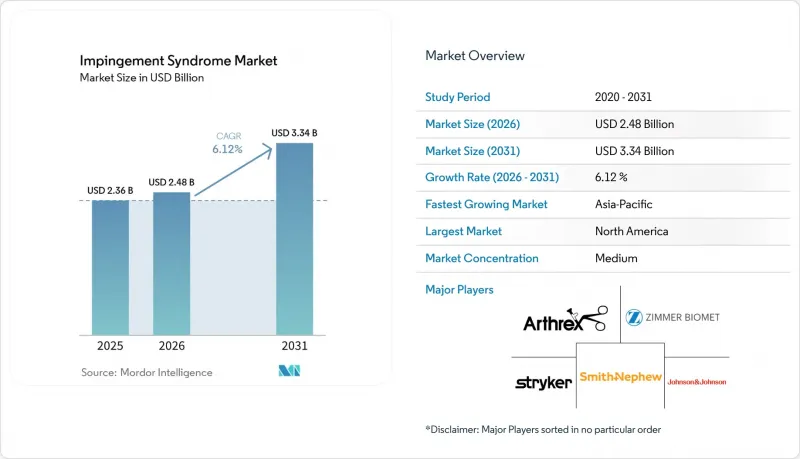
에 따르면 충돌증후군 시장은 2025년 23억 6,000만 달러에서 2026년에는 24억 8,000만 달러로 확대하며, 2031년까지 33억 4,000만 달러에 달할 것으로 예상되고 있으며, 2026-2031년에 CAGR 6.12%로 성장할 것으로 전망되고 있습니다.
전 세계 임핀지먼트 증후군 시장의 동향 및 인사이트
스포츠 참여 증가와 과사용 손상
임핀지먼트 증후군 시장은 반복적인 머리 위 동작으로 인해 지속적인 수혜를 받고 있습니다. 이는 스포츠 활동으로 인해 어깨 통증이 끊임없이 발생하고, 환자들이 진단, 치료 및 경과 관찰을 받게 되기 때문입니다. 2025년 대학 운동선수를 대상으로 실시된 연구에서는 연령대에 관계없이 머리 위로 하는 운동 활동과 어깨 임핀지먼트 증후군 사이에 통계적으로 유의미한 연관성이 확인되었습니다. 이는 활동적인 인구층에서 사례 수가 꾸준히 발생할 것임을 지원합니다. 또한 2025년의 관련 운동 연구에서도 머리 위로 동작을 수행하는 운동선수에게 측정 가능한 생체역학적 위험이 나타났으며, 이는 더 심각한 기능 장애가 진행될 때까지 기다리기보다는 조기 재활 프로토콜에 대한 수요를 지원하고 있습니다. 스포츠 특유의 부하 패턴도 중요한 요소입니다. 수영, 야구, 라켓 스포츠에서는 어깨에 가해지는 기계적 부하가 각각 다르기 때문에 치료 프로토콜을 함부로 표준화할 수 없습니다. 그 결과, 임핀지먼트 증후군 시장에서는 급성 스포츠 외상뿐만 아니라 장기적인 경과 관찰이 필요한 반복성 과사용 증후군에서도 지속적인 수요가 발생하고 있습니다.
고령화와 어깨 퇴행성 질환
임핀지먼트 증후군 시장은 노화에 따른 어깨의 퇴행성 기능 장애로 인해 스포츠 외상에만 국한되지 않는 사례 기반이 확대되고 있으며, 고령층에 대한 의존도가 높아지고 있습니다. 2025년 ‘세계 질병 부담(GBD)’ 패턴 분석에 따르면 중국, 일본, 한국의 근골격계 질환 발생률은 연령, 시대, 체질량지수(BMI)의 동향이 복합적으로 작용하는 결과, 2036년까지 높은 수준을 유지할 것으로 예상됩니다. 2024년에 공개된 유럽의 진료비 데이터도 퇴행성 어깨 질환이 여성 및 60세 이상의 고령자에게 집중되어 있으며, 임핀지먼트와 관련된 증상은 60-64세 연령대에서 정점에 달하고 있음을 보여주고 있습니다. 고령 환자는 더 장기간에 걸친 보존적 치료 과정을 거치는 경향이 있으며, 당장 수술이 필요하지 않은 경우에도 영상 진단, 약물 치료, 물리 치료, 재활 치료가 지속적으로 필요합니다. 이로 인해 특히 고령화가 이미 진행되고 있는 국가들을 중심으로 임핀지먼트 증후군 시장에는 보다 광범위하고 지속적인 환자 기반이 형성되고 있습니다.
시장 간 보험 환급의 명확성 부족
급여 기준의 불일치는 누가 수술을 받는지, 어디서 수술이 예정되는지, 그리고 지급이 확정되기까지 얼마나 많은 행정 절차가 필요한지에 영향을 미치기 때문에 임핀지먼트 증후군 시장에 여전히 직접적인 걸림돌이 되고 있습니다. 2025년에 실시된 또 다른 보험 환급 관련 조사에 따르면 22개의 수정 코드가 붙은 어깨 수술 청구 중 환급이 승인된 비율은 불과 26.5%에 불과했으며, 민간 보험사의 승인률은 메디케어에 비해 크게 뒤처졌습니다. 이러한 상황으로 인해 외래 진료가 저비용으로 신속한 처리를 가능하게 하는 경우에도 더 복잡한 외래 사례를 맡으려는 의지가 저하되고 있습니다. 또한 정책에 기반한 문서화 규정 역시 진단에서 시술로의 전환을 지연시키고 있으며, 이로 인해 의사결정 기간이 길어지고 동일 경로내 전환율이 낮아지고 있습니다. 그 결과, 임핀지먼트 증후군 시장은 규모를 확대할 수 있는 한편, 수익성이 가장 높은 치료 환경에서는 여전히 장벽에 직면해 있습니다.
부문 분석
2025년, 원발성 임핀지먼트 증후군은 임핀지먼트 증후군 시장 점유율의 39.84%를 차지했습니다. 이는 구조적 협착, 활액낭 자극 및 회전근개 압박과 관련된 가장 잘 알려진 임상 양상으로서의 위치를 반영한 것입니다. 이러한 폭넓은 임상적 인지도 덕분에 가치가 단일 진료 지점에 집중되지 않고, 검사, 영상 진단, 약물 치료, 물리 치료 및 수술 전반에 걸쳐 안정적인 수요가 지원되고 있습니다. 이차성 임핀지먼트 증후군은 불안정성, 견갑골 운동 이상, 신경근 기능 장애로 인해 기존의 구조적 협착만 있는 경우보다 다층적인 관리가 필요한 경우가 많기 때문에 임상적으로 여전히 구별되고 있습니다. 급성 임핀지먼트 증후군은 2031년까지 연평균 성장률(CAGR) 6.64%로 성장할 것으로 예측되며, 이는 스포츠 부상에서 진단으로의 전환이 더욱 신속해지고, 체계적인 중재에 이르기까지의 기간이 단축되고 있음을 반영합니다.
이러한 성장이 가속화되고 있는 급성 부문은 동일한 진료 과정 내에서 신속한 영상 진단, 관절경 하 치료 및 면밀한 감독 하의 재활을 지원할 수 있는 의료 서비스 제공자 및 의료기기 제조업체에게 유리합니다. 따라서 임핀지먼트 증후군 업계는 초기 발병 사례를 주요 환자 기반으로 유지하면서도, 더 신속하게 진단되어 치료 단계로 넘어가는 사례로 성장의 초점이 이동하고 있습니다.
2025년에는 성인이 42.63%의 점유율을 차지할 것으로 예상되며, 스포츠나 직업으로 인한 어깨 부하가 활동적인 근로 연령층에 집중되어 있으므로 임핀지먼트 증후군 시장 전체에서 가장 큰 연령층이 되었습니다. 또한 성인은 증상이 업무나 일상생활에 지장을 초래할 경우 영상 진단, 주사 요법, 외과적 치료를 받는 경향이 강하므로 여전히 치료를 받기 쉬운 계층입니다. 고령 환자층은 2031년까지 연평균 성장률(CAGR) 8.67%로 성장할 것으로 예측되며, 이는 어깨 퇴행성 질환으로의 구조적 전환과 장기적인 돌봄 수요의 증가를 반영하고 있습니다.
청소년 부문은 환자 수 측면에서 여전히 가장 작은 규모이지만, 머리 위로 하는 운동 활동으로 인해 젊은 환자들이 인생의 초기 단계에서 측정 가능한 생체역학적 스트레스에 노출됨에 따라 임상적 관심이 높아지고 있습니다. 따라서 젊은 환자에게 수술이 첫 번째 선택이 되지 않는 경우에도 재활 및 예방 프로토콜의 중요성은 변함없습니다. 이에 따라 임핀지먼트 증후군 업계는 성인 환자를 환자 수의 주축으로 삼고, 치료 기간이 더 길고 치료 양상이 다양해지는 경향이 있는 고령 환자를 성장의 새로운 영역으로 삼고 있습니다.
지역별 분석
2025년, 북미는 임핀지먼트 증후군 시장의 45.08% 점유율을 차지하며, 매출 측면에서 가장 큰 기여를 하는 지역으로서의 지위를 유지했습니다. 높은 수술 건수, 관절경 치료에 대한 폭넓은 보험 적용, 그리고 성숙한 외래 수술 센터 네트워크가 임핀지먼트 증후군 시장에서 이 지역의 주도적 지위를 지속적으로 지원하고 있습니다. 미국에서는 스미스 앤 네퓨(Smith & Nephew)사의 발표에 따르면 2025년 어깨 관절 치환술의 연간 시행 건수가 25만 건에 달하며, 이는 임핀지먼트 관련 인접 치료를 지원하는 어깨 관절 치료 기반의 규모를 보여줍니다. 북미 지역의 첨단 워크플로우 도입 집중으로 인해 이 지역은 특히 로봇 기술을 활용한 계획 수립 및 어깨 관절 수술 수행 측면에서 하이엔드 시장의 경쟁 중심지로서의 지위를 유지하고 있습니다.
아시아태평양은 2031년까지 연평균 성장률(CAGR) 9.28%로 성장할 것으로 예측되며, 임핀지먼트 증후군 시장에서 가장 빠르게 성장하는 지역 블록이 될 것입니다. 2025년 질병 부담 분석에 따르면 중국, 일본, 한국의 근골격계 질환 발생률은 2036년까지 높은 수준을 유지할 것으로 예상되며, 이 지역에는 고령화에 따른 견고한 수요 기반이 형성되어 있습니다. 또한 한국에서는 진료 관행의 변화가 명확하게 나타나고 있습니다. 2026년 조사에 따르면 적응증 사례에서 관절경 수술을 첫 번째 선택지로 삼는 경향이 확인되었기 때문입니다. 이는 해당 지역이 단일 성장 요인에 의존하는 것이 아니라, 확대되는 환자의 요구와 진화하는 시술 체계를 모두 갖추고 있음을 의미합니다.
유럽은 여전히 중요한 수입원이지만, 그 성장은 지침에 기반한 보존적 치료와 더욱 다양한 보험 급여 구조에 크게 좌우되고 있습니다. 독일은 이 지역 중에서도 특히 두드러지는데, 어깨 퇴행성 질환이 여전히 널리 관찰되며 입원 치료에서 외래 치료로의 전환이 진행되고 있습니다. 이 때문에 수술 건수의 증가세가 급속히 확대되고 있는 지역에 비해 완만하더라도, 유럽에서는 물리치료, 재활, 영상 진단 서비스가 계속해서 중요한 위치를 차지하고 있습니다. 중동 및 아프리카 및 남미는 여전히 규모는 작지만, 민간 정형외과 분야의 확대와 인프라 투자로 인해 임핀지먼트 증후군 시장에 장기적인 기회가 열리고 있습니다.
기타 혜택:
- 엑셀 형식의 시장 예측(ME) 시트
- 3개월간의 애널리스트 지원
자주 묻는 질문
목차
제1장 서론
- 조사 전제조건과 시장 정의
- 조사 범위
제2장 조사 방법
제3장 개요
제4장 시장 구도
- 시장 개요
- 시장 성장 촉진요인
- 시장 성장 억제요인
- 공급/밸류체인 분석
- 규제 상황
- 기술 전망
- Porter's Five Forces 분석
제5장 시장 규모와 성장 예측
- 유형별
- 환자 연령층별
- 컴포넌트별
- 최종사용자별
- 지역별
- 북미
- 미국
- 캐나다
- 멕시코
- 유럽
- 독일
- 영국
- 프랑스
- 이탈리아
- 스페인
- 기타 유럽 국가
- 아시아태평양
- 중국
- 일본
- 인도
- 호주
- 한국
- 기타 아시아태평양 국가
- 중동 및 아프리카
- GCC
- 남아프리카공화국
- 기타 중동 및 아프리카 국가
- 남미
- 브라질
- 아르헨티나
- 기타 남미 국가
- 북미
제6장 경쟁 구도
- 시장 집중도
- 시장 점유율 분석
- 기업 개요
- Arthrex, Inc.
- B. Braun SE
- Bioventus Inc.
- Breg, Inc.
- CONMED Corporation
- DJO, LLC
- Enovis Corporation
- Globus Medical, Inc.
- Johnson and Johnson
- LimaCorporate S.p.A.
- Medtronic plc
- Orthofix Medical Inc.
- OssDsign AB
- Ossur hf.
- Smith & Nephew plc
- Stryker
- Wright Medical Group N.V.
- Zimmer Biomet
제7장 시장 기회와 향후 전망
KSA 26.10.23According to Mordor Intelligence, the impingement syndrome market is expected to increase from USD 2.36 billion in 2025 to USD 2.48 billion in 2026 and reach USD 3.34 billion by 2031, growing at a CAGR of 6.12% over 2026-2031.
Global Impingement Syndrome Market Trends and Insights
Rising Sports Participation and Overuse Injuries
The impingement syndrome market continues to benefit from repetitive overhead motion because athletic activity creates a steady stream of shoulder complaints that move patients into diagnosis, therapy, and follow-up care. A 2025 study among university athletes confirmed a statistically significant association between overhead athletic activities and shoulder impingement syndrome across age groups, which supports stable case generation in active populations. A related 2025 exercise study also showed measurable biomechanical risk in overhead athletes, which supports the demand for early rehabilitation protocols instead of waiting for more severe dysfunction to develop. Sport-specific loading patterns also matter because swimming, baseball, and racket sports do not place the same mechanical demands on the shoulder, and that keeps treatment protocols from becoming standardized too quickly. The result is that the impingement syndrome market draws repeat demand from both acute sports injuries and recurring overuse patterns that require monitoring over time.
Aging Population and Degenerative Shoulder Disorders
The impingement syndrome market is becoming more dependent on older adults because degenerative shoulder dysfunction is expanding the case base beyond sports injuries alone. A 2025 analysis of Global Burden of Disease patterns showed that musculoskeletal disorder incidence in China, Japan, and South Korea is expected to remain heavy through 2036 under the combined effect of age, period, and body mass index trends. European billing data published in 2024 also showed that degenerative shoulder conditions were concentrated in women and in people older than 60, with impingement-related presentations peaking in the 60 to 64 age group. Older patients also tend to move through longer conservative care pathways, which keeps imaging, medication, physiotherapy, and rehabilitation relevant even when surgery is not immediate. This leaves the impingement syndrome market with a broader and more persistent patient base, especially in countries where aging is already advanced.
Limited Reimbursement Clarity Across Markets
Reimbursement variation remains a direct brake on the impingement syndrome market because it affects who gets surgery, where the case is scheduled, and how much administrative effort is required before payment is secured. A separate 2025 reimbursement study reported that only 26.5% of 22-modifier shoulder surgery claims were successfully reimbursed, and that commercial payer success rates lagged far behind Medicare. These conditions lower willingness to take on more complex outpatient cases, even when ambulatory settings offer lower cost and faster throughput. Policy-driven documentation rules also slow movement from diagnosis to procedure, which spreads decision-making over a longer period and reduces same-pathway conversion. As a result, the impingement syndrome market can expand in value while still facing friction in the highest-revenue treatment setting.
Other drivers and restraints analyzed in the detailed report include:
- Earlier MRI and Ultrasound Based Diagnosis
- Rise in Arthroscopic and Minimally Invasive Shoulder Procedures
- Underdiagnosis of Non-Traumatic Shoulder Pain
For complete list of drivers and restraints, kindly check the Table Of Contents.
Segment Analysis
Primary impingement syndrome held 39.84% of the impingement syndrome market share in 2025, which reflected its position as the most familiar clinical presentation linked to structural narrowing, bursal irritation, and rotator cuff crowding. Its broad clinical visibility supports steady demand across examination, imaging, medication, physical therapy, and surgery, rather than concentrating value in a single point of care. Secondary impingement syndrome remains clinically distinct because instability, scapular dyskinesis, and neuromuscular dysfunction often require more layered management than classic structural narrowing alone. Acute impingement syndrome is projected to grow at a 6.64% CAGR through 2031, which reflects faster movement from sports injury to diagnosis and a shorter path into structured intervention.
This faster-growing acute category favors providers and device makers that can support rapid imaging, arthroscopic treatment, and closely supervised rehabilitation in the same care episode. The impingement syndrome industry, therefore, keeps its volume base in primary presentations, while growth leans toward cases that are diagnosed and escalated more quickly.
Adults held 42.63% share in 2025, which made them the largest age cohort across the impingement syndrome market because sports-related and occupational shoulder loading is concentrated in active working years. Adults also remain the most procedure-ready group because they are more likely to pursue imaging, injection therapy, and surgical resolution when symptoms interfere with work or routine function. Geriatric patients are projected to grow at an 8.67% CAGR through 2031, which reflects a broader structural shift toward degenerative shoulder disease and longer-duration care needs.
The adolescent segment remains the smallest by volume, but it is drawing more clinical attention as overhead athletic activity exposes younger patients to measurable biomechanical stress earlier in life. This keeps rehabilitation and prevention protocols important even when surgery is not the likely first-line route for younger patients. The impingement syndrome industry, therefore, has a volume center in adults and a growth frontier in older patients whose care pathways are often longer and more varied.
Complete Report Scope:
- By Type
- Primary Impingement Syndrome
- Secondary Impingement Syndrome
- Acute Impingement Syndrome
- By Patient Age Group
- Adolescents
- Adults
- Geriatrics
- By Component
- Treatment Type
- Surgical Treatment
- Non-Surgical Treatment
- Physical Therapy
- Medication
- Diagnosis
- Physical Examination
- Imaging Techniques
- Electromyography
- Treatment Type
- By End-User
- Orthopedic Clinics
- Ambulatory Surgical Centers
- Rehabilitation Centers
- Physiotherapy Clinics
- By Geography
- North America
- United States
- Canada
- Mexico
- Europe
- Germany
- United Kingdom
- France
- Italy
- Spain
- Rest of Europe
- Asia-Pacific
- China
- Japan
- India
- Australia
- South Korea
- Rest of Asia-Pacific
- Middle East and Africa
- GCC
- South Africa
- Rest of Middle East and Africa
- South America
- Brazil
- Argentina
- Rest of South America
- North America
Geography Analysis
North America held 45.08% of the impingement syndrome market share in 2025, which kept it as the largest regional contributor to revenue. High procedure volumes, broad commercial coverage for arthroscopic care, and a mature ambulatory surgery center network continue to support the region's leading position in the impingement syndrome market. In the United States, Smith & Nephew states that shoulder replacement procedures total 250,000 annually in 2025, which indicates the scale of the shoulder care base that supports adjacent impingement-related intervention. The concentration of advanced workflow launches in North America keeps the region at the center of premium competition, especially for robotics-enabled planning and shoulder surgery execution.
Asia-Pacific is projected to grow at a 9.28% CAGR through 2031, which makes it the fastest-growing regional block in the impingement syndrome market. A 2025 burden analysis showed that musculoskeletal disorder incidence in China, Japan, and South Korea is expected to remain heavy through 2036, which gives the region a strong aging-related demand base. South Korea also offers a clear signal of changing practice because a 2026 survey documented movement toward arthroscopic-first management in suitable cases. This means the region combines expanding patient need with evolving procedural readiness, rather than relying on only one of those growth factors.
Europe remains a meaningful revenue contributor, but growth is shaped more heavily by guideline-based conservative care and more varied reimbursement structures. Germany stands out within the region because degenerative shoulder disease remains widespread, and the shift from inpatient care toward outpatient settings is continuing. This keeps physiotherapy, rehabilitation, and imaging services important in Europe even when procedural growth is more measured than in faster-expanding regions. Middle East and Africa and South America remain smaller, but private orthopedic expansion and infrastructure investment keep long-term opportunities open for the impingement syndrome market.
- Arthrex
- B. Braun
- Bioventus Inc.
- Breg
- Conmed
- DJO Global
- Enovis Corporation
- Globus Medical
- Johnson & Johnson
- LimaCorporate S.p.A.
- Medtronic
- Orthofix
- OssDsign AB
- Ossur
- Smiths Group
- Stryker
- Wright Medical Group
- Zimmer Biomet
Additional Benefits:
- The market estimate (ME) sheet in Excel format
- 3 months of analyst support
TABLE OF CONTENTS
1 Introduction
- 1.1 Study Assumptions and Market Definition
- 1.2 Scope of the Study
2 Research Methodology
3 Executive Summary
4 Market Landscape
- 4.1 Market Overview
- 4.2 Market Drivers
- 4.2.1 Rising Sports Participation and Overuse Injuries
- 4.2.2 Aging Population and Degenerative Shoulder Disorders
- 4.2.3 Earlier MRI and Ultrasound Based Diagnosis
- 4.2.4 Expansion of Outpatient Orthopedic Care
- 4.2.5 Rise in Arthroscopic and Minimally Invasive Shoulder Procedures
- 4.2.6 Tele-Rehabilitation and Home-Based Recovery Pathways
- 4.3 Market Restraints
- 4.3.1 Conservative Treatment Success Reduces Procedure Conversion
- 4.3.2 High Reliance on Clinical Judgment and Variable Coding
- 4.3.3 Limited Reimbursement Clarity Across Markets
- 4.3.4 Underdiagnosis of Non-Traumatic Shoulder Pain
- 4.4 Supply/Value Chain Analysis
- 4.5 Regulatory Landscape
- 4.6 Technological Outlook
- 4.7 Porter's Five Forces Analysis
- 4.7.1 Threat of New Entrants
- 4.7.2 Bargaining Power of Suppliers
- 4.7.3 Bargaining Power of Buyers
- 4.7.4 Threat of Substitutes
- 4.7.5 Competitive Rivalry
5 Market Size & Growth Forecasts (Value, USD)
- 5.1 By Type
- 5.1.1 Primary Impingement Syndrome
- 5.1.2 Secondary Impingement Syndrome
- 5.1.3 Acute Impingement Syndrome
- 5.2 By Patient Age Group
- 5.2.1 Adolescents
- 5.2.2 Adults
- 5.2.3 Geriatrics
- 5.3 By Component
- 5.3.1 Treatment Type
- 5.3.1.1 Surgical Treatment
- 5.3.1.2 Non-Surgical Treatment
- 5.3.1.2.1 Physical Therapy
- 5.3.1.2.2 Medication
- 5.3.2 Diagnosis
- 5.3.2.1 Physical Examination
- 5.3.2.2 Imaging Techniques
- 5.3.2.3 Electromyography
- 5.3.1 Treatment Type
- 5.4 By End-User
- 5.4.1 Orthopedic Clinics
- 5.4.2 Ambulatory Surgical Centers
- 5.4.3 Rehabilitation Centers
- 5.4.4 Physiotherapy Clinics
- 5.5 By Geography
- 5.5.1 North America
- 5.5.1.1 United States
- 5.5.1.2 Canada
- 5.5.1.3 Mexico
- 5.5.2 Europe
- 5.5.2.1 Germany
- 5.5.2.2 United Kingdom
- 5.5.2.3 France
- 5.5.2.4 Italy
- 5.5.2.5 Spain
- 5.5.2.6 Rest of Europe
- 5.5.3 Asia-Pacific
- 5.5.3.1 China
- 5.5.3.2 Japan
- 5.5.3.3 India
- 5.5.3.4 Australia
- 5.5.3.5 South Korea
- 5.5.3.6 Rest of Asia-Pacific
- 5.5.4 Middle East and Africa
- 5.5.4.1 GCC
- 5.5.4.2 South Africa
- 5.5.4.3 Rest of Middle East and Africa
- 5.5.5 South America
- 5.5.5.1 Brazil
- 5.5.5.2 Argentina
- 5.5.5.3 Rest of South America
- 5.5.1 North America
6 Competitive Landscape
- 6.1 Market Concentration
- 6.2 Market Share Analysis
- 6.3 Company Profiles (includes Global level Overview, Market level overview, Core Segments, Financials as available, Strategic Information, Market Rank/Share for key companies, Products & Services, Recent Developments)
- 6.3.1 Arthrex, Inc.
- 6.3.2 B. Braun SE
- 6.3.3 Bioventus Inc.
- 6.3.4 Breg, Inc.
- 6.3.5 CONMED Corporation
- 6.3.6 DJO, LLC
- 6.3.7 Enovis Corporation
- 6.3.8 Globus Medical, Inc.
- 6.3.9 Johnson and Johnson
- 6.3.10 LimaCorporate S.p.A.
- 6.3.11 Medtronic plc
- 6.3.12 Orthofix Medical Inc.
- 6.3.13 OssDsign AB
- 6.3.14 Ossur hf.
- 6.3.15 Smith & Nephew plc
- 6.3.16 Stryker
- 6.3.17 Wright Medical Group N.V.
- 6.3.18 Zimmer Biomet
7 Market Opportunities & Future Outlook
- 7.1 White-space & Unmet-need Assessment


