

|
시장보고서
상품코드
2154465
수소 제조 촉매 : 시장 점유율 분석, 업계 동향과 통계, 성장 예측(2026-2031년)Hydrogen Production Catalysts - Market Share Analysis, Industry Trends & Statistics, Growth Forecasts (2026 - 2031) |
||||||
 Mordor Intelligence
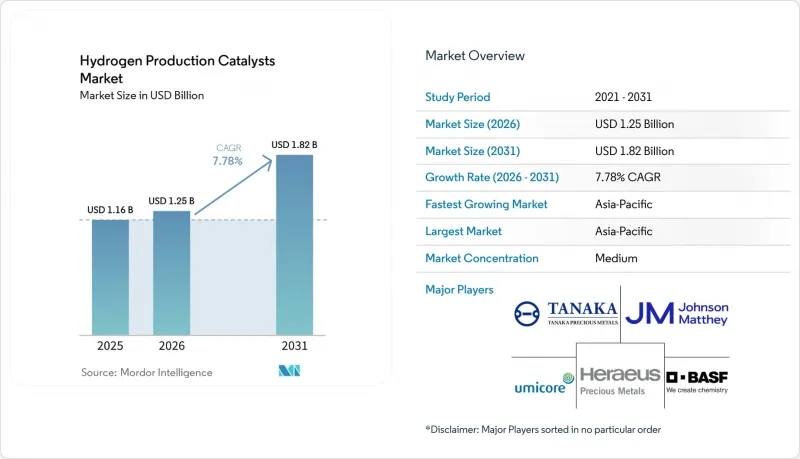
에 따르면 수소 제조 용촉매 시장 규모는 2025년에 11억 6,000만 달러로 평가되며, 2026년 12억 5,000만 달러에서 2031년까지 18억 2,000만 달러에 달할 것으로 추정되고 있으며, 예측 기간(2026-2031년)에 CAGR은 7.78%에 달할 전망입니다.
전 세계 수소 제조용 촉매 시장의 동향 및 인사이트
녹색 수소 및 전해조 도입
전해조 도입은 수소 제조용 촉매 시장의 주요 수요 요인입니다. 2025년에는 설치된 전해 용량이 두 배로 증가하여 전 세계에서 4기가와트를 넘어섰습니다. 또한 2026년 가동을 목표로 2.5기가와트 이상이 건설 중이었습니다. 중국은 알칼리 스택 및 여기에 사용되는 니켈·이리듐 촉매의 수요를 지원하고 있습니다. 이러한 규모 확대로 인해 알칼리 스택의 비용은 낮아지지만, 스택 전체를 공급하지 않고 촉매 재료만 판매하는 공급업체에게는 압박도 가해지고 있습니다. 2024년, 유럽내 수전해 설비 도입량의 66%를 양성자 교환막(PEM) 시스템이 차지하고 있으며, 지역적 수요는 이리듐계 양극 촉매에 집중되어 있습니다. 네덜란드의 에어 리퀴드(Air Liquide)사의 200메가와트 규모 ‘ELYgator’ 프로젝트와 레프솔(Repsol)사의 100메가와트 규모 ‘카르타헤나’ 프로젝트는 2025년에 최종 투자 결정에 이르렀으며, 이는 유럽 공급업체들에게 확실한 수요 기반이 되었습니다. 유럽연합(EU)의 ‘재생에너지 지침 III’는 산업 및 운송 분야의 수소 목표를 보다 명확히 규정하고 있으며, 2030년까지의 구매 결정을 지원하고 있습니다.
모빌리티 및 분산형 발전 분야에서의 수소연료전지 보급
운송 및 분산형 발전 분야에서의 수소연료전지 보급은 수소 생산 설비 이외의 분야에서 촉매 수요를 지원하고 있습니다. 2025년 중반까지 전 세계 연료전지차(FCV) 보유 대수는 10만 대에 육박했으며, 1,300곳 이상의 수소 충전소가 가동되고 있었습니다. 대형 트럭 도입 대수는 2023-2025년에 72% 증가하여 백금 촉매 코팅 수요를 끌어올렸습니다. 또한 고정형 전원 장치는 연료전지가 차량으로서의 수명을 다했을 때 촉매를 회수할 수 있는 길을 열어주고 있습니다. 혼다는 2025년 8월, 도쿠야마 주식회사 및 미쓰비시 상사 주식회사와 공동으로 실증 실험을 시작하여, 제품별로 발생하는 수소를 활용하여 재활용된 자동차용 연료전지로 데이터센터에 전력을 공급했습니다. 도요타 모터 북미는 2026년 5월, 2027년 초까지 상용 물류 차량에 연료전지 구동 방식의 클래스 8 트럭을 도입할 계획이라고 발표했으며, 동사의 3세대 연료전지 스택은 미국 국가표준협회(ANSI) 및 캐나다 표준협회(CSA)의 ‘Fuel Cell 1’ 인증을 획득했습니다.
백금족 금속 촉매의 높은 비용
백금족 금속 촉매의 높은 비용은 수소 제조용 촉매 시장에 있으며, 시급한 제약 요인으로 작용하고 있습니다. 2025년 백금족 금속의 총 수요는 231.9메트릭톤으로 예측된 반면, 공급량은 180.6메트릭톤에 그쳐, 이러한 공급 부족으로 인해 촉매의 기준 비용이 상승했습니다. 백금 가격은 2025년 평균 가격이 킬로그램당 4만 1,000달러였던 반면, 2026년 1월에는 킬로그램당 9만 1,176달러라는 일중 최고가를 기록했습니다. 귀금속 촉매 재료가 스택의 부품 원가에서 상당한 비중을 차지하고 있으므로 이러한 가격 변동은 양성자 교환막형 전해조 스택의 자본 비용을 상승시키고 있습니다. 프로젝트 비용이 달러로 지불되는 반면, 수익은 현지 통화로 얻어지는 경우, 비용 민감도는 특히 높아집니다. 에보닉 인더스트리즈 AG는 귀금속을 자체적으로 보유하고 있는 고객의 경우 백금 함유 촉매 가격 상승의 영향을 받지 않는다고 밝혔지만, 합성시 발생하는 손실이 실질 비용을 상승시킬 가능성은 여전히 남아 있습니다. 유럽의 화학물질 등록·평가·허가 및 제한(REACH) 요건은 백금족 금속 촉매의 워크플로우에 규정 준수 비용을 추가하게 됩니다.
부문별 분석
2025년, 수소 제조용 촉매 시장 규모 중 백금계 촉매가 50.12%를 차지했습니다. 이러한 위상은 수증기 메탄 개질(SMR)의 음극 용도, 연료 전지의 막-전극 어셈블리, 그리고 탄화수소 정제 반응에서 오랜 기간 중 사용되어 온 실적을 반영한 것입니다. 이러한 수요원이 동시에 축소될 가능성은 낮기 때문에 백금 공급망을 통한 지속적인 소비가 지원되고 있습니다. 따라서 새로운 전해 기술이 보급되더라도 백금계 촉매는 단기적인 수익 측면에서 계속해서 중요한 역할을 수행할 것입니다. 이리듐계 촉매는 2031년까지 연평균 성장률(CAGR) 8.23%로 확대될 것으로 예측됩니다. 이러한 성장은 양성자 교환막 전해(PEM 전해)와 밀접한 관련이 있으며, 산성이며 고도로 산화적인 조건에서는 이리듐 산화물이 여전히 정평이 나 있는 양극 촉매로 사용되고 있습니다.
타나카 프레셔스 메탈 그룹은 이중 기능 전극 촉매의 개발 및 상용화를 통해 일본의 ‘2025년 촉매공업회 기술상’을 수상했습니다. 이 설계는 양성자 교환막 수전해에서 산소 발생 반응과 가스 재결합 기능을 결합한 것입니다. 이를 통해 수소 크로스오버 문제를 해결하는 동시에 막의 얇은 두께화를 실현했습니다. 니켈계 촉매는 알칼리 전해 및 증기 메탄 개질에서 계속해서 사용되고 있습니다. 이러한 분야에서는 그램당 귀금속의 성능보다 비용이나 입수 가능성이 더 중요시되는 경우가 많기 때문입니다. 그 밖의 촉매 유형로는 루테늄계, 코발트계, 그리고 새롭게 등장한 비금속계 배합 등이 있습니다. 유럽연합(EU)의 ‘중요 원자재법’에서는 이리듐이 전략적 원자재로 분류되어 있으며, 촉매 포트폴리오의 다각화를 위한 인센티브가 강화되고 있습니다.
지역별 분석
아시아태평양은 2025년 수소 제조용 촉매 시장의 37.88%를 차지하고 있으며, 2031년까지 연평균 성장률(CAGR) 8.61%로 확대될 것으로 예측됩니다. 중국은 암모니아 및 메탄올 산업을 기반으로 이 지역의 촉매 수요를 지원하고 있습니다. 중국은 2차 개질용 촉매를 연간 약 8,000-12,000 메트릭톤 소비하고 있으며, 전 세계 전해 설비 용량의 약 65%를 가동하고 있습니다. 중국은 국내 대규모 프로젝트에서 알칼리 전해 방식을 중시하고 있으며, 이러한 추세는 니켈계 촉매에 유리하게 작용하고 있습니다. 인도는 2030년까지 계획 중인 암모니아 생산 능력을 연간 400만-600만 메트릭톤으로 확대할 예정이며, 이에 따라 추가적인 촉매 공급이 필요해질 것입니다. 일본과 한국에서는 연료전지차 도입 및 수소 관련 프로그램을 통해 고순도 백금족 금속 함유 촉매에 대한 수요가 유지되고 있습니다.
2025년 시점에 한국은 전 세계 연료전지차 보유 대수의 36%를 차지하고 있으며, 백금계 연료전지 촉매에 대한 지속적인 수요를 지원하고 있습니다. JERA와 덴소는 2025년 9월 니시나고야 발전소에서 고체 산화물 전해 실증 실험을 시작했습니다. 이 프로젝트에서는 자동차용 고체 산화물 전해 셀 기술을 채택하여, 기존 전해 방식에 비해 전력 소비량을 10% 절감하며 수소를 생산했습니다. 북미와 유럽은 나머지 세계 시장의 절반을 차지했습니다. 미국에서는 정유소용 수소 수요가 유지되고 있을 뿐만 아니라, 현대자동차, 도요타, 커민스의 연료전지 모듈 프로그램에 대한 민간 투자도 계속되고 있습니다. 캐나다의 오일샌드 수요와 멕시코의 정유소 기반 시설은 개질 촉매에 대한 추가적인 수요를 창출하고 있습니다.
유럽의 정책 체계는 수소 제조용 촉매 시장의 기술 구성을 형성하고 있습니다. ‘재생에너지 지침 III’에서는 2030년까지 산업용 수소의 42%를 재생에너지 원에서 조달할 것을 의무화하고 있으며, 이것이 양성자 교환막 전해법의 수요를 지원하고 있습니다. ‘중요 원자재법’에 따른 이리듐의 전략적 지정은 조달 방침에 영향을 미치고 있습니다. BASF는 2025년 3월, 독일 루트비히스하펜에 국내 최대 규모인 54메가와트급 양성자 교환막형 전해 장치를 가동하여, 시간당 최대 1메트릭톤의 수소를 생산할 수 있는 능력을 갖추고 있습니다. 남미, 중동 및 아프리카는 여전히 수요 규모가 작은 지역이지만, 그린 수소 수출 및 정제를 통해 프로젝트 파이프라인이 형성되고 있습니다. 사우디아라비아의 ‘NEOM 그린 수소 프로젝트’에는 2.2기가와트 규모의 전해 장치가 포함되어 있으며, 촉매 재료에 대한 향후 집중적인 수요를 창출하게 될 것입니다. 액센즈(Axens)는 2025년 4월, 사우디아라비아에 위치한 ‘Axens Catalyst Arabia Limited’의 거점을 확장하여, 테일가스 처리용 촉매를 현지에서 생산할 수 있는 체제를 구축했습니다.
기타 혜택:
- 엑셀 형식의 시장 예측(ME) 시트
- 3개월간의 애널리스트 지원
자주 묻는 질문
목차
제1장 서론
- 조사 전제조건과 시장 정의
- 조사 범위
제2장 조사 방법
제3장 개요
제4장 시장 구도
- 시장 개요
- 시장 성장 촉진요인
- 시장 성장 억제요인
- 밸류체인 분석
- Porter's Five Forces 분석
제5장 시장 규모와 성장 예측
- 유형별
- 생산 기술별
- 최종 용도별
- 지역별
- 아시아태평양
- 중국
- 인도
- 일본
- 한국
- 기타 아시아태평양 국가
- 북미
- 미국
- 캐나다
- 멕시코
- 유럽
- 독일
- 영국
- 프랑스
- 이탈리아
- 기타 유럽 국가
- 남미
- 브라질
- 아르헨티나
- 기타 남미 국가
- 중동 및 아프리카
- 사우디아라비아
- 남아프리카공화국
- 기타 중동 및 아프리카 국가
- 아시아태평양
제6장 경쟁 구도
- 시장 집중도
- 전략적 동향
- 시장 점유율·순위 분석
- 기업 개요
- 3M
- Axens
- BASF
- CLARIANT
- De Nora S.p.A.
- Evonik Industries AG
- Heraeus Precious Metals
- Honeywell International Inc.
- Johnson Matthey
- Shell plc
- TANAKA PRECIOUS METAL GROUP Co., Ltd.
- Topsoe A/S
- Umicore
제7장 시장 기회와 향후 전망
KSA 26.10.23According to Mordor Intelligence, the hydrogen production catalysts market size was valued at USD 1.16 billion in 2025 and is estimated to grow from USD 1.25 billion in 2026 to reach USD 1.82 billion by 2031, at a CAGR of 7.78% during the forecast period (2026-2031).
Global Hydrogen Production Catalysts Market Trends and Insights
Green Hydrogen and Electrolyzer Deployment
Electrolyzer deployment is a major demand driver for the hydrogen production catalysts market. Installed electrolysis capacity doubled in 2025 and surpassed 4 gigawatts globally, while more than 2.5 gigawatts were under construction for commissioning in 2026. China supports demand for alkaline stacks and the nickel and iridium catalysts used within them. This scale lowers alkaline stack costs, but it also puts pressure on suppliers that sell catalyst materials without supplying the wider stack. Proton exchange membrane systems represented 66% of installed water electrolysis in Europe in 2024, concentrating regional demand on iridium-based anode catalysts. Air Liquide's 200-megawatt ELYgator project in the Netherlands and Repsol's 100-megawatt Cartagena project reached a final investment decision in 2025, providing visible demand anchors for European suppliers. The European Union Renewable Energy Directive III provides clearer hydrogen targets for industry and transport, which support purchasing decisions through 2030.
Hydrogen Fuel-Cell Adoption in Mobility and Distributed Power
Hydrogen fuel-cell adoption in transport and distributed power supports catalyst demand beyond hydrogen generation assets. The global fuel cell vehicle fleet approached 100,000 units by mid-2025, and more than 1,300 hydrogen refueling stations were operating. Heavy-duty truck deployments grew 72% from 2023 to 2025, increasing demand for platinum catalyst coatings. Stationary power also creates a route for catalyst recovery when fuel cells reach the end of their vehicle life. Honda began a joint demonstration with Tokuyama Corporation and Mitsubishi Corporation in August 2025 that used by-product hydrogen to power a data center through repurposed automotive fuel cells. Toyota Motor North America stated in May 2026 that it planned to deploy fuel-cell-powered Class 8 trucks in commercial logistics fleets by early 2027, and its third-generation fuel cell stacks achieved American National Standards Institute and Canadian Standards Association Fuel Cell 1 certification.
High Cost of Platinum-Group-Metal Catalysts
High costs for platinum-group-metal catalysts are an immediate restraint on the hydrogen production catalysts market. Total platinum-group-metal demand in 2025 was projected at 231.9 metric tons, compared with a supply of 180.6 metric tons, creating a deficit that raised baseline catalyst costs. Platinum reached an intraday high of USD 91,176 per kilogram in January 2026, compared with an average of USD 41,000 per kilogram in 2025. This price movement increases the capital cost of proton exchange membrane electrolyzer stacks because precious-metal catalyst materials account for a meaningful share of the stack bill of materials. Cost sensitivity is particularly high where project costs are paid in US dollars, but revenue is earned in local currencies. Evonik Industries AG has stated that customers who own their precious metal do not face higher platinum-containing catalyst prices, although synthesis losses can still raise effective costs. Registration, Evaluation, Authorisation and Restriction of Chemicals (REACH) requirements in Europe add compliance costs for platinum-group-metal catalyst workflows.
Other drivers and restraints analyzed in the detailed report include:
- Catalyst Loading Reduction and Precious-Metal Utilization
- Advancement in Catalyst Activity, Durability, and Energy Efficiency
- Iridium and High-Purity Titanium Supply Constraints
For complete list of drivers and restraints, kindly check the Table Of Contents.
Segment Analysis
Platinum-based catalysts accounted for 50.12% of the hydrogen production catalysts market size in 2025. This position reflected long-standing use in steam methane reforming cathode applications, fuel cell membrane electrode assemblies, and hydrocarbon refining reactions. These demand pools are unlikely to contract at the same time, which supports recurring consumption through the platinum supply chain. Platinum-based catalysts, therefore, remain important to near-term revenue even as new electrolysis technologies scale. Iridium-based catalysts are projected to advance at an 8.23% CAGR through 2031. Their growth is tied to proton exchange membrane electrolysis, where iridium oxide remains the established anode catalyst under acidic and highly oxidative conditions.
TANAKA PRECIOUS METAL GROUP Co., Ltd. received Japan's 2025 Catalyst Manufacturers Association Technology Award for developing and commercializing a dual-function electrode catalyst. The design combines oxygen evolution reaction and gas recombination functions in proton exchange membrane water electrolysis. It addresses hydrogen crossover while enabling thinner membranes. Nickel-based catalysts continue to serve alkaline electrolysis and steam methane reforming, where cost and availability often matter more than precious-metal performance per gram. Other catalyst types include ruthenium-based, cobalt-based, and emerging non-precious formulations. The European Union Critical Raw Materials Act classifies iridium as a strategic raw material, strengthening the incentive to diversify catalyst portfolios.
Complete Report Scope:
- By Type
- Platinum-Based Catalysts
- Nickel-Based Catalysts
- Iridium-Based Catalysts
- Other Catalyst Types
- By Production Technology
- Steam Methane Reforming (SMR)
- Alkaline Water Electrolysis
- Proton Exchange Membrane (PEM) Water Electrolysis
- Other Production Technologies
- By End-Use
- Ammonia Production
- Petroleum Refining
- Methanol Production
- Other End-Uses
- By Geography
- Asia-Pacific
- China
- India
- Japan
- South Korea
- Rest of Asia-Pacific
- North America
- United States
- Canada
- Mexico
- Europe
- Germany
- United Kingdom
- France
- Italy
- Rest of Europe
- South America
- Brazil
- Argentina
- Rest of South America
- Middle-East and Africa
- Saudi Arabia
- South Africa
- Rest of Middle-East and Africa
- Asia-Pacific
Geography Analysis
Asia-Pacific accounted for 37.88% of the hydrogen production catalysts market in 2025 and is projected to advance at an 8.61% CAGR through 2031. China supports regional catalyst demand through its ammonia and methanol base. It consumed an estimated 8,000 to 12,000 metric tons of secondary reforming catalysts annually and commissioned nearly 65% of global installed electrolysis capacity. This pattern favors nickel-based catalysts because China emphasizes alkaline electrolysis for large domestic projects. India is expanding planned ammonia capacity by 4 to 6 million metric tons per year through 2030, which will require additional catalyst supply. Japan and South Korea retain demand for high-purity platinum-group-metal formulations through fuel cell vehicle fleets and hydrogen programs.
South Korea held 36% of the global fuel cell vehicle fleet in 2025, supporting continued demand for platinum-based fuel cell catalysts. JERA and Denso began a solid oxide electrolysis demonstration in September 2025 at Nishi-Nagoya Power Plant. The project used vehicle-derived solid oxide electrolyzer cell technology to produce hydrogen with 10% lower electricity consumption than conventional electrolysis methods. North America and Europe represented half of the remaining global market. The United States retains refinery hydrogen demand and private investment from Hyundai, Toyota, and Cummins in fuel cell module programs. Canada's oil sands requirements and Mexico's refinery base provide additional demand for reforming catalysts.
Europe's policy framework is shaping the technology mix for the hydrogen production catalysts market. Renewable Energy Directive III requires 42% of industrial hydrogen to come from renewable sources by 2030, which supports proton exchange membrane electrolysis demand. The Critical Raw Materials Act's strategic designation of iridium is influencing procurement approaches. BASF commissioned Germany's largest 54-megawatt proton exchange membrane electrolyzer in Ludwigshafen in March 2025, with the capacity to produce up to 1 metric ton of hydrogen per hour. South America, and Middle-East and Africa remain smaller demand pools, but green hydrogen exports and refining create project pipelines. Saudi Arabia's NEOM Green Hydrogen Project includes a 2.2-gigawatt electrolyzer, creating a concentrated future demand event for catalyst materials. Axens expanded its Axens Catalyst Arabia Limited site in Saudi Arabia in April 2025 to produce tail gas treatment catalysts locally.
- 3M
- Axens
- BASF
- CLARIANT
- De Nora S.p.A.
- Evonik Industries AG
- Heraeus Precious Metals
- Honeywell International Inc.
- Johnson Matthey
- Shell plc
- TANAKA PRECIOUS METAL GROUP Co., Ltd.
- Topsoe A/S
- Umicore
Additional Benefits:
- The market estimate (ME) sheet in Excel format
- 3 months of analyst support
TABLE OF CONTENTS
1 Introduction
- 1.1 Study Assumptions and Market Definition
- 1.2 Scope of the Study
2 Research Methodology
3 Executive Summary
4 Market Landscape
- 4.1 Market Overview
- 4.2 Market Drivers
- 4.2.1 Green Hydrogen and Electrolyzer Deployment
- 4.2.2 Hydrogen Fuel-Cell Adoption in Mobility and Distributed Power
- 4.2.3 Catalyst Loading Reduction and Precious-Metal Utilization
- 4.2.4 Catalyst-Coated Membrane and Catalyst Recycling Integration
- 4.2.5 Advancement in Catalyst Activity, Durability, and Energy Efficiency
- 4.3 Market Restraints
- 4.3.1 High Cost of Platinum-Group-Metal Catalysts
- 4.3.2 Iridium and High-Purity Titanium Supply Constraints
- 4.3.3 Durability and Qualification Challenges for Non-Precious Catalysts
- 4.4 Value Chain Analysis
- 4.5 Porter's Five Forces Analysis
- 4.5.1 Bargaining Power of Suppliers
- 4.5.2 Bargaining Power of Buyers
- 4.5.3 Threat of New Entrants
- 4.5.4 Threat of Substitutes
- 4.5.5 Competitive Rivalry
5 Market Size and Growth Forecasts (Value)
- 5.1 By Type
- 5.1.1 Platinum-Based Catalysts
- 5.1.2 Nickel-Based Catalysts
- 5.1.3 Iridium-Based Catalysts
- 5.1.4 Other Catalyst Types
- 5.2 By Production Technology
- 5.2.1 Steam Methane Reforming (SMR)
- 5.2.2 Alkaline Water Electrolysis
- 5.2.3 Proton Exchange Membrane (PEM) Water Electrolysis
- 5.2.4 Other Production Technologies
- 5.3 By End-Use
- 5.3.1 Ammonia Production
- 5.3.2 Petroleum Refining
- 5.3.3 Methanol Production
- 5.3.4 Other End-Uses
- 5.4 By Geography
- 5.4.1 Asia-Pacific
- 5.4.1.1 China
- 5.4.1.2 India
- 5.4.1.3 Japan
- 5.4.1.4 South Korea
- 5.4.1.5 Rest of Asia-Pacific
- 5.4.2 North America
- 5.4.2.1 United States
- 5.4.2.2 Canada
- 5.4.2.3 Mexico
- 5.4.3 Europe
- 5.4.3.1 Germany
- 5.4.3.2 United Kingdom
- 5.4.3.3 France
- 5.4.3.4 Italy
- 5.4.3.5 Rest of Europe
- 5.4.4 South America
- 5.4.4.1 Brazil
- 5.4.4.2 Argentina
- 5.4.4.3 Rest of South America
- 5.4.5 Middle-East and Africa
- 5.4.5.1 Saudi Arabia
- 5.4.5.2 South Africa
- 5.4.5.3 Rest of Middle-East and Africa
- 5.4.1 Asia-Pacific
6 Competitive Landscape
- 6.1 Market Concentration
- 6.2 Strategic Moves
- 6.3 Market Share (%)/Ranking Analysis
- 6.4 Company Profiles (includes Global Overview, Market Overview, Core Segments, Financials as available, Strategic Information, Products and Services, and Recent Developments)
- 6.4.1 3M
- 6.4.2 Axens
- 6.4.3 BASF
- 6.4.4 CLARIANT
- 6.4.5 De Nora S.p.A.
- 6.4.6 Evonik Industries AG
- 6.4.7 Heraeus Precious Metals
- 6.4.8 Honeywell International Inc.
- 6.4.9 Johnson Matthey
- 6.4.10 Shell plc
- 6.4.11 TANAKA PRECIOUS METAL GROUP Co., Ltd.
- 6.4.12 Topsoe A/S
- 6.4.13 Umicore
7 Market Opportunities and Future Outlook
- 7.1 White-Space and Unmet-Need Assessment


