

|
시장보고서
상품코드
2154486
색전 코일 : 시장 점유율 분석, 업계 동향과 통계, 성장 예측(2026-2031년)Embolization Coils - Market Share Analysis, Industry Trends & Statistics, Growth Forecasts (2026 - 2031) |
||||||
 Mordor Intelligence
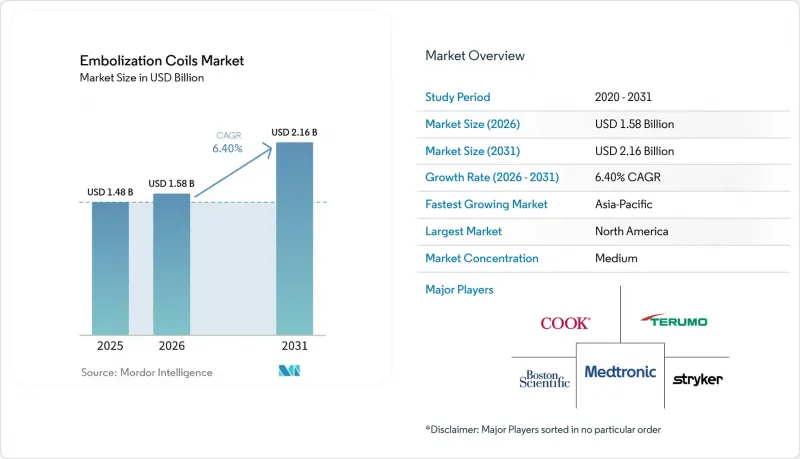
에 따르면 색전 코일 시장 규모는 2025년 14억 8,000만 달러에서 2026년에는 15억 8,000만 달러로 확대되어, 2031년까지 21억 6,000만 달러에 달할 것으로 예상되며, 2026년부터 2031년까지 CAGR 6.40%로 성장할 것으로 전망됩니다.
전 세계 색전 코일 시장의 동향 및 인사이트
신경혈관성 동맥류 및 AVM 치료 건수의 증가
두개내 동맥류의 색전술은 여전히 색전 코일 시장의 주요 수요 요인으로 자리 잡고 있습니다. 컴퓨터 단층촬영 혈관조영술(CTA) 및 자기공명 혈관조영술(MRA)의 이용이 확대됨에 따라, 응급 증상을 보이지 않는 환자에서 동맥류의 발견률이 높아졌습니다. 이에 따라 계획적인 신경혈관 중재술의 대상이 되는 환자층이 확대되었습니다. 세계보건기구(WHO)의 2025년 보고서에 따르면, 뇌졸중이 전 세계 건강 손실의 주요 신경학적 원인인 것으로 지적되었으며, 한편 스트로크 얼라이언스(Stroke Alliance)의 보고에 따르면 24가지 뇌 질환으로 인한 직접 비용은 1조 7,000억 달러를 초과했습니다.
아시아태평양 및 중동 및 아프리카 전역에 뇌졸중 센터가 확대됨에 따라, 동맥류 및 동정맥 기형 수술을 수행하기 위한 임상 인프라가 강화되었습니다. 미국심장협회(AHA)는 6년에 걸친 전국적 분석을 통해 급성 허혈성 뇌졸중에 대한 혈관내 치료 이용이 지속적으로 증가하고 있다고 보고했습니다. 이러한 추세는 카테터를 이용한 신경혈관 치료가 병원 치료 과정에서 더욱 정착되어 가고 있음을 보여줍니다.
최소침습적 혈관내 치료의 선호
혈관내 색전술은 입원 기간과 회복 기간을 단축할 수 있기 때문에 외과적 결찰이나 개두술보다 선호되는 경우가 많았습니다. 적격 환자의 경우, 중환자실 자원 사용도 감소했습니다. 이러한 임상적 및 운영상의 이점은 의료 시스템이 수용 능력과 비용을 관리하는 과정에서 카테터를 이용한 시술을 촉진했습니다. 색전 코일은 동맥류 및 혈관 폐색 수술에서 필수적인 역할을 계속 수행해 왔기 때문에 색전 코일 시장도 그 혜택을 누렸습니다.
교육 또한 혈관내 치료로의 전환을 촉진했습니다. 병원들이 중재적 방사선학 및 중재적 신경학 펠로우십 프로그램을 설립함에 따라, 자격을 갖춘 시술자의 수가 증가했습니다. 훈련을 받은 인력이 늘어나면서, 복잡한 코일 색전술이 제한된 수의 3차 의료 기관에 집중되던 상황이 완화되었습니다. OECD 데이터에 따르면, 재관류 요법의 제공이 개선되고 동시에 혈관 내 치료의 이용이 확대된 결과, 2013년부터 2019년까지 회원국 전체에서 허혈성 뇌졸중의 치사율이 감소했습니다.
높은 의료기기 및 시술 비용
하이드로겔 강화형이나 백금·텅스텐제 등 프리미엄 탈착식 시스템은 시술 1건당 수천 달러의 비용이 들 수 있습니다. 많은 중소득국의 의료 제도에서는 이러한 비용이 이용 가능한 환급액을 초과할 가능성이 있습니다. 임상적 필요성이 높은 경우에도, 기기 비용과 보험 급여 한도 간의 격차가 도입을 제한하는 요인이 될 수 있습니다. 그 결과, 지불 제도가 다른 국가들 간에 코일의 보급 현황에 편차가 나타나며, 보험 급여 체계가 잘 갖춰지고 의뢰 경로가 확립된 지역에 집중되어 있습니다.
비용은 프리미엄 코일 도입에 있어 유일한 장벽은 아닙니다. 2025년 2월에 추적 조사가 완료된 전향적 다기관 공동 무작위 임상시험에 따르면, 시술자들은 2세대 하이드로겔 설계보다 베어 플래티넘 코일이 조작하기 더 쉽다고 평가했으며, 10점 만점에 각각 8.8점과 6.3점을 기록했습니다. 따라서 고가 시스템의 경우, 시술 및 임상 측면에서 명확한 이점을 입증해야 합니다. 또한, 공동 구매 구조 역시 가격에 대한 압박을 가중시키고 있어, 제조사나 신규 진입 기업의 가격 책정 유연성을 제한하고 있습니다. 공급업체는 임상적 근거, 워크플로우상의 이점, 혹은 차별화된 임상 적용을 통해 프리미엄 가격 책정을 뒷받침해야 합니다.
부문 분석
2025년, 탈착식 코일은 색전용 코일 시장에서 61.45%의 점유율을 차지했습니다. 전해 또는 기계적 탈착을 수행하기 전에 코일의 위치를 재조정하고 안정성을 확인할 수 있는 이 특성은, 넓은 경부 동맥류나 고유량 동정맥루에서 정확한 혈관 폐색을 가능하게 합니다. 이 기능 덕분에 의사는 해부학적으로 복잡한 사례에서도 최종 해제 전에 코일의 위치를 조정할 수 있습니다.
공급업체는 이 부문의 방대한 도입 실적을 충족하기 위해 직경, 유연성 및 전달 방식에 대한 폭넓은 선택지를 제공해야 합니다. 제품 라인업이 충실하다면 프레임 설정, 충전, 마무리 각 단계에서 표준화된 조달을 지원할 수 있습니다. 푸시형 코일은 속도와 비용 효율성을 중시하는 종양학 및 위장관 출혈 수술에 힘입어 2026년부터 2031년까지 연평균 성장률(CAGR) 7.22%를 기록할 것으로 예상되는, 가장 빠르게 성장하는 전개 유형입니다.
베어 플래티넘 코일은 광범위한 임상 사용, 입증된 안전성, 기존 마이크로카테터 재고와의 호환성에 힘입어 2025년 매출 점유율의 41.67%를 차지했습니다. 의료진이 익숙하게 사용하는 사용감과 확립된 조달 관계가 수요를 더욱 부추기고 있습니다. 베어 플래티넘은 새로운 코일 기술을 평가하기 위한 표준 벤치마크로 자리매김하고 있습니다.
플래티넘-텅스텐 합금 코일은 2031년까지 연평균 성장률(CAGR) 7.56%로 성장할 것으로 예측됩니다. 높은 방사선 불투과성, 더 얇은 선경, 개선된 충진 밀도, 그리고 3차원적 적응성을 통해 복잡한 해부학적 구조에서 정밀한 시각화와 제어된 충진이 가능해집니다. 이 설계 방식은 30개국 이상에서 상용화되어 신경혈관 및 말초혈관 시술에서의 채택을 촉진하고 있습니다.
지역별 분석
북미는 2025년, 종합 뇌졸중 센터, 제3자 비용 상환, 그리고 확립된 중재적 방사선학 전문의 체제에 힘입어 색전 코일 시장의 40.40% 점유율을 차지했습니다. 6년에 걸친 전미 조사에 따르면, 미국의 급성 허혈성 뇌졸중 입원 환자 86만 7,335명 중 10만 3,355건에 대해 혈관 내 치료가 시행되었으며, 그 이용률은 11.9%였습니다. 캐나다에서는 주별 뇌졸중 네트워크를 통해 동맥류 치료의 표준화가 진행되고 있는 반면, 멕시코에서는 공립 및 사립 병원의 현대화를 통해 신경혈관 치료 체계를 확충하고 있습니다.
독일, 영국, 프랑스, 이탈리아, 스페인에서는 코일 색전술을 각국의 뇌졸중 치료 프로토콜에 포함시킴으로써 유럽 시장을 뒷받침하고 있습니다. EU 의료기기 규정은 중소기업의 진입 장벽이 되고 있지만, CE 인증을 취득한 기존 공급업체는 시장 접근을 유지하는 데 유리한 입장에 있습니다. 일본은 여전히 프리미엄 시장이며, 규제상의 기준점이 되고 있습니다. 테르모뉴로사는 2025년 11월에 ‘WovenEndoBridge 17’에 대해 PMDA의 승인을 획득하고, 2026년 5월에 판매를 시작할 예정입니다.
아시아태평양은 일본과 한국의 성숙한 중재적 방사선학 체계, 그리고 중국의 시술 건수 증가에 힘입어 2026년부터 2031년까지 7.90%라는 지역별 최고 연평균 성장률(CAGR)을 기록할 것으로 예측됩니다. 인도에서는 의료 기관의 체계 강화가 진행되고 있으며, 장비의 접근성, 교육, 가격 책정이 계속해서 도입의 중요한 요인으로 작용하고 있습니다. MicroPort NeuroScientific은 PentaMed와의 제휴를 통해 2025년 8월 이집트에서 ‘NUMEN 코일 색전 시스템’을 출시하며 중동 및 아프리카 시장 진출을 확대했습니다.
기타 혜택:
- 엑셀 형식의 시장 예측(ME) 시트
- 3개월간의 애널리스트 지원
자주 묻는 질문
목차
제1장 소개
- 조사 가정과 시장 정의
- 조사 범위
제2장 조사 방법
제3장 주요 요약
제4장 시장 구도
- 시장 개요
- 시장 성장 촉진요인
- 시장 성장 억제요인
- 가치 및 공급망 분석
- 규제 상황
- 기술 전망
- Porter's Five Forces 분석
제5장 시장 규모와 성장 예측
- 전개 방식별
- 소재별
- 용도별
- 최종사용자별
- 지역별
- 북미
- 미국
- 캐나다
- 멕시코
- 유럽
- 독일
- 영국
- 프랑스
- 이탈리아
- 스페인
- 기타 유럽 국가
- 아시아태평양
- 중국
- 인도
- 일본
- 호주
- 한국
- 기타 아시아태평양 국가
- 중동 및 아프리카
- GCC
- 남아프리카공화국
- 기타 중동 및 아프리카 국가
- 남미
- 브라질
- 아르헨티나
- 기타 남미 국가
- 북미
제6장 경쟁 구도
- 시장 집중도
- 시장 점유율 분석
- 기업 개요
- Acandis GmbH & Co. KG
- Artio Medical, Inc.
- ASAHI INTECC CO., LTD.
- B. Braun SE
- BALT Extrusion SAS
- Boston Scientific Corporation
- Cook Medical LLC
- Integer Holdings Corporation
- Johnson & Johnson
- KANEKA CORPORATION
- Lepu Medical Technology(Beijing) Co., Ltd.
- Medtronic plc
- Merit Medical Systems, Inc.
- MicroPort NeuroTech Co., Ltd.
- MicroVention, Inc.
- Penumbra, Inc.
- phenox GmbH
- Q'Apel Medical, Inc.
- Rapid Medical Ltd.
- Route 92 Medical, Inc.
- Shape Memory Medical, Inc.
- Sirtex Medical Pty Ltd
- Stryker Corporation
- Terumo Corporation
- Wallaby Medical, Inc.
제7장 시장 기회와 향후 전망
KSM 26.10.29According to Mordor Intelligence, the embolization coils market size is expected to increase from USD 1.48 billion in 2025 to USD 1.58 billion in 2026 and reach USD 2.16 billion by 2031, growing at a CAGR of 6.40% over 2026-2031.
Global Embolization Coils Market Trends and Insights
Rising Neurovascular Aneurysm and AVM Treatment Volumes
Intracranial aneurysm embolization remained a key demand driver for the Embolization coils market. Wider access to computed tomography angiography and magnetic resonance angiography increased aneurysm detection among patients without emergency presentations. This expanded the pool of patients eligible for planned neurovascular intervention. The World Health Organization's 2025 report identified stroke as the leading neurological contributor to global health loss, while the Stroke Alliance reported that the direct cost of 24 brain disorders exceeded USD 1.7 trillion.
The expansion of stroke centers across Asia-Pacific, the Middle East, and Africa strengthened the clinical infrastructure for aneurysm and arteriovenous malformation procedures. The American Heart Association reported continued growth in endovascular therapy use for acute ischemic stroke during a six-year national analysis. This trend showed that catheter-based neurovascular care had become more established within hospital treatment pathways.
Preference for Minimally Invasive Endovascular Procedures
Endovascular embolization was often preferred over surgical ligation or craniotomy because it reduced hospitalization and recovery time. In suitable patients, it also reduced intensive care resource utilization. These clinical and operational benefits supported catheter-based procedures as healthcare systems managed capacity and costs. The Embolization coils market benefited as coils remained integral to aneurysm and vessel occlusion procedures.
Training also reinforced the shift toward endovascular care. As hospitals established interventional radiology and interventional neurology fellowship programs, the number of qualified operators increased. A larger trained workforce reduced the concentration of complex coiling procedures in a limited number of tertiary hospitals. OECD data showed that ischemic stroke case-fatality rates declined across member countries between 2013 and 2019 as improvements in reperfusion therapy delivery coincided with wider endovascular use.
High Device and Procedure Costs
Premium detachable systems, including hydrogel-enhanced and platinum-tungsten designs, can cost several thousand USD per procedure. In many middle-income healthcare systems, these costs can exceed available reimbursement. The gap between device costs and reimbursement can limit adoption, even when clinical need is high. Consequently, coil uptake remains uneven across countries with varying payment systems and is concentrated in locations with stronger reimbursement frameworks and established referral pathways.
Cost is not the only barrier to premium coil adoption. A prospective, multicenter, randomized trial, with follow-up completed in February 2025, found that operators rated bare platinum coils easier to manipulate than second-generation hydrogel designs, with scores of 8.8 and 6.3, respectively, on a 10-point scale. Higher-priced systems must therefore demonstrate clear procedural or clinical benefits. Group purchasing arrangements also increase price pressure, limiting pricing flexibility for manufacturers and new entrants. Vendors must support premium pricing through clinical evidence, workflow advantages, or differentiated clinical applications.
Other drivers and restraints analyzed in the detailed report include:
- Expansion of Interventional Radiology and Stroke-Care Infrastructure
- Increased Use of Coils in Peripheral Hemorrhage and Oncology Embolization
- Requirements for Highly Specialized Operators and Infrastructure
For complete list of drivers and restraints, kindly check the Table Of Contents.
Segment Analysis
Detachable coils held a 61.45% share of the embolization coils market in 2025. Their ability to reposition coils and confirm stability before electrolytic or mechanical detachment supports precise vessel occlusion in wide-neck aneurysms and high-flow arteriovenous fistulae. This capability enables physicians to adjust placement before final release in anatomically complex cases.
Suppliers must offer a range of diameters, softness levels, and delivery options to address the segment's large installed base. Product breadth can support standardized purchasing across framing, filling, and finishing stages. Pushable coils are the fastest-growing deployment type, with a projected CAGR of 7.22% from 2026 to 2031, driven by oncology and gastrointestinal hemorrhage procedures that prioritize speed and cost efficiency.
Bare platinum coils held a 41.67% revenue share in 2025, supported by extensive clinical use, documented safety, and compatibility with existing microcatheter inventories. Physician familiarity and established procurement relationships further reinforce demand. Bare platinum remains the standard benchmark for evaluating newer coil technologies.
Platinum-tungsten alloy coils are forecast to grow at a CAGR of 7.56% through 2031. Higher radiopacity, thinner wire gauges, improved packing density, and three-dimensional conformability support detailed visualization and controlled filling in complex anatomy. This design approach has been commercialized in more than 30 countries, supporting adoption in neurovascular and peripheral procedures.
Complete Report Scope:
- By Deployment Type
- Detachable Coils
- Pushable Coils
- By Material
- Bare Platinum Coils
- Platinum-Tungsten Alloy Coils
- Platinum and Hydrogel Coils
- Fibered Polymer-Enhanced Coils
- Nitinol and Reduced-Artifact Coils
- Bioabsorbable Polymer Coils
- By Application
- Neurovascular Applications
- Peripheral Vascular Disease
- Oncology
- Gastrointestinal Bleeding
- Cardiology and Structural Heart Procedures
- Urology
- Trauma and Emergency Hemorrhage Control
- Others
- By End User
- Hospitals
- Ambulatory Surgical Centers
- Cardiology Centers
- Specialty Interventional Radiology Centers
- Others
- By Geography
- North America
- United States
- Canada
- Mexico
- Europe
- Germany
- United Kingdom
- France
- Italy
- Spain
- Rest of Europe
- Asia-Pacific
- China
- India
- Japan
- Australia
- South Korea
- Rest of Asia-Pacific
- Middle East and Africa
- GCC
- South Africa
- Rest of Middle East and Africa
- South America
- Brazil
- Argentina
- Rest of South America
- North America
Geography Analysis
North America held 40.40% of the embolization coils market share in 2025, supported by comprehensive stroke centers, third-party reimbursement, and an established interventional radiology workforce. A six-year national assessment reported 103,355 endovascular therapy procedures among 867,335 acute ischemic stroke hospitalizations in the United States, representing an 11.9% utilization rate. Canada standardizes aneurysm care through provincial stroke networks, while Mexico is expanding neurovascular capacity through public and private hospital modernization.
Germany, the United Kingdom, France, Italy, and Spain support the European market through the integration of coil embolization into national stroke care pathways. The EU Medical Device Regulation creates entry barriers for smaller companies, while established suppliers with CE certification are better positioned to retain market access. Japan remains a premium market and regulatory reference point, with Terumo Neuro receiving PMDA approval for WovenEndoBridge 17 in November 2025 and launching it commercially in May 2026.
Asia-Pacific is projected to record the fastest regional CAGR of 7.90% from 2026 to 2031, driven by mature interventional radiology systems in Japan and South Korea and increasing procedure volumes in China. India is strengthening institutional capacity, with equipment availability, training, and pricing remaining key adoption factors. MicroPort NeuroScientific launched the NUMEN Coil Embolization System in Egypt in August 2025 through its partnership with PentaMed, expanding access to Middle East and Africa markets.
- Acandis GmbH & Co. KG
- Artio Medical, Inc.
- Asahi Intecc
- B. Braun
- BALT Extrusion SAS
- Boston Scientific
- Cook Group
- Integer Holdings
- Johnson & Johnson
- KANEKA CORPORATION
- Lepu Medical Technology (Beijing) Co., Ltd.
- Medtronic
- Merit Medical Systems
- MicroPort NeuroTech Co., Ltd.
- MicroVention
- Penumbra
- Phenox
- Q'Apel Medical, Inc.
- Rapid Medical Ltd.
- Route 92 Medical, Inc.
- Shape Memory Medical, Inc.
- Sirtex Medical Pty Ltd
- Stryker
- Terumo
- Wallaby Medical, Inc.
Additional Benefits:
- The market estimate (ME) sheet in Excel format
- 3 months of analyst support
TABLE OF CONTENTS
1 INTRODUCTION
- 1.1 Study Assumptions and Market Definition
- 1.2 Scope of the Study
2 RESEARCH METHODOLOGY
3 EXECUTIVE SUMMARY
4 MARKET LANDSCAPE
- 4.1 Market Overview
- 4.2 Market Drivers
- 4.2.1 Rising Neurovascular Aneurysm and AVM Treatment Volumes
- 4.2.2 Preference for Minimally Invasive Endovascular Procedures
- 4.2.3 Expansion of Interventional Radiology and Stroke-Care Infrastructure
- 4.2.4 Increased Use of Coils in Peripheral Hemorrhage and Oncology Embolization
- 4.2.5 Improving Coil Conformability and Packing-Density Performance
- 4.2.6 Increasing Demand for Bioabsorbable and Artifact-Reducing Coil Technologies
- 4.3 Market Restraints
- 4.3.1 High Device and Procedure Costs
- 4.3.2 Requirements for Highly Specialized Operators and Infrastructure
- 4.3.3 Polymer Particulate Shedding and Long-Term Safety Concerns
- 4.3.4 Limited Comparative Evidence Across Coil Designs and Manufacturers
- 4.4 Value/Supply-Chain Analysis
- 4.5 Regulatory Landscape
- 4.6 Technological Outlook
- 4.7 Porter's Five Forces Analysis
- 4.7.1 Threat of New Entrants
- 4.7.2 Bargaining Power of Suppliers
- 4.7.3 Bargaining Power of Buyers
- 4.7.4 Threat of Substitutes
- 4.7.5 Competitive Rivalry
5 MARKET SIZE AND GROWTH FORECASTS (VALUE, USD)
- 5.1 By Deployment Type
- 5.1.1 Detachable Coils
- 5.1.2 Pushable Coils
- 5.2 By Material
- 5.2.1 Bare Platinum Coils
- 5.2.2 Platinum-Tungsten Alloy Coils
- 5.2.3 Platinum and Hydrogel Coils
- 5.2.4 Fibered Polymer-Enhanced Coils
- 5.2.5 Nitinol and Reduced-Artifact Coils
- 5.2.6 Bioabsorbable Polymer Coils
- 5.3 By Application
- 5.3.1 Neurovascular Applications
- 5.3.2 Peripheral Vascular Disease
- 5.3.3 Oncology
- 5.3.4 Gastrointestinal Bleeding
- 5.3.5 Cardiology and Structural Heart Procedures
- 5.3.6 Urology
- 5.3.7 Trauma and Emergency Hemorrhage Control
- 5.3.8 Others
- 5.4 By End User
- 5.4.1 Hospitals
- 5.4.2 Ambulatory Surgical Centers
- 5.4.3 Cardiology Centers
- 5.4.4 Specialty Interventional Radiology Centers
- 5.4.5 Others
- 5.5 By Geography
- 5.5.1 North America
- 5.5.1.1 United States
- 5.5.1.2 Canada
- 5.5.1.3 Mexico
- 5.5.2 Europe
- 5.5.2.1 Germany
- 5.5.2.2 United Kingdom
- 5.5.2.3 France
- 5.5.2.4 Italy
- 5.5.2.5 Spain
- 5.5.2.6 Rest of Europe
- 5.5.3 Asia-Pacific
- 5.5.3.1 China
- 5.5.3.2 India
- 5.5.3.3 Japan
- 5.5.3.4 Australia
- 5.5.3.5 South Korea
- 5.5.3.6 Rest of Asia-Pacific
- 5.5.4 Middle East and Africa
- 5.5.4.1 GCC
- 5.5.4.2 South Africa
- 5.5.4.3 Rest of Middle East and Africa
- 5.5.5 South America
- 5.5.5.1 Brazil
- 5.5.5.2 Argentina
- 5.5.5.3 Rest of South America
- 5.5.1 North America
6 COMPETITIVE LANDSCAPE
- 6.1 Market Concentration
- 6.2 Market Share Analysis
- 6.3 Company Profiles (includes Global Level Overview, Market Level Overview, Core Segments, Financials as available, Strategic Information, Market Rank/Share, Products and Services, Recent Developments)
- 6.3.1 Acandis GmbH & Co. KG
- 6.3.2 Artio Medical, Inc.
- 6.3.3 ASAHI INTECC CO., LTD.
- 6.3.4 B. Braun SE
- 6.3.5 BALT Extrusion SAS
- 6.3.6 Boston Scientific Corporation
- 6.3.7 Cook Medical LLC
- 6.3.8 Integer Holdings Corporation
- 6.3.9 Johnson & Johnson
- 6.3.10 KANEKA CORPORATION
- 6.3.11 Lepu Medical Technology (Beijing) Co., Ltd.
- 6.3.12 Medtronic plc
- 6.3.13 Merit Medical Systems, Inc.
- 6.3.14 MicroPort NeuroTech Co., Ltd.
- 6.3.15 MicroVention, Inc.
- 6.3.16 Penumbra, Inc.
- 6.3.17 phenox GmbH
- 6.3.18 Q'Apel Medical, Inc.
- 6.3.19 Rapid Medical Ltd.
- 6.3.20 Route 92 Medical, Inc.
- 6.3.21 Shape Memory Medical, Inc.
- 6.3.22 Sirtex Medical Pty Ltd
- 6.3.23 Stryker Corporation
- 6.3.24 Terumo Corporation
- 6.3.25 Wallaby Medical, Inc.
7 MARKET OPPORTUNITIES AND FUTURE OUTLOOK
- 7.1 White-Space and Unmet-Need Assessment


