

|
시장보고서
상품코드
2154495
AI 네이티브 PaaS(Platform as a Service) : 시장 점유율 분석, 업계 동향과 통계, 성장 예측(2026-2031년)AI-Native Platform-as-a-Service (PaaS) - Market Share Analysis, Industry Trends & Statistics, Growth Forecasts (2026 - 2031) |
||||||
 Mordor Intelligence
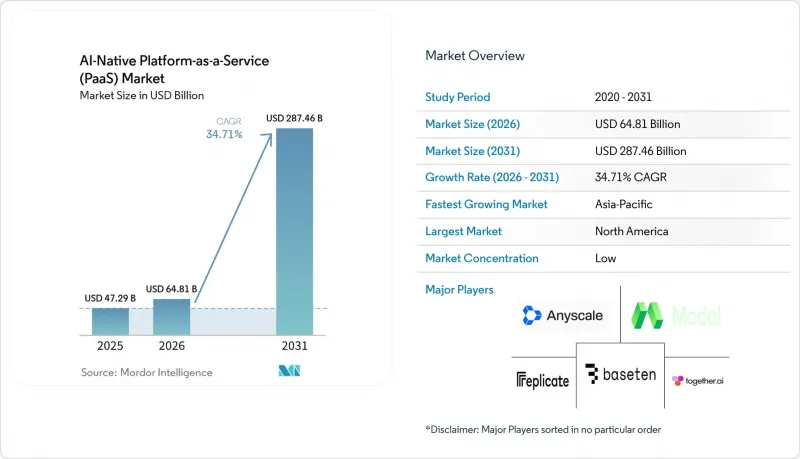
에 따르면 AI 네이티브 PaaS(Platform as a Service) 시장 규모는 2025년 472억 9,000만 달러에서 2026년에는 648억 1,000만 달러로 확대되어, 2026년부터 2031년까지 CAGR 34.71%를 기록하며 2031년까지 2,874억 6,000만 달러에 달할 것으로 예측됩니다.
전 세계 AI 네이티브 PaaS(Platform as a Service) 시장의 동향 및 인사이트
AI의 실험 단계에서 운영 환경으로의 전환
실험 단계에서 운영 환경으로의 전환은 AI 네이티브 PaaS(Platform-as-a-Service) 시장의 수요를 견인하는 가장 큰 요인입니다. 운영 시스템에는 신뢰성 높은 모델의 운영, 거버넌스, 모니터링 및 서비스 수준 보장이 필요하지만, 일시적인 사내 스택으로는 이를 제공하지 못하는 경우가 많습니다. 모든 업계의 조직이 AI 에이전트를 실제 워크플로우에 도입하고 있지만, 신뢰할 수 있는 확장성은 여전히 어려운 과제로 남아 있습니다. 이러한 격차로 인해 시스템 가동 후에도 모델 드리프트 점검, 재학습 트리거, 감사 기록, 비용 모니터링을 통해 성능을 관리하는 플랫폼에 대한 투자가 증가하고 있습니다. 기업 팀들은 모델의 품질은 물론, 평가, 모니터링, 접근 제어, 워크로드 라우팅에 대해서도 평가하고 있습니다. 공급자가 단일 관리형 운영 환경 내에서 여러 모델과 에이전트에 걸쳐 이러한 기능을 통합함으로써, AI 네이티브 PaaS 시장은 그 혜택을 누리게 될 것입니다.
AI 에이전트 및 멀티모델 애플리케이션의 보급
조직들은 단일 모델 호출에서 모델, 도구, 데이터 소스, 에이전트를 연계하는 애플리케이션으로 전환하고 있습니다. 이에 따라 오케스트레이션, 메모리 처리, 평가 및 접근 제어가 AI 네이티브 PaaS(Platform-as-a-Service) 시장의 핵심 기능으로 자리 잡고 있습니다. Anyscale은 2026년 6월, Azure 통합 기능의 공개 프리뷰를 시작했습니다. 이를 통해 고객이 관리하는 Azure 테넌트 내에서 멀티모달 데이터 준비, 미세 조정, 추론 및 에이전트 워크로드를 수행할 수 있게 되었습니다. 이 회사는 분산된 스택에 비해 실험 속도가 최대 4배 빨라졌으며, AI 총 소유 비용(TCO)이 최대 90% 절감되었다고 보고했습니다. LangChain과 NVIDIA는 2026년 7월 ‘NemoClaw Deep Agents’ 블루프린트를 발표했으며, 벤치마크 비교 결과 NVIDIA Nemotron 3 Ultra가 성능이 가장 유사한 폐쇄형 모델에 비해 추론 비용을 10분의 1로 줄였다고 합니다. AI 네이티브 PaaS(Platform-as-a-Service) 시장은 에이전트 간 통신, 도구 호출, 메모리 및 권한을 관리할 수 있는 공통 환경에 대한 수요에 힘입어 성장하고 있습니다.
AI 가속기의 비용 및 용량 변동성
가속기의 가용성이나 가격 정책은, 특히 전용 용량이 필요한 고객의 경우 플랫폼 도입 결정을 지연시키는 요인이 될 수 있습니다. 동등한 가속기 구성이라 하더라도 클라우드 제공업체 간에 가격 차이가 커서, 학습 및 추론 비용 산정을 복잡하게 만들고 있습니다. 이러한 불확실성은 사전에 대량의 용량을 확보할 수 없는 중소기업에게 특히 큰 과제가 됩니다. 추론은 AI 컴퓨팅의 대부분을 차지하기 때문에 추론 비용은 제공업체의 이익률과 고객에 대한 가격 책정에 영향을 미칠 수 있습니다. AI 네이티브 Platform-as-a-Service(PaaS) 시장은 유연한 구매 옵션, 워크로드 스케줄링, 사용량 상한 설정, 모델 선택 도구, 그리고 다양한 가속기 아키텍처 지원 등을 통해 이러한 우려를 완화할 수 있습니다. 이러한 대책이 용량 제약을 완전히 해소하는 것은 아니지만, 예산을 중시하는 사용자에게 AI 네이티브 PaaS 시장을 보다 실용적으로 만드는 데 도움이 됩니다.
부문 분석
2025년 기준, 애플리케이션 및 에이전트 개발 플랫폼은 시장의 33.42%를 차지했습니다. 이러한 위상은 모델 프로토타입에서 관리형 프로덕션 워크플로우로 가는 과정을 단축해 주는 도구에 대한 수요를 반영합니다. 모델 추론 및 서빙 플랫폼은 프로덕션 워크로드를 위한 런타임 계층을 제공합니다. 조직이 기존 모델을 특정 데이터나 비즈니스 업무에 맞게 조정함에 따라, 모델 훈련 및 미세 조정 플랫폼은 여전히 중요한 역할을 수행하고 있습니다. AI 데이터, 벡터 및 검색 서비스 또한 검색 증강 생성 및 지식 기반 애플리케이션을 지원합니다. 이러한 계층을 종합해 보면, 구매자들은 독립형 모델 엔드포인트가 아닌 통합된 워크플로우를 필요로 한다는 것을 알 수 있습니다.
AI 가시성, 평가 및 거버넌스 서비스는 2031년까지 연평균 성장률(CAGR) 35.69%로 확대될 것으로 예상되며, 이는 플랫폼 계층 중 가장 빠른 성장 속도입니다. Dynatrace는 2025년에 응답자의 29%에게 AI 기능이 가시성 플랫폼 선정의 주요 기준이었다고 보고했습니다. Pinecone은 프랑크푸르트에서 열린 발표회에서 ‘Dedicated Read Nodes’를 소개했습니다. 이 회사에 따르면, 이 기능을 통해 대상 고처리량 검색 워크로드에서 대규모 배포 시 최대 97%의 비용 절감이 가능해진다고 합니다. CoreWeave는 2025년 5월 Weights and Biases 인수를 완료하고, 컴퓨팅 인프라와 실험 추적 및 가시성을 연동했습니다. 이러한 동향은 평가와 모니터링이 운영 플랫폼의 일부로 자리 잡고 있음을 보여줍니다. AI 네이티브 PaaS(Platform as a Service) 업계에서는 이러한 기능을 개발 도구 및 서빙 도구와 연동하는 벤더가 우위를 점할 가능성이 높습니다.
2025년에는 시장의 78.81%를 클라우드 배포가 차지했습니다. 이러한 우위는 탄력적인 용량, 신속한 프로비저닝, 그리고 막대한 초기 투자 없이도 전용 컴퓨팅에 접근할 수 있다는 점에 기인합니다. 또한 클라우드 서비스는 관리형 데이터베이스, 모델 서비스, 모니터링 도구에 대한 접근을 간소화할 수도 있습니다. 이러한 이점은 팀이 워크로드를 신속하게 시작하거나 변경해야 할 때 중요합니다. 많은 조직에게 클라우드는 여전히 프로덕션 환경 수준의 AI 처리 능력을 실현하기 위한 가장 직접적인 수단입니다. 따라서 AI 네이티브 PaaS(Platform-as-a-Service) 시장은 계속해서 클라우드 기반 제공에 크게 의존하고 있습니다.
온프레미스 배포는 2031년까지 연평균 성장률(CAGR) 35.11%로 확대될 것으로 예측됩니다. 이러한 추세는 기밀 데이터, 모델 가중치 및 워크로드 배치 위치를 관리하고자 하는 요구를 반영합니다. Anyscale의 Azure 통합을 통해 고객은 자사의 Azure 테넌트 내에서 데이터 준비, 미세 조정, 추론 및 에이전트 워크로드를 실행할 수 있게 됩니다. 이러한 접근 방식은 관리형 플랫폼이 고객이 정의한 인프라 경계 내에서 어떻게 작동할 수 있는지를 보여줍니다. 또한, 서비스 관리와 고객의 제어권을 결합한 ‘BYOC(Bring-Your-Own-Cloud)’ 모델도 지원합니다. 따라서 고객이 제어하는 배포는 퍼블릭 클라우드와 온프레미스 인프라 중 하나를 선택해야 한다는 엄격한 제약 없이 확장할 수 있습니다.
지역별 분석
2025년, 북미는 전 세계 수요의 39.77%를 차지했습니다. 이 지역은 인프라 제공업체의 집중, 기업의 기술 지출, 그리고 AI 역량에 대한 적극적인 투자의 혜택을 받고 있습니다. Anyscale, Together AI, Pinecone, Arize AI, LangChain, Weights and Biases 등 많은 주요 플랫폼 기업들이 북미에 본사 또는 주요 사업 거점을 두고 있습니다. 이러한 공급업체 기반은 현지 고객의 도입을 촉진하는 동시에 소프트웨어, 클라우드, 통신, 금융 서비스, 생명과학 등 다양한 분야의 조직으로부터 발생하는 강력한 수요를 뒷받침하고 있습니다.
유럽에서는 기업 수요가 확대되고 있지만, 데이터 현지화 및 시스템 거버넌스가 제약요인으로 작용하고 있으며, Pinecone은 2026년 5월 AWS 프랑크푸르트 리전의 출시를 통해 이러한 과제를 해결했습니다. 유럽연합(EU)의 ‘AI 법’은 관련 AI 시스템의 투명성, 문서화 및 위험 관리에 대한 더욱 적극적인 노력을 촉진하고 있습니다. 남미는 여전히 도입 초기 단계에 있지만, 브라질의 기술 생태계와 금융 서비스의 현대화가 중요한 수요 원천이 되고 있습니다. 중동은 2026년 7월 아람코 벤처스가 Together AI의 8억 달러 규모 시리즈 C 자금 조달을 주도한 것에서도 알 수 있듯이, AI 인프라 자본의 전략적 공급원이 되어가고 있습니다. 아프리카에서는 현재 존재감이 제한적이지만, 정부의 디지털 전환 프로그램과 남아프리카공화국, 나이지리아, 이집트에서의 다국적 기업 진출을 통해 발전이 진행되고 있습니다.
아시아태평양은 2031년까지 연평균 성장률(CAGR) 35.58%로 확대될 것으로 예측되며, 이는 지역별 성장률 중 가장 높은 수치입니다. 이 지역에서는 대기업의 수요, 활발한 클라우드 투자, 그리고 국가 주도의 AI 역량 구축에 초점을 맞춘 프로그램이 결합되어 성장을 견인하고 있습니다. 일본, 한국, 인도, 중국 및 아시아태평양 전체는 현지화된 AI 플랫폼을 위한 중요한 수요 거점이 되고 있습니다. 현지 언어, 데이터 상주, 지역 내 호스팅 및 고객 주도 도입을 지원할 수 있는 공급업체들은 이러한 요구에 부응할 준비가 되어 있습니다. 이는 분산형 세계 인프라 내 AI 네이티브 PaaS 시장의 지역적 역할을 뒷받침하는 요소입니다.
기타 혜택:
- 엑셀 형식의 시장 예측(ME) 시트
- 3개월간의 애널리스트 지원
자주 묻는 질문
목차
제1장 소개
- 조사 가정과 시장 정의
- 조사 범위
제2장 조사 방법
제3장 주요 요약
제4장 시장 구도
- 시장 개요
- 시장 성장 촉진요인
- 시장 성장 억제요인
- 거시경제 요인이 시장에 미치는 영향
- 업계 밸류체인 분석
- 규제 상황
- 기술 전망
- Porter's Five Forces 분석
제5장 시장 규모와 성장 예측
- 플랫폼층별
- 전개 모델별
- 용도별
- 조직 규모별
- 최종 이용 산업별
- 지역별
- 북미
- 미국
- 캐나다
- 멕시코
- 남미
- 브라질
- 아르헨티나
- 기타 남미 국가
- 유럽
- 독일
- 영국
- 프랑스
- 이탈리아
- 스페인
- 기타 유럽 국가
- 아시아태평양
- 중국
- 인도
- 일본
- 한국
- 기타 아시아태평양 국가
- 중동
- 아랍에미리트
- 사우디아라비아
- 튀르키예
- 기타 중동 국가
- 아프리카
- 남아프리카공화국
- 나이지리아
- 이집트
- 기타 아프리카 국가
- 북미
제6장 경쟁 구도
- 시장 집중도
- 전략적 동향
- 시장 점유율 분석
- 기업 개요
- Anyscale, Inc.
- Baseten Labs, Inc.
- Modal Labs, Inc.
- Replicate, LLC
- Runpod Inc.
- TogetherAI, Inc.
- Fireworks AI, Inc.
- Northflank Ltd
- Beam Cloud, Inc.
- BentoML, Inc.
- Predibase, Inc.
- Lightning AI, Inc.
- Hugging Face, Inc.
- Pinecone Systems, Inc.
- Weaviate B.V.
- Qdrant Solutions GmbH
- Zilliz, Inc.
- Arize AI, Inc.
- LangChain, Inc.
- Weights & Biases, Inc.
- Lepton AI, Inc.
- OctoML, Inc.
제7장 시장 기회와 향후 전망
KSM 26.10.29According to Mordor Intelligence, the AI-native platform-as-a-service (PaaS) market size is expected to expand from USD 47.29 billion in 2025 to USD 64.81 billion in 2026, and is forecast to reach USD 287.46 billion by 2031, at a 34.71% CAGR over 2026-2031.
Global AI-Native Platform-as-a-Service (PaaS) Market Trends and Insights
Enterprise Shift From AI Experiments to Production Applications
The shift from experimentation to production is the strongest driver of demand for the AI-native platform-as-a-service (PaaS) market. Production systems require dependable model operations, governance, monitoring, and service-level commitments that temporary internal stacks often cannot provide. Organizations across sectors are moving AI agents into live workflows, yet reliable scaling remains difficult. This gap directs spending toward platforms that manage performance after a system goes live through model drift checks, retraining triggers, audit records, and cost monitoring. Enterprise teams assess evaluation, monitoring, access controls, and workload routing alongside model quality. The AI-native platform-as-a-service (PaaS) market benefits when providers bring these functions together across multiple models and agents within a single controlled operating environment.
AI Agent and Multi-Model Application Proliferation
Organizations are moving beyond single-model calls toward applications that coordinate models, tools, data sources, and agents. This makes orchestration, memory handling, evaluation, and access control central functions in the AI-native platform-as-a-service (PaaS) market. Anyscale introduced a public preview of its Azure integration in June 2026, allowing multimodal data preparation, fine-tuning, inference, and agent workloads within a customer-controlled Azure tenancy. The company reported up to 4 times faster experimentation and up to 90% lower total AI cost of ownership than with fragmented stacks. LangChain and NVIDIA launched the NemoClaw Deep Agents blueprint in July 2026, and its benchmark comparison stated that NVIDIA Nemotron 3 Ultra delivered 10 times lower inference cost than the nearest-performing closed model. The AI-native platform-as-a-service (PaaS) market is supported by demand for common environments that can manage agent communication, tool calls, memory, and permissions.
AI Accelerator Cost and Capacity Volatility
Accelerator availability and pricing can delay platform commitments, especially for customers who need dedicated capacity. Pricing can vary widely between cloud providers for comparable accelerator configurations, complicating estimates for training and inference costs. This uncertainty is particularly challenging for small and medium-sized enterprises that cannot reserve large amounts of capacity in advance. Inference costs can affect provider margins and customer pricing because inference accounts for a large share of AI compute. The AI-native platform-as-a-service (PaaS) market can reduce this concern through flexible purchasing options, workload scheduling, usage caps, model selection tools, and support for multiple accelerator architectures. These measures help make the AI-native platform-as-a-service (PaaS) market more practical for budget-conscious users, though they do not remove capacity constraints.
Other drivers and restraints analyzed in the detailed report include:
- Demand for Low-Latency Generative AI Inference
- Expansion of Open-Weight Model Deployment
- Data Privacy, Sovereignty, and Regulatory Constraints
For complete list of drivers and restraints, kindly check the Table Of Contents.
Segment Analysis
Application and Agent Development Platforms held 33.42% of the market in 2025. Their position reflects demand for tools that shorten the path from a model prototype to a managed production workflow. Model Inference and Serving Platforms provide the runtime layer for production workloads. Model Training and Fine-Tuning Platforms remain important as organizations adjust existing models for specialized data and business tasks. AI Data, Vector, and Retrieval Services also support retrieval-augmented generation and knowledge-based applications. Together, these layers show that buyers need an integrated workflow rather than a stand-alone model endpoint.
AI Observability, Evaluation, and Governance Services is projected to expand at a 35.69% CAGR through 2031, the fastest pace within the platform layer. Dynatrace reported in 2025 that AI capabilities were the leading criterion for selecting an observability platform for 29% of respondents. Pinecone's Frankfurt launch included Dedicated Read Nodes, which the company stated could deliver up to 97% cost reduction at scale for applicable high-throughput retrieval workloads. CoreWeave completed its acquisition of Weights and Biases in May 2025, linking compute infrastructure with experiment tracking and observability. These developments indicate that evaluation and monitoring are becoming part of the operating platform. The AI-native platform-as-a-service (PaaS) industry is likely to favor vendors that connect these functions with development and serving tools.
Cloud deployment accounted for 78.81% of the market in 2025. Its lead is supported by elastic capacity, rapid provisioning, and access to specialized compute without major upfront investment. Cloud services can also simplify access to managed databases, model services, and monitoring tools. These advantages matter when teams need to launch and modify workloads quickly. For many organizations, cloud remains the most direct way to reach production-scale AI capacity. The AI-native platform-as-a-service (PaaS) market, therefore, continues to rely heavily on cloud delivery.
On-premise deployment is projected to expand at a 35.11% CAGR through 2031. This momentum reflects the need for control over sensitive data, model weights, and workload locations. Anyscale's Azure integration allows customers to run data preparation, fine-tuning, inference, and agent workloads within their own Azure tenancy. This approach shows how managed platforms can operate within customer-defined infrastructure boundaries. It also supports a bring-your-own-cloud model that combines service management with customer control. Customer-controlled deployments can therefore expand without requiring a strict choice between public cloud and local infrastructure.
Complete Report Scope:
- By Platform Layer
- Model Inference and Serving Platforms
- Application and Agent Development Platforms
- Model Training and Fine-Tuning Platforms
- AI Data, Vector, and Retrieval Services
- AI Observability, Evaluation, and Governance Services
- By Deployment Model
- Cloud
- On-Premise
- By Application
- Generative AI Applications
- Natural Language Processing
- Computer Vision and Multimodal AI
- Recommendation and Personalization
- Predictive Analytics and Classical Machine Learning
- Other Applications
- By Organization Size
- Large Enterprises
- Small and Medium Enterprises
- By End-User Industry
- Retail and E-Commerce
- IT and Telecommunications
- Banking, Financial Services, and Insurance
- Healthcare and Life Sciences
- Media and Entertainment
- Other End-User Industries
- By Geography
- North America
- United States
- Canada
- Mexico
- South America
- Brazil
- Argentina
- Rest of South America
- Europe
- Germany
- United Kingdom
- France
- Italy
- Spain
- Rest of Europe
- Asia-Pacific
- China
- India
- Japan
- South Korea
- Rest of Asia-Pacific
- Middle East
- United Arab Emirates
- Saudi Arabia
- Turkey
- Rest of Middle East
- Africa
- South Africa
- Nigeria
- Egypt
- Rest of Africa
- North America
Geography Analysis
North America held 39.77% of global demand in 2025. The region benefits from a concentration of infrastructure providers, enterprise technology spending, and active investment in AI capacity. Many leading platform companies have headquarters or major operations in North America, including Anyscale, Together AI, Pinecone, Arize AI, LangChain, and Weights and Biases. This supplier base supports local customer adoption and strong demand from organizations across software, cloud, telecommunications, financial services, and life sciences.
Europe has expanding enterprise demand, but data localization and system governance pose constraints that Pinecone addressed with its AWS Frankfurt region launch in May 2026. The European Union's AI Act supports a stronger focus on transparency, documentation, and risk management for relevant AI systems. South America remains in an earlier stage of adoption, with Brazil's technology ecosystem and financial services modernization providing important demand channels. The Middle East is becoming a strategic source of AI infrastructure capital, as shown by Aramco Ventures leading Together AI's USD 800 million Series C in July 2026. Africa has a limited current presence and is developing through government digital transformation programs and multinational deployments in South Africa, Nigeria, and Egypt.
Asia-Pacific is projected to expand at a 35.58% CAGR through 2031, the fastest regional rate. The region combines large enterprise demand, active cloud investment, and programs focused on sovereign AI capabilities. Japan, South Korea, India, China, and the wider Asia-Pacific region are important demand centers for localized AI platforms. Providers that can support local languages, data residency, regional hosting, and customer-controlled deployments are positioned to address these needs. This supports the regional role of the AI-native PaaS market in distributed global infrastructure.
- Anyscale, Inc.
- Baseten Labs, Inc.
- Modal Labs, Inc.
- Replicate, LLC
- Runpod Inc.
- TogetherAI, Inc.
- Fireworks AI, Inc.
- Northflank Ltd
- Beam Cloud, Inc.
- BentoML, Inc.
- Predibase, Inc.
- Lightning AI, Inc.
- Hugging Face, Inc.
- Pinecone Systems, Inc.
- Weaviate B.V.
- Qdrant Solutions GmbH
- Zilliz, Inc.
- Arize AI, Inc.
- LangChain, Inc.
- Weights & Biases, Inc.
- Lepton AI, Inc.
- OctoML, Inc.
Additional Benefits:
- The market estimate (ME) sheet in Excel format
- 3 months of analyst support
TABLE OF CONTENTS
1 INTRODUCTION
- 1.1 Study Assumptions and Market Definition
- 1.2 Scope of the Study
2 RESEARCH METHODOLOGY
3 EXECUTIVE SUMMARY
4 MARKET LANDSCAPE
- 4.1 Market Overview
- 4.2 Market Drivers
- 4.2.1 Enterprise Shift from AI Experiments to Production Applications
- 4.2.2 Demand for Low-Latency Generative AI Inference
- 4.2.3 Expansion of Open-Weight Model Deployment
- 4.2.4 Developer Preference for Managed GPU and Serverless Workloads
- 4.2.5 AI Agent and Multi-Model Application Proliferation
- 4.2.6 Fragmented AI Toolchains Creating Demand for Unified Platforms
- 4.3 Market Restraints
- 4.3.1 AI Accelerator Cost and Capacity Volatility
- 4.3.2 Data Privacy, Sovereignty, and Regulatory Constraints
- 4.3.3 GPU Workload Isolation and Secure Execution Complexity
- 4.3.4 Model Drift, Evaluation Uncertainty, and Unpredictable Inference Economics
- 4.4 Impact of Macroeconomic Factors on the Market
- 4.5 Industry Value Chain Analysis
- 4.6 Regulatory Landscape
- 4.7 Technological Outlook
- 4.8 Porter's Five Forces Analysis
- 4.8.1 Threat of New Entrants
- 4.8.2 Bargaining Power of Suppliers
- 4.8.3 Bargaining Power of Buyers
- 4.8.4 Threat of Substitutes
- 4.8.5 Intensity of Competitive Rivalry
5 MARKET SIZE AND GROWTH FORECASTS (VALUE)
- 5.1 By Platform Layer
- 5.1.1 Model Inference and Serving Platforms
- 5.1.2 Application and Agent Development Platforms
- 5.1.3 Model Training and Fine-Tuning Platforms
- 5.1.4 AI Data, Vector, and Retrieval Services
- 5.1.5 AI Observability, Evaluation, and Governance Services
- 5.2 By Deployment Model
- 5.2.1 Cloud
- 5.2.2 On-Premise
- 5.3 By Application
- 5.3.1 Generative AI Applications
- 5.3.2 Natural Language Processing
- 5.3.3 Computer Vision and Multimodal AI
- 5.3.4 Recommendation and Personalization
- 5.3.5 Predictive Analytics and Classical Machine Learning
- 5.3.6 Other Applications
- 5.4 By Organization Size
- 5.4.1 Large Enterprises
- 5.4.2 Small and Medium Enterprises
- 5.5 By End-User Industry
- 5.5.1 Retail and E-Commerce
- 5.5.2 IT and Telecommunications
- 5.5.3 Banking, Financial Services, and Insurance
- 5.5.4 Healthcare and Life Sciences
- 5.5.5 Media and Entertainment
- 5.5.6 Other End-User Industries
- 5.6 By Geography
- 5.6.1 North America
- 5.6.1.1 United States
- 5.6.1.2 Canada
- 5.6.1.3 Mexico
- 5.6.2 South America
- 5.6.2.1 Brazil
- 5.6.2.2 Argentina
- 5.6.2.3 Rest of South America
- 5.6.3 Europe
- 5.6.3.1 Germany
- 5.6.3.2 United Kingdom
- 5.6.3.3 France
- 5.6.3.4 Italy
- 5.6.3.5 Spain
- 5.6.3.6 Rest of Europe
- 5.6.4 Asia-Pacific
- 5.6.4.1 China
- 5.6.4.2 India
- 5.6.4.3 Japan
- 5.6.4.4 South Korea
- 5.6.4.5 Rest of Asia-Pacific
- 5.6.5 Middle East
- 5.6.5.1 United Arab Emirates
- 5.6.5.2 Saudi Arabia
- 5.6.5.3 Turkey
- 5.6.5.4 Rest of Middle East
- 5.6.6 Africa
- 5.6.6.1 South Africa
- 5.6.6.2 Nigeria
- 5.6.6.3 Egypt
- 5.6.6.4 Rest of Africa
- 5.6.1 North America
6 COMPETITIVE LANDSCAPE
- 6.1 Market Concentration
- 6.2 Strategic Moves
- 6.3 Market Share Analysis
- 6.4 Company Profiles (includes Global Level Overview, Market Level Overview, Core Segments, Financials as available, Strategic Information, Market Rank/Share, Products and Services, Recent Developments)
- 6.4.1 Anyscale, Inc.
- 6.4.2 Baseten Labs, Inc.
- 6.4.3 Modal Labs, Inc.
- 6.4.4 Replicate, LLC
- 6.4.5 Runpod Inc.
- 6.4.6 TogetherAI, Inc.
- 6.4.7 Fireworks AI, Inc.
- 6.4.8 Northflank Ltd
- 6.4.9 Beam Cloud, Inc.
- 6.4.10 BentoML, Inc.
- 6.4.11 Predibase, Inc.
- 6.4.12 Lightning AI, Inc.
- 6.4.13 Hugging Face, Inc.
- 6.4.14 Pinecone Systems, Inc.
- 6.4.15 Weaviate B.V.
- 6.4.16 Qdrant Solutions GmbH
- 6.4.17 Zilliz, Inc.
- 6.4.18 Arize AI, Inc.
- 6.4.19 LangChain, Inc.
- 6.4.20 Weights & Biases, Inc.
- 6.4.21 Lepton AI, Inc.
- 6.4.22 OctoML, Inc.
7 MARKET OPPORTUNITIES AND FUTURE OUTLOOK
- 7.1 White-Space and Unmet-Need Assessment


