

|
시장보고서
상품코드
2154497
하이브리드 클라우드 AI 워크로드 오케스트레이션 : 시장 점유율 분석, 업계 동향과 통계, 성장 예측(2026-2031년)Hybrid Cloud AI Workload Orchestration - Market Share Analysis, Industry Trends & Statistics, Growth Forecasts (2026 - 2031) |
||||||
 Mordor Intelligence
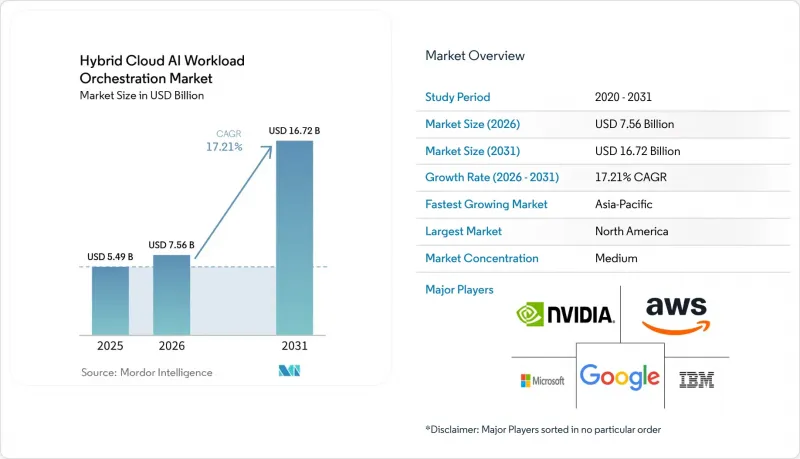
에 따르면 하이브리드 클라우드 AI 워크로드 오케스트레이션 시장 규모는 2025년 54억 9,000만 달러에서 2026년에는 75억 6,000만 달러로 확대되어, 2031년까지 167억 2,000만 달러에 달할 것으로 예상되며, 2026년부터 2031년까지 CAGR 17.21%로 확대될 것으로 전망됩니다.
세계 하이브리드 클라우드 AI 워크로드 오케스트레이션 시장의 동향 및 인사이트
LLM 훈련 및 추론 배포의 가속화
대규모 언어 모델(LLM)의 훈련 및 추론은 하이브리드 AI 인프라의 운영 요건을 변화시키고 있습니다. 이는 프로덕션 시스템이 더 이상 고정된 서버 군에서 단일 모델을 실행하는 것이 아니라, 컴퓨팅, 스토리지, 네트워크 작업이 연계되어 실행되는 일련의 프로세스가 되었기 때문입니다. 프로덕션 시스템에서는 프라이빗 환경과 퍼블릭 환경을 아우르며 프리필 노드, 디코딩 노드, KV 캐시 계층을 관리해야 하지만, 이러한 환경에서는 용량 조건, 성능 요구 사항, 데이터 관리 정책이 서로 다른 경우가 많습니다. 정적인 Kubernetes 구성에서는 전체 리소스에 걸쳐 실시간 의사결정을 내리고, 기반 인프라의 실제 상태를 반영하는 전용 오케스트레이션 계층이 없다면 이러한 단계를 효율적으로 관리할 수 없습니다. AWS는 NVIDIA Dynamo, vLLM 및 다중 노드 클러스터 간 고대역폭 KV 캐시 이동을 활용하는 Amazon SageMaker HyperPod용 분산 추론 기능을 도입했습니다. Google Cloud의 보고에 따르면, GKE에 탑재된 Managed Lustre에서 KV 캐시를 고성능 병렬 파일 시스템으로 마이그레이션한 결과, Llama-3.3-70B의 추론에 필요한 GPU 시간 요건을 약 60% 줄일 수 있었습니다. 이러한 다단계 아키텍처 덕분에 하이브리드 클라우드 AI 워크로드 오케스트레이션 시장의 역할은 기존의 작업 스케줄링에서 자원을 대량으로 소비하는 워크로드 구성요소의 동적 라우팅으로 확대되고 있습니다.
GPU 활용도와 컴퓨팅 비용의 최적화가 필수적입니다.
GPU 활용률은 대규모 AI 인프라를 운영하는 조직에게 핵심적인 재무적 우려 사항이 되고 있습니다. 이는 미사용 가속기 용량이 새로운 워크로드의 제약요인이 되는 한편, 하드웨어를 자체적으로 소유하고 있든 클라우드 계약을 통해 이용하고 있든 상관없이 높은 고정 비용이 발생하기 때문입니다. 미사용 용량을 안고 있는 조직은 인프라 비용 증가, 컴퓨팅 접근 지연, 변화하는 모델 요구 사항에 대응하는 유연성 저하, 그리고 제한된 GPU 용량을 어디에 할당해야 할지에 대한 내부 논의의 난항과 같은 과제에 직면해 있습니다. 후지쯔의 보고서에 따르면, 2024년에는 75% 이상의 조직에서 피크 부하 시 GPU 활용률이 70% 미만이었습니다. 레드햇은 IBM Vela 클러스터 도입 사례를 소개했습니다. 이 사례에서 Kueue 도입을 통해 GPU 활용률이 기준치인 30% 미만에서 활성 부하 시 90% 가까이까지 향상되었습니다. 마이크로소프트는 NVIDIA Run:ai가 Azure Kubernetes Service 도입 시 동적 GPU 할당 및 할당량 공유를 지원한다고 밝혔습니다. 하이브리드 클라우드 AI 워크로드 오케스트레이션 시장은 스케줄링 플랫폼이 용량 회수, 지출 관리, 그리고 사내 팀 및 테넌트 간에 희소한 컴퓨팅 리소스에 대한 보다 공정한 접근을 실현하는 도구로 평가받고 있다는 점에서 혜택을 보고 있습니다.
이종 하드웨어와 클라우드 API 간의 상호 운용성 격차
GPU 벤더, 클라우드 스케줄러, Kubernetes 도구 간에 공통된 API 계층이 존재하지 않는다는 점은 하이브리드 AI 환경의 도입 비용과 복잡성을 가중시킵니다. 멀티 클라우드 AI 팀은 비즈니스 목표가 단일하고 일관된 운영 모델인 경우에도 AWS Elastic Fabric Adapter, Google Kubernetes Engine의 추론 도구, 그리고 Run:ai가 탑재된 Azure Kubernetes Service에 대해 각각 별도의 통합이 필요할 수 있습니다. 이러한 통합에서는 사용 가능한 모든 환경에 대해 가용성, 비용, 탄소 강도 및 특정 정책 조건을 자동으로 평가하는 공통 워크로드 추상화가 제공되지 않습니다. 벤더별 통신 라이브러리는 서로 다른 가속기 유형의 분산 사용을 더욱 복잡하게 만듭니다. 이는 하드웨어 제품군 간에 데이터를 이동하거나 작업을 조정하기 위해 맞춤형 구현 작업이 필요할 수 있기 때문입니다. 이러한 제약으로 인해 공급 탄력성, 구매 유연성 및 비용 관리 측면에서 매력적임에도 불구하고, 멀티 벤더 GPU 풀의 도입이 지연될 가능성이 있습니다. 하이브리드 클라우드 AI 워크로드 오케스트레이션 시장은 소규모 벤더의 경우, 클라우드 간, 쿠버네티스 배포판, 가속기 플랫폼, 그리고 끊임없이 변화하는 공급자 인터페이스에 걸친 통합을 유지하기 위한 엔지니어링 리소스가 부족할 수 있기 때문에 추가적인 압박에 직면해 있습니다.
부문 분석
2025년에는 소프트웨어가 매출의 62.72%를 차지했습니다. 이는 물리적 컴퓨팅 환경 위에 위치한 거버넌스, 스케줄링 및 정책 적용 계층에 대해 고객이 가치를 두고 있음을 반영합니다. 하이브리드 클라우드 AI 워크로드 오케스트레이션 시장에서 이러한 계층은 워크로드 수용, 가속기 할당, ID 제어, 감사 기록, 그리고 테넌트가 클라우드와 로컬 시스템에 걸쳐 있는 공유 인프라를 어떻게 사용할지를 규정하는 규칙 등, 본래라면 별도의 제품에 분산되어 있던 기능을 통합합니다. 이러한 통합을 통해 도구 간의 인계 작업을 최소화하고, 본래라면 개별적으로 관리되던 워크로드에 대해서도 관리자가 공통된 운영 규칙을 적용할 수 있게 됩니다. 또한, 정기적인 라이선스 및 구독 모델은 하드웨어 구매 주기와 직접적인 연관이 약하기 때문에 플랫폼 벤더에게 더 지속가능한 수익 기반을 마련해 줍니다. 레드햇은 2026년 2월, 리눅스와 쿠버네티스부터 거버넌스가 적용된 AI 모델, 에이전트, 애플리케이션에 이르기까지 아우르는 통합 플랫폼으로서 ‘Red Hat AI Enterprise’를 출시했습니다. 이번 출시는 공급업체가 기존에 별도로 제공되던 인프라 제품을 보다 광범위한 계약으로 통합하여 조달을 간소화하는 동시에, 고객 1인당 소프트웨어 수익을 증가시키고 있는 실태를 보여줍니다.
서비스 시장은 2026년부터 2031년까지 연평균 성장률(CAGR) 17.61%로 확대될 것으로 예측됩니다. 그 배경에는 많은 사내 IT 팀이 당초 자체적으로 관리하기 어려운 도입 및 운영상의 요구 사항이 존재하기 때문입니다. 통합된 컨트롤 플레인을 프로덕션 환경에 도입하려면 데이터 위치, 워크로드 프로필, 클러스터 구성, 클라우드 계약, 액세스 규칙, 보안 제어 및 지속적인 성능 요구 사항에 대한 평가가 필요할 수 있습니다. 전문 서비스는 아키텍처를 구축하고 이러한 운영 요소를 통합할 수 있는 반면, 관리형 서비스는 가동 시작 후에도 성능, 비용 가시성 및 운영 규율을 유지할 수 있습니다. 조직은 사내 노하우를 축적하는 동안 서비스 의존도가 높은 프로젝트부터 시작하고, 팀이 더 많은 운영 업무를 담당하게 됨에 따라 지출의 더 큰 비율을 소프트웨어 라이선스나 플랫폼 구독으로 전환하는 경우가 많습니다. 따라서 하이브리드 클라우드 AI 워크로드 오케스트레이션 업계는 소프트웨어 가격 결정력과 고객이 환경을 구성, 운영, 개선하기 위한 외부 전문 지식에 대한 지속적인 수요가 결합된 형태를 띠고 있습니다.
2025년에는 클라우드가 매출의 57.28%를 차지했습니다. 이는 탄력적인 GPU 용량, 광범위한 지역에서의 가용성, 그리고 기업이 AI 환경의 모든 부분을 자체적으로 보유해야 할 필요성을 줄여주는 관리형 인프라 서비스에 힘입은 결과입니다. 하이브리드 클라우드 AI 워크로드 오케스트레이션 시장은 엄격한 데이터 상주 요건이 필요하지 않은 워크로드, 일시적인 용량 수요, 그리고 막대한 초기 하드웨어 투자 없이 대규모 GPU 플릿에 접근해야 하는 워크로드에서 계속해서 클라우드 환경에 의존하고 있습니다. 또한, 프로젝트가 소규모 파일럿 단계에서 대규모 프로덕션 워크로드로 전환될 때 클라우드를 활용하면 컴퓨팅 리소스 확장에 필요한 시간을 단축할 수 있습니다. 각 하이퍼스케일러 기업은 클러스터 관리나 분산 인프라에 대한 깊은 내부 전문 지식을 갖추지 못한 고객을 위해 일상적인 관리 부담을 덜어주는 관리형 서비스도 제공하고 있습니다. 로슈(Roche)는 미국 및 유럽의 하이브리드 클라우드 환경과 온프레미스 환경에 3,500대 이상의 NVIDIA Blackwell GPU를 도입했습니다. 이 도입 사례는 고급 사용자가 반드시 클라우드와 사설 인프라 중 한쪽만을 선택하는 것은 아니라는 점을 보여줍니다. 오히려 데이터, 성능, 규정 준수 요구 사항에 가장 적합한 위치와 용량 모델을 워크로드에 적용할 수 있도록 두 가지를 결합하는 경우도 있습니다.
규제 대상 사용자가 기밀성이 높은 워크로드에 대한 관리 권한을 더 강력하게 유지하고 관할상의 의무를 준수해야 하기 때문에 온프레미스 배포는 2026년부터 2031년까지 연평균 성장률(CAGR) 17.59%로 확대될 것으로 예측됩니다. 훈련 데이터, 추론 파이프라인, 감사 기록은 동일한 광역 리전 내에서 클라우드 리소스를 이용할 수 있더라도 정의된 위치에 보관해야 하는 경우가 있습니다. 전용 로컬 인프라를 활용함으로써 구매자는 NVIDIA, AMD, Intel 하드웨어에 공급처를 분산시키면서 데이터 준비, 미세 조정 및 기밀성이 높은 추론 작업에 대한 통제권을 유지할 수도 있습니다. HPE는 2026년 자사의 AI Factory 포트폴리오에 NVIDIA Mission Control 소프트웨어, Run:ai 및 NVIDIA Dynamo에 대한 지원을 추가했습니다. 하이브리드 클라우드 AI 워크로드 오케스트레이션 시장은 이러한 결합 모델에 의해 형성되고 있습니다. 이 모델에서는 사설 환경에서의 관리를 통해 데이터 보존 및 거버넌스 요구 사항을 충족하는 한편, 클라우드의 확장성을 통해 동일한 운영 환경 내에서 피크 시간대의 컴퓨팅 요구 사항을 처리합니다.
지역별 분석
2025년, 북미는 매출의 38.92%를 차지하며 하이브리드 클라우드 AI 워크로드 오케스트레이션 시장에서 이 지역이 선두를 달리고 있습니다. 이 지역에는 하이퍼스케일러, 전용 GPU 클라우드 제공업체, 연구 개발 역량, 그리고 이미 파일럿 프로젝트 단계를 넘어 본격적인 운영 단계로 전환된 기업의 AI 프로그램이 융합되어 있습니다. 미국은 AWS, Microsoft Azure, Google Cloud가 운영하는 대규모 관리형 GPU 플릿과 고부하 AI 워크로드를 처리하는 전문 인프라 제공업체를 통해 수요의 대부분을 주도하고 있습니다. NVIDIA는 2026년 1월 CoreWeave에 20억 달러를 투자했으며, 양사는 2030년까지 5기가와트를 초과하는 AI 팩토리 용량을 계획하고 있습니다. 캐나다와 멕시코에서는 미국 하이퍼스케일러의 인프라를 기반으로 한 국경을 초월한 하이브리드 아키텍처를 활용할 수 있는 금융 서비스 및 제조업 사용자들로부터 추가적인 수요가 발생하고 있습니다.
아시아태평양은 2026년부터 2031년까지 연평균 성장률(CAGR) 18.23%로 확대될 것으로 예측되며, 하이브리드 클라우드 AI 워크로드 오케스트레이션 시장에서 가장 빠르게 성장하는 지역이 될 전망입니다. 정부 주도의 국가 AI 프로그램, 기업 내 도입 확대, 그리고 각국의 슈퍼컴퓨팅에 대한 투자가 중국, 일본, 인도, 한국의 수요를 견인하고 있습니다. 각국의 데이터 거주지 정책으로 인해 하이브리드 제어 계층의 중요성이 높아지고 있습니다. 이는 퍼블릭 클라우드 용량을 기밀성이 높은 워크로드를 보유한 국내 인프라와 병행하여 운영해야 할 가능성이 있기 때문입니다. 일본의 ‘AI 전략’과 인도의 ‘IndiaAI 미션’은 각국의 데이터 거주지 프레임워크 하에서 운영되는 국내 AI 인프라에 대한 공공 자금 투자를 지시하고 있습니다. 동남아시아 및 호주에서는 현지 데이터 요건을 관리하고, 상용 및 연구용 워크로드를 모두 처리할 수 있는 용량을 요구하는 금융 서비스, 의료, 정부 기관의 수요가 더해지고 있습니다.
유럽은 하이브리드 클라우드 AI 워크로드 오케스트레이션 시장에서 큰 점유율을 차지하고 있으며, 독일, 프랑스, 영국이 주도적인 역할을 하고 있습니다. 이들 국가의 제약, 자동차, 금융 서비스 기업들은 EU 전체 및 각국의 데이터 규제를 모두 충족하는 관리형 AI 환경을 필요로 하고 있습니다. EU AI법, 일반 데이터 보호 규정(GDPR), EU 데이터법 및 디지털 운영 복원력법에 따라 거버넌스, 감사 가능성, 데이터 거주성 기능을 갖춘 시스템에 대한 조달이 촉진되고 있습니다. 중동에서는 사우디아라비아와 아랍에미리트(UAE)의 국가 주도 AI 프로그램을 통해 성장세가 가속화되고 있지만, 남미와 아프리카는 여전히 초기 단계에 있는 지역이며, 수요는 브라질, 콜롬비아, 남아프리카공화국, 나이지리아에 집중되어 있습니다.
기타 혜택:
- 엑셀 형식의 시장 예측(ME) 시트
- 3개월간의 애널리스트 지원
자주 묻는 질문
목차
제1장 소개
- 조사 가정과 시장 정의
- 조사 범위
제2장 조사 방법
제3장 주요 요약
제4장 시장 구도
- 시장 개요
- 시장 성장 촉진요인
- 시장 성장 억제요인
- 거시경제 요인이 시장에 미치는 영향
- 업계 밸류체인 분석
- 규제 상황
- 기술 전망
- Porter's Five Forces 분석
제5장 시장 규모와 성장 예측
- 구성요소별
- 도입 환경별
- 용도별
- 최종사용자별
- 조직 규모별
- 지역별
- 북미
- 미국
- 캐나다
- 멕시코
- 남미
- 브라질
- 아르헨티나
- 콜롬비아
- 기타 남미 국가
- 유럽
- 독일
- 영국
- 프랑스
- 이탈리아
- 기타 유럽 국가
- 아시아태평양
- 중국
- 일본
- 인도
- 한국
- 호주
- 동남아시아
- 기타 아시아태평양 국가
- 중동
- 사우디아라비아
- 아랍에미리트
- 튀르키예
- 기타 중동 국가
- 아프리카
- 남아프리카공화국
- 나이지리아
- 기타 아프리카 국가
- 북미
제6장 경쟁 구도
- 시장 집중도
- 전략적 동향
- 시장 점유율 분석
- 기업 개요
- NVIDIA Corporation
- Amazon Web Services, Inc.
- Microsoft Corporation
- Google LLC
- International Business Machines Corporation
- Hewlett Packard Enterprise Company
- Red Hat, Inc.
- Broadcom Inc.
- VMware LLC
- Nutanix, Inc.
- CloudBolt Software, Inc.
- Morpheus Data LLC
- Flexera Software LLC
- Scalr Inc.
- Mirantis, Inc.
- Platform9 Systems, Inc.
- Anyscale, Inc.
- CoreWeave, Inc.
- Rafay Systems, Inc.
- Hopsworks AB
- ClearML Ltd.
- Domino Data Lab, Inc.
- Lambda Labs, Inc.
- RunPod, Inc.
- Vast.ai, Inc.
- Modal Labs, Inc.
- Nscale Limited
- Vultr Holdings Corporation
제7장 시장 기회와 향후 전망
KSM 26.10.29According to Mordor Intelligence, the hybrid cloud AI workload orchestration market size is expected to increase from USD 5.49 billion in 2025 to USD 7.56 billion in 2026 and reach USD 16.72 billion by 2031, expanding at a CAGR of 17.21% over 2026-2031.
Global Hybrid Cloud AI Workload Orchestration Market Trends and Insights
Accelerating LLM Training and Inference Deployment
Large language model training and inference are changing the operating requirements for hybrid AI infrastructure because production systems are no longer a single model running on a fixed set of servers, but a coordinated sequence of compute, storage, and networking tasks. Production systems must manage prefill nodes, decode nodes, and KV-cache tiers across private and public environments, often with different capacity conditions, performance requirements, and data controls. Static Kubernetes configurations cannot manage these stages efficiently without a dedicated orchestration layer that makes real-time decisions across resources and reflects the actual state of the underlying infrastructure. AWS introduced disaggregated inference capabilities for Amazon SageMaker HyperPod that leverage NVIDIA Dynamo, vLLM, and high-bandwidth KV cache movement across multi-node clusters. Google Cloud reported that Managed Lustre with GKE reduced GPU-hour requirements for Llama-3.3-70B inference by nearly 60% when KV caches were moved to a high-performance parallel file system. These multi-stage architectures broaden the role of the Hybrid cloud AI workload orchestration market from conventional job scheduling to dynamic routing of resource-intensive workload components.
GPU Utilization and Compute Cost Optimization Imperative
GPU utilization has become a central financial concern for organizations operating AI infrastructure at scale because unused accelerator capacity constrains new workloads while generating high fixed costs, whether the hardware is owned locally or consumed through a cloud commitment. Organizations with unused capacity face higher infrastructure costs, slower access to compute, less flexibility to meet changing model requirements, and more difficult internal discussions over where scarce GPU capacity should be allocated. Fujitsu reported that more than 75% of organizations had GPU utilization below 70% at peak load in 2024. Red Hat described an IBM Vela cluster deployment in which Kueue helped improve GPU utilization from a baseline below 30% to nearly 90% under active load. Microsoft stated that NVIDIA Run:ai supports dynamic GPU fractioning and quota sharing for Azure Kubernetes Service deployments. The Hybrid cloud AI workload orchestration market benefits because scheduling platforms are assessed as tools for recovering capacity, controlling spend, and creating fairer access to scarce compute across internal teams and tenants.
Heterogeneous Hardware and Cloud API Interoperability Gaps
The lack of a shared API layer among GPU vendors, cloud schedulers, and Kubernetes tools increases the cost and complexity of deploying a hybrid AI environment. Multi-cloud AI teams may need distinct integrations for AWS Elastic Fabric Adapter, Google Kubernetes Engine inference tools, and Azure Kubernetes Service with Run:ai, even when the business objective is a single, consistent operating model. These integrations do not provide a common workload abstraction that automatically evaluates availability, cost, carbon intensity, and the specific policy conditions of every possible environment. Vendor-specific communication libraries further complicate distributed use of different accelerator types, because moving data or coordinating jobs across hardware families can require custom implementation work. The constraint can delay adoption of multi-vendor GPU pools, even when those pools are attractive for supply resilience, purchasing flexibility, and cost control. The Hybrid cloud AI workload orchestration market faces added pressure because smaller vendors may lack the engineering resources to maintain integrations across clouds, Kubernetes distributions, accelerator platforms, and shifting provider interfaces.
Other drivers and restraints analyzed in the detailed report include:
- Hybrid Data Residency and Sovereign AI Requirements
- Distributed AI Scheduling Across Heterogeneous Accelerators
- Shortage of AI Infrastructure Orchestration Specialists
For complete list of drivers and restraints, kindly check the Table Of Contents.
Segment Analysis
Software accounted for 62.72% of revenue in 2025, reflecting the value customers assign to governance, scheduling, and policy enforcement layers above the physical compute environment. Within the Hybrid cloud AI workload orchestration market, these layers bring together functions that would otherwise reside in separate products, including workload admission, accelerator allocation, identity controls, audit records, and the rules governing how tenants use shared infrastructure across cloud and local systems. This integration can limit handoffs between tools and help administrators apply common operating rules to workloads that would otherwise be managed separately. Their recurring license and subscription model is less directly tied to hardware purchasing cycles, which supports a more durable revenue base for platform vendors. Red Hat launched Red Hat AI Enterprise in February 2026 as a unified platform extending from Linux and Kubernetes to governed AI models, agents, and applications. The release shows how providers are consolidating formerly separate infrastructure products into broader agreements, simplifying procurement and increasing software revenue per customer.
Services are projected to expand at a CAGR of 17.61% between 2026 and 2031, driven by implementation and operational requirements that many internal IT teams cannot initially manage on their own. A deployment may require an assessment of data locations, workload profiles, cluster configurations, cloud contracts, access rules, security controls, and ongoing performance requirements before a unified control plane can be put into production. Professional services can establish the architecture and integrate these operating elements, while managed services can maintain performance, cost visibility, and operational discipline after launch. Organizations often start with service-heavy projects while they build internal knowledge, then shift a greater share of spending toward software licenses and platform subscriptions as their teams take on more operational work. The Hybrid cloud AI workload orchestration industry, therefore, combines software pricing power with the continuing demand for external expertise to help customers configure, operate, and improve their environments.
Cloud held 57.28% of revenue in 2025, supported by elastic GPU capacity, broad regional availability, and managed infrastructure services that reduce the need for enterprises to own every part of their AI environment. The Hybrid cloud AI workload orchestration market continues to rely on cloud environments for workloads that require no strict data-residency constraints, temporary capacity needs, and access to large GPU fleets without a major upfront hardware investment. Cloud use can also reduce the time required to scale compute when a project moves from a small pilot to a larger production workload. Hyperscalers also provide managed services that can reduce routine management requirements for customers lacking deep internal expertise in cluster administration or distributed infrastructure. Roche deployed more than 3,500 NVIDIA Blackwell GPUs across hybrid cloud and on-premises environments in the United States and Europe. The deployment illustrates that advanced users do not necessarily choose between cloud and private infrastructure; instead, they may combine them so that workloads can use the location and capacity model that best fits their data, performance, and compliance needs.
On-premises deployments are projected to expand at a CAGR of 17.59% from 2026 to 2031 as regulated users retain greater control over sensitive workloads and remain subject to jurisdictional obligations. Training data, inference pipelines, and audit records may need to remain in a defined location, even when cloud resources are available within the same broader region. Dedicated local infrastructure can also enable buyers to diversify their supply across NVIDIA, AMD, and Intel hardware while retaining control over data preparation, fine-tuning, and sensitive inference tasks. HPE added support for NVIDIA Mission Control software, Run: ai, and NVIDIA Dynamo within its AI Factory portfolio in 2026. The Hybrid cloud AI workload orchestration market is shaped by this paired model, where private control supports residency and governance needs while cloud elasticity addresses peak compute requirements in the same operating estate.
Complete Report Scope:
- By Component
- Software
- Services
- By Deployment Environment
- Cloud
- On Premise
- By Application
- GPU Scheduling and Allocation
- Workload Placement and Migration
- Cluster Management and Autoscaling
- Governance, Multi-Tenancy, and Policy Enforcement
- Monitoring, Observability, and Cost Optimization
- By End User
- Cloud Service Providers and GPU-as-a-Service Providers
- IT and Technology Companies
- BFSI
- Healthcare and Life Sciences
- Manufacturing and Automotive
- Government, Defense, and Research
- Retail, Consumer, and Media
- By Organization Size
- Large Enterprises
- Small and Medium Enterprises
- By Geography
- North America
- United States
- Canada
- Mexico
- South America
- Brazil
- Argentina
- Colombia
- Rest of South America
- Europe
- Germany
- United Kingdom
- France
- Italy
- Rest of Europe
- Asia-Pacific
- China
- Japan
- India
- South Korea
- Australia
- Southeast Asia
- Rest of Asia-Pacific
- Middle East
- Saudi Arabia
- United Arab Emirates
- Turkey
- Rest of Middle East
- Africa
- South Africa
- Nigeria
- Rest of Africa
- North America
Geography Analysis
North America held 38.92% of revenue in 2025, giving the region the leading position in the Hybrid cloud AI workload orchestration market. The region combines hyperscalers, purpose-built GPU cloud providers, research capacity, and enterprise AI programs that are already moving beyond pilot projects into active production. The United States drives most of the demand through large managed GPU fleets operated by AWS, Microsoft Azure, and Google Cloud, as well as specialist infrastructure providers serving intensive AI workloads. NVIDIA invested USD 2 billion in CoreWeave in January 2026, and the companies planned an AI factory capacity exceeding 5 gigawatts by 2030. Canada and Mexico add demand from financial services and manufacturing users that can use cross-border hybrid architectures anchored in the United States hyperscaler infrastructure.
Asia-Pacific is projected to expand at a CAGR of 18.23% from 2026 to 2031, making it the fastest-expanding regional part of the Hybrid cloud AI workload orchestration market. Government-backed sovereign AI programs, expanding enterprise adoption, and national supercomputing investments are driving demand across China, Japan, India, and South Korea. National data residency policies make hybrid control layers relevant, as public cloud capacity may need to operate alongside domestic infrastructure that retains sensitive workloads. Japan's AI Strategy and IndiaAI Mission direct public funding toward domestic AI infrastructure operating under national data-residency frameworks. Southeast Asia and Australia add demand from financial services, healthcare, and government organizations that manage local data requirements and seek capacity for both commercial and research workloads.
Europe represents a significant share of the Hybrid cloud AI workload orchestration market, led by Germany, France, and the United Kingdom. Pharmaceutical, automotive, and financial services organizations in these countries require controlled AI environments that meet both EU-wide and national data rules. The EU AI Act, General Data Protection Regulation, EU Data Act, and Digital Operational Resilience Act shape procurement toward systems with governance, auditability, and data-residency features. The Middle East is gaining momentum through sovereign AI programs in Saudi Arabia and the United Arab Emirates, while South America and Africa remain early-stage regions with demand centered on Brazil, Colombia, South Africa, and Nigeria.
- NVIDIA Corporation
- Amazon Web Services, Inc.
- Microsoft Corporation
- Google LLC
- International Business Machines Corporation
- Hewlett Packard Enterprise Company
- Red Hat, Inc.
- Broadcom Inc.
- VMware LLC
- Nutanix, Inc.
- CloudBolt Software, Inc.
- Morpheus Data LLC
- Flexera Software LLC
- Scalr Inc.
- Mirantis, Inc.
- Platform9 Systems, Inc.
- Anyscale, Inc.
- CoreWeave, Inc.
- Rafay Systems, Inc.
- Hopsworks AB
- ClearML Ltd.
- Domino Data Lab, Inc.
- Lambda Labs, Inc.
- RunPod, Inc.
- Vast.ai, Inc.
- Modal Labs, Inc.
- Nscale Limited
- Vultr Holdings Corporation
Additional Benefits:
- The market estimate (ME) sheet in Excel format
- 3 months of analyst support
TABLE OF CONTENTS
1 INTRODUCTION
- 1.1 Study Assumptions and Market Definition
- 1.2 Scope of the Study
2 RESEARCH METHODOLOGY
3 EXECUTIVE SUMMARY
4 MARKET LANDSCAPE
- 4.1 Market Overview
- 4.2 Market Drivers
- 4.2.1 Accelerating LLM Training and Inference Deployment
- 4.2.2 GPU Utilization and Compute Cost Optimization Imperative
- 4.2.3 Hybrid Data Residency and Sovereign AI Requirements
- 4.2.4 Distributed AI Scheduling Across Heterogeneous Accelerators
- 4.2.5 Agentic AIOps and Policy-Driven Automation Adoption
- 4.2.6 Energy-Aware Scheduling and Sustainable AI Infrastructure
- 4.3 Market Restraints
- 4.3.1 Heterogeneous Hardware and Cloud API Interoperability Gaps
- 4.3.2 Shortage of AI Infrastructure Orchestration Specialists
- 4.3.3 Multi-Tenant GPU Security and Isolation Complexity
- 4.3.4 Migration Friction Across Hybrid Control Planes
- 4.4 Impact of Macroeconomic Factors on the Market
- 4.5 Industry Value Chain Analysis
- 4.6 Regulatory Landscape
- 4.7 Technological Outlook
- 4.8 Porter's Five Forces Analysis
- 4.8.1 Intensity of Competitive Rivalry
- 4.8.2 Threat of New Entrants
- 4.8.3 Bargaining Power of Suppliers
- 4.8.4 Bargaining Power of Buyers
- 4.8.5 Threat of Substitutes
5 MARKET SIZE AND GROWTH FORECASTS (VALUE)
- 5.1 By Component
- 5.1.1 Software
- 5.1.2 Services
- 5.2 By Deployment Environment
- 5.2.1 Cloud
- 5.2.2 On Premise
- 5.3 By Application
- 5.3.1 GPU Scheduling and Allocation
- 5.3.2 Workload Placement and Migration
- 5.3.3 Cluster Management and Autoscaling
- 5.3.4 Governance, Multi-Tenancy, and Policy Enforcement
- 5.3.5 Monitoring, Observability, and Cost Optimization
- 5.4 By End User
- 5.4.1 Cloud Service Providers and GPU-as-a-Service Providers
- 5.4.2 IT and Technology Companies
- 5.4.3 BFSI
- 5.4.4 Healthcare and Life Sciences
- 5.4.5 Manufacturing and Automotive
- 5.4.6 Government, Defense, and Research
- 5.4.7 Retail, Consumer, and Media
- 5.5 By Organization Size
- 5.5.1 Large Enterprises
- 5.5.2 Small and Medium Enterprises
- 5.6 By Geography
- 5.6.1 North America
- 5.6.1.1 United States
- 5.6.1.2 Canada
- 5.6.1.3 Mexico
- 5.6.2 South America
- 5.6.2.1 Brazil
- 5.6.2.2 Argentina
- 5.6.2.3 Colombia
- 5.6.2.4 Rest of South America
- 5.6.3 Europe
- 5.6.3.1 Germany
- 5.6.3.2 United Kingdom
- 5.6.3.3 France
- 5.6.3.4 Italy
- 5.6.3.5 Rest of Europe
- 5.6.4 Asia-Pacific
- 5.6.4.1 China
- 5.6.4.2 Japan
- 5.6.4.3 India
- 5.6.4.4 South Korea
- 5.6.4.5 Australia
- 5.6.4.6 Southeast Asia
- 5.6.4.7 Rest of Asia-Pacific
- 5.6.5 Middle East
- 5.6.5.1 Saudi Arabia
- 5.6.5.2 United Arab Emirates
- 5.6.5.3 Turkey
- 5.6.5.4 Rest of Middle East
- 5.6.6 Africa
- 5.6.6.1 South Africa
- 5.6.6.2 Nigeria
- 5.6.6.3 Rest of Africa
- 5.6.1 North America
6 COMPETITIVE LANDSCAPE
- 6.1 Market Concentration
- 6.2 Strategic Moves
- 6.3 Market Share Analysis
- 6.4 Company Profiles (includes Global Level Overview, Market Level Overview, Core Segments, Financials as available, Strategic Information, Market Rank/Share, Products and Services, Recent Developments)
- 6.4.1 NVIDIA Corporation
- 6.4.2 Amazon Web Services, Inc.
- 6.4.3 Microsoft Corporation
- 6.4.4 Google LLC
- 6.4.5 International Business Machines Corporation
- 6.4.6 Hewlett Packard Enterprise Company
- 6.4.7 Red Hat, Inc.
- 6.4.8 Broadcom Inc.
- 6.4.9 VMware LLC
- 6.4.10 Nutanix, Inc.
- 6.4.11 CloudBolt Software, Inc.
- 6.4.12 Morpheus Data LLC
- 6.4.13 Flexera Software LLC
- 6.4.14 Scalr Inc.
- 6.4.15 Mirantis, Inc.
- 6.4.16 Platform9 Systems, Inc.
- 6.4.17 Anyscale, Inc.
- 6.4.18 CoreWeave, Inc.
- 6.4.19 Rafay Systems, Inc.
- 6.4.20 Hopsworks AB
- 6.4.21 ClearML Ltd.
- 6.4.22 Domino Data Lab, Inc.
- 6.4.23 Lambda Labs, Inc.
- 6.4.24 RunPod, Inc.
- 6.4.25 Vast.ai, Inc.
- 6.4.26 Modal Labs, Inc.
- 6.4.27 Nscale Limited
- 6.4.28 Vultr Holdings Corporation
7 MARKET OPPORTUNITIES AND FUTURE OUTLOOK
- 7.1 White-Space and Unmet-Need Assessment


