

|
시장보고서
상품코드
2154509
네트워크 디지털 트윈 플랫폼 : 시장 점유율 분석, 업계 동향과 통계, 성장 예측(2026-2031년)Network Digital Twin Platforms - Market Share Analysis, Industry Trends & Statistics, Growth Forecasts (2026 - 2031) |
||||||
 Mordor Intelligence
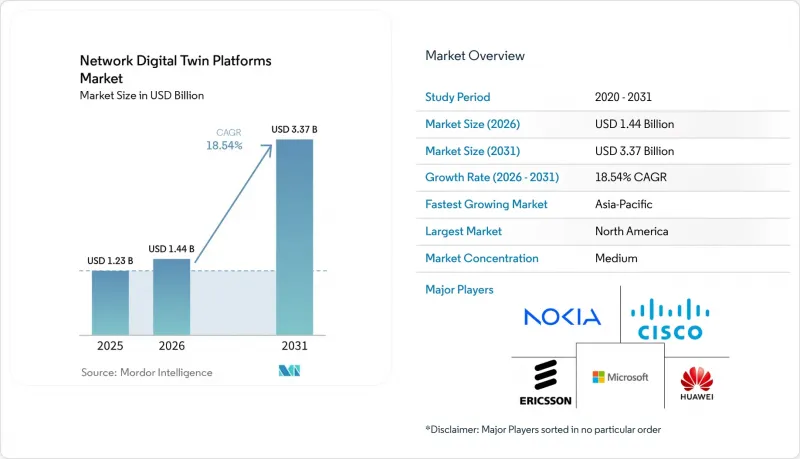
에 따르면 네트워크·디지털 트윈·플랫폼 시장 규모는 2025년에 12억 달러로 평가되며, 2026년 14억 달러에서 2031년까지 34억 달러에 달할 것으로 예측되며, 예측 기간(2026-2031년) 동안 CAGR은 18.5%가 될 전망입니다.
전 세계 네트워크 디지털 트윈 플랫폼 시장의 동향 및 인사이트
5G 및 Open RAN에 따른 네트워크의 복잡화
분산형 5G 및 Open RAN 아키텍처로 인해 무선 액세스 관리는 단일 벤더에 의한 엔지니어링 분야에서, 기존의 실험실 환경에서는 대규모로 재현할 수 없는 다중 벤더 간의 소프트웨어 조정 작업으로 변화했습니다. O-RAN 얼라이언스는 고충실도 디지털 트윈을 가동중인 운영을 중단하지 않고 xApps 및 rApps의 훈련과 검증을 수행하는 환경으로 자리매김하고 있습니다. 한편, 물리적 측정값, 노드 모델, 그리고 모델 간에 편차가 발생했을 때 재동기화를 트리거할 수 있는 O1 텔레메트리 동기화가 필요합니다. 노키아는 2026년 2월, NVIDIA의 ‘Aerial Omniverse 디지털 트윈’ 플랫폼에서 ‘RAN 디지털 트윈’을 출시했습니다. 이는 전파 전파 시뮬레이션을 활용하여 가혹한 모빌리티 시나리오에서의 빔포밍, 안테나 배치 및 핸드오버 성능을 평가하는 것입니다. 또한 O-RAN 얼라이언스는 노스이스턴 대학의 연구 플랫폼도 지원하고 있으며, 이 플랫폼에서는 xApps 및 rApps의 데이터 수집, 훈련, 테스트가 자동화되어 있습니다. 통신 사업자가 네트워크 변경에 자본을 투자하기 전에 사이트별 실증 자료가 필요한 경우, 네트워크 디지털 트윈 플랫폼 시장은 이에 따른 혜택을 누리게 될 것입니다.
폐루프 자동화 및 에이전틱 AI 검증
규칙 기반 자동화에서 자율형 소프트웨어 에이전트로의 전환에 따라, 제안된 변경 사항이 실제 시스템에 반영되기 전에 이를 테스트할 수 있는 안전한 환경에 대한 필요성이 높아지고 있습니다. ETSI는 디지털 트윈을 자가 복구 및 자가 최적화 네트워크 실험을 위한 가상 샌드박스로 정의하고 있으며, 이 노력의 일환으로 폐쇄 루프 자동화를 지원하기 위한 트윈 출력을 가능하게 하는 인터페이스에 초점을 맞추고 있습니다. NVIDIA는 시정 조치의 우선순위를 정할 때, 자사의 자율 통신 관련 이니셔티브에서 운영 지원 시스템, 비즈니스 지원 시스템, 텔레메트리 및 디지털 트윈을 조합하여 활용하고 있다고 밝혔습니다. 이 모델에서는 신뢰할 수 있는 데이터 커넥터와 명확하게 관리되는 온톨로지 관리가 더욱 중요시됩니다. 동기화가 불충분한 복제본으로는 자동화된 활동을 안전하게 유도할 수 없기 때문입니다. 또한 공급업체에게는 계획 프로젝트에서 제한적인 역할이 아닌, 보정, 모델 유지보수 및 통합에 있어 지속적인 역할이 부여됩니다. 통신 사업자가 디지털 트윈을 단순한 설계 도구가 아닌 운영 계층으로 취급하게 된다면, 네트워크 디지털 트윈 플랫폼 시장은 성장 기회를 얻을 수 있습니다.
고정밀도 RF 및 GPU 인프라 비용
고충실도 무선 주파수 시뮬레이션에는 전용 연산 리소스, 보정된 실제 데이터 및 지속적인 처리 능력이 필요하지만, IT 예산이 제한적인 Tier 2 및 Tier 3 통신 사업자의 경우 이를 확보하기 어려울 수 있습니다. VIAVI에 따르면, 도시 규모의 RAN 시뮬레이션에는 GPU를 통한 가속화와 AI 애플리케이션 검증용으로 구축된 O-RAN 준수 소프트웨어가 필요합니다. 클라우드 호스팅형 컴퓨팅은 초기 투자를 줄일 수 있지만, 네트워크 텔레메트리가 규제 대상이거나 기밀성이 높은 운영 정보로 취급되는 경우, 데이터 주권에 대한 우려가 발생할 수 있습니다. ETSI 또한 네트워크 운영에 사용되는 AI 시스템에 대한 사이버 보안 요구 사항을 수립하고 있습니다. 통신 사업자는 컴퓨팅 성능만을 단독으로 평가하기보다는 정확도, 보안 대책, 운영 비용 간의 균형을 맞춰야 합니다. 이러한 제약으로 인해 가격에 민감한 네트워크 디지털 트윈 플랫폼 시장 분야에서는 도입 속도가 둔화될 가능성이 있습니다.
부문 분석
소프트웨어는 2025년에 네트워크 디지털 트윈 플랫폼 시장의 63.2%를 차지할 것으로 예측되며, 2031년까지 연평균 성장률(CAGR) 20.12%로 성장할 것으로 전망됩니다. 이는 하드웨어 중심의 구매에서 구독형 및 클라우드 제공형 솔루션으로의 전환을 반영한 것입니다. 이 범주에는 플랫폼 코어, 시뮬레이션 및 에뮬레이션 엔진, 분석 모듈, 데이터 및 토폴로지 관리 계층, 오케스트레이션 및 보증 도구가 포함됩니다. 플랫폼 계층은 벤더 영역을 가로질러 텔레메트리 데이터를 집계하고, AI 추론을 호스팅하며, 타사 자동화 도구를 위한 애플리케이션 인터페이스를 제공합니다. 이 계층의 제어는 운영자가 사용하는 데이터, 모델, 운영 애플리케이션을 연결하므로, 더 광범위한 기술 스택 전반에 걸친 전환 경제성에 영향을 미칠 수 있습니다. 따라서 소프트웨어는 플랫폼 환경 내에서 핵심적인 제어 지점으로 남아 있을 것입니다.
서비스에는 자문, 시스템 통합, 도입, 마이그레이션 및 관리형 지원이 포함되어, 소프트웨어 조달과 운영 배포 사이의 격차를 해소합니다. 디지털 트윈에 대한 전문 지식이 제한적인 통신 사업자는 모델의 정확도를 높이고, 데이터 스키마를 변환하며, 운영 지원 시스템을 새로운 플랫폼에 연결하기 위해 외부 지원이 필요한 경우가 많습니다. 다중 벤더 네트워크 환경에서는 서로 다른 장비 및 성능 데이터 구조를 통합하기 위해 맞춤형 미들웨어가 필요할 수 있으므로 시스템 통합이 특히 중요합니다. TM Forum의 ‘Open Digital Architecture’는 이러한 통합 서비스에 대한 수요를 높일 수 있는 공통 프레임워크를 제공합니다. 또한, 매니지드 서비스를 활용함으로써 보정, 모델 재학습, 동기화 모니터링, 서비스 수준에 대한 책임성 확보 등을 일회성 구현 프로젝트가 아닌 지속적인 계약으로 전환할 수 있습니다. 이러한 접근 방식을 통해 사업자는 초기 도입 후에도 전문적인 자원을 지속적으로 활용할 수 있게 됩니다.
클라우드 기반 도입은 처리 요구 사항에 따라 확장 가능한 탄력적인 컴퓨팅 리소스를 통신 사업자가 선호하기 때문에 2025년에는 네트워크 디지털 트윈 플랫폼 수익의 56.77%를 차지할 것으로 예측됩니다. 상세한 RAN 시뮬레이션이나 에너지 최적화에는 막대한 컴퓨팅 능력이 필요하지만, 이러한 요구 사항은 하루 종일 일정하게 유지되는 것은 아닙니다. 클라우드 도입을 통해 통신 사업자는 동등한 수준의 전용 온프레미스 컴퓨팅 환경을 유지하지 않고도 워크로드를 확장할 수 있게 됩니다. 또한 분산된 운영 환경 전반에 걸쳐 분석, 데이터 관리 및 애플리케이션 업데이트를 보다 신속하게 배포할 수 있게 됩니다. 이러한 이점들은 특히, 로컬 인프라를 교체하지 않고 시뮬레이션 용량 확대, 분석 기능 업데이트, 그리고 분산된 네트워크 사이트 전반에 걸친 플랫폼 확장을 목표로 하는 통신 사업자들 사이에서 클라우드 기반 서비스가 현재 주도적인 위치를 차지하고 있음을 뒷받침합니다.
하이브리드 배포는 클라우드 기반 AI 및 시뮬레이션 기능과 지연에 민감한 데이터 및 규제 대상 데이터의 로컬 처리를 결합하기 때문에 2031년까지 연평균 성장률(CAGR) 19.87%로 성장할 것으로 예측됩니다. Tech Mahindra와 Microsoft는 2026년 6월에 제휴를 맺고, 복잡한 멀티 벤더 통신 환경을 위해 Azure 서비스, Azure 디지털 트윈 및 AI 프레임워크를 통합할 예정입니다. 기밀 처리 구성, 데이터 현지화 요구 사항 또는 수출 관리 의무를 관리하는 통신 사업자에게 온프레미스 시스템은 계속해서 중요한 역할을 할 것입니다. AI 처리의 설명 가능성과 투명성에 관한 ETSI의 지침에 따라, 통신 사업자는 기밀성이 높은 훈련 데이터를 로컬에 보관하면서 다른 워크로드에는 클라우드 용량을 활용하도록 권장받을 가능성이 있습니다. 따라서 하이브리드 배포는 데이터 관리 요구 사항을 충족하면서 확장 가능한 컴퓨팅 리소스에 대한 접근성을 유지할 수 있게 해주며, 이는 현지 규제, 상업적 계약 또는 내부 보안 정책에 따라 네트워크 텔레메트리 이동이 제한되는 경우에 중요합니다.
지역별 분석
2025년에는 북미가 네트워크 디지털 트윈 플랫폼 시장의 27.87%를 차지할 것으로 예상됩니다. 이 지역에는 Tier 1 통신 사업자, 클라우드 제공업체 및 독립적인 5G 구축 사례가 집중되어 있어, 실시간 시뮬레이션 및 운영 테스트에 대한 지속적인 수요를 뒷받침하고 있습니다. 미국이 주요 기여국이며, 금융 서비스 기업, 정부 기관 및 대기업에서 도입이 진행되고 있습니다. 캐나다에서는 이러한 플랫폼을 지방 지역의 연결성 계획에 활용하고 있으며, 가상 모델을 통해 현장 조사의 필요성을 줄이고 있습니다. 멕시코에서는 5G 주파수 대역 및 멀티밴드 무선 계획에 유사한 기능을 적용하고 있습니다.
유럽은 네트워크 디지털 트윈 플랫폼 시장에서 두 번째로 큰 지역 클러스터를 차지하고 있습니다. 독일, 영국, 프랑스는 확립된 통신 사업자의 기반과 네트워크 에너지 효율에 초점을 맞춘 정책을 통해 시장 활동을 뒷받침하고 있습니다. ETSI는 의도 기반 RAN 에너지 최적화를 위해 트윈 피드백 루프를 활용한 도이치 텔레콤과 화웨이의 개념 증명(PoC)을 기록했습니다. 또한, ETSI의 제로 터치 서비스 관리에 관한 노력은 트윈과 실제 운영 환경(라이브) 간의 인터페이스에 대한 통합 기대치도 확립하고 있습니다. 이탈리아와 유럽의 소규모 국가에서는 도입이 여전히 초기 단계에 있으며, 광섬유 액세스의 현대화 및 전송 계획이 주요 사용 사례로 나타나고 있습니다. 브라질과 아르헨티나에서는 그리 복잡하지 않은 시뮬레이션 환경이 필요한 엔트리 레벨 5G 용량 계획 솔루션의 시범 운영이 진행되고 있으며, 남미 전역에서의 보다 광범위한 도입을 위한 기반이 마련되고 있습니다.
아시아태평양은 2031년까지 연평균 성장률(CAGR) 20.11%로 성장할 것으로 예측되며, 이는 네트워크 디지털 트윈 플랫폼 시장에서 지역별 가장 높은 성장률입니다. 중국의 도시 규모 프로그램, 한국의 선진적인 5G 구축, 그리고 일본의 체계적인 6G 연구가 이 지역의 성장 동력을 이끌고 있습니다. KDDI가 2026년 6월에 시작할 예정인 공동 프로젝트에서는 전파 전파 시뮬레이션, 사용자 기기 에뮬레이션 및 GPU 컴퓨팅을 결합할 계획이며, 2028년 3월에 프로토타입을 완성할 예정입니다. KDDI 인도는 지방 광대역 계획을 위한 디지털 트윈 도입을 추진하고 있는 반면, 사우디아라비아와 아랍에미리트(UAE)에서는 스마트 시티 구상 및 5G 확대를 지원하기 위해 이러한 플랫폼을 활용하고 있습니다. 아프리카는 여전히 지역 시장 중 규모가 가장 작지만, 인프라 비용의 제약으로 인해 도입은 주로 계획 용도로 한정되어 있습니다. 그러나 클라우드 컴퓨팅의 활용이 더욱 광범위해짐에 따라, 예측 기간 후반에는 도입이 확대될 가능성이 있습니다.
기타 혜택:
- 엑셀 형식의 시장 예측(ME) 시트
- 3개월간의 애널리스트 지원
자주 묻는 질문
목차
제1장 소개
- 조사 가정과 시장 정의
- 조사 범위
제2장 조사 방법
제3장 주요 요약
제4장 시장 구도
- 시장 개요
- 시장 성장 촉진요인
- 시장 성장 억제요인
- 거시경제 요인이 시장에 미치는 영향
- 업계 밸류체인 분석
- 규제 상황
- 기술 전망
- Porter's Five Forces 분석
제5장 시장 규모와 성장 예측
- 구성요소별
- 전개 방식별
- 네트워크 도메인별
- 용도별
- 최종사용자별
- 지역별
- 북미
- 미국
- 캐나다
- 멕시코
- 남미
- 브라질
- 아르헨티나
- 기타 남미 국가
- 유럽
- 독일
- 영국
- 프랑스
- 이탈리아
- 기타 유럽 국가
- 아시아태평양
- 중국
- 일본
- 한국
- 인도
- 기타 아시아태평양 국가
- 중동
- 사우디아라비아
- 아랍에미리트
- 기타 중동 국가
- 아프리카
- 남아프리카공화국
- 나이지리아
- 기타 아프리카 국가
- 북미
제6장 경쟁 구도
- 시장 집중도
- 전략적 동향
- 시장 점유율 분석
- 기업 개요
- Nokia Corporation
- Telefonaktiebolaget LM Ericsson
- Huawei Technologies Co., Ltd.
- Microsoft Corporation
- VIAVI Solutions Inc.
- Cisco Systems, Inc.
- Juniper Networks, Inc.
- NEC Corporation
- Samsung Electronics Co., Ltd.
- Amazon Web Services, Inc.
- International Business Machines Corporation
- Keysight Technologies, Inc.
- Spirent Communications plc
- Ansys, Inc.
- Forward Networks, Inc.
- Mavenir Systems, Inc.
- Oracle Corporation
- Siemens AG
- Netcracker Technology Corporation
- Cohere Technologies, Inc.
제7장 시장 기회와 향후 전망
KSM 26.10.29According to Mordor Intelligence, the network digital twin platforms market size was valued at USD 1.2 billion in 2025 and is estimated to grow from USD 1.4 billion in 2026 to reach USD 3.4 billion by 2031, at a CAGR of 18.5% during the forecast period (2026-2031).
Global Network Digital Twin Platforms Market Trends and Insights
5G and Open RAN Network Complexity
Disaggregated 5G and Open RAN architectures have changed radio access management from a single-vendor engineering discipline into a multi-vendor software coordination task that conventional labs cannot reproduce at scale. The O-RAN Alliance identifies high-fidelity digital twins as an environment for training and validating xApps and rApps without interrupting live operations, while requiring synchronized physical measurements, node models, and O1 telemetry that can trigger resynchronization when a model drifts. Nokia launched its RAN Digital Twin on NVIDIA's Aerial Omniverse Digital Twin platform in February 2026, using radio propagation simulation to assess beamforming, antenna placement, and handover performance in demanding mobility scenarios. The O-RAN Alliance also supports a research platform at Northeastern University that automates data collection, training, and testing for xApps and rApps. The Network digital twin platforms market benefits when operators require site-specific evidence before committing capital to network changes.
Closed-Loop Automation and Agentic AI Validation
The move from rule-based automation to autonomous software agents raises the need for a safe environment to test proposed changes before they reach production systems. ETSI describes digital twins as a virtual sandbox for experimentation with self-healing and self-optimizing networks, and its work addresses interfaces that enable twin outputs to support closed-loop automation. NVIDIA states that its autonomous telecom work combines operational support systems, business support systems, telemetry, and digital twins when ranking remediation options. This model places greater importance on dependable data connectors and clearly governed ontology management, because a poorly synchronized replica cannot safely guide automated activity. It also gives suppliers a recurring role in calibration, model maintenance, and integration rather than a limited role in a planning project. The Network digital twin platforms market can gain as operators treat the twin as an operations layer rather than a design-only tool.
High-Fidelity RF and GPU Infrastructure Cost
High-fidelity radio-frequency simulation requires specialized compute resources, calibrated real-world data, and sustained processing capacity, which can be difficult for Tier 2 and Tier 3 operators with limited information technology budgets. VIAVI states that city-scale RAN simulations need GPU acceleration and O-RAN-compliant software built for AI application validation. Cloud-hosted compute can reduce upfront capital spending, but it can introduce data-sovereignty concerns where network telemetry is regulated or treated as sensitive operational information. ETSI has also established cybersecurity requirements for AI systems used in network operations. Operators must balance fidelity, security controls, and operating costs rather than evaluate compute capacity in isolation. This constraint can slow adoption in price-sensitive parts of the Network digital twin platforms market.
Other drivers and restraints analyzed in the detailed report include:
- Network Energy Optimization and Carbon-Reduction Mandates
- Cloud-Native, Edge, and Multi-Cloud Infrastructure Growth
- Multi-Vendor Data, Schema, and Ontology Fragmentation
For complete list of drivers and restraints, kindly check the Table Of Contents.
Segment Analysis
Software is projected to account for 63.2% of the network digital twin platforms market in 2025 and is projected to grow at a 20.12% CAGR through 2031, reflecting a shift toward subscription-based and cloud-delivered solutions rather than hardware-centric purchasing. The category includes platform cores, simulation and emulation engines, analytics modules, data and topology management layers, and orchestration and assurance tools. The platform layer aggregates telemetry across vendor domains, hosts AI inference, and provides application interfaces for third-party automation tools. Control of this layer can influence switching economics across the broader technology stack, as it connects the data, models, and operational applications operators use. Software, therefore, remains the central control point within the platform environment.
Services include advisory, systems integration, implementation, migration, and managed support, bridging the gap between software procurement and operational deployment. Operators with limited digital twin expertise often require external support to develop model fidelity, translate data schemas, and connect operational support systems to new platforms. Multi-vendor network estates make systems integration particularly important, as customized middleware may be required to reconcile different equipment and performance data structures. TM Forum's Open Digital Architecture provides a common framework that can increase demand for such integration services. Managed services can also transform calibration, model retraining, synchronization monitoring, and service-level accountability into recurring engagements rather than one-time implementation projects. This approach gives operators continued access to specialized resources after initial deployment.
Cloud-based deployment is projected to account for 56.77% of network digital twin platform revenue in 2025, driven by operators' preference for elastic computing resources that scale with processing requirements. Detailed RAN simulation and energy optimization require substantial computing capacity, although these requirements do not remain constant throughout the day. Cloud deployment allows operators to scale workloads without maintaining an equivalent dedicated on-premises computing estate. It also enables faster deployment of analytics, data management, and application updates across distributed operations. These advantages support the current leadership of cloud-based delivery, particularly among operators seeking to expand simulation capacity, update analytics capabilities, and extend platforms across dispersed network sites without replacing local infrastructure.
Hybrid deployment is forecast to grow at a 19.87% CAGR through 2031, as it combines cloud-based AI and simulation capabilities with local processing of latency-sensitive or regulated data. Tech Mahindra and Microsoft are expected to collaborate in June 2026 to combine Azure services, Azure Digital Twins, and AI frameworks for complex multi-vendor telecommunications environments. On-premises systems will remain relevant for operators managing classified configurations, data localization requirements, or export control obligations. ETSI guidance on the explainability and transparency of AI processing may encourage operators to retain sensitive training data locally while using cloud capacity for other workloads. Hybrid deployment can therefore address data control requirements while preserving access to scalable computing resources, which is important when local regulations, commercial contracts, or internal security policies restrict the movement of network telemetry.
Complete Report Scope:
- By Component
- Software
- Network Digital Twin Platform Software
- Simulation and Emulation Software
- Analytics, AI, and Optimization Software
- Data, Inventory, and Topology Software
- Orchestration and Assurance Software
- Services
- Consulting and Advisory Services
- Systems Integration Services
- Implementation and Migration Services
- Managed Operations and Support Services
- Software
- By Deployment Mode
- Cloud-Based
- On-Premise
- Hybrid
- By Network Domain
- Radio Access Network
- Core Network
- Transport and Backhaul
- Edge and Multi-Access Edge Computing
- Fixed Broadband and Fiber Access
- Other Network Domain
- By Application
- Network Design and Planning
- Network Performance Monitoring and Assurance
- Predictive Maintenance and Fault Management
- Capacity Planning and Traffic Optimization
- Security Testing and Compliance Validation
- Other Applications
- By End User
- Communication Service Providers
- Mobile Network Operators
- Internet Service Providers
- Tower Companies
- Network Equipment Manufacturers
- Other End Users
- By Geography
- North America
- United States
- Canada
- Mexico
- South America
- Brazil
- Argentina
- Rest of South America
- Europe
- Germany
- United Kingdom
- France
- Italy
- Rest of Europe
- Asia-Pacific
- China
- Japan
- South Korea
- India
- Rest of Asia-Pacific
- Middle East
- Saudi Arabia
- United Arab Emirates
- Rest of Middle East
- Africa
- South Africa
- Nigeria
- Rest of Africa
- North America
Geography Analysis
North America is expected to account for 27.87% of the Network Digital Twin Platforms Market in 2025. The region brings together tier-1 operators, cloud providers, and standalone 5G deployments, supporting sustained demand for real-time simulation and operational testing. The United States is the primary national contributor, with adoption across financial services firms, government agencies, and large enterprises. Canada uses these platforms for rural connectivity planning, where virtual models can reduce field survey requirements. Mexico applies similar capabilities to 5G spectrum and multiband radio planning.
Europe represents the second-largest geographic cluster in the Network Digital Twin Platforms Market. Germany, the United Kingdom, and France support market activity through established operator bases and policy focus on network energy efficiency. ETSI documented a Deutsche Telekom and Huawei proof of concept that used twin feedback loops for intent-driven RAN energy optimization. ETSI's work on zero-touch service management also establishes integration expectations for twin-to-live interfaces. Italy and smaller European countries remain in the early stages of adoption, with fiber access modernization and transport planning serving as the primary use cases. Brazil and Argentina are piloting entry-level 5G capacity planning solutions that require less complex simulation environments, creating a foundation for broader adoption across South America.
Asia-Pacific is forecast to grow at a CAGR of 20.11% through 2031, the highest regional growth rate in the Network Digital Twin Platforms Market. China's city-scale programs, South Korea's advanced 5G deployments, and Japan's structured 6G research are driving regional momentum. KDDI's planned June 2026 collaboration will combine radio propagation simulation, user equipment emulation, and GPU computing, with a prototype milestone scheduled for March 2028. KDDI India has promoted digital twins for rural broadband planning, while Saudi Arabia and the United Arab Emirates use these platforms to support smart city initiatives and 5G expansion. Africa remains the smallest regional market, as infrastructure costs limit adoption primarily to planning applications. However, broader availability of cloud computing could increase uptake later in the forecast period.
- Nokia Corporation
- Telefonaktiebolaget LM Ericsson
- Huawei Technologies Co., Ltd.
- Microsoft Corporation
- VIAVI Solutions Inc.
- Cisco Systems, Inc.
- Juniper Networks, Inc.
- NEC Corporation
- Samsung Electronics Co., Ltd.
- Amazon Web Services, Inc.
- International Business Machines Corporation
- Keysight Technologies, Inc.
- Spirent Communications plc
- Ansys, Inc.
- Forward Networks, Inc.
- Mavenir Systems, Inc.
- Oracle Corporation
- Siemens AG
- Netcracker Technology Corporation
- Cohere Technologies, Inc.
Additional Benefits:
- The market estimate (ME) sheet in Excel format
- 3 months of analyst support
TABLE OF CONTENTS
1 INTRODUCTION
- 1.1 Study Assumptions and Market Definition
- 1.2 Scope of the Study
2 RESEARCH METHODOLOGY
3 EXECUTIVE SUMMARY
4 MARKET LANDSCAPE
- 4.1 Market Overview
- 4.2 Market Drivers
- 4.2.1 5G and Open RAN Network Complexity
- 4.2.2 Closed-Loop Automation and Agentic AI Validation
- 4.2.3 Network Energy Optimization and Carbon-Reduction Mandates
- 4.2.4 Cloud-Native, Edge, and Multi-Cloud Infrastructure Growth
- 4.2.5 AI-Native 6G and High-Fidelity RAN Research
- 4.2.6 Digital Twin-Based Fiber and Fixed Access Modernization
- 4.3 Market Restraints
- 4.3.1 High-Fidelity RF and GPU Infrastructure Cost
- 4.3.2 Multi-Vendor Data, Schema, and Ontology Fragmentation
- 4.3.3 Cybersecurity Exposure From Twin-to-Live Network Connectivity
- 4.3.4 Scarcity of Telecom-Domain AI and Digital Twin Talent
- 4.4 Impact of Macroeconomic Factors on the Market
- 4.5 Industry Value Chain Analysis
- 4.6 Regulatory Landscape
- 4.7 Technological Outlook
- 4.8 Porter's Five Forces Analysis
- 4.8.1 Bargaining Power of Suppliers
- 4.8.2 Bargaining Power of Buyers
- 4.8.3 Threat of New Entrants
- 4.8.4 Threat of Substitutes
- 4.8.5 Competitive Rivalry
5 MARKET SIZE AND GROWTH FORECASTS (VALUE)
- 5.1 By Component
- 5.1.1 Software
- 5.1.1.1 Network Digital Twin Platform Software
- 5.1.1.2 Simulation and Emulation Software
- 5.1.1.3 Analytics, AI, and Optimization Software
- 5.1.1.4 Data, Inventory, and Topology Software
- 5.1.1.5 Orchestration and Assurance Software
- 5.1.2 Services
- 5.1.2.1 Consulting and Advisory Services
- 5.1.2.2 Systems Integration Services
- 5.1.2.3 Implementation and Migration Services
- 5.1.2.4 Managed Operations and Support Services
- 5.1.1 Software
- 5.2 By Deployment Mode
- 5.2.1 Cloud-Based
- 5.2.2 On-Premise
- 5.2.3 Hybrid
- 5.3 By Network Domain
- 5.3.1 Radio Access Network
- 5.3.2 Core Network
- 5.3.3 Transport and Backhaul
- 5.3.4 Edge and Multi-Access Edge Computing
- 5.3.5 Fixed Broadband and Fiber Access
- 5.3.6 Other Network Domain
- 5.4 By Application
- 5.4.1 Network Design and Planning
- 5.4.2 Network Performance Monitoring and Assurance
- 5.4.3 Predictive Maintenance and Fault Management
- 5.4.4 Capacity Planning and Traffic Optimization
- 5.4.5 Security Testing and Compliance Validation
- 5.4.6 Other Applications
- 5.5 By End User
- 5.5.1 Communication Service Providers
- 5.5.2 Mobile Network Operators
- 5.5.3 Internet Service Providers
- 5.5.4 Tower Companies
- 5.5.5 Network Equipment Manufacturers
- 5.5.6 Other End Users
- 5.6 By Geography
- 5.6.1 North America
- 5.6.1.1 United States
- 5.6.1.2 Canada
- 5.6.1.3 Mexico
- 5.6.2 South America
- 5.6.2.1 Brazil
- 5.6.2.2 Argentina
- 5.6.2.3 Rest of South America
- 5.6.3 Europe
- 5.6.3.1 Germany
- 5.6.3.2 United Kingdom
- 5.6.3.3 France
- 5.6.3.4 Italy
- 5.6.3.5 Rest of Europe
- 5.6.4 Asia-Pacific
- 5.6.4.1 China
- 5.6.4.2 Japan
- 5.6.4.3 South Korea
- 5.6.4.4 India
- 5.6.4.5 Rest of Asia-Pacific
- 5.6.5 Middle East
- 5.6.5.1 Saudi Arabia
- 5.6.5.2 United Arab Emirates
- 5.6.5.3 Rest of Middle East
- 5.6.6 Africa
- 5.6.6.1 South Africa
- 5.6.6.2 Nigeria
- 5.6.6.3 Rest of Africa
- 5.6.1 North America
6 COMPETITIVE LANDSCAPE
- 6.1 Market Concentration
- 6.2 Strategic Moves
- 6.3 Market Share Analysis
- 6.4 Company Profiles (includes Global Level Overview, Market Level Overview, Core Segments, Financials as available, Strategic Information, Market Rank/Share, Products and Services, Recent Developments)
- 6.4.1 Nokia Corporation
- 6.4.2 Telefonaktiebolaget LM Ericsson
- 6.4.3 Huawei Technologies Co., Ltd.
- 6.4.4 Microsoft Corporation
- 6.4.5 VIAVI Solutions Inc.
- 6.4.6 Cisco Systems, Inc.
- 6.4.7 Juniper Networks, Inc.
- 6.4.8 NEC Corporation
- 6.4.9 Samsung Electronics Co., Ltd.
- 6.4.10 Amazon Web Services, Inc.
- 6.4.11 International Business Machines Corporation
- 6.4.12 Keysight Technologies, Inc.
- 6.4.13 Spirent Communications plc
- 6.4.14 Ansys, Inc.
- 6.4.15 Forward Networks, Inc.
- 6.4.16 Mavenir Systems, Inc.
- 6.4.17 Oracle Corporation
- 6.4.18 Siemens AG
- 6.4.19 Netcracker Technology Corporation
- 6.4.20 Cohere Technologies, Inc.
7 MARKET OPPORTUNITIES AND FUTURE OUTLOOK
- 7.1 White-Space and Unmet-Need Assessment


