

|
시장보고서
상품코드
2154513
음악 및 페스티벌 관광 : 시장 점유율 분석, 업계 동향과 통계, 성장 예측(2026-2031년)Music and Festival Tourism - Market Share Analysis, Industry Trends & Statistics, Growth Forecasts (2026 - 2031) |
||||||
 Mordor Intelligence
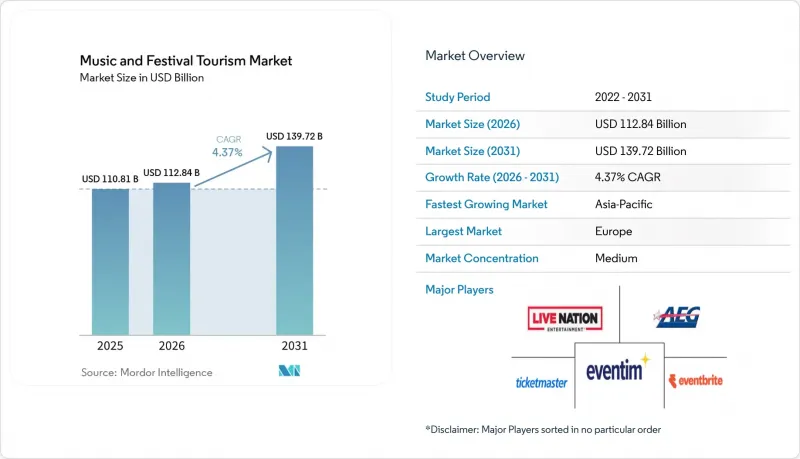
에 따르면 세계의 음악 및 페스티벌 관광 시장 규모는 2025년에 1,108억 1,000만 달러로 평가되며, 2026년 1,128억 4,000만 달러에서 2031년까지 1,397억 2,000만 달러에 달할 것으로 추정되며, 예측 기간(2026-2031년) 동안 CAGR은 4.37%가 될 전망입니다.
세계 음악 및 페스티벌 관광 시장의 동향과 인사이트
목적지 주도형 라이브 음악 여행에 대한 수요 증가
라이브 음악 여행은 현재 상당수의 소비자에게 여행의 주요 동기가 되고 있으며, 음악 페스티벌 관광 시장은 연령대를 불문하고 폭넓은 수요 기반을 확보하고 있습니다. 라이브 엔터테인먼트는 특히 젊은 여행객들 사이에서 여행의 주요 원동력이 되고 있으며, 콘서트, 페스티벌, 공연 예술 체험이 여행지 선택이나 여행 계획에 큰 영향을 미치는 경우가 많아지고 있습니다. 인도에서도 주요 음악 행사와 관련된 도시 간 이동이 증가하고 있으며, 이는 엔터테인먼트 주도형 여행의 영향력이 커지고 있음을 반영합니다. 이러한 추세는 인프라 정비와 투어 순회 경로의 확장에 힘입어 지속되고 있으며, 인도의 Z세대 여행객이 음악 행사 여행 1회당 지출하는 평균 금액은 약 570달러에 달합니다. 이러한 변화는 음악 페스티벌 관광 시장에 중요한 의미를 지닙니다. 이벤트 주도형 여행은 현지 호텔 수요를 강화하고, 음식 및 교통비 지출을 끌어올리며, 페스티벌의 인지도가 확립되면 새로운 개최 도시에 재방문 경로를 마련해 주기 때문입니다.
프리미엄 페스티벌 패키지 및 VIP 여행 패키지의 성장
음악 페스티벌 관광 시장은 티켓 판매에만 초점을 맞춘 모델에서 여행, 호스피탈리티, 프리미엄 접근권을 결합한 보다 광범위한 패키지 모델로 전환되고 있습니다. 라이브 음악 공연장 및 주요 페스티벌에서 VIP 및 프리미엄 서비스 제공이 강력한 성장세를 보이고 있으며, 이는 알찬 호스피탈리티, 한정된 접근권, 프리미엄 좌석, 그리고 차별화된 이벤트 경험에 대한 수요 증가를 반영합니다. 라이브 네이션은 원형 극장(앰피시어터) 전체에서 프리미엄 서비스 제공 전략을 확대하고 있습니다. 투모로우랜드의 ‘세계 저니(Global Journey)’ 프로그램도 이와 같은 논리에 기반을 두고 있으며, 180개국에서 온 참가자를 대상으로 항공권, 호텔, 픽업 서비스, 페스티벌 패스를 패키지로 묶어 판매함으로써, 개별 티켓 판매에 비해 여행자 1인당 수익을 높이고 있습니다. 이는 참가자 1인당 수익을 높이고, 예약 가시성을 향상시키며, 운영자가 여행자의 여정을 발견 단계부터 현지 소비에 이르기까지 더 세밀하게 관리할 수 있도록함으로써 음악 페스티벌 관광 시장의 중요한 원동력이 되고 있습니다.
높은 총 여행 비용이 가격에 민감한 참가자들의 참여를 제한하고 있습니다.
음악 페스티벌 관광 시장은 여전히 뚜렷한 경제적 제약에 직면해 있습니다. 이는 총 여행 비용이 티켓, 숙박, 교통, 식사, 굿즈 구매 등을 포함해 고액의 지출이 되기 때문입니다. 개인 소비 증가세가 둔화되면서 가계에 가해지는 압박이 커지고, 가처분 소득의 유연성이 낮아져 필수적이지 않은 여행이나 여가 활동에 대한 지출이 더욱 신중해지고 있습니다. 또한, 여행 빈도는 유지되고 있지만 여행자들이 더 가까운 목적지나 저가형 숙박 시설을 선택하는 경향이 있어 1회당 지출은 감소하고 있다는 점도 지적되고 있습니다. 이 문제는 인도에도 영향을 미치고 있습니다. 라이브 이벤트 여행에 대한 관심이 높아지고 있다고는 하지만, 특히 도시 간이나 국제 여행의 경우 젊은 여행객들에게 비용 관리의 필요성이 사라지는 것은 아니기 때문입니다. 그 결과, 음악 페스티벌 관광 시장에서는 프리미엄층 참가자와 가격에 민감한 층 간의 격차가 확대되는 한편, 소규모 페스티벌은 합리적인 가격대를 유지하기가 점점 더 어려워지고 있습니다.
부문 분석
2025년, 음악 페스티벌 관광 시장 규모의 34.8%를 차지한 ‘음악 페스티벌 관광’은 주요 이벤트 유형 중 1위를 차지하고 있습니다. 이 순위는 음악 프로그램과 사교·문화·여행지 체험을 결합한 다일 일정 형식의 강점을 반영하고 있습니다. 글래스턴베리, 코첼라, 투모로우랜드, 록 인 리오와 같은 대표 브랜드들은 1일 형식보다 긴 예약 기간과 더 강력한 숙박 수요를 창출함으로써 이러한 주도적 지위를 지속적으로 뒷받침하고 있습니다. 콘서트 관광은 여전히 두 번째 주요 축으로 자리 잡고 있습니다. 이는 아레나 투어나 아티스트 레지던시가 기간은 짧더라도 집중적인 숙박 및 교통 수요를 창출할 수 있기 때문입니다. 또한, 문화나 전통 음악을 주제로 한 페스티벌도 음악 행사가 지역의 정체성이나 확립된 문화적 배경과 연결되어 있는 여행지에서, 문화유산에 관심을 가진 여행객을 유치함으로써 그 역할을 확대하고 있습니다.
EDM 페스티벌은 2031년까지 연평균 성장률(CAGR) 5.6%로 성장할 것으로 예측되며, 음악 페스티벌 관광 시장에서 가장 빠르게 확대되고 있는 이벤트 형식이 되었습니다. 이러한 성장세는 확장성이 높은 브랜딩, 젊은 여행객의 수요, 그리고 검증된 콘셉트를 새로운 개최지로 프랜차이즈화할 수 있는 능력과 밀접하게 관련되어 있습니다. 정부 주도의 확장은 아시아태평양에서 특히 두드러지며, 태국은 세계적으로 인정받는 EDM 행사 개최지이자 이벤트 관광의 장기적인 성장 동력으로서 그 위상을 확고히 하고 있습니다. 이 모델은 인도에게도 중요한데, 대도시권에서 페스티벌에 대한 수요가 증가하고 있을 뿐만 아니라, 소비 수준이 높은 도시에서는 이벤트 형식의 재현이 점점 더 현실화되고 있기 때문입니다. 따라서 음악 페스티벌 관광 업계 전체에서는 뚜렷한 양극화가 나타나고 있으며, 며칠에 걸쳐 진행되는 목적지형 페스티벌이 가장 큰 고객 기반을 유지하는 한편, 정책 지원, 젊은 층의 수요, 디지털 상의 노출 가능성이 맞물려 EDM 형식의 페스티벌은 더욱 빠르게 확대되고 있습니다.
2025년 음악 페스티벌 관광 시장에서 국내 여행객의 점유율은 68.7%를 차지하고 있으며, 이는 대부분의 페스티벌에서 지역 및 타 도시에서 온 방문객이 여전히 방문객 기반을 형성하고 있음을 보여줍니다. 이러한 점유율은 이동 장벽이 낮고, 서류 절차의 부담이 적으며, 빽빽한 페스티벌 일정 속에서도 반복적으로 방문하기 쉽기 때문인 것으로 분석됩니다. 인도와 같은 시장에서는 도시 지역의 음악 수요가 증가하고 있는 반면, 장거리 이동 결정에는 여전히 가격 민감도가 영향을 미치고 있으므로 국내 이동이 특히 중요합니다. 또한, 국내 관람객은 보다 안정적인 수익의 기반이 되기 때문에 운영자는 공연장, 인력 배치, 티켓 재고 계획을 더 확신을 가지고 진행할 수 있습니다. 음악 페스티벌 관광 시장에서 이러한 국내 시장의 두터움은, 국제 여행을 통한 고부가가치 수요가 가세하기 전에 우선 인프라 구축을 뒷받침하는 역할을 하고 있습니다.
해외에서 오는 여행객은 2031년까지 연평균 성장률(CAGR) 5.3%로 증가할 것으로 예측되며, 음악 페스티벌 관광 시장에서 가장 빠르게 성장하는 여행객층이 될 것입니다. 국경을 넘어 참가하는 방문객은 1회 여행당 항공료, 체류 기간 및 패키지화된 체험에 대한 지출액이 많은 경향이 있으므로, 그 기여도는 중요합니다. 유럽은 행사 개최 빈도가 높고, 지역 내 교통망이 잘 갖춰져 있어 이러한 추세의 혜택을 누릴 수 있는 유리한 위치에 계속 머물고 있습니다. 한편, 아시아태평양은 젊은 층의 해외 여행 수요 및 인바운드 수요 증가로 인해 성장세가 가속화되고 있습니다. 따라서 음악 페스티벌 관광 업계는 규모 확대 측면에서는 여전히 국내 수요에 의존하고 있지만, 방문객 1인당 수익성을 높이기 위해서는 해외 여행객에 의존하고 있습니다.
지역별 분석
2025년, 유럽은 34.4%의 시장 점유율을 차지하며 음악 페스티벌 관광 시장을 주도했습니다. 이는 해당 지역의 잘 갖춰진 페스티벌 인프라, 다양한 이벤트 구성, 그리고 단거리 이동의 높은 편의성을 반영한 것입니다. 영국은 여전히 가장 두드러진 사례 중 하나로, 2024년에는 2,350만 명의 음악 관광객이 공연에 참여하여 100억 파운드의 경제적 효과를 창출했습니다. 한편, 해외에서 온 음악 관광객은 전년 대비 62% 증가한 160만 명에 달했습니다. 독일도 계속해서 견조한 모습을 보이고 있으며, 업계 보고서에 따르면 연간 500만 명 이상의 정기적인 콘서트 관람객이 있는 데다, BDKV의 데이터 역시 라이브 이벤트를 위해 여행하려는 의지가 여전히 높은 관람객층을 일관되게 보여주고 있습니다. 유럽은 그 규모 덕분에 여전히 가장 광범위한 페스티벌 기반을 보유하고 있지만, 이 지역에서는 라이선싱 압력, 소음 규제, 교통 체증에 대한 우려가 더욱 두드러지고 있습니다. 즉, 유럽은 음악 페스티벌 관광 시장에서 여전히 가장 큰 지역이지만, 시장이 성숙기에 접어들면서 특정 도시 지역의 공연장에서는 운영 조건이 점점 더 까다로워지고 있습니다.
북미는 대규모 이벤트 브랜드, 높은 구매력, 그리고 선진적인 프로모터 및 티켓 판매 시스템을 바탕으로 음악 페스티벌 관광 시장에서 확고한 입지를 유지하고 있습니다. 2025년에는 ‘오스틴 시티 리미츠 뮤직 페스티벌’만으로도 5억 5,780만 달러의 직접적인 경제적 효과를 창출했으며, 그중 8,740만 달러가 호텔 수입을 차지하여 이 지역의 대표 행사가 가진 지속력을 보여주고 있습니다. 라이브 네이션은 2026년 1분기 매출이 37억 9,000만 달러(전년 동기 대비 12% 증가)를 기록하며, 운영 비용 상승에도 불구하고 애널리스트들의 예상을 상회했습니다. 또한 66억 달러의 이연 수익을 기록했는데, 이는 2026년 투어 시즌에 대한 견조한 선행 수요를 반영한 것입니다. 남미 역시 프로모터들의 투자 확대와 아티스트 주도의 여행 이벤트에 대한 팬들의 수요 증가에 힘입어 주목도를 높이고 있습니다. 이 지역의 팬 커뮤니티는 현재 여행지 차원에서 대규모 수요를 창출할 수 있게 되었으며, 이는 향후 더 광범위한 음악 페스티벌 관광 시장에서 남미가 더 중요한 역할을 수행할 것임을 시사합니다.
아시아태평양은 2031년까지 연평균 성장률(CAGR) 6.1%로 성장할 것으로 예측되며, 음악 페스티벌 관광 시장에서 가장 빠르게 성장하는 지역 클러스터가 될 전망입니다. 이 지역은 젊은 인구 구성, 중산층 소비 확대, 그리고 관광의 촉매제 역할을 하는 라이브 엔터테인먼트에 대한 정부 지원 등의 혜택을 받고 있습니다. 이러한 추세 속에서 인도가 두드러지는 이유는 도시 간 이동이 수반되는 이벤트 여행이 이미 급증하고 있으며, 도시 지역의 음악에 대한 수요가 깊어지고 있고, 주요 소비 거점에서 대규모 페스티벌 형식이 보다 의도적으로 자리 잡고 있기 때문입니다. 한국은 K-POP 팬덤을 중심으로 한 국경을 초월한 페스티벌 모델을 구축하고 있는 반면, 태국은 세계적으로 인정받은 페스티벌 자산을 활용하여 인바운드 관광에서의 입지를 강화하고 있습니다. 중동 및 아프리카는 여전히 이전보다 규모가 작은 상태입니다. 그럼에도 불구하고 투자에 대한 관심은 높아지고 있으며, 우간다의 ‘Nyege Nyege’ 사례가 보여주듯이, 지방 도시에서의 페스티벌 관광은 이미 측정 가능한 지역적 파급 효과를 창출하고 있습니다.
기타 혜택:
- 엑셀 형식의 시장 예측(ME) 시트
- 3개월간의 애널리스트 지원
자주 묻는 질문
목차
제1장 소개
- 조사 가정과 시장 정의
- 조사 범위
제2장 조사 방법
제3장 주요 요약
제4장 시장 구도
- 시장 개요
- 시장 성장 촉진요인
- 시장 성장 억제요인
- 규제 상황
- 기술 전망
- Porter's Five Forces 분석
제5장 시장 규모와 성장 예측(달러, 금액)
- 이벤트 유형별
- 여행자 유형별
- 예약 방법별
- 지출 카테고리별
- 지역별
- 북미
- 미국
- 캐나다
- 멕시코
- 남미
- 브라질
- 페루
- 칠레
- 아르헨티나
- 기타 남미 국가
- 유럽
- 영국
- 독일
- 프랑스
- 스페인
- 이탈리아
- 베네룩스(벨기에, 네덜란드, 룩셈부르크)
- 북유럽 국가(덴마크, 핀란드, 아이슬랜드, 노르웨이, 스웨덴)
- 기타 유럽 국가
- 아시아태평양
- 인도
- 중국
- 일본
- 호주
- 한국
- 동남아시아(싱가포르, 말레이시아, 태국, 인도네시아, 베트남, 필리핀)
- 기타 아시아태평양 국가
- 중동 및 아프리카
- 아랍에미리트
- 사우디아라비아
- 남아프리카공화국
- 나이지리아
- 기타 중동 및 아프리카 국가
- 북미
제6장 경쟁 구도
- 시장 집중도
- 전략적 동향
- 시장 점유율 분석
- 기업 개요
- Live Nation Entertainment Inc.
- Anschutz Entertainment Group
- CTS Eventim AG & Co. KGaA
- TEG Pty Ltd
- DEAG Deutsche Entertainment AG
- HYBE Co., Ltd.
- MSG Entertainment Holdings, LLC
- Glastonbury Festival Events Limited
- WEAREONE.world BV
- Danny Wimmer Presents LLC
- Superstruct Entertainment Limited
- Percept Limited
- Nodwin Gaming Pvt. Ltd.
- Eventbrite, Inc.
- Viagogo Entertainment Inc.
- Vivid Seats LLC
- SeatGeek Inc.
- Fever Labs Inc.
- Bandsintown LLC
- ACFEA Tour Consultants Inc.
- Live Nation Entertainment Inc.
제7장 시장 기회와 향후 전망
KSM 26.10.29According to Mordor Intelligence, the global music and festival tourism market size was valued at USD 110.81 billion in 2025 and is estimated to grow from USD 112.84 billion in 2026 to reach USD 139.72 billion by 2031, at a CAGR of 4.37% during the forecast period (2026-2031).
Global Music and Festival Tourism Market Trends and Insights
Rising Demand for Destination-Led Live Music Travel
Live music travel is now a primary trip trigger for a meaningful share of consumers, giving the Music festival tourism market a broader demand base across age groups. Live entertainment is increasingly becoming a key driver of travel, particularly among younger travelers, with concerts, festivals, and performing arts experiences often shaping destination choices and trip planning. India is also witnessing growing intercity travel linked to major music events, reflecting the rising influence of entertainment-led travel, a trend supported by growing infrastructure and the expansion of touring circuits, with average per-trip spending among Gen Z indian travelers reaching approximately USD 570 per music-event trip. That shift matters for the Music festival tourism market because event-led travel strengthens local hotel demand, boosts food and mobility spending, and provides newer host cities with a repeat-visit pathway once festival awareness is established.
Growth of Premium Festival Packages and VIP Travel Bundles
The Music festival tourism market is moving away from a model centered solely on ticket sales toward a broader package model that combines travel, hospitality, and premium access. VIP and premium offerings are experiencing strong growth across live music venues and major festivals, reflecting increasing demand for enhanced hospitality, exclusive access, premium seating, and differentiated event experiences. Live Nation is expanding its premium offering strategy across amphitheaters. Tomorrowland's Global Journey program follows the same logic, packaging flights, hotels, transfers, and festival passes for attendees from 180 countries, thereby boosting revenue per traveler compared to a stand-alone ticket. This is a key driver for the Music festival tourism market because it increases yield per attendee, improves booking visibility, and gives operators more control over the traveler journey from discovery to on-site spending.
High Total Trip Cost Limits Price-Sensitive Participation
The Music festival tourism market still faces a clear affordability constraint because the total trip cost combines tickets, lodging, transport, food, and merchandise into one high outlay. Slowing consumer spending growth is creating greater pressure on household budgets, reducing disposable income flexibility and making non-essential travel and leisure spending more discretionary. It also notes that trip frequency is holding, but per-trip spend is falling as travelers shift to closer destinations and lower accommodation tiers. This issue affects India as well, because rising interest in live-event travel does not eliminate the need for cost discipline among younger travelers, especially for intercity or international trips. In the Music festival tourism market, the result is a wider gap between premium attendees and price-sensitive audiences, while smaller festivals face greater difficulty preserving accessible price points.
Other drivers and restraints analyzed in the detailed report include:
- Event Tourism Spending Spillover into Lodging, Food, and Local Mobility
- Artist-Driven Fan Pilgrimage Behavior and Repeat Attendance
- Event Cancellations, Weather Volatility, and Safety Risk
For complete list of drivers and restraints, kindly check the Table Of Contents.
Segment Analysis
Music Festival Tourism accounted for 34.8% of the Music festival tourism market size in 2025, making it the leading event type. This position reflects the strength of multi-day formats that combine music programming with social, cultural, and destination experiences. Flagship brands such as Glastonbury, Coachella, Tomorrowland, and Rock in Rio continue to support this leadership because they create long booking windows and stronger accommodation demand than single-day formats. Concert tourism remained the second major pillar because arena tours and artist residencies can still generate concentrated lodging and transportation demand over shorter timeframes. Cultural and traditional music festivals also widened their role by attracting heritage-focused travelers in destinations where music events are tied to local identity and established cultural settings.
EDM festivals are projected to grow at a 5.6% CAGR through 2031, making them the fastest-expanding event format in the Music festival tourism market. Their momentum is linked to scalable branding, younger traveler demand, and the ability to franchise proven concepts across new destinations. State-backed expansion is particularly evident in Asia-Pacific, where Thailand has positioned itself as a host market for globally recognized EDM properties and as a driver of long-term growth in event tourism. That model matters for India because festival demand in large urban centers is deepening and format replication is becoming more feasible in high-consumption cities. The wider Music festival tourism industry is therefore seeing a clear split, with multi-day destination festivals holding the largest base and EDM formats moving faster as policy support, youth demand, and digital discoverability converge.
Domestic travelers held a 68.7% share of the Music festival tourism market in 2025, indicating that local and intercity attendance still form the attendance base for most festivals. This share is grounded in lower travel friction, lower documentation barriers, and easier access to repeat attendance across dense festival calendars. In markets such as India, domestic movement is especially important because urban music demand is rising while price sensitivity still shapes long-haul decisions. Domestic attendance also provides a more stable revenue floor, which helps operators plan venues, staffing, and ticket inventory with greater confidence. In the Music festival tourism market, this domestic depth supports infrastructure development first, before international travel adds higher-value demand.
International travelers are projected to grow at a 5.3% CAGR through 2031, making them the fastest-growing traveler group in the Music festival tourism market. Their contribution is important because cross-border attendees tend to spend more per trip on flights, longer stays, and bundled experiences. Europe remains well-positioned to benefit from this trend because of its dense event calendar and strong intra-regional connectivity, while Asia-Pacific is building momentum through younger outbound and inbound demand. The Music festival tourism industry, therefore, continues to rely on domestic volume for scale, but it depends on international travelers for stronger per-visitor economics.
Complete Report Scope:
- By Event Type
- Concert Tourism
- Music Festival Tourism
- Cultural & Traditional Music Festivals
- Electronic Dance Music (EDM) Festivals
- Others (Religious & Spiritual,Classical & Opera,Jazz & Blues Festivals etc.)
- By Traveler Type
- Domestic
- International
- By Booking Mode
- Online Travel Agencies
- Direct Booking
- Travel Agents
- By Spending Category
- Tickets
- Accommodation
- Transportation
- Food & Beverage
- Merchandise & VIP Experiences
- By Geography
- North America
- United States
- Canada
- Mexico
- South America
- Brazil
- Peru
- Chile
- Argentina
- Rest of South America
- Europe
- United Kingdom
- Germany
- France
- Spain
- Italy
- BENELUX (Belgium, Netherlands, and Luxembourg)
- NORDICS (Denmark, Finland, Iceland, Norway, and Sweden)
- Rest of Europe
- Asia-Pacific
- India
- China
- Japan
- Australia
- South Korea
- South East Asia (Singapore, Malaysia, Thailand, Indonesia, Vietnam, and Philippines)
- Rest of Asia-Pacific
- Middle East and Africa
- United Arab Emirates
- Saudi Arabia
- South Africa
- Nigeria
- Rest of Middle East and Africa
- North America
Geography Analysis
Europe led the Music festival tourism market with 34.4% market share in 2025, reflecting the region's dense festival infrastructure, broad event mix, and strong short-haul travel connectivity. The United Kingdom remained one of the clearest examples, with 23.5 million music tourists attending shows in 2024 and generating GBP 10 billion in economic impact, while international music tourists rose to 1.6 million, up 62% year on year. Germany also continued to show resilience, with industry reports citing over 5 million regular concert attendees annually, as BDKV data consistently highlights a visitor base that remains highly willing to travel for live events. Europe's scale still gives it the broadest festival base, but the region is also where licensing pressure, noise rules, and congestion concerns are becoming more visible. That means Europe remains the largest region in the Music festival tourism market, even as its mature status brings tighter operating conditions in certain urban venues.
North America held a strong position in the Music festival tourism market because of its large event brands, high spending power, and advanced promoter-ticketing systems. Austin City Limits Music Festival alone generated USD 557.8 million in direct economic impact in 2025, including USD 87.4 million in hotel revenue, which shows the staying power of flagship events in the region. Live Nation reported Q1 2026 revenue of USD 3.79 billion (+12% year-on-year), beating analyst expectations despite higher operating costs, and recorded USD 6.6 billion in deferred revenue, reflecting robust forward demand for the 2026 touring season. South America is also gaining visibility as promoter investment expands and fan demand for artist-led travel events strengthens. Fan communities in the region can now generate destination-level demand at scale, which suggests a stronger role for South America within the wider Music festival tourism market over time.
Asia-Pacific is projected to grow at a 6.1% CAGR through 2031, making it the fastest-growing regional cluster in the Music festival tourism market. The region benefits from younger demographics, growing middle-class spending, and public support for live entertainment as a tourism catalyst. India stands out within this trend because intercity event travel has already moved up sharply, urban music demand is deepening, and large festival formats are being positioned more deliberately in major consumption centers. South Korea is building a cross-border festival model around K-pop fandom, while Thailand is using globally recognized festival properties to strengthen inbound tourism positioning. The Middle East and Africa remain smaller than they were. Still, investment interest is increasing, and Uganda's Nyege Nyege example shows that secondary-city festival tourism can already create measurable local returns.
- Live Nation Entertainment Inc.
Additional Benefits:
- The market estimate (ME) sheet in Excel format
- 3 months of analyst support
TABLE OF CONTENTS
1 Introduction
- 1.1 Study Assumptions and Market Definition
- 1.2 Scope of the Study
2 Research Methodology
3 Executive Summary
4 Market Landscape
- 4.1 Market Overview
- 4.2 Market Drivers
- 4.2.1 Rising Demand for Destination-Led Live Music Travel
- 4.2.2 Growth of Premium Festival Packages and VIP Travel Bundles
- 4.2.3 Event Tourism Spending Spillover Into Lodging, Food, and Local Mobility
- 4.2.4 Artist-Driven Fan Pilgrimage Behavior and Repeat Attendance
- 4.2.5 Festivalization of Secondary Cities and Non-Hub Destinations
- 4.2.6 Expansion of Online Discovery, Booking, and Ticket Resale Ecosystems
- 4.3 Market Restraints
- 4.3.1 High Total Trip Cost Limits Price-Sensitive Participation
- 4.3.2 Event Cancellations, Weather Volatility, and Safety Risk
- 4.3.3 Visa Friction and Cross-Border Travel Complexity
- 4.3.4 Local Community Pushback on Noise, Congestion, and Overtourism
- 4.4 Regulatory Landscape
- 4.5 Technological Outlook
- 4.6 Porter's Five Forces Analysis
- 4.6.1 Threat of New Entrants
- 4.6.2 Bargaining Power of Buyers
- 4.6.3 Bargaining Power of Suppliers
- 4.6.4 Threat of Substitutes
- 4.6.5 Competitive Rivalry
5 Market Size and Growth Forecasts (USD,Value)
- 5.1 By Event Type
- 5.1.1 Concert Tourism
- 5.1.2 Music Festival Tourism
- 5.1.3 Cultural & Traditional Music Festivals
- 5.1.4 Electronic Dance Music (EDM) Festivals
- 5.1.5 Others (Religious & Spiritual,Classical & Opera,Jazz & Blues Festivals etc.)
- 5.2 By Traveler Type
- 5.2.1 Domestic
- 5.2.2 International
- 5.3 By Booking Mode
- 5.3.1 Online Travel Agencies
- 5.3.2 Direct Booking
- 5.3.3 Travel Agents
- 5.4 By Spending Category
- 5.4.1 Tickets
- 5.4.2 Accommodation
- 5.4.3 Transportation
- 5.4.4 Food & Beverage
- 5.4.5 Merchandise & VIP Experiences
- 5.5 By Geography
- 5.5.1 North America
- 5.5.1.1 United States
- 5.5.1.2 Canada
- 5.5.1.3 Mexico
- 5.5.2 South America
- 5.5.2.1 Brazil
- 5.5.2.2 Peru
- 5.5.2.3 Chile
- 5.5.2.4 Argentina
- 5.5.2.5 Rest of South America
- 5.5.3 Europe
- 5.5.3.1 United Kingdom
- 5.5.3.2 Germany
- 5.5.3.3 France
- 5.5.3.4 Spain
- 5.5.3.5 Italy
- 5.5.3.6 BENELUX (Belgium, Netherlands, and Luxembourg)
- 5.5.3.7 NORDICS (Denmark, Finland, Iceland, Norway, and Sweden)
- 5.5.3.8 Rest of Europe
- 5.5.4 Asia-Pacific
- 5.5.4.1 India
- 5.5.4.2 China
- 5.5.4.3 Japan
- 5.5.4.4 Australia
- 5.5.4.5 South Korea
- 5.5.4.6 South East Asia (Singapore, Malaysia, Thailand, Indonesia, Vietnam, and Philippines)
- 5.5.4.7 Rest of Asia-Pacific
- 5.5.5 Middle East and Africa
- 5.5.5.1 United Arab Emirates
- 5.5.5.2 Saudi Arabia
- 5.5.5.3 South Africa
- 5.5.5.4 Nigeria
- 5.5.5.5 Rest of Middle East and Africa
- 5.5.1 North America
6 Competitive Landscape
- 6.1 Market Concentration
- 6.2 Strategic Moves
- 6.3 Market Share Analysis
- 6.4 Company Profiles (includes Global Level Overview, Market Level Overview, Core Segments, Financials as available, Strategic Information, Market Rank/Share, Products and Services, Recent Developments)
- 6.4.1 Live Nation Entertainment Inc.
- 6.4.1.1 Anschutz Entertainment Group
- 6.4.1.2 CTS Eventim AG & Co. KGaA
- 6.4.1.3 TEG Pty Ltd
- 6.4.1.4 DEAG Deutsche Entertainment AG
- 6.4.1.5 HYBE Co., Ltd.
- 6.4.1.6 MSG Entertainment Holdings, LLC
- 6.4.1.7 Glastonbury Festival Events Limited
- 6.4.1.8 WEAREONE.world BV
- 6.4.1.9 Danny Wimmer Presents LLC
- 6.4.1.10 Superstruct Entertainment Limited
- 6.4.1.11 Percept Limited
- 6.4.1.12 Nodwin Gaming Pvt. Ltd.
- 6.4.1.13 Eventbrite, Inc.
- 6.4.1.14 Viagogo Entertainment Inc.
- 6.4.1.15 Vivid Seats LLC
- 6.4.1.16 SeatGeek Inc.
- 6.4.1.17 Fever Labs Inc.
- 6.4.1.18 Bandsintown LLC
- 6.4.1.19 ACFEA Tour Consultants Inc.
- 6.4.1 Live Nation Entertainment Inc.
7 MARKET OPPORTUNITIES AND FUTURE OUTLOOK
- 7.1 Market Opportunities
- 7.1.1 Small-City Festival Circuit Packaging
- 7.1.2 Sustainable Low-Carbon Event Travel Bundles
- 7.2 White-Space and Unmet-Need Assessment


