

|
시장보고서
상품코드
2154728
남미의 정부 및 보안용 생체인식 : 시장 점유율 분석, 업계 동향과 통계, 성장 예측(2026-2031년)South America Government and Security Biometrics - Market Share Analysis, Industry Trends & Statistics, Growth Forecasts (2026 - 2031) |
||||||
 Mordor Intelligence
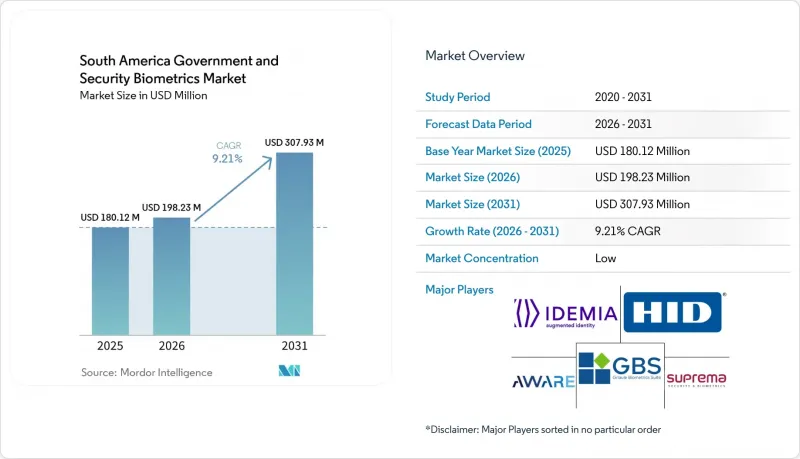
에 따르면 남미의 정부 및 보안용 생체인식 시장 규모는 2025년에 1억 8,012만 달러이며, 2026년부터 2031년까지 예측 기간 동안 CAGR 9.21%로 확대되어, 2031년에는 3억 793만 달러에 달할 것으로 전망됩니다.
남미 정부 및 보안용 생체인식 시장의 동향 및 인사이트
정부의 디지털 ID 및 국민 ID 확대
2032년까지 ‘Carteira de Identidade Nacional(CIN)’을 유일한 생체 인증이 적용된 국민 신분증으로 만들겠다는 브라질의 계획은 남미 정부 및 보안 생체 인증 시장의 수요를 견인하는 주요 요인으로 작용하고 있습니다. 브라질은 2026년 초까지 4,900만 명에게 CIN을 발급했습니다. 2026년 3월, 공공서비스 관리·혁신부는 PROCIN을 출범시키고, 바이아주, 아마파주, 아마조나스주, 마라냥주에서의 발급을 지원하기 위해 4,425만 레알(778만 달러)을 지원했습니다. 이 프로그램에서는 참여 각 주에서 등록 기능, 생체인식 정보 수집, 데이터 관리 및 신원 확인 시스템이 요구됩니다. 2025년 2월에 설립된 브라질 연방 생체인식 서비스는 통합된 다대다 대조를 지원하며, 부정 행위 탐지 시 생체인식 ID 데이터의 유용성을 높이고 있습니다. 아르헨티나도 2026년 2월부터 비접촉식 칩과 ICAO 9303 표준을 준수하는 기능을 갖춘 전자 신분증(Documento Nacional de Identidad) 발급을 시작함에 따라, 이에 호환되는 등록 및 검증 도구의 필요성이 높아지고 있습니다.
국경 관리의 현대화와 생체인식식 전자 게이트
국경 관리 프로그램에 따라 남미의 정부 및 보안용 생체인식 시장 수요는 주민 등록의 범위를 넘어 확대되고 있습니다. 공항, 육로 국경 검문소, 이민국에서는 여행 서류의 유효성을 확인하고, 생체 인증 데이터를 승인된 감시 목록과 대조할 수 있는 신원 확인 수단이 요구되고 있습니다. 칠레는 2025년 7월, 미국과 ‘생체인식에 의한 신원 확인 및 국경을 넘는 이민자 경보 프로그램’에 관한 의향서에 서명했습니다. 이 협정에 따라 지문 및 홍채 데이터가 교환되어, 국제 범죄나 고위험 이민자 흐름에 연루된 인물을 특정할 수 있게 됩니다. 이러한 협력 관계로 인해 데이터 수집의 품질, 상호 운용 가능한 생체인식 템플릿, 그리고 안전한 대조 프로세스의 중요성이 높아집니다. 또한 소프트웨어, 여행 서류, 검문소 설비의 통합 분야에서 실적이 입증된 공급업체가 우위를 점하게 될 것입니다. 국경 관리 기관은 시스템 오류가 승객 처리 및 보안 업무의 워크플로우를 방해할 가능성이 있으므로, 운영상의 신뢰성을 더욱 중시하는 경향을 보일 것으로 예상됩니다.
초기 인프라 및 통합 비용의 높음
남미의 정부 및 보안용 생체인식 시장에서는 국가 시스템이 가동되기까지 막대한 투자가 필요합니다. 프로젝트에는 등록 키트, 데이터 수집 스테이션, 서버, 소프트웨어 라이선스, 직원 교육 및 기존 기록의 이전 등이 포함될 수 있습니다. 주민등록 시스템이나 경찰 시스템에서는 플랫폼 간 전송이 어려운 형식으로 지문 템플릿이 저장되어 있는 경우가 많습니다. 이러한 기록을 ISO/IEC 준수 형식으로 마이그레이션하려면 현대화 프로그램에 추가적인 시간과 비용이 소요될 수 있습니다. 또한 연간 기술 예산이 국민 신분증 시스템이나 자동 생체인식 시스템의 장기적인 도입 일정과 맞지 않을 수 있습니다. 모듈식 조달을 통해 기관은 모든 하드웨어 설치를 완료하기 전에 소프트웨어 기능을 추가할 수 있지만, 현장 통합이나 지원의 필요성이 사라지는 것은 아닙니다.
부문 분석
다중 요소 인증은 2025년에 남미 정부 및 보안 생체 인증 시장 점유율의 64.23%를 차지할 것으로 예상되며, 2031년까지 연평균 성장률(CAGR) 10.84%로 성장할 것으로 전망됩니다. 이는 기관이 실존하는 인물과 신뢰할 수 있는 인증 정보 및 생체 인증 기록을 연계해야 하는 상황에서 활용됩니다. 일반적인 설계에서는 스마트 카드나 전자 문서와 지문 또는 얼굴 인증을 결합합니다. 이를 통해 제시 공격이나 문서 위조가 우려되는 경우, 단일 생체 인증 샘플에 대한 의존도를 낮출 수 있습니다. 주민 등록, 국경 관리, 법집행기관에서는 더 높은 보증 수준이 요구되는 업무 흐름에서 이러한 접근 방식을 채택하고 있습니다.
브라질 연방 생체 인증 서비스는 CIN 데이터베이스에 접근하는 기관에 대해 다중 요소 대조 지원을 의무화하고 있습니다. 이 요건으로 인해 신분증과 개인 모두를 검증할 수 있는 시스템의 보급이 촉진되고 있습니다. 단일 인증 요소 시스템은 대중교통 이용 등 위험이 낮고 처리 능력이 높은 용도에서는 여전히 유용합니다. 그러나 급여 지급이나 서류 발급, 또는 수사 결과 통지를 앞두고 기관이 신원을 확인해야 하는 상황에서는 적합하지 않습니다. 따라서 남미의 정부 및 보안용 생체인식 시장은 핵심적인 정부 기능에서 다층적인 신원 확인 방식으로 전환되고 있습니다.
2025년에는 접촉형 솔루션이 71.38%의 점유율을 차지했으나, 비접촉형 솔루션은 2031년까지 연평균 성장률(CAGR) 10.67%로 성장할 것으로 예측됩니다. 얼굴 인식은 사용자가 센서에 접촉할 필요가 없기 때문에 공항, 국경 검문소, 대중교통 각 거점에서의 처리 속도를 높여줍니다. 접촉형 시스템은 주민등록, 선거 데이터베이스 및 자동 지문 인식 시스템 분야에서 여전히 대규모 도입 실적을 보유하고 있습니다. 많은 기관이 단기간에 대체할 수 없는 방대한 지문 아카이브를 보유하고 있습니다. 또한 재등록 캠페인에는 자금, 장비 및 현지 행정 역량도 필요합니다.
이러한 도입 실적을 바탕으로, 남미의 정부 및 보안 분야 생체인식 시장에서 접촉형 기술은 여전히 중요한 위치를 차지하고 있습니다. Griaule사는 2026년 7월 NIST가 실시한 MINEX III 지문 인식 평가에서 세계 6위, 남미 공급업체 중 1위를 차지하며 지문 대조 성능의 지속적인 향상을 입증했습니다. 또한, 비접촉식 지문 수집 기술의 등장으로 이 두 가지 접근 방식의 구분은 점차 모호해지고 있습니다. 각 기관은 처리 속도를 중시하여 비접촉식 시스템을 채택하는 한편, 중복 제거나 법의학적 작업을 위해 지문 시스템을 유지할 수도 있습니다. 지문 이미지 데이터에 관한 ISO/IEC 규격은 어느 접근 방식에서든 상호 운용성을 확보하는 데 여전히 중요합니다.
기타 혜택:
- 엑셀 형식의 시장 예측(ME) 시트
- 3개월간의 애널리스트 지원
자주 묻는 질문
목차
제1장 소개
- 조사 가정과 시장 정의
- 조사 범위
제2장 조사 방법
제3장 주요 요약
제4장 시장 구도
- 시장 개요
- 시장 성장 촉진요인
- 시장 성장 억제요인
- 거시경제 요인이 시장에 미치는 영향
- 업계 밸류체인 분석
- 기술 동향
- 규제 상황
- Porter's Five Forces 분석
제5장 시장 규모와 성장 예측
- 인증 방식별
- 컨택트 유형별
- 제품 유형별
- 구성요소별
- 용도별
- 최종사용자별
- 지역별
- 브라질
- 아르헨티나
- 콜롬비아
- 칠레
- 베네수엘라
- 기타 남미 국가
제6장 경쟁 구도
- 시장 집중도
- 전략적 동향
- 시장 점유율 분석
- 기업 개요
- IDEMIA Identity and Security France S.A.S.
- HID Global Corporation
- Aware, Inc.
- Griaule Biometrics, LLC
- Suprema Inc.
- Precise Biometrics AB
- BIO-key International, Inc.
- Innovatrics, s.r.o.
- Integrated Biometrics, LLC
- Iris ID Systems, Inc.
- TECH5 Group B.V.
- M2SYS LLC
- Aratek Biometrics Co., Ltd.
- Dermalog Identification Systems GmbH
- Jenetric GmbH
- Xperix Inc.
- Neurotechnology UAB
- Mantra Softech(India) Private Limited
- FacePhi Biometria, S.A.
- Veridos GmbH
- IrisGuard, Inc.
제7장 시장 기회와 향후 전망
KSM 26.10.29According to Mordor Intelligence, the South America government and Security Biometrics Market size was USD 180.12 million in 2025 and is projected to reach USD 307.93 million by 2031, at a CAGR of 9.21% during the forecast period from 2026 to 2031.
South America Government and Security Biometrics Market Trends and Insights
Government Digital Identity and National ID Expansion
Brazil's plan to make the Carteira de Identidade Nacional, or CIN, the single biometric national identity credential by 2032 is a major driver of demand for the South America Government and Security Biometrics Market. The country had issued CIN credentials to 49 million people by early 2026. In March 2026, the Ministry of Management and Innovation in Public Services launched PROCIN and committed BRL 44.25 million (USD 7.78 million) to support issuance in Bahia, Amapa, Amazonas, and Maranhao. The program requires enrollment capacity, biometric capture, data management, and identity verification systems across participating states. Brazil's Federal Biometric Service, created in February 2025, supports centralized many-to-many matching and makes biometric identity data more useful for fraud detection. Argentina also began issuing its electronic Documento Nacional de Identidad in February 2026, featuring a contactless chip and ICAO 9303-aligned features, thereby expanding the need for compatible enrollment and verification tools.
Border Control Modernization and Biometric E-Gates
Border programs are extending demand in the South America Government and Security Biometrics Market beyond civil registration. Airports, land crossings, and migration agencies need identity checks that can validate travel documents and compare biometric data with authorized watchlists. Chile signed the Biometric Identification Transnational Migration Alert Program letter of intent with the United States in July 2025. The arrangement provides for the exchange of fingerprint and iris data to identify people connected with transnational crime and high-risk migration flows. This type of cooperation increases the importance of data capture quality, interoperable biometric templates, and secure matching processes. It also favors providers with demonstrated experience integrating software, travel documents, and checkpoint equipment. Border agencies are likely to give greater weight to operational reliability because failures can disrupt passenger processing and security workflows.
High Upfront Infrastructure and Integration Costs
The South America Government and Security Biometrics Market requires substantial investment before a national system becomes operational. Projects can include enrollment kits, capture stations, servers, software licenses, staff training, and migration of legacy records. Civil registries and police systems often store fingerprint templates in formats that are difficult to transfer between platforms. Moving these records to ISO/IEC-compliant formats can add time and cost to modernization programs. Annual technology budgets can also be misaligned with the longer delivery schedules of national identity or automated biometric identification systems. Modular procurement can help agencies add software functions before completing all hardware installations, but it does not remove the need for local integration and support.
Other drivers and restraints analyzed in the detailed report include:
- Public-Sector Demand for Fraud-Resistant Service Delivery
- AI-Enabled Multimodal Identification for Law Enforcement
- Data Privacy, Bias, and Public Acceptance Risks
For complete list of drivers and restraints, kindly check the Table Of Contents.
Segment Analysis
Multi-Factor Authentication held 64.23% of the South America Government and Security Biometrics Market share in 2025 and is forecast to grow at a 10.84% CAGR through 2031. It is used where agencies need to link a live person with a trusted credential and a biometric record. A common design combines a smart card or electronic document with fingerprint or facial capture. This reduces reliance on a single biometric sample when presentation attacks or document fraud are a concern. Civil registration, border control, and law enforcement agencies use this approach for higher-assurance workflows.
Brazil's Federal Biometric Service requires agencies accessing the CIN database to support multi-factor matching. That requirement encourages broader adoption of systems that can verify both credentials and individuals. Single Authentication Factor systems remain relevant for lower-risk and high-throughput uses, including transit access. However, they are less suitable where an agency must confirm identity before issuing benefits, documents, or investigative results. The South America Government and Security Biometrics Market is therefore moving toward layered verification for core government functions.
Contact-Based solutions held 71.38% share in 2025, while Non-Contact-Based solutions are forecast to grow at a 10.67% CAGR through 2031. Facial recognition supports faster processing at airports, border posts, and public transport locations because users do not need to touch a sensor. Contact-Based systems still have a large installed base in civil registries, electoral databases, and automated fingerprint identification systems. Many agencies maintain extensive fingerprint archives that cannot be quickly replaced. Re-enrollment campaigns also require funding, equipment, and local administrative capacity.
The installed base keeps contact-based technology relevant in the South America Government and Security Biometrics Market. Griaule ranked sixth globally in NIST's MINEX III fingerprint recognition evaluation in July 2026 and first among South American providers, demonstrating continuing performance improvements in fingerprint matching. Contactless fingerprint capture is also narrowing the distinction between the two approaches. Agencies can select non-contact systems for speed while retaining fingerprint systems for de-duplication and forensic work. ISO/IEC standards for fingerprint image data remain important for interoperability in both approaches.
Complete Report Scope:
- By Authentication Type
- Single Authentication Factor
- Multi-Factor Authentication
- By Contact Type
- Contact-Based
- Non-Contact-Based
- By Product Type
- Voice Recognition
- Facial Recognition
- Fingerprint Identification
- Vein Recognition
- Iris Recognition
- By Component
- Hardware
- Software
- Services
- By Application
- Border Control
- E-Passport
- E-Visa
- National ID
- Healthcare and Welfare
- Other Applications
- By End User
- Civil Government
- Military and Defense
- Law Enforcement
- E-Passport and E-Visa Authorities
- Healthcare and Welfare Agencies
- Commercial and Regulated Organizations
- By Geography
- Brazil
- Argentina
- Colombia
- Chile
- Venezuela
- Rest of South America
List of Companies Covered in this Report:
- IDEMIA Identity and Security France S.A.S.
- HID Global Corporation
- Aware, Inc.
- Griaule Biometrics, LLC
- Suprema Inc.
- Precise Biometrics AB
- BIO-key International, Inc.
- Innovatrics, s.r.o.
- Integrated Biometrics, LLC
- Iris ID Systems, Inc.
- TECH5 Group B.V.
- M2SYS LLC
- Aratek Biometrics Co., Ltd.
- Dermalog Identification Systems GmbH
- Jenetric GmbH
- Xperix Inc.
- Neurotechnology UAB
- Mantra Softech (India) Private Limited
- FacePhi Biometria, S.A.
- Veridos GmbH
- IrisGuard, Inc.
Additional Benefits:
- The market estimate (ME) sheet in Excel format
- 3 months of analyst support
TABLE OF CONTENTS
1 INTRODUCTION
- 1.1 Study Assumptions and Market Definition
- 1.2 Scope of the Study
2 RESEARCH METHODOLOGY
3 EXECUTIVE SUMMARY
4 MARKET LANDSCAPE
- 4.1 Market Overview
- 4.2 Market Drivers
- 4.2.1 Government Digital Identity and National ID Expansion
- 4.2.2 Border Control Modernization and Biometric E-Gates
- 4.2.3 Rising Public-Sector Demand for Fraud-Resistant Service Delivery
- 4.2.4 AI-Enabled Multimodal Identification for Law Enforcement
- 4.2.5 Mercosur Cross-Border Digital Identity Interoperability
- 4.2.6 Brazilian Biometric Boarding and Port Modernization
- 4.3 Market Restraints
- 4.3.1 High Upfront Infrastructure and Integration Costs
- 4.3.2 Data Privacy, Bias, and Public Acceptance Risks
- 4.3.3 Fragmented Procurement and Interoperability Across National Systems
- 4.3.4 Connectivity and Power Reliability Constraints Outside Major Urban Centers
- 4.4 Impact of Macroeconomic Factors on the Market
- 4.5 Industry Value-Chain Analysis
- 4.6 Technology Outlook
- 4.7 Regulatory Landscape
- 4.8 Porter's Five Forces Analysis
- 4.8.1 Threat of New Entrants
- 4.8.2 Bargaining Power of Suppliers
- 4.8.3 Bargaining Power of Buyers
- 4.8.4 Threat of Substitutes
- 4.8.5 Intensity of Competitive Rivalry
5 MARKET SIZE AND GROWTH FORECASTS (VALUE)
- 5.1 By Authentication Type
- 5.1.1 Single Authentication Factor
- 5.1.2 Multi-Factor Authentication
- 5.2 By Contact Type
- 5.2.1 Contact-Based
- 5.2.2 Non-Contact-Based
- 5.3 By Product Type
- 5.3.1 Voice Recognition
- 5.3.2 Facial Recognition
- 5.3.3 Fingerprint Identification
- 5.3.4 Vein Recognition
- 5.3.5 Iris Recognition
- 5.4 By Component
- 5.4.1 Hardware
- 5.4.2 Software
- 5.4.3 Services
- 5.5 By Application
- 5.5.1 Border Control
- 5.5.2 E-Passport
- 5.5.3 E-Visa
- 5.5.4 National ID
- 5.5.5 Healthcare and Welfare
- 5.5.6 Other Applications
- 5.6 By End User
- 5.6.1 Civil Government
- 5.6.2 Military and Defense
- 5.6.3 Law Enforcement
- 5.6.4 E-Passport and E-Visa Authorities
- 5.6.5 Healthcare and Welfare Agencies
- 5.6.6 Commercial and Regulated Organizations
- 5.7 By Geography
- 5.7.1 Brazil
- 5.7.2 Argentina
- 5.7.3 Colombia
- 5.7.4 Chile
- 5.7.5 Venezuela
- 5.7.6 Rest of South America
6 COMPETITIVE LANDSCAPE
- 6.1 Market Concentration
- 6.2 Strategic Moves
- 6.3 Market Share Analysis
- 6.4 Company Profiles (includes Global Level Overview, Market Level Overview, Core Segments, Financials as available, Strategic Information, Market Rank/Share, Products and Services, Recent Developments)
- 6.4.1 IDEMIA Identity and Security France S.A.S.
- 6.4.2 HID Global Corporation
- 6.4.3 Aware, Inc.
- 6.4.4 Griaule Biometrics, LLC
- 6.4.5 Suprema Inc.
- 6.4.6 Precise Biometrics AB
- 6.4.7 BIO-key International, Inc.
- 6.4.8 Innovatrics, s.r.o.
- 6.4.9 Integrated Biometrics, LLC
- 6.4.10 Iris ID Systems, Inc.
- 6.4.11 TECH5 Group B.V.
- 6.4.12 M2SYS LLC
- 6.4.13 Aratek Biometrics Co., Ltd.
- 6.4.14 Dermalog Identification Systems GmbH
- 6.4.15 Jenetric GmbH
- 6.4.16 Xperix Inc.
- 6.4.17 Neurotechnology UAB
- 6.4.18 Mantra Softech (India) Private Limited
- 6.4.19 FacePhi Biometria, S.A.
- 6.4.20 Veridos GmbH
- 6.4.21 IrisGuard, Inc.
7 MARKET OPPORTUNITIES AND FUTURE OUTLOOK
- 7.1 White-Space and Unmet-Need Assessment


