

|
시장보고서
상품코드
2154737
단열재 : 시장 점유율 분석, 업계 동향과 통계, 성장 예측(2026-2031년)Thermal Insulation Material - Market Share Analysis, Industry Trends & Statistics, Growth Forecasts (2026 - 2031) |
||||||
 Mordor Intelligence
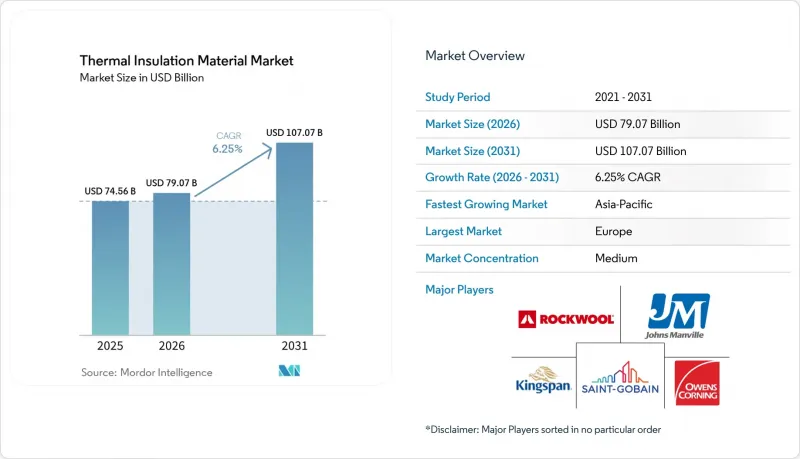
에 따르면 단열재 시장 규모는 2025년에 745억 6,000만 달러로 추정되며, 예측 기간(2026-2031년) 동안 CAGR 6.25%로 확대되어, 2026년 790억 7,000만 달러에서 2031년에는 1,070억 7,000만 달러에 달할 것으로 전망됩니다.
세계 단열재 시장의 동향과 인사이트
건축물의 에너지 성능 기준 강화
건축기준법이 단열재 시장의 수요를 견인하고 있습니다. 개정된 ‘건축물의 에너지 성능에 관한 지침(EU) 2024/1275’가 2024년에 발효되었으며, 회원국은 2026년 5월까지 이를 국내법에 반영해야 합니다. 이 지침은 각국 당국에 에너지 성능의 최저 기준을 수립할 것을 의무화하고 있으며, 이를 준수하기 위해서는 더 높은 사양의 단열재가 필요합니다. 유럽연합 집행위원회 위임규정(EU) 2026/52는 EN 15978:2011을 활용하여 건축물의 수명주기 동안의 지구온난화계수(GWP)를 산출하기 위한 EU 프레임워크를 도입하고 있습니다. 이 프레임워크에 따라 조달 기준은 단일 U값에서 검증된 환경 성능으로 전환됩니다. 제3자 기관으로부터 환경 제품 선언(EPD)을 취득한 공급업체는 제품 선정 시 요구되는 수명주기 데이터 요건을 충족할 수 있습니다.
에너지 효율이 높은 건물의 개보수 및 리노베이션에 대한 인센티브
개보수 프로그램은 신축 주기를 넘어선 단열재 시장의 수요를 뒷받침하고 있습니다. 독일 연방경제·수출통제청(BAFA)은 ‘고효율 건축물을 위한 연방 보조금 - 개별 조치(BEG EM)’ 프로그램을 통해 건축 외피의 단열을 지원하고 있습니다. ‘성능이 가장 낮은 건물’에 대한 보너스는 개별 개보수 로드맵을 이용하는 대상 가구에 대해 2027년 1분기에 시작될 전망입니다. 이 프로그램에서는 단일 개보수 조치가 아닌, 인증된 주택 전체에 대한 개보수 계획에 대해 지원이 이루어집니다. 도쿄도의 2026년도 임대주택 단열·재생에너지 프로그램은 218억 엔(약 1억 3,000만 달러)의 예산을 편성했으며, 2026년 5월부터 2027년 2월까지 신청을 접수하고 있습니다. 독일의 에너지 개보수율은 2025년에 0.67%까지 하락했으며, 단열 복합재 시스템의 매출액은 2024년에 15% 감소한 3,050만 m²를 기록했습니다. 이러한 동향은 프로그램 중단이 시공업체의 계획 및 재고 투자에 영향을 미칠 수 있음을 시사합니다. 정책 시행에 있어서는 일관된 인센티브가 여전히 중요합니다.
폴리머, 광물 섬유 및 에너지 투입 비용의 변동
원자재 비용 변동은 단열재 시장에 여전히 이익률 위험 요인으로 작용하고 있습니다. 미네랄울을 제조하려면 1,200°C가 넘는 온도에서 현무암이나 슬래그를 용융시켜야 하므로, 생산자는 전력 및 천연가스 가격 변동의 영향을 받습니다. 에너지 비용은 미네랄울 제조 비용의 20-35%를 차지합니다. 2026년 6월 미국 미네랄울 생산자 물가 지수는 275.3을 기록하여 2026년 2월과 거의 보합세를 보였습니다. 이는 전반적인 에너지 시장 상황이 계속해서 비용에 영향을 미치고 있기 때문입니다. 발포재 공급업체 역시 메틸렌 디페닐 디이소시아네이트(MDI) 및 관련 원료의 공급 상황에 의존하고 있습니다. 수직 통합을 실시하고 있거나 에너지 가격에 연동된 장기 계약을 체결한 제조업체는 소규모 지역 제조업체에 비해 비용 변동에 대처하는 능력이 더 뛰어납니다.
부문별 분석
유리섬유는 비용 경쟁력과 북미 및 유럽 주택 건설 분야의 확고한 제조·유통 기반을 바탕으로 2025년 단열재 시장에서 36.67%의 점유율을 차지했습니다. 락울은 2031년까지 연평균 성장률(CAGR) 6.79%로 가장 빠른 성장을 기록할 것으로 예상됩니다. 이 제품은 단일 제품 층으로 내화 성능과 방음 성능을 제공하며, EN 13501-1에 기반한 유로클래스 A1 불연성 요건을 충족할 수 있습니다. 이러한 특성은 A2 이상의 내화 등급이 점점 더 요구되고 있는 유럽의 공동 주택 및 상업용 고층 빌딩 프로젝트에서 중요합니다.
폴리우레탄, 폴리이소, EPS를 포함한 발포 제품은 지하 부분이나 지붕 데크에 적용되는 용도에서 여전히 중요한 위치를 차지하고 있습니다. 복합 시스템에서 사용 후 발생하는 제약과 원자재 가격 변동 위험이 이러한 제품의 향후 전망에 영향을 미치고 있습니다. 'IOP Conference Series : Earth and Environmental Science'에 게재된 조사에 따르면, 외단열 복합 시스템(ETICS)에서 발생하는 EPS 폐기물의 연간 양은 2050년까지 4배로 증가할 것으로 예측됩니다. 목질 섬유는 여전히 소규모 소재 범주에 속하지만, 생물 유래 탄소 산정을 우선시하는 DACH(독일·오스트리아·스위스) 및 북유럽 국가들의 프로젝트에서 주목받고 있습니다. 'Resources'지에 게재된 조사에 따르면, 2019년 독일의 단열재 수요 중 폴리머계 발포체가 48%, 미네랄울이 43%, 바이오 기반 소재가 9%를 차지했습니다. 목재 섬유는 바이오 기반 소재 점유율의 58%를 차지했습니다. 목재 섬유는 재료의 유래나 수명주기에 관한 문서화가 프로젝트 요건에 포함된 사업에서 활용되고 있습니다. 다만, 유리섬유, 암면, 발포재의 공급망이 이미 확립되어 있기 때문에 그 사용은 여전히 제한적입니다. 특정 프로젝트에서는 순환 경제에 기반한 제품 정책의 중요성이 높아질 가능성이 있습니다.
ROCKWOOL사는 2026년, 워싱턴주 와룰라에 1억 7,500만 달러를 투자한 공장의 착공을 진행했습니다. 이는 동사에게 있어 북미에서 5번째 시설이 됩니다. 이 공장은 에너지 규제 요건이 강화되는 가운데, 태평양 연안의 스톤울 공급 수요에 대응하기 위한 것입니다. 또한, Knauf Insulation사도 영국 쇼튼에 수중 아크로를 이용한 전기 용해 기술을 채택한 새로운 락 미네랄울 공장을 건설할 계획입니다. 이러한 투자는 단열성, 차음성, 내화성 및 환경 성능을 갖춘 제품 생산능력에 집중하기 위한 것입니다. 라이프사이클 보고서가 자재 선정의 지침이 되는 프로젝트에서는 제조 시 배출량이 낮음을 입증할 수 있는 공급업체가 검토 대상이 될 가능성이 있습니다.
지역별 분석
2025년, 유럽은 단열재 시장에서 36.56%의 점유율을 차지했습니다. 독일, 프랑스, 영국 및 북유럽 국가들이 이 지역의 수요를 주도했습니다. 개정된 ‘건축물의 에너지 성능에 관한 지침(EPBD)’은 2030년까지 신축 건축물의 배출량을 제로로 만들 것을 의무화하고, 대규모 개보수에 대한 에너지 성능 요건도 규정하고 있습니다. 유럽의 방대한 건축물 재고는 단열재 수요를 지속적으로 뒷받침하고 있습니다. 북유럽 국가들의 건축 기준에서는 신축 건물의 외벽에 대해 낮은 U값을 요구하고 있어, 고성능 제품에 대한 수요가 증가하고 있습니다. 이러한 규제 환경은 사양서에 기반한 수요와 기술적·환경적 문서가 갖춰진 제품의 사용을 촉진하고 있습니다.
독일에서는 정책의 지속성이 시공 활동에 미치는 영향을 확인할 수 있습니다. 2024년 복합 단열 시스템 매출은 15% 감소한 3,050만 m²를 기록했습니다. 2025년 에너지 개보수율은 0.67%로 하락했으나, 이는 근본적인 수요 부진이라기보다는 보조금 계획을 둘러싼 불확실성이 주요 요인입니다. 프로그램 조건의 변경으로 인해 시공업체의 교육 및 재고 투자가 감소하고 있습니다. 이로 인해 장기 목표에서 완료된 프로젝트로의 전환이 제한되고, 전문적인 시공 기술이 필요한 제품의 도입이 지연될 가능성이 있습니다.
아시아태평양은 2031년까지 연평균 성장률(CAGR) 7.03%로 성장할 것으로 예측되며, 이는 각 지역 중 가장 높은 성장률입니다. 중국, 인도 및 아세안(ASEAN) 국가들은 건설 활동의 활성화와 에너지 성능 요건의 강화로 성장을 주도하고 있습니다. 일본의 ‘미래 친환경 주택 2026’ 프로그램에서는 단열 성능 등급에 따라 구조용 단열재 개보수 시 1m³당 1만 3,000엔에서 6만 2,000엔이 지급됩니다. 이러한 프로그램은 신축 및 개보수 프로젝트에서 고사양 건축자재에 대한 수요를 뒷받침하고 있습니다.
북미는 지역별 기여도에서 두 번째로 높은 비중을 차지하고 있습니다. 미국에서는 단독주택 착공 건수가 둔화되고 있음에도 불구하고, 주택 개보수, 상업 시설 신축, 데이터센터 및 전기화 관련 시설이 수요를 뒷받침하고 있습니다. 남미, 중동 및 아프리카의 점유율은 비교적 낮습니다. 사우디아라비아의 ‘비전 2030’ 인프라 계획에서는 공공 건축물 입찰에 열 성능 기준이 포함되어 있습니다. 브라질의 ‘미나 카사, 미나 비다’ 계획은 저가 주택에서 유리섬유 및 발포 폴리스티렌(EPS)에 대한 수요를 뒷받침하고 있습니다. 활발한 건설 계획이 진행되고 있음에도 불구하고, 시공업체 확보의 어려움과 공급망의 용량 부족으로 인해 프로젝트 완료가 지연될 가능성이 있습니다.
기타 혜택:
- 엑셀 형식의 시장 예측(ME) 시트
- 3개월간의 애널리스트 지원
자주 묻는 질문
목차
제1장 소개
- 조사 가정과 시장 정의
- 조사 범위
제2장 조사 방법
제3장 주요 요약
제4장 시장 구도
- 시장 개요
- 시장 성장 촉진요인
- 시장 성장 억제요인
- 밸류체인 분석
- Porter's Five Forces 분석
제5장 시장 규모와 성장 예측
- 소재 유형별
- 온도 범위별
- 최종 이용 산업별
- 지역별
- 아시아태평양
- 중국
- 인도
- 일본
- 한국
- ASEAN 국가
- 기타 아시아태평양 국가
- 북미
- 미국
- 캐나다
- 멕시코
- 유럽
- 독일
- 영국
- 프랑스
- 이탈리아
- 북유럽 국가
- 러시아
- 기타 유럽 국가
- 남미
- 브라질
- 아르헨티나
- 기타 남미 국가
- 중동 및 아프리카
- 사우디아라비아
- 남아프리카공화국
- 기타 중동 및 아프리카 국가
- 아시아태평양
제6장 경쟁 구도
- 시장 집중도
- 전략적 동향
- 시장 점유율·순위 분석
- 기업 개요
- ARMACELL
- Asahi Kasei Corporation
- BASF
- Covestro AG
- Dow
- GAF Materials LLC
- Huntsman International LLC
- Johns Manville
- Kingspan
- Knauf Insulation
- Owens Corning
- Recticel NV/SA
- ROCKWOOL A/S
- Saint-Gobain
- Sika AG
제7장 시장 기회와 향후 전망
KSM 26.10.29According to Mordor Intelligence, the thermal insulation material market size was estimated at USD 74.56 billion in 2025 and is estimated to grow from USD 79.07 billion in 2026 to USD 107.07 billion by 2031, at a CAGR of 6.25% during the forecast period (2026-2031).
Global Thermal Insulation Material Market Trends and Insights
Tightening Building Energy-Performance Standards
Building codes are driving demand in the thermal insulation material market. The recast Energy Performance of Buildings Directive (EU) 2024/1275 entered into force in 2024, and member states must transpose it into national law by May 2026. The directive requires national authorities to establish minimum energy-performance thresholds, requiring higher-specification insulation for compliance. Commission Delegated Regulation (EU) 2026/52 introduces a Union framework for calculating building life-cycle global warming potential using EN 15978:2011. The framework shifts procurement criteria from standalone U-values to verified environmental performance. Suppliers with third-party Environmental Product Declarations can meet life-cycle data requirements in product selection.
Energy-Efficient Building Retrofits and Renovation Incentives
Renovation programs support demand for the thermal insulation material market beyond new-construction cycles. Germany's Federal Office for Economic Affairs and Export Control (BAFA) supports building-envelope insulation through the Federal Funding for Efficient Buildings - Individual Measures (BEG EM) program. A Worst-Performing Building bonus is expected to begin in Q1 2027 for eligible households using an Individual Refurbishment Roadmap. The program links support to a certified whole-house plan rather than a single improvement measure. Tokyo's FY2026 program for insulation and renewable energy in rental housing has a JPY 21.8 billion (~USD 0.13 billion) budget and accepts applications from May 2026 through February 2027. Germany's energy renovation rate declined to 0.67% in 2025, while sales of thermal composite insulation systems fell by 15% to 30.5 million m2 in 2024. These trends indicate that program discontinuity can affect contractor planning and inventory investment. Consistent incentives remain relevant to policy implementation.
Volatility in Polymer, Mineral Fiber, and Energy Input Costs
Input cost volatility remains a margin risk for the thermal insulation materials market. Mineral wool production requires melting basalt and slag at temperatures above 1,200°C, exposing producers to fluctuations in electricity and natural gas prices. Energy represents 20-35% of mineral wool production costs. The U.S. Producer Price Index for mineral wool stood at 275.3 in June 2026, largely unchanged from February 2026, as broader energy conditions continued to influence costs. Foam suppliers also depend on the availability of methylene diphenyl diisocyanate (MDI) and related feedstocks. Manufacturers with vertical integration or long-term, energy-indexed contracts have greater capacity to manage cost fluctuations than smaller regional producers.
Other drivers and restraints analyzed in the detailed report include:
- Growth of Electric Vehicles and Battery Thermal Management
- Industrial Decarbonization and Process-Energy Optimization
- High Installation Costs and Skilled-Installer Shortages
For complete list of drivers and restraints, kindly check the Table Of Contents.
Segment Analysis
Fiberglass held a 36.67% share of the thermal insulation material market in 2025, supported by its cost position and established manufacturing and distribution base in North American and European residential construction. Stone wool is expected to record the fastest growth, at a CAGR of 6.79% through 2031. It provides fire performance and acoustic control in a single product layer and can meet Euroclass A1 non-combustibility requirements under EN 13501-1. These characteristics are relevant for European multifamily buildings and commercial high-rise projects, where A2 or higher fire ratings are increasingly required.
Foam products, including polyurethane, polyiso, and EPS, remain important for below-grade and roof-deck applications. End-of-life constraints for composite systems and feedstock price exposure affect their outlook. Research published in IOP Conference Series: Earth and Environmental Science projects that annual EPS waste from External Thermal Insulation Composite Systems will increase fourfold by 2050. Wood fiber remains a smaller material category but is gaining attention in DACH and Nordic projects that prioritize biogenic carbon accounting. Research published in Resources reported that polymeric foams accounted for 48% of Germany's insulation demand in 2019, mineral wools for 43%, and bio-based materials for 9%. Wood fiber represented 58% of the bio-based share. It serves projects where material origin and lifecycle documentation are part of the project brief. Its use remains selective because fiberglass, stone wool, and foam supply chains are well established. Circular-economy product policies may become more relevant in selected projects.
ROCKWOOL broke ground in 2026 on a USD 175 million plant in Wallula, Washington, its fifth North American facility. The plant will address stone wool supply requirements on the Pacific Coast as energy code requirements tighten. Knauf Insulation has also planned a new rock mineral wool plant in Shotton, United Kingdom, using submerged arc furnace electric melting technology. These investments direct capacity toward products that provide thermal, acoustic, fire, and environmental performance. Suppliers that document lower manufacturing emissions may be considered in projects where lifecycle reporting guides material selection.
Complete Report Scope:
- By Material Type
- Fiberglass
- Stone Wool
- Foam
- Wood Fiber
- Other Materials
- By Temperature Range
- 0-100°C
- 100-500°C
- 500°C and Above
- By End-User Industry
- Construction
- Automotive
- HVAC
- Industrial
- Others
- By Geography
- Asia-Pacific
- China
- India
- Japan
- South Korea
- ASEAN Countries
- Rest of Asia-Pacific
- North America
- United States
- Canada
- Mexico
- Europe
- Germany
- United Kingdom
- France
- Italy
- NORDIC Countries
- Russia
- Rest of Europe
- South America
- Brazil
- Argentina
- Rest of South America
- Middle East and Africa
- Saudi Arabia
- South Africa
- Rest of Middle East and Africa
- Asia-Pacific
Geography Analysis
Europe held a 36.56% share of the thermal insulation material market in 2025. Germany, France, the United Kingdom, and the Nordic countries drove regional demand. The recast Energy Performance of Buildings Directive (EPBD) requires new buildings to be zero-emission by 2030 and sets energy-performance requirements for major renovations. Europe's large building stock continues to support demand for insulation. Nordic building codes require low U-values for new exterior walls, increasing demand for high-performance products. This regulatory environment supports specification-led demand and the use of products with technical and environmental documentation.
Germany reflects the impact of policy continuity on installation activity. Sales of thermal composite insulation systems declined by 15% to 30.5 million m2 in 2024. The energy renovation rate fell to 0.67% in 2025, primarily due to uncertainty around subsidy planning rather than underlying demand. Changes in program conditions reduce contractors' investment in training and inventory. This limits the conversion of long-term targets into completed projects and may delay the adoption of products requiring specialized installation skills.
Asia-Pacific is forecast to grow at a CAGR of 7.03% through 2031, the highest rate among regions. China, India, and ASEAN drive growth through increased construction activity and stricter energy-performance requirements. Japan's Mirai Eco Housing 2026 program provides JPY 13,000 to JPY 62,000 per m3 for structural insulation upgrades, based on thermal performance class. These programs support demand for higher-specification materials in new construction and renovation projects.
North America is the second-largest regional contributor. In the United States, residential retrofits, new commercial construction, data centers, and electrification-related facilities support demand despite softer single-family housing starts. South America, the Middle East, and Africa account for smaller shares. Saudi Arabia's Vision 2030 infrastructure program includes thermal-performance criteria in public-building tenders. Brazil's Minha Casa Minha Vida program supports demand for fiberglass and expanded polystyrene (EPS) in lower-cost housing. Limited installer availability and supply chain capacity may delay project completion despite active construction programs.
- ARMACELL
- Asahi Kasei Corporation
- BASF
- Covestro AG
- Dow
- GAF Materials LLC
- Huntsman International LLC
- Johns Manville
- Kingspan
- Knauf Insulation
- Owens Corning
- Recticel NV/SA
- ROCKWOOL A/S
- Saint-Gobain
- Sika AG
Additional Benefits:
- The market estimate (ME) sheet in Excel format
- 3 months of analyst support
TABLE OF CONTENTS
1 Introduction
- 1.1 Study Assumptions and Market Definition
- 1.2 Scope of the Study
2 Research Methodology
3 Executive Summary
4 Market Landscape
- 4.1 Market Overview
- 4.2 Market Drivers
- 4.2.1 Tightening Building Energy-Performance Standards
- 4.2.2 Energy-Efficient Building Retrofits and Renovation Incentives
- 4.2.3 Expansion of Energy-Efficient Construction in Asia-Pacific
- 4.2.4 Growth of Electric Vehicles and Battery Thermal Management
- 4.2.5 Industrial Decarbonization and Process-Energy Optimization
- 4.3 Market Restraints
- 4.3.1 Volatility in Polymer, Mineral Fiber, and Energy Input Costs
- 4.3.2 High Installation Costs and Skilled-Installer Shortages
- 4.3.3 End-of-Life and Recycling Constraints for Composite Insulation Systems
- 4.4 Value Chain Analysis
- 4.5 Porter's Five Forces Analysis
- 4.5.1 Bargaining Power of Suppliers
- 4.5.2 Bargaining Power of Buyers
- 4.5.3 Threat of New Entrants
- 4.5.4 Threat of Substitutes
- 4.5.5 Competitive Rivalry
5 Market Size and Growth Forecasts (Value)
- 5.1 By Material Type
- 5.1.1 Fiberglass
- 5.1.2 Stone Wool
- 5.1.3 Foam
- 5.1.4 Wood Fiber
- 5.1.5 Other Materials
- 5.2 By Temperature Range
- 5.2.1 0-100°C
- 5.2.2 100-500°C
- 5.2.3 500°C and Above
- 5.3 By End-User Industry
- 5.3.1 Construction
- 5.3.2 Automotive
- 5.3.3 HVAC
- 5.3.4 Industrial
- 5.3.5 Others
- 5.4 By Geography
- 5.4.1 Asia-Pacific
- 5.4.1.1 China
- 5.4.1.2 India
- 5.4.1.3 Japan
- 5.4.1.4 South Korea
- 5.4.1.5 ASEAN Countries
- 5.4.1.6 Rest of Asia-Pacific
- 5.4.2 North America
- 5.4.2.1 United States
- 5.4.2.2 Canada
- 5.4.2.3 Mexico
- 5.4.3 Europe
- 5.4.3.1 Germany
- 5.4.3.2 United Kingdom
- 5.4.3.3 France
- 5.4.3.4 Italy
- 5.4.3.5 NORDIC Countries
- 5.4.3.6 Russia
- 5.4.3.7 Rest of Europe
- 5.4.4 South America
- 5.4.4.1 Brazil
- 5.4.4.2 Argentina
- 5.4.4.3 Rest of South America
- 5.4.5 Middle East and Africa
- 5.4.5.1 Saudi Arabia
- 5.4.5.2 South Africa
- 5.4.5.3 Rest of Middle East and Africa
- 5.4.1 Asia-Pacific
6 Competitive Landscape
- 6.1 Market Concentration
- 6.2 Strategic Moves
- 6.3 Market Share (%)/Ranking Analysis
- 6.4 Company Profiles (includes Global Overview, Market Overview, Core Segments, Financials as available, Strategic Information, Products and Services, and Recent Developments)
- 6.4.1 ARMACELL
- 6.4.2 Asahi Kasei Corporation
- 6.4.3 BASF
- 6.4.4 Covestro AG
- 6.4.5 Dow
- 6.4.6 GAF Materials LLC
- 6.4.7 Huntsman International LLC
- 6.4.8 Johns Manville
- 6.4.9 Kingspan
- 6.4.10 Knauf Insulation
- 6.4.11 Owens Corning
- 6.4.12 Recticel NV/SA
- 6.4.13 ROCKWOOL A/S
- 6.4.14 Saint-Gobain
- 6.4.15 Sika AG
7 Market Opportunities and Future Outlook
- 7.1 White-Space and Unmet-Need Assessment


