

|
시장보고서
상품코드
2154740
열전도성 고분자 재료 : 시장 점유율 분석, 업계 동향과 통계, 성장 예측(2026-2031년)Thermal Conductive Polymer Material - Market Share Analysis, Industry Trends & Statistics, Growth Forecasts (2026 - 2031) |
||||||
 Mordor Intelligence
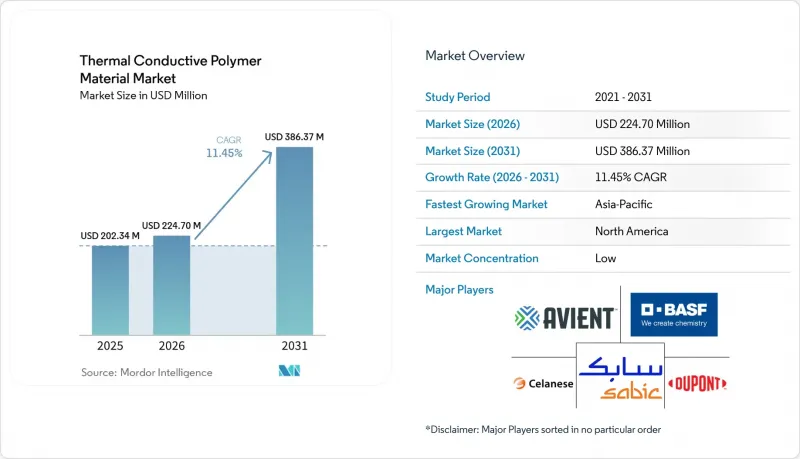
에 따르면 열전도성 고분자 재료 시장 규모는 2025년에 2억 234만 달러로 추정되며, 예측 기간(2026-2031년) 동안 CAGR 11.45%로 확대되어, 2026년 2억 2,470만 달러에서 2031년에는 3억 8,637만 달러에 달할 것으로 전망됩니다.
전 세계 열전도성 고분자 재료 시장의 동향 및 인사이트
전자기기의 소형화와 열유속 증가
열 조건이 시스템 수명에 영향을 미치기 때문에 반도체 패키징 분야에서는 열유속 관리에 대한 관심이 높아지고 있습니다. 충전제가 없는 폴리머의 열전도율은 0.5 W/m·K 미만입니다. 질화붕소, 그래핀, 및 탄소계 구조로 구성된 설계된 네트워크는 전기 절연성을 유지하면서 면내 열전도율 25 W/m·K 이상을 실현할 수 있습니다. 열전도성 고분자 재료 시장에는 고열유속 용도를 위한 초고열전도성 등급이 포함되어 있습니다. LED 및 파워 모듈 하우징용 중급 등급 컴파운드는 더 큰 가격 압박에 직면해 있습니다. 그 결과, 고열전도성 부문은 높은 이익률을 기록하고 있으며, 이는 공급업체들이 차세대 필러 시스템에 투자하는 데 힘을 실어주고 있습니다.
자동차의 전동화와 배터리 열 관리
전기자동차 아키텍처가 400V에서 800V로 전환됨에 따라, 셀 탭 및 커넥터 접합부의 열 부하가 증가하고 있습니다. 소재는 열 사이클을 견디고, 수명 기간 동안 유전 성능을 유지해야 합니다. 2026년 5월, 헨켈은 셀-투-팩(cell-to-pack)형 배터리 설계를 위해 열전도율 2 W/m*K의 폴리우레탄계 열전도성 접착제 ‘Loctite TLB 9270APS’를 출시했습니다. 이 제품은 구조용 접착, 전기 절연 및 알루미늄 냉각판으로의 열 전달을 실현합니다. BASF는 에틸렌글리콜과 물의 혼합액에서 3,000시간의 연속 운전이 검증된 ‘Ultramid Advanced T1000’ 등급을 개발하여 25,000시간의 차량 수명 목표를 지원하고 있습니다. ISO 16232 및 IATF 16949 요건으로 인해 인증까지의 기간이 길어지고 있어, 자동차 분야에서 실적이 입증된 공급업체가 유리한 입장에 있습니다.
금속 및 세라믹과의 열전도율 차이
열전도성 폴리머는 금속이나 세라믹스에 비해 열전도율이 낮습니다. 구리의 열전도율은 385 W/m*K, 알루미늄은 205 W/m*K입니다. 질화붕소 네트워크가 수직으로 배향된 시판용 폴리머 복합재료는 충전율 37%에서 면내 열전도율 19 W/m*K를 나타냅니다. 이러한 차이로 인해 발열이 심한 반도체 용도에서의 채택이 제한되고 있습니다. 설계 팀은 접합부의 온도를 낮게 유지함으로써 부품의 수명을 연장할 수 있는 경우, 금속 계면을 선택하기도 합니다. 그래핀과 탄소섬유 네트워크가 배향된 실험실 수준의 복합재료에서는 면내 열전도율 260 W/m·K 이상을 달성하고 있습니다. 그러나 사출 성형용 등급의 소재는 여전히 실험실 수준의 성능에 미치지 못하는 상황입니다. 이러한 제약은 2031년까지 지속될 것으로 예상됩니다.
부문 분석
PA는 2025년 열전도성 고분자 재료 시장에서 37.45%를 차지하고 있으며, 2031년까지 연평균 성장률(CAGR) 13.12%라는 가장 높은 성장률로 확대될 것으로 예측됩니다. 붕소 질화물, 알루미늄 질화물, 천연 흑연 필러와의 호환성 덕분에 다양한 열 요구 사항을 충족할 수 있습니다. 자동차 및 전자 분야 공급망 전반에 확립된 PA 컴파운딩 및 사출 성형 기술이 인증 등급의 채택을 뒷받침하고 있습니다. BASF는 “Ultramid Advanced” 포트폴리오에서 PA9T, PA6T/6I, PA6T/66, PA66/6T 등의 화학 조성을 포함한 50종 이상의 컴파운드 사출 성형 및 압출 성형용 등급을 제공하고 있습니다. 이러한 등급은 열적 성능, 내가수분해성, 난연성 및 기계적 강도 요건을 충족합니다.
BASF 퍼포먼스 머티리얼즈는 2024년에 68억 유로(약 78억 7,000만 달러)의 전 세계 매출을 기록했습니다. PC는 얇은 두께의 부품에서 뛰어난 난연성과 발광 어셈블리에서 뛰어난 광학 투명성을 바탕으로 열전도성 고분자 재료 시장에서 두 번째로 큰 폴리머 기반 소재가 되었습니다. 또한 PC 등급은 데이터센터의 전기 어셈블리에서 열 관리도 지원합니다. CES 2025에서 코베스트로는 열전도성 폴리카보네이트의 열 관리를 최적화하기 위해 마크로론 TC용 특허 출원 중인 마이크로메카닉스 시뮬레이션 제품군을 발표했습니다. PPS는 고온 및 화학적 조건이 가혹한 용도에 사용됩니다. PBT는 비용 효율성을 중시하는 커넥터 및 릴레이 하우징에 사용되는 반면, PEI는 180°C를 초과하는 항공우주 및 의료 용도를 지원합니다.
지역별 분석
2025년, 북미는 열전도성 고분자 재료 시장의 42.82%를 차지하고 있으며, 이는 미국의 고성능 데이터센터, 자동차 전기화, 그리고 반도체 OEM 활동에 힘입은 결과입니다. 세계 상위 5대 클라우드 사업자들은 2026년에 AI 인프라를 위해 2,000억 달러 이상의 설비 투자를 약속하고 있으며, 이로 인해 서버 냉각 어셈블리 및 배전 장치에 사용되는 폴리아미드(PA) 및 폴리카보네이트(PC) 컴파운드의 수요가 뒷받침되고 있습니다. 캐나다와 멕시코는 USMCA(미국·멕시코·캐나다 협정)에 기반한 자동차 공급망을 통해 이 지역을 뒷받침하고 있으며, 이 지역의 역내 조달 요건으로 인해 현지에서 생산되는 전기자동차(EV) 파워트레인용 폴리머 부품의 인증이 촉진되고 있습니다. 북미의 수요는 전자 인프라, 자동차 제조 및 소재 인증 활동을 하나로 연결하고 있습니다.
아시아태평양은 2031년까지 연평균 성장률(CAGR) 12.05%로 성장할 것으로 예상되며, 이는 열전도성 고분자 재료 시장에서 가장 높은 지역별 성장률입니다. 중국의 신에너지차(NEV) 관련 규제와 양쯔강 삼각주 지역의 전기자동차 배터리 및 전자기기 생산 거점의 존재로 인해 열전도성 폴리머 등급 인증에 소요되는 기간이 단축되고 있습니다. 대만은 2026년에 전 세계 첨단 반도체 생산량의 60% 이상을 차지하며, 고성능 패키징 기판 및 오버몰드 소재에 대한 수요를 뒷받침하고 있습니다. 대만 제조업체의 미국으로의 AI 서버 출하대수는 2025년에 전년 대비 거의 2배로 증가하여, 아시아의 생산과 북미의 데이터센터 수요를 연결하고 있습니다. 일본과 한국은 민생용 전자기기 및 자동차 수출 공급망에 소재 공급 능력을 제공하고 있습니다.
유럽에서는 BASF, 코베스트로, 랑세스, 엔바리오르가 지역 엔지니어링 폴리머 밸류체인에 참여하고 있습니다. 엔바리오르(Envalior)는 2025년 독일 벨딩겐 공장에서 폴리페닐렌 설파이드(PPS) 컴파운드의 생산을 시작하여, 전기자동차용 워터 펌프 하우징, 고온 커넥터, 열 관리 어셈블리에 사용되는 ‘Xytron’ PPS 컴파운드의 생산능력을 확충했습니다. EU의 REACH 규정 준수 및 폐차 관련 요건에 따라, 휘발성 유기 화합물(VOC) 함량이 낮은 할로겐 프리 등급으로의 배합 변경이 진행되고 있습니다. 인도 및 아세안 지역에서는 전자 및 자동차 제조업의 확대에 따라 장기적인 성장 가능성이 전망되고 있습니다. 남미, 중동 및 아프리카는 여전히 소규모 시장이지만, 브라질의 자동차 산업, 사우디아라비아의 산업 다각화, 남아프리카공화국의 항공우주 및 광업용 전자 분야에 활동이 집중되고 있습니다. 이 지역들은 수입된 특수 컴파운드에 의존하고 있지만, 국내 생산능력이 인증 기준을 충족하게 되면 시장이 확대될 가능성이 있습니다.
기타 혜택:
- 엑셀 형식의 시장 예측(ME) 시트
- 3개월간의 애널리스트 지원
자주 묻는 질문
목차
제1장 소개
- 조사 가정과 시장 정의
- 조사 범위
제2장 조사 방법
제3장 주요 요약
제4장 시장 구도
- 시장 개요
- 시장 성장 촉진요인
- 시장 성장 억제요인
- 밸류체인 분석
- Porter's Five Forces 분석
제5장 시장 규모와 성장 예측
- 폴리머 베이스별
- 최종 이용 산업별
- 지역별
- 아시아태평양
- 중국
- 인도
- 일본
- 한국
- ASEAN 국가
- 기타 아시아태평양 국가
- 북미
- 미국
- 캐나다
- 멕시코
- 유럽
- 독일
- 영국
- 프랑스
- 이탈리아
- 북유럽 국가
- 기타 유럽 국가
- 남미
- 브라질
- 아르헨티나
- 기타 남미 국가
- 중동 및 아프리카
- 사우디아라비아
- 남아프리카공화국
- 기타 중동 및 아프리카 국가
- 아시아태평양
제6장 경쟁 구도
- 시장 집중도
- 전략적 동향
- 시장 점유율·순위 분석
- 기업 개요
- Avient Corporation
- BASF
- Celanese Corporation
- Covestro AG
- Dow
- DuPont
- Ensinger
- KANEKA CORPORATION
- LANXESS
- Mitsubishi Chemical Corporation
- Momentive
- Nytex Composites Co., Ltd.
- RTP Company
- SABIC
- Shin-Etsu Chemical Co., Ltd.
제7장 시장 기회와 향후 전망
KSM 26.10.29According to Mordor Intelligence, the thermal conductive polymer material market size was estimated at USD 202.34 million in 2025 and is estimated to grow from USD 224.70 million in 2026 to USD 386.37 million by 2031, at a CAGR of 11.45% during the forecast period (2026-2031).
Global Thermal Conductive Polymer Material Market Trends and Insights
Electronics Miniaturization and Rising Heat Flux
Semiconductor packaging increasingly focuses on heat-flux management, as thermal conditions affect system life. Unfilled polymers have thermal conductivity below 0.5 W/m*K. Engineered networks comprising boron nitride, graphene, and carbon-based structures can achieve in-plane thermal conductivity above 25 W/m*K while maintaining electrical insulation. The thermally conductive polymer materials market includes ultra-high-conductivity grades for high-heat-flux applications. Mid-range compounds for LED and power-module housings face greater price pressure. As a result, margins are higher in the high-conductivity segment, supporting supplier investment in next-generation filler systems.
Electrification of Vehicles and Battery Thermal Management
The transition from 400 V to 800 V electric vehicle architectures increases thermal loading at cell tabs and connector interfaces. Materials must withstand thermal cycling and maintain dielectric performance over their service life. In May 2026, Henkel launched Loctite TLB 9270APS, a polyurethane-based thermally conductive adhesive with a thermal conductivity of 2 W/m*K for cell-to-pack battery designs. The product provides structural bonding, electrical insulation, and heat transfer to aluminum cooling plates. BASF developed Ultramid Advanced T1000 grades validated for continuous operation in ethylene glycol and water mixtures for 3,000 hours, supporting a 25,000-hour vehicle-life target. ISO 16232 and IATF 16949 requirements extend qualification timelines and favor suppliers with established automotive portfolios.
Thermal Conductivity Gap Versus Metals and Ceramics
Thermally conductive polymers have lower thermal conductivity than metals and ceramics. Copper has a thermal conductivity of 385 W/m*K, and aluminum has 205 W/m*K. Commercial polymer composites with vertically aligned boron nitride networks exhibit a through-plane thermal conductivity of 19 W/m*K at 37% filler loading. This difference limits adoption in high-heat semiconductor applications. Design teams may select metal interfaces when lower junction temperatures support component life. Laboratory composites with aligned graphene and carbon-fiber networks have achieved a through-plane thermal conductivity of more than 260 W/m*K. However, injection-molding-grade materials still fall short of laboratory-scale performance. This constraint is expected to continue through 2031.
Other drivers and restraints analyzed in the detailed report include:
- Metal Replacement Through Lightweight Molded Components
- AI Data Centers, Power Electronics, and High-Density Computing
- High Filler Loading and Processing Complexity
For complete list of drivers and restraints, kindly check the Table Of Contents.
Segment Analysis
PA accounted for 37.45% of the thermal conductive polymer material market in 2025 and is projected to grow at the fastest CAGR of 13.12% through 2031. Its compatibility with boron nitride, aluminum nitride, and natural graphite fillers supports varied thermal requirements. Established PA compounding and injection-molding capabilities across automotive and electronics supply chains support the adoption of qualified grades. BASF offers over 50 compounded injection-molding and extrusion grades in its Ultramid Advanced portfolio, including PA9T, PA6T/6I, PA6T/66, and PA66/6T chemistries. These grades meet the requirements for thermal performance, hydrolysis resistance, flame retardancy, and mechanical strength.
BASF Performance Materials reported global sales of EUR 6.8 billion (~USD 7.87 billion) in 2024. PC is the second-largest polymer base in the thermal-conductive polymer materials market, supported by thin-wall flame retardancy and optical clarity in illuminated assemblies. PC grades also support thermal management in data center electrical assemblies. At CES 2025, Covestro introduced a patent-pending micromechanics simulation suite for Makrolon TC to optimize heat management in thermally conductive polycarbonates. PPS is used in high-temperature and chemically demanding applications. PBT serves cost-sensitive connector and relay housings, while PEI supports aerospace and medical applications above 180°C.
Complete Report Scope:
- By Polymer Base
- Polyamide (PA)
- Polycarbonate (PC)
- Polybutylene Terephthalate (PBT)
- Polyphenylene Sulfide (PPS)
- Polyetherimide (PEI)
- Other Polymer Bases
- By End-User Industry
- Electrical and Electronics
- Automotive
- Industrial
- Aerospace and Defense
- Healthcare
- Other End-User Industries
- By Geography
- Asia-Pacific
- China
- India
- Japan
- South Korea
- ASEAN Countries
- Rest of Asia-Pacific
- North America
- United States
- Canada
- Mexico
- Europe
- Germany
- United Kingdom
- France
- Italy
- NORDIC Countries
- Rest of Europe
- South America
- Brazil
- Argentina
- Rest of South America
- Middle East and Africa
- Saudi Arabia
- South Africa
- Rest of Middle East and Africa
- Asia-Pacific
Geography Analysis
North America held 42.82% of the thermal conductive polymer material market in 2025, supported by U.S. hyperscale data centers, automotive electrification, and semiconductor OEM activity. The five largest global cloud operators have committed over USD 200 billion in capital expenditure for AI infrastructure in 2026, supporting demand for polyamide (PA) and polycarbonate (PC) compounds in server cooling assemblies and power distribution units. Canada and Mexico support the region through the USMCA automotive supply chains, in which regional content requirements promote polymer component qualification for locally produced EV powertrains. North American demand links electronics infrastructure, vehicle manufacturing, and material qualification activities.
Asia-Pacific is projected to grow at a CAGR of 12.05% through 2031, the highest regional growth rate in the thermal conductive polymer material market. China's new energy vehicle (NEV) mandates, and the Yangtze River Delta's EV battery and electronics base are reducing qualification timelines for thermal polymer grades. Taiwan accounts for over 60% of global advanced semiconductor manufacturing output in 2026, supporting demand for high-performance packaging substrates and overmold materials. AI server shipments to the United States from Taiwan-based manufacturers nearly doubled year over year in 2025, linking Asian production with North American data center demand. Japan and South Korea provide materials capabilities for consumer electronics and automotive export supply chains.
Europe includes BASF, Covestro, LANXESS, and Envalior across the regional engineering polymer value chain. Envalior began polyphenylene sulfide (PPS) compounding production at its Uerdingen facility in Germany in 2025, adding capacity for Xytron PPS compounds used in EV water-pump housings, high-temperature connectors, and thermal assemblies. EU REACH compliance and end-of-life vehicle requirements are driving reformulation toward halogen-free grades with lower volatile organic compound (VOC) content. India and ASEAN offer long-term potential as electronics and automotive manufacturing increases. South America and the Middle East and Africa remain smaller markets, with activity concentrated in Brazil's automotive industry, Saudi Arabia's industrial diversification, and South Africa's aerospace and mining electronics sectors. These regions rely on imported specialty compounds and may expand as domestic manufacturing capacity achieves qualification.
- Avient Corporation
- BASF
- Celanese Corporation
- Covestro AG
- Dow
- DuPont
- Ensinger
- KANEKA CORPORATION
- LANXESS
- Mitsubishi Chemical Corporation
- Momentive
- Nytex Composites Co., Ltd.
- RTP Company
- SABIC
- Shin-Etsu Chemical Co., Ltd.
Additional Benefits:
- The market estimate (ME) sheet in Excel format
- 3 months of analyst support
TABLE OF CONTENTS
1 Introduction
- 1.1 Study Assumptions and Market Definition
- 1.2 Scope of the Study
2 Research Methodology
3 Executive Summary
4 Market Landscape
- 4.1 Market Overview
- 4.2 Market Drivers
- 4.2.1 Electronics Miniaturization and Rising Heat Flux
- 4.2.2 Electrification of Vehicles and Battery Thermal Management
- 4.2.3 Metal Replacement Through Lightweight Molded Components
- 4.2.4 Mainstream Adoption of Electrically Insulating Heat-Dissipation Materials
- 4.2.5 AI Data Centers, Power Electronics and High-Density Computing
- 4.3 Market Restraints
- 4.3.1 Thermal Conductivity Gap Versus Metals and Ceramics
- 4.3.2 High Filler Loading and Processing Complexity
- 4.3.3 Cost Volatility of Specialty Fillers and Engineering Resins
- 4.4 Value Chain Analysis
- 4.5 Porter's Five Forces Analysis
- 4.5.1 Threat of New Entrants
- 4.5.2 Bargaining Power of Suppliers
- 4.5.3 Bargaining Power of Buyers
- 4.5.4 Threat of Substitutes
- 4.5.5 Competitive Rivalry
5 Market Size and Growth Forecasts (Value)
- 5.1 By Polymer Base
- 5.1.1 Polyamide (PA)
- 5.1.2 Polycarbonate (PC)
- 5.1.3 Polybutylene Terephthalate (PBT)
- 5.1.4 Polyphenylene Sulfide (PPS)
- 5.1.5 Polyetherimide (PEI)
- 5.1.6 Other Polymer Bases
- 5.2 By End-User Industry
- 5.2.1 Electrical and Electronics
- 5.2.2 Automotive
- 5.2.3 Industrial
- 5.2.4 Aerospace and Defense
- 5.2.5 Healthcare
- 5.2.6 Other End-User Industries
- 5.3 By Geography
- 5.3.1 Asia-Pacific
- 5.3.1.1 China
- 5.3.1.2 India
- 5.3.1.3 Japan
- 5.3.1.4 South Korea
- 5.3.1.5 ASEAN Countries
- 5.3.1.6 Rest of Asia-Pacific
- 5.3.2 North America
- 5.3.2.1 United States
- 5.3.2.2 Canada
- 5.3.2.3 Mexico
- 5.3.3 Europe
- 5.3.3.1 Germany
- 5.3.3.2 United Kingdom
- 5.3.3.3 France
- 5.3.3.4 Italy
- 5.3.3.5 NORDIC Countries
- 5.3.3.6 Rest of Europe
- 5.3.4 South America
- 5.3.4.1 Brazil
- 5.3.4.2 Argentina
- 5.3.4.3 Rest of South America
- 5.3.5 Middle East and Africa
- 5.3.5.1 Saudi Arabia
- 5.3.5.2 South Africa
- 5.3.5.3 Rest of Middle East and Africa
- 5.3.1 Asia-Pacific
6 Competitive Landscape
- 6.1 Market Concentration
- 6.2 Strategic Moves
- 6.3 Market Share (%)/Ranking Analysis
- 6.4 Company Profiles (includes Global Overview, Market Overview, Core Segments, Financials as available, Strategic Information, Products and Services, and Recent Developments)
- 6.4.1 Avient Corporation
- 6.4.2 BASF
- 6.4.3 Celanese Corporation
- 6.4.4 Covestro AG
- 6.4.5 Dow
- 6.4.6 DuPont
- 6.4.7 Ensinger
- 6.4.8 KANEKA CORPORATION
- 6.4.9 LANXESS
- 6.4.10 Mitsubishi Chemical Corporation
- 6.4.11 Momentive
- 6.4.12 Nytex Composites Co., Ltd.
- 6.4.13 RTP Company
- 6.4.14 SABIC
- 6.4.15 Shin-Etsu Chemical Co., Ltd.
7 Market Opportunities and Future Outlook
- 7.1 White-Space and Unmet-Need Assessment


