

|
시장보고서
상품코드
2154743
전자용 열관리 소재 : 시장 점유율 분석, 업계 동향과 통계, 성장 예측(2026-2031년)Electronic Thermal Management Materials - Market Share Analysis, Industry Trends & Statistics, Growth Forecasts (2026 - 2031) |
||||||
 Mordor Intelligence
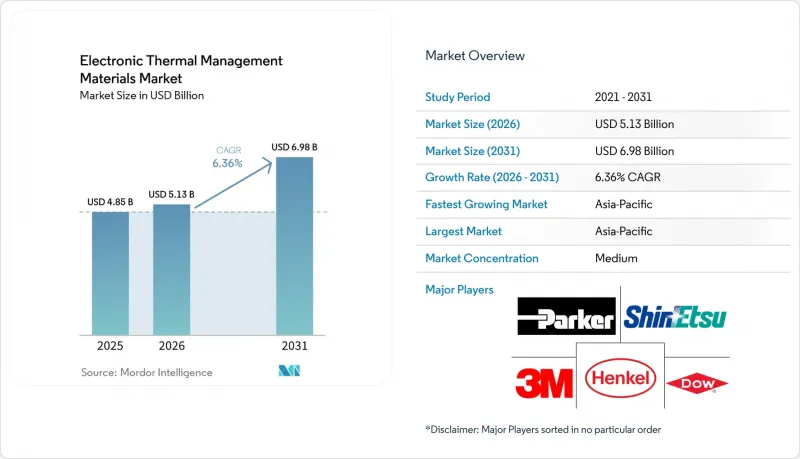
에 따르면 전자용 열관리 소재 시장 규모는 2025년에 48억 5,000만 달러로 추정되며, 2026년 51억 3,000만 달러에서 2031년까지 69억 8,000만 달러로 확대되어, 예측 기간(2026-2031년) 동안 CAGR은 6.36%에 달할 것으로 전망됩니다.
전 세계 전자용 열관리 소재 시장의 동향 및 인사이트
AI를 활용한 컴퓨팅 및 칩의 전력 밀도 향상
AI 워크로드는 전자 제품 공급망 전반에 걸친 열 설계 요건을 변화시키고 있습니다. AI 가속기 패키지의 열 설계 전력은 1,000W에 육박하거나 이를 초과하고 있어, 기존의 공랭식 방식 사용에 한계가 발생하고 있습니다. 이로 인해 다이-투-리드(D2D) 인터페이스 전반에 걸쳐 액체 금속, 인듐 박, 은 충전 젤의 사용이 증가하고 있습니다. 각 인터페이스는 낮은 열저항을 유지하면서 국부적인 열 부하를 관리해야 합니다. SK하이닉스는 2026년 5월, D2D PHY 영역에 냉각 요소를 통합한 iHBM을 발표하며 열저항을 30% 저감했다고 보고했습니다. 전자용 열관리 소재 시장에서는 변화하는 작동 조건이나 패키지 부하 하에서도 낮은 저항을 유지할 수 있는 배합이 요구되고 있습니다.
차량의 전동화와 고전압 파워 일렉트로닉스
전기자동차(EV)의 배터리 팩, 차량용 충전기 및 파워 인버터에는 다층 열 인터페이스 재료가 필요합니다. 실리콘 카바이드(SiC) 및 갈륨 나이트라이드(GaN) 소자는 더 높은 접합부 온도에서 작동하기 때문에 드라이브트레인 스택 전체에 걸친 열 요구 사항이 높아지고 있습니다. 셀-투-팩(cell-to-pack) 및 셀-투-섀시(cell-to-chassis) 아키텍처에서는 모듈 계층이 제거되어, 자동차 등급 인증 요건이 배터리 셀과 섀시의 계면까지 확대되었습니다. 2025년에 발표된 SAE International의 연구에 따르면, 특정 상변화 물질을 사용하면 능동적인 냉각을 수행하지 않아도 연속적인 세계 통일 경차 시험 절차(WLTP) 주행 사이클에서 EV 배터리의 가동 시간을 최대 80%까지 연장할 수 있는 것으로 밝혀졌습니다. 2025년 리뷰에 따르면, 탄소계 나노 첨가제를 통해 상변화 물질의 열전도율이 40-120% 향상된 반면, 저온 가공을 통해 이전 실험실 배합에 비해 재료 비용이 20-35% 절감된 것으로 밝혀졌습니다. 헨켈은 2026년 5월, 셀-투-팩(cell-to-pack) 및 셀-투-섀시(cell-to-chassis) 용도로 ‘Bergquist TGF 2030APS’와 ‘Loctite TLB 9270APS’를 출시했습니다.
인증 사이클 및 신뢰성 시험 비용
자동차 및 항공우주 프로그램용 새로운 열 인터페이스 재료의 경우, 18-36개월에 걸친 열기계적 신뢰성 시험이 필요할 수 있습니다. JESD22 열 사이클 시험 프로토콜에 따르면, 프로그램 승인 전에 극한 온도 조건에서 250-1,000 사이클의 검증이 요구됩니다. 시험은 인증에 소요되는 시간과 비용의 상당 부분을 차지합니다. 인증 후, 평판이 좋은 공급업체는 플랫폼 생산 기간 내내 그 지위를 유지할 수 있습니다. 새로운 배합의 경우 재인증이 필요할 수 있으며, 이로 인해 도입까지의 기간이 길어질 가능성이 있습니다. 이로 인해 소재 혁신이 2-3세대 정도 지연되거나, 연구 개발의 회수 기간이 길어질 수 있습니다. 중소규모 공급업체는 자동차 등급이나 데이터센터용 제품을 인증할 때, 특히 IATF 16949나 용도별 JEDEC, IPC(Association Connecting Electronics Industries)의 승인이 필요한 경우 더 높은 비용을 부담하게 됩니다.
부문 분석
2025년, 전자용 열관리 소재 시장에서 열 계면 재료는 44.74%를 차지했습니다. 이 재료들은 다이(die)와 히트 스프레더 사이, 히트 스프레더와 방열판 사이, 그리고 배터리 셀과 냉각 구조물 사이에 사용됩니다. 플랫폼별 OEM(주문자 상표 부착 생산자)의 검증을 거친 후, 배합은 일반적으로 프로그램의 수명주기 동안 계속 생산됩니다. 상변화 소재는 열 사이클 동안 불규칙한 표면에 밀착되는 능력에 힘입어 2026년부터 2031년까지 연평균 성장률(CAGR) 8.34%로 성장할 것으로 예측됩니다. 이로 인해 EV 배터리 모듈, 차량용 충전기, AI 가속기 어셈블리에서의 사용이 촉진되고 있습니다.
흑연 및 그래핀계 소재는 Z축 방향의 두께를 줄이면서 열을 가로 방향으로 분산시키기 때문에 소비자용 전자기기 및 5G 무선 장치에 채택이 확대되고 있습니다. 탄소계 나노 첨가제는 상변화 재료의 열전도율을 40-120% 향상시키고, 또한 저온 가공을 통해 기존 배합에 비해 비용을 20-35% 절감합니다. 인듐 박막 및 소결 은의 대체재를 포함한 금속계 소재는 3차원 집적회로(3D-IC) 및 HBM 패키지용 TIM1 용도로 사용되고 있습니다. 유럽의 화학제품 등록, 평가, 승인 및 제한(REACH) 규정 준수 요건에 따라 납 및 비스무트를 함유한 합금의 배합 선택지가 제한되고 있습니다. 그 밖의 재료로는 항공우주 및 의료용 전자기기를 위한 특수 필름, 코팅, 구조용 열접착제 등이 있으며, 이러한 분야에서는 장기적인 인증이 단위당 부가가치 향상을 뒷받침하고 있습니다.
지역별 분석
2025년, 아시아태평양은 전자기기용 열 관리 소재 시장의 41.39%를 차지할 것으로 예상되며, 2031년까지 연평균 성장률(CAGR) 7.63%로 성장할 것으로 전망됩니다. 이 지역에는 중국의 민생용 전자기기 생산, 한국 및 일본의 전기자동차(EV) 배터리 조립, 그리고 하이퍼스케일 데이터센터의 용량 확대가 포함됩니다. 2025년, 대만의 반도체 소재 소비액은 217억 달러였으며, 그 뒤를 중국이 156억 달러, 한국이 112억 달러로 이었습니다. 고대역폭 메모리(HBM) 조립, 치플릿, 인터포저에는 여러 개의 열전도층이 필요하기 때문에 첨단 패키징 기술이 열 인터페이스 재료(TIM), 상변화 재료, 흑연 스프레더의 수요를 뒷받침하고 있습니다. 또한 인도, 베트남, 태국, 인도네시아도 조립 및 테스트에 대한 투자와 국내 전기자동차 생산을 통해 수요를 뒷받침하고 있습니다.
북미는 전자용 열관리 소재 시장에서 2위의 점유율을 차지했습니다. 미국의 반도체 부문은 AI 가속기를 설계하고 있으며, 이러한 가속기의 열 사양은 전 세계 공급망 전반의 재료 개발에 영향을 미치고 있습니다. 하이퍼스케일 사업자들은 2025년과 2026년에 막대한 인프라 투자를 약속하고 있으며, AI 대응 랙에는 여러 열전달 지점에 액체 냉각 시스템과 인터페이스 소재가 필요합니다. 캐나다는 고성능 컴퓨팅 인프라를 통해 수요를 뒷받침하고 있으며, 멕시코는 자동차용 등급의 갭 필러 및 포팅 재료의 2차 거점 역할을 수행하고 있습니다. 유럽에서는 독일의 전기자동차 파워트레인 공급업체와 배터리 요구 사항이 특정 온도 범위에 걸친 열 관리 재료 개발을 뒷받침하고 있습니다.
남미는 신흥 시장의 기회를 제시하고 있으며, 브라질의 데이터센터 투자가 라틴아메리카 전역의 디지털 수요를 뒷받침하고 있습니다. 리튬 트라이앵글에서 아르헨티나의 역할은 중기적으로 지역 내 전기자동차 배터리 조립을 뒷받침할 가능성이 있습니다. 중동 및 아프리카 시장은 사우디아라비아의 ‘비전 2030’ 디지털 인프라 프로그램과 남아프리카공화국의 산업용 전자기기 활동에 의해 뒷받침되고 있습니다. 걸프협력회의(GCC) 회원국 정부는 AI 대응 인프라를 구축하고 있으며, 하이퍼스케일 시설이 가동을 시작하면 열 관리 소재에 대한 지역적 수요를 창출할 가능성이 있습니다. 단기적인 수요는 여전히 제한적이지만, 장기적인 성장은 지속적인 인프라 투자 노력에 달려 있습니다.
기타 혜택:
- 엑셀 형식의 시장 예측(ME) 시트
- 3개월간의 애널리스트 지원
자주 묻는 질문
목차
제1장 소개
- 조사 가정과 시장 정의
- 조사 범위
제2장 조사 방법
제3장 주요 요약
제4장 시장 구도
- 시장 개요
- 시장 성장 촉진요인
- 시장 성장 억제요인
- 밸류체인 분석
- Porter's Five Forces 분석
제5장 시장 규모와 성장 예측
- 소재 유형별
- 폼팩터별
- 용도별
- 지역별
- 아시아태평양
- 중국
- 인도
- 일본
- 한국
- ASEAN 국가
- 기타 아시아태평양 국가
- 북미
- 미국
- 캐나다
- 멕시코
- 유럽
- 독일
- 영국
- 프랑스
- 이탈리아
- 북유럽 국가
- 기타 유럽 국가
- 남미
- 브라질
- 아르헨티나
- 기타 남미 국가
- 중동 및 아프리카
- 사우디아라비아
- 남아프리카공화국
- 기타 중동 및 아프리카 국가
- 아시아태평양
제6장 경쟁 구도
- 시장 집중도
- 전략적 동향
- 시장 점유율·순위 분석
- 기업 개요
- 3M
- AI Technology, Inc.
- Boyd
- Dow
- DuPont
- Fujipoly America Corp.
- H.B. Fuller Company
- Henkel AG & Co. KGaA
- Honeywell International Inc.
- Indium Corporation
- Master Bond
- Momentive
- Panasonic Industry
- PARKER HANNIFIN CORP
- Shin-Etsu Chemical Co., Ltd.
- Wacker Chemie AG
제7장 시장 기회와 향후 전망
KSM 26.10.29According to Mordor Intelligence, the electronic thermal management materials market size was estimated at USD 4.85 billion in 2025 and is estimated to grow from USD 5.13 billion in 2026 to USD 6.98 billion by 2031, at a CAGR of 6.36% during the forecast period (2026-2031).
Global Electronic Thermal Management Materials Market Trends and Insights
AI-Enabled Computing and Rising Chip Power Density
AI workloads are changing thermal design requirements across the electronics supply chain. AI accelerator packages approach or exceed 1,000 W of thermal design power, limiting the use of conventional air cooling. This is increasing the use of liquid metals, indium foils, and silver-filled gels across die-to-lid interfaces. Each interface must manage localized heat loads while maintaining low thermal resistance. SK hynix introduced iHBM in May 2026, incorporating cooling elements into the D2D PHY area, and reported a 30% reduction in thermal resistance. The electronic thermal management materials market requires formulations that maintain low resistance under changing operating conditions and package loads.
Electrification of Vehicles and High-Voltage Power Electronics
Electric vehicle (EV) battery packs, onboard chargers, and power inverters require multiple layers of thermal interface material. Silicon carbide (SiC) and gallium nitride (GaN) devices operate at higher junction temperatures, increasing thermal requirements across the drivetrain stack. Cell-to-pack and cell-to-chassis architectures eliminate the module layer and extend automotive-grade qualification requirements to the battery cell-to-chassis interface. SAE International research published in 2025 found that specified phase change materials can extend EV battery operation without active cooling by up to 80% across consecutive Worldwide Harmonized Light Vehicles Test Procedure (WLTP) drive cycles. A 2025 review found that carbon-based nano-additives increased the thermal conductivity of phase change material by 40-120%, while low-temperature processing reduced material costs by 20-35% compared with earlier laboratory formulations. Henkel launched Bergquist TGF 2030APS and Loctite TLB 9270APS in May 2026 for cell-to-pack and cell-to-chassis applications.
Qualification Cycles and Reliability Testing Costs
A new thermal interface material for automotive or aerospace programs may require 18-36 months of thermomechanical reliability testing. JESD22 thermal cycling protocols require verification across 250-1,000 cycles at extreme temperatures before program approval. Testing accounts for a significant share of qualification time and cost. After qualification, established suppliers can retain their position throughout a platform's production life. New formulations may require requalification, extending adoption timelines. This can delay material innovation by two or three design generations and lengthen the R&D payback period. Smaller suppliers face higher costs when qualifying products for automotive-grade and data center applications, particularly when IATF 16949 and application-specific JEDEC or IPC (Association Connecting Electronics Industries) approvals are required.
Other drivers and restraints analyzed in the detailed report include:
- Semiconductor Packaging Complexity and Advanced Interconnects
- 5G, Edge Infrastructure and High-Density Data Centers
- Filler, Silicone, and Specialty Polymer Cost Volatility
For complete list of drivers and restraints, kindly check the Table Of Contents.
Segment Analysis
Thermal interface materials accounted for 44.74% of the electronic thermal management materials market in 2025. They are used between the die and heat spreader, the heat spreader and heat sink, and the battery cell and cooling structure. After platform-specific original equipment manufacturer (OEM) validation, a formulation typically remains in production throughout the program lifecycle. Phase change materials are forecast to grow at a CAGR of 8.34% from 2026 to 2031, supported by their ability to conform to irregular surfaces during thermal cycling. This supports their use in EV battery modules, onboard chargers, and AI accelerator assemblies.
Graphite- and graphene-based materials are gaining adoption in consumer electronics and 5G radio units because they distribute heat laterally with limited z-axis thickness. Carbon-based nano-additives improve phase change material conductivity by 40-120%, while lower-temperature processing reduces costs by 20-35% compared with earlier formulations. Metal-based materials, including indium foils and sintered silver alternatives, are used in TIM1 applications for three-dimensional integrated circuit (3D-IC) and HBM packages. Registration, Evaluation, Authorization and Restriction of Chemicals (REACH) compliance requirements limit formulation options for lead- and bismuth-bearing alloys in Europe. Other materials include specialty films, coatings, and structural thermal adhesives for aerospace and medical electronics, where long-term certification supports higher unit values.
Complete Report Scope:
- By Material Type
- Thermal Interface Materials
- Phase Change Materials
- Graphite and Graphene-Based Materials
- Metal-Based Thermal Materials
- Other Thermal Management Materials
- By Form Factor
- Sheet
- Paste
- Liquid
- Others
- By Application
- Consumer Electronics
- Automotive
- Aerospace
- Telecommunications
- Healthcare
- Industrial Equipment
- Other Applications
- By Geography
- Asia-Pacific
- China
- India
- Japan
- South Korea
- ASEAN Countries
- Rest of Asia-Pacific
- North America
- United States
- Canada
- Mexico
- Europe
- Germany
- United Kingdom
- France
- Italy
- NORDIC Countries
- Rest of Europe
- South America
- Brazil
- Argentina
- Rest of South America
- Middle East and Africa
- Saudi Arabia
- South Africa
- Rest of Middle East and Africa
- Asia-Pacific
Geography Analysis
Asia-Pacific accounted for 41.39% of the electronic thermal management materials market in 2025 and is projected to grow at a CAGR of 7.63% through 2031. The region includes consumer electronics production in China, EV battery assembly in South Korea and Japan, and the expansion of hyperscale data center capacity. In 2025, Taiwan consumed USD 21.7 billion in semiconductor materials, followed by China at USD 15.6 billion and South Korea at USD 11.2 billion. Advanced packaging supports demand for thermal interface materials (TIMs), phase-change materials, and graphite spreaders, as high-bandwidth memory (HBM) assemblies, chiplets, and interposers require multiple thermal layers. India, Vietnam, Thailand, and Indonesia also support demand through investments in assembly and testing and through domestic EV production.
North America held the second-largest position in the electronic thermal management materials market. The United States semiconductor sector designs AI accelerators, and the thermal specifications of these accelerators influence material development across the global supply chain. Hyperscale operators committed significant infrastructure capital in 2025 and 2026, while AI-capable racks require liquid cooling systems and interface materials at multiple heat-transfer points. Canada supports demand through high-performance computing infrastructure, while Mexico serves as a secondary hub for automotive-grade gap fillers and potting materials. In Europe, Germany's EV powertrain suppliers and battery requirements support thermal material development across specified temperature ranges.
South America presents an emerging market opportunity, as data center investments in Brazil support digital demand across Latin America. Argentina's role in the lithium triangle could support regional EV battery assembly over the medium term. The Middle East and Africa market is supported by Saudi Arabia's Vision 2030 digital infrastructure program and industrial electronics activity in South Africa. Gulf Cooperation Council governments are deploying AI-capable infrastructure, which could generate localized demand for thermal materials after hyperscale facilities become operational. Near-term demand remains limited, while long-term growth depends on ongoing infrastructure commitments.
- 3M
- AI Technology, Inc.
- Boyd
- Dow
- DuPont
- Fujipoly America Corp.
- H.B. Fuller Company
- Henkel AG & Co. KGaA
- Honeywell International Inc.
- Indium Corporation
- Master Bond
- Momentive
- Panasonic Industry
- PARKER HANNIFIN CORP
- Shin-Etsu Chemical Co., Ltd.
- Wacker Chemie AG
Additional Benefits:
- The market estimate (ME) sheet in Excel format
- 3 months of analyst support
TABLE OF CONTENTS
1 Introduction
- 1.1 Study Assumptions and Market Definition
- 1.2 Scope of the Study
2 Research Methodology
3 Executive Summary
4 Market Landscape
- 4.1 Market Overview
- 4.2 Market Drivers
- 4.2.1 AI-Enabled Computing and Rising Chip Power Density
- 4.2.2 Electrification of Vehicles and High-Voltage Power Electronics
- 4.2.3 Semiconductor Packaging Complexity and Advanced Interconnects
- 4.2.4 5G, Edge Infrastructure and High-Density Data Centers
- 4.2.5 Thermal-Material Qualification Embedded in OEM Design Wins
- 4.3 Market Restraints
- 4.3.1 Qualification Cycles and Reliability Testing Costs
- 4.3.2 Filler, Silicone and Specialty Polymer Cost Volatility
- 4.3.3 Thermal Expansion Mismatch and Long-Term Pump-Out Risk
- 4.4 Value Chain Analysis
- 4.5 Porter's Five Forces Analysis
- 4.5.1 Competitive Rivalry
- 4.5.2 Threat of New Entrants
- 4.5.3 Bargaining Power of Suppliers
- 4.5.4 Bargaining Power of Buyers
- 4.5.5 Threat of Substitutes
5 Market Size and Growth Forecasts (Value)
- 5.1 By Material Type
- 5.1.1 Thermal Interface Materials
- 5.1.2 Phase Change Materials
- 5.1.3 Graphite and Graphene-Based Materials
- 5.1.4 Metal-Based Thermal Materials
- 5.1.5 Other Thermal Management Materials
- 5.2 By Form Factor
- 5.2.1 Sheet
- 5.2.2 Paste
- 5.2.3 Liquid
- 5.2.4 Others
- 5.3 By Application
- 5.3.1 Consumer Electronics
- 5.3.2 Automotive
- 5.3.3 Aerospace
- 5.3.4 Telecommunications
- 5.3.5 Healthcare
- 5.3.6 Industrial Equipment
- 5.3.7 Other Applications
- 5.4 By Geography
- 5.4.1 Asia-Pacific
- 5.4.1.1 China
- 5.4.1.2 India
- 5.4.1.3 Japan
- 5.4.1.4 South Korea
- 5.4.1.5 ASEAN Countries
- 5.4.1.6 Rest of Asia-Pacific
- 5.4.2 North America
- 5.4.2.1 United States
- 5.4.2.2 Canada
- 5.4.2.3 Mexico
- 5.4.3 Europe
- 5.4.3.1 Germany
- 5.4.3.2 United Kingdom
- 5.4.3.3 France
- 5.4.3.4 Italy
- 5.4.3.5 NORDIC Countries
- 5.4.3.6 Rest of Europe
- 5.4.4 South America
- 5.4.4.1 Brazil
- 5.4.4.2 Argentina
- 5.4.4.3 Rest of South America
- 5.4.5 Middle East and Africa
- 5.4.5.1 Saudi Arabia
- 5.4.5.2 South Africa
- 5.4.5.3 Rest of Middle East and Africa
- 5.4.1 Asia-Pacific
6 Competitive Landscape
- 6.1 Market Concentration
- 6.2 Strategic Moves
- 6.3 Market Share (%)/Ranking Analysis
- 6.4 Company Profiles (includes Global Overview, Market Overview, Core Segments, Financials as available, Strategic Information, Products and Services, and Recent Developments)
- 6.4.1 3M
- 6.4.2 AI Technology, Inc.
- 6.4.3 Boyd
- 6.4.4 Dow
- 6.4.5 DuPont
- 6.4.6 Fujipoly America Corp.
- 6.4.7 H.B. Fuller Company
- 6.4.8 Henkel AG & Co. KGaA
- 6.4.9 Honeywell International Inc.
- 6.4.10 Indium Corporation
- 6.4.11 Master Bond
- 6.4.12 Momentive
- 6.4.13 Panasonic Industry
- 6.4.14 PARKER HANNIFIN CORP
- 6.4.15 Shin-Etsu Chemical Co., Ltd.
- 6.4.16 Wacker Chemie AG
7 Market Opportunities and Future Outlook
- 7.1 White-Space and Unmet-Need Assessment


