

|
시장보고서
상품코드
2154756
데이터센터 용수 및 폐수 처리 화학제품 : 시장 점유율 분석, 업계 동향과 통계, 성장 예측(2026-2031년)Data Center Water and Wastewater Treatment Chemicals - Market Share Analysis, Industry Trends & Statistics, Growth Forecasts (2026 - 2031) |
||||||
 Mordor Intelligence
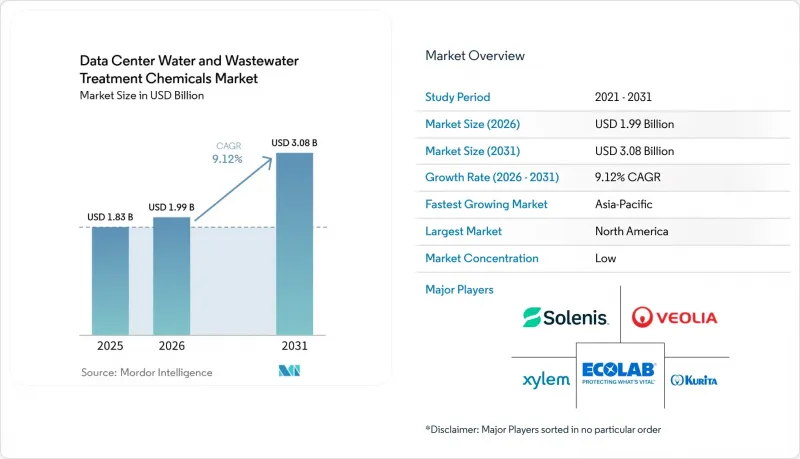
에 따르면 데이터센터 용수 및 폐수 처리 화학제품 시장 규모는 2025년에 18억 3,000만 달러로 추정되며, 2026년 19억 9,000만 달러에서 2031년까지 30억 8,000만 달러로 확대되어, 예측 기간(2026-2031년) 동안 CAGR은 9.12%에 달할 것으로 전망됩니다.
전 세계 데이터센터 용수 및 폐수 처리 화학제품 시장의 동향과 인사이트
하이퍼스케일 및 코로케이션 용량 확대
세계 데이터센터의 수용 능력은 2025년부터 2035년까지 6배 증가할 것으로 예상되며, 이에 따라 물 사용량과 스케일, 부식, 생물학적 오염을 억제하기 위해 사용되는 화학약품 프로그램도 증가할 것입니다. 이러한 확대로 인해 연속 가동에 대응하는 수처리가 필요한 대규모 시설의 수가 늘어날 것입니다. 데이터센터의 용수 및 폐수 처리 화학제품 시장은 캠퍼스가 일회성 유지보수 처리가 아닌 지속적인 관리가 필요한 경우 혜택을 받게 됩니다. 대규모 캠퍼스에서는 막대한 양의 냉각수를 소비하기 때문에 수동적인 화학약품 점검에만 의존할 수는 없습니다. 하루 500만 갤런 이상의 물을 사용하는 시설에서는 수질을 운영 기준 범위 내로 유지하기 위해 자동 투여, 센서 기반 공급 및 정기적인 데이터 확인이 필요합니다. 수질을 지속적으로 측정, 기록, 조정해야 하므로 이러한 시스템은 더 높은 계약 금액으로 이어집니다. 코로케이션 사업자는 이와 관련된 과제에 직면해 있습니다. 즉, 수질 문제가 단 한 건만 발생해도 서로 다른 서비스 계약을 맺고 있는 여러 테넌트에 영향을 미치며, 단일 사용자 시설의 경우보다 더 광범위한 서비스 문제를 야기할 가능성이 있습니다. 또한 북미와 유럽에서 시설의 인허가 취득에 있어서도 수자원 관리 계획의 중요성이 점점 더 커지고 있습니다. 이러한 규제적 강조에 따라 수처리 프로그램에 대한 실질적인 최소 기준이 확립되었으며, 현장 지원과 측정·보고를 결합할 수 있는 공급업체에 대한 수요가 증가하고 있습니다.
고밀도 AI 및 액체 냉각 도입
AI 훈련 랙은 랙당 60-100 kW에 달할 수 있으며, 일부 액체 냉각 구성의 경우 200 kW를 초과하기도 합니다. 반면, 기존 공랭식 시스템은 20-25 kW 범위에 그칩니다. 이러한 높은 열 부하로 인해 열전달 표면의 용해성 고형물, 침전물 및 부식을 관리해야 할 필요성이 커집니다. 또한, 고밀도 컴퓨팅 장비를 지원하는 시스템에서 수질 화학적 허용 범위가 좁아지는 결과로 이어집니다. 개방형 시설용 수처리 시스템에서도 여전히 부식 방지제, 살균제 및 스케일 억제제가 필요합니다. 한편, 폐쇄형 냉각 시스템에서는 더욱 엄격하게 관리된 수질과 알루미늄 및 구리 부품과 호환되는 약제 구성이 요구됩니다. 여기에는 저전도도 물이나 이종 금속 회로에 적합한 억제제 등이 포함됩니다. 그 결과, 하나의 캠퍼스 내에서 기존의 냉각수 프로그램 하나 대신 두 가지 서로 다른 수질 관리 프로그램을 운영하게 될 가능성이 있습니다. 2025년 8월, ChemTreat사는 다이렉트 투 칩(D2C) 냉각용 ‘CTSolutions D2C’를 출시했습니다. 이는 처리, 모니터링, 시운전 전 패시베이션, 운영용 화학 약품 및 디지털 동향 분석을 결합한 솔루션입니다. 그 결과, 데이터센터의 용수 및 폐수 처리 화학제품 시장은 시설 측면과 기술 측면 모두의 냉각 요구 사항을 충족하는 프로그램으로 전환되고 있습니다. 이러한 시스템 간의 상호 작용을 관리할 수 있는 공급업체는 AI에 중점을 둔 캠퍼스에 서비스를 제공하는 데 있어 더 유리한 입장에 있습니다.
고급 처리·모니터링 프로그램의 높은 비용
AI 중심의 처리 프로그램에서는 연속 센서, 자동 투여 컨트롤러, 실시간 분석 및 현장 서비스를 결합할 수 있습니다. 이러한 기능을 통해 운영자는 수질을 보다 적절하게 관리할 수 있게 되지만, 프로그램 비용은 증가합니다. 운영 비용은 기존의 고정 투여형 냉각 프로그램의 2배에서 4배에 달할 수 있습니다. 이러한 비용 차이로 인해, 수처리 예산이 장비 교체 비용과 경쟁 관계에 있는 기업 시설이나 소규모 코로케이션 사이트에서는 도입이 지연될 가능성이 있습니다. 또한, 가동 중단 시간 방지의 가치가 정량화되지 않은 경우, 첨단 모니터링 시스템의 도입도 지연될 우려가 있습니다. 특히 아시아태평양에서는 현지 공급업체들이 저비용 프로그램을 제공하고 있어 가격 면에서 강한 압박이 가해지고 있습니다. 따라서 데이터센터의 용수 및 폐수 처리 화학제품 시장은 제어 능력 향상을 통해 가동 시간을 확보하고, 물 낭비를 줄이며, 규제 준수를 지원할 수 있음을 입증해야 합니다. 고급 프로그램은 규모를 중시하는 중견 데이터센터에서 연간 20만-60만 달러의 효율화를 통한 비용 절감을 가져올 수 있지만, 사업자는 도입을 결정하기 전에 전체 수명주기에 걸친 명확한 비즈니스 사례를 필요로 합니다. 이러한 제약은 상당한 설치 용량을 보유하고 있음에도 고가의 프로그램에 자금을 투자할 능력이 제한적인 엔터프라이즈 시설의 ‘롱테일’ 부문에서 가장 두드러집니다. 가격에 민감한 고객이 더 단순한 대안으로 전환하기 전에, 공급업체는 운영 비용 절감과 설비 위험 감소를 입증해야 합니다.
부문 분석
2025년, 데이터센터 용수 및 폐수 처리 화학제품 시장에서 부식 방지제는 31.45%의 점유율을 차지하며 가장 큰 화학약품 카테고리가 되었습니다. 이러한 제품들은 개방형 재순환 냉각탑이나, 물이 중요한 장비와 장시간 접촉하는 폐쇄형 액체 냉각 루프(그 수가 증가 추세에 있습니다)에서 사용됩니다. 그 역할은 열교환기, 콜드 플레이트, 배관 및 기타 물과 접촉하는 부품을, 열전달을 저하시키거나 장비에 손상을 줄 수 있는 부식으로부터 보호하는 데 있습니다. 최신 부식 방지제 패키지에는 포스폰산염 및 아졸계 화합물이 사용되며, 강철, 구리 합금, 알루미늄을 포함한 혼합 금속 시스템에 대응하고 있습니다. 이는 고밀도 냉각 시스템에서 여러 재질이 동일한 작동 환경에 통합되는 사례가 증가하고 있기 때문에 중요합니다. 이러한 배합은 침전물을 생성하거나 시스템 내에서 사용되는 다른 처리용 화학 약품의 작용을 방해하지 않으면서 장비를 보호해야 합니다. 따라서 시장에서는 특정 재료, 수질, 냉각 구성에 맞춰 설계된 패키지로의 전환이 진행되고 있으며, 이를 위해서는 기존의 단일 금속 냉각 시스템에서 사용되던 프로그램보다 더 복잡한 화학 조성이 요구되고 있습니다.
살생물제 및 소독제 시장은 2031년까지 연평균 성장률(CAGR) 10.56%로 성장할 것으로 예측되며, 이는 화학약품 종류 중 가장 높은 성장률입니다. 이러한 성장은 레지오넬라균 억제 및 하이퍼스케일 캠퍼스 내 개방형 냉각탑의 지속적인 사용과 밀접한 관련이 있습니다. 개방형 냉각탑은 특히 시설이 고농축 사이클로 가동될 경우, 정기적인 생물학적 제어가 필요한 환경을 조성합니다. 농축 사이클이 높아지면 기존 염소 처리 프로그램의 효과가 저하되고, 안정화된 브롬, 이소티아졸리논계 비산화성 살균제 및 이산화염소의 역할이 커집니다. 또한, 화학 약품의 선정은 적용되는 규정 및 운영 요건을 준수해야 합니다. 열교환 표면의 침전물은 열적 스로틀링을 유발하여 냉각 효율을 저하시킬 수 있으므로, 스케일 억제제는 여전히 중요합니다. 응집제 및 응집 보조제는 블로우다운 처리와 재생수 조정을 지원하며, pH 조절제는 억제제 패키지의 보호 효과를 유지합니다. 산소 제거제, 소포제, 특수 분산제 등의 기타 화학 약품은 시설에서 블로우다운수를 회수하여 담수 취수량을 줄이는 경우 더욱 중요해집니다. 이러한 범주들이 결합되어 시설의 냉각 시스템 및 폐수처리 시스템 전반에 걸친 데이터센터 용수 및 폐수 처리 화학제품 시장을 뒷받침하고 있습니다.
지역별 분석
2025년, 북미는 지역별 매출의 38.55%를 차지했습니다. 북부 버지니아, 태평양 연안 북서부, 피닉스, 시카고, 콜럼버스 등의 주요 허브가 이 지역의 냉각수 처리 수요를 뒷받침하고 있습니다. 버지니아주 북부에는 디지털 인프라가 고도로 집중되어 있어, 신뢰성이 높은 시설용 수처리 시스템이 특히 중요시되고 있습니다. 미국 각 주 의회는 대규모 데이터센터에 대한 물 관리 계획, 정보 공개 요건 및 효율성 요건을 더욱 중시하고 있습니다. 이러한 요건으로 인해 시설들은 절수, 폐수 관리, 수질 관리를 문서화한 처리 프로그램의 도입을 촉진받고 있습니다. 미국 남부 및 서부 일부 지역의 수자원 제약도 재생 수원으로의 전환을 뒷받침하고 있습니다. 이로 인해 유입수의 성분이 음용수보다 변동하기 쉬워져 화학 처리의 복잡성이 증가하고 있습니다. 캐나다와 멕시코에서는 토론토, 몬트리올, 케레타로 지역의 코로케이션 활동 확대로 인해 지역 생산량이 증가하고 있지만, 이러한 지역에서는 현지 수질에 따라 개별적인 처리가 필요합니다. 따라서 북미의 데이터센터 용수 및 폐수 처리 화학제품 시장은 설비 용량의 집중과 수자원 관리 요건 모두에 의해 형성되고 있습니다.
아시아태평양은 데이터센터 용수 및 폐수 처리 화학제품 시장에서 2031년까지 연평균 성장률(CAGR) 10.73%를 기록하며, 지역별로는 가장 높은 성장률을 보일 것으로 예측됩니다. '동부 데이터, 서부 컴퓨팅' 이니셔티브에 따른 중국의 하이퍼스케일 확장으로 인해 워크로드가 내륙 지방으로 이동하고 있습니다. 내륙 지역은 연안 지역과 수자원 확보 상황이 다를 수 있어, 냉각수 프로그램이 대처해야 할 원수 조건도 변화하고 있습니다. 인도에서는 벵갈루루, 하이데라바드, 뭄바이, 첸나이에서 하이퍼스케일 사업이 확대되고 있습니다. 라자스탄 주의 ‘데이터센터 정책 2025’에서는 신규 시설에 대해 액체 배출 제로, 빗물 활용, 지하수 보충을 의무화하고 있으며, 이에 따라 고도 수처리 필요성이 높아지고, 블로우다운 처리, 회수, 재이용에 관한 기술적 요건도 엄격해지고 있습니다. 2026년 5월, Gradiant사는 북미, 유럽, 아시아의 주요 하이퍼스케일 사업자들과 ‘HyperSolved’ 도입을 발표했습니다. 싱가포르와 한국도 물 재이용 및 산업용수 관련 요건을 통해 보다 고도화된 처리 사양을 지지하고 있습니다. 이러한 각국 차원의 상황은 데이터센터의 용수 및 폐수 처리 화학제품 시장 전반에서 적응형 프로그램에 대한 수요를 뒷받침하고 있습니다.
유럽은 지역별 시장 중 3위의 규모를 자랑합니다. 독일에서는 냉각수 처리에 관한 엄격한 규제 환경이 마련되어 있으며, 제42차 연방 배출 규제 조례(BImSchV) 및 독일 기술자 협회(VDI) 6044 규격에 따라 부식 방지, 침전물 방지, 미생물 제어에 관한 문서화가 의무화되어 있습니다. 이러한 요건으로 인해 데이터센터 사업자에게 검증된 처리 기법의 중요성이 더욱 높아지고 있습니다. 유럽연합(EU)의 살생물제 규정에 따라 허용되는 살생물제의 범위가 좁아지고 있어, 공급업체에 대한 제형 변경 요구 사항이 높아지고 있습니다. 이는 규정을 준수하는 제품 포트폴리오를 유지하고 기술 문서를 통해 고객을 지원하는 공급업체에게 유리하게 작용할 수 있습니다. 남미는 하이퍼스케일 개발의 초기 단계에 있으며, 브라질 상파울루 및 리우데자네이루 회랑 지역의 활동이 주도적인 역할을 하고 있습니다. 중동 및 아프리카도 사우디아라비아와 남아프리카공화국 등을 포함해 투자를 유치하고 있습니다. 아라비아 반도의 심각한 물 부족은 블로우다운을 최소화하고 농축 사이클 횟수를 늘리는 고회수율 프로그램의 도입을 촉진하고 있습니다. 대규모 시설이 범용 산업용 처리에서 데이터센터 전용 프로그램으로 전환됨에 따라, 이러한 상황은 데이터센터의 용수 및 폐수 처리 화학제품 시장에 장기적인 기회를 제공하고 있습니다.
기타 혜택:
- 엑셀 형식의 시장 예측(ME) 시트
- 3개월간의 애널리스트 지원
자주 묻는 질문
목차
제1장 소개
- 조사 가정과 시장 정의
- 조사 범위
제2장 조사 방법
제3장 주요 요약
제4장 시장 구도
- 시장 개요
- 시장 성장 촉진요인
- 시장 성장 억제요인
- 밸류체인 분석
- Porter's Five Forces 분석
제5장 시장 규모와 성장 예측
- 화학제품 유형별
- 데이터센터 유형별
- 지역별
- 아시아태평양
- 중국
- 인도
- 일본
- 한국
- 기타 아시아태평양 국가
- 북미
- 미국
- 캐나다
- 멕시코
- 유럽
- 독일
- 영국
- 프랑스
- 이탈리아
- 기타 유럽 국가
- 남미
- 브라질
- 아르헨티나
- 기타 남미 국가
- 중동 및 아프리카
- 사우디아라비아
- 남아프리카공화국
- 기타 중동 및 아프리카 국가
- 아시아태평양
제6장 경쟁 구도
- 시장 집중도
- 전략적 동향
- 시장 점유율·순위 분석
- 기업 개요
- Aquatech International LLC
- Buckman
- DuPont
- Ecolab Inc.
- Gradiant Corporation
- IDE Technologies
- Kemira Oyj
- Kurita Water Industries Ltd.
- Lenntech B.V.
- Saltworks Technologies Inc.
- SNF Group
- Solenis
- SUEZ
- Veolia
- Xylem
제7장 시장 기회와 향후 전망
KSM 26.10.29According to Mordor Intelligence, the data center water and wastewater treatment chemicals market size was estimated at USD 1.83 billion in 2025 and is estimated to grow from USD 1.99 billion in 2026 to USD 3.08 billion by 2031, at a CAGR of 9.12% during the forecast period (2026-2031).
Global Data Center Water and Wastewater Treatment Chemicals Market Trends and Insights
Hyperscale and Colocation Capacity Expansion
Global data center capacity is expected to increase sixfold from 2025 to 2035, increasing water volumes and the chemical programs used to control scale, corrosion, and biological contamination. This expansion increases the number of large facilities that require water treatment designed for continuous operation. The data center water and wastewater treatment chemicals market benefits when a campus requires ongoing management rather than occasional maintenance treatment. Large campuses can consume substantial quantities of cooling water and cannot rely on manual chemical checks alone. Facilities using 5 million or more gallons per day need automated dosing, sensor-based delivery, and routine data review to keep chemistry within operating limits. These systems support higher contract values because water quality must be continuously measured, documented, and adjusted. Colocation operators face a related challenge: a single water-quality failure can affect multiple tenants with different service commitments, creating a broader service issue than it would at a single-user facility. Water management plans are also becoming increasingly important in site permitting across North America and Europe. This regulatory focus establishes a practical minimum for treatment programs and strengthens demand for suppliers capable of combining field support with measurement and reporting.
High-Density AI and Liquid-Cooling Adoption
AI training racks can reach 60-100 kW per rack, and some liquid-cooled configurations exceed 200 kW, compared with the 20-25 kW range associated with conventional air-cooled systems. This higher heat load increases the need to manage dissolved solids, deposits, and corrosion on heat-transfer surfaces. It also narrows the operating tolerance for water chemistry in systems that support high-density computing equipment. Open facility-water systems still require corrosion inhibitors, biocides, and scale control. Closed-loop cooling systems require more tightly controlled water quality and formulations compatible with aluminum and copper components, including low-conductivity water and inhibitors suited to mixed-metal circuits. As a result, a single campus may operate two distinct chemistry programs rather than one conventional cooling-water program. In August 2025, ChemTreat launched CTSolutions D2C for direct-to-chip cooling, combining treatment, monitoring, pre-commissioning passivation, operational chemistry, and digital trending. The data center water and wastewater treatment chemicals market is consequently shifting toward programs that address both facility-side and technology-side cooling requirements. Suppliers that can manage the interaction between these systems are better positioned to serve AI-focused campuses.
High Cost of Advanced Treatment and Monitoring Programs
AI-focused treatment programs can combine continuous sensors, automated dosing controllers, real-time analytics, and field service. These features give operators better control over water quality, but they increase program costs. Operating costs can be two to four times those of a conventional fixed-dose cooling program. This difference can delay adoption among enterprise facilities and smaller colocation sites where water-treatment budgets compete with equipment refresh spending. It can also slow the adoption of advanced monitoring, where the value of avoiding downtime has not been quantified. Price pressure is particularly strong in Asia-Pacific, where domestic suppliers offer lower-cost programs. The data center water and wastewater treatment chemicals market must therefore demonstrate how improved control protects uptime, reduces water waste, and supports regulatory compliance. Advanced programs can deliver USD 200,000 to USD 600,000 in annual efficiency savings at a scale-focused mid-tier data center, but operators need a clear life-cycle case before selecting them. This constraint is most visible in the long tail of enterprise facilities, which have meaningful installed capacity but limited ability to fund premium programs. Suppliers need to demonstrate operating savings and reduced equipment risk before price-sensitive customers switch to simpler alternatives.
Other drivers and restraints analyzed in the detailed report include:
- Water Scarcity and Reuse Requirements
- Stricter Discharge and Water-Quality Compliance
- Non-Chemical Disinfection and Closed-Loop Substitution
For complete list of drivers and restraints, kindly check the Table Of Contents.
Segment Analysis
Corrosion inhibitors accounted for 31.45% of the data center water and wastewater treatment chemicals market share in 2025, making them the largest chemical category. They are used in open recirculating towers and in a growing number of closed liquid-cooling loops, where water remains in contact with critical equipment for extended periods. Their role is to protect heat exchangers, cold plates, piping, and other wetted components from corrosion that could reduce heat transfer or damage equipment. Modern inhibitor packages use phosphonates and azoles to address mixed-metal systems containing steel, copper alloys, and aluminum. This is relevant because high-density cooling systems increasingly bring several material types into the same operating environment. These formulations must protect equipment without creating deposits or interfering with other treatment chemicals used in the system. The market is therefore moving toward packages designed for specific materials, water conditions, and cooling configurations, which require more complex chemistry than programs used in older single-metal cooling systems.
Biocides and disinfectants are forecast to grow at a 10.56% CAGR through 2031, the highest rate among chemical types. Their growth is tied to Legionella control and the continued use of open cooling towers at hyperscale campuses. Open towers create conditions that require regular biological control, particularly when facilities operate at high cycles of concentration. Higher cycles can reduce the effectiveness of conventional chlorine programs and increase the role of stabilized bromine, isothiazolinone-based non-oxidizing biocides, and chlorine dioxide. Chemical selection must also remain consistent with applicable regulatory and operational requirements. Scale inhibitors remain important because deposits on heat-transfer surfaces can cause thermal throttling and reduce cooling efficiency. Coagulants and flocculants support blowdown treatment and reclaimed-water conditioning, while pH chemicals maintain the protection provided by inhibitor packages. Other chemical types, including oxygen scavengers, antifoams, and specialty dispersants, become more relevant when facilities recover blowdown water to reduce freshwater withdrawals. Together, these categories support the data center water and wastewater treatment chemicals market across a facility's cooling and wastewater systems.
Complete Report Scope:
- By Chemical Type
- Corrosion Inhibitors
- Scale Inhibitors
- Biocides and Disinfectants
- Coagulants and Flocculants
- pH Control Chemicals
- Other Chemical Types
- By Data Center Type
- Hyperscale Data Centers
- Colocation Data Centers
- Enterprise Data Centers
- Others
- By Geography
- Asia-Pacific
- China
- India
- Japan
- South Korea
- Rest of Asia-Pacific
- North America
- United States
- Canada
- Mexico
- Europe
- Germany
- United Kingdom
- France
- Italy
- Rest of Europe
- South America
- Brazil
- Argentina
- Rest of South America
- Middle East and Africa
- Saudi Arabia
- South Africa
- Rest of Middle East and Africa
- Asia-Pacific
Geography Analysis
North America accounted for 38.55% of regional revenue in 2025. Large hubs, including Northern Virginia, the Pacific Northwest, Phoenix, Chicago, and Columbus, support the region's demand for cooling-water treatment. Northern Virginia's high concentration of digital infrastructure places particular importance on dependable facility water systems. US state legislatures are placing greater emphasis on water-management plans, disclosure requirements, and efficiency requirements for large data centers. These requirements encourage facilities to implement treatment programs that document conservation, discharge management, and water quality control. Water constraints in parts of the US South and West are also encouraging a shift toward reclaimed sources, which raises chemical complexity because incoming water can have a more variable composition than potable supplies. Canada and Mexico add regional output through growing colocation activity in Toronto, Montreal, and Queretaro, where local water quality requires tailored treatment. The data center water and wastewater treatment chemicals market in North America is therefore shaped by both capacity concentration and water-management requirements.
Asia-Pacific is forecast to grow at the fastest regional rate in the data center water and wastewater treatment chemicals market, at a CAGR of 10.73% through 2031. China's hyperscale expansion under the Eastern Data, Western Compute initiative shifts workloads to inland provinces, where water availability can differ from coastal locations, altering the source-water conditions that cooling-water programs must address. India is expanding hyperscale activity across Bangalore, Hyderabad, Mumbai, and Chennai. Rajasthan's Data Center Policy 2025 requires zero liquid discharge, rainwater harvesting, and groundwater replenishment for new facilities, increasing the need for advanced water treatment and raising the technical requirements for blowdown treatment, recovery, and reuse. In May 2026, Gradiant announced deployments of HyperSolved with large hyperscale operators across North America, Europe, and Asia. Singapore and South Korea also support higher treatment specifications through water recycling and industrial water requirements. These country-level conditions support demand for adaptive programs across the data center water and wastewater treatment chemicals market.
Europe is the third-largest regional market. Germany provides a demanding regulatory environment for cooling-water chemistry, with the 42nd Federal Immission Control Ordinance (BImSchV) and the Verein Deutscher Ingenieure (VDI) 6044 standard requiring documented corrosion protection, deposit prevention, and microbiological control. These requirements make verified treatment practices more important for data center operators. The European Union Biocidal Products Regulation is narrowing the permitted range of biocides, increasing reformulation requirements for suppliers, which can benefit providers that maintain compliant product portfolios and support customers with technical documentation. South America is at an earlier stage of hyperscale development, led by activity in Brazil's Sao Paulo and Rio de Janeiro corridors. The Middle East and Africa are also attracting investment, including in Saudi Arabia and South Africa. Severe water scarcity in the Arabian Peninsula creates an incentive for high-recovery programs that minimize blowdown and increase cycles of concentration. These conditions present a long-term opportunity for the data center water and wastewater treatment chemicals market as large facilities transition from generic industrial treatment to data-center-specific programs.
- Aquatech International LLC
- Buckman
- DuPont
- Ecolab Inc.
- Gradiant Corporation
- IDE Technologies
- Kemira Oyj
- Kurita Water Industries Ltd.
- Lenntech B.V.
- Saltworks Technologies Inc.
- SNF Group
- Solenis
- SUEZ
- Veolia
- Xylem
Additional Benefits:
- The market estimate (ME) sheet in Excel format
- 3 months of analyst support
TABLE OF CONTENTS
1 Introduction
- 1.1 Study Assumptions and Market Definition
- 1.2 Scope of the Study
2 Research Methodology
3 Executive Summary
4 Market Landscape
- 4.1 Market Overview
- 4.2 Market Drivers
- 4.2.1 Hyperscale and Colocation Capacity Expansion
- 4.2.2 High-Density AI and Liquid-Cooling Adoption
- 4.2.3 Water Scarcity and Reuse Requirements
- 4.2.4 Stricter Discharge and Water-Quality Compliance
- 4.2.5 Variable-Feedwater Chemistry in Reclaimed-Water Cooling
- 4.3 Market Restraints
- 4.3.1 High Cost of Advanced Treatment and Monitoring Programs
- 4.3.2 Integration Complexity in Live Mission-Critical Facilities
- 4.3.3 Non-Chemical Disinfection and Closed-Loop Substitution
- 4.4 Value Chain Analysis
- 4.5 Porter's Five Forces Analysis
- 4.5.1 Threat of New Entrants
- 4.5.2 Bargaining Power of Suppliers
- 4.5.3 Bargaining Power of Buyers
- 4.5.4 Threat of Substitutes
- 4.5.5 Competitive Rivalry
5 Market Size and Growth Forecasts (Value)
- 5.1 By Chemical Type
- 5.1.1 Corrosion Inhibitors
- 5.1.2 Scale Inhibitors
- 5.1.3 Biocides and Disinfectants
- 5.1.4 Coagulants and Flocculants
- 5.1.5 pH Control Chemicals
- 5.1.6 Other Chemical Types
- 5.2 By Data Center Type
- 5.2.1 Hyperscale Data Centers
- 5.2.2 Colocation Data Centers
- 5.2.3 Enterprise Data Centers
- 5.2.4 Others
- 5.3 By Geography
- 5.3.1 Asia-Pacific
- 5.3.1.1 China
- 5.3.1.2 India
- 5.3.1.3 Japan
- 5.3.1.4 South Korea
- 5.3.1.5 Rest of Asia-Pacific
- 5.3.2 North America
- 5.3.2.1 United States
- 5.3.2.2 Canada
- 5.3.2.3 Mexico
- 5.3.3 Europe
- 5.3.3.1 Germany
- 5.3.3.2 United Kingdom
- 5.3.3.3 France
- 5.3.3.4 Italy
- 5.3.3.5 Rest of Europe
- 5.3.4 South America
- 5.3.4.1 Brazil
- 5.3.4.2 Argentina
- 5.3.4.3 Rest of South America
- 5.3.5 Middle East and Africa
- 5.3.5.1 Saudi Arabia
- 5.3.5.2 South Africa
- 5.3.5.3 Rest of Middle East and Africa
- 5.3.1 Asia-Pacific
6 Competitive Landscape
- 6.1 Market Concentration
- 6.2 Strategic Moves
- 6.3 Market Share (%)/Ranking Analysis
- 6.4 Company Profiles (includes Global Overview, Market Overview, Core Segments, Financials as available, Strategic Information, Products and Services, and Recent Developments)
- 6.4.1 Aquatech International LLC
- 6.4.2 Buckman
- 6.4.3 DuPont
- 6.4.4 Ecolab Inc.
- 6.4.5 Gradiant Corporation
- 6.4.6 IDE Technologies
- 6.4.7 Kemira Oyj
- 6.4.8 Kurita Water Industries Ltd.
- 6.4.9 Lenntech B.V.
- 6.4.10 Saltworks Technologies Inc.
- 6.4.11 SNF Group
- 6.4.12 Solenis
- 6.4.13 SUEZ
- 6.4.14 Veolia
- 6.4.15 Xylem
7 Market Opportunities and Future Outlook
- 7.1 White-Space and Unmet-Need Assessment

(주말 및 공휴일 제외)


