

|
시장보고서
상품코드
2154762
탄소 중립 재료 : 시장 점유율 분석, 업계 동향과 통계, 성장 예측(2026-2031년)Carbon-Neutral Materials - Market Share Analysis, Industry Trends & Statistics, Growth Forecasts (2026 - 2031) |
||||||
 Mordor Intelligence
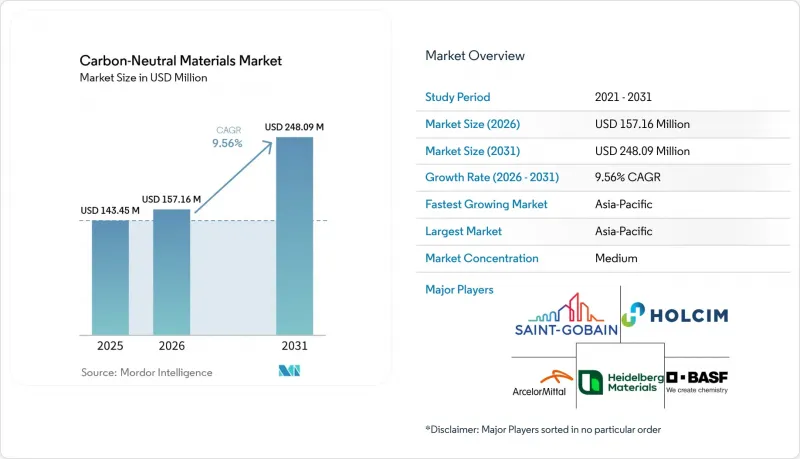
에 따르면 탄소 중립 재료 시장 규모는 2025년에 1억 4,345만 달러로 평가되며, 2026년 1억 5,716만 달러에서 2031년까지 2억 4,809만 달러에 달할 것으로 예측되며, 예측 기간(2026-2031년) 동안 CAGR은 9.56%가 될 전망입니다.
전 세계 탄소 중립 소재 시장의 동향 및 인사이트
규제에 따른 탈탄소화 의무화와 ‘바이 클린(Buy Clean)’ 조달
법적 구속력이 있는 조달 규정이 탄소 중립 자재 시장 전반에 걸친 도입을 촉진하고 있습니다. 캘리포니아주의 ‘바이 클린 캘리포니아법’에 따르면, 2025년 1월 1일부터 공공 사업에서 사용되는 구조용 강재, 콘크리트 철근, 판유리, 및 단열재에 대해 지구온난화지수(GWP) 상한선이 적용되었습니다. 워싱턴주는 2025년 7월 1일부터 총 연면적 10만 제곱피트를 초과하는 주 정부 건설 계약에 대해 유사한 요건을 적용했습니다. 2026년 7월, 유럽집행위원회는 ‘넷 제로 산업법’에 기반한 지침을 통해 당국에 공공 조달 시 가격 이외의 기준을 적용하도록 지시했습니다. 이러한 조치로 인해 환경 제품 선언(EPD)이 공급업체 자격 심사 과정에서 핵심적인 역할을 하게 되었습니다. 검증된 제품 데이터를 확보한 제조업체는 지속적으로 확대되는 공공 조달 과정에서 해당 문서를 활용할 수 있습니다.
친환경 건축물 인증 및 내재 탄소 공개
녹색 건축 제도로 인해 프로젝트 사양에서 ‘내재 탄소’ 성능이 점점 더 중요해지고 있습니다. ‘에너지 및 환경 설계 리더십(LEED)’ 버전 5(LEED v5)는 2026년 7월 1일부터 신규 프로젝트 등록 시 필수 요건이 되며, 그 ‘건물 전체 수명주기 평가’ 요건은 해당 평가 시스템의 모든 프로젝트에 적용됩니다. 캘리포니아주는 1단계 건축자재 제조업체를 대상으로 2026년 한 해 동안의 내재 탄소 정보 제출을 의무화하는 보고 요건을 확정했습니다. 개정된 ‘건축물의 에너지 성능에 관한 지침’에 따르면, 2028년 1월부터는 1,000제곱미터를 초과하는 신축 건물, 2030년부터는 모든 신축 건물에 대해 수명주기 GWP 공개가 의무화됩니다. 이를 통해 공장 수준의 탄소 배출량 측정과 건축물의 규정 준수에 필요한 서류가 연계됩니다. 공급업체가 프로젝트 설계 및 시공 초기 단계에서 일관된 환경 제품 선언서(EPD)를 제공할 수 있고, 구매자가 자재 선정 전에 검증된 데이터를 비교할 수 있다면, 탄소 중립 자재 시장은 그 혜택을 누리게 될 것입니다.
그린 프리미엄과 높은 전환 자본 집약도
저탄소 자재와 기존 자재 간의 가격 차이는 여전히 탄소 중립 자재 시장의 보급에 걸림돌로 남아 있습니다. 중국 환경개발국제협력위원회(CCICED)의 조사에 따르면, 시멘트나 유리 등 건축자재의 그린 프리미엄은 최근 기존 생산 비용을 139% 상회하는 것으로 나타났습니다. 기존 산업 자산을 전환하는 생산자에게 있어 자본 요건은 특히 큰 과제가 되고 있습니다. SSAB AB는 2025년 4월, 스웨덴 뤼레오에 위치한 화석 연료를 사용하지 않는 미니 밀을 위해 그린 파이낸스를 통한 자금 조달을 확보했습니다. 공적 지원에 대한 접근성, 장기 공급 계약, 그리고 구조화 금융의 활용 여부가 공장 전환의 성패를 좌우할 가능성이 있습니다. 이에 따라 자사의 대차대조표에만 의존하는 기업보다 금융 기관과 확고한 관계를 구축한 기업이 유리해질 수 있습니다.
부문별 분석
2025년, 탄소 중립 시멘트 및 콘크리트는 총 매출의 33.24%를 차지했습니다. 건설 업계는 내재 탄소(embodied carbon)에 관한 요건, 공공 조달 규정, 그리고 제조업체의 제품 수준 탄소 성능 문서화 의무에 직면해 있기 때문에 탄소 중립 자재 시장은 이 자재군에 의존하고 있습니다. 시멘트 제조에서는 소성 공정에서 다량의 공정 배출이 발생하기 때문에 규제, 공장 전환 및 탄소 포집에 대한 투자가 우선 과제로 대두되고 있습니다. 홀심(Holcim)의 보고서에 따르면, 2025년에는 ‘ECOPlanet’ 저탄소 시멘트가 시멘트 순매출의 36%를 차지했고, ‘ECOPact’ 친환경 콘크리트는 레디믹스 콘크리트 순매출의 31%를 차지했습니다. 이러한 결과는 인증, 판매망 및 프로젝트 명세서에 의해 뒷받침될 경우, 브랜드화된 저탄소 제품이 수요를 확보할 수 있음을 보여줍니다.
탄소 중립 폴리머 시장은 2031년까지 연평균 성장률(CAGR) 10.34%로 확대될 것으로 예측됩니다. 이 부문은 자동차 제조사의 배출량 감축 목표, 유럽의 제품 규제, 그리고 까다로운 용도에서의 성능 요건을 충족하는 소재에 대한 수요에 힘입어 성장하고 있습니다. BASF는 2025년 6월, 자동차, 전자 및 산업 용도로 ‘Ultramid LowPCF’ 및 ‘Ultramid ZeroPCF’ 폴리아미드 등급을 출시했습니다. 이 제품들은 고객의 배합 변경 없이 바로 사용할 수 있습니다. 브라스켐이 2025년 10월에 발표한 생애주기 평가(LCA) 최신 정보에 따르면, 해당 회사의 바이오 기반 폴리에틸렌 제품군이 대상으로 포함되었으며, 폴리에틸렌(PE) 왁스의 경우, 1kg당 4.7kg의 이산화탄소 환산치에 해당하는 순 이산화탄소 감축 효과가 보고되었습니다. 국제 지속가능성·탄소 인증 PLUS(ISCC PLUS)는 바이오매스 밸런스 소재를 주장하는 데 있어 중요성이 커지고 있으며, 단순한 제품 차별화 요소에 그치지 않고 공급망 진입 요건이 될 가능성이 있습니다.
지역별 분석
아시아태평양은 2025년에 총 매출의 37.72%를 차지할 것으로 예상되며, 2031년까지 연평균 성장률(CAGR) 10.11%로 확대될 것으로 전망됩니다. 이 지역의 탄소 중립 소재 시장은 중국, 인도, 일본, 한국의 수요에 더해 시멘트, 철강, 화학, 제조 분야의 광범위한 생산능력을 반영하고 있습니다. 인도의 인프라 구축 계획은 인증된 건설자재에 대한 수요를 뒷받침할 것으로 기대되는 반면, 일본과 한국에서는 내재 탄소 보고 체계 및 산업의 탈탄소화를 위한 노력이 강화되고 있습니다. 2026년 6월, 포스코홀딩스는 광양 제철소에서 250만 메트르톤 규모의 전기 아크로 건설을 완료했습니다. 이 전기로는 기존의 고로 생산에 비해 이산화탄소 배출량을 최대 75%까지 감축하도록 설계되었습니다. 이 지역의 대규모 제조 기반은 공급업체들에게 저탄소 제품의 인증 및 도입을 위한 큰 잠재적 토대가 되고 있습니다.
북미는 연방 및 주 차원의 ‘바이 클린(Buy-Clean)’ 프로그램과 전기 아크로 생산능력을 바탕으로 그 위상을 유지했습니다. 이 지역의 탄소 중립 자재 시장은 공공 건설 분야의 인증 요건이 명확해진 혜택을 받고 있으며, 이에 따라 생산자들은 검증 가능한 환경 제품 데이터를 마련해야 합니다. 캘리포니아주와 워싱턴주는 공공 건설용 자재에 대해 이러한 요건을 제정했습니다. 유럽에서는 탄소 국경 조정 메커니즘, 혁신 기금 프로그램, 그리고 디지털 제품 문서화가 계속해서 추진력을 제공했습니다. 유럽연합 집행위원회는 규정(EU) 2024/1781에 따라 2026년 7월 ‘디지털 제품 여권 등록부’를 출범시켜, 검증된 자재 추적성을 위한 기술적 인프라를 구축했습니다.
남미는 여전히 초기 단계에 있으며, 브라질의 브라스크엠(Braskem)사가 전개하는 ‘I'm green’ 바이오 기반 폴리머 플랫폼이 중요한 수출 자산으로 자리 잡고 있습니다. 중동 및 아프리카 역시 내재 탄소량 의무화 도입 측면에서는 여전히 초기 단계에 있지만, 사우디아라비아의 ‘비전 2030’에 기반한 건설 프로젝트와 남아프리카공화국의 그린 인프라 추진이 초기 수요의 조짐을 보이고 있습니다. 이러한 지역에서는 조달 기준이 더욱 구체화되고, 생산능력과 함께 보고 체계가 정비됨에 따라 탄소 중립 소재 시장이 확대될 가능성이 있습니다. 탄소 중립 소재 시장은 현지 프로젝트 요건, 이용 가능한 원료, 그리고 인증 요건을 충족하는 공급업체의 역량에 좌우될 것입니다. 국경을 넘어 공급하는 공급업체는 수출 대상 시장의 요건을 충족하는 제품 데이터가 필요합니다. 이러한 상황은 현지 프로젝트 개발자, 자재 제조업체 및 인증 기관 간의 조기 협력을 촉진할 가능성이 있습니다.
기타 혜택:
- 엑셀 형식의 시장 예측(ME) 시트
- 3개월간의 애널리스트 지원
자주 묻는 질문
목차
제1장 소개
- 조사 가정과 시장 정의
- 조사 범위
제2장 조사 방법
제3장 주요 요약
제4장 시장 구도
- 시장 개요
- 시장 성장 촉진요인
- 시장 성장 억제요인
- 밸류체인 분석
- Porter's Five Forces 분석
제5장 시장 규모와 성장 예측
- 소재 유형별
- 최종 이용 산업별
- 지역별
- 아시아태평양
- 중국
- 인도
- 일본
- 한국
- 기타 아시아태평양 국가
- 북미
- 미국
- 캐나다
- 멕시코
- 유럽
- 독일
- 영국
- 프랑스
- 이탈리아
- 기타 유럽 국가
- 남미
- 브라질
- 아르헨티나
- 기타 남미 국가
- 중동 및 아프리카
- 사우디아라비아
- 남아프리카공화국
- 기타 중동 및 아프리카 국가
- 아시아태평양
제6장 경쟁 구도
- 시장 집중도
- 전략적 동향
- 시장 점유율·순위 분석
- 기업 개요
- ARCELORMITTAL
- BASF
- Braskem
- Cemex S.A.B DE C.V.
- Covestro AG
- Heidelberg Materials AG
- HOLCIM
- LG Chem
- Nucor Corporation
- POSCO Holdings Inc.
- Saint-Gobain
- Sika AG
- SSAB AB
- Tata Steel Limited
- thyssenkrupp AG
제7장 시장 기회와 향후 전망
KSM 26.10.29According to Mordor Intelligence, the Carbon-Neutral materials market size was valued at USD 143.45 million in 2025 and is estimated to grow from USD 157.16 million in 2026 to reach USD 248.09 million by 2031, at a CAGR of 9.56% during the forecast period (2026-2031).
Global Carbon-Neutral Materials Market Trends and Insights
Regulatory Decarbonization Mandates and Buy-Clean Procurement
Legally binding procurement rules are supporting adoption across the carbon-neutral materials market. California's Buy Clean California Act applied Global Warming Potential (GWP) limits to structural steel, concrete reinforcing steel, flat glass, and insulation in public works from January 1, 2025. Washington State extended comparable requirements from July 1, 2025, to state construction contracts over 100,000 gross square feet. In July 2026, European Commission guidance under the Net-Zero Industry Act directed authorities to use non-price criteria in public procurement. These measures make environmental product declarations central to supplier qualification. Producers that establish verified product data can use that documentation across a growing set of public procurement processes.
Green-Building Certification and Embodied-Carbon Disclosure
Green-building systems are making embodied-carbon performance more important in project specifications. Leadership in Energy and Environmental Design version 5 (LEED v5) became mandatory for new project registrations on July 1, 2026, and its Whole Building Life Cycle Assessment requirement applies to every project in the cited rating system. California finalized reporting requirements that require manufacturers of Phase 1 building materials to submit embodied-carbon information for the 2026 calendar year. The revised Energy Performance of Buildings Directive requires life cycle GWP disclosure for new buildings above 1,000 square meters from January 2028 and for all new buildings from 2030. This connects factory-level carbon measurement with the documentation needed for building compliance. The carbon-neutral materials market benefits when suppliers can provide consistent environmental product declarations early in project design and construction, and buyers can compare verified data before material selection.
Green Premium and High Conversion Capital Intensity
The price difference between lower-carbon and conventional materials remains a barrier to adoption in the carbon-neutral materials market. The China Council for International Cooperation on Environment and Development found that green premiums for building materials such as cement and glass reached 139% above conventional production costs in recent years. Capital requirements are especially challenging for producers converting established industrial assets. SSAB AB secured funding in green financing in April 2025 for its fossil-free mini-mill in Lulea, Sweden. Access to public support, long-term offtake agreements, and structured financing can determine whether a plant conversion moves forward. This can favor companies with established lender relationships over companies relying only on corporate balance sheets.
Other drivers and restraints analyzed in the detailed report include:
- Corporate Scope 3 Commitments and Sustainable Product Premiums
- Carbon-Capture, Utilization and Mineralization Scale-Up
- Feedstock Scarcity and Fragmented Low-Carbon Supply Chains
For complete list of drivers and restraints, kindly check the Table Of Contents.
Segment Analysis
Carbon-neutral cement and concrete held 33.24% of total revenue in 2025. The carbon-neutral materials market relies on this material group because construction is exposed to embodied-carbon requirements, public procurement rules, and the need for producers to document product-level carbon performance. Cement manufacturing produces substantial process emissions from calcination, so it has become a priority for regulation, plant conversion, and carbon-capture investment. HOLCIM reported that ECOPlanet low-carbon cement represented 36% of cement net sales in 2025, while ECOPact green concrete accounted for 31% of ready-mix concrete net sales. These results showed that a branded lower-carbon offer can gain demand when it is supported by certification, sales coverage, and project specifications.
Carbon-neutral polymers are projected to advance at a 10.34% CAGR through 2031. The segment is supported by automaker emissions targets, European product rules, and demand for materials that meet performance requirements in demanding applications. BASF launched Ultramid LowPCF and Ultramid ZeroPCF polyamide grades in June 2025 for automotive, electronics, and industrial uses without requiring customer reformulation. Braskem's October 2025 life-cycle assessment updates covered its bio-based polyethylene portfolio and reported a net carbon dioxide benefit of 4.7 kilograms of carbon dioxide equivalent per kilogram for polyethylene (PE) wax. International Sustainability and Carbon Certification PLUS (ISCC PLUS) is becoming important for biomass-balanced material claims and can become a supply-chain entry requirement rather than only a product differentiator.
Complete Report Scope:
- By Material Type
- Carbon-Neutral Cement and Concrete
- Carbon-Neutral Metals
- Carbon-Neutral Polymers
- Carbon-Neutral Glass and Ceramics
- Other Material Types
- By End-Use Industry
- Building and Construction
- Automotive
- Packaging
- Electrical and Electronics
- Industrial Manufacturing
- Other End-Use Industries
- By Geography
- Asia-Pacific
- China
- India
- Japan
- South Korea
- Rest of Asia-Pacific
- North America
- United States
- Canada
- Mexico
- Europe
- Germany
- United Kingdom
- France
- Italy
- Rest of Europe
- South America
- Brazil
- Argentina
- Rest of South America
- Middle-East and Africa
- Saudi Arabia
- South Africa
- Rest of Middle-East and Africa
- Asia-Pacific
Geography Analysis
Asia-Pacific held 37.72% of total revenue in 2025 and is projected to advance at a 10.11% CAGR through 2031. The carbon-neutral materials market in the region reflected demand from China, India, Japan, and South Korea, as well as extensive cement, steel, chemicals, and manufacturing capacity. India's infrastructure pipeline can support demand for certified construction materials, while Japan and South Korea have strengthened embedded-carbon reporting and industrial decarbonization activity. In June 2026, POSCO Holdings Inc. completed a 2.5-million-metric-ton electric arc furnace at Gwangyang Works, which was designed to reduce carbon dioxide emissions by up to 75% compared with conventional blast furnace production. The scale of regional manufacturing gives suppliers a large potential base for lower-carbon product qualification and deployment.
North America retained its position through federal and state Buy-Clean programs and electric arc furnace capacity. The carbon-neutral materials market in the region benefits from clearer public construction qualification requirements, which require producers to prepare verifiable environmental product data. California and Washington State established these requirements for public construction materials. Europe remained supported by the Carbon Border Adjustment Mechanism, Innovation Fund programs, and digital product documentation. The European Commission launched the Digital Product Passport Registry in July 2026 under Regulation (EU) 2024/1781, creating technical infrastructure for verified material traceability.
South America remained at an earlier stage, with Braskem's I'm green bio-based polymer platform in Brazil serving as an important export asset. The Middle-East and Africa also remained at an earlier stage of mandatory embodied-carbon adoption, although Saudi Arabia's Vision 2030 construction pipeline and South Africa's green infrastructure commitments were creating initial demand signals. The carbon-neutral materials market can expand in these regions as procurement standards become more specific and reporting capability develops alongside production capacity. The carbon-neutral materials market will depend on local project requirements, available feedstocks, and suppliers' ability to meet certification needs. Cross-border suppliers will need product data that meets destination-market requirements. These conditions can favor early partnerships between local project developers, material producers, and certification providers.
- ARCELORMITTAL
- BASF
- Braskem
- Cemex S.A.B DE C.V.
- Covestro AG
- Heidelberg Materials AG
- HOLCIM
- LG Chem
- Nucor Corporation
- POSCO Holdings Inc.
- Saint-Gobain
- Sika AG
- SSAB AB
- Tata Steel Limited
- thyssenkrupp AG
Additional Benefits:
- The market estimate (ME) sheet in Excel format
- 3 months of analyst support
TABLE OF CONTENTS
1 Introduction
- 1.1 Study Assumptions and Market Definition
- 1.2 Scope of the Study
2 Research Methodology
3 Executive Summary
4 Market Landscape
- 4.1 Market Overview
- 4.2 Market Drivers
- 4.2.1 Regulatory Decarbonization Mandates and Buy-Clean Procurement
- 4.2.2 Green-Building Certification and Embodied-Carbon Disclosure
- 4.2.3 Corporate Scope 3 Commitments and Sustainable Product Premiums
- 4.2.4 Carbon-Capture, Utilization and Mineralization Scale-Up
- 4.2.5 Digital Product Passports and Verifiable Material Traceability
- 4.3 Market Restraints
- 4.3.1 Green Premium and High Conversion Capital Intensity
- 4.3.2 Feedstock Scarcity and Fragmented Low-Carbon Supply Chains
- 4.3.3 Performance Certification and Fragmented Standards
- 4.4 Value Chain Analysis
- 4.5 Porter's Five Forces Analysis
- 4.5.1 Bargaining Power of Suppliers
- 4.5.2 Bargaining Power of Buyers
- 4.5.3 Threat of New Entrants
- 4.5.4 Threat of Substitutes
- 4.5.5 Competitive Rivalry
5 Market Size and Growth Forecasts (Value)
- 5.1 By Material Type
- 5.1.1 Carbon-Neutral Cement and Concrete
- 5.1.2 Carbon-Neutral Metals
- 5.1.3 Carbon-Neutral Polymers
- 5.1.4 Carbon-Neutral Glass and Ceramics
- 5.1.5 Other Material Types
- 5.2 By End-Use Industry
- 5.2.1 Building and Construction
- 5.2.2 Automotive
- 5.2.3 Packaging
- 5.2.4 Electrical and Electronics
- 5.2.5 Industrial Manufacturing
- 5.2.6 Other End-Use Industries
- 5.3 By Geography
- 5.3.1 Asia-Pacific
- 5.3.1.1 China
- 5.3.1.2 India
- 5.3.1.3 Japan
- 5.3.1.4 South Korea
- 5.3.1.5 Rest of Asia-Pacific
- 5.3.2 North America
- 5.3.2.1 United States
- 5.3.2.2 Canada
- 5.3.2.3 Mexico
- 5.3.3 Europe
- 5.3.3.1 Germany
- 5.3.3.2 United Kingdom
- 5.3.3.3 France
- 5.3.3.4 Italy
- 5.3.3.5 Rest of Europe
- 5.3.4 South America
- 5.3.4.1 Brazil
- 5.3.4.2 Argentina
- 5.3.4.3 Rest of South America
- 5.3.5 Middle-East and Africa
- 5.3.5.1 Saudi Arabia
- 5.3.5.2 South Africa
- 5.3.5.3 Rest of Middle-East and Africa
- 5.3.1 Asia-Pacific
6 Competitive Landscape
- 6.1 Market Concentration
- 6.2 Strategic Moves
- 6.3 Market Share (%)/Ranking Analysis
- 6.4 Company Profiles (includes Global Overview, Market Overview, Core Segments, Financials as available, Strategic Information, Products and Services, and Recent Developments)
- 6.4.1 ARCELORMITTAL
- 6.4.2 BASF
- 6.4.3 Braskem
- 6.4.4 Cemex S.A.B DE C.V.
- 6.4.5 Covestro AG
- 6.4.6 Heidelberg Materials AG
- 6.4.7 HOLCIM
- 6.4.8 LG Chem
- 6.4.9 Nucor Corporation
- 6.4.10 POSCO Holdings Inc.
- 6.4.11 Saint-Gobain
- 6.4.12 Sika AG
- 6.4.13 SSAB AB
- 6.4.14 Tata Steel Limited
- 6.4.15 thyssenkrupp AG
7 Market Opportunities and Future Outlook
- 7.1 White-Space and Unmet-Need Assessment


