

|
시장보고서
상품코드
2154784
일회용 산소 마스크 : 시장 점유율 분석, 업계 동향과 통계, 성장 예측(2026-2031년)Disposable Oxygen Masks - Market Share Analysis, Industry Trends & Statistics, Growth Forecasts (2026 - 2031) |
||||||
 Mordor Intelligence
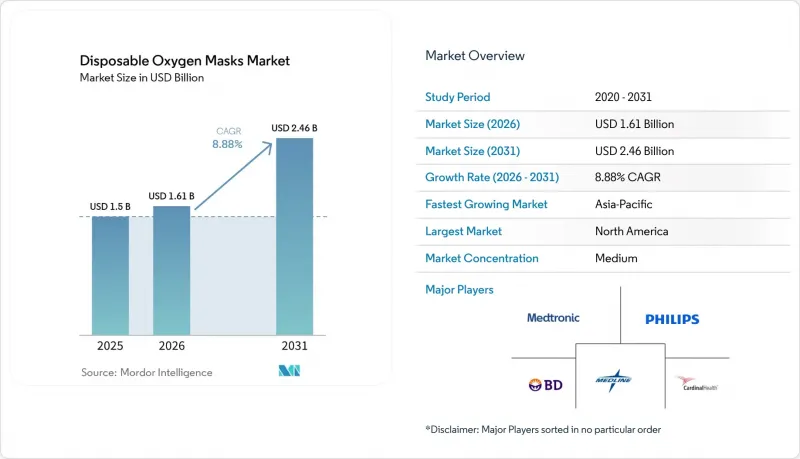
에 따르면 일회용 산소 마스크 시장 규모는 2025년에 15억 달러로 평가되며, 2026년 16억 1,000만 달러에서 2031년까지 24억 6,000만 달러에 달할 것으로 예측되며, 예측 기간(2026-2031년) 동안 CAGR은 8.88%가 될 전망입니다.
전 세계 일회용 산소 마스크 시장의 동향 및 인사이트
호흡기 질환의 증가와 급성기 의료에 대한 수요 증가
만성 호흡기 질환으로 인해 급성기 및 장기 요양 현장에서 산소 공급용 인터페이스에 대한 지속적인 수요가 발생하고 있습니다. 2023년, 전 세계적으로 만성 호흡기 질환 유병자 수는 5억 6,920만 명, 사망자 수는 420만 명에 달했으며, 그중 COPD(만성 폐쇄성 폐질환)로 인한 사망자 수는 340만 명이었습니다. COPD는 사망 원인 3위로 지목되고 있으며, 이는 산소 요법에 대한 지속적인 임상적 필요성을 뒷받침합니다. WHO 동남아시아 지역에서는 COPD로 인한 사망 원인 순위가 2000년 7위에서 2021년 4위로 상승했습니다. 이러한 변화로 인해 더 많은 잠재적 수요가 일회용 호흡기 소모품에 대한 표준화된 조달 시스템을 아직 구축 중인 의료 시스템으로 이동하고 있습니다. 여기에는 병원이나 지역사회를 불문하고, 임상 기준, 예측 가능한 재고 보충, 지역 유통 역량, 그리고 공공 예산의 한계를 균형 있게 고려해야 하는 조달 과정이 포함됩니다. 따라서 일회용 산소 마스크 시장은 확립된 병원의 수요와 저·중소득 국가에서 발전 중인 호흡기 치료 역량 모두와 관련이 있습니다.
가정 산소 요법의 확대
메디케어(Medicare)의 재택 산소 요법 적용 범위는 특정 임상 상황에서 표준 저산소혈증 기준치를 초과하여 적용될 수 있으며, 이를 통해 입원 시설 밖에서의 치료가 지원되고 있습니다. 이러한 환경에서는 병원의 간헐적인 일괄 발주 주기가 아닌, 환자와 공급업체가 정기적인 재고를 관리하기 때문에 이용 패턴이 변화합니다. 그 결과, 서비스의 연속성, 배송 조정, 그리고 즉시 이용 가능한 교체용 제품은 전국의 재택 간호 이용자들이 매일 중단 없이 일상적인 간호를 수행하는 데 있어 중요한 요소가 되고 있습니다. 재택 간호 시장은 2031년까지 연평균 성장률(CAGR) 8.8%로 확대될 것으로 예상되며, 일회용 산소 마스크 시장에서 가장 빠르게 성장하는 최종사용자 환경이 될 전망입니다. 택배 서비스 및 내구성 의료기기 유통 채널을 활용함으로써 매일 산소 요법을 이용하는 분들의 교체용 제품 구매를 보다 정기적으로 만들 수 있습니다. 인도와 중국의 공공 지원 케어 프로그램은 재택 호흡 케어에 대한 추가적인 잠재 수요층을 창출하고 있지만, 조달 관행은 지역에 따라 다릅니다. 이러한 변화로 인해 일회용 산소 마스크 시장에 진출하는 공급업체에게는 제품 조달과 마찬가지로 판매 채널 운영이 중요해지고 있습니다. 배송 일정, 처방전 서류 절차, 환자 교육, 의료용 내구성 기기 공급업체와의 연계 등이 제품이 사용자에게 제때 전달되는지에 영향을 미치기 때문입니다.
비강 캐뉼라 및 고유량 비강 캐뉼라 시스템을 통한 대체
급성 호흡 부전 환자를 대상으로 하는 모니터링 환경에서 고유량 비강 캐뉼라의 사용이 증가하고 있습니다. 미국의 대규모 의료 시스템에서 사용 건수는 2017년 초월 176건에서 2024년 말에는월 269건으로 증가했습니다. 이 치료법은 가습된 고유량 산소가 필요한 중환자실이나 스텝다운 병동에서 기존의 마스크와 가장 직접적으로 경쟁하고 있습니다. 이러한 환경에서는 임상 목표, 모니터링 자원 및 인력 배치 모델이 표준 응급실, 병동 또는 재택 간호 상황에서 일반적으로 수행되는 것보다 더 복잡한 형태의 호흡 중재를 지원할 수 있기 때문입니다. 2025년 연구에 따르면, 장비 비용, 유량 조절 요건, 그리고 치료 실패 인식 지연에 대한 우려로 인해, 감시 구역 외의 병동에서의 사용은 여전히 제한적인 것으로 나타났습니다. 표준 마스크는 신속한 설치와 저렴한 비용이 중시되는 응급실, 외과 치료, 일반 병동 및 외래 진료에서 여전히 실용적인 가치를 가지고 있습니다. 이러한 제약은 일회용 산소 마스크 시장 전체라기보다는 중증도가 높은 진료 현장에 집중되어 있습니다. 이는 의료진이 익숙한 인터페이스를 필요로 하고, 필요한 장비나 설치 시간, 전문적인 모니터링이 최소화되는 상황에서는 기존 마스크가 도입하기 더 쉽기 때문입니다.
부문 분석
2026년, 간이 산소 마스크는 일회용 산소 마스크 시장 점유율의 38.5%를 차지하며, 제품 유형 중 가장 큰 점유율을 기록했습니다. 병원에서는 비상 시 대비, 일상적인 산소 공급, 그리고 여러 병동에 걸친 프로토콜에 대응하기 위해 이러한 마스크를 대량으로 비축하고 있습니다. 친숙한 디자인과 도입 부담이 적다는 점이 의료 기관의 안정적인 구매를 뒷받침하고 있습니다. 리브리저식 마스크는 흡입 가스의 재순환이 임상적으로 적절한 용도에 대응합니다. 벤츄리식 마스크는 보다 정밀한 흡입 산소 분획 제어가 필요한 경우에 사용되며, 제어되지 않은 산소 공급이 임상적 위험을 초래할 수 있는 COPD(만성 폐쇄성 폐질환) 치료 등이 포함됩니다. 특수 용도 마스크는 더욱 차별화된 기능에 대한 수요를 반영하여, 2031년까지 연평균 성장률(CAGR) 7.8%로 성장할 것으로 예측됩니다.
특수 사양 제품에는 이산화탄소 모니터링 포트가 장착된 제품, 에어로졸과 산소의 병용 기능을 갖춘 제품, 마취 후 관리를 위한 스캐빈징 기능을 갖춘 제품 등이 포함됩니다. 특수 마스크용 일회용 산소 마스크 시장 규모는 단일 인터페이스로 개별 모니터링 및 공급 공정을 대체할 수 있는 경우 혜택을 볼 것입니다. Vyaire Medical사의 ‘AirLife Open Et’ 마스크는 호기 말 이산화탄소 모니터링 기능을 통합한 일회용 저유량 산소 마스크로, 2024년 11월 FDA의 510(k) 승인을 획득했습니다. 이러한 설계는 약물 목록의 복잡성을 줄이고 일관된 임상 설정을 지원하기 때문에 조달 담당 팀에게 선호될 가능성이 있습니다. Intersurgical사는 2026년에 발표된 동료 심사 연구에서 자사의 ‘EcoLite’ 고농도 마스크가 표준화된 매개변수 하에서 기존 비교 대상 제품보다 15-27% 더 높은 산소 농도를 공급했다고 보고했습니다. 이 조사에서는 그 결과가 일방향 밸브의 기능, 리저버 백의 용량, 그리고 안면 밀착성 향상 때문이라고 결론지었으며, 이는 호흡 치료 팀이 산소 공급의 일관성, 환자에 대한 착용감, 기기의 기능성, 통합 설계의 운영상 가치를 비교할 때, 임상적 근거가 특수 마스크 선정에 어떻게 영향을 미칠 수 있는지를 보여줍니다.
2026년 시점에서 PVC는 비용 측면의 우위와 입증된 제조 능력을 바탕으로 일회용 산소 마스크 시장의 58.4% 점유율을 차지했습니다. 공급업체와 의료 분야 구매 담당자들은 PVC의 가공 특성 및 성능 특성에 익숙하기 때문에 표준 산소 마스크 설계에 여전히 널리 사용되고 있습니다. 또한 PVC는 안정적인 공급과 비용 관리를 우선시하는 의료 기관의 입찰에서 대량 생산에도 대응할 수 있습니다. 실리콘은 2031년까지 연평균 성장률(CAGR) 8.2%로 확대될 것으로 예측됩니다. 이는 장시간 착용에 대한 내구성, 신생아용, 또는 환자와의 접촉과 관련된 사양으로 인해 서로 다른 소재 특성이 요구되는 상황에서 사용됩니다. 이 부문은 모든 마스크 설계에서 PVC가 급속히 대체되는 것보다는 점진적인 소재 전환을 반영하고 있습니다. 이는 제조업체가 소재의 성능을 검증하고, 적절한 생산능력을 유지하며, 기존 구매자에 대한 공급을 확보하고, 지역별 상이한 규정 준수 요건을 충족해야 하기 때문입니다.
유럽연합 집행위원회는 규정(EU) 2023/2482에 따라 의료기기에서 DEHP의 단계적 폐지 기한을 2030년 7월 1일까지 연장했습니다. 이 기한은 유럽에서 판매되는 제품에 기존의 DEHP 가소화 PVC를 사용하는 제조업체를 위한 규정 준수 대응 기간을 정의하는 것으로, 규제 적용이 임박하기 전에 소재 적합성 평가, 기술 문서, 제조 검증, 공급업체의 준비 상황 및 제품 변경 시기에 대해 검토해야 합니다. 각 제조사가 해당 기한까지 대체 재료의 인증을 진행함에 따라, 실리콘 재질의 일회용 산소 마스크 시장 규모는 확대될 가능성이 있습니다. 북미의 공급업체들은 서로 다른 규제 환경에서 사업을 전개하고 있지만, 캘리포니아주에서는 2030년부터 더 엄격한 요건이 적용됩니다. 의료용 실리콘은 수직 통합형 소수의 공급업체 그룹에 의해서만 생산되기 때문에 원료 공급은 중요한 과제가 됩니다. 고무 및 기타 엘라스토머는 표준 PVC의 경제성이나 실리콘의 사양이 소재 선정의 결정 요인이 되지 않는 소규모 특수 용도에서 여전히 중요한 역할을 하고 있으며, 특정 착용감, 성능 또는 용도 요건을 가진 설계에 대해 공급업체는 제한적이긴 하지만 안정적인 선택지를 제공하고 있습니다.
지역별 분석
2025년, 북미는 일회용 산소 마스크 시장 점유율의 35.4%를 차지했습니다. 이 지역에서는 병원의 수용 능력, 메디케어(Medicare)에 의한 재택 산소 요법 급여, 그리고 환자 1인당 사용량을 뒷받침하는 일회용 요구 사항이 결합되어 있으며, 확립된 공급자 네트워크, 구매 조직, 내구성 의료기기 유통 채널이 결합되어 공급업체가 병원의 수요와 재택 산소 요법 이용자의 지속적인 요구를 모두 충족할 수 있는 환경을 조성하고 있습니다. 미국 병원 신축 착공액은 2024년에 339억 달러에 달했으며, 2026년에는 307억 달러에 달할 것으로 예측됩니다. 신규 시설은 개원 전에 약품 목록과 공급 계약을 수립하기 때문에 향후 호흡기용 소모품 수요를 뒷받침하는 요인이 됩니다. 캐나다에서는 기존 계약 공급업체를 우선시하는 주 정부의 조달을 통해 수요가 확대되고 있습니다. 멕시코에서는 IMSS 병원 네트워크의 확장이 수요의 원천이 되고 있으며, 해당 네트워크 내 시설 활동의 증가는 일상적인 급성기 의료용 호흡기 소모품에 대한 지역적 수요 기반을 확대하고, 표준 산소 공급 인터페이스의 조달을 촉진할 가능성이 있습니다.
유럽은 두 번째로 큰 지역 시장이며, 독일, 영국, 프랑스에서는 국가 병원 공급 계약 및 재택 산소 요법 프로그램을 통해 시장이 뒷받침되고 있습니다. 이 지역의 조달 시스템에 따라 일회용 산소 마스크 시장에서는 가격, 규정 준수, 그리고 안정적인 공급이 중요시되고 있습니다. 아시아태평양은 2031년까지 연평균 성장률(CAGR) 8.1%로 성장할 것으로 예상되며, 이는 지역별 성장률 중 가장 높은 수치입니다. WHO 동남아시아 지역의 사망 원인 중 12%는 만성 호흡기 질환에 기인합니다. 중국은 이 지역 최대의 시장인 반면, 인도에서는 의료비 보조 및 현지 의료기기 제조 촉진 정책이 시장을 뒷받침하고 있습니다. 일본, 한국, 호주에서는 고령화, 보조금 제도, 규제 요건에 의해 형성된 보다 성숙한 재택 호흡기 치료 수요가 존재합니다. 이에 따라 확립된 품질 기준을 충족하고 체계적인 치료 채널을 통해 재택 환자에게 서비스를 제공할 수 있는 공급업체가 유리한 입지를 차지할 가능성이 있습니다.
중동 및 아프리카에서는 수요 추세가 엇갈리고 있습니다. 사우디아라비아와 아랍에미리트(UAE)에서는 규정을 준수하는 일회용 호흡기 제품이 필요한 병원 인프라가 잘 갖춰져 있습니다. 남아프리카공화국 및 기타 사하라 이남 시장에서는 의료 기관의 수용 능력이 낮지만, 급성기 의료 프로그램이나 비상 비축 물자를 통해 수요를 창출할 수 있습니다. 남미는 브라질과 아르헨티나에 집중되어 있으며, 이들 국가에서는 공공 의료 시스템이 비용 중심의 조달 예산 하에서 COPD 및 천식에 대한 막대한 수요를 충족시키고 있습니다. 브라질의 호흡기 관리 프로그램에서는 여전히 저비용의 간이 마스크를 중심으로 한 수요가 지탱되고 있습니다. 신흥 시장에서는 합리적인 가격의 제품이라 하더라도 적절한 서류, 일관된 품질, 그리고 신뢰할 수 있는 현지 공급 체계를 바탕으로 병원 및 지역 의료 현장에 공급되어야 하므로, 일회용 산소 마스크 시장에서는 규제 준수, 비용 관리, 그리고 충분한 유통망을 모두 갖춘 공급업체가 우위를 점하게 됩니다.
기타 혜택:
- 엑셀 형식의 시장 예측(ME) 시트
- 3개월간의 애널리스트 지원
자주 묻는 질문
목차
제1장 소개
- 조사 가정과 시장 정의
- 조사 범위
제2장 조사 방법
제3장 주요 요약
제4장 시장 구도
- 시장 개요
- 시장 성장 촉진요인
- 시장 성장 억제요인
- 가치 및 공급망 분석
- 규제 상황
- 기술 전망
- Porter's Five Forces 분석
제5장 시장 규모와 성장 예측, 금액 및 수량
- 제품 유형별 세분화
- 소재별 세분화
- 용도별 세분화
- 최종사용자별 세분화
- 유통 채널별 세분화
- 지역별 세분화
- 북미
- 미국
- 캐나다
- 멕시코
- 유럽
- 독일
- 영국
- 프랑스
- 이탈리아
- 스페인
- 기타 유럽 국가
- 아시아태평양
- 중국
- 일본
- 인도
- 한국
- 호주
- 기타 아시아태평양 국가
- 중동 및 아프리카
- GCC
- 남아프리카공화국
- 기타 중동 및 아프리카 국가
- 남미
- 브라질
- 아르헨티나
- 기타 남미 국가
- 북미
제6장 경쟁 구도
- 시장 집중도
- 전략적 동향
- 시장 점유율 분석
- 기업 개요
- Medline Industries, LP
- Teleflex Incorporated
- Intersurgical Ltd.
- Flexicare(Group) Limited
- Dynarex Corporation
- VYAIRE MEDICAL, INC.
- Ambu A/S
- Drive DeVilbiss Healthcare
- Besmed Health Business Corp.
- HEYER Medical AG
- BLS Systems Limited
- Cardinal Health, Inc.
- Becton, Dickinson and Company
- ICU Medical, Inc.
- Dragerwerk AG and Co. KGaA
- Fisher and Paykel Healthcare Limited
- Polymed Medical Devices
- GaleMed Corporation
- PFM medical AG
- Airways Surgical Pvt. Ltd.
- Armstrong Medical Ltd.
- Mercury Medical
- SunMed, LLC
- Convatec Group PLC
- ZOLL Medical Corporation
- Masimo Corporation
- Koninklijke Philips N.V.
- Medtronic plc
- ResMed Inc.
제7장 시장 기회와 향후 전망
KSM 26.10.29According to Mordor Intelligence, the disposable oxygen masks market size was valued at USD 1.5 billion in 2025 and is estimated to grow from USD 1.61 billion in 2026 to reach USD 2.46 billion by 2031, at a CAGR of 8.88% during the forecast period (2026-2031).
Global Disposable Oxygen Masks Market Trends and Insights
Rising Respiratory Disease and Acute-Care Demand
Chronic respiratory disease creates a continuing need for oxygen delivery interfaces across acute and long-term care settings. Chronic respiratory diseases caused 569.2 million prevalent cases and 4.2 million deaths worldwide in 2023, while COPD caused 3.4 million deaths. COPD was also identified as the third leading cause of death, which supports a durable clinical need for oxygen therapy. In the WHO South-East Asia Region, COPD moved from the seventh leading cause of death in 2000 to the fourth in 2021. This change shifts more potential volume toward health systems that are still building standardized procurement systems for disposable respiratory supplies, including purchasing processes that must balance clinical standards, predictable replenishment, local distribution capacity, and public budget limits across hospital and community settings. The disposable oxygen masks market is therefore linked to both established hospital demand and the developing respiratory-care capacity of lower- and middle-income countries.
Expansion of Home-Based Oxygen Therapy
Home oxygen coverage under Medicare can apply beyond standard hypoxemia thresholds in defined clinical circumstances, which supports care outside inpatient facilities. This setting changes the pattern of use because patients and suppliers manage recurring replenishment rather than a hospital's intermittent bulk order cycle, making service continuity, delivery coordination, and readily available replacement products important parts of routine care for homecare users nationwide each day without disruption. Homecare is forecast to grow at an 8.8% CAGR through 2031, making it the fastest-growing end-user setting in the disposable oxygen masks market. Home delivery and durable medical equipment channels can make replacement purchasing more regular for people who use oxygen therapy daily. Publicly supported care programs in India and China add another potential demand layer for home respiratory care, although procurement practices differ by location. The shift makes channel execution as important as product availability for suppliers serving the disposable oxygen masks market, because delivery schedules, prescription documentation, patient education, and coordination with durable medical equipment providers influence whether a product reaches the user on time.
Substitution by Nasal Cannulas and High-Flow Nasal Cannula Systems
High-flow nasal cannula use has grown in monitored settings for people with acute respiratory failure. Episodes at large U.S. health systems rose from 176 per month in early 2017 to 269 per month by late 2024. This modality competes most directly with conventional masks in intensive-care and step-down environments that need humidified high-flow oxygen, where the clinical objective, monitoring resources, and staffing model can support a more complex form of respiratory intervention than is typically used in a standard emergency, ward, or homecare encounter. A 2025 study found that ward-based use remained limited outside monitored areas because of equipment cost, titration requirements, and concerns about delayed recognition of therapy failure. Standard masks retain practical value in emergency departments, surgical care, general wards, and ambulatory care, where rapid setup and low cost matter. The restraint is concentrated in higher-acuity locations rather than across the entire disposable oxygen masks market, because conventional masks remain easier to deploy where staff need a familiar interface that requires limited equipment, setup time, and specialized monitoring.
Other drivers and restraints analyzed in the detailed report include:
- Infection-Control Preference for Single-Use Interfaces
- Hospital and Emergency-Care Capacity Expansion
- Reimbursement and Tender-Price Pressure in Homecare
For complete list of drivers and restraints, kindly check the Table Of Contents.
Segment Analysis
Simple oxygen masks held 38.5% of the disposable oxygen masks market share in 2026, the largest position among product types. Hospitals keep these masks in large quantities for emergency readiness, routine oxygen supplementation, and multi-ward protocols. Their familiar design and low deployment burden support steady institutional purchasing. Rebreather masks address applications where recirculation of inspired gas is clinically appropriate. Venturi masks are used when more precise fraction of inspired oxygen control is required, including care for COPD where uncontrolled oxygen delivery may create clinical risk. Specialty masks are forecast to grow at a 7.8% CAGR through 2031, reflecting demand for more differentiated functions.
Specialty configurations include products with carbon dioxide monitoring ports, combined aerosol and oxygen capability, and scavenging functions for post-anesthesia care. The disposable oxygen masks market size for specialty masks benefits when a single interface can replace a separate monitoring or delivery step. Vyaire Medical's AirLife Open Et mask received FDA 510(k) clearance in November 2024 as a disposable low-flow oxygen mask that integrates end-tidal carbon dioxide monitoring. Purchasing teams can favor these designs because they reduce formulary complexity and support consistent clinical setups. Intersurgical reported a 2026 peer-reviewed study in which its EcoLite high-concentration mask delivered 15-27% higher oxygen concentrations than a conventional comparator under standardized parameters. The study attributed the result to one-way valve function, reservoir-bag volume, and improved facial seal, showing why clinical evidence can influence specialty-mask decisions when respiratory therapy teams compare oxygen-delivery consistency, patient fit, device functionality, and the operational value of an integrated design.
PVC held 58.4% of the disposable oxygen masks market share in 2026, supported by cost advantages and validated manufacturing capacity. It remains widely used for standard oxygen-mask designs because suppliers and healthcare buyers are familiar with its processing and performance characteristics. PVC also supports high-volume production for institutional tenders that prioritize dependable supply and cost control. Silicone is forecast to expand at an 8.2% CAGR through 2031. It is used where extended-wear tolerance, neonatal use, or patient-contact specifications require a different material profile. The segment reflects a gradual material shift rather than a rapid replacement of PVC across all mask designs, since manufacturers must validate material performance, retain appropriate production capacity, maintain availability for existing buyers, and meet different regional compliance expectations.
The European Commission extended the DEHP sunset date for medical devices to July 1, 2030 under Regulation (EU) 2023/2482. This deadline defines a compliance window for producers that use legacy DEHP-plasticized PVC in products sold in Europe, requiring them to consider material qualification, technical documentation, manufacturing validation, supplier readiness, and the timing of product changes before the regulatory horizon becomes more immediate. The disposable oxygen masks market size for silicone may gain support as manufacturers qualify alternative materials before that date. North American suppliers work under a different regulatory context, while California has stricter requirements beginning in 2030. Input supply is important because medical-grade silicone is produced by a limited group of vertically integrated suppliers. Rubber and other elastomers remain relevant in smaller specialty uses where neither standard PVC economics nor silicone specifications determine the material choice, giving suppliers a limited but stable option for designs with particular fit, performance, or application requirements.
Complete Report Scope:
- Segmentation by Product Type
- Simple Oxygen Masks
- Rebreather Masks
- Venturi Masks
- Specialty Oxygen Masks
- Segmentation by Material
- Polyvinyl Chloride
- Silicone
- Others (Rubber and Elastomer)
- Segmentation by Application
- Respiratory Disorders
- Emergency & Critical Care
- Surgical Care
- Aerosol Therapy
- Segmentation by End User
- Hospitals & Clinics
- Homecare
- Emergency Services
- Other Healthcare Facilities
- Segmentation by Distribution Channel
- Direct Sales
- Retail
- Online Stores
- Segmentation by Geography
- North America
- United States
- Canada
- Mexico
- Europe
- Germany
- United Kingdom
- France
- Italy
- Spain
- Rest of Europe
- Asia-Pacific
- China
- Japan
- India
- South Korea
- Australia
- Rest of Asia-Pacific
- Middle East and Africa
- GCC
- South Africa
- Rest of Middle East and Africa
- South America
- Brazil
- Argentina
- Rest of South America
- North America
Geography Analysis
North America held 35.4% of the disposable oxygen masks market share in 2025. The region combines hospital capacity, Medicare home-oxygen coverage, and single-use requirements that support consumption per patient encounter, while its established provider networks, purchasing organizations, and durable medical equipment channels create a setting in which suppliers can serve both hospital demand and the recurring needs of home-based oxygen users. U.S. hospital construction starts reached USD 33.9 billion in 2024 and are projected at USD 30.7 billion in 2026. New facilities establish formularies and supply agreements before opening, which can support future respiratory-consumable demand. Canada adds demand through provincial procurement that favors established contracted suppliers. Mexico contributes through expansion across the IMSS hospital network, where additional institutional activity can broaden the regional demand base for routine acute-care respiratory supplies and support procurement of standard oxygen-delivery interfaces.
Europe is the second-largest regional setting, with Germany, the United Kingdom, and France supported by national hospital supply contracts and home-oxygen programs. The region's procurement systems make price, compliance, and dependable supply important to the disposable oxygen masks market. Asia-Pacific is forecast to grow at an 8.1% CAGR through 2031, the fastest regional rate. Chronic respiratory diseases account for 12% of deaths in the WHO South-East Asia Region. China is the region's largest national setting, while India is supported by subsidized care and local medical-device manufacturing measures. Japan, South Korea, and Australia have more mature home-respiratory-care needs shaped by aging populations, subsidy programs, and regulatory requirements, which can favor suppliers able to meet established quality expectations and serve home-based patients through organized care channels.
The Middle East and Africa has a split demand profile. Saudi Arabia and the United Arab Emirates are building hospital infrastructure that requires compliant single-use respiratory products. South Africa and other sub-Saharan markets have less institutional capacity but can generate demand through acute-care programs and emergency stockpiles. South America is concentrated in Brazil and Argentina, where public systems manage substantial COPD and asthma needs under cost-sensitive purchasing budgets. Brazil's respiratory-care programs support volumes that remain focused on lower-cost simple masks. In emerging settings, the disposable oxygen masks market favors suppliers that can combine compliance, cost control, and sufficient distribution coverage, since affordable products must still reach hospitals and community settings with appropriate documentation, consistent quality, and dependable local supply.
- Medline Industries
- Teleflex
- Intersurgical Ltd.
- Flexicare
- Dynarex
- VYAIRE MEDICAL, INC.
- Ambu
- Drive DeVilbiss Healthcare
- Besmed Health Business
- HEYER Medical AG
- BLS Systems Limited
- Cardinal Health
- Beckton Dickinson
- ICU Medical
- Dragerwerk AG and Co. KGaA
- Fisher & Paykel Healthcare
- Polymed Medical Devices
- GaleMed Corporation
- PFM medical AG
- Airways Surgical Pvt. Ltd.
- Armstrong Medical Ltd.
- Mercury Medical
- SunMed, LLC
- Convatec
- Zoll Medical
- Masimo
- Koninklijke Philips
- Medtronic
- Resmed
Additional Benefits:
- The market estimate (ME) sheet in Excel format
- 3 months of analyst support
TABLE OF CONTENTS
1 INTRODUCTION
- 1.1 Study Assumptions and Market Definition
- 1.2 Scope of the Study
2 RESEARCH METHODOLOGY
3 EXECUTIVE SUMMARY
4 MARKET LANDSCAPE
- 4.1 Market Overview
- 4.2 Market Drivers
- 4.2.1 Rising Respiratory Disease and Acute-Care Demand
- 4.2.2 Expansion of Home-Based Oxygen Therapy
- 4.2.3 Infection-Control Preference for Single-Use Interfaces
- 4.2.4 Hospital and Emergency-Care Capacity Expansion
- 4.2.5 Interoperable Masks That Reduce Flow-Setting and Device-Switching Errors
- 4.2.6 Procurement Demand for Low-Inventory, Multi-Configuration Mask Kits
- 4.3 Market Restraints
- 4.3.1 Substitution by Nasal Cannulas and High-Flow Nasal Cannula Systems
- 4.3.2 Reimbursement and Tender-Price Pressure in Homecare
- 4.3.3 Material-Transition and Medical-Grade Resin Supply Exposure
- 4.3.4 Fit, Seal, and Oxygen-Concentration Variability in Real-World Use
- 4.4 Value and Supply-Chain Analysis
- 4.5 Regulatory Landscape
- 4.6 Technological Outlook
- 4.7 Porters Five Forces Analysis
- 4.7.1 Bargaining Power of Suppliers
- 4.7.2 Bargaining Power of Buyers
- 4.7.3 Threat of New Entrants
- 4.7.4 Threat of Substitutes
- 4.7.5 Competitive Rivalry
5 MARKET SIZE AND GROWTH FORECASTS, VALUE AND VOLUME
- 5.1 Segmentation by Product Type
- 5.1.1 Simple Oxygen Masks
- 5.1.2 Rebreather Masks
- 5.1.3 Venturi Masks
- 5.1.4 Specialty Oxygen Masks
- 5.2 Segmentation by Material
- 5.2.1 Polyvinyl Chloride
- 5.2.2 Silicone
- 5.2.3 Others (Rubber and Elastomer)
- 5.3 Segmentation by Application
- 5.3.1 Respiratory Disorders
- 5.3.2 Emergency & Critical Care
- 5.3.3 Surgical Care
- 5.3.4 Aerosol Therapy
- 5.4 Segmentation by End User
- 5.4.1 Hospitals & Clinics
- 5.4.2 Homecare
- 5.4.3 Emergency Services
- 5.4.4 Other Healthcare Facilities
- 5.5 Segmentation by Distribution Channel
- 5.5.1 Direct Sales
- 5.5.2 Retail
- 5.5.3 Online Stores
- 5.6 Segmentation by Geography
- 5.6.1 North America
- 5.6.1.1 United States
- 5.6.1.2 Canada
- 5.6.1.3 Mexico
- 5.6.2 Europe
- 5.6.2.1 Germany
- 5.6.2.2 United Kingdom
- 5.6.2.3 France
- 5.6.2.4 Italy
- 5.6.2.5 Spain
- 5.6.2.6 Rest of Europe
- 5.6.3 Asia-Pacific
- 5.6.3.1 China
- 5.6.3.2 Japan
- 5.6.3.3 India
- 5.6.3.4 South Korea
- 5.6.3.5 Australia
- 5.6.3.6 Rest of Asia-Pacific
- 5.6.4 Middle East and Africa
- 5.6.4.1 GCC
- 5.6.4.2 South Africa
- 5.6.4.3 Rest of Middle East and Africa
- 5.6.5 South America
- 5.6.5.1 Brazil
- 5.6.5.2 Argentina
- 5.6.5.3 Rest of South America
- 5.6.1 North America
6 COMPETITIVE LANDSCAPE
- 6.1 Market Concentration
- 6.2 Strategic Moves
- 6.3 Market Share Analysis
- 6.4 Company Profiles (includes Global Level Overview, Market Level Overview, Core Segments, Financials as available, Strategic Information, Market Rank/Share, Products and Services, Recent Developments)
- 6.4.1 Medline Industries, LP
- 6.4.2 Teleflex Incorporated
- 6.4.3 Intersurgical Ltd.
- 6.4.4 Flexicare (Group) Limited
- 6.4.5 Dynarex Corporation
- 6.4.6 VYAIRE MEDICAL, INC.
- 6.4.7 Ambu A/S
- 6.4.8 Drive DeVilbiss Healthcare
- 6.4.9 Besmed Health Business Corp.
- 6.4.10 HEYER Medical AG
- 6.4.11 BLS Systems Limited
- 6.4.12 Cardinal Health, Inc.
- 6.4.13 Becton, Dickinson and Company
- 6.4.14 ICU Medical, Inc.
- 6.4.15 Dragerwerk AG and Co. KGaA
- 6.4.16 Fisher and Paykel Healthcare Limited
- 6.4.17 Polymed Medical Devices
- 6.4.18 GaleMed Corporation
- 6.4.19 PFM medical AG
- 6.4.20 Airways Surgical Pvt. Ltd.
- 6.4.21 Armstrong Medical Ltd.
- 6.4.22 Mercury Medical
- 6.4.23 SunMed, LLC
- 6.4.24 Convatec Group PLC
- 6.4.25 ZOLL Medical Corporation
- 6.4.26 Masimo Corporation
- 6.4.27 Koninklijke Philips N.V.
- 6.4.28 Medtronic plc
- 6.4.29 ResMed Inc.
7 MARKET OPPORTUNITIES AND FUTURE OUTLOOK
- 7.1 White-Space and Unmet-Need Assessment


