

|
시장보고서
상품코드
2154814
여성용 골반 임플란트 : 시장 점유율 분석, 업계 동향과 통계, 성장 예측(2026-2031년)Female Pelvic Implants - Market Share Analysis, Industry Trends & Statistics, Growth Forecasts (2026 - 2031) |
||||||
 Mordor Intelligence
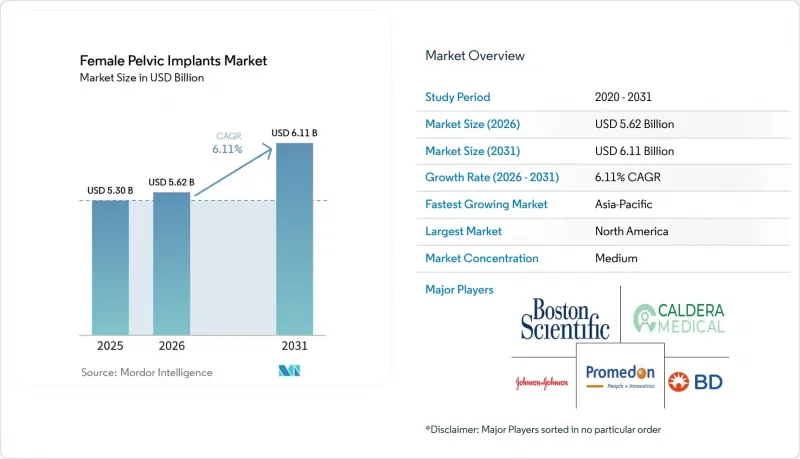
에 따르면 여성용 골반 임플란트 시장 규모는 2025년에 53억 달러로 평가되며, 2026년 56억 2,000만 달러에서 2031년까지 61억 1,000만 달러에 달할 것으로 예측되며, 예측 기간(2026-2031년) 동안 CAGR은 6.11%가 될 전망입니다.
전 세계 여성용 골반 임플란트 시장의 동향 및 인사이트
골반 장기 탈출증 및 복압성 요실금의 유병률 증가
골반 장기 탈출증 및 스트레스성 요실금은 여성용 골반 임플란트 시장에서 지속적인 임상적 수요를 창출하고 있습니다. 인구 증가와 고령화에 따라 그 절대적인 부담은 커지고 있습니다. 2025년 분석에 따르면, 미국 여성의 11%가 79세가 될 때까지 골반 장기 탈출증 또는 요실금 수술을 받는 것으로 보고되었습니다. 또한, 이들 환자 중 29.2%가 이후 재수술이 필요한 것으로 보고되었습니다. 유럽비뇨기과학회(EAU)의 매핑 조사에서는 복압성 요실금이 유병률이 가장 높은 아형으로 확인되었으며, 응답자의 39.1%가 이를 앓고 있는 것으로 나타났습니다. 신규 진단과 재수술 수요가 합쳐져 수술 건수 수요를 뒷받침하고 있습니다.
최소침습 외래 수술의 보급 확대
외래 수술은 여성용 골반 임플란트 시장에서 중요한 의료 현장으로 확대되고 있습니다. 메디케어·메디케이드 서비스 센터(CMS)는 2026년 최종 지급 규정에 따라 ASC(외래 수술 센터) 대상 시술 목록에 573개의 코드를 추가했습니다. 이를 통해 대상 외래 수술에 대한 보험 지급 기반이 더욱 공고해질 것입니다. 수술 시간 단축과 당일 퇴원을 가능하게 하는 슬링 시스템은 이러한 환경에서 유리한 입장에 있습니다. 복잡한 재건 수술이나 세심한 경과 관찰이 필요한 환자의 경우, 병원이 계속해서 중요한 역할을 수행할 것입니다. 공급업체는 외래 수술 센터에 적합한 교육, 재고 관리 및 보험 급여 지원을 제공해야 합니다.
메시 관련 합병증 및 재수술 위험
메시 침식, 만성 골반통, 성교통 및 감염은 여성용 골반 임플란트 시장의 의사결정에 계속해서 영향을 미치고 있습니다. 2025년 리뷰에 따르면, 자가 조직을 이용한 복원술의 재발률은 33%인 것으로 보고되었습니다. 이로 인해 임상의들은 재발 위험과 메시 관련 합병증 사이의 균형을 고려할 수밖에 없게 되었습니다. FDA는 새로운 기술적 특징을 갖춘 미니 슬링에 대해 섹션 522에 근거한 시판 후 조사를 의무화하고 있습니다. 이러한 요건은 장기적인 임상 추적 조사를 유지할 수 있는 기업에 유리하게 작용합니다. 또한, 문서화된 안전성과 생체적합성의 중요성도 더욱 높아지고 있습니다.
부문 분석
2025년 기준, 질 메시 임플란트는 여성용 골반 임플란트 시장 점유율의 45.65%를 차지했습니다. 이러한 위상은 스트레스성 요실금 수술에서 그 사용이 정착되었음을 반영합니다. 치골 후방 및 폐쇄공 경로 설계는 특정 환자에 대해 임상적으로 인정받는 선택지로 남아 있습니다. 질용 슬링 임플란트는 2031년까지 연평균 성장률(CAGR) 8.54%로 성장할 것으로 예측됩니다. 단일 절개 시스템은 외래 진료로의 전환이라는 추세에 부합합니다.
질용 이식편은 골반 장기 탈출증의 재건 및 복잡한 수복에 사용됩니다. 이식편과 관련된 여성용 골반 임플란트 시장 규모에 대해서는 별도로 공개되지 않았습니다. 생체 유래 및 합성 이식편은 각각 서로 다른 임상적 요구를 충족시킵니다. BioSynIRS 임상시험은 다구획 재건에 관한 12개월간의 비교 데이터를 제시하고 있습니다. Promedon사의 Ancoris와 같은 메시를 사용하지 않는 고정 제품은 경질 메시를 사용하지 않고 상부 복원에 대응합니다.
2025년에는 폴리프로필렌 메시가 51.76%의 점유율을 차지했습니다. 이는 확립된 공급 체계, 임상 현장에서의 익숙함, 그리고 저비용이라는 장점 덕분입니다. 대량으로 시행되는 슬링 수술 프로그램에서는 여전히 널리 사용되고 있습니다. 코팅된 폴리프로필렌 메시에 대한 연구에 따르면, 소재의 개선을 통해 임플란트와 조직 간의 상호작용을 향상시킬 수 있음이 시사되고 있습니다. 기존 공급업체들은 규제 요건 및 임상 데이터가 이미 마련되어 있다는 점에서도 이점을 누리고 있습니다.
PVDF 메시는 2031년까지 연평균 성장률(CAGR) 7.87%로 성장할 것으로 예측됩니다. 이 메시는 이식 후 열화에 대한 내성이 높은 것이 특징입니다. 다만, 비용이 높기 때문에 전문 시설 이외의 곳에서는 채택이 제한적일 가능성이 있습니다. 생체 이식편은 재수술이나 복잡한 다구획 사례에서 중요한 역할을 하고 있습니다. 흡수성 재료나 복합재료의 경우, 보다 광범위한 보급을 위해서는 장기적인 내구성에 대한 증거가 필요합니다.
지역별 분석
2025년, 북미는 여성용 골반 임플란트 시장 점유율의 42.43%를 차지했습니다. 유리한 보험 환급 제도, 전문의 확보, 그리고 로봇 수술 인프라가 이 지역을 뒷받침하고 있습니다. 미국은 국가별 시장 중 가장 큰 규모를 차지합니다. 보스턴 사이언티피크(Boston Scientific)와 AUGS는 골반저 관리와 관련된 2026년 코딩 및 보험 환급에 관한 자료를 제공하고 있습니다. 2025년에 Gynecare의 TVT 제품 포트폴리오가 Caldera Medical로 양도된 것도 미국 슬링 부문의 경쟁 환경에 변화를 가져왔습니다.
유럽은 지역별 기여도에서 두 번째로 큰 비중을 차지하고 있습니다. 독일, 영국, 프랑스, 이탈리아, 스페인이 매출의 대부분을 차지하고 있습니다. 제공된 2025년 데이터에 따르면, 독일은 자궁 탈출증으로 인한 장애 조정 생명년(DALY) 비율이 10만 명당 21.13으로 가장 높은 수치를 기록했습니다. 규정 2017/745 및 유럽 의약품 안전성 모니터링 지침에 따라 임상 증거 및 후속 조치에 대한 요건이 강화되었습니다.
아시아태평양은 2031년까지 연평균 성장률(CAGR) 7.43%로 성장할 것으로 예측됩니다. 일본과 한국은 고령화와 확립된 임상 기준의 혜택을 받고 있습니다. 중국과 인도에서는 도시 지역의 의료 체계가 확대됨에 따라 수술 건수가 증가할 것으로 예상됩니다. 사회적 편견, 진단 부족, 그리고 지방 지역의 전문의 접근성 제한이 여전히 장벽으로 작용하고 있습니다. 남미에서는 의뢰 네트워크와 프로메돈(Promedon)사의 아르헨티나 사업이 뒷받침되면서 시장 기반이 형성되고 있습니다.
기타 혜택:
- 엑셀 형식의 시장 예측(ME) 시트
- 3개월간의 애널리스트 지원
자주 묻는 질문
목차
제1장 소개
- 조사 가정과 시장 정의
- 조사 범위
제2장 조사 방법
제3장 주요 요약
제4장 시장 구도
- 시장 개요
- 시장 성장 촉진요인
- 시장 성장 억제요인
- 공급망 분석
- 규제 상황
- 기술 전망
- Porter's Five Forces
제5장 시장 규모와 성장 예측
- 제품 유형별
- 소재별
- 적응증별
- 최종사용자별
- 지역
제6장 경쟁 구도
- 시장 집중도
- 시장 점유율 분석
- 기업 개요
- ABISS
- American Medical Systems
- B. Braun Melsungen AG
- Betatech Medical
- Becton, Dickinson and Company
- Boston Scientific Corporation
- Caldera Medical
- Cook Medical
- Cousin Biotech
- DynaMesh/FEG Textiltechnik
- Dipromed Srl
- Johnson & Johnson Services, Inc.
- Neomedic International
- pfm medical ag
- Promedon Group
- P.M.I. GmbH
- THT bio-science
- UroCure
제7장 시장 기회와 향후 전망
KSM 26.10.29According to Mordor Intelligence, the female pelvic implants market size was valued at USD 5.30 billion in 2025 and is estimated to grow from USD 5.62 billion in 2026 to reach USD 6.11 billion by 2031, at a CAGR of 6.11% during the forecast period (2026-2031).
Global Female Pelvic Implants Market Trends and Insights
Rising Prevalence of Pelvic Organ Prolapse and Stress Urinary Incontinence
Pelvic organ prolapse and stress urinary incontinence create a durable clinical need for the female pelvic implants market. The absolute burden rises as the population grows and ages. A 2025 analysis reported that 11% of U.S. women undergo surgery for pelvic organ prolapse or urinary incontinence by age 79. It also reported that 29.2% of these patients subsequently require revision surgery. The European Association of Urology identified stress urinary incontinence as the most prevalent subtype in its mapping study, affecting 39.1% of respondents. New diagnoses and revision care together support procedure demand.
Increasing Adoption of Minimally Invasive Outpatient Procedures
Outpatient surgery is expanding an important care setting for the female pelvic implants market. The Centers for Medicare & Medicaid Services added 573 codes to the ASC Covered Procedures List in its 2026 final payment rule. This provides a stronger reimbursement basis for eligible outpatient procedures. Sling systems that support shorter procedures and same-day discharge are well positioned in this setting. Hospitals will remain important for complex repair and patients needing close monitoring. Suppliers need training, inventory, and reimbursement support that suit ambulatory surgical centers.
Mesh-Related Complications and Revision Risk
Mesh erosion, chronic pelvic pain, dyspareunia, and infection continue to affect decision making in the female pelvic implants market. A 2025 review reported a 33% relapse rate for native-tissue repair. This leaves clinicians balancing recurrence risk against mesh-related complications. The FDA requires section 522 postmarket surveillance for mini-slings with novel technological characteristics. These requirements favor companies able to maintain long-term clinical follow-up. They also increase the importance of documented safety and biocompatibility.
Other drivers and restraints analyzed in the detailed report include:
- Aging and Post-Menopausal Female Population
- Lightweight and Adjustable Implant Innovation
- Regulatory Restrictions on Transvaginal POP Mesh
For complete list of drivers and restraints, kindly check the Table Of Contents.
Segment Analysis
Vaginal mesh implants held 45.65% of the female pelvic implants market share in 2025. Their position reflects their established use in stress urinary incontinence procedures. Retropubic and transobturator designs remain clinically recognized options for selected patients. Vaginal sling implants are forecast to grow at an 8.54% CAGR through 2031. Single-incision systems fit the movement toward outpatient care.
Vaginal grafts serve pelvic organ prolapse reconstruction and complex repair. The female pelvic implants market size for grafts was not separately provided. Biologic and synthetic grafts meet different clinical needs. The BioSynIRS trial provides 12-month comparative evidence for multicompartment reconstruction. Mesh-free anchoring products such as Promedon's Ancoris address apical repair without transvaginal mesh.
Polypropylene mesh held 51.76% share in 2025. It benefits from established supply, clinical familiarity, and a lower cost profile. It remains common in high-volume sling programs. Research on coated polypropylene meshes suggests that material modification can improve implant-tissue interaction. Existing suppliers also benefit from completed regulatory and clinical documentation.
PVDF mesh is forecast to grow at a 7.87% CAGR through 2031. It is associated with greater resistance to degradation after implantation. Its cost premium can limit adoption beyond specialist centers. Biological grafts have a role in revision and complex multicompartment cases. Absorbable and composite materials require longer-term durability evidence before wider uptake.
Complete Report Scope:
- By Product Type
- Vaginal Mesh Implants
- Vaginal Sling Implants
- Vaginal Graft Implants
- Other Product Types
- By Material
- Polypropylene Mesh
- PVDF Mesh
- Biological Grafts
- Absorbable and Composite Materials
- By Indication
- Pelvic Organ Prolapse (POP)
- Stress Urinary Incontinence (SUI)
- Mixed Urinary Incontinence
- By End-User
- Hospitals
- Ambulatory Surgical Centers (ASCs)
- Specialty Clinics
- Geography
- North America
- United States
- Canada
- Mexico
- Europe
- Germany
- United Kingdom
- France
- Italy
- Spain
- Rest of Europe
- Asia-Pacific
- China
- Japan
- India
- Australia
- South Korea
- Rest of Asia-Pacific
- Middle East and Africa
- GCC
- South Africa
- Rest of Middle East and Africa
- South America
- Brazil
- Argentina
- Rest of South America
- North America
Geography Analysis
North America held 42.43% of the female pelvic implants market share in 2025. Favorable reimbursement, specialist capacity, and robotic surgical infrastructure support the region. The United States is the largest country market. Boston Scientific and AUGS provide 2026 coding and reimbursement resources for pelvic floor care. The 2025 Gynecare TVT portfolio transfer to Caldera Medical also changed competition in the U.S. sling category.
Europe is the second-largest regional contributor. Germany, the United Kingdom, France, Italy, and Spain account for much of its revenue. Germany recorded the highest uterine prolapse disability-adjusted life year rate in the supplied 2025 evidence at 21.13 per 100,000. Regulation 2017/745 and the European vigilance guidance increase requirements for clinical evidence and follow-up.
Asia-Pacific is forecast to grow at a 7.43% CAGR through 2031. Japan and South Korea benefit from aging populations and established clinical standards. China and India offer procedure growth as urban healthcare capacity expands. Social stigma, underdiagnosis, and limited rural specialist access remain barriers. South America has an emerging base supported by referral networks and Promedon's Argentine operations.
- ABISS
- American Medical Systems
- B. Braun
- Betatech Medical
- Beckton Dickinson
- Boston Scientific
- Caldera Medical
- Cook Group
- Cousin Biotech
- DynaMesh / FEG Textiltechnik
- Dipromed
- Johnson & Johnson
- Neomedic International
- pfm medical
- Promedon Group
- P.M.I. GmbH
- THT bio-science
- UroCure
Additional Benefits:
- The market estimate (ME) sheet in Excel format
- 3 months of analyst support
TABLE OF CONTENTS
1 Introduction
- 1.1 Study Assumptions & Market Definition
- 1.2 Scope Of The Study
2 Research Methodology
3 Executive Summary
4 Market Landscape
- 4.1 Market Overview
- 4.2 Market Drivers
- 4.2.1 Rising Prevalence of Pelvic Organ Prolapse and Stress Urinary Incontinence
- 4.2.2 Increasing Adoption of Minimally Invasive Outpatient Procedures
- 4.2.3 Aging and Post-Menopausal Female Population
- 4.2.4 Lightweight and Adjustable Implant Innovation
- 4.2.5 Expanding Urogynecology Access and Reimbursement
- 4.2.6 Postoperative Digital Monitoring and Personalized Patient Selection
- 4.3 Market Restraints
- 4.3.1 Mesh-Related Complications and Revision Risk
- 4.3.2 Regulatory Restrictions on Transvaginal POP Mesh
- 4.3.3 High Procedure Cost and Uneven Reimbursement
- 4.3.4 Limited Specialist Training and Delayed Diagnosis
- 4.4 Supply-Chain Analysis
- 4.5 Regulatory Landscape
- 4.6 Technological Outlook
- 4.7 Porter's Five Forces
- 4.7.1 Threat Of New Entrants
- 4.7.2 Bargaining Power Of Buyers
- 4.7.3 Bargaining Power Of Suppliers
- 4.7.4 Threat Of Substitutes
- 4.7.5 Competitive Rivalry
5 Market Size & Growth Forecasts (Value, USD)
- 5.1 By Product Type
- 5.1.1 Vaginal Mesh Implants
- 5.1.2 Vaginal Sling Implants
- 5.1.3 Vaginal Graft Implants
- 5.1.4 Other Product Types
- 5.2 By Material
- 5.2.1 Polypropylene Mesh
- 5.2.2 PVDF Mesh
- 5.2.3 Biological Grafts
- 5.2.4 Absorbable and Composite Materials
- 5.3 By Indication
- 5.3.1 Pelvic Organ Prolapse (POP)
- 5.3.2 Stress Urinary Incontinence (SUI)
- 5.3.3 Mixed Urinary Incontinence
- 5.4 By End-User
- 5.4.1 Hospitals
- 5.4.2 Ambulatory Surgical Centers (ASCs)
- 5.4.3 Specialty Clinics
- 5.5 Geography
- 5.5.1 North America
- 5.5.1.1 United States
- 5.5.1.2 Canada
- 5.5.1.3 Mexico
- 5.5.2 Europe
- 5.5.2.1 Germany
- 5.5.2.2 United Kingdom
- 5.5.2.3 France
- 5.5.2.4 Italy
- 5.5.2.5 Spain
- 5.5.2.6 Rest of Europe
- 5.5.3 Asia-Pacific
- 5.5.3.1 China
- 5.5.3.2 Japan
- 5.5.3.3 India
- 5.5.3.4 Australia
- 5.5.3.5 South Korea
- 5.5.3.6 Rest of Asia-Pacific
- 5.5.4 Middle East and Africa
- 5.5.4.1 GCC
- 5.5.4.2 South Africa
- 5.5.4.3 Rest of Middle East and Africa
- 5.5.5 South America
- 5.5.5.1 Brazil
- 5.5.5.2 Argentina
- 5.5.5.3 Rest of South America
- 5.5.1 North America
6 Competitive Landscape
- 6.1 Market Concentration
- 6.2 Market Share Analysis
- 6.3 Company Profiles {(Includes Global Level Overview, Market Level Overview, Core Segments, Financials As Available, Strategic Information, Market Rank/Share For Key Companies, Products & Services, And Recent Developments)}
- 6.3.1 ABISS
- 6.3.2 American Medical Systems
- 6.3.3 B. Braun Melsungen AG
- 6.3.4 Betatech Medical
- 6.3.5 Becton, Dickinson and Company
- 6.3.6 Boston Scientific Corporation
- 6.3.7 Caldera Medical
- 6.3.8 Cook Medical
- 6.3.9 Cousin Biotech
- 6.3.10 DynaMesh / FEG Textiltechnik
- 6.3.11 Dipromed Srl
- 6.3.12 Johnson & Johnson Services, Inc.
- 6.3.13 Neomedic International
- 6.3.14 pfm medical ag
- 6.3.15 Promedon Group
- 6.3.16 P.M.I. GmbH
- 6.3.17 THT bio-science
- 6.3.18 UroCure
7 Market Opportunities & Future Outlook
- 7.1 White-Space & Unmet-Need Assessment


