

|
시장보고서
상품코드
2154834
알루미늄 커튼월 : 시장 점유율 분석, 업계 동향과 통계, 성장 예측(2026-2031년)Aluminum Curtain Wall - Market Share Analysis, Industry Trends & Statistics, Growth Forecasts (2026 - 2031) |
||||||
 Mordor Intelligence
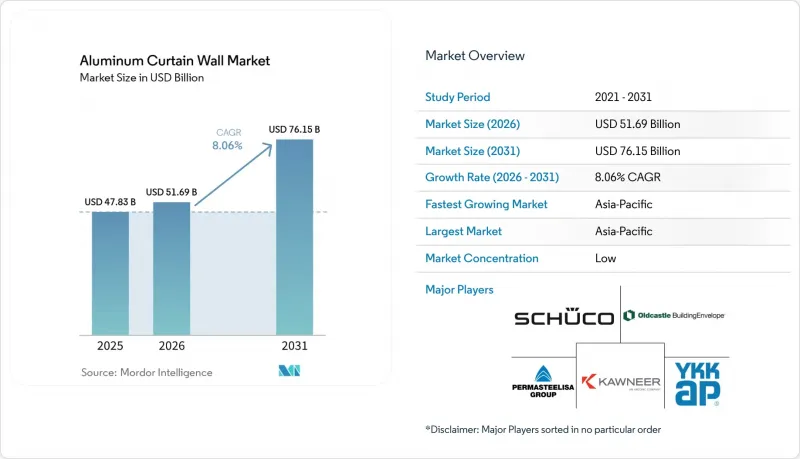
에 따르면 알루미늄제 커튼월 시장 규모는 2025년에 478억 3,000만 달러로 평가되며, 2026년 516억 9,000만 달러에서 2031년까지 761억 5,000만 달러에 달할 것으로 예측되고 있으며, 예측 기간(2026-2031년)에 CAGR은 8.06%에 달할 전망입니다.
전 세계 알루미늄 커튼월 시장의 동향 및 인사이트
에너지 절약 건축 기준 및 그린 빌딩 인증
미국 그린 빌딩협회(USGBC)는 2025년에 ‘에너지 및 환경 설계 리더십(LEED)’ v5를 발표하며, 에너지 효율 관련 크레딧과 건물 전체의 탄소 배출량 산정을 분리했습니다. 이러한 변경으로 인해 복잡한 건물 전체의 에너지 시뮬레이션을 수행하지 않더라도 고성능 커튼월 사양이 에너지 크레딧 획득에 기여하기 쉬워졌습니다. 캘리포니아주의 ‘2025년 건축물 에너지 효율 기준’에서는 비주거용 개보수 공사의 경우 커튼월 조립체의 U값 상한을 0.280으로 정하고 있으며, 해당 프로젝트에서 성능이 낮은 제품으로의 교체를 제한하고 있습니다. 프랑스의 RE2020 요건에서도 알루미늄 커튼월과 관련된 프로젝트별 환경 문서 제출의 필요성이 높아졌습니다. 이러한 요건으로 인해 알루미늄 커튼월 시장에서 특히 건축가가 사양 수립시 적합성을 입증해야 하는 경우, 인증된 열 성능과 신뢰성 높은 제품 데이터의 중요성이 더욱 커지고 있습니다. 또한 주목할 만한 점은 시스템의 초기 가격에서 제품이 사후 재설계가 필요 없이 문서화된 성능 요건을 충족할 수 있는지 여부로 초점이 이동하고 있습니다. 공급업체 입장에서는 이로 인해 인증 기록 및 기술 지원이 선택적 서비스가 아니라 프로젝트 제안의 기본 요소 중 하나가 됩니다.
고층 상업 빌딩 및 복합 용도 건축물
높이 200미터를 초과하는 건물에서는 고공에서의 시공 속도 및 작업자 안전 확보가 어려워지기 때문에 유닛화된 알루미늄 커튼월 시스템이 일반적으로 채택되고 있습니다. 따라서 개발업자가 고밀도 도시 지역에서 초고층 빌딩, 사무실, 복합 용도 시설, 공항 프로젝트를 계획할 경우, 알루미늄 커튼월 시장은 그 혜택을 누리게 될 것입니다. 인도의 ‘Ude Desh ka Aam Naagrik(UDAN)’ 공항 확장 프로그램은 2030년까지 50개 도시를 대상으로 하고 있으며, 하이데라바드, 벵갈루루, 첸나이의 상업 개발도 대규모 파사드 패키지에 대한 수요를 촉진했습니다. 중국에서도 두 개의 연결된 타워 전체에 불소 수지 코팅이 적용된 알루미늄 복합 패널을 채택한 ‘텐센트 빈하이 타워’가 보여주듯이, 주요 상업 시설에 대해 엄격한 사양이 계속해서 설정되고 있습니다. 아시아태평양 공급업체들의 맞춤형 알루미늄 압출재 납기 단축도 북미 및 유럽 프로젝트의 조달 결정에 영향을 미칠 가능성이 있습니다. 이러한 영향은 프로젝트에 맞춤형 프로파일이 필요하고 긴 생산 리드타임을 허용할 수 없는 경우에 가장 두드러집니다. 이에 따라 제조 능력과 납기 신뢰성이 알루미늄 커튼월 시장에서 직접적인 역할을 하게 됩니다.
높은 설치·시험·유지관리 비용
프리팹화로 인해 일부 작업이 공장으로 이관된 경우에도, 설치 비용은 알루미늄 커튼월 프로젝트 총 비용의 35%-45%를 차지했습니다. 또한 새로운 시스템에서는 공기 투과성, 내수성, 구조 성능에 관한 미국재료시험협회(ASTM)의 E283, E330 및 E331 규격에 따른 시험도 필요했습니다. 2025년 6월 알루미늄 가격 상승으로 인해 가격 고정 기간이 30일 이하로 단축되어 고정 가격 계약의 불확실성이 높아졌습니다. 복잡한 건축 형태와 다양한 기후 요건으로 인해 프로젝트 팀은 당초 예산을 지키기 위해 유리나 단열 자재를 대체재로 교체하는 경우가 있습니다. 이러한 상황은 일부 중규모 상업 프로젝트의 실현 가능성을 제한하고, 알루미늄 커튼월 시장에 추가적인 압박을 가하고 있습니다. 따라서 시공사는 성능, 비용, 그리고 견적을 고정할 수 있는 기간 간의 균형을 맞춰야 합니다. 특히 프로젝트 공사 기간이 자재 가격 고정 기간을 초과하는 경우, 알루미늄 커튼월 시장에 가해지는 이러한 압박은 매우 커집니다.
부문 분석
유닛형 커튼월은 2025년에 61.56%의 점유율을 차지할 것으로 예상되며, 2031년까지 연평균 성장률(CAGR) 8.85%로 확대될 것으로 전망됩니다. 이러한 위상은 고층 프로젝트에서의 적극적인 채택을 반영한 것으로, 공장에서 제조된 패널 덕분에 설치 시간이 단축되고 비계에 대한 의존도가 낮아졌습니다. 높이 200미터를 초과하는 건물의 경우, 해당 높이에서 현장 시공을 관리하기 어려웠기 때문에 파사드 시공의 70% 이상에서 유닛화 시스템이 채택되었습니다. 또한 이러한 시스템은 프로젝트 팀이 점점 더 요구하게된 공기·물·단열 성능 요건에도 부응했습니다. Kawneer Company, Inc.는 2026년 4월, ‘2500 UT PLUS Enhanced Thermal Option’을 발표했습니다. 이는 공장 조립 효율을 유지하면서 1인치 두께의 복층 유리를 통해 U값을 0.25까지 낮추는 데 성공한 제품입니다.
스틱 공법을 이용한 커튼월은 저층에서 중층 프로젝트나 형상이 복잡한 건축 외피에서 여전히 중요한 역할을 하고 있습니다. 이러한 프로젝트에서는 패널 설계의 반복이 충분하지 않아, 완전한 유닛화 생산에 필요한 설비 투자를 정당화할 수 없는 경우가 있습니다. 세미 유닛화 커튼월은 현장 시공 시의 유연성을 유지하면서, 공장에서 품질관리를 부분적으로 실시할 수 있는 방식입니다. 이 방식은 알루미늄 커튼월 시장에서 시공 중에 파사드의 입면도를 조정해야 할 때 유용했습니다. BIM 툴을 통한 패널 상세 설계의 자동화가 진행됨에 따라 더욱 복잡한 프로젝트에서도 공장 생산 시스템을 적용할 수 있게 되어 알루미늄 커튼월 업계에서 유닛화 솔루션의 보급이 더욱 확대될 가능성이 있습니다. 현장 상황이나 설계 변경에 대해 더 높은 유연성이 요구되는 경우, 스틱 빌트 방식이나 세미 유닛화 커튼월은 여전히 유효한 선택지가 됩니다. 따라서 어떤 방식을 선택할지는 프로젝트의 층수, 패널의 반복성, 형상, 작업 조건 및 요구되는 성능에 따라 결정됩니다.
지역별 분석
아시아태평양은 2025년에 44.05%의 점유율을 차지할 것으로 예상되며, 2031년까지 연평균 성장률(CAGR) 8.62%로 확대될 것으로 전망됩니다. 중국에서는 상업용 복합 시설 및 초고층 프로젝트가 지역 수요를 지원했으며, 통합된 알루미늄 공급망이 국내 수요와 수출을 지탱했습니다. 인도에서는 공항 개발, 하이데라바드, 벵갈루루, 첸나이의 정보기술 회랑, 그리고 뭄바이의 고급 주거용 빌딩이 수요를 견인했습니다. 일본과 한국에서는 내풍 성능 및 내진 성능에 대해 기술적으로 인증된 시스템이 요구되었습니다. YKK AP 주식회사는 22억 엔(약 1,470만 달러)을 투자하여 2026년 1월 시험 시설 ‘N-CueB’의 운영을 시작했습니다. 이 시설에서는 풍압 시험 및 내진 변위 시험이 수행되고 있습니다. 방콕, 자카르타, 쿠알라룸푸르를 포함한 동남아시아국가연합(ASEAN) 각 도시에서는 내화 성능을 갖춘 파사드 시스템을 적용한 초고층 빌딩급 프로젝트에 대한 수요가 증가했습니다. 이러한 광범위한 지역적 건설 기반이 상업, 교통, 주거 등 다양한 용도에 걸친 수요를 지원했습니다. 또한 이를 통해 아시아태평양의 알루미늄 커튼월 시장에서는 대규모 국내 시장의 수요와 여러 개발도상국 도심 지역의 수요를 결합할 수 있게 되었습니다.
북미의 수요는 건축 기준법에 따른 개보수 및 리노베이션 투자가 주를 이루고 있습니다. U값 관련 요건의 강화로 고성능 시스템에 대한 필요성이 높아졌으며, 이는 건축 기준법이 선행하는 주에서의 제품 선정에 영향을 미쳤습니다. Old Castle Building Envelope사는 2026년 6월, 시스템의 깊이를 늘리지 않고 얇은 3중 단열 유리 유닛(IGU)을 채택하여 U값을 0.19까지 낮춘 ‘Reliance-TC SS’를 출시했습니다. Kawneer Company, Inc.도 2026년 중 자사의 ‘2500 UT Unitwall System’의 단열 옵션을 개선했습니다. 캐나다 퀘벡주 및 온타리오주 시장에서는 사무실, 의료, 공공 시설 등의 프로젝트를 배경으로 수요가 지원된 반면, 국제 에너지 절약 기준(IECC) 및 미국 냉난방 공조 공학회(ASHRAE) 90.1이 해당 지역 전체의 단열 사양에 영향을 미쳤습니다. 이러한 환경에서는 시스템의 U값이나 시험 실적이 선정의 결정적인 요인이 되는 경우가 있습니다. 그 결과, 각 공급업체들은 제품 깊이를 늘리거나 제조 공정에 지장을 초래하지 않으면서 단열 성능을 향상시키는 방향으로 제품 개발을 추진하고 있습니다.
유럽은 알루미늄 커튼월 시장에서 지속가능성에 관한 규제와 건축 외피 개보수의 주요 중심지로서의 위치를 계속 유지했습니다. 프랑스의 RE2020 규정, ‘Decret Tertiaire’ 및 BAT-EN-113 인센티브 제도는 상업용 커튼월을 단열 유리로 교체하는 것을 촉진했습니다. 독일의 ‘Bundesforderung fur effiziente Gebaude’ 프로그램은 Uw 값이 0.9 W/(m2·K) 미만을 달성하는 파사드 개보수에 대해 대상 투자 비용의 최대 15%를 지원했습니다. 북유럽 국가들에서는 매우 높은 단열 성능이 요구되고 있으며, 이것이 삼중 유리를 채택한 알루미늄 시스템에 대한 수요를 지원했습니다. 라이너스 알루미늄(Rainer’s Aluminium)은 2026년 3월, U값이 0.8 W/(m²·K)로 매우 낮으며 패시브 하우스 및 크래들 투 크래들(Cradle to Cradle) 인증을 모두 획득한 ‘SlimWall 35’를 출시했습니다. 남미, 중동 및 아프리카에서는 상업 시설, 인프라, 고사양 프로젝트를 통해 수요가 확대되었습니다. 한편, 퍼마스틸리사 그룹은 해당 지역의 파사드 공사를 위해 두바이에 제조 합작 회사를 설립했습니다. 이러한 지역은 현지 생산의 심화 정도나 가격 민감도에 차이가 있지만, 대규모 프로젝트에서는 여전히 첨단 파사드 시스템이 요구되는 경우가 있습니다. 지역내 생산 능력을 강화함으로써 맞춤형 시스템에 대한 접근성을 개선하고, 이러한 프로젝트의 납기 제약을 완화할 수 있습니다.
기타 혜택:
- 엑셀 형식의 시장 예측(ME) 시트
- 3개월간의 애널리스트 지원
자주 묻는 질문
목차
제1장 서론
- 조사 전제조건과 시장 정의
- 조사 범위
제2장 조사 방법
제3장 개요
제4장 시장 구도
- 시장 개요
- 시장 성장 촉진요인
- 시장 성장 억제요인
- 밸류체인 분석
- Porter's Five Forces 분석
제5장 시장 규모와 성장 예측
- 제품 유형별
- 용도별
- 지역별
- 아시아태평양
- 중국
- 인도
- 일본
- 한국
- ASEAN 국가
- 기타 아시아태평양 국가
- 북미
- 미국
- 캐나다
- 멕시코
- 유럽
- 독일
- 영국
- 프랑스
- 이탈리아
- 북유럽 국가
- 기타 유럽 국가
- 남미
- 브라질
- 아르헨티나
- 기타 남미 국가
- 중동 및 아프리카
- 사우디아라비아
- 남아프리카공화국
- 기타 중동 및 아프리카 국가
- 아시아태평양
제6장 경쟁 구도
- 시장 집중도
- 전략적 동향
- 시장 점유율·순위 분석
- 기업 개요
- Alumil
- Aluprof S.A.
- ALUTECH
- GUTMANN
- HUECK System GmbH & Co. KG
- Jansen AG
- Kawneer Company, Inc.
- Metal Yapi Sistemleri Tic. A.S.
- Oldcastle BuildingEnvelope
- Permasteelisa Group
- Ponzio
- RAICO Bautechnik GmbH
- Reynaers Aluminium
- Schuco International
- TECHNAL
- YKK AP Inc.
제7장 시장 기회와 향후 전망
KSA 26.10.28According to Mordor Intelligence, the aluminum curtain wall market size was valued at USD 47.83 billion in 2025 and is estimated to grow from USD 51.69 billion in 2026 to reach USD 76.15 billion by 2031, at a CAGR of 8.06% during the forecast period (2026-2031).
Global Aluminum Curtain Wall Market Trends and Insights
Energy-Efficient Building Codes and Green-Building Certifications
The U.S. Green Building Council launched Leadership in Energy and Environmental Design (LEED) v5 in 2025 and separated energy-efficiency credits from whole-building carbon accounting. This change made it easier for high-performance curtain wall specifications to contribute to energy credits without requiring complex whole-building energy simulations. California's 2025 Building Energy Efficiency Standards set a maximum curtain wall assembly U-factor of 0.280 for nonresidential retrofits, limiting lower-performing substitutions in qualifying projects.. France's RE2020 requirements also increased the need for project-specific environmental documentation for aluminum curtain walls. These requirements make certified thermal performance and reliable product data more important in the aluminum curtain wall market, particularly where architects must show compliance during specification. They also shift attention from the initial system price toward whether a product can meet the documented performance requirement without late redesign. For suppliers, this makes certification records and technical support part of the basic project offer rather than an optional service.
High-Rise Commercial and Mixed-Use Construction
Buildings taller than 200 meters commonly use unitized aluminum curtain wall systems because installation speed and worker safety become more difficult at greater heights. The aluminum curtain wall market, therefore, benefits when developers plan supertall, office, mixed-use, and airport projects in dense urban areas. India's Ude Desh ka Aam Naagrik (UDAN) airport expansion program targeted 50 cities by 2030, while commercial development in Hyderabad, Bengaluru, and Chennai added to demand for large facade packages. China also continued to set demanding specifications for major commercial assets, as shown by Tencent Binhai Tower, which used fluorocarbon-coated aluminum composite panels across two interconnected towers. Faster delivery of custom aluminum extrusions from Asia-Pacific suppliers can also influence sourcing decisions for projects in North America and Europe. The effect is strongest where a project needs custom profiles and cannot absorb a long production lead time. This gives fabrication capacity and delivery reliability a direct role in the aluminum curtain wall market.
High Installation, Testing, and Maintenance Costs
Installation represented 35%-45% of the total aluminum curtain wall project cost, even when prefabrication moved some labor into factories. New systems also required testing against American Society for Testing and Materials (ASTM) E283, E330, and E331 standards for air infiltration, water resistance, and structural performance. The June 2025 rise in aluminum prices shortened price-hold windows to 30 days or fewer and increased uncertainty for fixed-price contracts. Complex building forms and multiple climate requirements can lead project teams to substitute glazing or thermal components to protect initial budgets. These conditions limit project feasibility for some mid-scale commercial projects and add pressure to the aluminum curtain wall market. Contractors must therefore balance performance, cost, and the period for which they can hold a quotation. The pressure is particularly significant in the aluminum curtain wall market when project schedules extend beyond the available material-price commitment.
Other drivers and restraints analyzed in the detailed report include:
- Factory-Prefabricated Facade Adoption
- Facade Retrofit and Building-Energy Renovation Demand
- Skilled Facade Engineering and Installation Labor Shortages
For complete list of drivers and restraints, kindly check the Table Of Contents.
Segment Analysis
Unitized curtain wall held a 61.56% share in 2025 and is projected to advance at an 8.85% CAGR through 2031. Its position reflected strong use in high-rise projects, where factory-built panels reduced installation time and reduced dependence on scaffolding. Buildings taller than 200 meters used unitized systems in more than 70% of facade applications because field installation was harder to manage at those heights. The systems also supported the air, water, and thermal performance expectations that project teams increasingly require. Kawneer Company, Inc. introduced the 2500 UT PLUS Enhanced Thermal Option in April 2026, which achieved U-factors as low as 0.25 with 1-inch insulating glass while retaining shop-assembly efficiency.
Stick-built curtain wall remained relevant for low-to-mid-rise projects and building envelopes with complex shapes. These projects may not have enough repeated panel design to justify the setup needed for full unitized production. Semi-unitized curtain wall offered partial factory quality control while maintaining more flexibility during field installation. This format was useful where facade elevations needed adjustment during construction in the aluminum curtain wall market. As BIM tools automate panel detailing, more complex projects may become suitable for factory-built systems, supporting broader adoption of unitized solutions in the aluminum curtain wall industry. Stick-built and semi-unitized curtain walls still provide options where site conditions or design changes need greater flexibility. The choice among the formats, therefore, depends on project height, repetition, geometry, labor conditions, and required performance.
Complete Report Scope:
- By Product Type
- Unitized Curtain Wall
- Stick-Built Curtain Wall
- Semi-Unitized Curtain Wall
- By Application
- Commercial Buildings
- Residential Buildings
- Other Applications
- By Geography
- Asia-Pacific
- China
- India
- Japan
- South Korea
- ASEAN Countries
- Rest of Asia-Pacific
- North America
- United States
- Canada
- Mexico
- Europe
- Germany
- United Kingdom
- France
- Italy
- NORDIC Countries
- Rest of Europe
- South America
- Brazil
- Argentina
- Rest of South America
- Middle East and Africa
- Saudi Arabia
- South Africa
- Rest of Middle East and Africa
- Asia-Pacific
Geography Analysis
Asia-Pacific held a 44.05% share in 2025 and is projected to advance at an 8.62% CAGR through 2031. China supported regional demand through commercial mixed-use and supertall projects, while its integrated aluminum supply chain supported domestic use and exports. India added demand through airport development, information technology corridors in Hyderabad, Bengaluru, and Chennai, and premium residential buildings in Mumbai. Japan and South Korea required technically certified systems for wind and seismic performance. YKK AP Inc. began operating the N-CueB testing facility in January 2026 following a JPY 2.2 billion investment (approximately USD 14.7 million), and the facility supports wind-pressure testing and seismic-displacement testing. The Association of Southeast Asian Nations (ASEAN) cities, including Bangkok, Jakarta, and Kuala Lumpur, added demand for skyscraper-class projects with fire-rated facade systems. This broad regional construction base supported demand across commercial, transport, and residential applications. It also enabled Asia-Pacific to combine demand from large national markets with demand from multiple developing urban centers in the aluminum curtain wall market.
North America's demand is centered on code-driven upgrades and retrofit investment. Stronger U-factor requirements increased the need for high-performance systems and affected product selection in code-leading states. Oldcastle BuildingEnvelope launched the Reliance-TC SS in June 2026 with U-factors as low as 0.19 using thin triple-insulated glass units (IGUs) without increasing system depth. Kawneer Company, Inc. also improved the thermal option for its 2500 UT Unitwall System during 2026. Canada's Quebec and Ontario markets supported demand across office, medical, and institutional projects, while the International Energy Conservation Code (IECC) and American Society of Heating, Refrigerating and Air-Conditioning Engineers (ASHRAE) 90.1 influenced thermal specifications across the region. In this environment, a system's U-factor and test record can be decisive during selection. Suppliers are consequently directing product development toward thermal gains that do not add depth or disrupt fabrication.
Europe remained a major center for sustainability rules and building-envelope renovation in the aluminum curtain wall market. France's RE2020 regulation, Decret Tertiaire, and BAT-EN-113 incentive scheme supported the replacement of commercial curtain walls with insulated glazing. Germany's Bundesforderung fur effiziente Gebaude program offered up to 15% of eligible investment costs for facade renovations achieving a Uw below 0.9 W/(m2*K). Nordic countries required very strong thermal performance, which supported demand for triple-glazed aluminum systems. Reynaers Aluminium introduced SlimWall 35 in March 2026, with a U-value as low as 0.8 W/(m2*K) and both Passive House and Cradle-to-Cradle certifications. South America, the Middle East, and Africa added demand through commercial, infrastructure, and high-specification projects, while Permasteelisa Group established a manufacturing joint venture in Dubai for regional facade work. These regions differ in their local manufacturing depth and price sensitivity, but major projects can still require advanced facade systems. Regional production capacity can improve access to customized systems and reduce delivery constraints for those projects.
- Alumil
- Aluprof S.A.
- ALUTECH
- GUTMANN
- HUECK System GmbH & Co. KG
- Jansen AG
- Kawneer Company, Inc.
- Metal Yapi Sistemleri Tic. A.S.
- Oldcastle BuildingEnvelope
- Permasteelisa Group
- Ponzio
- RAICO Bautechnik GmbH
- Reynaers Aluminium
- Schuco International
- TECHNAL
- YKK AP Inc.
Additional Benefits:
- The market estimate (ME) sheet in Excel format
- 3 months of analyst support
TABLE OF CONTENTS
1 Introduction
- 1.1 Study Assumptions and Market Definition
- 1.2 Scope of the Study
2 Research Methodology
3 Executive Summary
4 Market Landscape
- 4.1 Market Overview
- 4.2 Market Drivers
- 4.2.1 Energy-Efficient Building Codes and Green-Building Certifications
- 4.2.2 High-Rise Commercial and Mixed-Use Construction
- 4.2.3 Factory-Prefabricated Facade Adoption
- 4.2.4 Facade Retrofit and Building-Energy Renovation Demand
- 4.2.5 Design Digitization and Automated Facade Fabrication
- 4.3 Market Restraints
- 4.3.1 High Installation, Testing, and Maintenance Costs
- 4.3.2 Skilled Facade Engineering and Installation Labor Shortages
- 4.3.3 Project-Specific Fire, Seismic, Wind, and Acoustic Certification
- 4.4 Value Chain Analysis
- 4.5 Porter's Five Forces Analysis
- 4.5.1 Bargaining Power of Suppliers
- 4.5.2 Bargaining Power of Buyers
- 4.5.3 Threat of New Entrants
- 4.5.4 Threat of Substitutes
- 4.5.5 Competitive Rivalry
5 Market Size and Growth Forecasts (Value)
- 5.1 By Product Type
- 5.1.1 Unitized Curtain Wall
- 5.1.2 Stick-Built Curtain Wall
- 5.1.3 Semi-Unitized Curtain Wall
- 5.2 By Application
- 5.2.1 Commercial Buildings
- 5.2.2 Residential Buildings
- 5.2.3 Other Applications
- 5.3 By Geography
- 5.3.1 Asia-Pacific
- 5.3.1.1 China
- 5.3.1.2 India
- 5.3.1.3 Japan
- 5.3.1.4 South Korea
- 5.3.1.5 ASEAN Countries
- 5.3.1.6 Rest of Asia-Pacific
- 5.3.2 North America
- 5.3.2.1 United States
- 5.3.2.2 Canada
- 5.3.2.3 Mexico
- 5.3.3 Europe
- 5.3.3.1 Germany
- 5.3.3.2 United Kingdom
- 5.3.3.3 France
- 5.3.3.4 Italy
- 5.3.3.5 NORDIC Countries
- 5.3.3.6 Rest of Europe
- 5.3.4 South America
- 5.3.4.1 Brazil
- 5.3.4.2 Argentina
- 5.3.4.3 Rest of South America
- 5.3.5 Middle East and Africa
- 5.3.5.1 Saudi Arabia
- 5.3.5.2 South Africa
- 5.3.5.3 Rest of Middle East and Africa
- 5.3.1 Asia-Pacific
6 Competitive Landscape
- 6.1 Market Concentration
- 6.2 Strategic Moves
- 6.3 Market Share (%)/Ranking Analysis
- 6.4 Company Profiles (includes Global Overview, Market Overview, Core Segments, Financials as available, Strategic Information, Products and Services, and Recent Developments)
- 6.4.1 Alumil
- 6.4.2 Aluprof S.A.
- 6.4.3 ALUTECH
- 6.4.4 GUTMANN
- 6.4.5 HUECK System GmbH & Co. KG
- 6.4.6 Jansen AG
- 6.4.7 Kawneer Company, Inc.
- 6.4.8 Metal Yapi Sistemleri Tic. A.S.
- 6.4.9 Oldcastle BuildingEnvelope
- 6.4.10 Permasteelisa Group
- 6.4.11 Ponzio
- 6.4.12 RAICO Bautechnik GmbH
- 6.4.13 Reynaers Aluminium
- 6.4.14 Schuco International
- 6.4.15 TECHNAL
- 6.4.16 YKK AP Inc.
7 Market Opportunities and Future Outlook
- 7.1 White-Space and Unmet-Need Assessment


