

|
시장보고서
상품코드
2154849
형광 셀 : 시장 점유율 분석, 업계 동향과 통계, 성장 예측(2026-2031년)Fluorescence Cell - Market Share Analysis, Industry Trends & Statistics, Growth Forecasts (2026 - 2031) |
||||||
 Mordor Intelligence
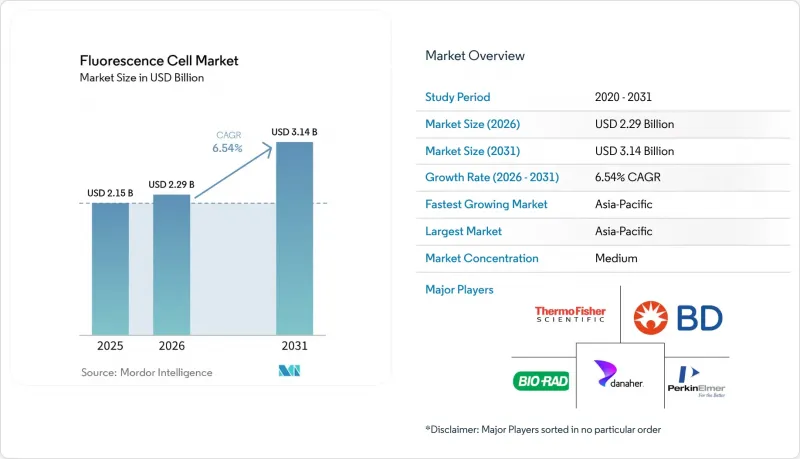
에 따르면 형광 셀 시장 규모는 2025년 21억 5,000만 달러에서 2026년에는 22억 9,000만 달러로 확대하며, 2031년까지 31억 4,000만 달러에 달할 것으로 예상되고 있으며, 2026-2031년에 CAGR 6.54%로 성장할 것으로 전망되고 있습니다.
전 세계 형광 세포 시장의 동향 및 인사이트
생물의학 연구 및 진단 분야에서의 도입: 장비 구입 보조금이 설비 투자를 지원
생물의학 연구는 공동 이용 시설 및 장비 보조금을 통해 형광 세포 시장내 구매를 지속적으로 견인하고 있습니다. 2026년 7월, 텍사스 대학교 오스틴 캠퍼스는 ZEISS사의 ‘Lightsheet 7’ 현미경 도입을 위해 미국 국립보건원(NIH)의 S10 보조금을 수령할 예정입니다. 이 시스템은 오스틴 지역 최초의 라이트시트 현미경이 될 전망이며, 17개 연구팀과 29개의 NIH 지원 프로젝트를 지원하게 될 것입니다. 공동 조달 모델을 통해 개별 연구실이 단독으로 자금을 조달하기 어려운 첨단 장비에도 여러 연구실이 접근할 수 있게 됩니다. 임상 현장 도입은 완만한 속도로 진행되고 있지만, 임상 인증 및 품질 요건은 검증된 시스템을 보유한 확고한 공급업체에게 유리하게 작용할 가능성이 있습니다.
하이컨텐츠 스크리닝 및 세포 기반 신약 개발: 3D 모델이 분석 기준을 혁신하다
하이컨텐츠 형광 이미징은 3D 종양 스페로이드, 오가노이드 및 오가논-온-칩 모델에 대한 적용이 점점 확대되고 있습니다. 기존의 2D 세포배양과 비교하여, 이러한 모델에는 더욱 정교한 이미징 능력이 요구됩니다. 2025년 'Nature Communications'지에 게재될 예정인 연구에서는 HCS-3DX 플랫폼이 공배양 종양 모델에서 단일 세포 수준의 해상도를 실현하며, AI를 활용한 3D 스크리닝이 어떻게 하이컨텐츠 스크리닝의 일관성을 향상시킬 수 있는지를 입증할 것으로 보고될 전망입니다. 이러한 워크플로우에는 이미징 장비 외에도 전용 플레이트, 시약, 미세유체 챔버가 필요합니다. 그 결과, 형광 세포 시장에서 소모품과 소프트웨어의 중요성이 점점 더 커지고 있습니다.
높은 초기 투자 비용과 수명 주기 비용: 접근성 격차가 시장의 지역적 분포를 좌우
고성능 형광 시스템은 일반적으로 20만 달러에서 100만 달러 이상이 듭니다. 또한 유지보수 계약, 레이저 교체, 시약비 등이 연간 정가의 10%-20%를 추가로 부담하게 됩니다. 그 결과, 5년간의 총 소유 비용은 초기 설비 투자액을 크게 초과할 가능성이 있습니다. 이러한 비용 부담은 연구 예산으로 고가의 장비 도입을 감당하기 어려울 수 있는 남미, 중동 및 아프리카에서 특히 두드러집니다. 공동 이용 시설이나 ‘서비스형 장비(IaaS)’ 모델은 주요 연구 센터 이외의 지역으로의 접근성 확대에 기여할 가능성이 있습니다. 그러나 훈련을 받은 운영자, 재현 가능한 조사 기법, 그리고 임상적 타당성 검증이 필요하므로 도입 비용이 더욱 증가하여 형광 세포 시장에서의 보급을 제약할 가능성이 있습니다.
부문 분석
형광 현미경은 2025년 형광 세포 시장 매출의 37.5%를 차지할 것으로 예측됩니다. 학술연구소, 제약 회사의 전임상 시설 및 병원 병리과에서는 이러한 장비가 널리 사용되고 있습니다. 이러한 선도적인 위상은 확립된 도입 실적과 세포 생물학, 종양학, 신경과학 연구 분야에 걸친 폭넓은 적용성을 반영합니다. 제품 라인업은 보급형 탁상형 장비부터 공초점 및 초고해상도 시스템에 이르기까지 다양하며, 공급업체는 기술 요구 사항과 자본 예산이 서로 다른 각 연구소의 요구를 충족시킬 수 있습니다.
형광 활성화 세포 선별 장치는 형광 세포 시장에서 여전히 고부가가치 제품 카테고리로 자리 잡고 있으며, 특히 세포 치료제 제조 과정에서 제어된 선별 및 품질관리 워크플로우에 대한 필요성이 높아지고 있는 것이 그 요인입니다. 형광 이미징 시스템 또한 공간 생물학 및 신약 개발 프로그램에서 중요한 역할을 수행하고 있습니다. 또한 프로브와 염료는 이러한 장비 카테고리 전반에 걸쳐 지속적인 구매를 창출하고 있습니다.
액세서리 및 소모품은 2031년까지 연평균 성장률(CAGR) 8.6%로 성장할 것으로 예측되며, 형광 세포 시장에서 가장 빠르게 성장하는 제품군이 될 전망입니다. 이러한 성장은 도입 대수의 확대에 힘입은 것입니다. 복잡한 실험을 수행하려면 시약, 플레이트 및 관련 소모품을 지속적으로 구매해야 하기 때문입니다. 자동 이미징 시스템은 이미징 스테이지, 배양, 액체 처리 및 분석 툴을 더욱 통합하여 호환 가능한 시약과 소프트웨어에 대한 지속적인 수요를 창출하고 있습니다.
서모피셔 사이언티픽(Thermo Fisher Scientific)은 2025년 2월 ‘Invitrogen EVOS S1000 공간 이미징 시스템’을 출시했습니다. 이 시스템은 최대 9개의 형광 표적을 동시에 포착할 수 있도록 설계되었으며, 다양한 시약과 호환됩니다. 이러한 기능 덕분에 자본 설비의 판매와 지속적인 시약 수요가 연계됩니다. 공급업체는 호환 가능한 소모품을 활용함으로써 초기 시스템 판매 이후에도 지속적인 수입원을 확보할 수 있습니다.
형광 수명 이미징 현미경법(FLIM)은 2025년에 시장 매출의 31.7%를 차지할 것으로 예측됩니다. 이 시장의 위상은 분석의 심도 및 화학적 전처리 없이 자가형광과 프로브 신호를 구별할 수 있는 능력을 반영합니다. 이러한 능력은 내인성 신호가 기존의 강도 기반 기법에 간섭을 일으킬 수 있는 조직 샘플에서 유용합니다. 공초점 현미경은 광학 단층촬영, 다중 채널 검출 및 확립된 프로토콜 덕분에 여전히 널리 채택되고 있습니다.
형광 세포 시장에서는 AI 기반 언믹싱 기술로 인해 스펙트럼 분리가 향상됨에 따라 다중 스펙트럼 이미징이 주목받고 있습니다. 또한 양자점은 광학적 안정성 덕분에 장시간의 생세포 실험에서도 여전히 중요한 역할을 하고 있습니다. 이러한 기술들은 해상도, 처리량, 신호 품질과 같은 다양한 요구 사항을 충족시킵니다. 그 결과, 형광 세포 시장은 단일 교체 주기가 아닌 여러 기술 경로로 구성되어 있습니다.
초고해상도 현미경 시장은 2031년까지 연평균 성장률(CAGR) 7.8%로 성장할 것으로 예측됩니다. STED, STORM, PALM 각 기술은 전문 물리학 연구소의 범위를 넘어, 현재는 상용 플랫폼을 통해 이용 가능해졌습니다. 2025년 'Nature Biotechnology'지에 게재된 연구에서는 조합적 염색과 딥러닝을 활용하여 5개의 이미징 채널에서 22유형의 단백질 이미징 패널을 재구성한 ‘CombPlex’가 평가되었습니다. 이 접근법을 통해 각 실험에서 얻어지는 정보 밀도가 높아졌으며, 첨단 이미징 기술이 멀티플렉스 생물학적 분석을 지원할 수 있다는 가능성이 입증되었습니다.
칼 자이스 마이크로스코피(Carl Zeiss Microscopy)는 광대역 여기 형광 현미경에 관한 미국 특허를 2026년 7월에 취득할 전망입니다. 이 특허는 임상 및 연구용 이미징 분야에서 지속적인 독자적 개발을 보여줍니다. 그러나 초해상도 시스템은 까다로운 생세포 응용 분야에서 여전히 광독성 및 광퇴색이라는 과제에 직면해 있습니다.
지역별 분석
2025년에는 북미가 형광 세포 시장의 41.7%를 차지할 것으로 예측됩니다. 이 지역은 학술 의료 센터의 집중, 미국 국립보건원(NIH)이 자금을 지원하는 연구 인프라, 그리고 상업적인 바이오의약품 활동이라는 강점을 활용하고 있습니다. 연방 정부의 장비 구매 보조금과 대학 병원의 설비 투자 예산이 시스템 조달을 지원하는 한편, ‘Instrument-as-a-Service(IaaS)’ 모델을 통해 연구실은 이미 도입된 장비를 업그레이드할 수 있게 되었습니다. 공급업체, 시약 공급업체, 주요 연구 클러스터 간의 긴밀한 협력이 이 지역의 생태계를 더욱 강화하고 있습니다. 이러한 요인들이 이미징, 선별, 분석 소프트웨어 및 소모품에 대한 수요를 지원하고 있습니다. 캐나다의 유전체학 및 정밀 의학 네트워크 또한 형광 세포 시장의 수요에 기여하고 있습니다. [출처: NIH.gov]
유럽에서는 학술연구, 임상 진단, 제약 용도에 걸쳐 수요 기반이 균형 있게 형성되어 있습니다. 본 분석에서 독일, 영국, 프랑스, 네덜란드가 가장 활발한 국내 시장으로 나타났습니다. 다년간 걸친 연구 컨소시엄을 통해 대학 네트워크 전반에 걸친 장비 갱신이 협력적으로 진행되고 있습니다. 칼 자이스(Carl Zeiss)는 2026년 7월, 일상적인 임상 진단 현장을 위한 ‘Axioscan 7 Clinical’을 출시할 예정입니다. 이 시스템은 투과광, 명시야, 형광 모드를 지원하며, 다양한 배율 및 Z-스택 기능을 갖추고 있습니다. 이러한 개발은 유럽에서 검증된 임상 워크플로우의 중요성이 높아지고 있음을 지원합니다. 또한 살토리아스(Sartorius)사는 ‘Eveo Cell Therapy Platform’을 통해 세포 치료제 제조 분야에도 주력하고 있습니다. 그 결과, 유럽에서는 지속적인 연구 수요에 더해 규제 대상 제조 환경에서의 분석 수요가 증가하고 있는 것으로 나타납니다.
아시아태평양은 2031년까지 연평균 성장률(CAGR) 7.7%로 성장할 것으로 예측되며, 형광 세포 시장에서 가장 빠르게 성장하는 지역이 될 전망입니다. 중국에서는 국가가 지원하는 생의학 연구 인프라와 유전체 연구 프로그램이 대학 병원 및 위탁 연구 기관(CRO)의 구매를 촉진하고 있습니다. 인도에서는 의약품 제조 및 위탁 연구 활동이 동정 및 순도 시험용 툴에 대한 수요를 견인하고 있습니다. 일본에서는 하마마츠 포토닉스, 니콘, 올림푸스, 시마즈 제작소를 통해 첨단 정밀 광학 기술이 제공되고 있습니다. 또한 일본의 대학에서도 재생 의학 및 재료 과학 연구를 위한 첨단 플랫폼이 도입되고 있습니다. 남미, 중동 및 아프리카에서는 도입이 아직 초기 단계에 머물러 있습니다. 브라질과 걸프협력회의(GCC) 회원국의 연구 센터가 주요 수요처이지만, 인프라 부족과 수입 의존도로 인해 조달 속도는 여전히 제한되고 있습니다.
기타 혜택:
- 엑셀 형식의 시장 예측(ME) 시트
- 3개월간의 애널리스트 지원
자주 묻는 질문
목차
제1장 서론
- 조사 전제조건과 시장 정의
- 조사 범위
제2장 조사 방법
제3장 개요
제4장 시장 구도
- 시장 개요
- 시장 성장 촉진요인
- 시장 성장 억제요인
- 공급망 분석
- 규제 상황
- 기술 전망
- Porter's Five Forces
제5장 시장 규모와 성장 예측
- 제품 유형별
- 기술별
- 용도별
- 최종사용자별
- 지역
제6장 경쟁 구도
- 시장 집중도
- 시장 점유율 분석
- 기업 개요
- Agilent Technologies, Inc.
- Becton, Dickinson and Company
- Bio-Rad Laboratories, Inc.
- Bio-Techne Corporation
- Bruker Corporation
- Carl Zeiss AG
- Cytek Biosciences, Inc.
- Danaher Corporation
- Hamamatsu Photonics K.K.
- Hellma GmbH and Co. KG
- HORIBA, Ltd.
- Merck KGaA
- Miltenyi Biotec GmbH
- Nikon Corporation
- Olympus Corporation
- Oxford Instruments plc
- PerkinElmer Inc.
- Revvity, Inc.
- Shimadzu Corporation
- Starna Scientific Ltd.
- Tecan Group Ltd.
- Thermo Fisher Scientific Inc.
제7장 시장 기회와 향후 전망
KSA 26.10.28According to Mordor Intelligence, the fluorescence cell market size is expected to increase from USD 2.15 billion in 2025 to USD 2.29 billion in 2026 and reach USD 3.14 billion by 2031, growing at a CAGR of 6.54% over 2026-2031.
Global Fluorescence Cell Market Trends and Insights
Biomedical Research and Diagnostic Adoption: Instrumentation Grants Sustain Capital Procurement
Biomedical research continues to drive purchases in the fluorescence cells market through shared facilities and equipment grants. In July 2026, the University of Texas at Austin is expected to receive a National Institutes of Health (NIH) S10 award for a ZEISS Lightsheet 7 microscope. The system is expected to be the first light-sheet microscope in the Austin region, supporting 17 research teams and 29 NIH-sponsored projects. Shared procurement models enable multiple laboratories to access advanced instruments that may be difficult for individual laboratories to fund independently. Although clinical adoption is progressing at a slower pace, clinical certification and quality requirements can benefit established suppliers with validated systems.
High-Content Screening and Cell-Based Drug Discovery: 3D Models Reset the Assay Standard
High-content fluorescence imaging is increasingly being applied to 3D tumor spheroids, organoids, and organ-on-chip models. Compared with conventional 2D cell cultures, these models require more sophisticated imaging capabilities. A 2025 Nature Communications study is expected to report that the HCS-3DX platform delivers single-cell resolution in coculture tumor models and demonstrates how AI-guided 3D screening can improve the consistency of high-content screening. These workflows require specialized plates, reagents, and microfluidic chambers in addition to imaging instruments. Consequently, consumables and software are becoming increasingly important in the fluorescence cells Market.
High Capital and Lifecycle Cost: Access Asymmetry Shapes Market Geography
High-end fluorescence systems typically cost between USD 200,000 and more than USD 1 million. In addition, service agreements, laser replacements, and reagent expenses can add 10%-20% of the list price annually. Consequently, total ownership costs over a five-year period can significantly exceed the initial capital investment. This cost burden is particularly pronounced in South America, the Middle East, and Africa, where research budgets may not accommodate high-cost instruments. Shared-use facilities and instrument-as-a-service models can help expand access beyond major research centers. However, the need for trained operators, reproducible methodologies, and clinical validation further increases implementation costs and may constrain adoption in the fluorescence cells market.
Other drivers and restraints analyzed in the detailed report include:
- Oncology, Infectious-Disease and Immunology Workflows: Multi-Disease Burden Expands the Addressable Base
- AI-Enabled Image Analysis and Laboratory Automation: The Operator Bottleneck Is Being Structurally Resolved
- Photobleaching, Phototoxicity and Autofluorescence: Illumination Intensity Limits Live-Cell and Tissue Workflows
For complete list of drivers and restraints, kindly check the Table Of Contents.
Segment Analysis
Fluorescence microscopes are projected to account for 37.5% of the fluorescence cells market revenue in 2025. Academic laboratories, pharmaceutical preclinical facilities, and hospital pathology departments widely use these instruments. Their leading position reflects a well-established installed base and broad applicability across cell biology, oncology, and neuroscience research. Product offerings range from entry-level benchtop instruments to confocal and super-resolution systems, allowing suppliers to address laboratories with varying technical requirements and capital budgets.
Fluorescence-activated cell sorters remain a high-value product category in the fluorescence cells market, particularly as cell therapy manufacturing increasingly requires controlled sorting and quality-control workflows. Fluorescence imaging systems also play an important role in spatial biology and drug discovery programs. In addition, probes and dyes generate recurring purchases across these instrument categories.
Accessories and consumables are forecast to grow at a CAGR of 8.6% through 2031, making them the fastest-growing product group in the fluorescence cells market. Growth is supported by the expanding installed base, as complex experiments require recurring purchases of reagents, plates, and related supplies. Automated imaging systems further integrate imaging stages, incubation, liquid handling, and analysis tools, creating continued demand for compatible reagents and software.
Thermo Fisher Scientific launched the Invitrogen EVOS S1000 Spatial Imaging System in February 2025. The system is designed to capture up to nine fluorescent targets simultaneously while supporting broad reagent compatibility. This capability links capital equipment sales with ongoing reagent demand. Suppliers can leverage compatible consumables to establish recurring revenue streams after the initial system sale.
Fluorescence lifetime imaging microscopy (FLIM) is projected to hold 31.7% of market revenue in 2025. Its market position reflects its analytical depth and ability to distinguish autofluorescence from probe signals without chemical pretreatment. This capability is valuable in tissue samples where endogenous signals can interfere with conventional intensity-based methods. Confocal microscopy remains widely adopted due to its optical sectioning, multichannel detection, and established protocols.
Multispectral imaging is gaining traction as AI-based unmixing improves spectral separation in the fluorescence cells market. Quantum dots also remain relevant for long-duration live-cell experiments due to their photostability. Together, these technologies address distinct requirements for resolution, throughput, and signal quality. As a result, the fluorescence cells market comprises multiple technology pathways rather than a single replacement cycle.
Super-resolution microscopy is forecast to grow at a CAGR of 7.8% through 2031. STED, STORM, and PALM technologies have progressed beyond specialist physics laboratories and are now available through commercial platforms. A 2025 Nature Biotechnology study evaluated CombPlex, which reconstructed 22-protein imaging panels from five imaging channels using combinatorial staining and deep learning. The approach increased the information density available from each experiment and demonstrated the potential of advanced imaging to support multiplexed biological analysis.
Carl Zeiss Microscopy is expected to receive a U.S. patent in July 2026 for a broadband-excitation fluorescence microscope. The patent indicates continued proprietary development across clinical and research imaging applications. However, super-resolution systems continue to face phototoxicity and photobleaching challenges in demanding live-cell applications.
Complete Report Scope:
- By Product Type
- Fluorescence Microscopes
- Fluorescence Activated Cell Sorters (FACS)
- Fluorescence Imaging Systems
- Fluorescent Probes and Dyes
- Accessories and Consumables
- By Technology
- Super-Resolution Microscopy
- Fluorescence Lifetime Imaging Microscopy (FLIM)
- Confocal Microscopy
- Multispectral Imaging
- Quantum Dot Technology
- Other Technologies
- By Application
- Cell Biology
- Clinical Diagnostics
- Pharmaceutical Research
- Other Applications
- By End User
- Academic and Research Institutes
- Pharmaceutical and Biotechnology Companies
- Hospitals and Diagnostic Laboratories
- Other End Users
- Geography
- North America
- United States
- Canada
- Mexico
- Europe
- Germany
- United Kingdom
- France
- Italy
- Spain
- Rest of Europe
- Asia-Pacific
- China
- Japan
- India
- Australia
- South Korea
- Rest of Asia-Pacific
- Middle East and Africa
- GCC
- South Africa
- Rest of Middle East and Africa
- South America
- Brazil
- Argentina
- Rest of South America
- North America
Geography Analysis
North America is projected to account for a 41.7% share of the fluorescence cells market in 2025. The region benefits from a strong concentration of academic medical centers, National Institutes of Health (NIH)-funded research infrastructure, and commercial biopharmaceutical activity. Federal instrumentation grants and academic hospital capital budgets support system procurement, while instrument-as-a-service models enable laboratories to upgrade installed equipment. Close collaboration between suppliers, reagent providers, and major research clusters further strengthens the regional ecosystem. These factors support demand for imaging, sorting, analysis software, and consumables. Canada's genomics and precision medicine networks also contribute to demand in the fluorescence cells market. [Source: NIH.gov]
Europe has a well-balanced demand base across academic research, clinical diagnostics, and pharmaceutical applications. Germany, the United Kingdom, France, and the Netherlands represent the most active national markets in the analysis. Multi-year research consortia facilitate coordinated equipment upgrades across university networks. Carl Zeiss AG is expected to introduce the Axioscan 7 Clinical in July 2026 for routine clinical diagnostic settings. The system will support transmitted-light, brightfield, and fluorescence modalities, with multiple magnification and z-stacking options. This development underscores the growing importance of validated clinical workflows in Europe. Sartorius is also targeting cell therapy manufacturing through its Eveo Cell Therapy Platform. Consequently, Europe combines sustained research demand with increasing requirements for analysis in regulated production environments.
Asia-Pacific is forecast to grow at a CAGR of 7.7% through 2031, making it the fastest-growing region in the fluorescence cells market. China's state-supported biomedical research infrastructure and genomics programs support purchases by academic hospitals and contract research organizations. In India, pharmaceutical manufacturing and contract research activities drive demand for identity and purity testing tools. Japan contributes significant precision optics capabilities through Hamamatsu Photonics, Nikon, Olympus, and Shimadzu. Japanese universities also deploy advanced platforms for regenerative medicine and materials science research. South America and the Middle East and Africa remain at earlier stages of adoption. Brazil and Gulf Cooperation Council research centers serve as the key demand anchors; however, infrastructure gaps and import dependence continue to limit the pace of procurement.
- Agilent Technologies
- Beckton Dickinson
- Bio-Rad Laboratories
- Bio-Techne
- Bruker
- Carl Zeiss
- Cytek Biosciences, Inc.
- Danaher
- Hamamatsu Photonics
- Hellma GmbH and Co. KG
- HORIBA
- Merck
- Miltenyi Biotec
- Nikon
- Olympus
- Oxford Instruments
- PerkinElmer
- Revvity, Inc.
- Shimadzu
- Starna Scientific Ltd.
- Tecan Group
- Thermo Fisher Scientific
Additional Benefits:
- The market estimate (ME) sheet in Excel format
- 3 months of analyst support
TABLE OF CONTENTS
1 Introduction
- 1.1 Study Assumptions & Market Definition
- 1.2 Scope Of The Study
2 Research Methodology
3 Executive Summary
4 Market Landscape
- 4.1 Market Overview
- 4.2 Market Drivers
- 4.2.1 Biomedical Research and Diagnostic Adoption
- 4.2.2 Oncology, Infectious-Disease and Immunology Workflows
- 4.2.3 High-Content Screening and Cell-Based Drug Discovery
- 4.2.4 Multiplexed Spectral and Spatial Cell Analysis
- 4.2.5 AI-Enabled Image Analysis and Laboratory Automation
- 4.2.6 Cell and Gene Therapy Characterization
- 4.3 Market Restraints
- 4.3.1 High Capital and Lifecycle Cost
- 4.3.2 Photobleaching, Phototoxicity and Autofluorescence
- 4.3.3 Skilled-Operator and Quantitative-Analysis Gap
- 4.3.4 Reproducibility, Interoperability and Clinical-Validation Burden
- 4.4 Supply-Chain Analysis
- 4.5 Regulatory Landscape
- 4.6 Technological Outlook
- 4.7 Porter's Five Forces
- 4.7.1 Threat Of New Entrants
- 4.7.2 Bargaining Power Of Buyers
- 4.7.3 Bargaining Power Of Suppliers
- 4.7.4 Threat Of Substitutes
- 4.7.5 Competitive Rivalry
5 Market Size & Growth Forecasts (Value, USD)
- 5.1 By Product Type
- 5.1.1 Fluorescence Microscopes
- 5.1.2 Fluorescence Activated Cell Sorters (FACS)
- 5.1.3 Fluorescence Imaging Systems
- 5.1.4 Fluorescent Probes and Dyes
- 5.1.5 Accessories and Consumables
- 5.2 By Technology
- 5.2.1 Super-Resolution Microscopy
- 5.2.2 Fluorescence Lifetime Imaging Microscopy (FLIM)
- 5.2.3 Confocal Microscopy
- 5.2.4 Multispectral Imaging
- 5.2.5 Quantum Dot Technology
- 5.2.6 Other Technologies
- 5.3 By Application
- 5.3.1 Cell Biology
- 5.3.2 Clinical Diagnostics
- 5.3.3 Pharmaceutical Research
- 5.3.4 Other Applications
- 5.4 By End User
- 5.4.1 Academic and Research Institutes
- 5.4.2 Pharmaceutical and Biotechnology Companies
- 5.4.3 Hospitals and Diagnostic Laboratories
- 5.4.4 Other End Users
- 5.5 Geography
- 5.5.1 North America
- 5.5.1.1 United States
- 5.5.1.2 Canada
- 5.5.1.3 Mexico
- 5.5.2 Europe
- 5.5.2.1 Germany
- 5.5.2.2 United Kingdom
- 5.5.2.3 France
- 5.5.2.4 Italy
- 5.5.2.5 Spain
- 5.5.2.6 Rest of Europe
- 5.5.3 Asia-Pacific
- 5.5.3.1 China
- 5.5.3.2 Japan
- 5.5.3.3 India
- 5.5.3.4 Australia
- 5.5.3.5 South Korea
- 5.5.3.6 Rest of Asia-Pacific
- 5.5.4 Middle East and Africa
- 5.5.4.1 GCC
- 5.5.4.2 South Africa
- 5.5.4.3 Rest of Middle East and Africa
- 5.5.5 South America
- 5.5.5.1 Brazil
- 5.5.5.2 Argentina
- 5.5.5.3 Rest of South America
- 5.5.1 North America
6 Competitive Landscape
- 6.1 Market Concentration
- 6.2 Market Share Analysis
- 6.3 Company Profiles {(Includes Global Level Overview, Market Level Overview, Core Segments, Financials As Available, Strategic Information, Market Rank/Share For Key Companies, Products & Services, And Recent Developments)}
- 6.3.1 Agilent Technologies, Inc.
- 6.3.2 Becton, Dickinson and Company
- 6.3.3 Bio-Rad Laboratories, Inc.
- 6.3.4 Bio-Techne Corporation
- 6.3.5 Bruker Corporation
- 6.3.6 Carl Zeiss AG
- 6.3.7 Cytek Biosciences, Inc.
- 6.3.8 Danaher Corporation
- 6.3.9 Hamamatsu Photonics K.K.
- 6.3.10 Hellma GmbH and Co. KG
- 6.3.11 HORIBA, Ltd.
- 6.3.12 Merck KGaA
- 6.3.13 Miltenyi Biotec GmbH
- 6.3.14 Nikon Corporation
- 6.3.15 Olympus Corporation
- 6.3.16 Oxford Instruments plc
- 6.3.17 PerkinElmer Inc.
- 6.3.18 Revvity, Inc.
- 6.3.19 Shimadzu Corporation
- 6.3.20 Starna Scientific Ltd.
- 6.3.21 Tecan Group Ltd.
- 6.3.22 Thermo Fisher Scientific Inc.
7 Market Opportunities & Future Outlook
- 7.1 White-Space & Unmet-Need Assessment


